Civil War Day-By-Day

Civil War Day-by-Day

June 14, 1861

  • General Joseph Johnston begins to withdraw from Harpers Ferry by blowing up the 800-foot B&O trestle over the Potomac River
  • Skirmish, Seneca Mills, Md.

A Chronological History of the Civil War in America1

  • Rebels evacuated and burned Harper’s Ferry, destroyed the railroad bridge, and took the armory machinery to Richmond.
  • Another street fight in St. Louis, in which six rebels were killed by the Union soldiers.

  1. A Chronological History of the Civil War in America by Richard Swainson Fisher, New York, Johnson and Ward, 1863
0 comments

Kansas Troops in St. Joseph

News of the Day

Daily Times
Leavenworth, Kansas
June 13, 1861

The St. Joseph Gazette, a secession sheet, discourses in a very mournful tone concerning the arrival of the Federal soldiers at that place. The Gazette is evidently displeased, which reminds us of those oft-quoted, but pungent and truthful lines of Hudibras, about the dislike which rogues entertain for the law which dooms them to the halter:
[“]Troops in Our City.—They have succeeded! The Union men and supporters of Abe Lincoln, by misrepresentation in charging Southern men with acts of violence and proscription, have brought into our midst a band of soldiers from abroad—and for what? Not to restore good order and quiet, for our City was never more peaceable and orderly, but to keep in subjection men whom THEY FEAR may not support the Administration in its unholy work of subduing a people that ask for nothing but to be let alone. On Monday evening about two hundred troops from Leavenworth reached here via the Weston road. They bring with them two pieces of artillery, and several hundred stand of arms for the purpose of organizing a Home Guard, to be commanded probably by men from the New England States. It remains to be seen whether or not our city will be more quiet and orderly now than it has been heretofore.
* * * * * * * * * *
Such an infringement on the rights of a free people was one of the charges of tyranny alleged against George III by our revolutionary fathers. Military surveillance has ever been galling to a free people.[“]
.
“Infringement on the rights of a free people,” forsooth! The Government sends soldiers to protect her faithful citizens from the persecution of lawless traitors, and this is an arbitrary and despotic act, according to the [illegible] of justice entertained by Secessionists!
0 comments

“H N Jr. has spent the day with Willie Lincoln at the “White House” and dined there with the Prest.”—Horatio Nelson Taft

Diary of US patent clerk Horatio Nelson Taft.

THURSDAY 13

It has been cooler today and quite comfortable. We are relieved today in reference to the “Bethel affair.” Our loss not more than first reported 25 or 30. Nothing stirring in the way of news of importance, but important events expected every day and people are on the “qui vive” all the time. Went out into the fields with wife & Juliet to see the 12th in their skirmish drill. H N Jr. has spent the day with Willie Lincoln at the “White House” and dined there with the Prest. Holly has been to the N[avy] Y[ar]d with his Sunday School teacher & took tea with him.

______

The three diary manuscript volumes, Washington during the Civil War: The Diary of Horatio Nelson Taft, 1861-1865, are available online at The Library of   Congress.

0 comments

Wretched Southern news and a life lost.—Woolsey family letters; Eliza Woolsey Howland to Joseph Howland at Albany.

Woolsey family letters during the War for the Union

8 Brevoort Place, June 13, 1861.

We are waiting for our travellers who are due now at any moment by the “Adriatic.” Abby and I came down this morning from Fishkill leaving a lovely summer morning behind us, but bringing some of it in the shape of flowers, strawberries and vegetables. Mother has everything in nice order for the girls, cribs for the babies, little novelties and conveniences for the girls, plenty of lovely flowers, etc., etc. It will be a tight squeeze to accommodate them all, but it will be done, with Mother’s usual faculty, and there would have been a place for you, too, if you could have come. . . . How wretched the Southern news is; such bungling and such frightful and unnecessary loss of life. That battle of Bethel must injure us very much and give strength to the rebels. I suppose you have seen the death of poor Theodore Winthrop – one of its victims. It has shocked us all and brought the matter very close.


Major Winthrop was shot in the fight at Great Bethel, June 10th, 1861. From the Yale College Obituary Record this extract is taken:

“While gallantly leading a charge on the battery he fell mortally wounded and died in a few minutes. His body was buried near the spot where he fell. It was subsequently disinterred, and after obsequies in New York City was brought to New Haven, where, on the 28th of June, 1861, with unusual demonstrations of respect from military, civic and academic bodies, and from the people-at-large, it was laid to rest in the burial-place of his father.”

All the students and faculty marched in procession to the grave.

As the coffin was brought through New York it was taken to the Seventh Regiment Armory. There Mother and G. saw it resting on a gun carriage, when they went for a last farewell. They had, so short a time before, helped to pack and buckle on his knapsack!

0 comments

Thanksgiving.

News of the Day

Daily Advocate
Baton Rouge, Louisiana
June 13, 1861

To-day being set apart for thanksgiving and prayer in the Confederate States, in order to give our employees an opportunity to participate in the solemn ceremonies of the occasion, no paper will be issued from this office on Friday morning. We anticipate a general suspension of business for the day.
0 comments

“Flatterer.”—John B. Jones diary at the rebel war office.

Civil War Day-by-Day

JUNE 13th. —Only one of the Williamsburg volunteers came into the department proper; and he will make his way, for he is a flatterer. He told me he had read my “Wild Western Scenes” twice, and never was so much entertained by any other book. He went to work with hearty good-will.

0 comments

“Our captains impress me, as a body, most favorably.”—Diary of Rutherford B. Hayes

Diary and Letters of Rutherford Birchard Hayes

Thursday, June 13, Colonel William S. Rosecrans appeared and assumed the command. Our regiment was paraded after retreat had been sounded. The long line looked well, although the men were ununiformed and without arms. We were lucky in having a band enlisted as privates at Ashland.

Colonel Rosecrans is a spirited, rapid talker and worker and makes a fine impression on officers and men. Appointments of regimental staff officers were made. . . . Guards or sentinels detailed. Men lectured on manners and behavior, etc., etc.

There are many good singers in camp, and as we are not reduced to order yet, the noises of the camp these fine evenings and the strangeness have a peculiar charm. How cold the nights are! I am more affected as I look at the men on parade than I expected to be; not more embarrassed. I am not greatly embarrassed, but an agreeable emotion, a swelling of heart possesses me. The strongest excitement was when I saw the spirit and enthusiasm with which the oath was taken.

Our captains impress me, as a body, most favorably. Captain McIlrath is a large, fine-looking man, six feet three and a half inches high; has been a chief of police in Cleveland–one of the best in his vocation; takes great pride in his company and has it in a fine state of discipline–the best of any in camp. Captain Skiles has served in Mexico, is apparently a man of fine character, a member of church. Captain Moore is a New England-farmer-like man, shrewd and trusty. Captain Zimmerman is a conscientious, amiable, industrious man and has a stout set of men from the iron region, Mahoning County.

0 comments

An Arkansas Heroine.

News of the Day

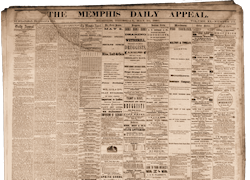
The Memphis Daily Appeal
Memphis, Tennessee
June 13, 1861

The Pocahontas Herald details the following:
.
Miss Williams, a daughter of Isaac Williams, living in Black river swamp, about seven miles from this place, heard the report of the approach of troops to this place on Sunday evening. Her father was not at home, but she immediately caught a horse, and was soon off in search of him. She found him at a neighbor’s, and told him to hurry on home and get his gun and come here and help to drive back the enemy. She then returned home, got down her father’s rifle, moulded his lead all into bullets, took the gun, powder and bullets and hid them under the house, and again got on the horse and rode to several houses and spread the alarm, returning home in time to give the old man his gun and ammunition, and started him, with a crowd of ten men whom she had collected for the scene of action. All of this she done in less than two hours. Such acts of heroism should not be passed by without notice.
0 comments

“…out on a reconoitering expedition..,”–Army Life of an Illinois Soldier, Charles Wright Wills.

Civil War Day-by-Day

Cairo, June 13, 1861.

I am converted to the belief that Cairo is not such a bad place after all. The record shows that less deaths have occurred here in seven weeks among 3,000 men, than in Villa Ridge (a higher, and much dryer place with abundant shade and spring water), in five weeks among 1,000. There has been but one death here by disease in that time, and that with miserable hospital accommodations. The soldiers lie like the d___l about Cairo. The days are hot of course, but we do nothing now between 8 a.m. and 9 p.m. but cook and eat, so that amounts to not near as much as working all day at home. The mosquitoes and bugs are furious from 6 p.m. to 11, but we are drilling from 7 p.m. to nearly 9, and from that to 11 we save ourselves by smoking, which we all do pretty steadily. The nights after 11 are splendidly cool, so much so that we can cover ourselves entirely in our blankets, which is a block game on the mosquitoes, and sleep like logs. I believe those Camp Mather boys are hard sticks from the accounts we get of their fingers sticking to chickens, vegetables, etc. The citizens here say that the boys have not taken a thing without permission, or insulted a citizen. “Bully for us.”

We had a little fun yesterday. [continue reading…]

0 comments

Fast day in New Orleans. War Diary of a Union Woman in the South by Dora Richards Miller.

War Diary of a Union Woman in the South

June 13.—To-day has been appointed a Fast Day. I spent the morning writing a letter on which I put my first Confederate postage-stamp. It is of a brown color and has a large 5 in the center. To-morrow must be devoted to all my foreign correspondents before the expected blockade cuts us off.


Note: To protect Mrs. Miller’s job as a teacher in post-civil war New Orleans, her diary was published anonymously, edited by G. W. Cable, names were changed and initials were generally used instead of full names—and even the initials differed from the real person’s initials. (Read Dora Richards Miller’s biographical sketch.)

0 comments

Civil War Day-By-Day

Civil War Day-by-Day

June 13, 1861

A Chronological History of the Civil War in America1

  • Fast day in the Confederate States, in accordance with the President’s proclamation.

  1. A Chronological History of the Civil War in America by Richard Swainson Fisher, New York, Johnson and Ward, 1863
0 comments

Stockade and gates closing the approach to the long bridge

News of the Day

Stockade and gates closing the approach to the long bridge, Washington D.C. June 1861Title: Stockade and gates closing the approach to the long bridge
Creator(s): Waud, Alfred R. (Alfred Rudolph), 1828-1891, artist
Date Created/Published: [1861 June]
Medium: 1 drawing on olive paper: pencil, Chinese white, and black ink wash; 13.0 x 19.3 cm. (sheet).
Reproduction Number: LC-DIG-ppmsca-21414 (digital file from original item, recto) LC-DIG-ppmsca-21415 (digital file from original item, verso) LC-USZ62-4537 (b&w film copy neg.)
Rights Advisory: No known restrictions on publication.
Call Number: DRWG/US – Waud, no. 498 (A size) [P&P]
Repository: Library of Congress Prints and Photographs Division Washington, D.C. 20540 USA
Notes:
…..Title inscribed lower left.
…..Inscribed: Stockade and gates closing the approach to the long bridge [thro’] two enfiladed lines. (a dusty place). Inscribed on verso: Long bridg [sic?] Stockade & gate closing the approach to the long bridge across the Potomac, at Washington 61.
…..Published in: New York Illustrated News, July 13, 1861, p. 149, as: Stockade and Gate Closing the Approach to the Long Bridge across the Potomac, at Washington.
…..Gift, J.P. Morgan, 1919 (DLC/PP-1919:R1.2.498)
…..Reference print available in the Civil War Drawings file J.
…..Forms part of: Morgan collection of Civil War drawings.

Library of Congress permalink

___________
Mike’s notes:

Note – This image has been digitally adjusted for one or more of the following:
– fade correction,
– color, contrast, and/or saturation enhancement
– selected spot and/or scratch removal
– cropped for composition and/or to accentuate subject

0 comments

“Rumor says so.”—Horatio Nelson Taft

Diary of US patent clerk Horatio Nelson Taft.

WEDNESDAY, JUNE 12, 1861.

Bad news today from Fort Monroe, a fight and a repulse with considerable loss of life. It is feared that the loss is much greater than reported, rumor says so. Our Friends E.P. & Capt Welling left on the 21/2 train for Home. I went with them this morning to the Genl P.O. and to McGuires Private Gallery of paintings. Was at the Parade of the 12th again this evening. It is realy an interesting show and costing nothing. Some of the soldiers are sick. My wife sends them tea & toast.

______

The three diary manuscript volumes, Washington during the Civil War: The Diary of Horatio Nelson Taft, 1861-1865, are available online at The Library of   Congress.

0 comments

Hurrah for the Ladies.

News of the Day

The Bellville Countryman
Texas
June 12, 1861

In Mississippi, and some other of the Confederate States, and even in some parts of Texas, the ladies are banding together for the purpose of drilling and practising the use of firearms, resolving, if necessary, to send the men off to fight, while they stay at home to protect their firesides from the incursions of hostile Indians or Abolitionists. At one or two places in Mississippi they have perfected themselves in the drill and manual of arms of the soldier, and declare their intention also to attend to the crops, while the males are away. This is PURE patriotism, and their action cannot be too highly lauded. We do not imagine the fair sex of our section behind any in their love of country, and should like to see such a movement set on foot. Who will put the ball in motion? Instances were common in our early history of the daring deeds performed by women, the heroic mothers of liberty. Though there may be no necessity the experiment can do no harm.
0 comments

Secesh and Arson.

News of the Day

Daily Times
Leavenworth, Kansas
June 12, 1861

We learn that a number of houses, the property of Union men, were burned at Barnesville, Cass County, Missouri, last week, by the secessionists, and their owners driven out. Barnesville has had the reputation of being a loyal town, and hence this visit of vengeance. Secessionists are perambulating the country, and warning Union men out, and scarce a day passes but some outrage comes to our ears from the mobocracy of Missouri.— [Osawatomie Herald]
0 comments

“The camp is yet higgledy-piggledy…”—Rutherford B. Hayes

Diary and Letters of Rutherford Birchard Hayes

COLUMBUS, June 12, 1861.

DEAR FORCE:–You can’t regret more than I do the issue of this business, so far as you are concerned. I have tried to get two companies (so as to include you and Company A of G.G. [Guthrie Greys]) admitted. Failing in that, I tried one, but the thing is all settled, and the governor fears to disturb the elements again.

Our regiment promises to be an exceedingly pleasant one. We are the first regimental officers on the ground. Our colonel will command in this camp until a brigadier-general arrives. We are the best known persons, and the struggle is to get into our regiment from all quarters. The camp is yet higgledy-piggledy and will require some labor to bring it up. But all goes on rapidly. We have been busy as bees a large part of the time in the scorching sun; but so far, it [is] great fun. I enjoy it as much as a boy does a Fourth of July.

Sincerely,

R.B. HAYES

M. F. FORCE, ESQ.

0 comments

“The war is making us all tenderly sentimental. No casualties yet, no real mourning, nobody hurt. So it is all parade, fife, and fine feathers.”— Mary Chesnut’s diary.

Civil War Day-by-Day

June 12th.–Have been looking at Mrs. O’Dowd as she burnished the “Meejor’s arrms” before Waterloo. And I have been busy, too. My husband has gone to join Beauregard, somewhere beyond Richmond. I feel blue-black with melancholy. But I hope to be in Richmond before long myself. That is some comfort.

The war is making us all tenderly sentimental. No casualties yet, no real mourning, nobody hurt. So it is all parade, fife, and fine feathers. Posing we are en grande tenue. There is no imagination here to forestall woe, and only the excitement and wild awakening from every-day stagnant life are felt. That is, when one gets away from the two or three sensible men who are still left in the world.

When Beauregard’s report of the capture of Fort Sumter was printed, Willie Ancrum said: ” How is this? Tom Ancrum and Ham Boykin’s names are not here. We thought from what they told us that they did most of the fighting.”

Colonel Magruder ¹ has done something splendid on the peninsula. Bethel is the name of the battle. Three hundred of the enemy killed, they say.

Our people, Southerners, I mean, continue to drop in from the outside world. And what a contempt those who seceded a few days sooner feel for those who have just come out! A Camden notable, called Jim Velipigue, said in the street to-day: “At heart Robert E. Lee is against us; that I know.” What will not people say in war times! Also, he said that Colonel Kershaw wanted General Beauregard to change the name of the stream near Manassas Station. Bull’s Run is so unrefined. Beauregard answered : “Let us try and make it as great a name as your South Carolina Cowpens.” ²

Mrs. Chesnut, born in Philadelphia, can not see what right we have to take Mt. Vernon from our Northern sisters. She thinks that ought to be common to both parties. We think they will get their share of this world’s goods, do what we may, and we will keep Mt. Vernon if we can. No comfort in Mr. Chesnut’s letter from Richmond. Unutterable confusion prevails, and discord already.

In Charleston a butcher has been clandestinely supplying the Yankee fleet outside the bar with beef. They say he gave the information which led to the capture of the Savannah. They will hang him.

Mr. Petigru alone in South Carolina has not seceded. When they pray for our President, he gets up from his knees. He might risk a prayer for Mr. Davis. I doubt if it would seriously do Mr. Davis any good. Mr. Petigru is too clever to think himself one of the righteous whose prayers avail so overly much. Mr. Petigru’s disciple, Mr. Bryan, followed his example. Mr. Petigru has such a keen sense of the ridiculous he must be laughing in his sleeve at the hubbub this untimely trait of independence has raised.

Looking out for a battle at Manassas Station. I am always ill. The name of my disease is a longing to get away from here and to go to Richmond.

______

¹ John Bankhead Magruder was a graduate of West Point, who had served in the Mexican War, and afterward while stationed at Newport, R. I., had become famous for his entertainments. When Virginia seceded, he resigned his commission in the United States Army. After the war he settled in Houston, Texas.

The battle of Big Bethel was fought on June 10, 1861. The Federals lost in killed and wounded about 100, among them Theodore Winthrop, of New York, author of Cecil Dreeme. The Confederate losses were very slight.

² The battle of the Cowpens in South Carolina was fought on January 17, 1781; the British, under Colonel Tarleton, being defeated by General Morgan, with a loss to the British of 300 killed and wounded and 500 prisoners.

0 comments

The Eleventh Indiana Zouaves in Camp McGinnis, Resting, the Day after the Battle of Romney

Miscellaneous document sources
The Eleventh Indiana Zouaves in Camp McGinnis, Resting, the Day after the Battle of Romney

(from Frank Leslie’s Illustrated History of the Civil War…, edited by Louis Shepheard Moat, Published by Mrs. Frank Leslie, New York, 1895)

0 comments

“From all I can see and infer, we shall make no attempt this year to invade the enemy’s country.”—John B. Jones’ diary at the rebel war office.

Civil War Day-by-Day

JUNE 12th.—Gen. Lee has been or is to be created a full general in the Confederate army, and will be assigned to duty here. He is third on the list, Sydney Johnston being second. From all I can see and infer, we shall make no attempt this year to invade the enemy’s country. Our policy is to be defensive, and it will be severely criticised, for a vast majority of our people are for “carrying the war into Africa” without a moment’s delay. The sequel will show which is right, the government or the people. At all events, the government will rule.

0 comments

Half Sheet

News of the Day

The Bellville Countryman
Texas
June 12, 1861

We are under the necessity of issuing but a half sheet this week. It is well to recollect that paper is very scarce, and that unless the blockade is raised before long, many newspapers will have to suspend for want of the article, as we understand there is none or very little for sale in Houston or Galveston. The Countryman will be as tenacious of life as any of them.
0 comments

Exodus from Missouri.

News of the Day

Dallas Herald
Texas
June 12, 1861

A company of Emigrants from Missouri, numbering nearly 90 negroes besides whites camped a few miles from Dallas on Friday and Saturday. They report a large number behind and say that thousands will move out of that State during the summer and fall.
A gentleman traveling from the north says that the roads are lined with emigrants and that an immense number of valuable negroes are brought with them.—They are reported to be men of wealth and the best society of Missouri.
0 comments

“…that night I had my first sleep under canvas.”—Diary of Rutherford B. Hayes

Diary and Letters of Rutherford Birchard Hayes

Our mustering was completed June 11 and 12. We were guests of Colonel King (for rations) at the log headquarters and slept at Platt’s. Both good arrangements. Wednesday evening, 12th, we got up a large marquee, fine but not tight, and that night I had my first sleep under canvas–cool but refreshing.

0 comments

“Colonel Rosecrans is an energetic, educated West Pointer..,”—Rutherford B. Hayes

Diary and Letters of Rutherford Birchard Hayes

COLUMBUS, June 12, 1861.

DEAR UNCLE:–We are in Camp Jackson–hot, busy, and jolly. Colonel Rosecrans is an energetic, educated West Pointer, very cheerful and sensible. Judge Matthews you know. We are on good terms with our captains, and the whole thing pleases me vastly; but I see no chance of getting out to see you; so you must come here one of these days. We are in the suds yet; still I would enjoy a visit even now. I cannot say more now. Good-bye.

Sincerely,

R.B. HAYES.

P.S.–We were sworn in to-day; our commissions are from the 7th.

S. BIRCHARD.

0 comments

“…put down the traitors every where on both sides of the road…”

The Letters of Samuel Ryan Curtis

Head Quarters Department of the West,
St. Louis Arsenal, June 12th 1861′

To Col S. R. Curtis Keokuk, Iowa

A terrible secession movement, headed by Gov. Jackson, has commenced.

I want you to come at once, with all the force you can command, to Hannibal, Mo. and move over the road from there to St. Josephs and put down the traitors every where on both sides of the road, and if possible, strike down upon Lexington

N. Lyon
Brig Gen U.S. Vols
Commanding

[copy]


1. General Lyon was on the point of setting out on an expedition up the Missouri River to drive Price and the Southern forces out of the northern portion of the State.

0 comments

Hung

News of the Day

Daily Times
Leavenworth, Kansas
June 12, 1861

A Union man was hung near Otterville, Mo., last week, for being a little too free in the expression of his devotion to the stars and stripes. He resided near the border when at home.— [Osawatomie Herald]
0 comments