Monday, 2d–We are having regular drilling now; company drill at 10 o’clock in the forenoon for two hours, and in the afternoon regimental drill for two hours. Every evening at 5 o’clock we have dress parade.
American Civil War Chronicles
Every evening at 5 o’clock we have dress parade. Downing’s Civil War Diary.–Alexander G. Downing.
September 2, 2021
“…we went to Camp Cameron to see the ‘Anderson Zuaves.’ Saw their Dress parade and Battallion drill.”—Horatio Nelson Taft
September 2, 2021
MONDAY 2
Pleasant day and has passed off with but little excitement. People feel better since the success at Hateras Inlet N.C. If we are successful on the other side of the River we shall be all right again. Took a long walk after dinner with wife & Julia out to the “Park” (7th St) to see the Cavalry there, some 3000. From there we went to Camp Cameron to see the “Anderson Zuaves.” Saw their Dress parade and Battallion drill. Introduced to a number of the officers.
______
The three diary manuscript volumes, Washington during the Civil War: The Diary of Horatio Nelson Taft, 1861-1865, are available online at The Library of Congress.
Capt. Lee’s report. Rebel War Clerk
September 2, 2021
SEPTEMBER 2d.—I voluntarily hunted up Capt. Lee’s report, and prepared an article for the press based on its statements.
“To-day the Astoria flags are out in great numbers for our naval capture; a little victory which is refreshing after so many defeats.”—Woolsey Family Letters; Mary Woolsey Howland to Georganna.
September 2, 2021
Astoria, Monday, Sept. 2nd.
Dear Georgy: Your interesting letter was highly appreciated by little May, as well as by her parents, who thought it very kind of you to elaborate so nice a little story out of the materials. May’s artistic efforts were revived by it and all her inspirations lately breathe of camp life and army movements. I enclose the last one, “Recollections of what I saw on Riker’s Island when passing in the boat,” which is really not bad for a fancy sketch. You would have been amused to hear her reading the newspapers aloud to little Bertha the other day. I was writing at the time and took down verbatim one sentence. “We are sorry to state that General Brigade, a contraband of war, was taken prisoner last night at Fort Schuyler: he was on his way to visit the navy-yard at Bulls Run and was brought home dead and very severely wounded.”
The children and nurses have just driven off with a carriage full of little pails and spades to spend the afternoon digging in the sand at Bowery Bay. You know the bliss, especially if the tide admits of rolling up their pantalettes and wading in. We are having lovely weather, which I wish you were sharing. Indeed, I am greatly disappointed that you will not come on while things are comparatively quiet and stay awhile with us. Robert and I have had some delicious sails in the boat, for which I have taken a great liking, and we are having a quiet but delightful summer. To-day the Astoria flags are out in great numbers for our naval capture; a little victory which is refreshing after so many defeats. Abby and Cousin William are very blue up in Lenox and write desponding notes in the Toots style. The Micawber mood will probably follow, in which Abby will be “inscribing her name with a rusty nail” on the walls of some southern dungeon. Indeed I begin to think she must be in the confidence of the rebel leaders, from the entire assurance with which she looks for an attack by sea upon some northern port, while the land army meantime marches triumphantly to Washington.
We are looking for Sarah Woolsey this week to make a little visit, and were in hopes that Rose Terry, who was with her, would come too.
I sent your two letters to Mother, who will enjoy them as much as May did. When you write again tell us more about Joe,–how he is looking after the summer’s campaign, how he really is, etc. It seems strange to think that autumn is already here and the dreaded hot weather for the troops nearly over, I suppose. If we can get anything for you in New York while the girls are away, or do any of the things for which you have depended upon them, be sure to let me know. . . . I wonder if a season will ever come when for once we can all spend it together without the need of ink and paper. Some large, generally satisfactory Utopian farmhouse, where, as in Pomfret days, one vehicle and one horse (alas, poor beast!) and Mother to drive, would be ample accommodation and style for all. Give our love and a God-speed to Joe when you see him next, and insist upon his taking good care of himself when out of your sight.
Affectionately yours,
Mary.
A march through the most beautiful parts of Maryland
September 2, 2021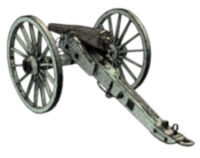
Monday, August [September] 2.—Orders arrived for our remaining section to unite forthwith with the rest of the battery at Darnestown. The morning was beautiful. The battery got ready to march. Col. Geary had his regiment drawn up in line. The whole regiment presented arms as we passed by, they being greatly attached to us, while we gave nine cheers and a Narragansett for Col. Geary and his brave regiment. This day’s march will always be a pleasant recollection for the surviving. Our road was leading through the most beautiful parts of Maryland. Late in the afternoon we arrived at Darnestown, and united once more with the rest of the battery, after having been parted for three weeks. Gen. Banks’ headquarters are there, and all the troops of his command, lying around the town. We had a very pleasant camp, but should not enjoy it long.
Unidentified Boy in Union Zouave Uniform with Drum
September 2, 2021Civil War Era Photographic Portraiture No. 12
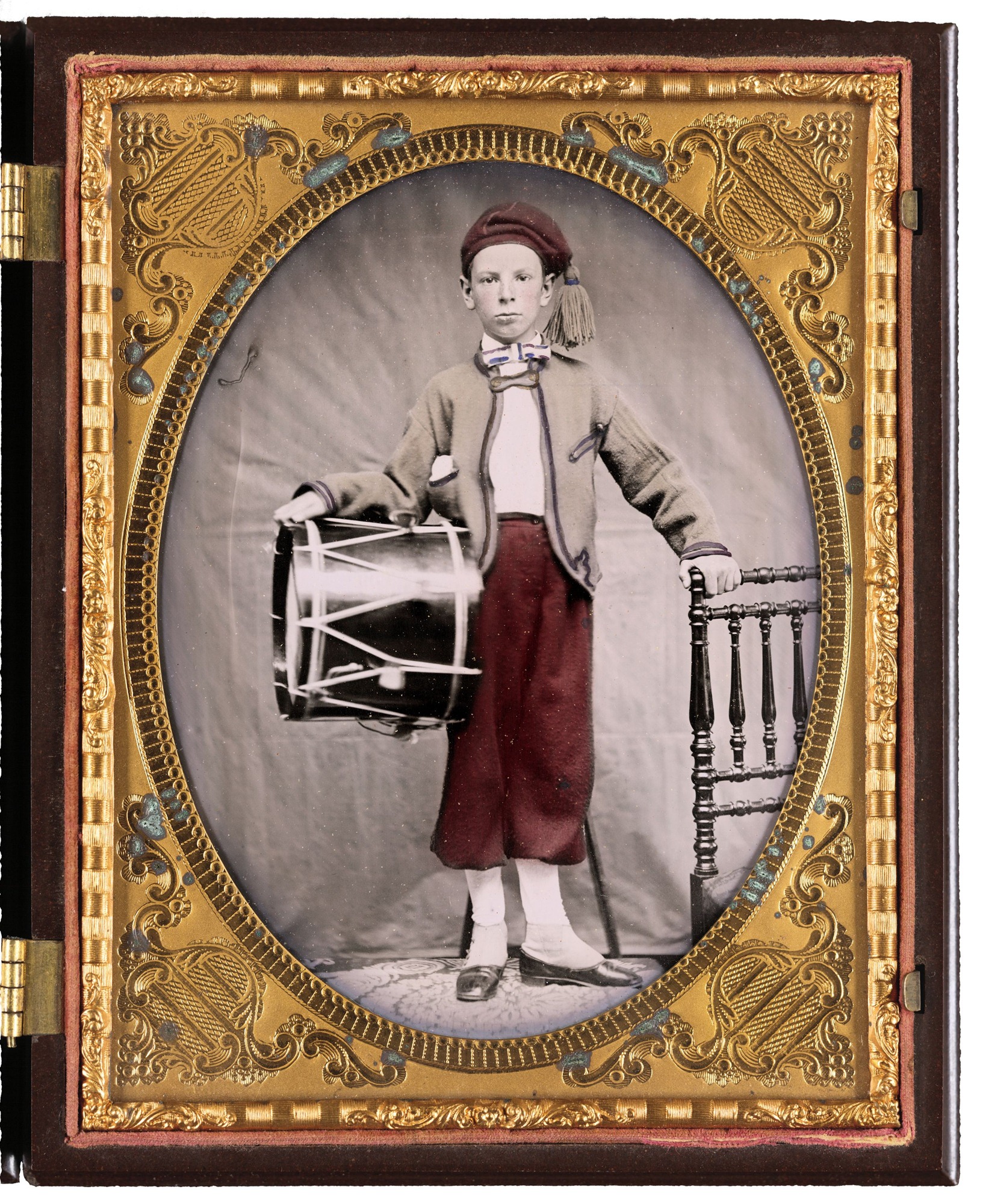
Title: [Unidentified boy in Union zouave uniform with drum]
Date Created/Published: [between 1861 and 1865]
Medium: 1 photograph : half-plate ambrotype, hand-colored ; 15.6 x 12.5 cm (case)
Reproduction Number: LC-DIG-ppmsca-34499 (digital file from original item)
Rights Advisory: No known restrictions on publication.
Access Advisory: Use digital images. Original served only by appointment because material requires special handling. For more information see:
Call Number: AMB/TIN no. 3039 [P&P]
Repository: Library of Congress Prints and Photographs Division Washington, D.C. 20540 USA
Notes:
…..Title devised by Library staff.
…..Case: Berg, no. 1-3S.
…..Gift; Tom Liljenquist; 2012; (DLC/PP-2012:127).
…..More information about this collection is available at http://hdl.loc.gov/loc.pnp/pp.lilj
…..Purchased from: George S. Whiteley IV, Atlanta, Ga., 2012.
…..Forms part of: Liljenquist Family Collection of Civil War Photographs (Library of Congress).
…..Forms part of: Ambrotype/Tintype photograph filing series (Library of Congress).
…..Exhibited: “The Civil War in America” at the Library of Congress, Washington, D.C., 2013.
Library of Congress item permalink
Mike’s notes:
Image restoration note – This image has been digitally adjusted for one or more of the following:
– fade correction,
– color, contrast, and/or saturation enhancement
– selected spot and/or scratch removal
– cropped for composition and/or to accentuate subject matter
– straighten image
Image restoration is the process of using digital restoration tools to create new digital versions of the images while also improving their quality and repairing damage.
“Almost everybody here is looking for an attack…,”–Journal of Surgeon Alfred L. Castleman.
September 2, 2021
2nd.–The following extract from a letter which I have just written to a friend, is the sum and substance of my thoughts, journalized for to-day. “Major _____ will not write his mother whether an attack on Washington is expected. I will tell you what I think: From the dome of the Capitol we can see the rebels throwing up works just beyond Arlington. Every day or two we have picket skirmishing. On Wednesday night we had, within a short distance of Washington, seven men set as picket guards. The next day I saw one of the seven wounded in the side by a musket ball. The other six were killed. Almost everybody here is looking for an attack, but I do not believe we shall have one. I have no doubt that Beauregard would like to draw us out to attack him; that he would then retreat, with the hope of drawing us into his nets as he did at Bull Run. But he will not attack us here.
William Howard Russell’s Diary: General Scott and McClellan.—McClellan on his camp bed.
September 2, 2021
September 2nd.–It would seem as if the North were perfectly destitute of common sense. Here they are as rampant because they have succeeded with an overwhelming fleet in shelling out the defenders of some poor unfinished earthworks, on a spit of sand on the coast of North Carolina, as if they had already crushed the Southern rebellion. They affect to consider this achievement a counterpoise to Bull Run.
Surely the press cannot represent the feelings of the staid and thinking masses of the Northern States! The success is unquestionably useful to the Federalists, but it no more adds to their chances of crushing the Confederacy, than shooting off the end of an elephant’s tail contributes to the hunter’s capture of the animal.
An officious little person, who was buzzing about here as correspondent of a London newspaper, made himself agreeable by coming with a caricature of my humble self at the battle of Bull Run, in a laborious and most unsuccessful imitation of Punch, in which I am represented with rather a flattering face and figure, seated before a huge telescope, surrounded by bottles of London stout, and looking at the fight. This is supposed to be very humorous and amusing, and my good-natured friend was rather astonished when I cut it out and inserted it carefully in a scrap-book, opposite a sketch from fancy of the New York Fire Zouaves charging a battery and routing a regiment of cavalry, which appeared last week in a much more imaginative and amusing periodical, which aspires to describe with pen and pencil the actual current events of the war.
Going out for my usual ride to-day, I saw General Scott, between two aides-de-camp, slowly pacing homewards from the War Office. He is still Commander-in-Chief of the army, and affects to direct movements and to control the disposition of the troops, but a power greater than his increases steadily at General McClellan’s head-quarters. For my own part I confess that General McClellan does not appear to me a man of action, or, at least, a man who intends to act as speedily as the crisis demands. He should be out with his army across the Potomac, living among his generals, studying the composition of his army, investigating its defects, and, above all, showing himself to the men as soon afterwards as possible, if he cannot be with them at the time, in the small affairs which constantly occur along the front, and never permitting them to receive a blow without taking care that they give at least two in return. General Scott, jam fracta membra labore, would do all the work of departments and superintendence admirably well; but, as Montesquieu taught long ago, faction and intrigue are the cancers which peculiarly eat into the body politic of republics, and McClellan fears, no doubt, that his absence from the capital, even though he went but across the river, would animate his enemies to undermine and supplant him.
I have heard several people say lately, “I wish old Scott would go away,” by which they mean that they would be happy to strike him down when his back was turned, but feared his personal influence with the President and his Cabinet. Two months ago and his was the most honoured name in the States: one was sickened by the constant repetition of elaborate plans, in which the General was represented playing the part of an Indian juggler, and holding an enormous boa constrictor of a Federal army in his hands, which he was preparing to let go as soon as he had coiled it completely round the frightened Secessionist rabbit; “now none so poor to do him reverence.” Hard is the fate of those who serve republics. The officers who met the old man in the street to-day passed him by without a salute or mark of recognition, although he wore his uniform coat, with yellow lapels and yellow sash; and one of a group which came out of a restaurant close to the General’s house, exclaimed, almost in his hearing, “Old fuss-and-feathers don’t look first-rate to-day.” [continue reading…]
Civil War Day-By-Day
September 2, 2021
September 2, 1861
- Vernon County, Missouri—Battle of the Mules [Confederate], Battle of Dry Wood Creek [Union]
- On September 2nd, Grant’s Federals occupied Belmont, preparatory to seizing Columbus, across the Mississippi river.
A Chronological History of the Civil War in America1
- Sec. of the Treasury issued an appeal to the people for a national loan.
- Legislature of Kentucky met; Senate 27 Union and 11 secession; House 76 Union and 24 secession
- Floating dock at Pensacola, Fla., burned.
- A Chronological History of the Civil War in America by Richard Swainson Fisher, New York, Johnson and Ward, 1863
“Watched a smoke on the Virginia Hills and thought it might be from a battle there.”—Horatio Nelson Taft
September 1, 2021
SUNDAY, SEPTEMBER 1, 1861.
Another delightful day. Went to church with wife and boys in the morning and read at home nearly all the rest of the day. Good news today rcd from Genl Butlers naval expedition which sailed from Fortress Monroe. It will be reviveing to all after our recent disasters. Watched a smoke on the Virginia Hills and thought it might be from a battle there. Took a walk with Julia in evening, called with her at Doct Everitts. Came home and went down to the camp with wife & Julia to hear the Band of the Regt which performed very finely.
______
The three diary manuscript volumes, Washington during the Civil War: The Diary of Horatio Nelson Taft, 1861-1865, are available online at The Library of Congress.
Richmond Grays, 1859, in Charles Town, Virginia for the Execution of John Brown
September 1, 2021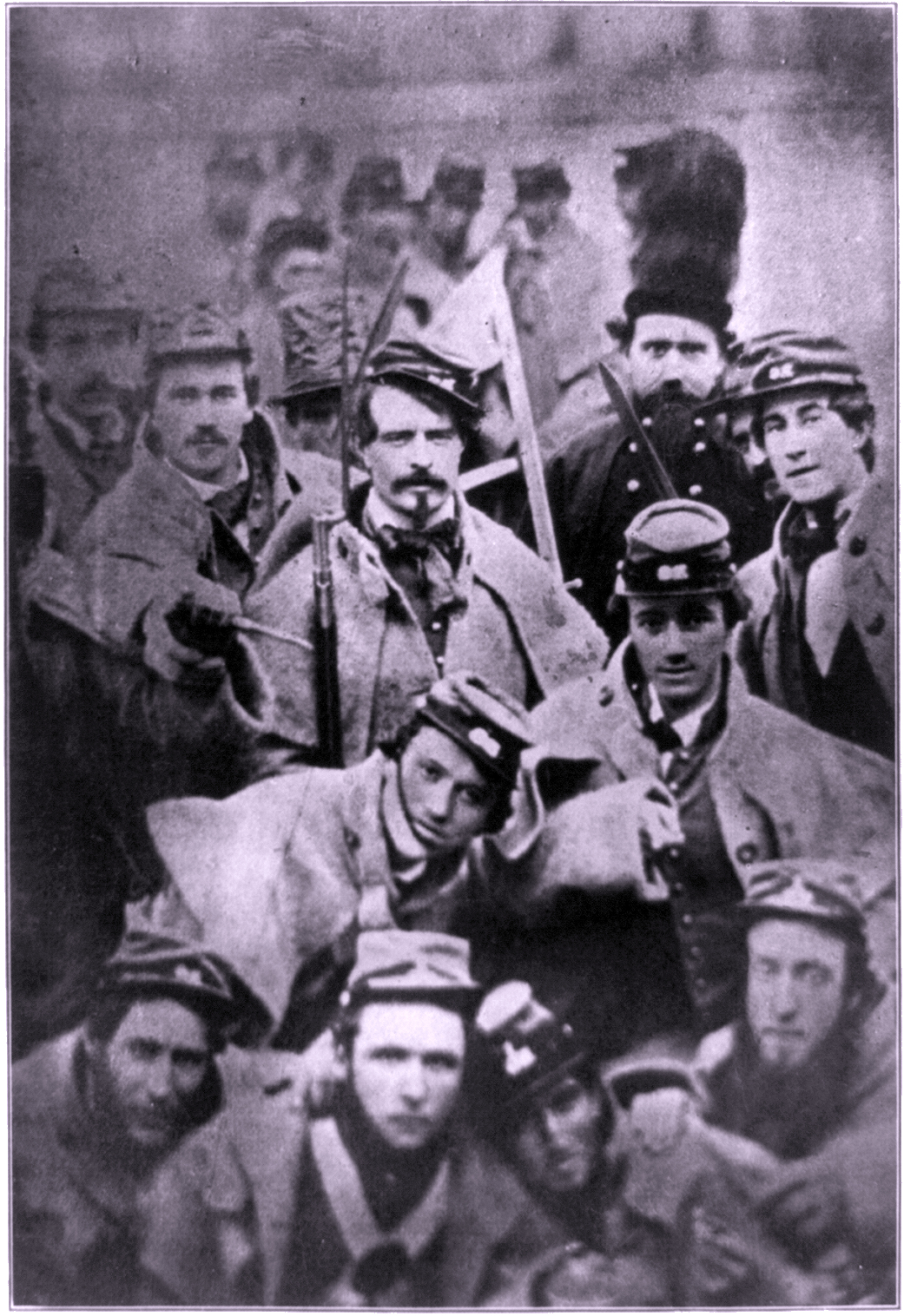
Title: [Soldiers from Richmond Grays at execution of abolitionist John Brown in Charles Town, West Virginia]
Other Title: Young Confederates off to war.
Young Southerners at Richmond making light of war.
Creator(s): Dinkle, Lewis Graham, 1829-1906, photographer
Date Created/Published: [New York] : [The Review of Reviews Co.], [photographed 1859, printed 1911]
Medium: 1 photograph : photomechanical print ; image 19 x 14 cm, page 27 x 19 cm.
Summary: Photomechanical print from reproduction of sixth-plate ambrotype shows group portrait of soldiers at the execution of John Brown; most are from Richmond Grays (which became Company A, 1st Virginia Volunteers Regiment in 1861) including Robert Alexander Caskie, center with goatee; John Wilkes Booth, left of Caskie’s shoulder; and Aylett Reins Woodson, bottom center; also Lieutenant Julian Alluisi of the Virginia Rifles in shako hat at top right. Tentatively identified are Louis F. Bossieux, center right; Cyrus Bossieux, top far left; Charles D. Clark, top right; David Garrick Wilson, bottom right; and William H. Caskie, behind Charles D. Clark. Photograph was previously thought to be of Confederate soldiers during the Civil War (Source: Angela Smythe, 2016).
Reproduction Number: LC-USZ62-8908 (b&w film copy neg.)
Rights Advisory: No known restrictions on publication.
Call Number: Illus. in E468.7 .M64 1911 [P&P]
Repository: Library of Congress Washington, D.C. 20540 USA
Notes:
…..Title devised by Library staff.
…..Illus. in: The Photographic history of the Civil War : Thousands of scenes photographed 1861-65, with text by many special authorities / Francis Trevelyan Miller, editor-in-chief ; Robert S. Lanier, managing editor. New York : The Review of Reviews Co., 1911, volume 1, page 145, “Young Southerners at Richmond making light of war.”
…..Photograph attributed to Charles Town, West Virginia, ambrotypist, Lewis Graham Dinkle (Source: Angela Smythe, 2016).
…..Identification of John Wilkes Booth front Antebellumrichmond.com, “Chasing Shadows 150 Years Old, Part II; Conversations Through the Glass, ” by Angela Smythe, May 10, 2014.
…..Original ambrotype in private collection in Richmond, Virginia.
Library of Congress item permalink
Smythe, Angela. “Has He Been Hiding in Plain Sight? John Wilkes Booth and the Richmond Grays.” Antebellum Richmond, May 10, 2014. http://antebellumrichmond.com/conversations.html.
Mike’s notes:
Image restoration note – This image has been digitally adjusted for one or more of the following:
– fade correction,
– color, contrast, and/or saturation enhancement
– selected spot and/or scratch removal
– cropped for composition and/or to accentuate subject matter
– straighten image
Image restoration is the process of using digital restoration tools to create new digital versions of the images while also improving their quality and repairing damage.
Corn
September 1, 2021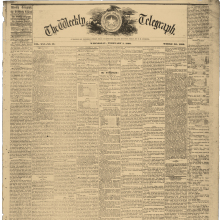
Tri-Weekly Telegraph (Houston)
September 1, 1862,
There are in this State about two thousand wheat growers. The crop this season is a plentiful one, and yet flour is worth $30 per barrel. Now, with all due respect–which simply means our own interests considered–we propose to drop wheat-raisers, wheat-grinders, and wheat-ground sellers, for the present altogether. In other words, we propose to discard the use of flour, and use as a substitute corn meal. In view of this fact, we will send the Weekly Telegraph one year to the man, or his friend, who will tell us the greatest number of ways that corn can be served up, as an article of food for man, not in figures only, but in living examples. Tell us all about corn meal, hominy, fritters, &c.
Drummed Out!—Rutherford B. Hayes
September 1, 2021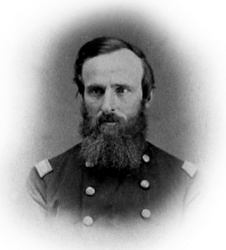
Sunday, 1 [September].–Drummed three men (youngsters) out of Captain Drake’s company, by [the] colonel’s order. The men all approve it but it makes me sick. The boys all probably confirmed thieves before they joined the army, but it makes me sick. Also sent back a waggon-master and drivers. This pleased me. The rascals refused to drive further unless certain conditions were complied with. Sent off, all right! Took the mutinous waggon-master off his horse.
Three hundred additional men
September 1, 2021
Sunday, September 1.—Col. Geary received three hundred additional men for his regiment.
Rebel War Clerk
September 1, 2021
SEPTEMBER 1st.—The press and congressional critics are opening their batteries on the Secretary of War, for incompetency. He is not to blame. A month ago, Capt. Lee, son of the general, and a good engineer, was sent to the coast of North Carolina to inspect the defenses. His report was well executed; and the recommendations therein attended to with all possible expedition. It is now asserted that the garrison was deficient in ammunition. This was not the case. The position was simply not tenable under the fire of the U. S. ships of war.
A Diary From Dixie
September 1, 2021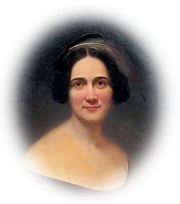
September 1st.–North Carolina writes for arms for her soldiers. Have we any to send? No. Brewster, the plainspoken, says, “The President is ill, and our affairs are in the hands of noodles. All the generals away with the army; nobody here; General Lee in Western Virginia. Reading the third Psalm. The devil is sick, the devil a saint would be. Lord, how are they increased that trouble me? Many are they that rise up against me!”
“… many of the flourishing tales we heard of prowes on the battle field were made up for home.”
September 1, 2021
1 September
Lewis arrived from Virginia and went up that night to see about his Commission. He returned yesterday, having been obliged to wait several days to see the Governor. He had companions, for there were many there waiting for the same purpose. He returned having received his Commission he is to apply to the Surgeon General or some such person and then he will go some where. I think upon the whole it is the best, as he will be in the line of his profession.—
He looks well and upon the whole I think it has not injured him. He says it was the life of a hound and all the evil selfish feelings brought out. In this Palmetoe Guard one day Capn Cuthbert would be very pleasant & easy with the men and soon after, like a raging lion. Many shirked duty[,] lied, stole, and others had to work all the time because they stayed in Camp and were quiet, many of the flourishing tales we heard of prowes on the battle field were made up for home. What poor creatures we all are!
Heard from Papa he says Charles writes to him. Judge Law wrote to Mrs Butler she must come South. P. Butler is in Fort Lafayete New York Harbour, a prisoner. Mr Wharton her Phila lawyer is also in prison. Julian McAllister is promoted to be Captain in the U.S. forces. Mrs McAllister is with her Mother with her 2 younger children.—Ann Barnwell has an admirer in Lionel Nowel he is a clerk, gets 15 hundred a year & is said to be a very gentlemanly man.
The Troops are said to be still suffering from fevers, &c., in Virginia. The Hospitals I expect are under the charge of inexperienced Surgeons. After the Battle we heard that the legs and arms were sawed off and thrown out of doors & windows and many lives lost from ignorance. Lewis has brought home a Dressing Gown taken from a Yankee’s trunk a pistol a bowy knife a picture of a little Yankee girl.
After a great many delays Lewis got his appointment and the next day at 7 o’clock went off to Cole’s Island where some troops are stationed. We fixed him up and now it is proposed that Lewis should to applied for a Confederate appointment from Walker.—Mr Grimball is to write a letter to that effect I suppose nothing will come of it but one can but try.—Striving is the appointed way.—We made 4 calico shirts for Lewis and fixed him up as well as we could. We have constant rains now. Lewis said with regard to the Camp life that men did there what they would be ashamed to do at home.
Thievish scoundrels.
September 1, 2021
The first armed clashes of the war, the fall of Fort Sumpter (sic), the subsequent route of inexperienced men and officers at Bull Run, built up the confidence of the Southern armies. One effect of such reverses was to create suspicions in the minds of many men genuinely loyal to the Union. After the equally inexplicable debacle at Wilson’s Creek in southern Missouri, we had to give up hope of securing any help from that quarter. Our location on roads leading from Missouri into Arkansas placed us between two fires, unmistakably endangering our existence. At that, however, we had nothing as yet to fear from our neighbors; the bete noir of our lives were gangs made up of thievish scoundrels who carried on warfare in gangster fashion. For their protection they operated under a flag; and under it they carried on their nefarious business of robbery and plunder. The objectivity and impartiality with which they operated were remarkable; their tolerance so comprehensive that under one set of circumstances they operated as good Secessionists, under another as equally good Union men. We were soon made aware of our plight; and to the best of our people the horrendous lessons of civil war were being learned. The terrorizing bands were outfitted in military uniforms; they committed deed of violence as if devils incarnate, and in every respect they were similar to the roving bands that plagued peaceful people during the Thirty Years’ War.
“Memoirs, Letters, and Diary Entries of German Settlers in Northwest Arkansas, 1853-1863”. Selected and Translated By Clarence Evans, Tahlequah, Oklahoma. The Arkansas Historical Quarterly Vol. VI Fall, 1947 No. 3
Downing’s Civil War Diary.–Alexander G. Downing.
September 1, 2021
Sunday, 1st–We had our first preaching in camp today, both morning and evening, by the chaplain of the Eleventh Iowa Infantry. Quite a number of folks came out from town to attend the meeting. At 5 o’clock we had dress parade with the Eighth Iowa.
“…imbecility in the management of our military affairs.”–Journal of Surgeon Alfred L. Castleman.
September 1, 2021
September 1st.–I cannot but feel depressed at what seems to be great imbecility in the management of our military affairs. By whose fault, I know not. Here we are with one hundred and fifty thousand troops, and we can stand on our National Capitol and see the rebels fortifying on Munson’s Hill. I wonder if Gen. McClellan does not need a rest to hold his glass steady whilst he looks at them.
We have just received news of Dupont’s having got a foothold in North Carolina. This places us in rear of the enemy, and brightens our prospects wonderfully, if our army there will only press their advantage.
William Howard Russell’s Diary: —A gun levelled at me in fun.—Increase of odium against me.—Success of the Hatteras expedition.
September 1, 2021
September 1st.–Took a ride early this morning over the Long Bridge. As I was passing out of the earthwork called a fort on the hill, a dirty German soldier called out from the parapet, “Pull-Run Russell! you shall never write Pulls’ Runs again,” and at the same time cocked his piece, and levelled it at me. I immediately rode round into the fort, the fellow still presenting his firelock, and asked him what he meant, at the same time calling for the sergeant of the guard, who came at once, and, at my request, arrested the man, who recovered arms, and said, “It was a choake –I vant to freeken Pull-Run Russell.” However, as his rifle was capped and loaded, and on full cock, with his finger on the trigger, I did not quite see the fun of it, and I accordingly had the man marched to the tent of the officer, who promised to investigate the case, and make a formal report of it to the brigadier, on my return to lay the circumstances before him. On reflection I resolved that it was best to let the matter drop; the joke might spread, and it was quite unpleasant enough as it was to bear the insolent looks and scowling faces of the guards at the posts, to whom I was obliged to exhibit my pass whenever I went out to ride.
On my return I heard of the complete success of the Hatteras expedition, which shelled out and destroyed some sand batteries guarding the entrance to the great inland sea and navigation called Pamlico Sound, in North Carolina, furnishing access to coasters for many miles into the Confederate States, and most useful to them in forwarding supplies and keeping up communications throughout. The force was commanded by General Butler, who has come to Washington with the news, and has [continue reading…]
“We have about 50 prisoners here now.”–Army Life of an Illinois Soldier, Charles Wright Wills.
September 1, 2021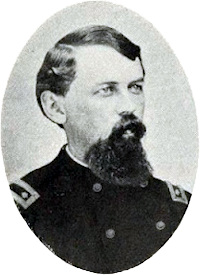
Cairo, September 1, 1861.
We had blankets given us this last week and new accoutrements throughout. If they would only change our guns now we would have nothing but a move to ask for. A uniform was also furnished us last week. It is of excellent all-wool goods, and not so heavy as to be uncomfortable. The color is very fine grey, the pants are fashionably cut and equal to such as would cost six dollars in Peoria. The coats have short skirts and are rather fancifully trimmed with blue. It is much the best uniform I have seen yet, although it costs but $13. We will have a fatigue suit shortly. Yesterday we were mustered for pay. We will get our first month’s wages this week “they say.” There are wagons and mules here now by the hundreds, and when our tents are ready (they are here now) we will be ready to move. I think there must be near 10,000 men here now. Logan’s, Pugh’s, Buford’s, and another’s regiment; Hick’s and Raritan’s came in last week. The first three belong to McCormick’s1 Brigade. General McClernand is here now. Every one thinks we will move in a very few days. I kind o’ feel it in my bones, too, but it is too good to be true, so I’m taking all the bets I can from 10 cents worth of peanuts to a half bushel of apples, I betting that we are here two weeks from now. I’ve got them any way, for if we move, I hope to be able to borrow apples, etc., from the seceshers to pay my little bills, and if I stay here I’ll have some eatables free for consolation. We Canton boys have hired a cook for ourselves and are living much better than I ever did before in camp.
Our cook is a jewel, and by trading off rations keeps us in clover all the time. He sets a better table for us than the Peoria house boarders eat from, honestly. An old schoolmate of mine in our mess furnishes us with milk. He and John Wallace go out every night about 2 or 3 o’clock and—somebody’s cow don’t milk well next morning. We’ll never have such times sojering again, but you can’t imagine how we do want to get over into Missouri or Arkansas. We don’t have half as easy times as these at home and but for the discipline it wouldn’t seem like soldiering. I’ve been bored like sin the last two weeks drilling new recruits, but I’m glad of it, for it is rather pleasant to me to have something disagreeable when I’m bored feeling good. [continue reading…]
“…but we never dreamed that such a struggle would result as that in which we are now engaged…”–Letters from Elisha Franklin Paxton.
September 1, 2021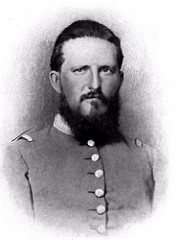
Camp Harmon, September 1,1861.
I wish very much this war was over, and I could be with you again at our home. There you remember, Love, you used to read, last December, to me of the stirring events in South Carolina; but we never dreamed that such a struggle would result as that in which we are now engaged, that the husbands and fathers among our people would be called upon to leave wives and children at home to mourn their absence whilst mingling in such a scene of blood and carnage as that through which we passed on the 21st of July. But so it is. How little we know of the future and our destiny! Dark as the present is, I indulge the hope it may soon change, and I may be with you again, not for a short visit, but to stay. Whilst such is the fond hope, when I look within my heart I find an immovable purpose to remain until the struggle ends in the establishment of our independence. Can the fond love which I cherish for you and our dear little children be reconciled with such a purpose? If I know myself, such is the fact. But, Love, my eye hurts me. It is sad to think of it, and that it disables me for life. It deprives me of the pleasure of reading for information and pleasure, unfits me for most kinds of business, and deprives me of the means of earning an independent support, which I feel I could do if I had my sight. The present is dark enough, but the future seems darker still, when I think of my return home, possibly made a bankrupt by the confiscation of my Ohio land, and then without means of earning a support or paying for my farm. I must not think of it now; it will be bad enough when it comes. I ought not to press my weak eye any farther. Kiss our dear little ones for me. Speak of me often to them. Never let them forget their “papa gone,” who loves them so well.
Civil War Day-By-Day
September 1, 2021
September 1, 1861
A Chronological History of the Civil War in America1
- Fight at Boone Court House, Va.; rebels routed and village burned.
- Fight at Bennett’s Mills, Mo.
- A Chronological History of the Civil War in America by Richard Swainson Fisher, New York, Johnson and Ward, 1863
Extracts from the journal of Commander Semmes, C.S. Navy, commanding C.S.S. Sumter
June 30, 2021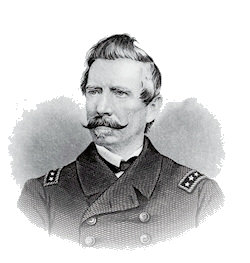
Sunday, June 30.—Dies memorabilis. At about 2 a.m. the steamer Empire Parish came alongside and put on board of us about 100 barrels of coal. At 10:30 a.m. this steamer having returned from Pass à l’Outre, a boatman pulled under our stern and informed us that the Brooklyn was no where to be seen and that the pass was all clear. We immediately got underway and steamed down the pass. The pilot, becoming alarmed, expressed his unwillingness to take us out, as he had not been out of the pass for three months and “would not run us ashore for anything.” This was really provoking. However, I hoisted my jack for a pilot, and as good luck would have it, as I ran by the pilot station a bold fellow jumped on board of me and his wife waved him on to his duty as we passed, and we continued on our course rapidly for the bar. In the meantime we had some time before discovered the Brooklyn some 7 or 8 miles to the southward of the bar under steam and hurrying up to prevent our escape. We dashed by the Bremen ship on the bar which considerately slacked a bow warp to let us pass more conveniently , and hauling close round her head spars to the northward, we were in a few moments outside of the bar. The Brooklyn had by this time approached us within about 4 miles, and was making every effort to overhaul us. A deeply exciting chase commenced, and I was for some time doubtful of my success. The Brooklyn had the reputation of being very fast both under sail and steam, and I was very doubtful whether my gallant little ship had the heels of her. The Brooklyn having made sail,we did the same, steering first N.N.E., then N.E. by N., then N. E., then N. E.by E., and so hauling in a gradual curve seaward . The Brooklyn having emerged from a squall in which she had been hid loomed up very large with her heavy battery and tall spars, her flag being plainly distinguishable at her peak. At length it began to be perceptible that we were dropping her by slow degrees, and my excited nervous system experienced a partial relaxation from the tension to which it had been strained for the last three hours. At 3:30 the Brooklyn, seeing that we had the heels of her, gave up the chase and bore up to the northward. Called on hands, sent them into the rigging and gave three cheers for the Confederate flag, after which, by invitation, I met the officers in the wardroom and drank a glass of wine with them in honor of the event. It was a positive luxury as the evening set in to breathe the pure air and look over the vast expanse of blue waters, with the feeling of a liberated prisoner. What an eventful career we have before us! May the Almighty smile upon us and our cause, and may we show ourselves worthy servants of Him and it. Night beautiful and starlight, with a light in the north throwing a pencil of rays to the northeast as if lighting us on our way.