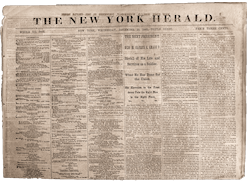
March 17, 1863, The New York Herald
From Cairo, Cincinnati, Chicago and other points we continue to receive very encouraging, though very meagre and mysterious, reports of the success of the Yazoo expedition and of the probable evacuation of Vicksburg by the rebels. Our latest despatches from the West inform us that our Yazoo gunboat squadron had successfully descended the river to Haines’ Bluff, near the mouth of the river; that in their descent they had captured twenty-six steamboats, eighteen of which were destroyed; that rumors were rife of the evacuation of Vicksburg, and that it was supposed that the greater part of the rebel force would go to Chattanooga and endeavor to overwhelm General Rosecrans.
We can trace none of these reports to an authentic source. We have nothing from general Grant or Admiral Porter tending to confirm them – except a despatch form the latter that the naval expedition has reached the Yazoo in safety – and yet we are inclined to the belief that they are substantially correct. We think it altogether probable that the danger, the necessities and the desperate game of the rebels may have brought them to the extremity of abandoning Vicksburg, in order to save their army at that place and its artillery and munitions of war, and in order to join that army with the army of Bragg in Tennessee, and to make a bold dash with an overwhelming force upon General Rosecrans before reinforcements can reach him from the army of General Grant. The ablest general of the rebels, Jo. Johnston, is their supreme in command in the Southwest. His peculiar strategy was effectively illustrated in the first battle of Bull Run. Abandoning temporarily the Shenandoah valley to General Patterson, it was this same Johnston who achieved the most important victory of the rebellion by bringing his whole army to a timely junction with that of Beauregard. Subsequently, at Shiloh, Sidney Johnston tried the same strategical combination, though not with the same success. Beauregard, in abandoning Corinth and in sending forward a portion of his troops to the relief of Richmond, and Stonewall Jackson, in slipping out of the valley of Virginia and in pushing forward to the Chickahominy, repeated on a larger scale, and more disastrously to our weakened army, the successful game of Manassas. With Jo. Johnston, therefore, the originator of this system of rebel warfare, in charge of the rebel armies of the Southwest, we think it altogether likely that he may have [continue reading…]

 Camp Winder, March 15,1863.