Thursday, 13th.—Marched out to Snake Creek Gap. Captain Morgan died at 12 M. Cannonading towards Dalton.
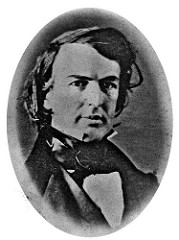
(Note: picture is of an unidentified Confederate soldier.)
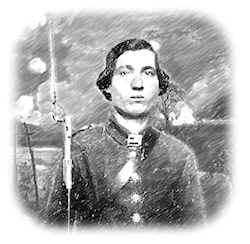
Thursday, 13th.—Marched out to Snake Creek Gap. Captain Morgan died at 12 M. Cannonading towards Dalton.
(Note: picture is of an unidentified Confederate soldier.)
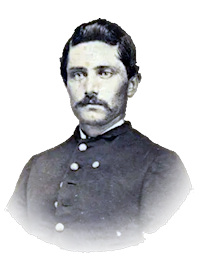
Thursday, 13th–We left our teams behind at Kingston and they did not catch up with us till this morning. We lay here in camp all day. About sundown we received marching orders and our division started for Adairsville, some fifteen miles distant from Rome. We left our teams and all artillery behind and marching through on a by-road, reached Adairsville by midnight.
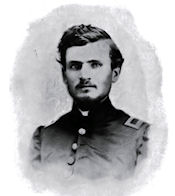
13th. Thursday. Lay in camp all day. Forage.
Three miles from Rome, Ga., October 13, 1864.
Started at 8 this morning and landed here at dark. Heard 40 or 50 cannon shots in vicinity of Rome during the day’s march. The country to-day is fair for Georgia, but not equal to that between Cartersville and Kingston. While we were resting to-day, Osterhaus (at present commanding our corps) rode by our regiment and a few scamps hollowed “sowbelly, sowbelly.” You know the men have been living on army beef for a month, and it is not desirable fare; still they were only in fun, and I noticed the general smile, but some puppy finally cried out “kraut,” and another echoed it with “kraut by the barrel.” The general wheeled his horse and rode up to us, his face white with passion. “Vat regiment ish dis?” No one answered. He rode up near me and again asked, “Vat regiment ish dis?” I told him. “Vy don’t you kit up?” I arose and again answered him respectfully, “The 103d Illinois, sir.” “Vare ish your colonel?” “At the right of the regiment, sir.” He rode up to Wright and gave him the devil. I have not been so mortified for a long time. We all think a great deal of Osterhaus, and just coming into his division were all desirous that his first impressions of our regiment should be favorable. As it is, two or three insulting puppies have given us a name with him that I have no doubt will cause us trouble for a long time. Yelping “sauer kraut” at a German is a poor way to gain his favor.
(Duplicated also.) October 13, 1864.
The men drew full rations of bacon to-day. There has been some fighting nine miles down the north side of the Coosa river to-day. Our corps moves back on the Kingston road at “retreat.” Don’t know where to.
Received two letters from you to-day, also papers, for which am very thankful. Have had a good rest to-day. Everybody is in glorious spirits. Kilpatrick started west today with 50 days’ rations of salt. I wish I was with him.
October 13th.–Rained all night; clear and cool this morning.
The government publishes nothing from Georgia yet; but it is supposed there is intelligence of an important character in the city, which it would be impolitic to communicate to the enemy.
All still remains quiet below the city. But the curtain is expected to rise on the next act of the tragedy every moment. Gen. Grant probably furloughed many of his men to vote in Pennsylvania and Ohio, on Tuesday last–elections preliminary to the Presidential election–and they have had time to return to their regiments.
If this pause should continue a week or two longer, Gen. Lee would be much strengthened. Every day the farmers, whose details have been revoked, are coming in from the counties; and many of these were in the war in ’61 and ’62–being experienced veterans. Whereas Grant’s recruits, though greater in number, are raw and unskilled.
The Medical Boards have been instructed to put in all men that come before them, capable of bearing arms ten days. One died in the trenches, on the eleventh day, of consumption!
There is a rumor of a fight on our extreme left. It is said Field’s division (C. S.) repulsed three assaults of the enemy. If the battle be still continued (4 P.M. –the wind from the west prevents us from hearing guns), no doubt it is the beginning of a general engagement–decisive, perhaps, of the fate of Richmond.
We have many accounts of evasions of military service, occasioned by the alleged bad faith of the government, and the despotic orders from the Adjutant-General’s office.
And yet Gov. Smith’s certificates for exemption of rich young Justices of the Peace, Commissioners of the (county) Revenue, Deputy Sheriffs, clerks, constables, officers and clerks of banks, still come in daily; and they are “allowed” by the Assistant Secretary of War. Will the poor and friendless fight their battles, and win their independence for them? It may be so; but let not rulers in future wars follow the example! Nothing but the conviction that they are fighting for their families, their sacred altars, and their little property induces thousands of brave Southerners to remain in arms against such fearful odds as are now arrayed against them.
Mr. Kean, the young Chief of the Bureau of War, has come in from “the front,” with a boil on his thigh. He missed the sport of the battle to-day.
Mr. Peck, the agent to purchase supplies for his starving fellow clerks, confesses that he bought 10 barrels of flour and 400 pounds of bacon for himself; 4 barrels of flour for Judge Campbell, Assistant Secretary of War; 4 barrels for Mr. Kean, 1 for Mr. Cohen, and 1 for Mr. Shepherd. This has produced great indignation among the 200 clerks who sent him, and who got but 73 ½ pounds each, and they got 13 pounds of bacon each; while Mr. P. bought for himself 400 pounds.
Oct. 13—My saddle had been stolen during my absence. My baggage had been lost or misplaced. I found mine, Dr. Logan’s, Lieut. McNeil’s and Mr. Ball’s on a forage wagon. Sup with Brother Armstrong in W. and spend the night with our wagons near Fisher’s Hill.
12th.—The armies around Richmond remain quiet. Butler is digging the canal at “Dutch Gap,” and Grant is fortifying “Fort Harrison” most vigorously. General Rosser has had a little reverse in the Valley, losing some guns. He had a cavalry fight, overcame the enemy, and drove them for miles; but encountering a body of infantry which was too much for him, he had to retreat, leaving his guns to the enemy.
The hospitals are full of the wounded; my afternoons are very much engaged, nursing them. I was very sorry yesterday to find R. S. painfully wounded.
October 1st to 12th. Nothing special has taken place between these dates. Picket duty, and plenty of hard work, has been the order of each day as they come and go. Business is improving in the town. Many places are opening up, ready for business. Trains running quite regular. Lieutenant-Colonel Peale returned to the regiment, taking command, after being absent about two months in Washington, D. C.
Wednesday, 12th.—Marched eighteen miles to Resacca by 3 P. M., and surrounded the place. After dark relieved and began tearing up railroad; tore up two miles, to where Stewart’s Corps began. Captain Jake Morgan wounded in skirmish.
(Note: picture is of an unidentified Confederate soldier.)
Wednesday, 12th–We started early this morning and marched to within five miles of Rome by midnight, when we went into bivouac for the rest of the night. We had to move very slowly on account of the teams giving out. Our horses and mules are getting very thin. This is because of the scarcity of forage, and then, too, the roads are very rough, which made it hard on them. Hood’s force is thought to be about thirty thousand, while our army numbers fifty thousand men, of all arms, and the men are in fine shape. We received a large mail at Kingston, when passing through there this evening.
Three miles south of Kingston, October 12, 1864.
Started at daylight this morning. The Rebels were then at Rome. Stopped here at 5 p.m. It is understood that the Rebel Army has moved southwest into Alabama.
Passed through the best country to-day that we have seen in Georgia. We are camped on what has been a splendid plantation (equal to anything on Copperas creek), and on the only clover field, I think, in Georgia. This is about the only ground on which I have seen the Jamestown weed, plantain, or clover. We are very scare of forage, and the officers turned their horses out on the clover to graze. The Northern stock enjoyed it exceedingly, but the Southern horses did not know enough to eat it. They nosed around among the rich bundles of clover to pick out the weeds and hard wild grass, the latter not near as good as our poorest prairie grass.
(A duplicate of dates.) October 12, 1864.
Last night while our train was passing through Cassville, a town four miles south of Kingston, an ambulance gave out and the driver unhitched and concluded to stay all night. That was some three miles from where we stayed. Nine stragglers also laid down beside the ambulance for the night. The 17th Corps came through there to-day and found the driver dead, with a bayonet thrust through him, and the traps of the nine men laying around. The horses and nine men are missing. I heard to-night that the bodies of the nine men had been found altogether. Our men burned the town. I expect we will lie here tomorrow, and if Hood’s army is in this vicinity go for it next day. Nobody thinks he will dare to fight us. We have parts of five corps here.
October 12th.–Bright and beautiful. All quiet below, save an occasional booming from the fleet.
Nothing from Georgia in the papers, save the conjectures of the Northern press. No doubt we have gained advantages there, which it is good policy to conceal as long as possible from the enemy.
Squads of able-bodied detailed men are arriving at last, from the interior. Lee’s army, in this way, will get efficient reinforcements.
The Secretary of the Treasury sends a note over to the Secretary of War to-day, saying the Commissary-General, in his estimates, allows but $31,000,000 for tax in kind–whereas the tax collectors show an actual amount, credited to farmers and planters, of $145,000,000. He says this will no doubt attract the notice of Congress.
Mr. Peck, our agent to purchase supplies in North Carolina, has delivered no wheat yet. He bought supplies for his family; 400 bushels of wheat for 200 clerks, and 100 for Assistant Secretary of War, Judge Campbell, and Mr. Kean, the young Chief of the Bureau. This he says he bought with private funds; but he brought it at the government’s expense. The clerks are resolved not to submit to his action.
I hear of more desertions. Mr. Seddon and Mr. Stanton at Washington are engaged in a singular game of chance. The harsh orders of both cause mutual abandonments, and now we have the spectacle of men deserting our regiments, and quite as many coming over from the enemy’s regiments near the city. [continue reading…]
Oct. 12—Get to Mt. Jackson. Find Dr. Triplett’s family in great sorrow. Rev. Henry Hardin, of N. C. had married a daughter of Dr. T. and had one child, a son, of one year’s age. I had seen the Rev. Mr. Hardin in the Valley a few week’s before. I called. Of the woman who opened the door I inquired the whereabouts of Rev. Hardin. She said. “He left here three weeks ago, as your army retreated. We have not heard from him since. He is perhaps in North Carolina. The Federals arrested my aged husband and took him up the Valley that day. They carried him through here yesterday in an ambulance sick. I walked beside him a short distance and handed him some clean clothing. I cannot tell where or how he may be today. Last night my daughter’s child died.” As she said that she pushed open the door, and I saw a noble looking woman kneeling by the sofa on which lay a beautiful dead child. I knelt down and said, “Let us pray!” The Lord did help us to cast our burden on Him. We prayed for the sick grandfather, for the young father and for the two mothers. I saw no one in the house except the two women and the dead child. When armies were passing through a town every family had to “sorrow alone.” As I rose up the young mother remained kneeling, but turning gave me her hand saying: “To whom am I indebted for this great kindness?” I never gave my name with more grateful pleasure. After the war, Rev. Mr. H. was Agent for the American Bible Society and attended sessions of our Methodist Annual Conference. He always said: “Brother Betts, wife sends love to you.”
After some years I saw a notice of his death. I felt personally bereaved. Wishing to know the particulars of his death and to offer my sympathies to his family, I wrote to Mrs. H. at J. asking her to tell me about his death and send me his picture. She sent his picture and added that he said he would be on the banks of the River waiting and watching for her. Glory to God for such a hope!
Tuesday, 11th.—Marched to Lowry’s Chapel eighteen miles from Resacca.
(Note: picture is of an unidentified Confederate soldier.)
Tuesday, 11th–The weather has been cool and pleasant for several days. Our entire corps started early this morning at 2 o’clock, going as we suppose, to Kingston. We marched through to Cartersville, where we went into camp for the night.
We hear that there was a hard fight at Altoona yesterday with fearful loss of life on both sides, but Hood had to give up trying to capture the place. It is reported that Hood is now moving toward Rome, Georgia.
Allatoona Pass, October 11, 1864.
Our corps moved at the setting of the sun, and continued moving until we were all confoundedly tired. I never saw the men so noisy, funny, or in any way or every way feeling half so good. After we had marched about eight miles, one of Howard’s staff came back along the line and informed us that Sherman had just notified Howard that Richmond is ours. Everybody believed it, but nobody cheered. They were saving the yells for the confirmation. We camped at 1 a.m. with orders for reveille at 4 and march at 5 a.m.
11th. Tuesday. In camp till 4 P. M. Moved to position on Cedar Creek, passing Fisher’s Hill, via Pike and Strasburg. Camped near Middletown.
October 11th.–Bright and pleasant. All is quiet below.
From Georgia we have many rumors. It is reported that a battle has been fought (second time) at Altoona, which we captured, with 4000 prisoners; that Rome has been taken, with 3000 negro prisoners; and, finally, that we have Atlanta again. I have seen no such dispatches. But the gentleman who assured me it was all true, has a son a clerk at the President’s office, and a relative in the telegraph office. Dispatches may have come to the President; and, if so, it may be our policy to forbid their publication for the present, as the enemy would derive the first intelligence of their disaster from our newspapers.
Well, Gen. Gardner reports, officially, that of the number of exempts, and of the mixed class of citizens arrested in the streets, and summarily marched to the “front,” “a majority have deserted!” Men, with exemptions in their pockets, going to or returning from market, have been seized by the Adjutant-General’s orders, and despotically hurried off without being permitted even to send a message to their families. Thousands were entrapped, by being directed to call at Gen. Barton’s headquarters, an immense warehouse, and receive passes; but no Gen. Barton was there–or if there, not visible; and all the anxious seekers found themselves in prison, only to be liberated as they were incorporated into companies, and marched “to the front.” From the age of fifteen to fifty-five, all were seized by that order–no matter what papers they bore, or what the condition of their families–and hurried to the field, where there was no battle. No wonder there are many deserters–no wonder men become indifferent as to which side shall prevail, nor that the administration is falling into disrepute at the capital.
Oct. 1, 1864—Move through rain and mud and camp three miles beyond New Hope.
Oct. 2—I preach in a. m. Brother Power preaches at night.
Oct. 6—Ride to Waynesboro. Spend night at Hospital of 2nd Corps.
Oct 6—Go to Richmond.
Oct. 7—In the City. Very busy.
Oct. 8—Train late. Spend night at Mr. Goodwin’s in Charlottesville.
Sunday, Oct. 9—Hear Brother Lindsay preach. Attend Sunday School. Get to terminus of Railroad near Staunton. Spend very cold night in the field.
Oct. 10—Meet Rev. Dice. Start five miles with Capt. ________. Night at Brother Smith’s in Mt. Sidney.
Oct. 11—Get to Harrisonburg. Find Foster and Downes. Start two miles with Dr. Black’s train.
Washington Oct 11th 1864
The State Election in P.a. Ohio & Indiana “comes off” today and excite much interest as the result in those States will indicate pretty surely what will be the result there in Nov. I have been down to the Republican Head Qrs on 9th St but no news had been rcd up to 9 o’clock. No very important War news has been rcd the past week. There has been some fighting near Richmond and also in the Shenandoah Valley. Genl Sheridan has fallen back down the Valley and is now probably near Winchester. He has met with no Serious losses but captured many prisoners and 25 or Thirty Cannon, Defeating the rebels in all important engagements. Genl Grant it is thought will make an onslaught on Richmond soon. I think in a week or so, at least before the 1st Nov. It is the genl impression now that Mr Lincoln will be re-Elected by a large majority. If that should be so, and it is seen that it is the settled determination of the Govt to put down the rebellion, to Continue the War until the rebels submit and lay down their arms, I think the rebel leaders will see the folly of resisting and will submit before New Years. In fact I do not believe they can continue the War much longer for the Want of men. The Draft to make out the 300,000 men is now proceeding peaceably all over the loyal States and the Regiments have been arriving at their destinations for a month past, far the larger portion of the 300,000 are Volunteers. There is no Draft in some of the States. The High Bounties have called out men enough to fill their quotas. The rebel strength in men is diminishing every day and they cannot recruit.
October 10.—I am cast down by hearing that J. P. has been captured; he was caught while scouting in the enemy’s lines, on James River. Poor child! I feel very, very anxious about him.
Our army in the Valley has regained its foothold, the enemy having retreated. B. C. had his horse killed under him in a fight near Waynesborough, but he escaped unhurt.
The Federal Army below Richmond advanced a few days ago, and took “Fort Harrison.” We live now amid perpetual firing of cannon. The loss of Fort Harrison is, I am afraid, a very serious loss to us. The enemy made a second advance, which has been handsomely repulsed. They seem to be putting forth their utmost efforts against us. I pray that our armies may be able to resist them and drive them to their own land.
Monday, 10th.—Crossed Coosa River, 9 A. M. Marched fourteen miles on Dirt Town Road.
(Note: picture is of an unidentified Confederate soldier.)
Monday, 10th–A large detail from our regiment was put to work on the railroad. Three of us, Hiram Frank, John D. Moore and I, took French leave this afternoon and climbed to the top of Kenesaw mountain. It is a grand view from the mountain, but we had to pay for our sightseeing, for when we got back to camp we found that our command had left. They were ordered to go on the double-quick to Altoona, Georgia, and we had to run about four miles before we caught up with them. Our bunkmates were carrying our knapsacks, haversacks, canteens and rifles, with all accouterments, and they were about as thankful as we were when we caught up with them.[1]
[1] General Corse had flagged Sherman for reinforcements, as Hood was trying to capture the place. Our army had about one million rations stored at Altoona. Sherman flagged: “Hold the fort; I am coming,” and General Corse answered back that he’d hold the fort to the death if need be.—A. G. D.
Near Kenesaw Mountain, October 10, 1864.
Was on the ground we charged on the 27th of June, and also on top of Kenesaw to-day. Very fine view, but nothing like equal to that from Lookout. The signal station here communicates direct with Atlanta, Allatoona and Roswell.
I picked up some black oak acorns to-day from a tree that shades the graves of 12 or 15 of our soldiers, mostly from our regiment, who fell on the 27th. They were buried where they fell. That charge was the maddest folly of the campaign.