Sept. 8th.–Rode over to Arlington House. Went round by Aqueduct Bridge, Georgetown, and out across Chain Bridge to Brigadier Smith’s head-quarters, which are established in a comfortable house belonging to a Secessionist farmer. The General belongs to the regular army, and, if one can judge from externals, is a good officer. A libation of Bourbon and water was poured out to friendship, and we rode out with Captain Poe, of the Topographical Engineers, a hard-working, eager fellow, to examine the trench which the men were engaged in throwing up to defend the position they have just occupied on some high knolls, now cleared of wood, and overlooking ravines which stretch towards Falls Church and Vienna. Everything about the camp looked like fighting: Napoleon guns planted on the road; Griffin’s battery in a field near at hand; mountain howitzers unlimbered; strong pickets and main-guards; the five thousand men all kept close to their camps, and two regiments, in spite of McClellan’s order, engaged on the trenches, which were already mounted with field-guns. General Smith, like most officers, is a Democrat and strong anti-Abolitionist, and it is not too much to suppose he would fight any rather than Virginians. As we were riding about, it got out among the men that I was present, and I was regarded with no small curiosity, staring, and some angry looks. The men do not know what to make of it when they see their officers in the company of one whom they are reading about in the papers as the most &c, &c, the world ever saw. And, indeed, I know well enough, so great is their passion and so easily are they misled, that without such safeguard the men would in all probability carry out the suggestions of one of their particular guides, who has undergone so many cuffings that he rather likes them. Am I not the cause of the disaster at Bull’s Run? [continue reading…]
American Civil War Chronicles
“But before she is here long she will probably be startled with an alarm, false or real, of a fight, which will make her wish she was at home again.”–Letters from Elisha Franklin Paxton.
September 8, 2021
Camp Harmon, September 8, 1861.
I will devote to a letter to my loving little wife at home part of this quiet Sunday evening. Sinner as I am, I like to see something to mark the difference between Sunday and week-day. We have no drills on Sunday, and generally two or three sermons in different parts of the camp, which was not so some time since, when everything went on as on every other day. This morning we had a sermon from Bishop Johns, who dined with us, and this afternoon he preaches again. We expect this evening a distinguished visitor, Mrs. Jackson, so we shall have mistress as well as master in the camp. The General went for her to Manassas yesterday evening, but returned without her, finding she had gone to Fairfax, where he immediately started in search of her. When she arrives his headquarters, I doubt not, will present much more the appearance of civilization. But before she is here long she will probably be startled with an alarm, false or real, of a fight, which will make her wish she was at home again.
Rebel War Clerk.—”Having no nationality, all wars are harvests for them.”
September 7, 2021
SEPTEMBER 7th.—The Jews are at work. Having no nationality, all wars are harvests for them. It has been so from the day of their dispersion. Now they are scouring the country in all directions, buying all the goods they can find in the distant cities, and even from the country stores. These they will keep, until the process of consumption shall raise a greedy demand for all descriptions of merchandise.
Col. Bledsoe has resigned, but says nothing now about getting me appointed in his place. That matter rests with the President, and I shall not be an applicant.
“The Union cause now looks much brighter and we are looking for success all round.”—Horatio Nelson Taft
September 7, 2021
SATURDAY, SEPTEMBER 7, 1861.
Very hot sun today and the atmosphere oppressive. I was down to the P.O. Pd my gas bill for the month 95 cts. Came home about noon and found Doct David. Went to market before dark. Went with Julia down to the Camp (the Doct and wife had gone to the Presidents). Have been drawing some with Pencil, studying upon a self cocking and self loading gun with the rotary trigger. No news yet from over [there?]. The Union cause now looks much brighter and we are looking for success all round.
______
The three diary manuscript volumes, Washington during the Civil War: The Diary of Horatio Nelson Taft, 1861-1865, are available online at The Library of Congress.
Thomas Isaiah Booker
September 7, 2021Civil War Era Photographic Portraiture No. 17
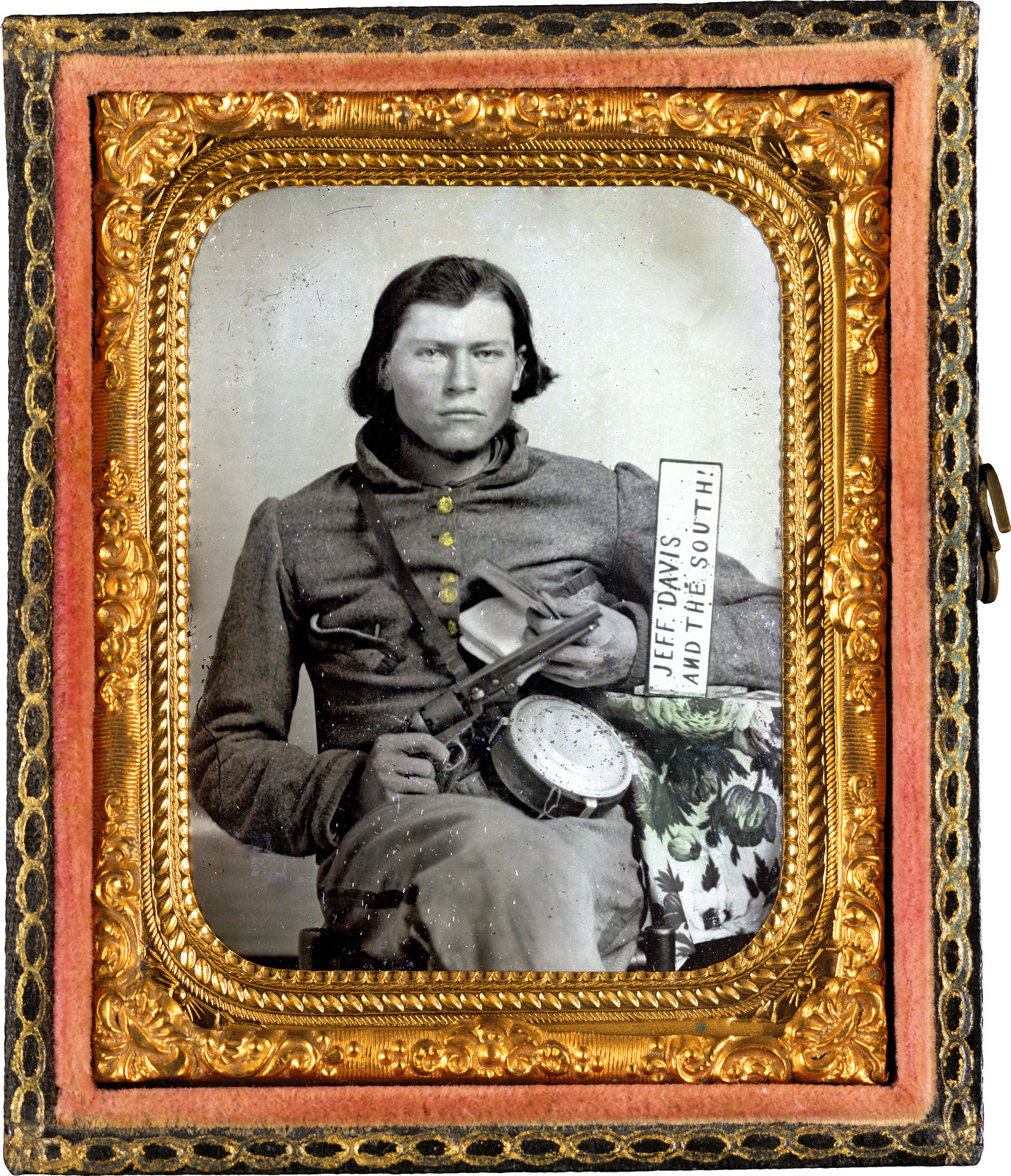
Title: [Thomas Isaiah Booker in Confederate uniform with Colt navy revolver, book, tin drum canteen, and sign reading Jeff Davis and the South!]
Date Created/Published: [between 1861 and 1863]
Medium: 1 photograph : ninth-plate ambrotype, hand-colored ; 7.4 x 6.3 cm (case)
Summary: Photo shows identified soldier from Louisiana from either Co. D, 8th Louisiana Cavalry Regiment; Co. B, 28th Louisiana Infantry Regiment, or Co. B, 29th Louisiana Infantry Regiment.
Reproduction Number: LC-DIG-ppmsca-34375 (digital file from original item)
Rights Advisory: No known restrictions on publication.
Access Advisory: Use digital images. Original served only by appointment because material requires special handling.
Call Number: AMB/TIN no. 3030 [P&P]
Repository: Library of Congress Prints and Photographs Division Washington, D.C. 20540 USA
Notes:
…..Title devised by Library staff.
…..Case: Leather; circle and scroll design.
…..Soldier identification from great granddaughter Suella Booker Cooper (November 2012).
…..Gift; Tom Liljenquist; 2012; (DLC/PP-2012:127).
…..More information about this collection is available at http://hdl.loc.gov/loc.pnp/pp.lilj
…..Purchased from: Bryan Watson, Civil War Images, Torrington, Wyoming, 2012.
…..Forms part of: Liljenquist Family Collection of Civil War Photographs (Library of Congress).
…..Forms part of: Ambrotype/Tintype photograph filing series (Library of Congress).
Library of Congress item permalink
_______________
Mike’s notes:
Image restoration note – This image has been digitally adjusted for one or more of the following:
– fade correction,
– color, contrast, and/or saturation enhancement
– selected spot and/or scratch removal
– cropped for composition and/or to accentuate subject matter
– straighten image
Image restoration is the process of using digital restoration tools to create new digital versions of the images while also improving their quality and repairing damage.
A big picnic dinner in camp today.–Alexander G. Downing.
September 7, 2021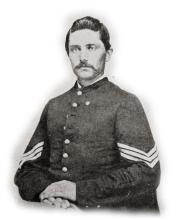
Saturday, 7th–We had a big picnic dinner in camp today, given for the soldiers by the ladies of Scott county. There was fried chicken, bread, pie and cake by the wagon load, free to all who were hungry. The food was placed on a long table and each man could walk up and help himself. There must have been as many as five thousand who enjoyed the dinner. It was a beautiful day for the occasion.
“Our fort is completed, and we have just received orders to cook three days rations, and be ready to move at a moment’s notice.”–Journal of Surgeon Alfred L. Castleman.
September 7, 2021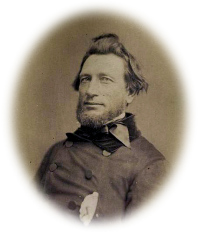
7th.–On the high land overlooking the Potomac, about six or seven miles above the Navy Yard at Washington, we have, since our arrival here, thrown up a small fort, formed extensive abattis, and made redoubts and fortifications to command the turnpike leading down the river, and the bridge over which any enemy must pass from any direction above here to reach Washington. This looks like business. The earthwork fort is small, but very strong, and its large siege guns, from twelve to eighteen feet long, with their sullen faces watching up and down the road in every direction, give it a most formidable appearance. A brigade (I have not learned what one) has just advanced beyond us to commence another fort, about two miles to the southwest of us. Neither fort has yet been officially named, but the one just finished is called by the soldiers Fort Mott; the one about to be built they will for the present distinguish by the name of Fort Ethan Allen. In this manner we are closing on the enemy by slow approaches, or parallels. Let Dupont and Butler, from North Carolina, advance to meet us, whilst Fremont takes care of the Mississippi, and we shall have an early closing up of the war. Every day’s observation more and more satisfies me that the enemy will not fight us here.
9 p. M.–Our fort is completed, and we have just received orders to cook three days rations, and be ready to move at a moment’s notice.
I will here note, once for all, the manner of the soldiers taking care of themselves in a storm, when they have no tents. They all have “rubber blankets.” Two forks are set, and a pole laid from one to the other, some four or five feet from the ground. A kind of lean-to roof is made by placing brush or poles against this, one end resting on the ground, the other end resting on the pole. To make this roof water-proof, the rubber blankets are stretched, like tiles on a roof, and no water gets through. In moderate weather the men cuddle together under this, and are reasonably comfortable. In cold weather they make large log fires in front of these “bivouacs,” and pass the nights without freezing.
An order was received to-day from the War Department, that in future no labor shall be required of soldiers on the Sabbath, except what is absolutely necessary for our defence.
William Howard Russell’s Diary: Rumoured death of Jefferson Davis.
September 7, 2021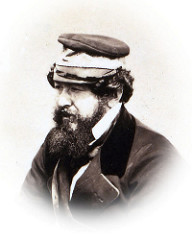
Sept. 7th.–Yes; “Jeff. Davis must be dead.” There are some touching lamentations in the obituary notices over his fate in the other world. Meanwhile, however, his spirit seems quite alive; for there is an absolute certainty that the Confederates are coming to attack the Capitol. Lieut. Wise and Lord A. Vane Tempest argued the question whether the assault would be made by a flank movement above or direct in front; and Wise maintained the latter thesis with vigour not disproportioned to the energy with which his opponent demonstrated that the Confederates could not be such madmen as to march up to the Federal batteries. There is actually “a battle” raging (in the front of the Philadelphia newspaper offices) this instant–Populus vult decipi–decipiatur.
“It seems that the British and French Consuls at Charleston have acted in concert in making a treaty with Jeff Davis…”–Adams Family Letters, Henry Adams, private secretary of the US Minister to the UK, to his brother, Charles.
September 7, 2021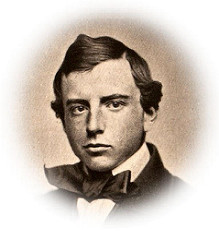
London, September 7, 1861
Yours in answer to mine written after the Bull’s Run arrived last night and I answer it at once. Whatever weight your arguments might have had on me in ordinary times, just now they are entirely superseded by the new turn things have taken since that letter was written. I could not go home now if I would, nor would if I could. Work has increased to such an extent since our return from our excursion that I am absolutely necessary here. Things have taken a turn which makes it every day more probable that we must sooner or later come into collision with England, and of course with that prospect I can’t leave the Chief and the family in the lurch. So you need not at present feel any alarm about my blundering home, as you call it, for I promise you fair warning so that you may be down at the wharf to receive me with the towns-people.
Warning you to preserve it a profound secret, I will disclose to you some of the horrors of the prison-house. Remember, your finger ever on your lip. [continue reading…]
Feeling in the UK no longer “leaning 0ur way.”–Adams Family Letters, Charles Francis Adams, U.S. Minister to the U.K., to his son, Charles.
September 7, 2021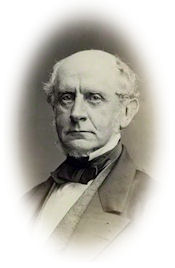
London, September 7, 1861
The feeling here which at one time was leaning our way has been very much changed by the disaster at Bull’s run, and by the steady operation of the press against us. Great Britain always looks to her own interest as a paramount law of her action in foreign affairs. She might deal quite summarily with us, were it not for the European complications which are growing more and more embarrassing. There are clouds in the north and in the south, in the east and in the west, which keep England and France leaning against each other in order to stand up at all. The single event of the death of Napoleon, perhaps even that of Lord Palmerston, would set everything afloat, and make the direction of things in Europe almost impossible to foresee. Hence we may hope that these two powers will reflect well before they inaugurate a policy in regard to us which would in the end react most fatally against themselves. . . .
Working as As judge-advocate—Rutherford B. Hayes
September 6, 2021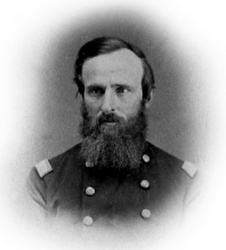
Friday, [September] 5 [6].–As judge-advocate, with General Benham, Colonels Scammon, Smith, et al., I tried two cases. J. W. Trader, etc.
Difficulties in getting arms.—Diary of John B. Jones.
September 6, 2021
SEPTEMBER 6th.—We are not increasing our forces as rapidly as might be desired, for the want of arms. We had some 150,000 stand of small arms, at the beginning of the war, taken from the arsenals; and the States owned probably 100,000 more. Half of these were flint-locks, which are being altered. None have been imported yet. Occasionally a letter reaches the department from Nashville, offering improved arms at a high price, for gold. These are Yankees. I am instructed by the Secretary to say they will be paid for in gold on delivery to an agent in Nashville. The number likely to be obtained in this manner, however, must be small; for the Yankee Government is exercising much vigilance. Is not this a fair specimen of Yankee cupidity and character? The New England manufacturers are furnishing us, with whom they are at war, with arms to fight with, provided we agree to pay them a higher price than is offered by their own Government! The philosophical conclusion is, that this war will end when it ceases to be a pecuniary speculation.
…a variety of the most beautiful peaches.
September 6, 2021
Friday, September 6. — A bright morning greeted our eyes. The clear sky promised a pleasant day. We discovered an orchard near by, which furnished us with a variety of the most beautiful peaches. After taking a good supply of them, marching was resumed. Arrived by nine o’clock A. M. at Camp Jackson, occupied by the Thirty-fourth Regiment New York Volunteers, Col. LaDue. We were well received. Towards evening, the Colonel and Lieut. Tompkins took the fifth piece along, in the direction of the Potomac, getting the gun in position close to the canal, after masking it. All quiet during the night.
“Found that an application had been made, or two rather, for my old invention, the rotary trigger, for guns.”—Horatio Nelson Taft
September 6, 2021
FRIDAY 6
Beautiful day again. No particular news afloat but expected every hour to hear of a battle. Spent part of the day at the pat office, wrote a letter there to Brother C R. Found that an application was [sic] had been made, or two rather, for my old invention, the rotary trigger, for guns. There is intoference declared betwen them. I must attend to it. Came home and found my old model. Attended Julia & Miss Hartly to Mrs Youngs Musical Soiree. Got home at 11 o’clock.
______
The three diary manuscript volumes, Washington during the Civil War: The Diary of Horatio Nelson Taft, 1861-1865, are available online at The Library of Congress.
Daily rations–Alexander G. Downing.
September 6, 2021
Friday, 6th–Nothing of importance. We have company drill twice a day now. We draw our rations every morning about 9 o’clock now. They consist of bread, beans, potatoes, bacon, rice, sugar, coffee, salt and pepper, also soap and candles. Twice a week we have salt beef and fresh beef. Each one draws enough for the day according to army regulations.[i]
[i] Mr. Downing says that he learned later that Mr. Hiram Price (the Davenport banker) provisioned the soldiers with his own funds, which is in keeping with the well-known facts concerning the financing of the first regiments by Mr. Price and others, for the State of Iowa.–Ed.
“This is the story, though some are so uncharitable as to discredit it, notwithstanding one hole through his canteen and another through his cheek.”–Journal of Surgeon Alfred L. Castleman.
September 6, 2021
6th.–I introduce the following letter to a friend, as sufficiently explicit as to the occurrences since the last date:
Chain Bridge, Va., Sept. 6, 1861.
I commence this letter with the reiteration, Poor Virginia! That State, which for forty years has stood as the guiding star of our galaxy of States,–that State, which alone could, six months ago, have assumed the position of umpire to the belligerents, and which only would have been respected in the assumption–now stands at the very foot of the list. In the commencement of this contest she degraded herself by offering to become, the cat’s paw for South Carolina, and was still farther degraded by South Carolina rejecting the proposition to become her menial. By her officious subservience, however, she got her paw into the fire, and how dreadfully it is burned only those who are on her soil can form any idea. Everywhere is the destruction going on. Her soil is the battle-field, and, so far as the destruction of property is concerned, it matters but little which party is successful. Armies must have room to move and manÅ“uvre, soldiers will have the fruits and vegetables which grow around their encampment, and camp life is a poor fertilizer of that moral growth which marks the line of “mtum el tuum.”
This letter is written on sheets taken from the former residence of Hon. W. W. Slade, once a member of Congress from Virginia. I rode around with a foraging party. We entered his fine old mansion, and I could not but weep over the sad changes which I could see had taken place within a few hours. Within no living soul was left. The soldiers entered; for a time I stood back, but when I did go in what a sight presented itself! Already the floors were covered knee-deep with books and papers, which it must have required a long life of toil and trouble to amass, fine swinging-mirrors shivered into thousands of pieces–a fit emblem of the condition to which efforts are being made to reduce this glorious government–each piece reflecting miniature images of what the whole had shown, but never again to reflect those pigmy images in one vast whole. In the large and spacious drawing-room stood the ruins of one of those old-fashioned sideboards, around which had grown so much of the reputation of Southern high life and hospitality; its doors, wrenched from their hinges, lay scattered on the floor; large mahogany sofas, with their covers torn off, marble-top tables, stationery, china, stoves and spittoons, were there in one promiscuous heap of ruins. I stepped into the library, hoping to bring away some relic that had been untouched by the soldiers, but I was too late–all here was ruin. In a corner I picked up a few yellow pamphlets, and read “Constitution and By-Laws of the National Democratic Association.” Sadly enough I left the house, and seated myself, to rest and think, on the spacious verandah. For a moment I looked on the vast orchards, the beautiful flower garden, the long rows of laden grape vines, the broad acres of corn and clover, and thought, “What a place and what a condition to pass old age in comfort and quiet,” and my heart began to lighten. How momentary the lightning, for just then company after company from the different regiments came up; gates were thrown open, fences thrown down, and horses, cattle and mules were destroying all these evidences of prosperity and comfort. And this is but one feature in the great haggard countenance of war which stares at us whenever we look at Virginia’s “sacred soil.” Alas, poor Virginia! This subject alone would give interest to a whole volume, but I must leave it.
On Tuesday night, at half-past ten o’clock, the “long roll” brought our brigade, of five regiments, to their feet, when we found ourselves under orders to march at once for the Virginia side of the river, where, it was said, a large body of rebels had been collecting just at night. We had had slight skirmishing in that neighborhood for several days, and now the crisis was expected, and our regiment was to have a chance. All was excitement, and in half an hour from the alarm we were ready to start. By the time we arrived here it had commenced raining–we found no enemy–bivouaced for the night, and slept in the rain to the music of the tramp, tramp of infantry, and the rattling, roaring tear of artillery wagons over the roughly macademized road which passed by our encampment. Yesterday it rained all day, as if every plug had been pulled out; still we kept on our arms and ready for action–our general and brigade officers dashing about all the time, and warning us to be ready for an attack.
Day before yesterday a scouting party of our brigade went in pursuit of a party of cavalry who had been seen hovering about us. When they came in sight the cavalry took to their heels, leaving to us only three large contrabands, who “tink massa oughten to run away from poor nigga so, heah! Heah! They just run and leab us to de mercy of de darn abolishuns, heah! heah!” They report that around Fairfax and Centreville there are sixty or seventy regiments, who are well provisioned, but that there is a great deal of sickness among them, measles being the prevailing disease. We had, when we left Kalarama, about twenty-five in the hospital, whom we left there under the charge of Dr. _____. There are three or four here who have sickened in consequence of exposure to the two days and two night’s rain, but they will be out in a day or two. We have not yet lost a man by disease or accident, though I hear that one man yesterday received a musket ball through his cap, but as it did not hit his head it is thought he will recover. The musket was carelessly fired by some soldier in our camp.
A little occurrence to-day has caused quite a stir in our camps, and I deem it worthy to be noted here tor my remembrance. Capt. Strong, of the Second Regiment of Wisconsin Volunteers, was with a small party on picket guard. He strolled away from his company, and suddenly found himself surrounded by six of the rebel pickets. Being out of reach of help from his men, he surrendered himself a prisoner. After a short consultation as to whether they should kill the “d___d Yankee” on the spot, they concluded that they would first take him into camp. They demanded his pistols, which he took from his belt and presented. But at the moment when the rebels were receiving them, they both went off, killing two of his captors on the spot. But there were four left, two on foot, two on horseback. He dashed into a pine thicket, they discharging their pieces after him and immediately giving chase. He struck into a deep hollow or ravine leading down to the Potomac. It was so precipitous that the horsemen could not follow. But when he emerged from it near the river, he found himself confronted by the two horsemen who had ridden around and reached the spot in time to head him off. He had received a shot through his canteen. Immediately on seeing his pursuers he fired again, killing one more of them, and simultaneously he received another shot through his cheek. He continued firing with his revolvers till he had made in all eleven shots. By this time the fourth man had been unhorsed. The footmen did not pursue, and he made his way into camp. This is the story, though some are so uncharitable as to discredit it, notwithstanding one hole through his canteen and another through his cheek.
William Howard Russell’s Diary: General Halleck. —General McClellan and the Sabbath.—Rumoured death of Jefferson Davis.
September 6, 2021
Sept. 6th.–At 3.30 p.m. General McClellan sent over an orderly to say he was going across the river, and would be glad of my company; but I was just finishing my letters for England, and had to excuse myself for the moment; and when I was ready, the Genera and staff had gone ventre à terre into Virginia. After post, paid my respects to General Scott, who is about to retire from the command on his full-pay of about £3500 per annum, which is awarded to him on account of his long services.
A new Major-General–Halleck–has been picked up in California, and is highly praised by General Scott and by Colonel Cullum, with whom I had a long talk about the generals on both sides. Halleck is a West Point officer, and has published some works on military science which are highly esteemed in the States. Before California became a State, he was secretary to the governor or officer commanding the territory, and eventually left the service and became a lawyer in the district, where he has amassed a large fortune. He is a man of great ability, very calm, practical, earnest, and cold, devoted to the Union –a soldier, and something more. Lee is considered the ablest man on the Federal side, but he is slow and timid. “Joe” Johnson is their best strategist. Beauregard is nobody and nothing–so think they at head-quarters. All of them together are not equal to Halleck, who is to be employed in the West. [continue reading…]
Unidentified soldier in Confederate uniform with Berdan’s Sharps rifle and Colt 1862 Police Model pistol
September 6, 2021Civil War Era Photographic Portraiture No. 16
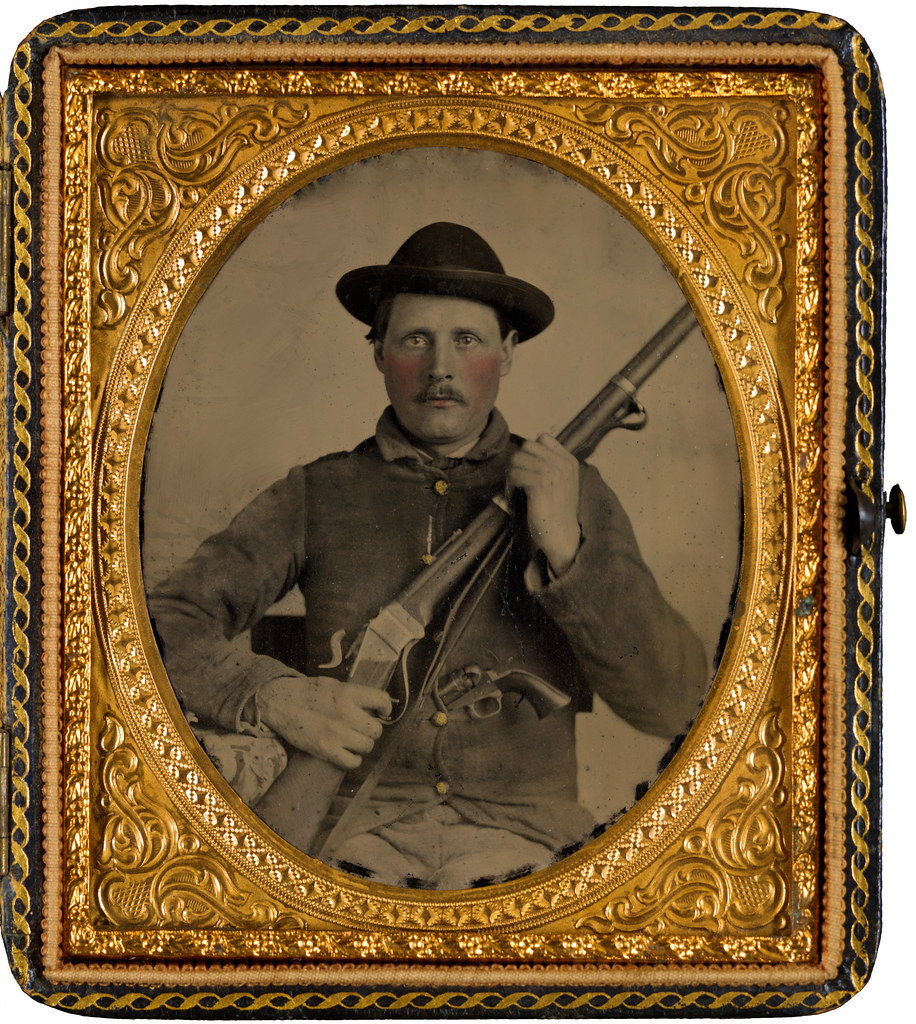
Title: [Unidentified soldier in Confederate uniform with Berdan’s Sharps rifle and Colt 1862 Police Model pistol]
Date Created/Published: [between 1861 and 1865]
Medium: 1 photograph : sixth-plate ambrotype, hand-colored ; 9.3 x 8.0 cm (case)
Reproduction Number: LC-DIG-ppmsca-33426 (digital file from original item)
Rights Advisory: No known restrictions on publication.
Access Advisory: Use digital images. Original served only by appointment because material requires special handling.
Call Number: AMB/TIN no. 2969 [P&P]
Repository: Library of Congress Prints and Photographs Division Washington, D.C. 20540 USA
Notes:
…..Title devised by Library staff.
…..Case: Leather; plain push-button.
…..Soldier identified by seller as being from Forsyth County, North Carolina.
…..Gift; Tom Liljenquist; 2012; (DLC/PP-2012:127).
…..More information about this collection is available at http://hdl.loc.gov/loc.pnp/pp.lilj
…..Purchased from: Cecil E. Jackson, Columbia, S.C., 2012.
…..Forms part of: Liljenquist Family Collection of Civil War Photographs (Library of Congress).
Library of Congress item permalink
__________
Mike’s notes:
Image restoration note – This image has been digitally adjusted for one or more of the following:
– fade correction,
– color, contrast, and/or saturation enhancement
– selected spot and/or scratch removal
– cropped for composition and/or to accentuate subject matter
– straighten image
Image restoration is the process of using digital restoration tools to create new digital versions of the images while also improving their quality and repairing damage.
“The army in Virginia seems quiet; but our arms had a severe reverse on Thursday.”—Diary of a Southern Refugee, Judith White McGuire.
September 6, 2021
“The Briars,” Sept. 6.—We returned home, as we are wont to call this sweet place, yesterday, and are just now taken up with family matters of deep interest. The army in Virginia seems quiet; but our arms had a severe reverse on Thursday. Fort Hatteras was bombarded and taken by Federal vessels. They also secured many prisoners.
General Floyd, in Western Virginia, had a severe skirmish with the enemy, about a week ago, and drove them off with considerable loss. Our loss was small.
Civil War Day-By-Day
September 6, 2021
September 6, 1861
- Union forces captured Paducah without bloodshed. This town gave the Union a large measure of control over the river systems that were vital to the region.
In behalf of the regiment.—Woolsey family letters
September 5, 2021
Camp Trenton, 1861.
Miss Woolsey, Ebbitt House: I have the honor to acknowledge your favor of the 2nd inst., and would beg leave to say in reply, that the stores will be most acceptable, and in order that you may have no further trouble in the matter, an order signed by our Surgeon, Dr. Grant, will be presented you by our regimental wagoner, who will take charge of the goods for us.
With many thanks for your interest in behalf of the regiment, I have the honor to remain
Your obedient servant,
SAML. L. BUCK,
Major 2nd Regt. N. J. V.
“…almost all the captains have horses and a few mules have been “realized”—that’s the word—from Secessionists.”—Rutherford B. Hayes
September 5, 2021
SUTTON, OR SUTTONVILLE, VIRGINIA, September 5, 1861.
DEAREST:–We are in another camp of fine views. This is the last stronghold of our army as we advance toward the enemy. We are now part of an army of from six to eight thousand and are pushing towards an advancing enemy stronger in numbers, it is said. Some time will perhaps elapse before we meet, but we are pretty certain to meet unless the enemy withdraws. This, I think, they will do. I like the condition of things. Our force, although not large, is of good regiments for the most part: McCook’s Ninth, Colonel Smith’s Thirteenth, Lytle’s Tenth (Irish), are all here; also Colonel Moor’s Twenty-eighth (Markbreit’s regiment), Colonel Lowe’s Twelfth, our regiment, and Colonel Porshner’s Forty-ninth (Wilstach regiment) coming; also one part company of Regulars; four companies artillery, four companies cavalry. An army about as large as can well manÅ“uvre in these mountains. General Rosecrans is in command in person with General Benham of the Regular Army to second him. We are camped on both sides of Elk River, connected by a beautiful suspension bridge. Camps on high hills; fortifications on all the summits. “A gay and festive scene,” as Artemus Ward would say, especially about sundown when three or four fine bands are playing in rivalry.
Elk River empties into Kanawha, so that the water now dripping from my tent will pass you, perhaps, about a fortnight hence; the clearest, purest water it is too. From the tops of the high hills you can see the rocks in the river covered by ten or twenty feet of water. Nothing finer in Vermont or New Hampshire.
I have just got a letter from Dr. James [D. Webb]. Say to him, let all my letters be opened, and if any are important, send them; otherwise, not, unless from some especial friend. Send me some stamps and tell me how you are off for cash. We expect to be paid soon; if so, I can send you some three hundred to six hundred dollars.
We are to have a bore here in a few days–a court-martial on some officer in the Tenth or Twelfth, and I am to be judge-advocate, unless I can diplomatize out of it, which I hope to do.
We got today papers from Cincinnati–the Times of the 28th and the Commercial of the 2d. Think of it; only three days old! It has rumors that General Rosecrans is captured. Well, not quite. He is in good health, and the Twenty-third Regiment is his especial guard. No force can get him here without passing my tent.
Among the interesting things in camp are the boys. You recollect the boy in Captain McIlrath’s company; we have another like unto him in Captain Woodward’s. He ran away from Norwalk to Camp Dennison; went into the Fifth, then into the Guthries, and as we passed their camp, he was pleased with us, and now is “a boy of the Twenty-third.” He drills, plays officer, soldier, or errand boy, and is a curiosity in camp. We are getting dogs too, some fine ones; almost all the captains have horses and a few mules have been “realized”–that’s the word–from Secessionists.
It is clearing off, so we shall be happy again. I am sorry you are unwell. Don’t get down-spirited. We shall get through and come home again. Love and kisses for all the boys. Affectionate regards to Grandma. Jim’s letters will be very acceptable. Goodbye, darling.
Affectionately,
R. B. HAYES.
P.S.–If you could see the conveniences (?) I have for writing, you would see how such a scrawl as this becomes a possibility. I have found out the day of the week and month; it is Thursday, the 5th September, 1861.
MRS. HAYES.
The toad will croak his requiem, and the viper will coil beneath the thistle growing over his head.—Rebel War Clerk
September 5, 2021
SEPTEMBER 5th.—Our Congress has authorized the raising and organizing of four hundred regiments. The Yankee Congress, 500,000 men. The enemy will get their’s first; and it is said that between 600,000 and 700,000, for three years or the war, have already been accepted by the U. S. Government. Their papers boast that nearly a million volunteers were tendered. This means mischief. How many will rush forward a year hence to volunteer their services on the plains of the South? Full many ensanguined plains will greet the horrific vision before this time next year; and many a venal wretch coming to possess our land, will occupy till the day of final doom a tract of six feet by two in some desolate and unfrequented swamp. The toad will croak his requiem, and the viper will coil beneath the thistle growing over his head.
An unoccupied house being close by, we all took possession of it, and found ourselves quite comfortable.
September 5, 2021
Thursday, September 5.—At dawn of day, contrary to our expectations, the enemy did not open on us again. Having had no food since the day before, some of us went to the town, and as fortune, would have it, found bread, molasses, and that renowned coffee kettle, the fourth detachment will well remember. We enjoyed a good soldiers’ breakfast. Lieut. Tompkins, behaving towards the men like a gentleman, they would have done most anything for him. In several cases he relieved our wants, out of his own purse. Late in the afternoon we left Great Falls, marching towards Seneca Mills, as the enemy made various demonstrations up and down the Potomac. Rain falling incessantly, and passing through dense woods marching became a matter of impossibility, and it was decided to halt by the roadside until daylight. An unoccupied house being close by, we all took possession of it, and found ourselves quite comfortable.