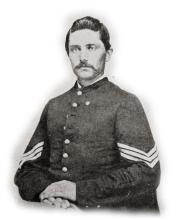
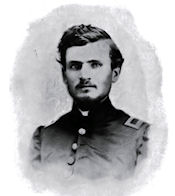
“I tried some of the “venison” but it tasted strangely like hog.”–Army Life of an Illinois Soldier, Charles Wright Wills.

Civil War Day-by-Day

Bird’s Point, Mo., December 1, 1861.

This, the beginning of winter, is the warmest and altogether the most pleasant day we have had for several weeks. During our whole trip to Bloomfield and back we had splendid weather, but ever since our return it has been at least very unsplendid. The climax was reached day before yesterday and capped with several inches of snow. I was up the river 15 miles at the time with a party loading a flatboat with logs for our huts. We had a sweet time of it and lots of fun. The mud was from six inches to a foot deep, and by the time we got the logs to the boat they were coated with mud two inches thick, and before we got a dozen logs on the boat we had a second coat on us, from top to toe of mud. It snowed and rained all the time we worked but I heard no complaint from the men, and in fact I have never seen so much fun anywhere as we had that day. There is any amount of game where we were, the boys said that were out, and they brought to camp several skinned “deer.” I tried some of the “venison” but it tasted strangely like hog.

Of course drill is discontinued for the present, and as working on the quarters is almost impossible we sit and lie in the tent and gas and joke and eat and plan devilment. We have a barrel of apples now, lots of pecans and tobacco and not a thing to trouble us. The enemy have quit coming around here and we can stroll six or seven miles without danger if we get past our pickets safely. There was a great deal of firing down at Columbus yesterday and I heard some more this morning. I don’t know whether the gunboats are down or not. It may be the Rebels are practicing with their big guns; or maybe they are firing a salute over the fall of Fort Pickens. It will be a great joke if they take that, won’t it? [continue reading…]

0 comments

Rebel War Clerk

Civil War Day-by-Day

DECEMBER 1st.—The people here begin to murmur at the idea that they are questioned about their loyalty, and often arrested, by Baltimore petty larceny detectives, who, if they were patriotic themselves (as they are all able-bodied men), would be in the army, fighting for the redemption of Maryland.

0 comments

Through Some Eventful Years

Through Some Eventful Years by Susan Bradford Eppes
Susa Bradford Eppes

December 1st, 1861.—Father was reading what I had written about the Battle of Manassas and he said, “My baby has forgotten to write of school plans. They should be recorded by all means. In years to come you will read of it with great interest and it should have come before the account of the battle.” As he thinks it is not too late to tell of it I will write it here, though I do not like to think of it. I was so opposed to it at first and so disappointed when I had to give it up. In June, last, Grandpa wrote to Mother, urging her to send me to Raleigh to school. Mother was educated in that city and many of her old friends still live there. I would probably have their children as classmates. Grandpa, himself, would take me to Raleigh and see to all details necessary. His plan was for me to go on to Enfield with cousin Johnnie, who was then at home on a furlough and would see me safely in his hands. I could visit Grandma and himself until school opened. He said Raleigh was so far in the interior that there would be no danger of the enemy reaching it and he could think of no safer place in these days of war. He went on to say he thought the war would be over in sixty days; a great many people think so. Father was opposed to this but Mother thought well of it and though I hated the thought of leaving them, Mother told such entrancing tales of school life in Raleigh, that I soon became reconciled. Then, too, I dearly love to please Grandpa. Mother graduated with first honors and her father was so delighted that he gave her that lovely set of jet and gold, which I have always admired. I thought to myself, I, too, can study hard and perhaps I can get first honors and Father and Mother may be proud of their “ugly duckling” yet. Though the blockade is much more effective than we had any idea it would or could be, it was still an easy matter to fit out a school girl.

In the fall of 1860 uncle Arvah had bought an unusually large stock of goods and when, in the following January, Florida seceded, he wired his commission merchants in New York, to buy such goods as he was in the habit of supplying himself with, to the value of the cotton in his name, which they held in their possession. When these goods arrived, and they were shipped immediately, the bills of lading showed one hundred and forty-two thousand dollars worth of merchandise. So Mother had no difficulty in finding pretty materials; she and Lulu made my dresses and Mrs. Manning made my underwear. They were so beautifully made that I told sister Mag it was almost like her bridal trousseau. My traveling dress was brown, a soft, rough-surfaced material of wool, with small flecks of gold color woven in. There is a long cape, lined with satin of the same shade as the dress, quilted in small diamonds. My hat is of beaver felt, the color of the dress, three fluffy little ostrich tips are fastened in with a gold arrow. The cape, too, is fastened with three gold clasps. Such a pretty dress. But I will not wear it to North Carolina, for as soon as I had made up my mind to go things began to happen. The Battle of Manassas did not seem to alarm them but when the enemy attacked the coast of North Carolina, Father and Mother were quite positive that I must stay at home. So, war interferes with everything, even with education. It may be all for the best, I am sure it is, since Cousin Richard was killed. I believe what made Father and Mother change their minds is the discovery that the enemy are sending spies through the country to cut off telegraphic communication, when they get ready to attack. It would be dreadful to be cut off from your own home folks.


Susan Bradford is 15 years old when this entry was made.
0 comments

Tent modifications.—Woolsey family letters, Elizah to husband Joseph Howland.

Woolsey family letters during the War for the Union

Ebbitt House, December 1, ‘61

We saw yesterday a nice dodge for enlarging your tent and making the back one more private. It is pitching the two tents three or four feet apart and spreading the fly over the intermediate vestibule. Chaplain Edward Walker of the 4th Connecticut, whom we went to see yesterday, had his two tents arranged so, and the effect was very pretty. In the front one he had the regimental library (a very nice one) and the back one was his own, and between them was the little vestibule floored like the others and boarded at the sides to keep out the cold, and in it he had his stove and washing apparatus, and from its ceiling hung a pretty wire basket filled with moss and wild flowers! a charming little bit of New England country life in the midst of civil war. He is a nice fellow, one of Dr. Leonard Bacon’s Congregational boys and just the one for an army Chaplain–so cheerful and strong, and honest and kind-hearted. . . . He went with us through the camp and to the hospital, where we left them some supplies, including a lot of hair pillows which we had made from Abby’s material.

G. lately drove Chaplain Wrage’s wife out to her husband’s camp, carrying socks, pillows, comforters, farina, etc. to the hospital. The camp was very German and dirty; no New England faculty shown in keeping it warm and clean, and the little German bowers looked dreary in the freezing weather. The Colonel, who addresses us as “my ladies” in a polite note, is under arrest for stealing; the Lieutenant-Colonel and Quartermaster are fools, and the men suffer in consequence.

0 comments

“I hear nothing said of winter quarters, and so far there seems to be no determination to provide them.”–Letters from Elisha Franklin Paxton.

Elisha Franklin Paxton – Letters from camp and field while an officer in the Confederate Army

Winchester, December 1, 1861.

I have received your last letter, and am sorry that you write so despondently of the future. It would be sad, indeed, for me to think that day would ever come when the dear wife and little ones whose happiness and comfort have been the chief aim of my life, should be dependent. You would not be more grieved, I am sure, than I would be at such a prospect, and its reality could not distress you more than it would me, if I should be alive to witness it. But, Love, it does not become either of us to harass ourselves with trouble which the future has in store for us. Mine at present is not blessed with as many comforts as I have seen in times past; but it is the case with many thousands who feel impelled with a sense of patriotism and duty to bear it in patience, and I shall try to follow their example. When I sent the message to your father I knew that what he would have to give you out of his estate would be abundant to furnish a comfortable support for you and your children, whatever misfortune may befall my life or my property, and I desired, if it had not been done, that it might be secured to you as your own. The widow and orphan of many a gallant man destined to fall before this struggle ends, though deserving, have not, I apprehend, such a prospect of a comfortable provision as you have. So, Love, the best consolation I can offer you is that there are others whose future is as dark as yours, and that yours is not so bad but that it might be worse. It grieves me, I am sure, as much as it does you, and we must both make up our minds, as the surest guaranty of happiness, to bear the present in patience and cheerfulness, and cherish a hope of another time, when we shall be together again, loving and happy as we used to be. If I survive this war, I have no fear of being unable to earn, by my own industry and energy, a comfortable support for my household. If fate determines that I must perish in the contest, then I trust that He whose supreme wisdom and goodness tempers the wind to the shorn, lamb will shield from want the widow and orphans left dependent upon His providence. This is the first day of winter, and as yet we have had no snow. It has for some time been quite cold, and the water often frozen over. I have not as yet suffered much from exposure, and think I shall stand the winter well. With the assistance of four or five blankets, and bed made of some hay and leaves laid on split timber raised off the ground, I sleep quite warm. I hear nothing said of winter quarters, and so far there seems to be no determination to provide them. I think it would be as well to go into winter quarters, for the weather and the roads will soon be such as to make active operations utterly impracticable.

Will Lewis and Annie left here Wednesday, I think, and, I suppose, have reached home before this time. I sent by her my likeness and some candy for the children. When he returns send me your likeness–that which was taken before we were married. I suppose you know where it is put away, for I don’t remember.

And now, Love, as I have written you quite a long letter compared with what I generally write, I will bid you goodbye till my next. You have my heartfelt sympathy in your approaching illness, and my sincere hope of your speedy and safe recovery. Kiss dear little Matthew and Galla for me, and tell them to be good boys. And now, dearest, again good-bye.

0 comments

An absurd story that was going the rounds.—Woolsey family letters, Caroline Carson Woolsey to Georgeanna and Eliza.

Woolsey family letters during the War for the Union

December 1st.

L. came in a few evenings ago. He was at Conway last summer, and able to contradict an absurd story that was going the rounds,–that Charley and Joe having joined the army, Mother had given up housekeeping and gone into the hospitals, and all the daughters were children of the regiment!

Dr. Carmalt called too. He is very quiet, but good-looking, and ready to laugh at poor jokes, which is much in his favor. . . . I never told you what a nice dressing-gown the one you left for Abby was; and though she was immensely disgusted at your having given it, she wears it every night and looks comfortable and warm, which is what she did not look, with her flannel petticoat over her shoulders.

0 comments

A Captain under arrest.—William Howard Russell’s Diary.

My Diary North and South – William Howard Russell

December 1st.–A mixed party of American officers and English went to-day to the post at Great Falls, about sixteen or seventeen miles up the Potomac, and were well repaid by the charming scenery, and by a visit to an American military station in a state of nature. The captain in command told us over a drink that he was under arrest, because he had refused to do duty as lieutenant of the guard, he being a captain. “But I have written to McClellan about it,” said he, and I’m d–d if I stay under arrest more than three days longer.” He was not aware that the General’s brother, who is a captain on his staff, was sitting beside him at the time. This worthy centurion further informed us he had shot a man dead a short time before for disobeying his orders. “That he did,” said his sympathising and enthusiastic orderly, “and there’s the weapon that done it.” The captain was a boot and shoe maker by trade, and had travelled across the isthmus before the railway was made to get orders for his boots. A hard, determined, fierce “sutor,” as near a savage as might be.

“And what will you do, captain,” asked I, “if they keep you in arrest?”

“Fight for it, sir. I’ll go straight away into Pennsylvania with my company, and we’ll whip any two companies they can send to stop us.”

Mr. Sumner paid me a visit on my return from our excursion, and seems to think everything is in the best possible state.

0 comments

Downing’s Civil War Diary.–Alexander G. Downing.

Diary of Alexander G. Downing; Company E, Eleventh Iowa Infantry

Saturday, 30th–We had our first general review today, including the infantry, cavalry and artillery. The parade ground was full of soldiers, most of them full-armed for active service. And thus ends the month of November at Benton Barracks, St. Louis, Missouri.

0 comments

War Diary of Luman Harris Tenney.

War Diary of Luman Harris Tenney.

30th. Made several calls with Fannie–enjoyed them so much. Returned to Cleveland with Ma and Theodore.

0 comments

Diary of David L. Day.

David L Day – My diary of rambles with the 25th Mass

Nov. 30. According to the customs of our Puritan Fathers, last Thursday was observed in Massachusetts and other states as a day of thanksgiving to God, for his manifold mercies and bounties to the erring children of men. The day was observed here throughout all the camps as a holiday. All drills were suspended, and in our camp religious services were held, after which the boys engaged in ball playing and other amusements to which their inclinations might lead. Although deprived of joining our friends at home in their festivities and meeting them around the dear old board, it seems we were not forgotten. Our thanksgiving dinners are just beginning to arrive, and our camp is literally piled up with boxes and bales containing good things from the dear ones at home.

0 comments

Pay Day—Horatio Nelson Taft

Diary of US patent clerk Horatio Nelson Taft.

SATURDAY, NOVEMBER 30, 1861.

This day (the last of Autumn) has passed off without any particular event happening. I was in the office all day recording Patent Deeds. We were paid off today, my pay not being a very heavy amount having been in the office only six days. Did not get so weary as I did yesterday. J. N. Granger returned today from a visit home to Ontario County NY. He called upon me in my room this morning. Bought groceries & marketing. Went down to fire on 10th St, bot the papers at Shepherds, called for Julia at Mr Hartleys.

______

The three diary manuscript volumes, Washington during the Civil War: The Diary of Horatio Nelson Taft, 1861-1865, are available online at The Library of   Congress.

0 comments

Rebel War Clerk

Civil War Day-by-Day

NOVEMBER 30th.—Mr. Benjamin has been defeated for the C. S. Senate. Mr. Hunter has been named as a candidate for the C. S. Senate from Virginia. I thought he would not remain in the cabinet, after his relative was arrested (with no reason assigned) by order of Mr. Benjamin. Besides, the office is a sinecure, and may remain so for a long time, if the powers at Washington should “stint, and say aye” to the demands of England.

0 comments

Sanitary policy dispute resolved.–Journal of Surgeon Alfred L. Castleman.

Journal of Surgeon Alfred L Castleman.

30th.–It is a great relief to my feelings that the difficulties heretofore existing between the Military and Medical Departments in our Regiment are to-day adjusted, and I hope removed by the rescinding the order of the 9th inst, that my directions about the sanitary police of the camps need not be obeyed, and by a substitution of a public order from which this is an extract: “The condition of the health of the regiment requires more than ordinary care. The sanitary regulations of the camp must be entrusted to the Surgeon of the regiment.” I have good reason to hope, too, that all personal feelings of an unpleasant character, which have grown out of this unhappy difference of opinion as to official rights, are removed, and that in future the relations of the two departments may be pleasant to the parties, and beneficial to the sick. I now determined that more than ever will I devote my energies to the removal of the causes of the recent severe sickness, and to counteract their results.

0 comments

“Thanksgiving Day.”—Success thus far in favour of the North.—William Howard Russell’s Diary.

My Diary North and South – William Howard Russell

Thanksgiving Day on the 28th was celebrated by enormous drunkenness in the army. The weather varied between days of delicious summer–soft, bright, balmy, and beautiful beyond expression–and days of wintry storm, with torrents of rain.

Some excitement was caused at the end of the month by the report I had received information from England that the law officers of the Crown had given it as their opinion that a United States man-of-war would be justified by Lord Stowell’s decisions in taking Mason and Slidell even in the British Channel, if the Nashville transferred them to a British mail steamer. This opinion was called for in consequence of the Tuscarora appearing in Southampton Water; and, having heard of it, I repeated it in strict confidence to some one else, till at last Baron de Stoeckl came to ask me if it was true. Receiving passengers from the Nashville, however, would have been an act of direct intercourse with an enemy’s ship. In the case of the Trent the persons seized had come on board as lawful passengers at a neutral port.

The tide of success runs strongly in favour of the North at present, although they generally get the worst of it in the small affairs in the front of Washington. The entrance to Savannah has been occupied, and by degrees the fleets are biting into the Confederate lines along the coast, and establishing positions which will afford bases of operations to the Federals hereafter. The President and Cabinet seem in better spirits, and the former indulges in quaint speculations, which he transfers even to State papers. He calculates, for instance, there are human beings now alive who may ere they die behold the United States peopled by 250 millions of souls. Talking of a high mound on the prairie, in Illinois, he remarked, “that if all the nations of the earth were assembled there, a man standing on its top would see them all, for that the whole human race would fit on a space twelve miles square, which was about the extent of the plain.”

0 comments

Inspection and pay.–Alexander G. Downing.

Diary of Alexander G. Downing; Company E, Eleventh Iowa Infantry

Friday, 29th–We had inspection for pay today, which includes inspection of knapsacks and equipments. After inspection and pay, I went down town on a pass and purchased a portfolio,[1] a paper weight and a pocket knife for army service.[i]


[i] This portfolio, together with my Bible, I carried through my four years’ service.–A. G. D.

0 comments

War Diary of Luman Harris Tenney.

War Diary of Luman Harris Tenney.

29th. At Prof. Morgan’s to a tea party–a nice visit. Made several calls. Called at Fannie’s.

0 comments

“Our troops are now begining to be in earnest.”—Horatio Nelson Taft

Diary of US patent clerk Horatio Nelson Taft.

FRIDAY 29

A wet day and quite warm, no fire necessary for comfort. Have been hard at work in the office all day recording Land Patent Deeds, find it very tiresome. Have spent most of the evening at Chas Room with him and Sallie. News from the south looks favorable and in fact we are looking for favorable news from our forces everywhere. Our troops are now begining to be in earnest. Rainy evening.

______

The three diary manuscript volumes, Washington during the Civil War: The Diary of Horatio Nelson Taft, 1861-1865, are available online at The Library of   Congress.

0 comments

Rebel War Clerk

Civil War Day-by-Day

NOVEMBER 29th.—Gen. Sydney Johnston has command of the army in Tennessee and Kentucky. I wish it were only as strong as the wily enemy is in the habit of representing it!

0 comments

“The seeds of disease are now sown in our regiment, which, in despite of the greatest care, will not fail to yield rich harvests of sickness all winter.”–Journal of Surgeon Alfred L. Castleman.

Journal of Surgeon Alfred L Castleman.

29th.–Since the order of the early part of this month, that my directions in reference to the sanitary measures could be disregarded, I have not visited the camp, or given any directions in regard to cleaning, ventilating, &c., and though it is now but three weeks since that order was made, the sick list, which had decreased in two weeks from about two hundred to thirty-nine, has suddenly run up again to one hundred and sixty, and the diseases are assuming a low typhoid type. So foul are the tents that if a soldier, with simple intermittent, remains three days in his quarters, he is sent to hospital in a condition approximating ship-fever. The seeds of disease are now sown in our regiment, which, in despite of the greatest care, will not fail to yield rich harvests of sickness all winter. Our Governor has been in camp to-day. He has no doubt seen the effect of this military interference, for he has called on me to know if something cannot be done to arrest the trouble. I have laid the whole matter fully before him, and I have no doubt that what is in his power to do, will be done to avert the evil.

0 comments

Proficient in battalion drill.–Alexander G. Downing.

Diary of Alexander G. Downing; Company E, Eleventh Iowa Infantry

Thursday, 28th–The weather is very warm and pleasant. The regiment is becoming quite proficient in battalion drill, Colonel Hare seeming to understand the movements quite well. When the Colonel gives the orders to the different company officers, he usually simply says to Compton, “You know how to move your company.”

0 comments

War Diary of Luman Harris Tenney.

War Diary of Luman Harris Tenney.

28th. C. G. and D. R. returned to camp. Visited, called at Fannie’s. Splendid time. Attended a small charade party at Mrs. Holtslander’s. Thanksgiving meetings.

0 comments

Thanksgiving—Horatio Nelson Taft

Diary of US patent clerk Horatio Nelson Taft.

THURSDAY 28

Rather a warm day with rain this evening. It being “Thanksgiving” I did not go to the office. Did some fixing round the house in the morning and then went to Church with all the family. After church and after dinner went with the three boys to the “Monument” pond after aquatic plants and fish for the Aquarium. On our return met four Regts of NY troops on their way over the River. It is said today that our troops have advanced.

______

The three diary manuscript volumes, Washington during the Civil War: The Diary of Horatio Nelson Taft, 1861-1865, are available online at The Library of   Congress.

0 comments

Rebel War Clerk

Civil War Day-by-Day

NOVEMBER 28th.—Nothing of importance to-day. There will be no such quiet time after this year.

0 comments

Thanksgiving in camp with Joe.– From Eliza Woolsey Howland’s journal.

Woolsey family letters during the War for the Union
The Governors of all the loyal states issued in these dark days their annual proclamation of a day of Thanksgiving. Governor Andrews’ of Massachusetts was dated Nov. 21,’61, “the anniversary of the day on which the Pilgrims of Massachusetts on board the Mayflower united themselves in a solemn compact of government:
 
‘Sing aloud unto God our Strength.’”
 
The proclamation proposes to “give thanks for the privilege of living unselfishly, and dying nobly in a great and righteous cause.”
These state proclamations came, heartening and sustaining a people sorely in need.
 
E’s Journal.

November 28, Thanksgiving.

We have kept the day with J. in camp. He commissioned us to ask Mrs. Franklin to meet the General, unbeknown to him. So we sent the carriage for her by half-past eight, and started a little after nine, hoping to reach camp in time for service with the regiment. The roads were very bad, however, and we were too late. We stopped at the Brigade Hospital on the way, to leave oysters, jelly, oranges, etc., keeping some for the regimental “sick in quarters.” Our camp looked very neat and comfortable, tents all raised three or four feet on logs and clay, and nearly every one with a fire-place or stove. J. had arranged everything nicely for us, and his little fire and General Slocum’s were running races. General Franklin soon arrived, and we all sat round the firesides till dinner time. The dining-room was the Sibley tent, charmingly ornamented with evergreens, and the dinner was a great victory in its way; for out of the little tent-kitchen appeared successively, oyster soup, roast turkey, cranberry sauce, canvas-back ducks, vegetables, and a genuine and delicious plum pudding that would do justice to any New England housekeeper. Cake, pies and ice cream were also among the good things. The whole day was delightful, ending with a visit to General Franklin’s camp and the return to town with outriders.

0 comments

Downing’s Civil War Diary.–Alexander G. Downing.

Diary of Alexander G. Downing; Company E, Eleventh Iowa Infantry

Wednesday, 27th–No news of importance. We enjoy our drilling under First Lieutenant Compton. He has the company under perfect control. The boys always make an effort to execute his commands and we are never ashamed of our drilling when other soldiers are standing by observing our movements.

0 comments