Diary of Horatio Nelson Taft.

Diary of US patent clerk Horatio Nelson Taft.

Friday 21st

It has been pleasant today, it was frozen up this morning. I have been in the office as usual. Willie Taft spent part of the day with me at the office while his Ma & the other boys went to the Presidents. The illumination will not take place tomorrow night in consequence of the Presidents affliction. The news from Tennessee is favorable for our cause, Nashville is probably in our possession. I have not been out tonight. Julia interested us for an hour reciting poetry from different authors. She quite surprised me with the accuracy of her reading (or rendering) Schillers Battle piece, E A Poes “Bells” &c. She recited whole pages from memory. “Bengen on the Rhine” was finely done, also “our Flag.” Near 11 o’clock. Julia and the boys were abed long ago. I have been Drafting some. Wife is frying doughnuts in the Kitchen.

______

The three diary manuscript volumes, Washington during the Civil War: The Diary of Horatio Nelson Taft, 1861-1865, are available online at The Library of Congress.

0 comments

Rebel War Clerk

Civil War Day-by-Day
A likeness of Jones when he was editor and majority owner of the Daily Madisonian during President John Tyler’s administration.

FEBRUARY 21st.—All our garrison in Fort Henry, with Gen. Tilghman, surrendered. I think we had only 1500 men there. Guns, ammunition, and stores, all gone.

No news from Donelson—and that is bad news. Benjamin says he has no definite information. But prisoners taken say the enemy have been reinforced, and are hurling 80,000 against our 15,000.

0 comments

Downing’s Civil War Diary.–Alexander G. Downing.

Diary of Alexander G. Downing; Company E, Eleventh Iowa Infantry

Friday, 21st–We are to bid goodby to Lookout Station tomorrow. Some of the good people living here are sorry to see us go. May they have success for their loyalty to the Union cause.

0 comments

War Diary of Luman Harris Tenney.

War Diary of Luman Harris Tenney.

Feb. 21st. Continued our journey and reached Kansas City a little after noon. Arrested two men pretending to be secessionists–drunk. Encamped out on snow and ice a little distance from town. Major heard of a gang of jay-hawkers and secessionists at Independence under Parker and Quantrell. He detailed 150 men to go after them under Lieutenant Nettleton. Brownell and I got leave to go too. Was up nearly all night issuing cartridges and preparing to go.

0 comments

Village Life in America

Village Life in America, 1852 – 1872, by Caroline Cowles Richards

February 21.–Our society met at Fanny Palmer’s this afternoon. I went but did not stay to tea as we were going to Madame Anna Bishop’s concert in the evening. The concert was very, very good. Her voice has great scope and she was dressed in the latest stage costume, but it took so much material for her skirt that there was hardly any left for the waist.

0 comments

Eliza Woolsey Howland to her husband: Navy Yard.—Rebel flags to be presented to Congress.—News from Charley.—Swollen face.—Leech.

Woolsey family letters during the War for the Union
Eliza Woolsey Howland to Joe Howland.

February 21

We went yesterday to the Navy Yard and were very much interested in all we saw. They make 15,000 Enfield rifle and musket balls in every twelve hours, or 30,000 while (as now) they work day and night! They also turn out 800 rifled and other cannon balls a day, and three rifled brass cannons a week, besides the ordinary work of a ship-yard and naval station. Our usual luck attended us, for we fell in, by mere chance, with a young naval officer whom Hatty had met in Rome, and he took us about and, best of all, showed us all the rebel flags which are to be presented to Congress, so we had an opportunity, which probably no other outsiders have had, of trampling them privately under foot. The flags of Fort Donelson and Fort Henry were there–fresh and new and without the trace of a bullet hole–those taken from Roanoke and Hatteras, and the famous palmetto one which was replaced by the Stars and Stripes at Hilton Head. There was also a pretty little company flag made of choice silk and embroidered by ladies’ hands.

. . . Later. … News from Charley. “Inside of Hatteras inlet, just going up to Roanoke Island.” The voyage had been rough and wretched but he was well and happy. . . .

We had no letters of interest yesterday except one from Carry, which Mother enclosed to Charley at Roanoke Island. She gave a very funny account of a wretched swollen face she has had. The Doctor recommended a leech, so they sent for one, but were completely at a loss to tell its head from its tail, and finally with many pokes from a hairpin (a new use) they wriggled it into the tube and trusted to Providence to turn it right end up! During the process, however, she was foolish enough to faint dead away, and no sooner had she revived than Miss Parsons did the same. And Carry wanted to go as army nurse!

0 comments

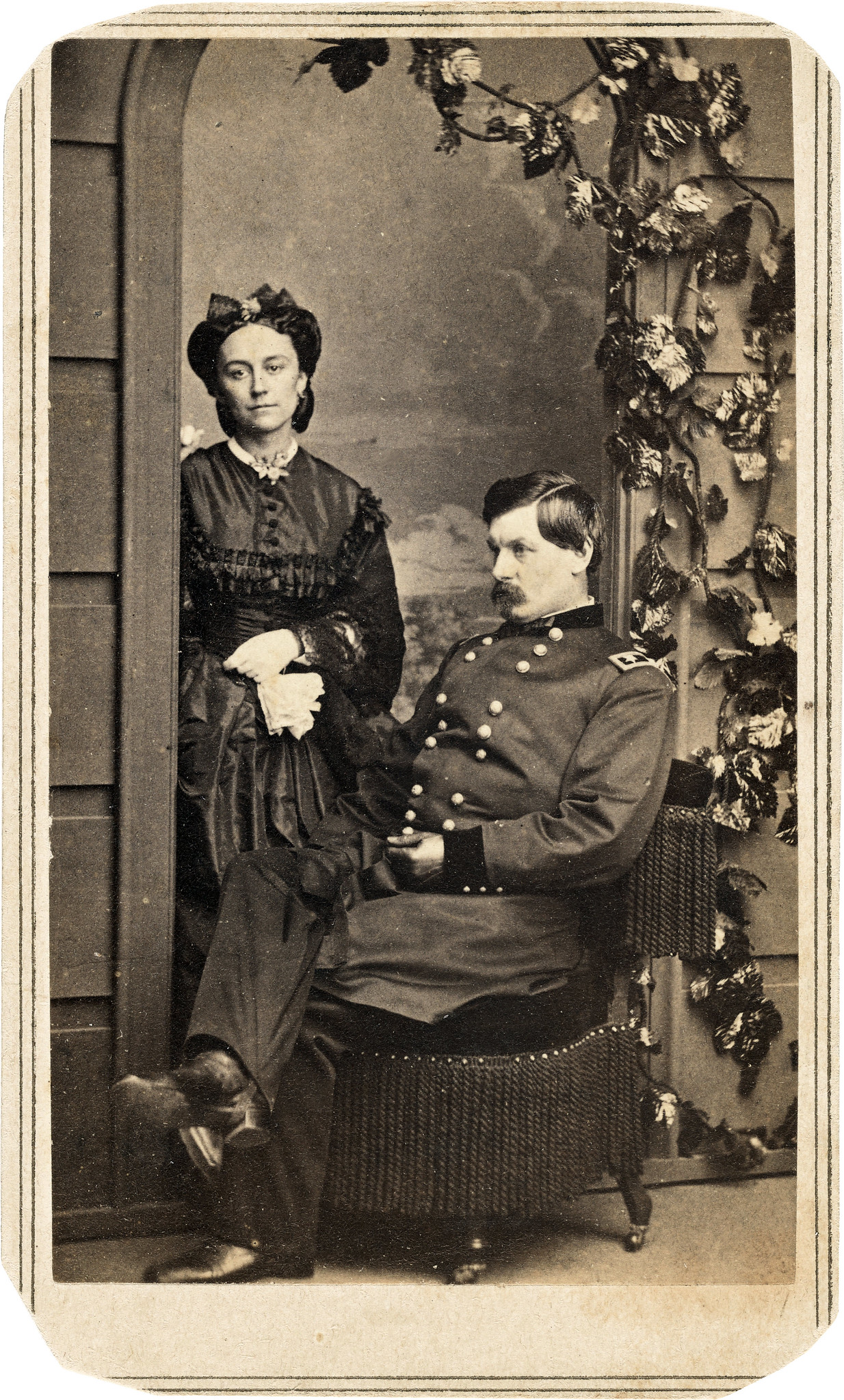
General George Brinton McClellan and his Wife

News of the Day

The J. Paul Getty Museum, Open Content Program

Title: [General George Brinton McClellan and his wife]
Artist/Maker: Charles DeForest Fredricks (American, 1823 – 1894)
Culture: American
Place: New York, United States (Place Created)
Date: 1862
Medium: Albumen silver print
Object Number: 84.XD.1157.100
Dimensions: 9 × 5.4 cm (3 9/16 × 2 1/8 in.)
Signature(s): (Verso, mount) imprinted in black ink, at center: “Charles D. Fredricks & Co.,/ “Spécialité.”/ 587 Broadway, New York.”
Department: Photographs

https://www.getty.edu/art/collection/objects/89634/charles-deforest-fredricks-general-george-brinton-mcclellan-and-his-wife-american-1862/

0 comments

Mary Chesnut: “…to-day I hear none of the Richmond news is encouraging.”

Civil War Day-by-Day

February 21st.–A crowd collected here last night and there was a serenade. I am like Mrs. Nickleby, who never saw a horse coming full speed but she thought the Cheerybles had sent post-haste to take Nicholas into co-partnership. So I got up and dressed, late as it was. I felt sure England had sought our alliance at last, and we would make a Yorktown of it before long. Who was it? Will you ever guess?–Artemus Goodwyn and General Owens, of Florida.

Just then, Mr. Chesnut rushed in, put out the light, locked the door and sat still as a mouse. Rap, rap, came at the door. “I say, Chesnut, they are calling for you.” At last we heard Janney (hotel-keeper) loudly proclaiming from the piazza that “Colonel Chesnut was not here at all, at all.” After a while, when they had all gone from the street, and the very house itself had subsided into perfect quiet, the door again was roughly shaken. “I say, Chesnut, old fellow, come out–I know you are there. Nobody here now wants to hear you make a speech. That crowd has all gone. We want a little quiet talk with you. I am just from Richmond.” That was the open sesame, and to-day I hear none of the Richmond news is encouraging. Colonel Shaw is blamed for the shameful Roanoke surrender. ¹

Toombs is out on a rampage and swears he will not accept a seat in the Confederate Senate given in the insulting way his was by the Georgia Legislature: calls it shabby treatment, and adds that Georgia is not the only place where good men have been so ill used.

The Governor and Council have fluttered the dove-cotes, or, at least, the tea-tables. They talk of making a call for all silver, etc. I doubt if we have enough to make the sacrifice worth while, but we propose to set the example.

______

¹ General Burnside captured the Confederate garrison at Roanoke Island on February 8, 1862.

0 comments

Journal of Surgeon Alfred L. Castleman: “… on the investigation of my hospital management and condition…”

Journal of Surgeon Alfred L Castleman.

21st.–No grounds yet on which to base an opinion as to when or where we shall go. One day brings us assurances that our Division will in a few days go to Annapolis to join the mortar fleet bound South. The next we hear that we are to advance and take Manassas. To-day we hear that we are shortly to go to Kentucky, and join the fighting army under Buell. There is also a rumor here that the rebels are leaving Manassas in great numbers. If that be true (the President and Gen. McClellan both believe it), we shall probably advance on that stronghold and occupy it ourselves until we are ready for the “on to Richmond ” move. But why, if we have been staying here all winter to “bag the enemy” at Manassas, do we now lie still and permit them to leave? This “gives me pause” in my opinions. I do not like such doings, nor can I quite comprehend such Generalship. But it is not for me to criticise the plans of educated military leaders. I presume they know much better than I, what is best to be done, and I shall still confide in their judgment and wisdom.

This, morning Brigade Surgeon _____, of Brigade _____, made the following statement on the investigation of my hospital management and condition: “I was Surgeon of a Regiment in the three months service; since then I have been Brigade Surgeon of four Brigades;” (including 18 regiments) ” I have seen no hospital fund anywhere as large as that of this hospital; I have seen none managed with more economy, nor any patients made so comfortable. I have seen no Surgeon anywhere who seemed to feel so lively an interest in the hospital and the welfare of his Regiment; I have seen no Surgeon who devoted so many hours in the service of the sick, as this Surgeon.”

This statement, coming officially from a Surgeon whose duty it has been to supervise the care of the hospitals and the treatment of the sick; from an officer whose business has for the last ten months brought him in contact with half the hospitals of the army of the Potomac, and whose headquarters have been for several months within sixty feet of my hospital, was gratifying to me, and entirely satisfactory to those whose duty it was made to investigate, and they so expressed themselves in dismissing the subject.

0 comments

Downing’s Civil War Diary.–Alexander G. Downing.

Diary of Alexander G. Downing; Company E, Eleventh Iowa Infantry

Thursday, 20th–No news of importance. Grant’s recent victories have made the Union sentiment stronger in this locality, which will be a big help to the few Union men left here.

0 comments

War Diary of Luman Harris Tenney.

War Diary of Luman Harris Tenney.

20th. Received letter from Fannie and finished letter to her. Wrote requisitions to balance wood drawn. Were mounted and started from Fort Leavenworth at ten A. M. Traveled about twenty miles over the rolling prairies, and encamped in a piece of woods on an Indian farm. Country finely settled. Indians upon the woodland. Saw a prairie wolf.

0 comments

Horatio Nelson Taft records the death of his sons’ friend, Willie Lincoln.

Diary of US patent clerk Horatio Nelson Taft.

Thursday Feb 20th 1862

This has been a bright pleasant day, quite a rarity for a month past. There is no particular news in the papers. I have been down onto the Ave this evening. Called upon Mr Daws M.C. who is sick at his rooms co[rne]r of 8th & Ave, bought some maps and two Flags in view of the Celebration of the 22nd. I must make arrangements tomorrow to illuminate on Saturday night. We hear tonight with much sorrow that our little friend Willie Lincoln died at 5 p.m. He had been sick for near three weeks with Typhoid fever. “Bud” has been to see him or to enquire about him almost every day. He and his Mother were there yesterday about noon. Willie was then thought to be better. He was an amiable good hearted boy, was here with our boys almost every day or our boys were there. We all got much attached to him & “Tad” his Brother. He had more judgment and foresight than any boy of his age that I have ever known, poor Willie we all lament.

______

The three diary manuscript volumes, Washington during the Civil War: The Diary of Horatio Nelson Taft, 1861-1865, are available online at The Library of Congress.

0 comments

Rebel War Clerk

Civil War Day-by-Day
A likeness of Jones when he was editor and majority owner of the Daily Madisonian during President John Tyler’s administration.

FEBRUARY 8th to 20th.—Such astounding events have occurred since the 8th instant, such an excitement has prevailed, and so incessant have been my duties, that I have not kept a regular journal. I give a running account of them.

Roanoke has fallen before superior numbers, although we had 15,000 idle troops at Norfolk within hearing of the battle. The government would not interfere, and Gen. Huger refused to allow the use of a few thousand of his troops.

But Gen. Wise is safe; Providence willed that he should escape the “man-trap.” When the enemy were about to open fire on his headquarters at Nag’s Head, knowing him to be prostrated with illness (for the island had then been surrendered after a heroic defense), Lieutenants Bagly and Wise bore the general away in a blanket to a distance of ten or fifteen miles. The Yankees would have gladly exchanged all their prisoners for Gen. Wise, who is ever a terror to the North.

Capt. O. Jennings Wise fell, while gallantly cheering his men, in the heat of the battle. A thousand of the enemy fell before a few hundred of our brave soldiers. We lost some 2,500 men, for there was no alternative but to surrender.

Capt. Wise told the Yankee officers, who persisted in forcing themselves in his presence during his dying moments, that the South could never be subjugated. They might exterminate us, but every man, woman, and child would prefer death to abject subjugation. And he died with a sweet smile on his lip, eliciting the profound respect of his most embittered enemies.

The enemy paroled our men taken on the island; and we recovered the remains of the heroic Capt. Wise. His funeral here was most impressive, and saddened the countenances of thousands who witnessed the pageant. None of the members of the government were present; but the ladies threw flowers and evergreens upon his bier. He is dead—but history will do him justice; and his example will inspire others with the spirit of true heroism.

And President Tyler is no more on earth. He died after a very brief illness. There was a grand funeral, Mr. Hunter and others delivering orations. They came to me, supposing I had written one of the several biographies of the deceased which have appeared during the last twenty years. But I had written none—and none published were worthy of the subject. I could only refer them to the bound volumes of the Madisonian in the State library for his messages and other State papers. The originals are among my papers in the hands of the enemy. His history is yet to be written—and it will be read centuries hence.

Fort Henry has fallen. Would that were all! The catalogue of disasters I feared and foretold, under the policy adopted by the War Department, may be a long and a terrible one.

The mission of the spies to East Tennessee is now apparent. Three of the enemy’s gun-boats have ascended the Tennessee River to the very head of navigation, while the women and children on its banks could do nothing more than gaze in mute despair. No batteries, no men were there. The absence of these is what the traitors, running from here to Washington, have been reporting to the enemy. Their boats would no more have ventured up that river without the previous exploration of spies, than Mr. Lincoln would dare to penetrate a cavern without torch-bearers, in which the rattle of venomous snakes could be heard. They have ascended to Florence, and may get footing in Alabama and Mississippi!

And Fort Donelson has been attacked by an immensely superior force. We have 15,000 men there to resist, perhaps, 75,000 Was ever such management known before? Who is responsible for it? If Donelson falls, what becomes of the ten or twelve thousand men at Bowling Green?
0 comments

A Diary From Dixie—Mary Boykin Miller Chesnut

Civil War Day-by-Day

COLUMBIA, S. C, February 20, 1862.–Had an appetite for my dainty breakfast. Always breakfast in bed now. But then, my Mercury contained such bad news. That is an appetizing style of matutinal newspaper. Fort Donelson ¹ has fallen, but no men fell with it. It is prisoners for them that we can not spare, or prisoners for us that we may not be able to feed: that is so much to be “forefended,” as Keitt says. They lost six thousand, we two thousand; I grudge that proportion. In vain, alas! ye gallant few–few, but undismayed. Again, they make a stand. We have Buckner, Beauregard, and Albert Sidney Johnston. With such leaders and God’s help we may be saved from the hated Yankees; who knows?

______

¹ Fort Donelson stood on the Cumberland River about 60 miles northwest of Nashville. The Confederate garrison numbered about 18,000 men. General Grant invested the Fort on February 13, 1862, and General Buckner, who commanded it, surrendered on February 16th. The Federal force at the time of the surrender numbered 27,000 men; their loss in killed and wounded being 2,660 men and the Confederate loss about 2,000.

0 comments

“Eight or nine boatloads of prisoners have passed here to-day.”–Army Life of an Illinois Soldier, Charles Wright Wills.

Civil War Day-by-Day

Headquarters 7th Illinois Cavalry,
Cape Girardeau, Mo., February 19, 1862.

Aren’t things working right now? Do you notice the accounts of the old 8th, and will you say again that I got out of her ranks at the right time? I knew that the 8th would never make her colonel (God bless him!) to blush, or dishonor her friends or herself. I have seen only the St. Louis papers of 18th with very meager dispatches, but enough to know that she had the “post of honor” and plenty of fighting. Two hundred of them with Major Post are prisoners. I’ll bet my life Company E is not among them. If the Rebels will keep the major and exchange the men the regiment will gain. If I was in the 8th yet and knew what I do now I wouldn’t leave her for any commission there is in this post. I’ve got a good easy place here and have the good will of everybody around me, but my soul and sympathies are with the 8th, and it makes me sick to think what a fool I was to leave her. I’ll be shot if I don’t love that regiment more than I do the whole world beside. I never thought of it so much untill I got away. I expect some of our boys of my old mess are killed, but its all right, “military necessity,” somebody has to go under. Eight or nine boatloads of prisoners have passed here to-day. They look a little better than our Missouri prisoners but are not uniformed, although comfortably dressed.

0 comments

Diary of Horatio Nelson Taft

Diary of US patent clerk Horatio Nelson Taft.

Wednesday 19th

Rain all day, roads and crossing are in a horrible condition. The news looks favorable for further Victories to be heard of before long. The whole country is jubilent over the past. I have not been out tonight. After dinner I cleaned out the Aquarium and put in fresh water. The Eel has been burrowed in the sand all winter, have not seen him before in three months, he is very active. Got a Tribune of the newsboy and have read all the evening.

______

The three diary manuscript volumes, Washington during the Civil War: The Diary of Horatio Nelson Taft, 1861-1865, are available online at The Library of Congress.

0 comments

Downing’s Civil War Diary.–Alexander G. Downing.

Diary of Alexander G. Downing; Company E, Eleventh Iowa Infantry

Wednesday, 19th–News came that Roanoke Island has been taken by our men. It is reported that our company will leave for California, Missouri, in three or four days and all are rejoicing that our stay here is about over.

0 comments

War Diary of Luman Harris Tenney.

War Diary of Luman Harris Tenney.

19th. Commenced letter to Fannie. Cold better.

0 comments

“Our children in the city are delighted to have us so near them..,”—Diary of a Southern Refugee, Judith White McGuire.

Diary of a Southern Refugee During the War by Judith White McGuire

Wednesday, 19th.—We are now in our own comfortable little room on Grace Street, and have quite a home-like feeling. Our children in the city are delighted to have us so near them, and the girls have come on a visit to their cousin, Mrs. C., and will be present at the inauguration on the 22d.

0 comments

Diary of David L. Day.

David L Day – My diary of rambles with the 25th Mass

Paroling the Prisoners.

Feb. 18. The prisoners are all paroled, and were sent off today. Paroling the prisoners was rather interesting to the lookers on. They were required to affix their autographs to the parole, and it was curious to observe that a large majority of them wrote it the same way, simply making the letter X. Capt. Messenger, the provost marshal, was master of ceremonies. He is a very eccentric man, and many of the prisoners scarcely knew whether to be pleased or frightened at the curious questions he asked and remarks he made to them.

0 comments

“Wild stories are told of the numbers captured. God in his mercy help us!”—Diary of a Southern Refugee, Judith White McGuire.

Diary of a Southern Refugee During the War by Judith White McGuire

Tuesday Morning.—The wires are cut somewhere between this and Tennessee. We hear nothing farther West than Lynchburg; rumours are afloat that Donelson has fallen. We are too unhappy about it to think of any thing else.

Evening.—It is all true. Our brave men have yielded to overpowering numbers. The struggle for three days was fearful. The dread particulars are not known. Wild stories are told of the numbers captured. God in his mercy help us!

0 comments

Diary of Horatio Nelson Taft

Diary of US patent clerk Horatio Nelson Taft.

Tuesday 18th

Nothing new today. Extensive preparations are being made for celebrating the 22nd. I was down to the Ave and in to McClees Gallery. Ed Dick[erson] was up and spent the evening. Doct Barnes & Lady were over from Camp and called upon us. I spent the evening at home.

______

The three diary manuscript volumes, Washington during the Civil War: The Diary of Horatio Nelson Taft, 1861-1865, are available online at The Library of Congress.

0 comments

Downing’s Civil War Diary.–Alexander G. Downing.

Diary of Alexander G. Downing; Company E, Eleventh Iowa Infantry

Tuesday, 18th–It is cloudy and quite cool. News came that Fort Henry has been taken and we fired a feu de joie. Some of the boys are afraid that the war will be over before we have a chance to have the honor of being in a battle.

0 comments

War Diary of Luman Harris Tenney.

War Diary of Luman Harris Tenney.

18th. Drew requisitions for wood and attended to delivery. Had quite a cold.

0 comments

Reports say Burnside Expedition suffered terribly for actual necessities. — Eliza Woolsey Howland to Joe Howland.

Woolsey family letters during the War for the Union

February 18th.

We have just packed and despatched Charley for Baltimore and Fortress Monroe, and are now writing notes of introduction for Mr. Vincent Colyer, who is to join him at the Fortress, and if possible take him with him to Roanoke and Port Royal. I have given him a note to Mr. Withers, and G. will write one to Dr. Bacon, and I only wish we had some jolly little things to slip into the envelopes too. Mr. Colyer is to take down a quantity of stores for the hospitals. Charley also has a large trunk full. We hear from private sources that the sick of the Burnside expedition have suffered terribly for actual necessities–water to wash with, and food to eat, and this six weeks after the expedition had started! . . .

Charley was at the War Department yesterday just after the news came of Grant’s success at Fort Donelson and Mr. McClure described McClellan as coming in “pale with excitement” to rejoice over the victory a moment with Stanton before going to work again. . . .

0 comments