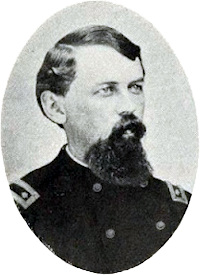
Robert M. McGill

Robert M. Magill – Personal Reminiscences of a Confederate Soldier Boy, 39th Georgia Regiment of Infantry

Thursday, Friday, 22d-25th.—Had to go on picket, away out in the mountains; thought it pretty doleful-looking place. Being on post at about 2 A. M. Something appeared; looking through brush, that looked like fire, so we whispered to each other: “Isn’t that fire?” All thought it was; then the question arose, who can it be making up a fire at this time of night, away out here in the mountains, and the answer came readily: “Yankees or Bushwhackers.” We were about getting ready to send and notify our officer of the guard, and the reserve, of our discovery, when a cloud that had rather obscured our vision, floated gracefully away, and the moon shined forth in resplendant beauty.

Reported some time during the night of the 24th that the Federals are crossing at Wheeler’s Gap, six miles below here. Started at daylight and marched down there. Nobody here to disturb our peace.

Sunday, 25th.—Heard good sermon to-day, 2 p. M.; ordered back to Big Creek Gap.


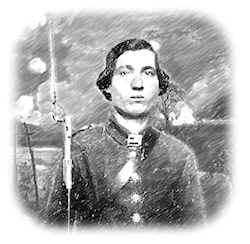
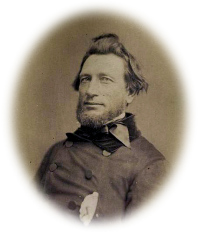
(Note: picture is of an unidentified Confederate soldier.)

0 comments

Journal of Surgeon Alfred L. Castleman.

Journal of Surgeon Alfred L Castleman.

25th.–I had a dream last night. There is nothing being done to-day, and as Dr. Franklin, when he gave as one of his rules of conduct, “Never tell your dreams,” did not add, never write them, I here record mine. “Like master, like man.” Master McClellan had his dream published for the the world; I see no good reason why I may not record mine for my humble self. It was part vision, part dream– part retrospective, part prospective: I saw Buell, and Halleck, and Grant, and Pope, and Foote, battling successfully. I saw some slight errors in their conduct. I saw Grant resting securely at Shiloh, made careless by his former successes, and I saw the terrible consequences of his self-reliant carelessness, and yet with all the draw-backs, and the terrible responsibility, the aggregate of all the efforts in the West and Southwest, had resulted in a great progress of our cause. I saw some of the gigantic projects of Fremont, at first sneered at and ridiculed; afterwards adopted, and become the most powerful agents of our success.

“A change came o’er the spirit of my dream,” and I saw the Army of the Potomac at Bull Run scattered in flight –routed, massacred–when it should have been successful. I saw the terrible slaughter at Big Bethel–so great that the Government never dared to tell it–greater than any of us had ever imagined. I saw thousands of our best men driven to the slaughter at Ball’s Bluff without the possibility of either success or escape. I saw in my vision what I had witnessed in reality, our fight at Lee’s Mill, when about two hundred of our brave men were sacrificed by being led against an enemy of the strength and position of whom our leaders were ignorant, I saw the army fall back, and die by hundreds in the swamps and ditches, waiting for the enemy to leave. I saw the pursuit from Warwick to Williamsburg, in which we rushed upon a body of the retreating army, and were repulsed with the loss of fifty men. I saw again Hancock’s little Brigade drawn up in line of battle, about sun-set of the same day, under command of Col. Cobb, in sight of Fort Magruder, and distinctly heard the voice of General _____ ask the Colonel if he would take that fort with his little Brigade “now, or wait till your men have had their suppers?” I saw the men, tired and hungry (for they had not ate a mouthful all day) throw off their knapsacks right in the field where they stood, and go forward to “take that fort before they had their suppers.” And then I saw what had not been visible to my eyes awake, 15,000 of the best troops of the Confederate army lying in and around that fort, the strongest I had ever seen, and our little, jaded, worn-out brigade of three thousand on their way to take it. And how clearly then did the dream show me the incompetency of the leaders on whom these devoted men were pouring out their whole confidence. I saw a Providence lead the brigade astray into the enemy’s abattis, entangle and detain it there till after dark, then lead it across an open field into another abattis, impassable even by daylight, and there compel it to remain till morning, complaining of the very fate which was preserving it from entire destruction. I saw the impossibility of escape for a single man, had they passed the abattis and attacked the fort. I saw Gen. Hooker next morning, groping about, ignorant of the position of the rest of our army, and of the strength and position of the enemy, until he stumbled on them, and found himself unexpectedly engaged with a force which he was unable to withstand. I saw him with his corps fight as rarely ever man fought before –his brave men and officers falling around him, unflinching and unaided, calling in vain for succor on whole divisions of the army, who were looking on as idle spectators, but looked in vain for the commander-in-chief, or some one with authority to order up these idle but anxious brigades. I saw Hancock’s Brigade engaged without plan, and without order, the General, secure behind the walls of the fort, ordering his regiments to fall back from before the advancing foe, and that same Providence inspiring one regiment to stand fast, despite that order, to fight the battle to the death, to save the army, and to win for their General a reputation which he had not courage to risk in the unequal combat. So much in retrospect. My dream reached ahead, and I saw Gen. McClellan at the head of a large army marching into Richmond. Suddenly we came upon a fort thrown up by the enemy. I got upon an elevation, and saw a few thousand troops there. A balloon was in the air; my dream transported me to this balloon; I looked into Richmond; there was a small army there preparing to evacuate; the citizens were hurrying to and fro, packing up and leaving the city; some were already crossing the river. The few troops who were there, marched out, presenting a bold front, as if to delay our advance till the citizens could have time to escape. The aeronaut dropped a note to the commander to hurry forward, and he would not only take the city but capture an immense spoil. My eye followed the fall of the note, and what was my surprise to see breastworks had sprung up for miles in length, in front of our army; men, dead and dying, were lying in the ditches, and thousands of spades and shovels were burying them there without winding sheets or coffins, whilst the Commander-in-Chief, with folded arms, stood looking on. A shout arose, “Hurrah for McClellan!” and a response, so deep and sudden that it shook the very ground! “What has he accomplished.” I awoke, startled more by the idea conveyed in question, than by its noise. I immediately arose, and having thought for a few minutes over the retrospection of my vision, caught up my diary and wrote it down with this addendum: “Now here we are in the sight of Richmond, preparing for the great battle which is perhaps to decide the fate of free institutions for ages, without any more idea of what we have to contend against than we had at Lee’s Mill or Fort Magruder. Have we no way to discover the enemy’s strength and position as he does ours? If after all I have witnessed I have misgivings as to the result, it should not be wondered at, nor should I be blamed for my want of confidence. Whilst I hope for the best, I keep prepared for the worst; only whatever is in reserve for us, let it come and relieve this suspense.”

0 comments

“Confederate scrip goes among the people here freely. If a man refuses to take it they lynch him.”–Army Life of an Illinois Soldier, Charles Wright Wills.

Civil War Day-by-Day

Near Corinth, Miss., May 24, 1862.

I returned last night from a two day’s scout. Our orders were to scour the country along the Tennessee river to near Eastport and return through Iuka, Burnsville and Glendale. A Michigan colonel commanded the party and skipped Iuka three miles. There were little bands of Rebels in sight nearly all the time we were in that vicinity, so that I could not gallop off to the place alone, and of course the colonel wouldn’t let me have men to go with me.

We rode all day yesterday through a steady rain and over roads that were for miles obstructed by felled trees and bridges burned. We came back through Pope’s division yesterday. Think he is as about as well fortified as Beauregard can be. ‘Tis astonishing how much ditching he has done within a week. Has also cut down enough trees (to make his left unapproachable) to last all of Illinois ten years for firewood. There’s no site for a Bull Run here. Confederate scrip goes among the people here freely. If a man refuses to take it they lynch him. Not the citizens but soldiers do the dirty work. The people here all say that the seceded States will have to go back where they started from.

0 comments

Rebel War Clerk

Civil War Day-by-Day
A likeness of Jones when he was editor and majority owner of the Daily Madisonian during President John Tyler’s administration.

MAY 24th.—Every day the two armies are shelling each other, more or less; and every gun can be heard from the Hospital Hill, north of the city, whither many repair to listen.

0 comments

Downing’s Civil War Diary.–Alexander G. Downing.

Diary of Alexander G. Downing; Company E, Eleventh Iowa Infantry

Saturday, 24th–The Eleventh Iowa went out on picket at 5 o’clock this evening. It was reported in camp that General Beauregard is moving all of his heavy ordnance and his entire army to the south with a view of evacuating Corinth. The report says that teams loaded with munitions of war are leaving Corinth every day.

0 comments

0

Civil War Day-by-Day

May 24th. We left Grand Gulf on the 23d, at which time the Flag Officer joined us, and arrived four miles below Vicksburg at four o’clock, P. M., where we found several gunboats awaiting our arrival. We swelled the number here to eleven vessels of war. The city is situated on a bluff perhaps sixty feet high, and they have a battery on the hill, and another one below, but we do not know the number of guns mounted; they also have a ram to protect them, besides large numbers of troops behind the city. The Kennebec, with the several captains of the fleet, went up to reconnoitre, and on returning was saluted by the ram with a shot which fell far short.

0 comments

War Diary of Luman Harris Tenney.

War Diary of Luman Harris Tenney.

24th. Saturday. Reveille at 4 A. M. Breakfasted, loaded wagon and horsed at six A. M. Grazed about five miles. Splendid prairie view. But one little bunch of woods in sight. Reached Iola about three o’clock. Good visit with the boys.

0 comments

A Diary From Dixie

Civil War Day-by-Day

May 24th.–The enemy are landing at Georgetown. With a little more audacity where could they not land? But we have given them such a scare, they are cautious. If it be true, I hope some cool-headed white men will make the negroes save the rice for us. It is so much needed. They say it might have been done at Port Royal with a little more energy. South Carolinians have pluck enough, but they only work by fits and starts; there is no continuous effort; they can’t be counted on for steady work. They will stop to play–or enjoy life in some shape.

Without let or hindrance Halleck is being reenforced. Beauregard, unmolested, was making some fine speeches– and issuing proclamations, while we were fatuously looking for him to make a tiger’s spring on Huntsville. Why not? Hope springs eternal in the Southern breast.

My Hebrew friend, Mem Cohen, has a son in the war. He is in John Chesnut’s company. Cohen is a high name among the Jews: it means Aaron. She has long fits of silence, and is absent-minded. If she is suddenly roused, she is apt to say, with overflowing eyes and clasped hands, “If it please God to spare his life.” Her daughter is the sweetest little thing. The son is the mother’s idol. Mrs. Cohen was Miriam de Leon. I have known her intimately all my life.

Mrs. Bartow, the widow of Colonel Bartow, who was killed at Manassas, was Miss Berrien, daughter of Judge Berrien, of Georgia. She is now in one of the departments here, cutting bonds–Confederate bonds–for five hundred Confederate dollars a year, a penniless woman. Judge Carroll, her brother-in-law, has been urgent with her to come and live in his home. He has a large family and she will not be an added burden to him. In spite of all he can say, she will not forego her resolution. She will be independent. She is a resolute little woman, with the softest, silkiest voice and ways, and clever to the last point.

Columbia is the place for good living, pleasant people, pleasant dinners, pleasant drives. I feel that I have put the dinners in the wrong place. They are the climax of the good things here. This is the most hospitable place in the world, and the dinners are worthy of it.

In Washington, there was an endless succession of state dinners. I was kindly used. I do not remember ever being condemned to two dull neighbors: on one side or the other was a clever man; so I liked Washington dinners.

In Montgomery, there were a few dinners–Mrs. Pollard’s, for instance, but the society was not smoothed down or in shape. Such as it was it was given over to balls and suppers. In Charleston, Mr. Chesnut went to gentlemen’s dinners all the time; no ladies present. Flowers were sent to me, and I was taken to drive and asked to tea. There could not have been nicer suppers, more perfect of their kind than were to be found at the winding up of those festivities.

In Richmond, there were balls, which I did not attend– very few to which I was asked: the MacFarlands’ and Lyons’s, all I can remember. James Chesnut dined out nearly every day. But then the breakfasts–the Virginia breakfasts–where were always pleasant people. Indeed, I have had a good time everywhere–always clever people, and people I liked, and everybody so good to me.

Here in Columbia, family dinners are the specialty. You call, or they pick you up and drive home with you. “Oh, stay to dinner!” and you stay gladly. They send for your husband, and he comes willingly. Then comes a perfect dinner. You do not see how it could be improved; and yet they have not had time to alter things or add because of the unexpected guests. They have everything of the best–silver, glass, china, table linen, and damask, etc. And then the planters live “within themselves,” as they call it. From the plantations come mutton, beef, poultry, cream, butter, eggs, fruits, and vegetables.

It is easy to live here, with a cook who has been sent for training to the best eating-house in Charleston. Old Mrs. Chesnut’s Romeo was apprenticed at Jones’s. I do not know where Mrs. Preston’s got his degree, but he deserves a medal.

At the Prestons’, James Chesnut induced Buck to declaim something about Joan of Arc, which she does in a manner to touch all hearts. While she was speaking, my husband turned to a young gentleman who was listening to the chatter of several girls, and said: “Ecoutez! ” The youth stared at him a moment in bewilderment; then, gravely rose and began turning down the gas. Isabella said: ” Ecoutez, then, means put out the lights.”

I recall a scene which took place during a ball given by Mrs. Preston while her husband was in Louisiana. Mrs. Preston was resplendent in diamonds, point lace, and velvet. There is a gentle dignity about her which is very attractive; her voice is low and sweet, and her will is iron. She is exceedingly well informed, but very quiet, retiring, and reserved. Indeed, her apparent gentleness almost amounts to timidity. She has chiseled regularity of features, a majestic figure, perfectly molded.

Governor Manning said to me: “Look at Sister Caroline. Does she look as if she had the pluck of a heroine?” Then he related how a little while ago William, the butler, came to tell her that John, the footman, was drunk in the cellar–mad with drink; that he had a carving-knife which he was brandishing in drunken fury, and he was keeping everybody from their business, threatening to kill any one who dared to go into the basement. They were like a flock of frightened sheep down there. She did not speak to one of us, but followed William down to the basement, holding up her skirts. She found the servants scurrying everywhere, screaming and shouting that John was crazy and going to kill them. John was bellowing like a bull of Bashan, knife in hand, chasing them at his pleasure.

Mrs. Preston walked up to him. “Give me that knife,” she demanded. He handed it to her. She laid it on the table. “Now come with me,” she said, putting her hand on his collar. She led him away to the empty smoke-house, and there she locked him in and put the key in her pocket. Then she returned to her guests, without a ripple on her placid face. “She told me of it, smiling and serene as you see her now,” the Governor concluded.

Before the war shut him in, General Preston sent to the lakes for his salmon, to Mississippi for his venison, to the mountains for his mutton and grouse. It is good enough, the best dish at all these houses, what the Spanish call “the hearty welcome.” Thackeray says at every American table he was first served with “grilled hostess.” At the head of the table sat a person, fiery-faced, anxious, nervous, inwardly murmuring, like Falstaff, “Would it were night, Hal, and all were well.”

At Mulberry the house is always filled to overflowing, and one day is curiously like another. People are coming and going, carriages driving up or driving off. It has the air of a watering-place, where one does not pay, and where there are no strangers. At Christmas the china closet gives up its treasures. The glass, china, silver, fine linen reserved for grand occasions come forth. As for the dinner itself, it is only a matter of greater quantity–more turkey, more mutton, more partridges, more fish, etc., and more solemn stiffness. Usually a half-dozen persons unexpectedly dropping in make no difference. The family let the housekeeper know; that is all.

People are beginning to come here from Richmond. One swallow does not make a summer, but it shows how the wind blows, these straws do–Mrs. “Constitution ” Browne and Mrs. Wise. The Gibsons are at Doctor Gibbes’s. It does look squally. We are drifting on the breakers.
0 comments

Journal of Surgeon Alfred L. Castleman.

Journal of Surgeon Alfred L Castleman.

24th.–Another day of inaction near Gaine’s Mill, on the Chickahominy. An instance of petty despotism occurred to-day. I was sick, confined to my bed. We were approaching Richmond, with prospect of a fight. The Division Surgeon procured an order from General Smith, detailing me to organize and take charge of a hospital at Liberty Hall. I reported sick. The order was repeated; the report was repeated. The order came the third time, with the same result. General ______ took the matter in hand, and ordered me from my quarters, as a non-effective, to this hospital, or house, unorganized, without any provivisions for the sick, now packed full of soldiers, suffering with infectious diseases of the worst kind. From this order I had to appeal to the Division Commander, who at once had it rescinded, and the “amiable General H______” was cheated of his victim.

0 comments

0

Diary and Letters of Rutherford Birchard Hayes

Flat Top Mountain, May 23, 1862. Friday. – Warm and dry; getting dusty!! Mr. French lies here wounded – his thigh bone shattered by a ball that passed clear through his leg. Dr. McCurdy thinks he will not survive more than three or four weeks. . . . Our regiment elected him chaplain a week or two ago to date from the day of battle, May 1, 1862. I hope the Governor will commission [him] promptly. . . .

The Commercial is reported as saying that people may “act as if they had heard some very good news” from General Halleck’s army.

It is dusty!! A cold wind blowing. The plan of going to Packs Ferry and crossing New River, uniting with Colonel Crook, and thence through Union to Christiansburg, is not yet fixed upon.

0 comments

Rebel War Clerk

Civil War Day-by-Day
A likeness of Jones when he was editor and majority owner of the Daily Madisonian during President John Tyler’s administration.

MAY 23d.—Oh, the extortioners! Meats of all kinds are selling at 50 cts. per pound ; butter, 75 cts.; coffee, $1.50; tea, $10; boots, $30 per pair; shoes, $18; ladies’ shoes, $15; shirts, $6 each. Houses that rented for $500 last year, are $1000 now. Boarding, from $30 to $40 per month. Gen. Winder has issued an order fixing the maximum prices of certain articles of marketing, which has only the effect of keeping a great many things out of market. The farmers have to pay the merchants and Jews their extortionate prices, and complain very justly of the partiality of the general. It does more harm than good.

0 comments

Downing’s Civil War Diary.–Alexander G. Downing.

Diary of Alexander G. Downing; Company E, Eleventh Iowa Infantry

Friday, 23d–We formed a line of battle at 4 o’clock this morning, but the rebels did not make their expected attack. The army generally now forms a line of battle every morning at 4 and remains in line until about 6 o’clock. It rained some today, and on account of the wet weather it was only at times that there was activity along the lines.

0 comments

War Diary of Luman Harris Tenney.

War Diary of Luman Harris Tenney.

23rd. Started at 8 A. M. for Iola. Marched fifteen miles. Saw George. Shaved by Charlie Fairbanks. Encamped out in the open air by Turkey Creek. A. B. and I cooked our suppers. Happy time. A grand ridge of mounds surrounds us.

0 comments

Lethal relics sent home.

Woolsey family letters during the War for the Union

One of the favorite relics to send home from the front used to be shot and shell picked up on battle fields. Carry seemed to feel less grateful than we expected for those forwarded to 8 Brevoort Place, from the immediate front of the Sanitary Commission.

Caroline Woolsey to Charles Woolsey

Friday Morning

Dear Charley: We live in mortal fear of the projectiles going off, the grape shot exploding, and the cannon balls doing something else equally unpleasant. There is no reason why we should not set up an armory, we have such a variety of arms. But really the grape has never been used and I see nothing to prevent its suddenly igniting; at all events, I don’t mean to hammer on the nail at the top, which I ?rmly believe to be a fuse. The day it came Mr. W. was calling and, though I was deeply interested of course in what he was saying, I could not help hearing the conversation that went on in the entry between mother and the city expressman, whom mother took to be a soldier from the Daniel Webster and treated accordingly, gave him half a dollar (12½ cents being the price) and, not exactly invited him in to dinner, but offered him some there!… We have a quantity of things to send to the girls on the return hospital transport. Uncle Edward sent here yesterday 100 shirts, some to go to Eliza, and 1,000 pocket handkerchiefs… Mother and I went to the Park Barracks yesterday in Jane’s place. There is a system of passes now, and no lady can get in without one, except myself, who go and come freely and no questions asked,—I don’t know why, unless there is a natural dignity and committee expression in my face that no one is discerning enough, except the admitting policeman, to see… Write when you can and tell us all you do. We still direct Cheeseman’s Creek.

0 comments

Because the friendship of the rebel section (granted independence), was better for trade.

Woolsey family letters during the War for the Union
Jane Stuart Woolsey to a friend in Europe
May 23, 1862.
We all talk politics now. I asked a wide-awake cousin to-day, ” What do you think about England now?” “England? England?” was the answer, “I had entirely forgotten that there was such a country!” . . . Our English friends sent us Mr. Gladstone’s speech. Mr. Gladstone is a fair representative Englishman, and a man whom everyone must respect, but hear him! the same mysterious incapacity to understand us. Hear his excuse for England’s lack of sympathy. He says an expression of sympathy with us would have alienated six or ten millions who might have become an independent nation! But why alienate, for their sakes, eighteen or nineteen millions, already an independent people? Because the friendship of the rebel section (granted independence), was better for trade. How the shop shines through! Then he uses the false analogy of the rebels of ’76, etc., etc., and that is the best they can do. But at the same time I honor the fortitude, and pity the sorrows of Lancashire, and don’t despair of even “sympathy” when Bright and Stuart Mill live and lift up their voices; though it seems sometimes as if Great Britain had wantonly thrown away the friendship of this country, between the South, which hates her because she has not yet broken the blockade, and the North, which distrusts her intentions. Probably there is no other question on which both sections are so completely agreed… I think I must have done my little duty by the affairs of the nation, and descend from these topics to the comparatively ridiculous items of personal narrative. We are connected with one or two organizations for receiving the disabled volunteers on their way home, . . . helpless, wasted, gaunt, fever-smitten, worn-out men. It is the old story; camp sickness immensely in excess of wounds. [continue reading…]
0 comments

Our front entry is literally fillled up now with immense bundles and packages of shirts, drawers, stockings, shoes, everything.

Woolsey family letters during the War for the Union

From Mother

8 Brevoort Place, Friday Morning.

My dear Girls and Charley.—All your notes and letters are of thrilling interest to us now, and though we think it very kind of you to take a minute even for us, in the midst of all that is going on around you, we are craving enough to cry for more, more. I was a little disappointed not to see you, Charley, by the Daniel Webster, but I am not surprised at your staying behind. . . I meant to have given more time to my pen for you, but spent all day yesterday at the Park Barracks, nailing blue cambric over wooden clothes-horses for screens around the men’s beds, a very tiresome job, and I came home used up, and went to bed at once. This morning I feel all right again. My quiet three months in Washington and a drive out, instead of a dragging walk every day, has spoiled me for the distracting noise and cares of New York, or else I have grown old and feeble! I want very much to slip into Jane’s place at the hospitals if she will let me, for she is breaking herself down. It is not half so pleasant here in these places as it was in Washington or Alexandria, as you could go in there amongst the soldiers and talk with them, and give them, yourselves, the clean handkerchiefs, all cologned! and the books and papers, etc., but here you are not allowed to do this; can only be admitted to the committee room by ticket. . . . This system is carried to a hateful excess. . . . The greatest quantity of goods and food and drink and every thing you can imagine is constantly being sent in—people send them here (to No.8), too. Our front entry is literally ?lled up now with immense bundles and packages of shirts, drawers, stockings, shoes, everything. One item is one dozen boxes of cologne from your Uncle E. . . . Abby has bought out several industrial societies in shirts and drawers. Charley, I saw one poor soldier walking off yesterday with what I instantly recognized as one of your old shirts I had given to Mrs. Buck. She said he was so proud of his plaited bosom! They prefer old ?ne ones to new cotton without bosoms or stiff wristbands. And they all ask for neckties to wear home, so I am going out this morning to buy a great lot of them. . . . Carry is writing to you, dear Charley, and Abby is scratching away to some of you. Pico and Mac are yelping and ravenous for breakfast. . . . DO come up for a run one of these days, but not to take turns in night-watches on board with the sick, in a crowded cabin. I want you to have a little rest and some fresh air. . . . Did Charley ?nd the gimlets and corkscrew? I stuffed such little things in where I could ?nd room, for his stateroom. I should judge he had not much room to hang a coat from the looks of his den on the transport when I saw it. With ever so much love to you all, and the earnest wish that you would send for me,—I want to go down exceedingly—

Your Loving Mother.

0 comments

12 Boston rockers, 6 boxes of brandy (if it gets there), 1 package of mosquito bar (getting very scarce), a bundle and a basket, and chewing tobacco

Woolsey family letters during the War for the Union

Abby Howland Woolsey to her sister, Eliza Howland.

Dear E. : The returning Spaulding takes to you 12 Boston rockers, 6 boxes of brandy (if it gets there), 1 package of mosquito bar (getting very scarce), a bundle and a basket, and chewing tobacco, for Charley to distribute! . . . Tell him the 22d marched in splendid order; their own uniforms and long yellow leather leggings. The cheers and fireworks and interest all along the line were as great as the 7th ever elicited. Carry and Charles Johnson sat on a stoop on Broadway, till ten o’clock night before last, to see them pass. We hear that they are ordered to Harpers Ferry.

0 comments

“…some tidy, sensible, once-upon-a-time-fashionable ladies, nursing men every day in the fever wards…”

Woolsey family letters during the War for the Union

Abby Howland Woolsey to her sisters Georgeanna Woolsey and Eliza Howland.

May.

My Dear Children : . . . Doesn’t Charley want something? Mother is racking her brain to think what it can be, as he no doubt does want something, going off in the hurry he did. She is afraid, too, that he is exposed to illness—running risks from the climate, from contact with soldiers’ clothing, from the atmosphere of the hospital ship, etc., etc.

Yesterday, Jane, Carry, Mrs. Buck, and Col. Bliss and a few others, started from Park Barracks for Bedloe’s Island on a committee of investigation. They chartered a little steam tug at ten dollars an hour, and went from the Battery, not staying very long, and quite enjoying the trip. They found the hospitals extremely comfortable. Some sick in the brick barracks, and some in three large hospital tents—close on the shore, with the sea breeze driving through them, and the waves rippling up close by. The men they saw were as pleased with their accommodations as could be, and everything looked ten times better ventilated and more hopeful than at the City Hospital, for instance. They have about a hundred men on Bedloe’s Island—mostly from the Ocean Queen—and not many now are alarmingly ill. The ladies took down four large baskets of oranges, jelly, towels, etc.—some of the abundant supplies that have been pouring in at the Park Barracks—and we are to get together next week some books for a library. Jane says she has seen what does her heart good at the City Hospital—some tidy, sensible, once-upon-a-time-fashionable ladies, nursing men every day in the fever wards—Mrs. Charles Strong, Miss Irving, and four or five others; they went down and offered their services, which were accepted—such was the great number of sick, and the necessity of an immediate increase of nurses; and they go down every morning at seven and go away at seven, taking their meals down there. Hired nurses, men, watch at night. Here was an excellent chance to put some of the port wine uncle E. sent us, into use. Jane came right up for a jug and put it in Mrs. Strong’s charge, and it has been of inestimable use already to some of the patients. These ladies must have served a week or ten days now, and will continue daily. They do everything for the men, under the direction of the doctors, administering food and medicine. It is really most praiseworthy and delightful, and, as in the case of your young doctors whom you like so much, gives you a better idea of human nature—their human nature, at all events. I cannot say so much for the young doctors of the New York Hospital as you do for yours. They made a strike the other day for increase of salary, writing the Trustees quite an impudent letter, reminding them what advantages the State now offered to volunteer surgeons at Yorktown, etc., and requesting an immediate answer. They did have a very immediate one. The gentlemen assembled next morning and sent the young doctors word that they could have just so many hours to pack up and quit,—an answer that astonished and mortified them. You see it was very mean, for it was just when the largest number of sick that the house could contain were being brought in. The Trustees intended to increase the corps of surgeons, but that these residents would not listen to, “they were fully competent to do all.” Jane went down this morning with Mrs. Professor Hitchcock, Mrs. Smith, and Mrs. Buck, to take their turn at 194, but found that the last week’s committee and their friends to the number of twenty, were so firmly established still, that they refused all hints about “relinquishing the keys,” being “tired of the service,” etc., etc. ; “Oh, no ; we are as fresh and interested as possible:” and indeed they were, though they were at the rooms until one last night, when Colonel Howe chartered an omnibus and sent them home. They had received all those who came yesterday afternoon by cars from Baltimore, and had worked faithfully, and hated to give up to the new set.

0 comments

0

Diary and Letters of Rutherford Birchard Hayes

Camp Flat Top Mountain, May 22, 1862.

Dearest : – I have written you one or two letters which I suspect fell into the hands of the enemy, but ere this, I do not doubt, you have received dispatches and word by Thomas which relieves you of all trouble on my account.

We have had a good deal of war this month. More than half the time during two weeks we were in the presence of the enemy. Most of the time they [we] were either pursuing them or they were crowding us. The number killed and wounded, considering the amount of firing, was not large. I suppose the total loss of this army would not exceed two hundred. Our force is not strong enough to do the work before us. We have so many points to garrison and so long a line of communications to protect, that it leaves a very small force to push on with. . . .

Before this reaches you, the great battles of the war will probably be fought. If successful, we shall not meet with much determined opposition hereafter. I was sent to meet a flag of truce sent by General Williams and Humphrey Marshall this morning. The officers talk in a high tone still, but the privates are discouraged, and would be gladly at home on any terms.

Affectionately,

R.

Mrs. Hayes.

0 comments

0

Diary and Letters of Rutherford Birchard Hayes

Camp Flat Top, May 22, 1862. Thursday. – Today Colonel Scammon with a small escort went over to Packs Ferry to look after affairs with Major Comly and his boat-builders. A Captain Jenkins, of Kentucky, came from General Williams to negotiate as to exchange of prisoners. General Cox detailed Lieutenant-Colonel Hines and myself to meet him. After some reflection, I suggested that it was honoring Captain Jenkins too much to send two lieutenant-colonels, and the programme was changed.

I have caught a bad cold, the worst I have had since I came into the army, caused chiefly by changing underclothes and stockings from thick to thin.

Called on Colonel Moor of the Twenty-eighth. The German officers are neater and more soldierly in dress and accoutrements than ours. The Twenty-eighth has a fine band, twenty or twenty-four musicians. Wrote to Lucy a short letter – no flow in it; but how I love my wife and boys! All the more tenderly for these separations.

0 comments

Rebel War Clerk

Civil War Day-by-Day
A likeness of Jones when he was editor and majority owner of the Daily Madisonian during President John Tyler’s administration.

MAY 22d.—There is lightning in the Northwest, and the deep thunder of avenging guns is heard at Washington! Gen. Jackson, sent thither by Gen. Lee, is sweeping everything before him, defeating Shields, Banks, Fremont, and one or two other Yankee major-generals, with his little corps d’armée! And his coadjutor, Ewell, is worthy of his companionship. He has swept them out of the valley, scattering their hosts like quails before the fowler. They fly in every direction; and the powers at Washington are trembling for the safety of their own capital. Glorious Jackson! and he gives, as is justly due, the glory to God.

0 comments

Downing’s Civil War Diary.–Alexander G. Downing.

Diary of Alexander G. Downing; Company E, Eleventh Iowa Infantry

Thursday, 22d–Things were a little more quiet this forenoon, but there was some very heavy cannonading off on the left flank this afternoon. Skirmishing is still going on between the pickets. There are not many men being killed on either side, since they are well protected by their respective fortifications; it is when they have to advance on skirmish in the open that they suffer losses.

0 comments

War Diary of Luman Harris Tenney.

War Diary of Luman Harris Tenney.

22nd. Drew rations. Archie grazed both horses. We washed our clothes.

0 comments

There are 1,200 or more sick men there, and until the Commission took hold they were in a most wretched plight…

Woolsey family letters during the War for the Union

Eliza Woolsey Howland to her husband, Joe.

Floating Hospital, Spaulding,
Off White House, May 22.

We are to go on shore presently to see what we can do for the large field hospital there. Two of our doctors, Ware and Draper of New York, spent the day yesterday trying to organize it and make the men tolerably comfortable. They furnished from the Commission nearly a thousand mattresses, secured them fresh water in hogsheads (which they were entirely without) and saw that all who needed medicine got it. System and food seem to be the great wants, and to-day we ladies will attend to the latter, take them supplies and show the hospital cooks how to prepare them. There are 1,200 or more sick men there, and until the Commission took hold they were in a most wretched plight, lying on the damp ground without beds, without food or water, and with little or no care. … I hope you take all necessary precautions in this wretched climate. Don’t give up your quinine. . . .

Later. – Directly after I wrote you this morning Georgy and I went to the shore to breakfast the men we had dinnered and teaed yesterday, and there we had a little house nearby, which Dr. Ware had found, nicely cleaned out for a hospital or resting-place for the sick when the other overflows. The floor of one of the rooms up stairs is six inches deep in beans. That makes a good bed for them. . . . Meantime Mrs. Griffin and the others got this boat in order for sick, and this afternoon fifty odd have been brought on board. To-morrow it will fill up and leave for New York.

0 comments

Journal of Surgeon Alfred L. Castleman.

Journal of Surgeon Alfred L Castleman.

22nd.–A quiet day in military matters. No movement of the army. Ballooning all day; discovered large force in front of us. Unless the fear of McDowell or Banks, in the rear, should induce an evacuation, we must expect hard fighting here. Heavy thunder storm this P. M.

0 comments