July 8th.–I hired a horse at a livery stable, and rode out to Arlington Heights, at the other side of the Potomac, where the Federal army is encamped, if not on the sacred soil of Virginia, certainly on the soil of the district of Columbia, ceded by that State to Congress for the purposes of the Federal Government. The Long Bridge which spans the river, here more than a mile broad, is an ancient wooden and brick structure, partly of causeway, and partly of platform, laid on piles and uprights, with drawbridges for vessels to pass. The Potomac, which in peaceful times is covered with small craft, now glides in a gentle current over the shallows unbroken by a solitary sail. The “rebels” have established batteries below Mount Vernon, which partially command the river, and place the city in a state of blockade.
As a consequence of the magnificent conceptions which were entertained by the founders regarding the future dimensions of their future city, Washington is all suburb and no city. The only difference between the denser streets and the remoter village-like environs, is that the houses are better and more frequent, and the roads not quite so bad in the former. The road to the Long Bridge passes by a four-sided shaft of blocks of white marble, contributed, with appropriate mottoes, by the various States, as a fitting monument to Washington. It is not yet completed, and the materials lie in the field around, just as the Capitol and the Treasury are surrounded by the materials for their future and final development. Further on is the red, and rather fantastic, pile of the Smithsonian Institute, and then the road makes a dip to the bridge, past some squalid little cottages, and the eye reposes on the shore of Virginia, rising in successive folds, and richly wooded, up to a moderate height from the water. Through the green forest leaves gleams the white canvas of the tents, and on the highest ridge westward rises an imposing structure, with a portico and colonnade in front, facing the river, which is called Arlington House, and belongs, by descent, through Mr. Custis, from the wife of George Washington, to General Lee, Commander-in-Chief of the Confederate army. It is now occupied by General M’Dowell as his head-quarters, and a large United States’ flag floats from the roof, which shames even the ample proportions of the many stars and stripes rising up from the camps in the trees.
At the bridge there was a post of volunteer soldiers. The sentry on duty was sitting on a stump, with his firelock across his knees, reading a newspaper. He held out his hand for my pass, which was in the form of a letter, written by General Scott, and ordering all officers and soldiers of the army of the Potomac to permit me to pass freely without let or hindrance, and recommending me to the attention of Brigadier-General M’Dowell and all officers under his orders. “That’ll do, you may go,” said the sentry. “What pass is that, Abe?” inquired a non-commissioned officer. “It’s from General Scott, and says he’s to go wherever he likes.” “I hope you’ll go right away to Richmond, then, and get Jeff Davis’s scalp for us,” said the patriotic sergeant.
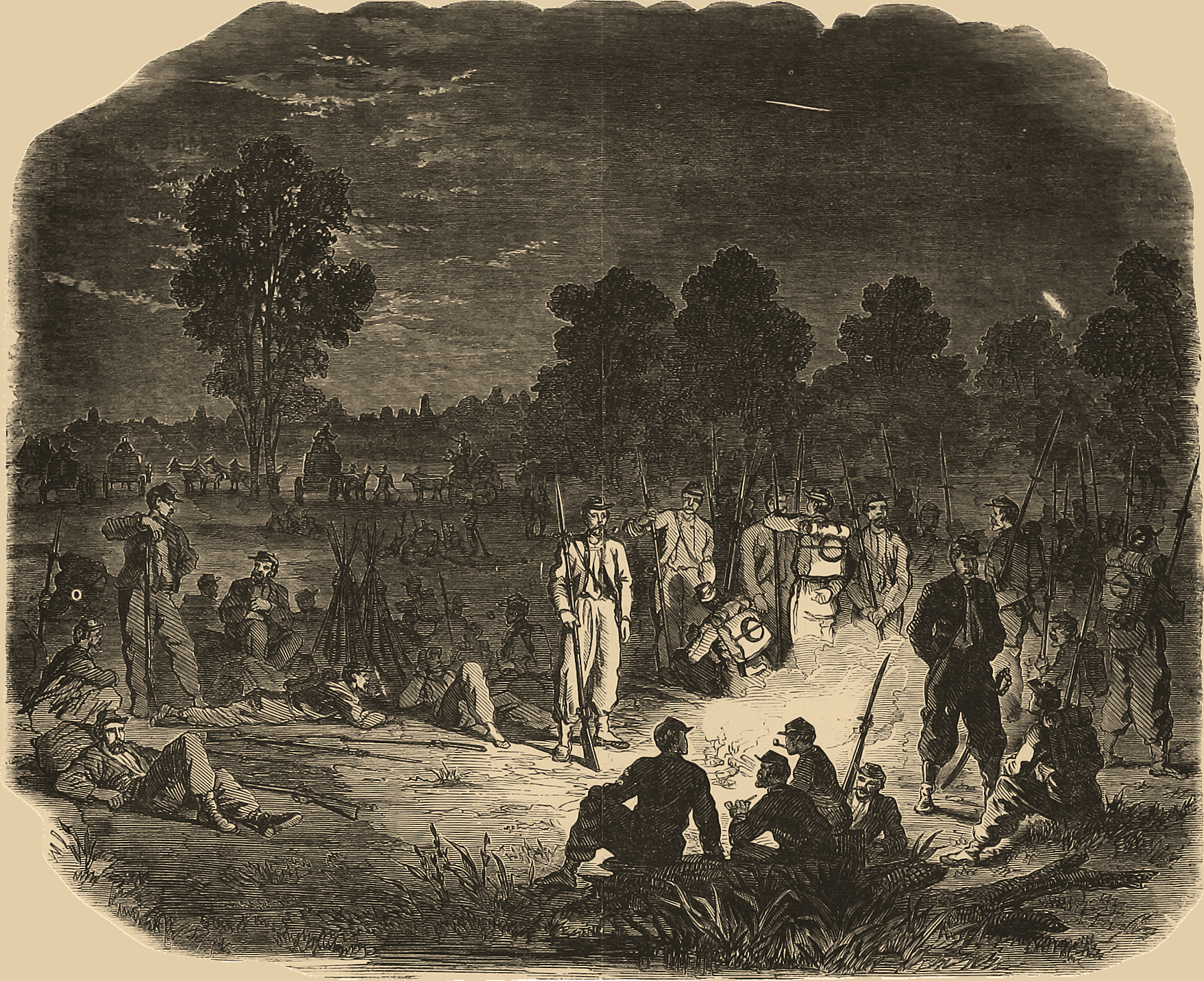
At the other end of the bridge a weak tête de pont, commanded by a road-work further on, covered the approach, and turning to the right I passed through a maze of camps, in front of which the various regiments, much better than I expected to find them, broken up into small detachments, were learning elementary drill. A considerable number of the men were Germans, and the officers were for the most part in a state of profound ignorance of company drill, as might be seen by their confusion and inability to take their places when the companies faced about, or moved from one flank to the other. They were by no means equal in size or age, and, with some splendid exceptions, were inferior to the Southern soldiers. The camps were dirty, no latrines–the tents of various patterns–but on the whole they were well castrametated.
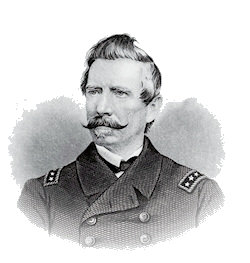
The road to Arlington House passed through some of the finest woods I have yet seen in America, but the axe was already busy amongst them, and the trunks of giant oaks were prostrate on the ground. The tents of the General and his small staff were pitched on the little plateau in which stood the house, and from it a very striking and picturesque view of the city, with the White House, the Treasury, the Post Office, Patent Office, and Capitol, was visible, and a wide spread of country, studded with tents also as far as the eye could reach, towards Maryland. There were only four small tents for the whole of the head-quarters of the grand army of the Potomac, and in front of one we found General M’Dowell, seated in a chair, examining some plans and maps. His personal staff, as far as I could judge, consisted of Mr. Clarence Brown, who came over with me, and three other officers, but there were a few connected with the departments at work in the rooms of Arlington House. I made some remark on the subject to the General, who replied that there was great jealousy on the part of the civilians respecting the least appearance of display, and that as he was only a brigadier, though he was in command of such a large army, he was obliged to be content with a brigadier’s staff. Two untidy-looking orderlies, with ill-groomed horses, near the house, were poor substitutes for the force of troopers one would see in attendance on a general in Europe but the use of the telegraph obviates the necessity of employing couriers. I went over some of the camps with the General. The artillery is the most efficient-looking arm of the service, but the horses are too light, and the number of the different calibres quite destructive to continuous efficiency in action. Altogether I was not favourably impressed with what I saw, for I had been led by reiterated statements to believe to some extent the extravagant stories of the papers, and expected to find upwards of 100,000 men in the highest state of efficiency, whereas there were not more than a third of the number, and those in a very incomplete, ill-disciplined state. Some of these regiments were called out under the President’s proclamation for three months only, and will soon have served their full time, and as it is very likely they will go home, now the bubbles of national enthusiasm have all escaped, General Scott is urged not to lose their services, but to get into Richmond before they are disbanded.
It would scarcely be credited, were I not told it by General M’Dowell, that there is no such thing procurable as a decent map of Virginia. He knows little or nothing of the country before him, more than the general direction of the main roads, which are bad at the best; and he can obtain no information, inasmuch as the enemy are in full force all along his front, and he has not a cavalry officer capable of conducting a reconnaissance, which would be difficult enough in the best hands, owing to the dense woods which rise up in front of his lines, screening the enemy completely. The Confederates have thrown up very heavy batteries at Manassas, about thirty miles away, where the railway from the West crosses the line to Richmond, and I do not think General M’Dowell much likes the look of them, but the cry for action is so strong the President cannot resist it.
On my way back I rode through the woods of Arlington, and came out on a quadrangular earthwork, called Fort Corcoran, which is garrisoned by the 69th Irish, and commands the road leading to an aqueduct and horse-bridge over the Potomac. The regiment is encamped inside the fort, which would be a slaughter-pen if exposed to shell-fire. The streets were neat, the tents protected from the sun by shades of evergreens and pine boughs. One little door, like that of an ice-house, half buried in the ground, was opened by one of the soldiers, who was showing it to a friend, when my attention was more particularly attracted by a sergeant, who ran forward in great dudgeon, exclaiming “Dempsey! Is that you going into the ‘magazine’ wid yer pipe lighted?” I rode away with alacrity.
In the course of my ride I heard occasional dropping shots in the camp. To my looks of inquiry, an engineer officer said quietly, “They are volunteers shooting themselves.” The number of accidents from the carelessness of the men is astonishing; in every day’s paper there is an account of deaths and wounds caused by the discharge of firearms in the tents.
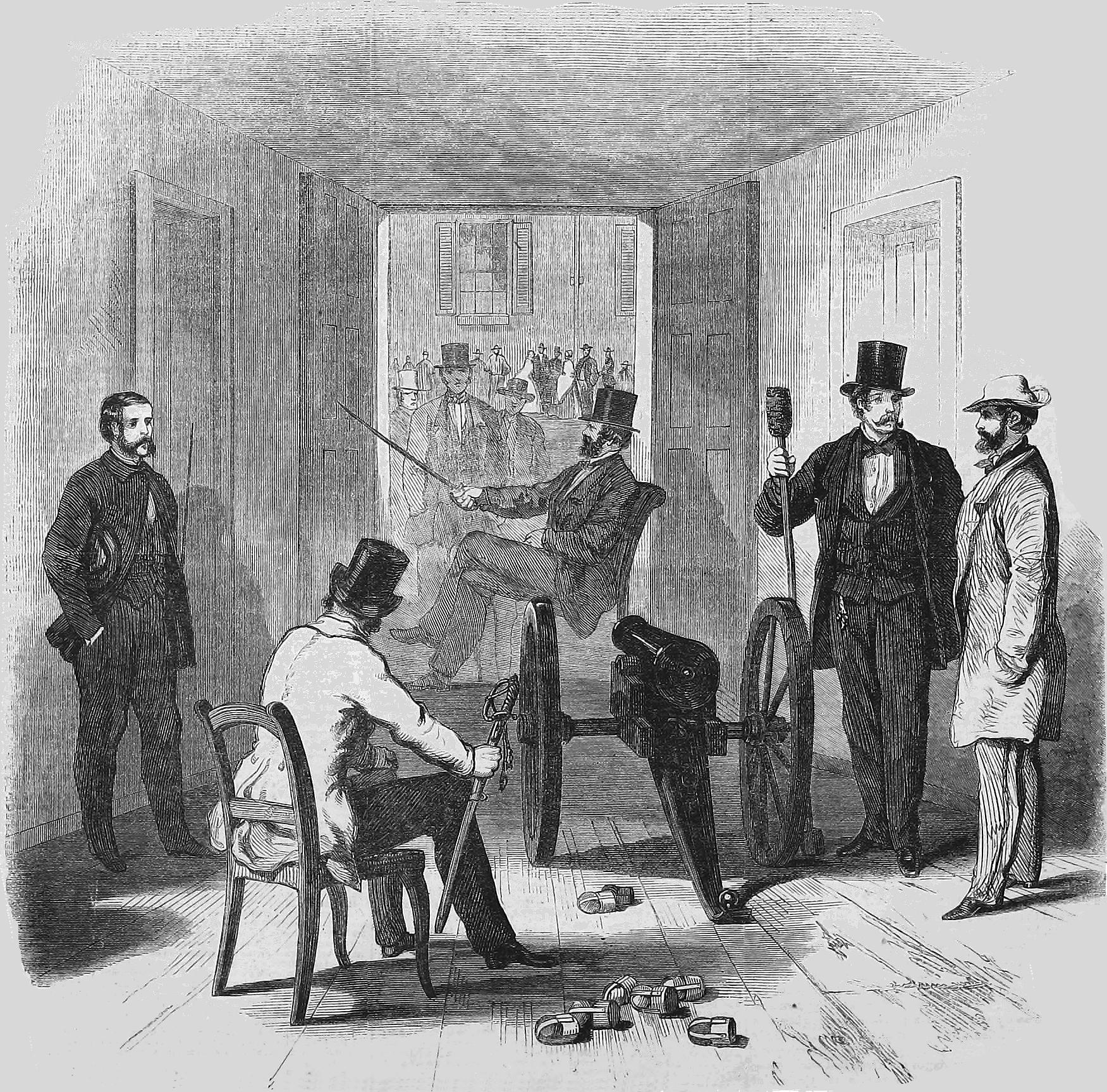
Whilst I was at Arlington House, walking through the camp attached to head-quarters, I observed a tall red-bearded officer seated on a chair in front of one of the tents, who bowed as I passed him, and as I turned to salute him, my eye was caught by the apparition of a row of Palmetto buttons down his coat. One of the officers standing by said, “Let me introduce you to Captain Taylor, from the other side.” It appears that he came in with a flag of truce, bearing a despatch from Jefferson Davis to President Lincoln, countersigned by General Beauregard at Manassas. Just as I left Arlington, a telegraph was sent from General Scott to send Captain Taylor, who rejoices in the name of Tom, over to his quarters.
The most absurd rumours were flying about the staff, one of whom declared very positively that there was going to be a compromise, and that Jeff Davis had made an overture for peace. The papers are filled with accounts of an action in Missouri, at a place called Carthage, between the Federals commanded by Colonel Sigel, consisting for the most part of Germans, and the Confederates under General Parsons, in which the former were obliged to retreat, although it is admitted the State troops were miserably armed, and had most ineffective artillery, whilst their opponents had every advantage in both respects, and were commanded by officers of European experience. Captain Taylor had alluded to the news in a jocular way to me, and said, “I hope you will tell the people in England we intend to whip the Lincolnites in the same fashion wherever we meet them,” a remark which did not lead me to believe there was any intention on the part of the Confederates to surrender so easily.