July 14th.–At six o’clock this morning the steamer arrived at the wharf under the walls of Fortress Monroe, which presented a very different appearance from the quiet of its aspect when first I saw it, some months ago. Camps spread around it, the parapets lined with sentries, guns looking out towards the land, lighters and steamers alongside the wharf, a strong guard at the end of the pier, passes to be scrutinised and permits to be given. I landed with the members of the Sanitary Commission, and repaired to a very large pile of buildings, called “The Hygeia Hotel,” for once on a time Fortress Monroe was looked upon as the resort of the sickly, who required bracing air and an abundance of oysters; it is now occupied by the wounded in the several actions and skirmishes which have taken place, particularly at Bethel; and it is so densely crowded that we had difficulty in procuring the use of some small dirty rooms to dress in. As the business of the Commission was principally directed to ascertain the state of the hospitals, they considered it necessary in the first instance to visit General Butler, the commander of the post, who has been recommending himself to the Federal Government by his activity ever since he came down to Baltimore, and the whole body marched to the fort, crossing the drawbridge after some parley with the guard, and received permission, on the production of passes, to enter the court.
The interior of the work covers a space of about seven or eight acres, as far as I could judge, and is laid out with some degree of taste; rows of fine trees border the walks through the grass plots; the officers’ quarters, neat and snug, are surrounded with little patches of flowers, and covered with creepers. All order and neatness, however, were fast disappearing beneath the tramp of mailed feet, for at least 1200 men had pitched their tents inside the place. We sent in our names to the General, who lives in a detached house close to the sea face of the fort, and sat down on a bench under the shade of some trees, to avoid the excessive heat of the sun until the commander of the place could receive the Commissioners. He was evidently in no great hurry to do so. In about half an hour an aide-de-camp came out to say that the General was getting up, and that he would see us after breakfast. Some of the Commissioners, from purely sanitary considerations, would have been much better pleased to have seen him at breakfast, as they had only partaken of a very light meal on board the steamer at five o’clock in the morning; but we were interested meantime by the morning parade of a portion of the garrison, consisting of 300 regulars, a Massachusetts’ volunteer battalion, and the 2nd NewYork Regiment.
It was quite refreshing to the eye to see the cleanliness of the regulars–their white gloves and belts, and polished buttons, contrasted with the slovenly aspect of the volunteers; but, as far as the material went, the volunteers had by far the best of the comparison. The civilians who were with me did not pay much attention to the regulars, and evidently preferred the volunteers, although they could not be insensible to the magnificent drum-major who led the band of the regulars. Presently General Butler came out of his quarters, and walked down the lines, followed by a few officers. He is a stout, middle-aged man, strongly built, with coarse limbs, his features indicative of great shrewdness and craft, his forehead high, the elevation being in some degree due perhaps to the want of hair; with a strong obliquity of vision, which may perhaps have been caused by an injury, as the eyelid hangs with a peculiar droop over the organ.
The General, whose manner is quick, decided, and abrupt, but not at all rude or unpleasant, at once acceded to the wishes of the Sanitary Commissioners, and expressed his desire to make my stay at the fort as agreeable and useful as he could. “You can first visit the hospitals in company with these gentlemen, and then come over with me to our camp, where I will show you everything that is to be seen. I have ordered a steamer to be in readiness to take you to Newport News.” He speaks rapidly, and either affects or possesses great decision. The Commissioners accordingly proceeded to make the most of their time in visiting the Hygeia Hotel, being accompanied by the medical officers of the garrison.
The rooms, but a short time ago occupied by the fair ladies of Virginia, when they came down to enjoy the sea breezes, were now crowded with Federal soldiers, many of them suffering from the loss of limb or serious wounds, others from the worst form of camp disease. I enjoyed a small national triumph over Dr. Bellows, the chief of the Commissioners, who is of the “sangre azul” of Yankeeism, by which I mean that he is a believer, not in the perfectibility, but in the absolute perfection, of New England nature, which is the only human nature that is not utterly lost and abandoned–Old England nature, perhaps, being the worst of all. We had been speaking to the wounded men in several rooms, and found most of them either in the listless condition consequent upon exhaustion, or with that anxious air which is often observable on the faces of the wounded when strangers approach. At last we came into a room in which two soldiers were sitting up, the first we had seen, reading the newspapers. Dr. Bellows asked where they came from; one was from Concord, the other from Newhaven. “You see, Mr. Russell,” said Dr. Bellows, “how our Yankee soldiers spend their time. I knew at once they were Americans when I saw them reading newspapers.” One of them had his hand shattered by a bullet, the other was suffering from a gun-shot wound through the body. “Where were you hit?” I inquired of the first. “Well,” he said, “I guess my rifle went off when I was cleaning it in camp.” “Were you wounded at Bethel?” I asked of the second. “No, sir,” he replied; “I got this wound from a comrade, who discharged his piece by accident in one of the tents as I was standing outside.” “So,” said I, to Dr. Bellows, “whilst the Britishers and Germans are engaged with the enemy, you Americans employ your time shooting each other!”
These men were true mercenaries, for they were fighting for money–I mean the strangers. One poor fellow from Devonshire said, as he pointed to his stump, “I wish I had lost it for the sake of the old island, sir,” paraphrasing Sarsfield’s exclamation as he lay dying on the field. The Americans were fighting for the combined excellences and strength of the States of New England, and of the rest of the Federal power over the Confederates, for they could not in their heart of hearts believe the Old Union could be restored by force of arms. Lovers may quarrel and may reunite, but if a blow is struck there is no redintegratio amoris possible again. The newspapers and illustrated periodicals which they read were the pabulum that fed the flames of patriotism incessantly. Such capacity for enormous lying, both in creation and absorption, the world never heard. Sufficient for the hour is the falsehood.
There were lady nurses in attendance on the patients; who followed–let us believe, as I do, out of some higher motive than the mere desire of human praise–the example of Miss Nightingale. I loitered behind in the rooms, asking many questions respecting the nationality of the men, in which the members of the Sanitary Commission took no interest, and I was just turning into one near the corner of the passage when I was stopped by a loud smack. A young Scotchman was dividing his attention between a basin of soup and a demure young lady from Philadelphia, who was feeding him with a spoon, his only arm being engaged in holding her round the waist, in order to prevent her being tired, I presume. Miss Rachel, or Deborah, had a pair of very pretty blue eyes, but they flashed very angrily from under her trim little cap at the unwitting intruder, and then she said, in severest tones, “Will you take your medicine, or not?” Sandy smiled, and pretended to be very penitent.
When we returned with the doctors from our inspection we walked round the parapets of the fortress, why so called I know not, because it is merely a fort. The guns and mortars are old-fashioned and heavy, with the exception of some new-fashioned and very heavy Columbiads, which are cast-iron 8-, 10-, and 12-inch guns, in which I have no faith whatever. The armament is not sufficiently powerful to prevent its interior being searched out by the long range fire of ships with rifle guns, or mortar boats; but it would require closer and harder work to breach the masses of brick and masonry which constitute the parapets and casemates. The guns, carriages, rammers, shot, were dirty, rusty, and neglected; but General Butler told me he was busy polishing up things about the fortress as fast as he could.
Whilst we were parading these hot walls in the sunshine, my companions were discussing the question of ancestry. It appears your New Englander is very proud of his English descent from good blood, and it is one of their isms in the Yankee States that they are the salt of the British people and the true aristocracy of blood and family, whereas we in the isles retain but a paltry share of the blue blood denied by incessant infiltrations of the muddy fluid of the outer world. This may be new to us Britishers, but is a Q. E. D. If a gentleman left Europe 200 years ago, and settled with his kin and kith, intermarrying his children with their equals, and thus perpetuating an ancient family, it is evident he may be regarded as the founder of a much more honourable dynasty than the relative who remained behind him, and lost the old family place, and sunk into obscurity. A singular illustration of the tendency to make much of themselves may be found in the fact, that New England swarms with genealogical societies and bodies of antiquaries, who delight in reading papers about each other’s ancestors, and tracing their descent from Norman or Saxon barons and earls. The Virginians opposite, who are flouting us with their Confederate flag from Sewall’s Point, are equally given to the “genus et proavos.”
At the end of our promenade round the ramparts, Lieutenant Butler, the General’s nephew and aide-decamp, came to tell us the boat was ready, and we met His Excellency in the court-yard, whence we walked down to the wharf. On our way, General Butler called my attention to an enormous heap of hollow iron lying on the sand, which was the Union gun that is intended to throw a shot of some 350 lbs. weight or more, to astonish the Confederates at Sewall’s Point opposite, when it is mounted. This gun, if I mistake not, was made after the designs of Captain Rodman, of the United States artillery, who in a series of remarkable papers, the publication of which has cost the country a large sum of money, has given us the results of long continued investigations and experiments on the best method of cooling masses of iron for ordnance purposes, and of making powder for heavy shot. The piece must weigh about 20 tons, but a similar gun, mounted on an artificial island called the Rip Raps, in the Channel opposite the fortress, is said to be worked with facility. The Confederates have raised some of the vessels sunk by the United States officers when the Navy Yard at Gosport was destroyed, and as some of these are to be converted into rams, the Federals are preparing their heaviest ordnance, to try the effect of crushing weights at low velocities against their sides, should they attempt to play any pranks among the transport vessels. The General said: “It is not by these great masses of iron this contest is to be decided: we must bring sharp points of steel, directed by superior intelligence.” Hitherto General Butler’s attempts at Big Bethel have not been crowned with success in employing such means, but it must be admitted that, according to his own statement, his lieutenants were guilty of carelessness and neglect of ordinary military precautions in the conduct of the expedition he ordered. The march of different columns of troops by night concentrating on a given point is always liable to serious interruptions, and frequently gives rise to hostile encounters between friends, in more disciplined armies than the raw levies of United States volunteers.
When the General, Commissioners, and Staff had embarked, the steamer moved across the broad estuary to Newport News. Among our passengers were several medical officers in attendance on the Sanitary Commissioners, some belonging to the army, others who had volunteered from civil life. Their discussion of professional questions and of relative rank assumed such a personal character, that General Butler had to interfere to quiet the disputants, but the exertion of his authority was not altogether successful, and one of the angry gentlemen said in my hearing, “I’m d–d if I submit to such treatment if all the lawyers in Massachusetts with stars on their collars were to order me to-morrow.”
On arriving at the low shore of Newport News we landed at a wooden jetty, and proceeded to visit the camp of the Federals, which was surrounded by a strong entrenchment, mounted with guns on the water face; and on the angles inland, a broad tract of cultivated country, bounded by a belt of trees, extended from the river away from the encampment; but the Confederates are so close at hand that frequent skirmishes have occurred between the foraging parties of the garrison and the enemy, who have on more than one occasion pursued the Federals to the very verge of the woods.
Whilst the Sanitary Commissioners were groaning over the heaps of filth which abound in all camps where discipline is not most strictly observed, I walked round amongst the tents, which, taken altogether, were in good order. The day was excessively hot, and many of the soldiers were laying down in the shade of arbours formed of branches from the neighbouring pine wood, but most of them got up when they heard the General was coming round. A sentry walked up and down at the end of the street, and as the General came up to him he called out “Halt.” The man stood still. “I just want to show you, sir, what scoundrels our Government has to deal with. This man belongs to a regiment which has had new clothing recently served out to it. Look what it is made of.” So saying the General stuck his fore-finger into the breast of the man’s coat, and with a rapid scratch of his nail tore open the cloth as if it was of blotting paper. “Shoddy sir. Nothing but shoddy. I wish I had these contractors in the trenches here, and if hard work would not make honest men of them, they’d have enough of it to be examples for the rest of their fellows.”
A vivacious prying man, this Butler, full of bustling life, self-esteem, revelling in the exercise of power. In the course of our rounds we were joined by Colonel Phelps, who was formerly in the United States army, and saw service in Mexico, but retired because he did not approve of the manner in which promotions were made, and who only took command of a Massachusetts regiment because he believed he might be instrumental in striking a shrewd blow or two in this great battle of Armageddon–a tall, saturnine, gloomy, angry-eyed, sallow man, soldier-like too, and one who places old John Brown on a level with the great martyrs of the Christian world. Indeed one, not so fierce as he, is blasphemous enough to place images of our Saviour and the hero of Harper’s Ferry on the mantelpiece, as the two greatest beings the world has ever seen. “Yes, I know them well. I’ve seen them in the field. I’ve sat with them at meals. I’ve travelled through their country. These Southern slave-holders are a false, licentious, godless people. Either we who obey the laws and fear God, or they who know no God except their own will and pleasure, and know no law except their passions, must rule on this continent, and I believe that Heaven will help its own in the conflict they have provoked. I grant you they are brave enough, and desperate too, but surely justice, truth, and religion, will strengthen a man’s arm to strike down those who have only brute force and a bad cause to support them.” But Colonel Phelps was not quite indifferent to material aid, and he made a pressing appeal to General Butler to send him some more guns and harness for the field-pieces he had in position, because, said he, “in case of attack, please God I’ll follow them up sharp, and cover these fields with their bones.” The General had a difficulty about the harness, which made Colonel Phelps very grim, but General Butler had reason in saying he could not make harness, and so the Colonel must be content with the results of a good rattling fire of round, shell, grape, and cannister, if the Confederates are foolish enough to attack his batteries. There was nothing to complain of in the camp, except the swarms of flies, the very bad smells, and perhaps the shabby clothing of the men. The tents were good enough. The rations were ample, but nevertheless there was a want of order, discipline, and quiet in the lines which did not augur well for the internal economy of the regiments. When we returned to the river face, General Butler ordered some practice to be made with a Sawyer rifle gun, which appeared to be an ordinary cast-iron piece, bored with grooves, on the shunt principle, the shot being covered with a composition of a metallic amalgam like zinc and tin, and provided with flanges of the same material to fit the grooves. The practice was irregular and unsatisfactory. At an elevation of 24 degrees, the first shot struck the water at a point about 2000 yards distant. The piece was then further elevated, and the shot struck quite out of land, close to the opposite bank, at a distance of nearly three miles. The third shot rushed with a peculiar hurtling noise out of the piece, and flew up in the air, falling with a splash into the water about 1500 yards away. The next shot may have gone half across the continent, for assuredly it never struck the water, and most probably ploughed its way into the soft ground at the other side of the river. The shell practice was still worse, and on the whole I wish our enemies may always fight us with Sawyer guns, particularly as the shells cost between £6 and £7 a-piece.
From the fort the General proceeded to the house of one of the officers, near the jetty, formerly the residence of a Virginian farmer, who has now gone to Secessia, where we were most hospitably treated at an excellent lunch, served by the slaves of the former proprietor. Although we boast with some reason of the easy level of our mess-rooms, the Americans certainly excel us in the art of annihilating all military distinctions on such occasions as these; and I am not sure the General would not have liked to place a young Doctor in close arrest, who suddenly made a dash at the liver wing of a fowl on which the General was bent with eye and fork, and carried it off to his plate. But on the whole there was a good deal of friendly feeling amongst all ranks of the volunteers, the regulars being a little stiff and adherent to etiquette.
In the afternoon the boat returned to Fortress Monroe, and the general invited me to dinner, where I had the pleasure of meeting Mrs. Butler, his staff, and a couple of regimental officers from the neighbouring camp. As it was still early, General Butler proposed a ride to visit the interesting village of Hampton, which lies some six or seven miles outside the fort, and forms his advance post. A powerful charger, with a tremendous Mexican saddle, fine housings, blue and gold embroidered saddle-cloth, was brought to the door for your humble servant, and the General mounted another, which did equal credit to his taste in horseflesh; but I own I felt rather uneasy on seeing that he wore a pair of large brass spurs, strapped over white jean brodequins. He took with him his aide-de-camp and a couple of orderlies. In the precincts of the fort outside, a population of contraband negroes has been collected, whom the General employs in various works about the place, military and civil; but I failed to ascertain that the original scheme of a debit and credit account between the value of their labour and the cost of their maintenance had been successfully carried out. The General was proud of them, and they seemed proud of themselves, saluting him with a ludicrous mixture of awe and familiarity as he rode past. “How do, Massa Butler? How do, General?” accompanied by absurd bows and scrapes. “Just to think,” said the General, “that every one of these fellows represents some 1000 dollars at least out of the pockets of the chivalry yonder.” “Nasty, idle, dirty beasts,” says one of the staff, sotto voce; “I wish to Heaven they were all at the bottom of the Chesapeake. The General insists on it that they do work, but they are far more trouble than they are worth.”
The road towards Hampton traverses a sandy spit, which, however, is more fertile than would be supposed from the soil under the horses’ hoofs, though it is not in the least degree interesting. A broad creek or river interposed between us and the town, the bridge over which had been destroyed. Workmen were busy repairing it, but all the planks had not yet been laid down or nailed, and in some places the open space between the upright rafters allowed us to see the dark waters flowing beneath. The Aide said, “I don’t think, General, it is safe to cross;” but his chief did not mind him until his horse very nearly crashed through a plank, and only regained its footing with unbroken legs by marvellous dexterity; whereupon we dismounted, and, leaving the horses to be carried over in the ferry boat, completed the rest of the transit, not without difficulty. At the other end of the bridge a street lined with comfortable houses, and bordered with trees, led us into the pleasant town or village of Hampton–pleasant once, but now deserted by all the inhabitants except some pauperised whites and a colony of negroes. It was in full occupation of the Federal soldiers, and I observed that most of the men were Germans, the garrison at Newport News being principally composed of Americans. The old red brick houses, with cornices of white stone; the narrow windows and high gables; gave an aspect of antiquity and European comfort to the place, the like of which I have not yet seen in the States. Most of the shops were closed; in some the shutters were still down, and the goods remained displayed in the windows. “I have allowed no plundering,” said the General; “and if I find a fellow trying to do it, I will hang him as sure as my name is Butler. See here,” and as he spoke he walked into a large woollen-draper’s shop, where bales of cloth were still lying on the shelves, and many articles such as are found in a large general store in a country town were disposed on the floor or counters; “they shall not accuse the men under my command of being robbers.” The boast, however, was not so well justified in a visit to another house occupied by some soldiers. “Well,” said the General, with a smile, “I daresay you know enough of camps to have found out that chairs and tables are irresistible; the men will take them off to their tents, though they may have to leave them next morning.”
The principal object of our visit was the fortified trench which has been raised outside the town towards the Confederate lines. The path lay through a churchyard filled with most interesting monuments. The sacred edifice of red brick, with a square clock tower rent by lightning, is rendered interesting by the fact that it is almost the first church built by the English colonists of Virginia. On the tombstones are recorded the names of many subjects of his Majesty George III., and familiar names of persons born in the early part of last century in English villages, who passed to their rest before the great rebellion of the Colonies had disturbed their notions of loyalty and respect to the Crown. Many a British subject, too, lies there, whose latter days must have been troubled by the strange scenes of the war of independence. With what doubt and distrust must that one at whose tomb I stand have heard that George Washington was making head against the troops of His Majesty King George III.! How the hearts of the old men who had passed the best years of their existence, as these stones tell us, fighting for His Majesty against the French, must have beaten when once more they heard the roar of the Frenchman’s ordnance uniting with the voices of the rebellious guns of the colonists from the plains of Yorktown against the entrenchments in which Cornwallis and his deserted band stood at hopeless bay! But could these old eyes open again, and see General Butler standing on the eastern rampart which bounds their resting-place, and pointing to the spot whence the rebel cavalry of Virginia issue night and day to charge the loyal pickets of His Majesty The Union, they might take some comfort in the fulfilment of the vaticinations which no doubt they uttered, “It cannot, and it will not, come to good.”
Having inspected the works–as far as I could judge, too extended, and badly traced – which I say with all deference to the able young engineer who accompanied us to point out the various objects of interest–the General returned to the bridge, where we remounted, and made a tour of the camps of the force intended to defend Hampton, falling back on Fortress Monroe in case of necessity. Whilst he was riding ventre d terre, which seems to be his favourite pace, his horse stumbled in the dusty road, and in his effort to keep his seat the General broke his stirrup leather, and the ponderous brass stirrup fell to the ground; but, albeit a lawyer, he neither lost his seat nor his sang froid, and calling out to his orderly “to pick up his toe plate,” the jean slippers were closely pressed, spurs and all, to the sides of his steed, and away we went once more through dust and heat so great I was by no means sorry when he pulled up outside a pretty villa, standing in a garden, which was occupied by Colonel Max Webber, of the German Turner Regiment, once the property of General Tyler. The camp of the Turners, who are members of various gymnastic societies, was situated close at hand; but I had no opportunity of seeing them at work, as the Colonel insisted on our partaking of the hospitalities of his little mess, and produced some bottles of sparkling hock and a block of ice, by no means unwelcome after our fatiguing ride. His Major, whose name I have unfortunately forgotten, and who spoke English better than his chief, had served in some capacity or other in the Crimea, and made many inquiries after the officers of the Guards whom he had known there. I took an opportunity of asking him in what state the troops were. “The whole thing is a robbery,” he exclaimed; “this war is for the contractors; the men do not get a third of what the Government pay for them; as for discipline, my God! it exists not. We Germans are well enough, of course; we know our affair; but as for the Americans, what would you? They make colonels out of doctors and lawyers, and captains out of fellows who are not fit to brush a soldier’s shoe.” “But the men get their pay?” “Yes; that is so. At the end of two months, they get it, and by that time it is due to sutlers, who charge them 100 per cent.”
It is easy to believe these old soldiers do not put much confidence in General Butler, though they admit his energy. “Look you; one good officer with 5000 steady troops, such as we have in Europe, shall come down any night and walk over us all into Fortress Monroe whenever he pleased, if he knew how these troops were placed.”
On leaving the German Turners, the General visited the camp of Duryea’s New York Zouaves, who were turned out at evening parade, or more properly speaking, drill. But for the ridiculous effect of their costume the regiment would have looked well enough; but riding down on the rear of the ranks the discoloured napkins tied round their heads, without any fez cap beneath, so that the hair sometimes stuck up through the folds, the ill-made jackets, the loose bags of red calico hanging from their loins, the long gaiters of white cotton–instead of the real Zouave yellow and black greave, and smart white gaiter–made them appear such military scarecrows, I could scarcely refrain from laughing outright. Nevertheless the men were respectably drilled, marched steadily in columns of company, wheeled into line, and went past at quarter distance at the double much better than could be expected from the short time they had been in the field, and I could with all sincerity say to Col. Duryea, a smart and not unpretentious gentleman, who asked my opinion so pointedly that I could not refuse to give it, that I considered the appearance of the regiment very creditable. The shades of evening were now falling, and as I had been up before 5 o’clock in the morning, I was not sorry when General Butler said, “Now we will go home to tea, or you will detain the steamer.” He had arranged before I started that the vessel, which in ordinary course would have returned to Baltimore at 8 o’clock, should remain till he sent down word to the captain to go.
We scampered back to the fort, and judging from the challenges and vigilance of the sentries, and inlying pickets, I am not quite so satisfied as the Major that the enemy could have surprised the place. At the tea-table there were no additions to the General’s family; he therefore spoke without any reserve. Going over the map, he explained his views in reference to future operations, and showed cause, with more military acumen than I could have expected from a gentleman of the long robe, why he believed Fortress Monroe was the true base of operations against Richmond.
I have been convinced for some time, that if a sufficient force could be left to cover Washington, the Federals should move against Richmond from the Peninsula, where they could form their depots at leisure, and advance, protected by their gunboats, on a very short line which offers far greater facilities and advantages than the inland route from Alexandria to Richmond, which, difficult in itself from the nature of the country, is exposed to the action of a hostile population, and, above all, to the danger of constant attacks by the enemies’ cavalry, tending’ more or less to destroy all communication with the base of the Federal operations.
The threat of seizing Washington led to a concentration of the Union troops in front of it, which caused in turn the collection of the Confederates on the lines below to defend Richmond. It is plain that if the Federals can cover Washington, and at the same time assemble a force at Monroe strong enough to march on Richmond, as they desire, the Confederates will be placed in an exceedingly hazardous position, scarcely possible to escape from; and there is no reason why the North, with their overwhelming preponderance, should not do so, unless they be carried away by the fatal spirit of brag and bluster which comes from their press to overrate their own strength and to despise their enemy’s. The occupation of Suffolk will be seen, by any one who studies the map, to afford a most powerful leverage to the Federal forces from Monroe in their attempts to turn the enemy out of their camps of communication, and to enable them to menace Richmond as well as the Southern States most seriously.
But whilst the General and I are engaged over our maps and mint juleps, time flies, and at last I perceive by the clock that it is time to go. An aide is sent to stop the boat, but he returns ere I leave with the news that “She is gone.” Whereupon the General sends for the Quartermaster Talmadge, who is out in the camps, and only arrives in time to receive a severe “wigging.” It so happened that I had important papers to send off by the next mail from New York, and the only chance of being able to do so depended on my being in Baltimore next day. General Butler acted with kindness and promptitude in the matter. “I promised you should go by the steamer, but the captain has gone off without orders or leave, for which he shall answer when I see him. Meantime it is my business to keep my promise. Captain Talmadge, you will at once go down and give orders to the most suitable transport steamer or chartered vessel available, to get up steam at once and come up to the wharf for Mr. Russell.”
Whilst I was sitting in the parlour which served as the General’s office, there came in a pale, brighteyed, slim young man in a subaltern’s uniform, who sought a private audience, and unfolded a plan he had formed, on certain data gained by nocturnal expeditions, to surprise a body of the enemy’s cavalry which was in the habit of coming down every night and disturbing the pickets at Hampton. His manner was so eager, his information so precise, that the General could not refuse his sanction, but he gave it in a characteristic manner. “Well, sir, I understand your proposition. You intend to go out as a volunteer to effect this service. You ask my permission to get men for it. I cannot grant you an order to any of the officers in command of regiments to provide you with these; but if the Colonel of your regiment wishes to give leave to his men to volunteer, and they like to go with you, I give you leave to take them. I wash my hands of all responsibility in the affair.” The officer bowed and retired, saying, “That is quite enough, General.”1
At 10 o’clock the Quartermaster came back to say that a screw steamer called the Elizabeth was getting up steam for my reception, and I bade good-by to the General, and walked down with his aide and nephew, Lieutenant Butler, to the Hygeia Hotel to get my light knapsack. It was a lovely moonlight night, and as I was passing down an avenue of trees an officer stopped me, and exclaimed, “General Butler, I hear you have given leave to Lieutenant Blank to take a party of my regiment and go off scouting to-night after the enemy. It is too hard that–” What more he was going to say I know not, for I corrected the mistake, and the officer walked hastily on towards the General’s quarters. On reaching the Hygeia Hotel I was met by the correspondent of a New York paper, who as commissary-general, or, as they are styled in the States, officer of subsistence, had been charged to get the boat ready, and who explained to me it would be at least an hour before the steam was up; and whilst I was waiting in the porch I heard many Virginian, and old world stories as well, the general upshot of which was that all the rest of the world could he “done” at cards, in love, in drink, in horseflesh, and in fighting, by the true-born American. Gen. Butler came down after a time, and joined our little society, nor was he by any means the least shrewd and humorous raconteur of the party. At 11 o’clock the Elizabeth uttered some piercing cries, which indicated she had her steam up; and so I walked down to the jetty, accompanied by my host and his friends, and wishing them good bye, stepped on board the little vessel, and with the aid of the negro cook, steward, butler, boots, and servant, roused out the captain from a small wooden trench which he claimed as his berth, turned into it, and fell asleep just as the first difficult convulsions of the screw aroused the steamer from her coma, and forced her languidly against the tide in the direction of Baltimore.
__________
1 It may be stated here, that this expedition met with a disastrous result. If I mistake not, the officer, and with him the correspondent of a paper who accompanied him, were killed by the cavalry whom he meant to surprise, and several of the volunteers were also killed or wounded.



 Autoposting ACWC blog posts to Facebook stalled last year when payment to the app was inadvertently not made. In the timeline, Lee had just surrendered.
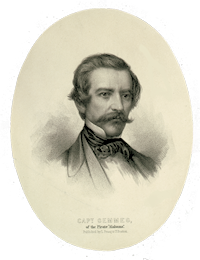 –Advices were received at New York, that the privateer Sumter arrived at Cienfuegos, Cuba, on the 6th of July, carrying in as prizes the brigs Cuba, Machias, Naiad, Albert Adams, Ben Dunning, and the barks West Wind, and Louisa Kilham. She also fell in with the ship Golden Rocket off the Isle of Pines, which was set fire to and burned, after taking off the officers and crew.