21st.–Oh the glorious letter of Gen. Burnside! He asks no subterfuge to hide him from what others might deem the disgrace of defeat. His honor overrules his reticence, and he comes nobly to the rescue of his commander, of the Secretary of War, of the President, of the Government. Right or wrong, he assumes the responsibility of the late battle, with all the odium. I feel that he may safely do so, and await the verdict of history, which in my opinion will place this in the list of the most brilliant military manÅ“uvres. But how different his course from that of some others whose reticence prevailed, and whose high sense of honor could permit them to listen to abuses heaped on the Government for their acts, without the manliness to come boldly to the rescue. How plain the line between the patriot and the partisan! We feel joyous to-night. This letter is a strike. We have an honest man to lead us, and we will follow his lead.
American Civil War Chronicles
Fredericksburg.–Letters from Elisha Franklin Paxton.
December 21, 2022
Camp near Port Royal, December 21,1862.
I wrote to you some days since, informing you that I had passed through the battle at Fredericksburg without damage. The loss in my brigade was seventy-six. We reached the battle-ground on Friday morning, the 12th inst., when everything indicated that we should have a battle that day. We took first one position and then another, all the while expecting the fight to open; but the day passed off quietly, excepting some artillery firing and some skirmishing. That night we slept in our places. The next morning all was quiet as on the day before for a while, but then the artillery and musketry became more rapid in firing, and continued to increase until for more than a mile along the line there seemed a continuous roar of musketry. We were soon ordered forward, and then I made sure we should be in the battle; but when we reached the position occupied by our second line, we were halted, and there one of my regiments became engaged with a body of the enemy which had advanced within our lines. It lasted a very little while, however. The enemy were driven back along our whole line, and not renewing it, the battle closed. That night we slept on the field, among the dead and wounded. The next morning we occupied our first line. We supposed, of course, that the battle would be renewed, but the day passed off quietly; the next day it was the same case, and the next morning it was found that the enemy had left the field and crossed over the river. We then moved down to our present camp some fifteen miles below Fredericksburg. I hear nothing from the enemy. Their pickets are on the other side of the river, and ours are on this. When do you think we will have another battle? Where will it be? Such questions puzzle the minds of a great many people, and yours too, I doubt not. It may be to-morrow; it may not be for months. I hope the Yankees, having practice enough for the year, will conclude to go into winter quarters and let us do the same. Next week will be Christmas, and I hope a happy one to the loved wife and children of my own home. To many, in summing up and looking over their bereavements for the year, it will be sad enough. We have been more blessed, and should feel grateful for it. To the future I look, not in gloom and despondency, but with the calmness and composure of one who feels that his own destiny in a sea of troubles like this is not in any way under his control. The cloud will pass away when God in his righteous judgment wills it, and it becomes us all to bear it in patience. May the prayers which ascend to heaven from so many supplicants, with such earnestness and fervor as they never knew before, soon be answered. They will be when we deserve it.
__________
General Order. General, Orders No. 65
Head Qrs. Paxton’s Brigade,
December 18, 1862.
Regimental commanders will institute a close examination of the conduct of officers and men in the late battle. They will see that merited censure and punishment falls upon delinquencies; that fidelity and gallantry are rewarded with praise and promotion. If any remained behind in camp or fell to the rear without proper leave upon the march, which seemed to all to lead to the field of battle, or when brought to the enemy sought safety in flight, their officers will see that they are arrested and the proper steps taken for their punishment.
Your line, as it moved after long hours of weary suspense to the support of your comrades in front, exhibiting the spirit and determination of soldiers resolved to conquer or die, was witnessed by your brigade commander with a feeling of pride and gratification such as he had never known before. Such a result can never be achieved by men who harass themselves with alternating hope of safety and fear of danger; it is the work only of the soldier who habituates himself to the idea that he must stand to his colors so long as he has a cartridge or a bayonet to defend him; and if he fails in this he deserves to be despised and cast off even by the women and children of his own home. He who moves under such a resolution must of necessity do his duty, win the applause, and a still nobler reward in the conviction which it causes to his own heart that he is what the meanest feels he would like to be –a true man and a true soldier.
He who proves recreant to his country and his cause at such a time merits the just sentence of military law–to die under the colors he disgraced and by the muskets of the gallant comrades he deserted.
(Signed) B. F. Paxton,
Brig.-Genl.
Official.
Friend C. Cox, A. D. C.
Robert M. McGill
December 20, 2022
Saturday, 20th.—Started on our march 10 A.M.
(Note: picture is of an unidentified Confederate soldier.)
Downing’s Civil War Diary.–Alexander G. Downing.
December 20, 2022
Saturday, 20th–We struck our tents early this morning and marched twenty-one miles back toward Holly Springs. It is a disappointment to have to retrace our steps and the boys are not as jolly as they were when going south. Holly Springs is said to have been taken and our supplies cut off. We have been put on half rations.
War Diary of Luman Harris Tenney.
December 20, 2022
Saturday, 20th. Reached the river about noon. After some delay were ferried over and marched to the cars. Then waited in a cold wind and occasional sleet for two hours, then marched through the town east to barracks. Got some coffee and hard bread. In the evening had a good fire. Most of the boys up town. Capt. invited me to Quincy House but preferred to stay in camp. Quincy a very neat town–city.
A Rebel War Clerk’s Diary
December 20, 2022
DECEMBER 20th.—Last accounts from Fredericksburg state that the enemy are retiring toward the Potomac and Washington. We have got some of their pontoon bridges, and other things left behind. It is now very cold, with a fair prospect of the Potomac freezing over. Let them beware!
But we were in a bad way: our army, instead of numbering 200,000 as the Federal journals report, did not exceed 50,000 men; and not half that number went into action. The Secretary of War had ordered several regiments from Gen. S. Jones, in Western Virginia; now sent to North Carolina.
There is no mail yet from beyond Goldsborough, and the news from North Carolina seems vague and unsatisfactory. They say we beat the enemy at Kinston; yet they have destroyed a portion of the railroad between Goldsborough and Wilmington. They say the Federals are retreating on Newbern; yet we know they made 500 of our men prisoners after they crossed the Neuse. It is reported that our loss is small, and the enemy’s large; and that our 3000 men fought successfully their 18,000. However, we have sent some 15,000 reinforcements.It is reported that the Federals are evacuating Nashville; but reports from the West are not always reliable.
A communication has been received by Secretary Seddon from S. B. M., of Vicksburg, proposing to purchase shoes, blankets, etc. in the United States, and sell them to the government for cotton or for Confederate notes. This was referred to the Quartermaster-General, who favors it. Now what will Mr. Secretary do? Better wait till the President returns!
The late Secretary of War, Mr. Randolph, has formed a partnership with Mr. G. A. Myers. Today a paper was sent in by them to the new Secretary, containing the names of ten clients, all Jews and extortioners, who, it appears, at the beginning of the war, and before Virginia had fully seceded, joined several Virginia companies of artillery, but did not drill with them. They hired substitutes for a small sum, all, as the memorial sets forth, being foreigners of the class subsequently exempted by act of Congress. And these counselors demand the exemption of the Jew extortioners on the ground that they once furnished substitutes, now out of the service! And it is probable they will carry their point, and gain large fees. Substitutes now are worth $2000–then, $100.
A dispatch from Charleston to-day says: “Iron steamer Columbia, formerly the Giraffe, of Liverpool, with cargo of shoes, blankets, Whitworth guns, and ammunition, arrived yesterday.” I suppose cargoes of this nature have been arriving once a week ever since the war broke out. This cargo, and the ship, belong to the government.
9 o’clock P.M.—After a very cold day, it has become intensely frigid. I have two fires in our little Robin’s Nest (frame) on the same floor, and yet ice forms rapidly in both rooms, and we have been compelled to empty the pitchers! This night I doubt not the Potomac will be closed to Burnside and his transports! During the first Revolution, the Chesapeake was frozen over. If we have a winter like that, we shall certainly have an armistice in Virginia without the intervention of any other than the Great Power above. But we shall suffer for the want of fuel: wood is $18 per cord, and coal $14 per cart load.
Gen. Bonham, who somehow incurred the dislike of the authorities here, and was dropped out of the list of brigadiers, has been made Governor of South Carolina. And Gen. Wise, who is possessed of perhaps the greatest mind in the Confederacy, is still fettered. They will not let him fight a battle, because he is “ambitious!” When Norfolk was (wickedly) given up, his home and all his possessions fell into the hands of the enemy. He is now without a shelter for his head, bivouacing with his devoted brigade at Chaffin’s farm, below the city. He is the senior brigadier in the army, and will never be a major-general.
Through Some Eventful Years
December 20, 2022
December 20th, 1862.—Last night we sat up all night, getting Harry ready to get off this morning, early, for Virginia. His sister and nieces were packing clothes, putting up provisions for him to take back to camp with him and I was finishing the last pair of socks I had on hand, that makes six pair I have knit for him. He wanted me to kiss him goodbye but Mother does not approve of caresses. All my playmates, with a few exceptions, have been boys and Mother’s rule is “hands off.” I am not allowed to waltz with any but cousins and she does not exactly like that.
Captain Mac Whitehead and Major Whitehead go tomorrow. Other people are coming but these soldiers who are going, are so near and dear and these new-comers are only just “company.” It makes a great difference.
Susan Bradford is 16 years old when this entry was made.
Journal of Surgeon Alfred L. Castleman.
December 20, 2022
20th.–A deep gloom hangs over the army to-day. I have at no time seen it so depressed–depressed not only at its new defeat, but at its own halting between opinions. Though the affection of the soldiers for Gen. Burnside was warm and active, it had not been confirmed by trials and experience, and the “expectant friends of Gen. McClellan” are still busy in taking advantage of this defeat to depreciate Gen. Burnside in the confidence of the army. This causes halting in opinions, and fears that our new Commander-in-Chief may not prove competent to the charge entrusted to him. It is of a piece with the McClellan tactics. Rule or ruin has been the motto of many of his friends.
0
December 19, 2022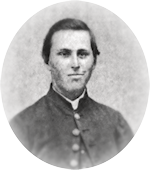
December. Much cold rain and snow-storms. Near our camp was a great neighborhood for pigs. They were allowed to roam about, running through our camp. Colonel warned the people to keep them out. It did no good. Colonel shot one, wounding it. Members of our company captured and dressed it. Company C had fresh pork for dinner. The owner tried to collect pay. The Colonel promised if the pigs were kept out of camp for two weeks he would pay. In less than three days the pigs were in camp again.
The routine for each day. Roll call at 6 A. M. Breakfast at 7. Guard mount, 8.30. Company drill, 9 to 11. Dinner, 12. Battalion drill, 2 to 4. Clean up for dress parade at 5 P. M. Supper at 6. Roll-call, 9. Taps, 9.30. On guard duty every other day and night. Much sympathy in this vicinity for the South. Railroads are kept well guarded.
Robert M. McGill
December 19, 2022
Friday, 19th.—Company drill and inspection this morning. P.M., orders to be ready to march to-morrow morning for Jackson, Miss. 39th detailed to guard wagon train, and that means a march through to Jackson, Miss.
(Note: picture is of an unidentified Confederate soldier.)
Downing’s Civil War Diary.–Alexander G. Downing.
December 19, 2022
Friday, 19th–The boys worked all day setting up their tents. The boys of our company cut down a red oak tree from which we made staves, set them in trenches dug in the ground, and had just finished putting up the tents, when at 5 p. m. the long roll sounded to form in line. We were ordered to march to the station to board the cars for Holly Springs, as the rebels had taken the place and burned our rations. But we did not go, as another regiment nearer the station got there ahead of us and we were marched back to our camp, with orders, though, to be ready to start for Holly Springs in the morning. We had expected to stay here several days and are sorry to have to leave the place, for it would have made us an excellent camp ground, being on a south hillside with timber just thick enough for shelter.
War Diary of Luman Harris Tenney.
December 19, 2022
Friday, 19th. Up at 4 A. M. Off on foot for the ferry at 7. Boys started with the Indian warwhoop. All in good cheer. Quite a long walk. Bid Kansas goodbye before noon and were off on hog cars at Weston. At St. Joseph got a lunch, pie, bread and ham. Got some hay. Bill and I fixed a bed. 34 in a freight car, all lay down, piled top of one another.
A Rebel War Clerk’s Diary
December 19, 2022
DECEMBER 19th.—Gen. Burnside acknowledges a loss of upwards of 5000, which is good evidence here that his loss was not less than 15,000. The Washington papers congratulate themselves on the escape of their army, and say it might have been easily captured by Lee. They propose, now, going into winter quarters.
We have nothing further from North Carolina or Mississippi. Gen. Banks’s expedition had passed Hilton Head.
A Mr. Bunch, British Consul, has written an impudent letter to the department, alleging that an Irishman, unnaturalized, is forcibly detained in one of our camps. He says his letters have not been answered, which was great discourtesy, and he means to inform Lord John Russell of it. This letter was replied to in rather scathing terms, as the Irishman had enlisted and then deserted. Besides, we are out of humor with England now, and court a French alliance. The President was at Chattanooga on the 15th instant; and writes the Secretary that he has made some eight appointments of brigadiers, and promotions to major-generals. Major-Gen. Buckner is assigned to command at Mobile.
We are straightened for envelopes, and have taken to turning those we receive. This is economy; something new in the South. My family dines four or five times a week on liver and rice. We cannot afford anything better; others do not live so well. Custis and I were vaccinated to-day, with the rest of the officers of the department.
The Northern papers now want the Federal army to go into winter quarters. This was, confessedly, to be the final effort to take Richmond. It failed. Many of the people regard the disaster of Burnside as the harbinger of peace. An officer from the field informs me that all our generals were sadly disappointed, when it was discovered that Burnside had fled. They wanted one more blow at him, and he would have been completely destroyed.
Journal of Surgeon Alfred L. Castleman.
December 19, 2022
19th.–To-day we have fallen back on to the same camping ground which we left on the 11th to advance to the capture of Fredericksburg. How different the feelings of the soldiery on that beautiful moonlight morning, whilst they struck and loaded their tents amid their cheering huzzas, and bidding farewell to the ground which they supposed they were placing in their rear forever, from what they are to-night. Whilst beaten and repulsed, they are this moment re-pitching their tents on the identical spot where they cherished such bright visions of glory. ‘Tis unfortunate that we did not find some other place “to fall back on.
Downing’s Civil War Diary.–Alexander G. Downing.
December 18, 2022
Thursday, 18th–We started at 6 o’clock this morning and arrived in Oxford at about 10. We were inspected by General Grant, passing through the town by platoon. We marched on eight miles out from town and went into camp along the railroad. Grant has his headquarters in Oxford. It is a fine town, on high ground and well built up with fine homes of the rich planters. A college is located here, with good buildings.[1] The surrounding plantations are well fenced and have good buildings.
[1] Our diarist must have seen either the University of Mississippi, opened in 1848, or Union Female College, a Cumberland Presbyterian college, founded in 1854.—Ed.
War Diary of Luman Harris Tenney.
December 18, 2022
Thursday, 18th. After a good breakfast, cousin went up to camp with me. Officers gone. Went back to town and the Planters. Introduced him to Capts. Seward and Welch. Went about town with him. Enjoyed all. Went to fort and helped in turning over property. In the evening went with Bill Porter and Nichols to theatre. Officers there. “Pizarro.” Rolla played well. Wanted to go to Festival but dared not.
A Rebel War Clerk’s Diary
December 18, 2022
DECEMBER 18th.—We have more accounts of the battle of Fredericksburg now in our possession. Our loss in killed and wounded will probably be more than the estimate in the official report, while Federal prisoners report theirs at 20,000. This may be over the mark, but the Examiner’s correspondent at Fredericksburg puts down their loss at 19,000. The Northern papers of the 14th inst. (while they supposed the battle still undecided) express the hope that Burnside will fight his last man and fire his last cartridge on that field, rather than not succeed in destroying Lee’s army! Lee’s army, after our victory, is mostly uninjured. The loss it sustained was not a “flea-bite.”
The enemy, in their ignominous flight on Saturday night, left their dead propped up as sentinels and pickets, besides 3000 on the plain.
Accounts from North Carolina indicate the repulse of the enemy, though they have burnt some of the railroad bridges. We shall hear more anon. Reinforcements are flying to the scene of action.
How glad I will be to leave this place.
December 18, 2022
Washington County Historical Society version (1965)1
Dec. 18—Fritz came today with a military escort of 100 men. He says we will leave tomorrow. How gladly I will leave here. Only the parting from Mina will hurt, that and the fact that I will have to leave my beautiful piano here, on which my Heinrich plays so well.
The Arkansas Historical Quarterly version (1947)2
Dec. 18
Fritz is with an escort of one hundred men, he has written us, and we are supposed to leave tomorrow. Eberles want to wait until spring of next year. If they do, maybe they can live on what we leave behind. Maybe they can manage to hold on to their farm. How glad I will be to leave this place. My only source of sadness will be the necessity of saying good-bye to Nani. Yes, I will have to leave my piano upon which Henry has, in better days, played so beautifully.
- Lemke, W. J. The Hermanns of Old Hermannsburg: Washington County, Arkansas. Fayetteville, AR: Washington County Historical Society, 1965.
- Memoirs, Letters, and Diary Entries of German Settlers in Northwest Arkansas, 1853-1863. Selected and Translated By Clarence Evans, Tahlequah, Oklahoma. The Arkansas Historical Quarterly. Vol. VI Fall, 1947 No. 3
Journal of Surgeon Alfred L. Castleman.
December 18, 2022
18th.–To-day has been spent in clearing up, as if in preparation for a move or a battle. We have given our surplus “hard talk,” with some tea, coffee, sugar and other necessaries of life to the poor, paralytic old man, whose premises we have occupied. He is an uncompromising rebel, but humanity forbids that we should permit him to starve.
What will be the effect of this repulse on the spirits of the army? I shall watch with much solicitude. For the Commander-in-Chief, it has happened at a most inauspicious moment. He had just superceded General McClellan, who had many warm friends, who stood ready to take advantage of every misstep, or misfortune of the new Commander, and to turn it to the credit of their friend, now in disgrace. Though the army was rapidly growing into an affection for General Burnside, the feeling was of new growth, and not yet confirmed by long acquaintance, by trials, or by successes. The friends of McClellan, true to the instincts of human nature, will magnify the reverses, whilst they will withhold credit for the merits of the manÅ“uvre. Already General Burnside’s friends are finding it necessary to defend him against the attacks of the croakers, by following the example set by the friends of McClellan on the Peninsula, in attributing the failures to the interference of the President, to General Halleck, or to Mr. Secretary Stanton. For my own part, I feel that defence is unnecessary, for when I consider the fact, that public opinion compelled the crossing and the attack on Fredericksburg; that no commander could have withstood the outside pressure, however great the danger of advance; when I recollect the successful crossing in the face of so large a force, the successful attack and capture of part of the heights, the falling back, made necessary by the tardiness of some of his Generals to support him, the ruse of clearing the decks for action, the removal of the hospitals and wounded to a point out of reach of fire, yet in full view of the enemy, the withdrawal of the army so quietly and so adroitly that even his own divisions were deceived into the belief by each, that it was the only division recrossing, altogether mark it as one of the most adroitly managed military manÅ“uvres since the crossing of the Delaware by General Washington.
0
December 17, 2022
December 17th. This afternoon, at two o’clock, Major-General Banks and Brigadier-General Augur, with their staffs, visited the ship. Our Admiral and Commodore seemed highly pleased to meet with them; they remained on board about two hours. As they were leaving, a salute of thirteen guns was fired.
Downing’s Civil War Diary.–Alexander G. Downing.
December 17, 2022
Wednesday, 17th–We struck our tents this morning and at 10 o’clock started toward Oxford. We went into bivouac for the night within four miles of the town. The weather is fine for marching and we have good roads.
War Diary of Luman Harris Tenney.
December 17, 2022
(Fort Leaven worth)
Wednesday, 17th. In the morning took the prisoners to the fort and hurried over to Col. Burris. Rode up to south part of town and found Cousin Austin’s. Stayed to dinner. Had a good visit. Made me promise to call in the evening if we stayed in town. Went over in the evening. Lost my way. Found Mr. Buckingham of the Bulletin there. Read some of his letters for Augusta for the Baptist benefit. Augusta played on her guitar and sang, also on the piano. Enjoyed the evening very much indeed. Leona a very pretty girl. Had a lunch and apples, good feather bed. Had nice peach sauce.
A Rebel War Clerk’s Diary
December 17, 2022
DECEMBER 17th.—A dispatch from Gen. G. W. Smith, last night, says we have repulsed the enemy from Kinston, N. C., but a dispatch this morning says a cavalry force has cut the railroad near Goldsborough, broken down the wires, and burnt the bridge. We had no letters from beyond that point this morning.
Last night large quantities of ammunition and some more regiments were sent to North Carolina. This is done because Richmond is relieved by the defeat and retreat of Burnside. But suppose it should not be relieved, and a force should be sent suddenly up the James and York Rivers?
We have not a word from Fredericksburg, and it is probable Burnside’s batteries still command the town. Lee is content and has no idea of crossing the river. There are two notable rumors in the streets: first, that we have gained a great battle in Tennessee; and, second, that the government at Washington has arrested John Van Buren and many other Democratic leaders in the North, which has resulted in a riot, wherein 1000 have fallen, making the gutters in New York run with blood!
Gen. Lee’s official report says our loss in the battle of the 13th in killed and wounded did not exceed 1200, whereas our papers said 2050 wounded have already been brought to this city. Well, our government must have spies at Washington as an offset to Federal spies here among Gen. Winder’s policemen; for we knew exactly when the enemy would begin operations in North Carolina, and ordered the cotton east of the Weldon Railroad to be burnt on the 16th inst., yesterday, and yesterday the road was cut by the enemy. I have not heard of the cotton being burnt—and I don’t believe it was destroyed. Nor do I believe Gen. Smith knew that Burnside would be defeated in time to send troops from here to North Carolina.
Elwood Fisher died recently in Georgia, and his pen, so highly prized by the South for its able vindication of her rights, was forgotten by the politicians who have power in the Confederate Government. All Mr. Memminger would offer him was a lowest class clerkship. He died of a broken heart. He was more deserving, but less fortunate, than Mr. M. It was Mr. Memminger, it seems, who refused to contribute anything to supply the soldiers with shoes, and the press is indignant. They say he is not only not a native South Carolinian, but Hessian born.
0
December 16, 2022
December 16th. To-day six more steamers arrived loaded with troops, and as they passed our ship cheer upon cheer rent the air, while a brass band discoursed splendid music.
Downing’s Civil War Diary.–Alexander G. Downing.
December 16, 2022
Tuesday, 16th–The Sixth Division received orders to be ready to march in the morning. We have been in the rear of the army and we are now to move forward. The railroad being in operation now, it is said that our base of supplies will be moved forward and established at Holly Springs, Mississippi.