0

News of the Day

April 17, 1863, The New York Herald

“THE FOOD QUESTION.”

The Bread Riot in Richmond.

OUR HEADQUARTERS CORRESPONDENCE.

April 11, 1863.

A refugee from Richmond, who left that city on Tuesday, gives an interesting account of the riot of the 2d inst. Considerable excitement had prevailed for some time in consequence of the exorbitant prices, and rumors of a popular movement had been in circulation for several days. Females had begged in the streets and at the stores until begging did no good, and many had been driven to robbery to sustain life. On the morning of the 2d inst., a large meeting, composed principally of the wives and daughters of the working classes, was held in the African church, and a committee appointed to wait upon the Governor to request that articles of food should be sold at government rates. After the passage of sundry resolutions the meeting adjourned, and the committee proceeded to wait upon Governor Letcher. The functionary declined to take any steps in the matter, and upon urging the case the ladies were peremptorily ordered to withdraw. The result of the interview was soon made public, when a body of females, numbering about three hundred, collected together and commenced helping themselves to bread, flour, meat, articles of clothing, &c. The entire city was at once thrown into consternation. Stores were closed, the windows barred, doors bolted, and every precaution taken against forcible entries; but hatchets and axes in the hands of women rendered desperate by hunger made quick work, and building after building was rapidly broken open. The destruction commenced on Carey street, above Fifteenth street, and was becoming general in that section of the city, when the City Guard, with fixed bayonets, arrived at the scene of operations. A few individuals attempted to resist the women, but without success. One man who struck a female was [continue reading…]

0 comments

0

News of the Day

April 17, 1863, The New York Herald

General Foster has been relieved from his dangerous position at Washington, N.C. A despatch received by General Dix, at Fortress Monroe, yesterday, says that a steamer, with a regiment of troops and a supply of provisions and ammunition, succeeded in running the rebel batteries on Tar river, and arrived at Washington on Tuesday.

There was nothing new from Suffolk yesterday. The rebels still continue to invest the place. Our correspondence to date of the 15th gives all the details of the skirmishing up to that time. No general engagement has yet taken place; but the utmost vigilance and activity prevails on both sides.

The Richmond Sentinel says that our iron-clad fleet left Charleston harbor for the south on Sunday, at four o’clock in the afternoon; but that the impression prevailed there that they would soon return and renew the attack upon the city.

Our correspondent at Hamilton, Bermuda, informs us, under date of the 6th of April, that the schooner Legate, which arrived there from Cuba on the 30th of March, reported that the British warship Cygnet, when entering a port of Cuba from a cruise undertaken from the same place, was fired on by two United States vessels – one on each side her – at one and the same moment. Captain Masters, of the Legate, had heard that on the commander of the cygnet demanding an explanation from the American officers, he was informed that they had mistaken his vessel for the Alabama, Florida, or some other rebel privateer. This temporary difficulty, if it even really occurred, may have been exaggerated into the rumors just forwarded from Havana concerning the arrest and parole of Admiral Wilkes.

0 comments

0

Cruise of the U.S. Flag-Ship Hartford -Wm. C. Holton

April 16th. Mr. Eaton, of U. S. A. Signal Corps, receiving despatches from and transmitting despatches to U. S. S. Richmond, by means of signals from main-masthead. Albatross engaged shelling the woods on the point opposite Port Hudson, where rebel pickets were stationed–our mail matter being on its way overland, in charge of an officer and some of the crew of the Richmond, at this time. At three P. M. our mail arrived, and the Albatross’s boat fetched it on board of us, returning again with the party who brought it over to us, renewing her shelling of the woods while it was returning below again. These carriers of the United State mail (overland), while in the performance of their duty this day, were fired at by rebel bushwhackers, chased, and came near being captured by same, before reaching the river’s edge and coming under the protection of our guns.

At five P. M., up anchor, got under way, and stood up the river a little farther; at seven thirty P. M., came to anchor a short distance above the village of Bayou Sara, opposite a large and splendid plantation, upon which, and but a few yards from the river’s bank, with fine shade trees in front and rear, loomed up a fine planter’s residence, and, adjoining same, an overseer’s humble cottage, near which were the quarters for the hands employed on the place.

0 comments

War Diary of Luman Harris Tenney.

War Diary of Luman Harris Tenney.

16th. Got up and foraged eggs for myself and oats for my horse. Box gone. Team tipped over last night three times. Very dark. Slept with Thede. 103rd camped near by. Many boys came over, seemed good to see them. Issued beef. Boiled beef and had tea, crackers and gingerbread for supper. Like old times. Thede and Charlie on picket. Occupied their tent alone. Wrote to Sarah Felton.

0 comments

A Confederate Girl’s Diary

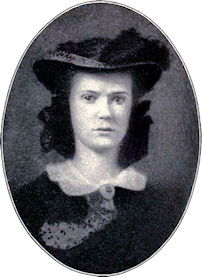
A Confederate Girl’s Diary by Sarah Morgan Dawson

Thursday, April 16th.

Mr. Halsey brought us each a little tortoise-shell ring he had made for us by his camp-fire, as a keepsake, and of course we promised to wear them for him, particularly as they make our hands look as white as possible. Towards sunset, in spite of prayers and entreaties from Miriam, who insisted that I was too feeble to attempt it, I insisted on walking out to the bench by the river to enjoy the cool breeze; and was rather glad I had come, when soon after Dr. Capdevielle made his appearance, with two beautiful bouquets which he presented with his French bow to us; and introducing his friend, Mr. Miltonberger, entered into one of those lively discussions about nothing which Frenchmen know how to make so interesting. . . .

No sooner had they left than, to our infinite surprise, the immortal seven of Saturday night walked in. Wonder what fun they find in coming? I see none. For we rarely trouble ourselves about their presence; there are but two I have addressed as yet; one because I am forced to say yes or no to his remarks, and the other because I like his banjo, which he brought again, and feel obliged to talk occasionally since he is so accommodating, and affords me the greatest amusement with his comic songs. I was about retiring unceremoniously about twelve o’clock, completely worn out, when they finally bethought themselves of saying good-night, and saved me the necessity of being rude. Wonder if that is all the fun they have? I should say it was rather dry. It is mean to laugh at them, though; their obliging dispositions should save them from our ridicule. Last evening Mr. Halsey succeeded in procuring a large skiff, whereupon four or five of them offered to row, and took us ‘way down the Tchefuncta through the most charming scenery to a spot where Echo answered us in the most remarkable way; her distinct utterance was really charming. Not being aware of the secret, I thought the first answer to the halloo was from pickets. Mr. Halsey has a magnificent voice; and the echoes came back so full and rich that soon we appointed him speaker by mutual consent, and were more than repaid by the delightful sounds that came from the woods. The last ray of the sun on the smooth waters; the soldiers resting on their oars while we tuned the guitar and sang in the still evening, until twilight, slowly closing over, warned us to return, forms another of those pictures indescribable though never to be forgotten.

0 comments

Downing’s Civil War Diary.–Alexander G. Downing.

Diary of Alexander G. Downing; Company E, Eleventh Iowa Infantry

Thursday, 16th–The weather is very pleasant. Mrs. Hall, the wife of our colonel, returned to camp today from the North. Another large fleet went down the river today.

0 comments

Diary of David L. Day.

David L Day – My diary of rambles with the 25th Mass

April 16. Work goes bravely on at the fort; one gun mounted today and if we can have two or three days more we shall be ready to receive company. Our little force here is being well handled, and with the aid of the boats can make a stubborn resistance. We heard that Gen. Spinola left Newbern with quite a force, going overland to the relief of Gen. Foster, but when about half way there he got scared and turned back. Gen. Foster will not compliment him very highly for that feat. I have heard a rumor that we have had an invitation to surrender; that a flag of truce came to our lines and requested an interview with the post commander. Col. Pickett went out. They said something about his surrendering, when the colonel replied he had not been in communication with his superior recently and had received no orders to surrender, and that under the circumstances he thought it wouldn’t look hardly military to surrender without first burning a little powder over it. He then dismissed the flag. Bravo, colonel, bravo!

0 comments

A Rebel War Clerk’s Diary

A Rebel War Clerk’s Diary at the Confederate States Capital, By John Beauchamp Jones
A likeness of Jones when he was editor and majority owner of the Daily Madisonian during President John Tyler’s administration.

APRIL 16th—The Federal papers have heard of the failure to take Charleston, and the sinking of the Keokuk; and yet they strive to mollify the disaster, and represent that but little damage was sustained by the rest of the fleet. Those that escaped, they say, have proved themselves invulnerable. The Keokuk had ninety shots on the water line. No wonder it sunk!

Gen. Longstreet has invested Suffolk, this side of Norfolk, after destroying one gun-boat and crippling another in the Nansemond River. Unless the enemy get reinforcements, the garrison at Suffolk may be forced to surrender. Perhaps our general may storm their works!

I learn, to-day, that the remaining eye of the President is failing. Total blindness would incapacitate him for the executive office. A fearful thing to contemplate!

0 comments

0

News of the Day

April 16, 1863, The New York Herald

Our Suffolk Correspondence.

THE FIGHT.

ON THE SIGNAL TOWER (NINETY FEET HIGH),

April 14, 1863.

At eleven o’clock the enemy opened from the direction of the Sommerton road with heavy artillery. We replied with our batteries, when the enemy opened with some light field artillery against our left. To this latter fire we responded with our guns from Fort Dix. Another fort next, to the right, opened with its guns, and still another one, to the right of this again. The enemy replied with moderate rapidity, changing his position as fast as we obtained the range of his guns. Thus the cannonading continued for some little while.

The general scene at this time was one of peculiar interest. On General Terry’s front, a short distance forward, were two or three houses in full flames. Our infantry stood up to the breastworks, while our skirmishers were deployed for quite a distance forward all along in front. The enemy skirmishers stretched out about the same distance; but they had the advantage of rails and other things to protect them, while our men had to lay down and get up in a broad open space – one that we had cleared ourselves – on a smooth open plain. Our infantry reserves held their positions, with cavalry, to the right and left, the camps in the background forming an entire circle, the town in the midst of this; the tortuous, winding Nansemond behind this again, with its burthen of white and lead-colored gunboats, and etceteras always incident to scenes of this character. In less than an hour the enemy stopped firing, and fell back one mile. Our cavalry then went out to charge on a piece of artillery limbered up in the road, when a force of rebel sharpshooters rose up in the woods and delivered at them a whole volley.

We could now see that our shots had done some execution; for several of the enemy’s horses ran off riderless, while more lay dead in the road. Our cavalry retired, when the enemy advanced again with two sections and renewed the fight. So plain was the enemy to view that we could see their officers, or cavalry men, waving their swords and rushing to and fro in haste, and almost recklessness. The wind being strong, blowing towards the enemy, a detachment of the Eleventh Pennsylvania cavalry advanced again and set fire to several houses by the roadside. This they did in the coolest and quickest manner possible. Our shells also set fire to some woods near by. By this maneuver we caused a dense smoke to blow, so to speak, directly in the face of the enemy’s force working their guns. In order to get clear of the smoke the enemy would thus be compelled to move his artillery nearer, or to either side of the road, thereby giving us a better chance for sight and range. After this the firing became less lively, the enemy firing a few shots, then retiring, and then again advancing, and the like. Up to this period the engagement was confined to Acting Brigadier General Foster’s and Acting Brigadier General Murphy(Irish Legion) brigades.

By one o’clock the enemy had ceased firing, doing so only occasionally, and we were shelling them out of the woods.

A train is going to Portsmouth now, and I must close this despatch. My next one will contain the afternoon proceedings. We have no news yet of any one killed or seriously wounded.

0 comments

0

News of the Day
1860s newsprint

April 16, 1863, Tyler Reporter

All persons who have heretofore been exempted, in the county of Smith, from enrollment for service, under either of the following heads, are ordered to report to me, at my office in Tyler, on or before the 20th day of April next, for a fuller and more minute investigation of the grounds upon which exemptions in such cases were granted:

Salt Makers, Wagon Makers, Shoe Makers, Blacksmiths, Tanners, Millers, Overseers on the plantations of Widows and Soldiers, Persons taking care of indigent families, together with all others, who have not yet reported, between the ages of 18 and 40 years.

Those who are now standing exempt from either of the causes above mentioned, will be ordered into camps who refuse to obey this order, and treated as deserters.

 April 7th, 1863.
J. M. Taylor, En’g Offi.


0 comments

0

News of the Day
1860s newsprint

April 16, 1863, Savannah Republican (Georgia)

 The Texas Pioneer says Gen. Magruder has ordered that, if the militia, which have been called for the defense of the State, will organize into companies, and have their arms, ammunition, equipage, &c., boxed and sent to the Ordnance Office at Houston, they may be disbanded and allowed to return home. They will be required to muster once a week, in order to go into action whenever called upon; but the “arrangement is made in the hope and expectation that the militia will not be called away again from their industrial pursuits.”

0 comments

0

News of the Day
1860s newsprint

April 16, 1863, Tyler Reporter

Whenever, says the Rebel, you hear of a regiment, battalion, company, or squad, infantry or cavalry, destroying fences and other property of farmer citizens, you may safely set it down that the Colonel, Lieutenant Colonel, Captain or Sergeant of the party is not fit for an officer, and a disgrace to the honorable profession of arms.

The above contains a great truth and an important lesson, which it will be well to learn.

0 comments

0

News of the Day
1860s newsprint

April 16, 1863, Tyler Reporter

The death by freezing of twelve Confederate prisoners at Camp Douglas, Ohio, has been noticed. The 22th Illinois (Scotch) regiment, on guard there held a meeting and protested against the condition of the camp and barracks. The Chicago Times has the following particulars of the death of the prisoners:

Word was brought to the city last evening that during the night of Sunday, twelve of the Confederate prisoners confined in the pens at Camp Douglas were frozen to death. It is asserted that on Monday morning they were found in the miserable handful of hay in their bunks frozen stiff, though to all appearances in the enjoyment of perfect health the day previous. The barracks of Camp Douglas are well known to be totally unfitted, during the prevalence of such weather as the present, for the use of anything, scarcely cattle. Those in which these prisoners are confined are many of them destitute of stoves, the windows in some of them are broken out, and through the holes and the cracks in the apertures in roof the cold wind freely enters.

It is said that the local officers at the camp, actuated by a humanity their superiors might pattern after with profit, have done all in their power to make the condition of the prisoners comfortable.–But there are those above them who have a terrible sin to answer for. It were mercy that, after their capitulation, our cannon had been turned upon these prisoners and butchered them where they stood, rather than a far Southern clime, without any preparation being made for their comfort or protection, they should be transported hither, to meet with scarcely anything worthy the name of shelter, the fierce rigors of a Northern wind–to be murdered by neglect–to endure the tortures of a death by cold.

0 comments

0

News of the Day

April 16, 1863, The New York Herald

Our latest news from General Foster at Washington, N.C., up to the 12th instant, states that he can hold out for three weeks; that he has plenty of supplies, and can resist any force the enemy have to bring against him. On the other hand the rebel accounts represent his position as most critical. The Wilmington Journal of the 9th says that Washington was actually in the hands of General Hill on the day previous; but this is not probable.

Our Newburn correspondence today gives a full account of the fight at Blount’s Mills, from which our troops were compelled to fall back to Newbern, and were thus unable to reinforce General Foster.

There was a pretty heavy skirmishing going on during Tuesday and Wednesday on the Blackwater, near Suffolk, in which the forces of General Peck engaged the attacking party of the rebels with some success. Our Suffolk correspondence contains a very full account of the affair.

We give numerous extracts from the Southern journals today, and despatches from different points in Rebeldom, including Charleston, Mobile, Vicksburg, Chattanooga, and Jackson, Mississippi. The affair at Charleston forms the principal subject of comment in the Richmond papers. They are exultant over the failure of our iron-clads to capture the city, but erroneously credit it to the firing of the forts; whereas it is known that it was owing to the obstructions in the channel that our boats did not knock Charleston to pieces.

The Richmond Whig reports that a fight took place at Williamsburg on Saturday, the 4th inst., between the forces under General Wise and our troops; that at an early hour on that morning the rebels drove in the Union pickets and occupied the town, the latter retiring to Fort Magruder, from which point they commenced shelling the place. General Wise took a position near the college and replied to their fire. [continue reading…]

0 comments

0

News of the Day
1860s newsprint

April 16, 1863, Tyler Reporter

 The Little Rock True Democrat has the following concerning the Arkansas Post Prisoners. We trust their treatment in prison has not been so bad as represented. It now appears very certain that they have been exchanged, we shall probably hear from them soon:

 The prison at Camp Douglas, Chicago, is a prefect pest house and slaughter pen. Our brave men immured in these dungeons die rapidly, and the infernal rascals who control the prison refused the patriots blankets, medicines or proper food. It was a vast receptacle of mud and filth, surrounded or covered by stagnant water, and so unhealthy that the guards stationed there began to sicken and die. The small pox broke out, and the would-be murderers became alarmed at the danger of disease spreading and grew afraid that in their attempts at the slow murder of patriots, they might spread disease among themselves. Of late, we are told, they have made some efforts to clean up the prison and build a hospital. Whenever we have found a list of deaths there, we have published the names of the Missourians, Arkansians and Texians. The following we find among the names of those who died in the four days, from 24th to 27th February:

 (We only give those from Texas.)

 John W Renfrew, of 7th Texas; James Jackson, T C Towell and R C Edmondson, of the 10th Texas. T Perry, D D Turner, W McMinn, Daniel Ketsell, W H Meigs, T R Tankerley, Allen Brian, W H Milton, Morton V Walker, W H Wilhams, Daniel J Tramel, B F Christopher, W S Coleman, and Robert T Work, of the 15th Texas. K A McKnight of the 16th Texas. Creed Engledon, Joseph Swinney, W O Taylor, Joseph Cobb, A P Lowry, E B Burris, R G Granberry, Thos S Watkins, Martin M Pendegrass, W O Embry and Allen F Barber of the 17th Texas. W A Stewart, A G Early, Thomas Elliott, T T Winn, W M Reynolds, Jos W Stetes, Joseph W Styles, N J Hyde, James B Ware and W H McDaniel, of the 18th Texas. John Foster, of the sappers and miners. Hugh March.

0 comments

0

News of the Day
1860s newsprint

April 16, 1863, Daily Mississippian (Jackson, Mississippi)

 We learn from Gen. Pearce, who has just arrived here, that Fox Hart (nephew of Martin D. Hart, who was hung at Fort Smith), with thirty of his men, have been captured near Greenville, Hunt county. The refugees were found in the Journigan Thicket, from whence they had sent out some negroes, which they had stolen in Arkansas, on a foraging expedition, and were captured; and after the negroes were whipped, they gave information of the hiding place of Hart and party. Two boxes of Enfield rifles were also captured, and a large quantity of ammunition. Fox Hart was shot, and the remainder of this notorious party were sent to Little Rock, where we hope they will receive that justice due deserters and traitors to their country.–Austin Gazette.

0 comments

0

News of the Day

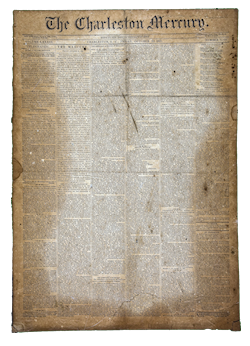
April 16, 1863, The Charleston Mercury

The number of blockading vessels off this port yesterday was eleven.

No movements worthy of note have been observed on the Island below, recently occupied by the enemy.

The Yankees were engaged Monday night in shelling Chisolm Island, near where the steamboat Washington was burnt by our troops, under Captain STEPHEN ELLIOTT, Jr. Their object was, doubtless, to prevent our men from taking off the guns from the wreck. Captain ELLIOTT’S Beaufort Artillery Company had secured one twenty-four pounder brass howitzer, also the bell of the steamer, besides a considerable number of rifles, clothing, &c..

0 comments

0

News of the Day
1860s newsprint

April 16, 1863, Peoria Morning Mail (Illinois)

 We are informed that a rather rich, but withall a rather humiliating affair came off a few days since in the Provost Marshal’s office in the city of St. Louis. Michael Foley, a resident of Bath, Mason county, last week took a trip to St. Louis. While walking along the street he happened to meet a band of rebel prisoners. Their appearance in a uniform entirely new to him attracted his attention and without stopping, he continued to look at them, probably thinking that in this great and glorious country, which is at present under the law martial, it was no harm to look at a passing pageant, even if it was principally made up of rebels. But he had forgotten that Abraham is a man more careful of the loyalty of his people than any of his predecessors have found it necessary to be. He had not quite concluded in his own mind whether the procession was an object of pity or contempt, when he was touched upon the shoulder by a uniformed gentleman, who politely invited him to recreate himself a while in the Provost Marshal’s office. Of course he accepted the invitation at once, since it has occasionally been noticed, that to decline an invitation given in that delicate sort of way, has an effect to confuse the programme.

 When arrived at the Provost marshal’s office, he was cross-question for an hour, insulted by pompous officials, threatened, and brow-beaten, to make him say something by which he could be convicted. During the examination the following questions were asked and answered:

 “Are you a Democrat?”

 “No!”

 “Have you read the Chicago Times?”

 “Yes!”

 “Do you endorse it?”

 “Partly!”

 These questions seemed to throw some light on the cause of the arrest, but Mr. Foley, being naturally of an inquiring mind, naturally became the questioner, when the following colloquy, substantially, took place:

 “Do you make a man’s politics a test of his loyalty?”

 “Yes, to a certain extent!”

 We cannot avoid saying that the answer last recorded was, in our opinion, disingenuous. They make it a test of loyalty to a very uncertain extent!

 After the examination was finished, and Mr. Foley had time to see what it all meant, he concluded that he was guilty of the crime of being dressed in a suit of homespun clothes, which, it seems, is sufficient cause of arrest in St. Louis, under the mild administration of a Provost Marshal.

0 comments

0

News of the Day
1860s newsprint

April 16, 1863, Tyler Reporter

Head Quarters Clark’s Regiment, }
Camp Near Pine Bluff, Ark., Feb. 23, ’63. }

To the people of Texas:

You have always been noted for the readiness with which you give aid to your country when she needs assistance. You have liberally and nobly contributed in the prosecution of the present war. You are still willing to do so, I know, if further contributions are necessary. Though the present indications are somewhat propitious, we should depend alone upon ourselves for peace. Other nations may help us when it suits their interest to do so, and our enemy is not worthy of trust in any case. There may yet be much hard fighting to do to end the war, and the commands now in the field having been depleted by death and other causes, need replenishing. It devolves upon you to fill them up, and I therefore invite your attention to the following extract from a circular of the Adjutant and Inspector General, of date the 18th January, 1863:

“Such persons as are liable to conscription will be allowed to join any particular company and regiment, requiring recruits, in which the officers “(enrolling or recruiting)” may be serving. In like manner such persons as are within conscript ages, and who may come forward and offer themselves for service, will be allowed to volunteer, and will receive all the benefits which are secured by law to volunteers. Recruits thus obtained, however, must, in all cases, enter companies already in the service, and cannot be organized into new companies or regiments.”

By the above extract you perceive that you still have the opportunity of volunteering. Forced service is distasteful to you. It would be an anomaly in the history of Texas. I desire to replenish my regiment, and invite you to join me. I would be pleased to receive you, and think you would find as pleasant service in my command and the Brigade to which it is attached, as any other. Capt. L. B. Wood, Company “K,” of Polk county, and Lt. J. D. G. Adrian, Company “C,” of Smith county, are on their way to Texas, and are authorized to recruit for their respective companies. Other recruiting officers will be dispatched to Texas and notice given.

Edward Clark.
Col. Clark’s Tex. Regt.

0 comments

0

News of the Day
1860s newsprint

April 16, 1863, Peoria Morning Mail (Illinois)

 A merchant in New York, advertising for a boy, adds: “Lads who part their hair in the middle need not apply.”

 If the Administration had put that clause in their “proposals for Generals,” the country would have been better served than it has been. Fremont in that case would never have been favored with a command.

0 comments

0

News of the Day
1860s newsprint

April 16, 1863, Peoria Morning Mail (Illinois)

Letter from the Hon. Mrs. F.

 A few days ago, one Mrs. Fulgum, from Richmond, Virginia, was arrested at the outposts, and a number of letters for rebels in Nashville were taken from her person. She gave the Provost Marshal some unsealed letters, probably to avoid suspicion, but one sealed and directed to “Mrs. Anna Hays, Nashville, care of ex-Mayor R. B. Cheatham, or Robert T. Smiley, Esq.” was found in her custody. Upon perusal, this letter was smart and interesting. Your readers will certainly enjoy those portions which I have copied for the public. The writer is the wife of a notorious ex-member of Congress of the United States, and a member of the present Confederate Congress. Her son, Capt. H. S. ‘F., is Adjutant General on the staff of the rebel Major General McCown.

Richmond, Va., Feb. 6, 1863.

 “My Dear Anna–I have an opportunity offered this morning for conveying a letter to you and enclose it gladly. * * * My little boy is named ‘Malvern.’ His papa called him after the battleground of Malvern Hill, where our braves fought so nobly. He begins to play, and tries to talk. He spits at the Yankee pictures, and makes very wry faces at Old Abe’s picture. He is a great boy, and the best and prettiest baby I ever saw. He is much petted by the members of Congress who know him. Mr. F. is very much engaged in the House during the day. * * * * *

 “We are boarding at Mrs. Johnson’s, on Governor street, just opposite Governor Letcher’s mansion. It is a large boarding house, high prices and starvation within. Such living never was known before on earth. Tell grandma the poorest hut in the western district of Tennessee is a palace compared with this, so far as fare goes. We have to cook almost everything we eat in our own room. In our ‘larder,’ the stock on hand is a boiled bacon ham, which we gave only eleven dollars for; three pounds of pure Rio coffee we gave four dollars per pound for, and one pound of green tea at seventeen dollars per pound; two pounds of brown sugar at two dollars and seventy-five cents per pound; one bushel of fine apples, about the size of a good common marble, which were presented to me by a member of Congress from Missouri; one pound of butter, about six months old, at two dollars per pound, and six sweet potatoes at fifty cents. We have to give a dollar for a very small slice of pound cake, at the confectioneries. I forgot to say I had a present of a fine jar of pickles and a piece of cheese from a member also. Well, so much for the way we live. You see the board is three dollars, each, per day, for F. and I, and half price for the servant, and then we get nothing on earth to eat. Yesterday, for dinner, we had nothing on the table but two eggs and a slice of cold baker’s bread, and a glass of water. Well, linen such as we gave one dollar for at home, when I left, sells here at six dollars, and the commonest domestic two dollars, calico two or three collars per yard of the most indifferent kind. You may well believe I got but little. Richmond is strictly a Jewish city–all making fortunes out of the war, and having less sympathy for our dear old Tennessee, and Nashville in particular, than some Yankees have; for they have learned to respect us, whereas these Virginians are the most horridly envious creatures that ever called themselves men.

 “The women are far below the standard of Nashville ladies, either in elegance or refinement. There is seldom a lady seen who shows the gift of high-born gentility here. Such have generally abandoned this city and retired to the country to keep recluse, so that the mongrel race reigns supreme on the street and at all frequented parts of the city. Still we have some very delightful acquaintances, who show their hearts and homes are near the sun. * * * We find Gov. Letcher’s family real types of the Old Dominion gentry. He has a daughter just your size. * * * There are about a dozen unmarried members here who promised me to vote the capital where I wished if I would provide them a ‘chance’ with my little queens. They all agree the Nashville girls are the belles deservedly of the Southern Confederacy. * * * You have heard, I reckon, that Mr. Harris the minister, married a Miss Emily Johnson, of Jackson, Miss. She is worth a million in her own right. He drives his coupe, and is quite a dasher, and declares he never courted any girl in Tennessee. He has quit preaching and is very clever and hospitable in his house. Don’t let any one see this, but you may read it to them, except _____; I don’t want the Yanks to hear what I say.”

 The Honorable Mrs. F., having more to say, added another sheet of letter paper, of which the following is rather racy:

 * * * “Joe Pickett is here from Memphis. He is courting a Miss M____n, a great belle–ugly and rich. * * * Gen. Price is here on business. He is a fine gentleman and very handsome. * * * Tell them (the writer’s children–Correspondent Commercial.) Mrs. Jeff. Davis is not pretty, but a fine looking woman–dresses badly, in no taste. She is not much liked here, and is said to control “Jeffie,” as she calls her husband. She has several children. She takes but little notice of them. They go about with their clothes tossed on in any way and every style. ‘She has the public affairs to attend to.’ Ask Aunt Kitty what she thinks of that.

 “The President looks careworn and troubled. He is very thin, and looks feeble and bent. He prays aloud in church, and is a devout Episcopalian. Dr. Wheat and Mrs. Wheat are here. They came on to have the remains of Robert Wheat removed to this place. Mrs. Wheat is most heart-broken. She has lost her two oldest sons in the war.

 “Ever your devoted friend and aunt,

  “Chattie.”

 The italics are those of the Honorable Mrs. F.
 

0 comments

0

News of the Day
1860s newsprint

April 16, 1863, Tyler Reporter

Brownsville, Texas, March 18th, 1863.

Mr. Hamilton:

Some seven or eight days ago, the Yankee transport “Honduras” anchored off the mouth of the Rio Grande, and amongst its precious cargo was to be found E. J. Davis, a renegade citizen of Texas, who at one time disgraced the Texas bench, but who now is commissioned a Colonel in the abolition army; the notorious murderer and renegade, Montgomery, with a commission as Captain, was his confrere and fellow traveller. They came to Matamoras, and for several days, were engaged in enlisting renegades into their service at that point. Some few desertions from a certain class of our soldiery occurred, and owing to the assumed neutrality of Mexico we were forced to submit to it. We met daily in the streets these hated minions of a Government which has been seeking for two years to accomplish our destruction, and were forced to stay the avenging hand; were forced to submit to witness the loathesome sight of those who claimed to be citizens of Texas, parading the grand Plazas of Matamoras in the Federal uniform. Some 170 of these traitorous wretches had congregated there, and reveled in their supposed security. A few days ago they left Matamoras, and proceeded to Bagdad, a Mexican town near the mouth of the river, and just opposite a point where a small Confederate force was stationed. Here again they began a series of indignities which were very provoking. Being still impressed with the idea of their safety, on account of the declared neutrality of the soil upon which they were camped, and emboldened by being under the guns of the “Honduras,” their cowardly natures prompted them to peer at and insult our brave boys. On the night of the 14th of March, Gen. Bee having gone to “Point Isabel,” the boys thought the opportunity too good to be lost, and “made their arrangements according.” About 25 of them left Fort Brown, and by the time we reached the mouth the number was increased to 70. We secured a sufficient number of boats to cross our entire force at once. This we did at 4 o’clock a.m. After reaching the town, our force was so disposed as to cut off the retreat of the renegades. Learning that the Mexican Commandante had about 160 Mexican soldiers in the town, and not wishing to come, unnecessarily, in conflict with them, the commandante was notified of our purpose and requested to withdraw his soldiers from the danger of a collision.–Surrounding the house in which Col. Davis was said to be, he was ordered to surrender, and, I regret to say, he did so. Had he made resistance, the world would have been well rid of a treacherous monster, and Texas of one of her most unworthy citizens. The notorious Capt. Montgomery, who was a participant with “Jim Lane” in his Kansas outrages, was soon afterwards captured, with some five or six others. Many of them eluded our search by hiding in Mexican houses, in steamboats, schooners, &c., but many of them, in attempting to escape, were unfortunate, and are now filling the capacious maws of Mexican “riotas” and Buzzards. At 6 o’clock a.m. we had accomplished our work, and were returning to our boats for the purpose of recrossing the river into “Dixie land,” when the Mexicans dashed out of their houses and delivered upon us a deafening but harmless volley. Our commander immediately wheeled the boys into line, and ordering them to hold their fire, returned to the town and assured the Mexican authorities that we had no design to injure the people or insult the nationality of Mexico. This seemed to quiet them, and we again resumed our march, when some 60 or 80 Mexicans again made a dash and fired upon us. This time we had one of our boys wounded, and could stand it no longer. We were ordered to fire, and upon the first fire these “heroic soldiers” fled in confusion.

Having accomplished our purpose, we crossed the river and started for Fort Brown, where we arrived safely with one prisoner only, (Col. Davis) the others having escaped on the route. Davis would have escaped also, but for the fact that when taken, his wife was with him, and made such a strong appeal to our commander to spare his life, that he agreed to do so, until delivered to Gen. Bee, and the boys faithfully adhered to this promise. He was to-day delivered to Gen. Bee by some unknown parties. The Mexican authorities regarding the crossing into their territory as a violation of her neutrality, demanded the return of Davis, which Gen. Bee, in order that we might not complicate our affairs at this time by a war with Mexico, and for other important commercial reasons, acceded to. Davis may thank his stars that he had a wife, and that his wife happened to be the daughter of Forbes Britton, and happened to be present when he was captured–else his long, ungainly, foul carcass would now be dangling from a Rio Grande Maguite. Unless he leaves this section of the country immediately, his release will only be temporary.

I am only reconciled to his being permitted to return to his infamy, by the hope that I shall soon meet him upon the battle-field, when the tears and entreaties of his wife, may not stay the hand of vengeance. I wish I could mention the names of the brave boys who participated in the arrest and punishment of these vile traitors, but predential considerations restrain me. They all acted like the genuine Texas soldier, and showed themselves capable of great achievements. I counted 72 vessels, lying off the mouth. To-day an English-man-of-war, came to anchorage. The morning of the fight, a Yankee vessel left for New Orleans, for reinforcements, and we may have lively times here in a few days. We will probably fight against odds, but I feel confident of the result.

I have written you a long letter, but hope you and your readers may find something of interest in it. To them, as to you, if it should prove uninteresting, I promise to do better next time.

Yours, with the greatest confidence in your
prudence and patriotism.
UNKNOWN.

 N.B.–”Escape” has a technical meaning out here.
  U.K.

0 comments

0

News of the Day

April 16, 1863, The New York Herald

Our Suffolk Correspondence.

ON SIGNAL TOWER, SUFFOLK, Va.,

TUESDAY, April 14 – 9. A.M.

During the entire night we were engaged in the construction of new fortifications, by order of General Peck, under the immediate superintendence of Lieut. James, Topographical Engineers. For this work we used and are using every able bodied contraband in town. We even went through the town and have taken the men servants out of the saloons, private houses, &c. The darkeys have worked well, and can now appreciate the value of these […..] dirt heaps,”as they style them.

This morning the sun shone out in full vigor, making joyous the hearts of men and officers; for if there is anything that operates greatly to depress the spirits it is to compel men to fight in mud and rain.

The gunboats are hard at work shelling the woods on the off side of the Nansemond river, at every point where it is thought the enemy is likely to be or contemplate erecting batteries.

About ten o’clock last night a deserter came into our lines, bringing the following information: –

“The Confederates have taken 2,000 prisoners at Washington, N. C., including the federal killed and wounded. They captured the whole garrison, including guns and everything else.” Whether this news is true or not your correspondent cannot tell, other than the report of this deserter. (Our advices from General Foster are to the 12th instant, in which it [continue reading…]

0 comments

0

News of the Day

April 16, 1863, The New York Herald

Our Suffolk Correspondence.

ON SIGNAL TOWER, SUFFOLK, Va.,

Monday, Midnight, April 13, 1863.

It will be remembered that my despatch of this morning left the enemy firing with his artillery from the Sommerton road. At one o’clock he ceased firing and retired in good order. About three o’clock P.M. he appeared on the same ground and renewed the fight. After a brief engagement he was again forced to fall back, owing to our ability to concentrate some thirty-five guns on any one given point.

During the afternoon the enemy appeared n the other side of the Nansemond river, and attacked our gunboats with dismounted cavalrymen and sharpshooters, causing a loss to us of only two or three wounded. Four of the gunboats opened fire at once upon the enemy, when he fell back into the woods. From this place we dislodged him with the aid of shell. He then retired still further back, occasionally displaying a few scouts in the tops of trees and mounted ones at other prominent points.

The enemy opened a signal station on the Petersburg Railroad, where it crosses the Franklin Railroad, during the early part of the afternoon. We soon discovered that this station was of immense advantage to him, in that he could signal for many miles up and down the line of the railroad. To destroy this station, which was three miles distant, became a military necessity, and the gunboat Smith Briggs, Captain Lee, was ordered to do the work. From the deck of the gunboat nothing could be seen beyond a mile except the wood. But the firing commenced, and with the aid of our signal officers, who, placed in three positions – one in the extreme advance toward the station, the other on the main tower in town, and still [continue reading…]

0 comments

0

News of the Day
1860s newsprint

April 16, 1863, Tyler Reporter

A letter in the Houston Telegraph, from Brownsville, of date the 28th of March, says that the clouds raised by the recent abduction of Davis and others from Mexican territory, and the more recent seizure of a Federal schooner in the anchorage off the mouth of the Rio Grande, which threatened so much to interrupt the friendly relations of the frontier, have gradually subsided, and given way to halcyon signs of peace and kindness. Matamoras is said to be filled with goods, and causes are operating to give prices a downward tendency. On the 28th there were nearly a hundred vessels at the anchorage awaiting their discharge.

0 comments