April THURSDAY 30, 1863
Shallie & I went to Maj Nace, 15th Ill whom I nursed while a prisoner in our Hospital—he recovered my things, and kindly gave me a permit, but being old Abe’s fast day, I came home without them and will return tomorrow.

April THURSDAY 30, 1863
Shallie & I went to Maj Nace, 15th Ill whom I nursed while a prisoner in our Hospital—he recovered my things, and kindly gave me a permit, but being old Abe’s fast day, I came home without them and will return tomorrow.
APRIL 30th.—The enemy are advancing across the Rappahannock, and the heavy skirmishing which precedes a battle has begun. We are sending up troops and supplies with all possible expedition. Decisive events are looked for in a few days. But if all of Longstreet’s corps be sent up, we leave the southern approach to the city but weakly defended. Hooker must have overwhelming numbers, else he would not venture to advance in the face of Lee’s army! Can he believe the silly tale about our troops being sent from Virginia to the Carolinas? If so, he will repent his error.
We hear of fighting in Northwestern Virginia and in Louisiana, but know not the result. The enemy have in possession all of Louisiana west of the Mississippi River. This is bad for us,—sugar and salt will be scarcer still. At GrandGulf our batteries have repulsed their gun-boats, but the battle is to be renewed.
The railroad presidents have met in this city, and ascertained that to keep the tracks in order for military purposes, 49,500 tons of rails must be manufactured per annum, and that the Tredegar Works here, and the works at Atlanta, cannot produce more than 20,000 tons per annum, even if engaged exclusively in that work! They say that neither individual nor incorporated companies will suffice. The government must manufacture iron or the roads must fail!
A cheering letter was received from Gov. Vance today, stating that, upon examination, the State (North Carolina) contains a much larger supply of meat and grain than was supposed. The State Government will, in a week or so, turn over to the Confederate Government 250,000 pounds of bacon, and a quantity of corn; and as speculators are driven out of the market, the Confederate States agents will be able to purchase large supplies from the people, who really have a considerable surplus of provisions. He attributes this auspicious state of things to the cessation of arbitrary impressments.
Previous post: Stonewall & Lee disapprove application for leave of absence.
April 10—Procured subscribers for sundry religious papers and forwarded $73.50 for them. Wrote to wife. Met Rev. Bennick, of S. C. Conference, chaplain 24th N. C. Regiment, Bro. Marshall, 12th Georgia Regiment, conducts morning prayers for me. Get bundle N. C. Christian Advocates. The paper is revived, thank God! Get letters from Rev. M. Miller and Rev. J. J. Lansdell. Write to Rev. W. E. Pell.
April 12—I kept a little volume in my bosom, giving a verse of scripture for each day in the year. The verse for April 12 was Matt. 26, 42: “Oh, my Father. if this cup may not pass away from me, except I drink it, Thy will be done.” By his help I said: “Thy will be done,” and went on happy in my work. Bro J. Wm. Jones, 13th Va. and Dr. Curtis, 57th N. C. Regiments arrive. Bro. Jones preaches for me. Dine and walk to Bro. Jones’ regiment and preach. After supper I walk alone by Hamilton’s Crossing to camp. Letter from Bishop Atkinson.
April 13—In camp. Visit Geo. T. Swain at Younge’s.
April 14—Meet chaplains. Rev. Brigadier General Pendleton, D. D., was with us. Bro. Nelson preaches. Happy meeting. Chaplains agree to pray for each other at sunset every day.
April 15—Rainy day. Oh, Mary, I expected to start to you to-day!
April 16—Write to Mary. Visit 20th and 12th Regiments.
April 17—Walk to Hamilton’s Crossing to get telegram from wife. Buy twenty-four Testaments. Bro. Jones walks back to 60th Georgia Regiment with me.
April 18—Chaplains Patterson and Smith at prayers with us. I preach to Gordon’s Brigade. Bro. Lacy preaches in p. m.
Sun, 19—Prayers early. Preach at 10 a. m. Get telegram. “I am well,” from wife. Thank God! Oh, Father, be with her! Preach in 2nd Regiment in p. m. Prayer meeting in Co. “G,” at night. Decided interest.
Apr 20—Rain all day. Public service at 10. Read and explain Deut. 20. Get ten days furlough. Having sold my horse several months before, I was now trying to buy. Not finding a suitable one for sale, when the spring campaign, soon to open, made such demand for them, my Colonel encouraged me to apply for ten days furlough to go to North Carolina to buy one, hoping I might yet reach my wife in time to see her pass an impending crisis.
Tuesday, Apr. 21—Damp morning. Receive two men into the church at morning prayers. Start to North Carolina.
At the beginning of the Confederate War, a chaplain was not allowed forage for a horse. I believe the U. S. Army Regulations never considered a Chaplain a mounted officer. My Colonel always drew forage for my horse as one of his. I am told that “Stonewall” Jackson asked our Congress to allow forage for each Chaplain, because he thought they could be so much more active and efficient by being mounted. My being mounted gave me a chance to help many a foot-sore, sick or wounded man. I could walk for hours and give a ride to the foot-sore or wounded. I could stop or turn aside and look after the wounded, and then hurry on and overtake my Regiment.
Apr. 23—Get to Chapel Hill at 7:30 a. m., and find all well.
Apr. 24—At home.
Apr. 25—Our fifth child, a son, is born at 3:30 a. m Mother and child doing well. Thank God!
Apr. 26—Hear Bro. Jenkins preach twice.
Apr. 27—Plant corn and beans.
Apr. 28—Buy little black mare from Charles Johnson for $200. Rain.
Apr. 29, 1863—Over thirty-three years have passed since I wrote my diary for the above day. With a grateful heart I copy the exact words. “I wish here devoutly to acknowledge that merciful Providence that has guided me for twenty days past.” I leave wife and little ones early. God blesses me at the family altar. Ride on horseback. Spend night with Mrs. M. Waller at Knap O’Reeds. Bros. Peed and Tilly called and sat with me awhile.
Apr. 30—Meet Rev. W. C. Gannon, my Conference class-mate at Tally Ho. He rides with me to Oxford. I dine with Rev. L. K. Willie. Miss my way and meet Col. C. P. Taylor. He went out as Captain of Co. “G” of 30th Regiment, but retired in May 1861. He lived and died a noble Christian. Pass Williamsboro, Townsville, and spend night with Charles Taylor.
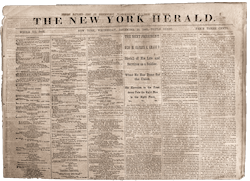
April 30, 1863, The New York Herald
The Advance Movement of the Army of the Potomac.
WASHINGTON, April 29, 1863.
It was generally believed on Monday, and in some quarters positively asserted, that the Army of the Potomac had commenced moving, and a Washington paper of the next day openly proclaimed it as a fact. In this respect that newspaper had a decided advantage over the wires, But even if the intelligence had been telegraphed through loyal sources it would have been no news to the rebels; for a Fredericksburg correspondent of one of the Richmond paper writes his […..] is confirmed” that our […..] is withdrawing from the line of the Rappahannock.” The observation of newspaper men, ever since the war commenced, leads to the conclusion that nearly everything the Army of the Potomac does is promptly known to the rebels, and one occasion even the countersign was known to them before it was communicated to our own troops.
Review of General Sickles’’ Corps.
OUR ARMY CORRESPONDENCE.
HEADQUARTERS, THIRD ARMY CORPS,
ARMY OF THE POTOMAC, April, 27, 1863.
It was not an insignificant compliment which was paid to General Sickles’ corps by the General commanding this army in ordering it our for service today. The occasion was the visit of the venerable Secretary of State and a large party of [continue reading…]
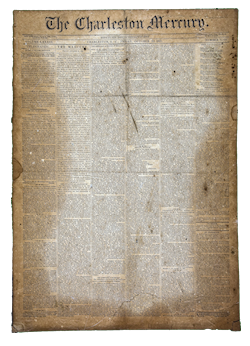
April 30, 1863, The Charleston Mercury
LATEST FROM BRAGG’S ARMY.
CHATTANOOGA, April 27. – Our army is in line of battle at Wartrace. General JOHNSTON has taken the field. The enemy’s advanced pickets are within two miles of Wartrace. The skirmishing on Saturday failed to move the enemy’s advance.
RODDY’S cavalry has advanced from Tuscumbia. The enemy is now at Little Bear Creek, six miles from Tuscumbia. The enormities committed by the Hessians of GRANT’S army, are unparalleled. They are burning houses over women’s heads, destroying corn fields, robbing housed, and have torn rings from women’s fingers.
RODDY’S fight is considered the most brilliant and desperate of the war. Maj. JOHNSON and Capt. LEFFE greatly distinguished themselves.
April 30, 1863, The New York Herald
The only news from General Hooker’s army, notwithstanding the reports of an advance movement, is the details of the splendid review of General Sickles’ corps by Mr. Seward, the Prussian and Swedish ministers and a number of other distinguished personages on Monday.
The raid of the rebels into Western Virginia has created an intense excitement all along the line of the Baltimore and Ohio Railroad, especially at Wheeling. The enemy in strong force had advanced to within seven miles of Grafton, where Colonel Mulligan was in command. The President of the Baltimore and Wilmington Railroad states that only one train of empty cars was stopped by the rebels, and only one bridge – that near Oakland – was destroyed.
The recent defeat of the rebels at Cape Girardeau, Missouri, was a very creditable affair for our troops. The forces of General Marmaduke, while retreating, were surprised by the Union troops in pursuit on Sunday night, and one entire regiment was cut off. All who were not either killed or wounded were made prisoners, and their camp equipage, guns, horses and plunder were taken from them. Generals Vandever and McNeil followed the rest of General Marmaduke’s army on the next day, pressing closely on their rear.
One day’s later news from New Orleans, by the Empire City, puts us in possession of the fact that General Banks had taken possession of the Opelousas Railroad, and he had communicated with Admiral Farragut above Port Hudson. He had captured a large number of rebels, also a large amount of stores, cotton and ammunition, from the rebels. About five hundred rebel prisoners were arriving daily at New Orleans when the Empire City sailed. [continue reading…]
April 30, 1863, Savannah Republican (Georgia)
The Augusta Manufacturing Company, through their President, Wm. E. Jackson, Esq., have generously allowed ten bales of sheetings and shirtings of their manufacture to be taken to Lake City, Fla., to be sold to the families of sick and disabled soldiers, and families of soldiers in the service, at a small advance on cost. It will enable very many families, whose means are limited, to obtain the goods at less than half the rates charged by merchants. Such acts of kindness should not pass unnoticed in these days of high prices, and this is recorded with the hope that the example may be followed by many who are able to come to the relief of the needy in this time of trial.
April 30, 1863, Savannah Republican (Georgia)
In spite of all the efforts of Confederate journals North and South to conceal the fact, or deprive it of importance, no doubt remains that very serious bread riots have taken place in Richmond and other southern towns. In these riots the women have been the leaders; and that fact alone proves that absolute hunger must have been the cause of them. Women do not get up street riots, break open provision shops, and pillage bakeries and flour stores from political sympathies, nor from resentment against high prices. When their children are in peril of starvation, they become capable of anything. Nothing short of that extremity can have provoked the demonstrations admitted by the Rebel papers to have taken place in Richmond, in Raleigh, in Salisbury and many other Southern towns.
In each of these cases the rioters were women–”mostly soldiers’ wives,” say the North Carolina papers, that give account of the latest transactions. And these papers, more honest than those at Richmond, candidly admit that the women were prompted by hunger, their spirit sharpened, perhaps, by “hatred against speculators.” The women armed themselves with hatchets and axes, broke upon stores that were not willingly opened to them, and took barrels of salt, flour and molasses, which they had hauled to the market house and divided equally between those who needed it. This was a real hunger riot, and no cloak for indiscriminate robbery, as pretended in Richmond. The Raleigh, N.C., Standard, in giving an account of it, exclaims with feeling, and with despair: “Bread riots have commenced, and where they will end God only knows.”
We do not wish nor expect to create hopes of advantage over the rebellion by the mere representations of scarcity of provisions in the South. The best reliance–as it is, indeed, the only one–that a wise and powerful government should have, is the arm of military power delivering irresistible blows upon the enemy in the field. But it is certainly sound policy to consider the physical condition of the enemy we are contending with, and take advantage of any moment of weakness and exhaustion that may come upon him. That time with the Rebels we surely believe is now. We have cumulative evidence that a scarcity of food never before paralleled exists in the South, that is weakening the Rebel army, disturbing the Rebel rulers, and upturning the most inveterate traditions and usages of Southern society. This is the time, then, to press our armies upon the enemy, and still further disturb and disorganize his agriculture. Two months hence it may be too late. He may have then harvested his crops and passed the point of famine.–N. Y. Times.
April 30, 1863, The Charleston Mercury
FROM VICKSBURG – THE YANKEE GUNBOATS RUNNING THE GAUNTLET – ILLUMINATION OF THE RIVER – EXCITING SCENES – BURNING OF A YANKEE TRANSPORT, ETC.
From the Vicksburg Whig of April 17th, we extract the following graphic account of the recent passage of a portion of the Yankee fleet by the Confederate batteries at Vicksburg:
Last night about eleven o’clock the rapid firing of the pickets above the city admonished all that the enemy’s boats were advancing. In a short time a black object was visible floating down the river, and as soon as it came in range our upper batteries opened fire. The gunboat, which it afterwards proved to be, soon returned fire and steamed on down the centre of the stream until about opposite the city, after which she ceased propelling and floated along. When she got opposite Major Ogden’s battery, the house of Mr. Arnold, on the opposite side of the river, was discovered to be on fire, the flames of which revealed several other boats coming down in the bend. As they came in range battery after battery opened, and the flashes from the guns and the burning house on the other shore, gave us a fine view of the advancing steamers.
Our batteries still continued belching forth with apparently good effect, but nevertheless an occasional shot came from her, the flashes of which showed her to be a low, heavy iron-clad of the Essex pattern, with two chimneys, the tops of which appeared to be painted white. Five boats next moved down almost together, and as they came under the fire of the Wyman’s Hill batteries, Yankee missiles were sent thick and fast into our city. The firing of guns, whizzing of ball, bursting of shells, the devouring flames that rose from Arnold’s house and the huzzas from the crowds that congregated on the hills, in the streets and wherever a view of the passing boats could be obtained, was a sight beggaring all [continue reading…]

“Headquarters Army of Potomac,
April 30.
Major General Howard: I have the honor to enclose to you the accompanying statement concerning the position and forces of the enemy.
Very respectfully,
Your obedient servant,
Chas. W. Woolsey,
Lt. and A. D. C.”
_____________
Copy of telegram:
“The Major General commanding directs that General Sedgwick cross the river as soon as indications will permit, capture Fredericksburg, with everything in it, and vigorously pursue the enemy.
(Signed) Brig. Genl. VanAlen.
Per Charles W. Woolsey, A. D. C.”

April 29th. Commences with pleasant weather. Nothing of importance has occurred this twenty-four hours.
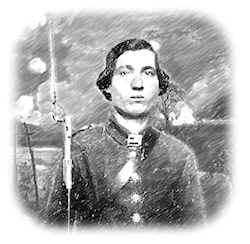
Wednesday, 29th.—Heavy cannonading towards Grand Gulf.
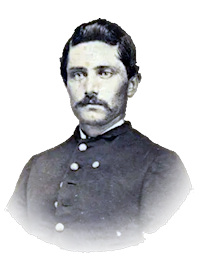
(Note: picture is of an unidentified Confederate soldier.)
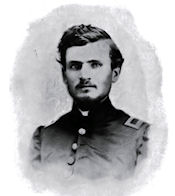
29th. Went out for oats. After breakfast started back to Somerset. Let our horses eat and then followed. Drake, Ritter, Bob and I stopped half way and got a cup of tea. Found reinforcements at S. Issued pork. No mail for me. “H,” “E,” and “M” ordered over the river. In the evening got my coat fixed–mended. Got my washing. Wrote to Fannie.
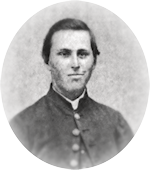
April 29th. Our company was ordered for guard duty to guard the railroad bridge over the Gunpowder River, on the Baltimore & Philadelphia Road. A very pleasant change and much enjoyed in the fine early spring weather. The fishing and sailing were fine. Many boats at that point we were allowed to use. Many attempts had been made to burn the bridge. It had to be kept well guarded. (It was later destroyed by rebel guerillas making a raid through Maryland.)
Wednesday, 29th–The teams all went back to the landing this morning for provisions and the boys cleaned up our camping ground. We have first-rate grub now, hard crackers, sowbelly, green tea, besides fresh beef every fifth day. We draw full rations every five days when in camp, and every three days when on the march. The boys live fine. I wrote a couple of letters today.
Wednesday Night, April 29.—On Saturday Mr. –– and myself went up to Cedar Hill, and he attempted to go to Fredericksburg; when he reached Hamilton’s Crossings he found it impossible to go on—conveyances were so scarce and the roads so terrible. He had the pleasure to dine, by invitation, at General Jackson’s head-quarters. That night he spent with his old friend, Mr. M. Garnett. Once having every luxury which could be desired, he now lives in his desolated house, surrounded by down-trodden fields, without fences, trees, or vegetation of any sort. His servants, except a few faithful ones, have deserted him; his horses and stock of all kinds have been swept away; his sons in the army; and he is cheerful and buoyed with hope, not for himself, but for the cause: good old patriot as he is, forgetting his own privations in zeal for his country. On Sunday Mr. –– heard an admirable sermon at head-quarters (General Jackson’s) from the Rev. Mr. Lacy, a Presbyterian chaplain, and returned home on Monday, having found it impossible to fulfil the object of his trip, that of preaching to the soldiers in Fredericksburg.
April WEDNESDAY 29, 1863
Tate, Florence, Nannie & myself came to Memphis this noon. I was arrested and taken to Gen Aubrand’s Hd Qts1 sent back to get a permit. May God forgive me if there be sin in hating the Yankees—remained with Florence all night.
APRIL 29th.—Gen. Beauregard is eager to have completed the “Torpedo Ram,” building at Charleston, and wants a “great gun” for it. But the Secretary of the Navy wants all the iron for mailing his gun-boats. Mr. Miles, of South Carolina, says the ram will be worth two gun-boats.
The President of the Manassas Gap Railroad says his company is bringing all its old iron to the city. Wherefore?
The merchants of Mobile are protesting against the impressment by government agents of the sugar and molasses in the city. They say this conduct will double the prices. So Congress did not and cannot restrain the military authorities.
Gen. Humphrey Marshall met with no success in Kentucky. He writes that none joined him, when he was led to expect large accessions, and that he could get neither stock nor hogs. Alas, poor Kentucky! The brave hunters of former days have disappeared from the scene.
The Secretary of War was not permitted to see my letter which the President referred to him, in relation to an alphabetical analysis of the decisions of the departments. The Assistant Secretary, Judge Campbell, and the young Chief of the Bureau of War, sent it to the Secretary of the Navy, who, of course, they knew had no decisions to be preserved. Mr. Kean, I learn, indorsed a hearty approval of the plan, and said he would put it in operation in the War Office. But he said (with his concurrence, no doubt) that Judge Campbell had suggested it some time before. Well, that may be, but I first suggested it a year ago, and before either Mr. K. or Judge Campbell were in office. Office makes curious changes in men! Still, I think Mr. Seddon badly used in not being permitted to see the communications the President sends him. I have the privilege, and will use it, of sending papers directly to the Secretary.
Gen. Lee telegraphs the President to-day to send troops to Gordonsville, and to hasten forward supplies. He says Lt.-Gen. Longstreet’s corps might now be sent from Suffolk to him. Something of magnitude is on the tapis, whether offensive or defensive, I could not judge from the dispatch.
We had hail this evening as large as pullets’ eggs.
The Federal papers have accounts of brilliant successes in Louisiana and Missouri, having taken 1600 prisoners in the former State and defeated Price at Cape Girardeau in the latter. Whether these accounts are authentic or not we have no means of knowing yet. We have nothing further from Mississippi.
It is said there is some despondency in Washington.
Our people will die in the last ditch rather than be subjugated and see the confiscation of their property.
April 29, 1863, Montgomery Weekly Advertiser
The Macon Ga., Telegraph, of the 22d, gives the following account of a most flagrant highway robbery committed by females in Monroe county, on Friday last. It is said that these females were not able to plead poverty or necessity as an excuse for their acts, but whether they could or not, it is time such exhibitions of lawlessness were put down with a strong hand. The Telegraph says:
A factory at Seven Islands, in Butts county, had loaded a wagon with seven bales of manufactured goods, and dispatched it by their customary driver, a trusty old negro, to Forsyth, for transportation upon the Macon & Western Railroad. The wagon arrived at Forsyth in due time with only three bales and the driver’s story, (which there is no reason to doubt, as he identified many of the parties, and it is also sustained by circumstantial evidence,) is as follows: When the wagon had progressed about seven miles on its journey, it was stopped by a line of twenty eight women drawn up across the road–the most of them armed with knives and pistols, and in the thicket close to the scene of action sat a man upon a stump, also armed with a double-barrelled gun. The women called upon the negro to halt, upon the peril of his life, and then immediately commenced discharging the load of the wagon–cutting open the bales, and as soon as they had taken as many pieces of cloth as they could carry away, made off, leaving Jim to proceed on his journey with the three bales left.
April 29, 1863, Dallas Herald
We are pleased to say to our readers that we have received our supply of white paper, and shall next week enlarge our sheet. We hope that we shall not again be compelled to print on brown paper. We earnestly request all subscribers to renew their subscription, as we shall be compelled to discontinue every paper at the expiration of the time paid for, unless the price is paid up promptly.
April 29, 1863, Arkansas True Democrat (Little Rock)
Jackson, Miss., March 6, 1863.
Madam–I have the honor to acknowledge the reception, at the hands of Dr. Blackburn, of the elegant “chappeau” sent to me by yourself and other ladies of Montgomery. I accept it with pride, and shall wear it in grateful remembrance of the fair donors.
When the history of the revolution shall be written, I trust that the ladies of the South may receive that credit to which their lofty and self sacrificing patriotism so justly entitles them. Through our darkest hours they have stood firm and unshaken, seeing, with the eye of faith, the rainbow of promise spanning the horizon of the future, when to others all seemed gloomy, desolate and hopeless. The first to counsel resistance to tyranny, they have nobly maintained their position by sending forth to battle, and perhaps to death, the objects of their earthly adoration; and this not reluctantly, as the miser parts with his gold, but cheerfully and courageously they have laid their temporal happiness on the altar of their country, content to lose everything except honor, and determined that at any hazard it should be maintained. Nor have their exertions stopped here. The soldiers of every battle-field, and on every starving march, and in every hospital, have been nerved, strengthened and encouraged by the words of cheer and sympathy that have reached them from home. Nobly have the women of the South fulfilled their mission in this our struggle for constitutional government. Their conduct gives assurance to the world that men descended from such mothers, having such wives and sisters, can never be made to bow the neck to the yoke of oppression, no matter with what strength it may be forced upon them.
For the complimentary expressions toward myself, contained in your letter, I am deeply grateful, but I cannot accept them without assuring you that whatever of good to the cause I may have been enabled to accomplish is due to the exertions of the noble men who have constituted my command. They have endured the heats of summer and colds of winter–have faced death in its most horrid forms, in camp and on the battle field, with a sublime heroism to which history presents few parallels.
Again thanking you for your kind remembrance of me, I remain, very respectfully, your friend and obedient servant.
Sterling Price,
Major General.
Mrs. Alex. F. Givens, and others, Montgomery, Alabama.
April 29, 1863, Charleston Mercury
In compliance with the suggestion of the Surgeon General, we begin to-day the publication of extracts from the valuable work of Dr. Porcher. We call the special attention of farmers and planters, of house-wives, gardeners, and all who deal with herbs, to these extracts, in the hope that they will devote themselves with energy to the patriotic task of collecting and preparing medicinal plants for the use of the soldiers in the field and in hospitals. A vast deal of good may be done, and an immense stock of native medicines may be gathered before next winter sets in, if the hints here given are attended to. Of course, a fair price will be paid for all medicines, and a ready sale will be found for them:
Sassafras.–Whilst engaged in active duties as Surgeon to the Holcombe Legion, whenever a soldier suffered from measles, pneumonia, bronchitis, or cold, his companion or nurse was directed to procure the roots and leaves of sassafras, and a tea made with this supplied that of flax seed or gum arabic.
Bene (Sesamum).–The planters and farmers throughout the Confederate States should save and cure all the leaves of the Bene now growing, to be used in camp dysentery, in colds, coughs, etc., among our soldiers, in place of gum arabic or flax seed. One or two leaves in a tumbler of water imparts their mucilaginous properties.
Dogwood (Cornus Florida)–Since the war, the bark has been employed with great advantage in place of quinine–by physicians in Sumter District, S. C., and elsewhere–particularly in cases of low forms of fever, and in dysentery, on the river courses, of a typhoid character. It is given as a substitute for Peruvian bark. In fact, in almost any case where the Cinchona bark was used.
Wild Jalap (Podophyllum Peltatum).–This can be used as a laxative in place of rhubarb or jalap, or whenever a purgative is required. Every planter in the Confederate States can produce the opium, mustard and flax seed that is required, either for the army or home use.
Podophyllum peltatum, L. Wild jalap; May Apple.–We have employed this plant among negros as a substitute for jalap and the ordinary cathartics, and find that it answers every purpose, being easily prepared by the person having charge of them. Thirty grains of the root in substance were given, or an infusion of one ounce in a pint of water, of which [continue reading…]
April 29, 1863, Galveston Weekly News
We learn by a gentleman from Hempstead, that the ladies of that county gave a fair on last Tuesday night in Hempstead, for the benefit of Waller’s Battalion the proceeds of which amounted to upwards of TEN THOUSAND DOLLARS. This is the largest contribution we have yet heard of at any one fair, and speaks stronger than any language for the patriotism of Austin county.
April 29, 1863, Tri-Weekly Telegraph (Houston, Texas)
Yesterday the sale of the negroes belonging to Gen. H. P. Bee, took place at the auction rooms of Col. J. S. Sydnor, and the prices ranged beyond those paid a week or two since. The number sold yesterday was 31, and the amount of the sale was between eighty-five and eighty-six thousand dollars. Women from 18 to 20 years of age, sold for $4000 and $4500. One woman with two small children sold for $5,700. Ordinary negro men brought over $4000. The lot was not an extraordinarily good one, though very fair, but the prices were unusually high.
April 29, 1863, Savannah Republican (Georgia)
Dismal Swamp, N. C.,
April 21st, 1863.
Mr. Editor:–From the above captain you may judge that we have gone nearly to the “jumping off place.” I never was so near out of the civilized world. But let this dismal region come in at its proper place. I will continue the narration of our expedition in order.
The day I last wrote from Gatesville, and after my letter was sealed, there was enacted, at Col. Cumming’s headquarters, one of the most interesting, comic, and amusing hypodromes recorded in the annals of this war. In the evening, a dozen or more young ladies from Gatesville visited our brigade, paying especial honors to the 20th Georgia. They were neatly and appropriately dressed, and tolerably good looking to boot, but most of them came out in “go-carts”–a vehicle in common use in this region. They went by singing “Wait for the Wagon,” &c., and were heartily cheered by the boys. When they reached Col. Cumming’s headquarters they all descended from their “carriages”, and were entertained by the band and songs by Thad. Murphy–an amusing character who had gained considerable reputation in comic shows and negro minstrelsy. Col. C. was pressed to address them, but declined. The evening passed off pleasantly enough.–When the hour of departure arrived, the young ladies were in the most gallant manner escorted to their “go carts”–some drawn by horses, some by mules, but the greater part, by oxen! One young lady, and a pretty one too, exclaimed “Where’s my carriage?” The “carriage” drove up and wheeled about for her to get in. What do you suppose that “carriage” was? A little two wheeled cart, with a body 3 by 5 feet, and drawn by a little red two year old bull! Now that’s a fact! During our entire trip through northeastern North Carolina, I have not seen but two carriages, a half dozen buggies and three sulkies. But I have seen five hundred go-carts! They are fashionable. But the funniest features of this funny mode of locomotion is that all, male and female, stand up to drive. The first time we saw two girls standing up in one of those two wheeled carts busily plying the whip to the pony between the shafts, there was a universal burst of laughter from all beholders. But they became so common as to create no remark; on the contrary, a buggy or sulky became a matter of some importance, if not of surprise.
The citizens of Gatesville gave an entertainment the same night and invited the brigade. It was intended as a supper and ball; but the jealousy and misguided pride of some gold laced officers broke it up. There was too large an attendance of privates to suit them, and they determined to carry the day. The soldiers seeing what was in the wind, determined to “stick ’em out.” It was little less than a “row”–disgraceful to the brigade. It is understood that brandy was at the bottom of it.
The next day (Saturday) we passed through Gatesville, on our way to the “Block House,” on Chowan river, distant about twenty miles. Numerous Secesh flags hung from the windows, and the children cheered for the “Jeff Davis boys.” Gatesville is rather a pretty town. The Court House is large, and the churches speak favorably for the morals of the people. The streets and walks are well shaded, and, with a little attention, it could be made one of the prettiest towns in the eastern portion of the State.
Fish, eggs, butter, milk, chickens and potatoes were abundant and cheap. Southwestern Georgia cannot surpass this country in the production of potatoes. I never saw finer, sweeter yams. For once I got my “fill” of eggs and shad.
Two or three hours by sun we halted at an old church, near a large swamp, and within two miles of the entrenched camps and block houses of the Buffaloes, but they were gone.–Had we been a day sooner we could have captured the whole possee comitatus. There was one company of Massachusetts men and renegades, numbering about one hundred and fifty. They were in great distress, fearing we would come down upon them before the transport from the Yankee fleet, off Newbern, I suppose, come to their assistance. They are said to have been in despair, and would have surrendered without resistance. But about three o’clock of the morning we reached them, a transport came up the Chowan and carried them off. Before leaving there, they destroyed their block houses.
The Chowan is very wide and deep–capable of floating a vessel of heavy burden. It affords an abundant supply of the choicest shad, rock, mullet, perch and pike. The people are all good livers in this section, and many are wealthy. Mr. Elliott had stolen from him 55 negroes, and I heard of some farmers who have lost from 100 to 400.
This class of citizens have been sorely persecuted by the Buffaloes or renegades. There is a hybrid breed of traitors, called “sawed horned Buffaloes,” because they do not take up arms and engage in open acts of war, but profess to be friends to whichever party happens to be in power. They are said, however, to favor the Yankees most, by informing them of our movements. They bring news to us also, but their tales are not credited.
On the following day the enemy were reported as having crossed the swamps by the turnpike and moving towards Gatesville to get in our rear. In consequence of this report we marched twenty or twenty-two miles by a circuitous route to Sandy Crossing, where we halted for the night. The report was exaggerated, only a small scouting party having appeared at the west end of the pike. At 12 m yesterday we reached the Dismal Swamp turnpike. The 17th regiment was detailed to guard this pike while the rest of the command proceeded with the expedition.
It is useless for me to attempt a description of the swamp or the country in which we are stationed. In the absence of a map, and my ignorance of the geography, or topography, of the country, I am at a loss to understand any thing about it. It is the wildest, strangest country I ever saw. The sun rises in the south and sets in the north! The swamp is dark and dismal, and impassable to every creature but bears, wolves, panthers, et id genus, which are said to be numerous. In many places a man will sink to his neck in the quagmires. The water looks as black as tar; the fish are black; every thing except man is black, and he is swarthy enough. The people are ignorant beyond anything I have seen in the States. I have asked every man (citizen) I met the name of the county, and at last was told by a soldier. He says it is Perquimon county. It ought to have been persimmon county. Possum Scuffle District! Some told me it was Colmmon co.; some McColmmon; some Gates, Aquamine and Pasquotank. It is positively affirmed that some of the people don’t know that there is a Southern Confederacy. One family was very anxious to learn how Gen. George Washington is “getting on with his army!” They have never heard of Lee, Jackson, Longstreet, or Beauregard! In one precinct near the Dismal Swamp the people, it is said, vote for Henry Clay at every election! They think he is running for President. I think there is a slight mistake here. It is Jackson–old Hickory–they vote for. Whigs don’t live in “sich” a swamp. Not one half of the people have ever heard of the battle in front of Richmond–or the last battle of Manassas! This must be the region from which came the honest “tar heels”–the victim and source of so much raillery and jest.
The enemy’s cavalry pickets are two miles in front of us at the toll gate, where the pike turns southward towards South Mills. They destroyed a barn near the gate last night, containing from 300 to 500 barrels of corn. We have one section of artillery, one company of cavalry, and can hold in check a force of ten thousand men.
But I am spinning my narrative to too great a length. Bear with me one moment and I am done for the time.
I know not what direction Gen. Benning will take, nor how long this regiment will remain here.
We are in total ignorance of what is going on at Suffolk. Can hear nothing reliable.
It is reported and believed that the Yankees have evacuated Elizabeth City. We get no papers, and very few letters. If we stay here long we will all become “tar heels” or hoosiers.
More anon. V.A.S.P.