May 12th. This morning, at 1 o’clock, heard heavy firing down the river in the neighborhood of Port Hudson, which ceased in twenty minutes afterwards; at five forty -five steamer L. A. Sykes arrived from Alexandria, and at six thirty steamed back up Red river again; finished tricing the logs upon port side of ship; at 3 P. M., the steamer General Price came down Red river; light, easterly breezes; at four twenty the ironclad gunboat Pittsburgh, from Black river, came down and anchored ahead of us; ten of our men, volunteers who went on the expedition up Red river on board of her, returned to this ship with bag and hammock; at seven thirty-five the iron-clad Benton, flag-ship of Rear-Admiral Porter’s fleet, came down and out of Red river also; sent steam tug Ivy for our men, some twenty in number, detached on board of her for above referred-to expedition; the lads returned in good spirits, having had a pleasant trip to Alexandria and back, which place is now occupied by General Banks’s forces, and has the glorious stars and stripes once more flung to the breeze, whose colors the inhabitants are thrice glad to see once more. The boats did not come across the enemy during their absence. Many of the beautiful plantations of noted secessionists on Red river, left in charge of overseers, furnished the boys plenty of good food, such as chickens, turkeys, eggs, &c., and greatly did they enjoy this change of fodder from hard bread and salt horse.
American Civil War Chronicles
Robert M. McGill
May 12, 2023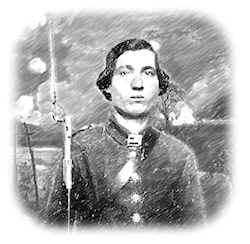
Tuesday, 12th.—Moved back to Hall’s Ferry Road. Reported Stonewall Jackson died from wounds received in the recent fight in Virginia.
(Note: picture is of an unidentified Confederate soldier.)
Diary of a Southern Refugee, Judith White McGuire.
May 12, 2023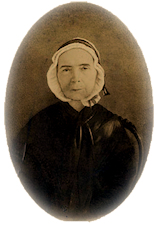
Tuesday Evening, May 12th.—How can I record the sorrow which has befallen our country! General T. J. Jackson is no more. The good, the great, the glorious Stonewall Jackson is numbered with the dead! Humanly speaking, we cannot do without him; but the same God who raised him up, took him from us, and He who has so miraculously prospered our cause, can lead us on without him. Perhaps we have trusted too much to an arm of flesh; for he was the nation’s idol. His soldiers almost worshipped him, and it may be that God has therefore removed him. We bow in meek submission to the great Ruler of events. May his blessed example be followed by officers and men, even to the gates of heaven! He died on Sunday the 10th, at a quarter past three, P. M. His body was carried by yesterday, in a car, to Richmond. Almost every lady in Ashland visited the car, with a wreath or a cross of the most beautiful flowers, as a tribute to the illustrious dead. An immense concourse had assembled in Richmond, as the solitary car containing the body of the great soldier, accompanied by a suitable escort, slowly and solemnly approached the depot. The body lies in state to-day at the Capitol, wrapped in the Confederate flag, and literally covered with lilies of the valley and other beautiful Spring flowers. Tomorrow the sad cortege will wend its way to Lexington, where he will be buried, according to his dying request, in the “Valley of Virginia.” As a warrior, we may appropriately quote from Byron:
“His spirit wraps the dusky mountain,
His memory sparkles o’er the fountain,
The meanest rill, the mightiest river,
Rolls mingling with his fame forever.”
As a Christian, in the words of St. Paul, I thank God to be able to say, “He has fought the good fight, he has finished his course, he has kept the faith. Henceforth there is laid up for him a crown of righteousness, which the Lord, the righteous Judge, shall give him at the last day.”
Downing’s Civil War Diary.–Alexander G. Downing.
May 12, 2023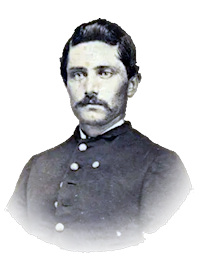
Tuesday, 12th–We took up our march at 5 o’clock this morning and marched sixteen miles over very fine roads. This is a very rich country, and before the war, was prosperous, but now looks quite desolate, the buildings and fences having been burned by our troops. At the approach of our army the people fled, leaving all behind them. At noon we halted for lunch, and since it was so fearfully hot, remained here during the heat of the day in the shade of evergreens. The Eleventh Iowa was situated just opposite the residence of General Bowie, said to be a descendant of the inventor of the bowie knife. The main Bowie residence was burned and household articles, among which is a grand piano, are strewn about the large lawn. The outbuildings, on a grand scale, were not molested. The lawn contains about forty acres and is planted in all kinds of tropical trees and shrubbery, with cisterns and fountains at different points. The plantation borders the west bank of Lake St. Joseph, the public highway being just between it and the lake. This plantation, containing several thousand acres, is all planted to corn, which is now in tassel and silk. Our march today was along the west bank of the lake with a continuous cornfield on our right. When night came we were still by the lake, where we went into bivouac.
War Diary of Luman Harris Tenney.
May 12, 2023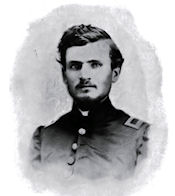
12th. Sent a letter to Minnie. Played chess with Chester and Lt. Case, on the whole did well. Short talk with Bushnell. Could have done better in Arkansas. Let our horses into a field to graze. Read the Commercial of the 10th, some in Gazette. Drove up a beef from town.
A Rebel War Clerk’s Diary
May 12, 2023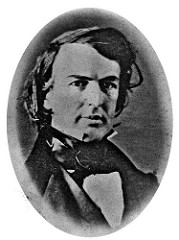
MAY 12th.—The departments and all places of business are still closed in honor of Gen. Jackson, whose funeral will take place to-day. The remains will be placed in state at the Capitol, where the people will be permitted to see him. The grief is universal, and the victory involving such a loss is regarded as a calamity.
The day is bright and excessively hot; and so was yesterday.
Many letters are coming in from the counties in which the enemy’s cavalry replenished their horses. It appears that the government has sent out agents to collect the worn-down horses left by the enemy; and this is bitterly objected to by the farmers. It is the corn-planting season, and without horses, they say, they can raise no crops. Some of these writers are almost menacing in their remarks, and intimate that they are about as harshly used, in this war, by one side as the other.
To-day I observed the clerks coming out of the departments with chagrin and mortification. Seventy-five per cent. of them ought to be in the army, for they are young able-bodied men. This applies also to the chiefs of bureaus.
The funeral was very solemn and imposing, because the mourning was sincere and heartfelt. There was no vain ostentation. The pall bearers were generals. The President followed near the hearse in a carriage, looking thin and frail in health. The heads of departments, two and two, followed on foot—Benjamin and Seddon first—at the head of the column of young clerks (who ought to be in the field), the State authorities, municipal authorities, and thousands of soldiers and citizens. The war-horse was led by the general’s servant, and flags and black feathers abounded.
Arrived at the Capitol, the whole multitude passed the bier, and gazed upon the hero’s face, seen through a glass in the coffin.
Just previous to the melancholy ceremony, a very large body of prisoners (I think 3500) arrived, and were marched through Main Street, to the grated buildings allotted them. But these attracted slight attention,—Jackson, the great hero, was the absorbing thought. Yet there are other Jacksons in the army, who will win victories,—no one doubts it.
The following is Gen. Lee’s order to the army after the intelli gence of Gen. Jackson’s death:
“HEADQUARTERS ARMY NORTHERN VA.,
“May 11th, 1863.”
GENERAL ORDERS No. 61.
“With deep grief the Commanding General announces to the army the death of Lieut.-Gen. T. J. Jackson, who expired on the 10th inst., at 3 1/2 p.m. The daring, skill, and energy of this great and good soldier, by the decree of an all-wise Providence, are now lost to us. But while we mourn his death, we feel that his spirit still lives, and will inspire the whole army with his indomitable courage and unshaken confidence in God as our hope and our strength. Let his name be a watchword to his corps, who have followed him to victory on so many fields. Let officers and soldiers emulate his invincible determination to do everything in the defense of our beloved country.
“R. E. LEE, General.”
The Letter of Gen. Lee to Gen. Jackson.
The letter written by Gen. Lee to Gen. Jackson before the death of the latter is as follows:
“CHANCELLORVILLE, May 4th.
” GENERAL
“I have just received your note informing me that you were wounded. I cannot express my regret at the occurrence. Could I have dictated events, I should have chosen for the good of the country to have been disabled in your stead.
“I congratulate you upon the victory which is due to your skill and energy.
“Most truly yours,…………………………………………..
” R. E. LEE.
“To Gen. T J. Jackson.”
“The nation’s agony,” as it is termed in a Washington paper, in an appeal for 500,000 more men, now demands a prompt response from the people. And yet that paper, under the eye and in the interest of the Federal Government, would make it appear that “the Army of the Potomac” has sustained no considerable disaster. What, then, constitutes the “nation’s agony”? Is it the imminency of war with England? It may be, judging from the debates in Parliament, relating to the liberties the United States have been taking with British commerce. But what do they mean by the “nation?” They have nothing resembling a homogeneous race in the North, and nearly a moiety of the people are Germans and Irish. How ridiculous it would have been even for a Galba to call his people the Roman nation! An idiot may produce a conflagration, but he can never rise to the dignity of a high-minded man. Yet that word “Nation” may raise a million Yankee troops. It is a “new thing.”
The Northern papers say Charleston is to be assailed again immediately; that large reinforcements are going to Hooker, and that they captured six or eight thousand prisoners in their flight on the Rappahannock. All these fictions are understood and appreciated here; but they may answer a purpose in the North, by deceiving the people again into the belief that Richmond will certainly fall the next time an advance is made. And really, where we see such extravagant statements in the Federal journals, after a great battle, we are much rejoiced, because we know them to be unfounded, and we are led to believe our victory was even greater than we supposed it to be.
0
May 12, 2023
From the diary of Osborn H. Oldroyd
MAY 12TH–Roused up early and before daylight marched, the 20th in the lead. Now we have the honored position, and will probably get the first taste of battle. At nine o’clock slight skirmishing began in front, and at eleven we filed into a field on the right of the road, where another regiment joined us on our right, with two other regiments on the left of the road and a battery in the road itself. In this position our line marched down through open fields until we reached the fence, which we scaled and stacked arms in the edge of a piece of timber. No sooner had we done this than the boys fell to amusing themselves in various ways, taking little heed of the danger about to be entered. A group here and there were employed in “euchre,” for cards seem always handy enough where soldiers are. Another little squad was discussing the scenes of the morning. One soldier picked up several canteens, saying he would go ahead and see if he could fill them. Soon after he disappeared, he returned with a quicker pace and with but one canteen full, saying, when asked why he came back so quick–”while I was filling the canteen I heard a noise, and looking up discovered several Johnnies behind trees, getting ready to shoot, and I concluded I would retire at once and report.” Meanwhile my bedfellow had taken from his pocket a small mirror and was combing his hair and moustache. Said some one to him. “Cal., you needn’t fix up so nice to go into battle, for the rebs won’t think any better of you for it.”
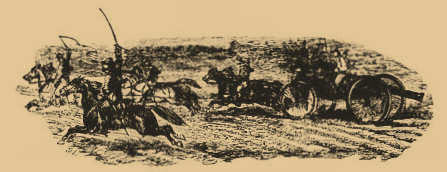
DeGolier’s Battery going into action at the Battle of Raymond.
Just here the firing began in our front, and we got orders : “Attention ! Fall in–take arms–forward–double-quick, march!” And we moved quite lively, as the rebel bullets did likewise. We had advanced but a short distance–probably a hundred yards–when we came to a creek, the bank of which was high, but down we slid, and wading through the water, which was up to our knees, dropped upon the opposite side and began firing at will. We did not have to be told to shoot, for the enemy were but a hundred yards in front of us, and it seemed to be in the minds of both officers and men that this was the very spot in which to settle the question of our right of way. They fought desperately, and no doubt they fully expected to whip us early in the fight, before we could get reinforcements. There was no bank in front to protect my company, and the space between us and the foe was open and perfectly level. Every man of us knew it would be sure death to all to retreat, for we had behind us a bank seven feet high, made slippery by the wading and climbing back of the wounded, and where the foe could be at our heels in a moment. However, we [continue reading…]
0
May 12, 2023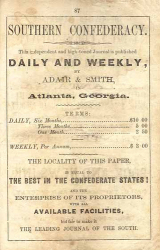
May 12, 1863, Southern Confederacy (Atlanta, Georgia)
We invite the special attention of everybody at home to the letter of our special correspondent J. H. H., from Estell Springs, in to-day’s paper–particularly to that portion of it in reference to writing letters to soldiers in the field.
We ought to write to our friends and relatives in the army and write to them often.–But we should also be careful what we write to them. Wives, mothers, daughters, and friends should not write them anything that would give them pain. Write to them everything that is pleasant: tell them all the news of the country–all about the crops, the neighborhood gossip, the old church they used to visit, who goes there, the new pastor, who is born, got married or died, the number of chickens and pigs you are raising, and all such little things about home and neighborhood affairs as will be interesting and satisfactory to your brave loved ones in the field; but don’t write to them any thing unpleasant–anything they can’t mend. They are in the field fighting to keep back the foe. They have enough there to tax all their faculties in the way of thoughtfulness and deep concern. They should not have any of the unpleasantness which those at home experience thrust upon them to bear in addition to their troubles, trials, and hardships in camp. Always write them cheerful or amusing letters, and bear patiently your ills and troubles at home till the war is over.
0
May 12, 2023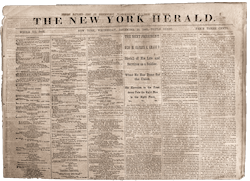
May 12, 1863, The New York Herald
Since the rebellion broke out we have had a great many uprisings at the North. There have been uprisings of the men of the North, the patriots of the North, the politicians of the North, the contractors of the North, the stock jobbers of the North, the gold gamblers of the North, the editors of the North, the orators of the North, the abolitionists of the North, and so on, not only ad infinitum, but also ad nauseam. Still, none of these uprisings seems to have amounted to anything practical, and we have not yet subdued the South, where there have as yet been no uprisings at all. Now, however, the proper war spirit appears to be about to develop itself in the proper quarter. An uprising of the women of the North ought certainly to be effectual in putting down rebellion. That such an uprising is at hand is evident from the following circular, addressed by Mrs. Elizabeth Cady Stanton to the loyal women of the nation: –
In this crisis of our country’s destiny it is the duty of every citizen to consider the peculiar blessings of a republican form of government, and decide what sacrifices of wealth and life are demanded for its defence and preservation.
The policy of the war, our whole future life, depends on a universal, clearly defined idea of the end proposed, and the immense advantages to be secured to ourselves and all mankind by its accomplishment.
No mere party or sectional cry, no technicalities of constitution or military law, no mottoes of craft or policy, are big enough to touch the great heart of a nation in the midst of revolution. A grand idea, such as freedom or justice, is needed to kindle and sustain the fires of a high enthusiasm. [continue reading…]
0
May 12, 2023
May 12, 1863, Weekly Columbus Enquirer (Georgia)
Mr. E. Steadman calls upon all the cotton yarn spinners of the State to meet in convention at Atlanta on the 15th inst., to arrange a united effort on the part of the factories to supply the destitute families of soldiers with yarns.
Col. Ira R. Foster, Quartermaster of the State, whose duty it has been made by the Legislature to procure supplies of yarn for soldiers’ families, approves this call, and urges that the work be commenced as generally and as soon as possible.
0
May 12, 2023
May 12, 1863, The New York Herald
The report that General Hooker’s army is again on the south side of the Rappahannock, and advancing, gives general satisfaction. It was feared that his return to this side signified the suspension of any offensive operations on our part in Virginia for several months to come; but it is now believed that we are to have not only a resumption of active hostilities, but that, pursuing the combinations entered into under the present condition of the rebel army, we can hardly fail to secure the most decisive and comprehensive victories.
In the single fact that General Hooker’s retreat across a rapid flooded river on two narrow pontoon bridges was undisturbed by the enemy we have conclusive evidence that the rebel army had been too badly shattered to disturb him. Otherwise General Lee could not have asked a better opportunity for a decisive blow. His official reports show that he was fully apprised of the movement; and yet during the two days and nights occupied in accomplishing it he refrained from any positive interference, permitting even our rear guard, bag and baggage, to cross without molestation. Had Lee been in a condition to seize the opportunity to cut our army in two, and then to destroy it in detail, he would have attempted it. The fact that he did not attempt it shows that General Hooker retreat was unnecessary. To this extraordinary discovery, and to the important achievements and disclosures of General Stoneman’s brilliant cavalry expedition to the very doors of Richmond, we are indebted for this return of our army to the south side of the Rappahannock.
It is also very evident that Stoneman’s unexpected operations, and the reported movements of our peninsular forces, instantly demanded of Lee the removal of his whole army southward, or a division of his columns to strengthen Richmond, extremely dangerous to his already seriously depleted army. Meantime, cut off [continue reading…]
0
May 12, 2023
May 12, 1863, The New York Herald
There is nothing to report from General Hooker’s advance today.
The rebels were at work in considerable force yesterday on the Orange and Alexandria Railroad, repairing the bridge over the Rapidan.
The Stoneman cavalry expedition is immortal. We have given heretofore very full accounts from army correspondents, embracing nearly all the leading facts of interest in that brilliant raid. Today we publish the official report of Colonel Kilpatrick, describing his portion of the expedition from Louisa Court House to Gloucester Point. We commend it to our readers as a specimen of the succinct style which well befits a soldier. The story is as simply and plainly told as the deeds therein recounted were boldly executed. Wherever he met the enemy in his hasty ride of five days he defeated and scattered them. He destroyed their commissary stores at every point he touched upon; captured prisoners within the lines of the enemy; cut up their communications at the different railroad bridges, and, to sum up in his own language, […..] ten o’clock A.M. on the 7th I found safety and rest under our brave old flag, within our lines at Gloucester Point.”
Rumors were prevalent in Washington yesterday that General Halleck was about to take the field in person. It was not stated that General Hooker was to be superseded, the impression being that the presence of General Halleck at the scene of future operations would have a salutary effect upon the direction of affairs. [continue reading…]
0
May 12, 2023
May 12, 1863, The New York Herald
THE SIEGE OF SUFFOLK.
Our West Point Correspondence.
WEST POINT, Va., May 9, 1863.
A portion of the Fourth army corps, Major General Erasmus A. Keyes commanding, reached this point shortly after one o’clock on Thursday last (7th inst.) The troops were conveyed thither in a large fleet of transports, convoyed by a fleet of gunboats. The landing of our troops was undisputed by the enemy. Immediately on landing General Keyes ordered a reconnoissance up the York river road towards White House, the old base of operations of our army last summer. For this purpose Company F, Captain Edwards, and Company D, Captain Paul, Fifth Pennsylvania cavalry, were selected. The two companies were divided into small parties, moving on different, and, where the nature of the country permitted, on parallel roads. After the commands had proceeded a few miles from town the detachment of Company F, Sixth New York cavalry, Lieutenant Crozier, was fired upon by a party of ambushed rebels, killing two of our horses, among which was the lieutenant. The horse, therefore, reared on his hind legs in a death throe, falling heavily on his rider, crushing the latter in such a manner that he died shortly afterwards. Lieut. Crozier was from Hoboken, New Jersey, and as a gentleman and soldier was unsurpassed. His loss is deeply regretted by his command. The ambushed rebels were caught. They belonged to the Tenth and Fifteenth regiments Virginia cavalry. The reconnoissance was continued to White House, where all the troops met. All the track on the York River Railroad from West Point to White House was recently removed by the rebels. The railroad depot and bridge across the Pamunky was destroyed by order of Captain Paul. On the trip our cavalry rescued a Lieutenant Estes, aid to General Kilpatrick and fifteen men, who were made prisoners near Fredericksburg, and were than in charge of a rebel [continue reading…]
0
May 12, 2023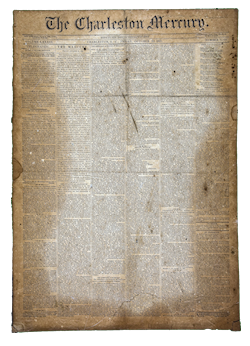
May 12, 1863, The Charleston Mercury
While the Northern journals console their readers for the late disappointment by telling them that another expedition is preparing for the capture of Charleston, there are undoubted signs of activity on the sea islands in possession of the enemy. Within the last two days and nights a very large and formidable battery has been erected by the enemy on Folly Island to bear upon the southern portion of Morris Island; and, in full view of Fort Sumter, the Yankee sentinel is seen steadily pacing to and fro on his post. An entrenched camp has been made lower down on Folly Island, and unmistakable preparations are evidently progressing. The abandonment of Cole’s Island spring before last, and the difficulties of access on our part, enable the foe to proceed. At Seabrook Island, North Edisto, there are also indications of earnest efforts to make a safe basis. A force of several regiments has been and is now at work, while five iron clad gunboats and a number of transports lie in the stream. Some seventy transports are still waiting in Broad River, and the outposts of the enemy in General WALKER’S District have recently been doubled in strength.
In view of these appearances, it becomes us to prepare vigorously to resist another demonstration before the heated terms puts an end to active operations. The 16th June, 1862, saw the bold and desperate assault upon Secessionville. We have not yet reached the middle of May. Under all the circumstances, to assume that the enemy will not attack again before fall, would be the most reckless fatuity.
0
May 12, 2023
May 12, 1863, The New York Herald
Colonel Kilpatrick’s Report.
WASHINGTON, May 11, 1863.
The following was received at headquarters today:–
YORKTOWN, Va., May 8, 1863.
Major General H.W. HALLECK, Commander-in-Chief of the United States Army:–
GENERAL – I have the honor to report that, by direction of Major General Stoneman, I left Louisa Court House the morning of the 3d inst. with one regiment (the Harris Light Cavalry of my brigade), reached Hungary on the Fredericksburg Railroad at daylight on the morning of the 4th, destroyed the depot, telegraph wires and railroad for several miles; passed over to the Brook turnpike; drove in the rebel pickets down the pike, across the brook; charged a battery and forced it to retire to within two miles of the city of Richmond; captured Lieutenant Brown, Aide-de-Camp to General Winder, and eleven men within the fortifications; passed down to the left to the Meadow Bridge, on the Chickahominy, which I burned; ran a train of cars into the river; retired to Hanovertown, on the peninsula; crossed and destroyed the ferry, just in time to check the advance of a pursuing cavalry force; burned a train of thirty wagons, loaded with bacon; captured thirteen prisoners, and encamped for the night five miles from the river.
I resumed my march at one A. M., of the 5th; surprised a force of three hundred cavalry at Aylett; captured two officers and thirty-three men; burned fifty-six wagons and the depot, containing upwards of 20,000 barrels of corn and wheat, [continue reading…]
0
May 12, 2023
May 12, 1863, The New York Herald
THE LEADERS OF THE EXPEDITION.
The Leaders of the Famous Cavalry Expedition Around Lee’s Rebel Army.
SKETCH OF GENERAL STONEMAN.
Major General George Stoneman is a native of New York, and between thirty-five and forty years of age. He was appointed from his native State to the West Point Military Academy in 1842, and graduated on the 30th of June, 1846, standing No. 33 in a very large class. Among his classmates were Generals McClellan, Foster, Reno (dead), Couch, Seymour, C. C. Gilbert, Sturgis, Palmer; Colonels Rush, Magilton, and many others in the Union army, Stonewall Jackson and several other rebels. On the 1st of July, 1846, he was appointed brevet second lieutenant of the First dragoons, and received his full commission on the 12th of July, 1847. He was promoted to a first lieutenancy in July, 1854, and was appointed aid to General Wool in January, 1855. On the 3d of March, 1855, he was promoted to a captaincy, and transferred to one of the newly organized mounted regiments – viz., the Second cavalry – under command of Col. A. S. Johnston. In 1859 he stood No. 8 on the lineal roll of cavalry captains, and at the end of the next year, by the promotion of Joseph E. Johnston, he rose one step in the line. In 1859 he was commander of Camp Hudson, in the neighborhood of San Antonio, Texas, and in 1860 held charge of Camp Palo Alto, near Fort Brown, Texas. Therefore at the commencement of the rebellion he was in the midst of the rebels at the Southwest; but, unlike many belonging to his own regiment, he remained loyal, although three of the field officers, besides others, turned traitors. On his return to the North he was promoted to the majority of the Fourth cavalry regiment, with a commission dating from May 9, 1861, and on the 13th of August following was appointed a brigadier general of volunteers. With this rank he assisted General McClellan in the organization of his Army of the Potomac. When that army moved to the peninsula, General Stoneman was placed in command of the cavalry division. In [continue reading…]
0
May 12, 2023
May 12, 1863, The New York Herald
The late catastrophe on the Rappahannock is full of instruction, if the authorities at Washington could only profit by it and amend their ways. The criticism on the battle by Mr. Emil Schalk, in the letter which we published on Sunday, is well deserving of attention. This gentleman evidently understand his subject, and has a military mind of no common order. He is the author of “Campaigns of 1862 and 1863, Illustrating the Principles of Strategy,” a book which ought to be in the hands of all our generals. His comments on the recent fight on the Rappahannock are well reasoned. He classes it among other battles fought during this war, in which thousands and thousands of brave soldiers are immolated, without any adequate result for the enormous loss of life, and which may be traced directly to the mistakes of the generals commanding. Of the rebel general he says: “General Lee has certainly gained for himself by this battle the name of one of the ablest generals of the present age;” while of Hooker he remarks: – “The idea of a general who is on the offensive, whose avowed object is the capture or destruction of a whole army, making six miles in thirty-six hours, just at the most critical moment of his operations, and finally, after intrenching himself without being on the communications of his enemy, tells his soldiers that the enemy has to run away or to attack him on his own ground, where he will destroy him, has not its parallel in modern times.”
These observations are undoubtedly just; but there is one point on which we do not agree with Mr. Schalk. It is his depreciation of the movement of Stoneman. If Hooker had not enough of troops without this large cavalry force, there might be some force in the objection; but when we are told by Mr. Stanton that only one-third of his men were brought into action, the case is entirely altered. It is true, perhaps, that all Stoneman’s cavalry were not needed to cut Lee communications and cooperate with the Union troops in North Carolina and those under General Dix in capturing Richmond. But Stoneman’s operations were singularly successful; and had our infantry force in the vicinity of James river been equally enterprising, or had Hooker done his duty on the Rappahannock, Richmond, Fredericksburg and the whole of Lee’s army [continue reading…]
0
May 12, 2023
May 12, 1863, The New York Herald
THE SIEGE OF SUFFOLK.
Our Suffolk Correspondence.
SUFFOLK, Va., May 8, 1863.
The recent movement of General Hooker at Fredericksburg relieved us of the forces of Longstreet and Hill, who were closely besieging us up to Sunday last, and they are now probably far on their way to reinforce the closely pressed legions of the rebel General Lee. The fact that the siege of Suffolk was not abandoned sooner shows that Lee did not anticipate so rapid and immediate a movement on the part of General Hooker, and, more over, shows that Lee has need of every available man to oppose his active opponent. The rebels had drawn an excellent cordon of works around us, and were evidently prepared to sustain a repulse in case they made an assault upon us. On the South Quay road there are three parallels of redoubts and rifle pits, the outer line – some four miles from the Nansemond – being the strongest. On the Petersburg road there are two lines running through the dense woods which immediately appear near the Draw Bridge battery. Their lines are strengthened by every artifice which the surrounding materials furnished. In fact, their lines of contravallation proved that they undertook the siege of Suffolk with a powerful force, and with the firm intention of reducing the place. Large details from the different regiments here are now actively engaged levelling the [continue reading…]
0
May 11, 2023
(excerpt)
May 11th, 1863.
“We are all saddened to the heart to-night by hearing the death of our hero Jackson! In addition to our own irreparable loss, it will put new life and courage into our cruel foe. It will cause mourning all over our land and each person seems to feel as if he had lost a relative. I feel more disheartened about the war now than I have ever felt before. It seems to me, it is to be interminable, and what a wretched life of anxiety it is to look forward to! I suppose the death of Jackson has affected us all and I can’t help thinking it will put new life into the enemy and give him courage to make another attempt very soon. You see by the papers they claim having taken almost as many prisoners as we have and I am sure the loss of Jackson has turned the last fight into a calamity, if not a curse. I expect you will think I am really blue—but you know Jackson has been my hero and favorite for a long time. We must, though, hope on, hope ever!”
0
May 11, 2023
May 11th. Is ushered upon us with pleasant weather, and light breezes from south-east. From noon to 1 o’clock, A. M., heavy firing heard down the river; at five fifty U. S. steamer Estrella came down Red river from Alexandria, with despatches to Commodore Palmer; at six forty-five the Albatross got under way and stood up the river; sent our pilot, Mr. Carroll, on board of her; at nine o’clock inspected crew at quarters, employed placing logs on port side of ship to protect the boilers and machinery against assaults from the enemy’s rams or iron-clad boats; Albatross came down the river and anchored in her old berth; at noon, a tug came down from upper fleet, Porter’s, with despatches and a mail; at one P. M., the gunboat Estrella got under way and entered the mouth of Red river on her return to Alexandria; at one thirty the tug-boat followed her, steaming away very fast; at three o’clock the steam tug and tender to the ship Benton came down and out of Red river, having Rear-Admiral Porter on board, and came alongside of us; Admiral Porter came on board of us and communicated with the Commodore. These are all the important occurrences of this day, also all the arrivals and departures of vessels at this station.
Downing’s Civil War Diary.–Alexander G. Downing.
May 11, 2023
Monday, 11th–We started this morning at 5 o’clock and marched about eight miles, when we stacked our arms until 3 p. m. We continued our march to Perkins’s Landing about forty-five miles below Vicksburg as the river runs, or twenty miles as the crow flies. Here we bivouacked for the night. The country here is very low and often overflows. The large plantations, such as Perkins’s, Holmes’s and Jeff Davis’s, are usually planted to cotton. The work is all done by slaves driven by overseers who live on the plantations, while the owners, planters, reside in more healthy localities.
War Diary of Luman Harris Tenney.
May 11, 2023
11th. Issued five days’ rations in the morning. Watched the boys play chess. Had a good visit with Thede and Charley. News in papers a little more encouraging. In the evening heard Co. H boys sing. Enjoyed it much. Capt. Nettleton and Col. Ratliffe told me some news.
A Rebel War Clerk’s Diary
May 11, 2023
MAY 11th.—Lieut.-Gen. J. T. Jackson died at 3 P.M. yesterday. His remains will arrive in the city at 5 P.M. this afternoon. The flags are at half-mast, and all the government offices and even places of business are closed. A multitude of people, mostly women and children, are standing silently in the streets, awaiting the arrival of the hero, destined never again to defend their homes and honor.
A letter from Gen. Lee says, emphatically, that if cavalry be not brought from North Carolina and the South, the enemy’s cavalry will be enabled to make raids almost anywhere without molestation. I recollect distinctly how he urged the Secretary of War (Randolph), months ago, to send to Texas for horses, but it was not attended to—and now we see the consequences.
The exchanged prisoners here, taken at Arkansas Post, are ordered to the Mississippi. Gen. Longstreet urged the Secretary to send them off, if that were their destination, without a moment’s delay, several days ago—else they would be too late to participate in the campaign.
Northern papers set down Hooker’s loss at 20,000, a modest figure, subject to revision.
The Federal Secretary of War has issued a statement to mollify the panic. He is bound to acknowledge that, whereas Hooker advanced upon Lee across the river, he is now, after the battle, back again, where he started from. But he says not more than a third of the army was engaged ; and as 30,000 reinforcements have been sent from Washington, and as many from Suffolk, the army will soon be as strong as ever, and in condition for another advance—and defeat.
But what credit can we attach to such statements, since McClellan, under oath, said that he had ninety odd thousand men at the battle of Sharpsburg, 75,000 of whom only were actually engaged, while Lee had 100,000? We know that he did not have 40,000 engaged!
Gen. Van Dorn is dead–being killed by a man whose peace he had ruined.
More applications for passports to leave the country are coming in—and they are “allowed” by the Assistant Secretary of War. How could he refuse, since his own family (at least a portion of it) have enjoyed the benefits of sojourning in the North since the war began?
A letter was received to-day from Mr. Ranney, president of the N. C., Jackson, and Great Northern Railroad Co., asking the protection of government from harm for violations of the Act of Congress of April 19th, 1862, prohibiting the transportation of cotton within the enemy’s lines. He incloses a number of peremptory orders from Lieut.-Gen. Pemberton, dated January 19th, February 16th and 19th, to take large amounts of cotton into the enemy’s lines for S. J. Josephs (Jew?), and for Messrs. Clarke, Ford, and Rust, etc. etc. He says Gen. P. threatened to seize the road if he did not comply, and asserted that he had authority from the Secretary of War to issue the orders. One of these orders was from Gov. Pettus, for a small lot not more than fifty bales, to be exchanged for salt. This was authorized by the President, who most positively forbid the others. The letter from Gen. Johnston the other day said this traffic was subjugating the people. Was that “allowed” to reach the Secretary and the President? I know not; it has not yet passed through my hands from the President back to the department.
0
May 11, 2023
From the diary of Osborn H. Oldroyd
MAY 11TH.–We drew two days’ rations and marched till noon. My company, E, being detailed for rear guard, a very undesirable position. General Logan thinks we shall have a fight soon. I am not particularly anxious for one, but if it comes I will make my musket talk. As we contemplate a battle, those who have been spoiling for a fight cease to be heard. It does not even take the smell of powder to quiet their nerves–a rumor being quite sufficient.
We have no means of knowing the number of troops in Vicksburg, but if they were well generaled and thrown against us at some particular point, the matter might be decided without going any further. If they can not whip us on our journey around their city, why do they not stay at home and strengthen their boasted position, and not lose so many men in battle to discourage the remainder? We are steadily advancing, and propose to keep on until we get them where they can’t retreat. My fear is that they may cut our supply train, and then we should be in a bad fix. Should that happen and they get us real hungry, I am afraid short work would be made of taking Vicksburg.
Having seen the four great Generals of this department, shall always feel honored that I was a member of Force’s 20th Ohio, Logan’s Division, McPherson’s Corps of Grant’s Army. The expression upon the face of Grant was stern and care-worn, but determined. McPherson’s was the most pleasant and courteous–a perfect gentleman and an officer that the 17th corps fairly worships. Sherman has a quicker and more dashing movement than some others, a long neck, rather sharp features, and altogether just such a man as might lead an army through the enemy’s country. Logan is brave and does not seem to know what defeat means. We feel that he will bring us out of every fight victorious. I want no better or braver officers to fight under. I have often thought of the sacrifice that a General might make of his men in order to enhance his own eclat, for they do not always seem to display the good judgment they should. But I have no fear of a needless sacrifice of life through any mismanagement of this army.
0
May 11, 2023
May 11, 1863, The Charleston Mercury
A week has passed since the defeat of HOOKER, and, as yet, no full or consecutive account of it has been obtained. The main facts, however, are now known. The Richmond Examiner thus briefly sketches the movements of the two armies:
Hooker’s first object in crossing the Rappahannock above the town was to get in the rear of Fredericksburg. His second aim was to prevent a flank attack on the left by the Confederates, who, he supposed, would march up the bank of the river to cut his army at the fords. Hence, he determined to cross the Rappahannock above the confluence with the Rapidan, to march through a portion of Culpeper, and passing the latter river at Germanna and Ely, to keep his communication behind him, the Rappahannock on his left flank, and the Confederate army and Fredericksburg always in front of him. On Tuesday week his troops were drawn up in full array on the hills of Stafford, in view of the town, pontoons were thrown over, and a strong detachment sent across at Deep Run. This first step was a mere feint to distract the attention. Next day his army disappeared, and the detachment was withdrawn, while the main body passed the rivers above in the order stated. Still believing that Lee’s onset would be made close to the river, and on his left flank, he rapidly strengthened that part of his line with field works, and then swung the rest forward to Chancellorsville.
It appears, however, from the despatches of the Confederate General, that his ways were not as the ways of Hooker, nor was his attack made in the manner which Hooker had decided he should make it. The Confederate operations were aimed at the right wing – that reaching to Spotsylvania Court House – of the Federals. General Jackson did flank them, after all, but it was the right flank – that nearest Richmond – not the left, which Hooker had carefully guarded with a river and field works. [continue reading…]