Day after day, till the month was over and August had come, I passed in a state of powder and julep, which the Virginian doctor declared saved my life. The first time I stirred out the change which had taken place in the streets was at once apparent: no drunken rabblement of armed men, no begging soldiers–instead of these were patrols in the streets, guards at the corners, and a rigid system of passes. The North begin to perceive their magnificent armies are mythical, but knowing they have the elements of making one, they are setting about the manufacture. Numbers of tapsters and serving men, and canaille from the cities, who now disgrace swords and shoulder-straps, are to be dismissed. Round the corner, with a kind of staff at his heels and an escort, comes Major General George B. M’Clellan, the young Napoleon (of Western Virginia), the conqueror of Garnet, the captor of Peagrim, the commander-in-chief, under the President, of the army of the United States. He is a very squarely-built, thick-throated, broad-chested man, under the middle height, with slightly bowed legs, a tendency to embonpoint, His head, covered with a closely cut crop of dark auburn hair, is well set on his shoulders. His features are regular and prepossessing–the brow small, contracted, and furrowed; the eyes deep and anxious-looking. A short, thick, reddish moustache conceals his mouth; the rest of his face is clean shaven. He has made his father-in-law, Major Marcy, chief of his staff, and is a good deal influenced by his opinions, which are entitled to some weight, as Major Marcy is a soldier, and has seen frontier wars, and is a great traveller. The task of licking this army into shape is of Herculean magnitude. Every one, however, is willing to do as he bids: the President confides in him, and “Georges” him; the press fawn upon him, the people trust him; he is “the little corporal” of unfought fields–omnis ignotus pro mirifico, here. He looks like a stout little captain of dragoons, but for his American seat and saddle. The latter is adapted to a man who cannot ride: if a squadron so mounted were to attempt a fence or ditch half of them would be ruptured or spilled. The seat is a marvel to any European. But M’Clellan is nevertheless “the man on horseback” just now, and the Americans must ride in his saddle, or in anything he likes. [continue reading…]
American Civil War Chronicles
William Howard Russell’s Diary: General M’Clellan.—Reception at the White House.— Drunkeness among the Volunteers.
August 1, 2026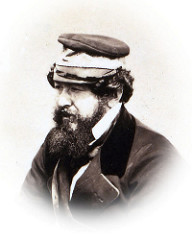
Through Some Eventful Years by Susan Bradford Eppes
August 1, 2026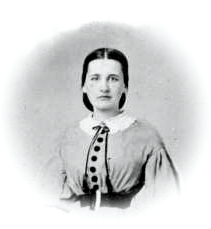
August 1st, 1861.—The Howell Guards are going to Virginia on the 12th of this month. Poor sister Mag, she is not a bit patriotic and she is almost brokenhearted at this news. Her baby is more than a year old now, fifteen months old, and he is learning to talk and is so funny and sweet but even Eddie cannot bring a smile to his mother’s face, she is the very picture of woe.
Susan Bradford is 15 years old when this entry was made.
“Most of the liquor-dealing Captains and Lieutenants who commanded before the battle have resigned…,”—War Letters of William Thompson Lusk.
August 1, 2026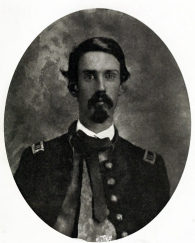
Meridian Hill, Washington,
Aug. 1st, 1861.
Dear Cousin Lou:
I am seated in my tent, the rain is pouring in torrents, and I am at leisure to think of friends at home. You see whom I was first remembering, not having forgotten the kind letter which Mr. Houston brought me from Thompsonville, when I was somewhere over in Virginia. I thank you so much for all the dear, kind expressions of love your letter contained.
Oh! Ah! Here come about twenty-five men or more with complaints, and as the Captain is away, I must straighten up, and play the part of Magistrate. Oh Olympian Jove! Oh Daniel risen to judgment! The malcontents have been severally coaxed, wheedled, threatened, and sent about their business, and the Centurion is once again at leisure. A pleasant thing is this exercise of power, especially when commands can be given in the quietest manner possible, and yet to feel that from your judgment there can be no appeal. In fact, dear Cousin Lou, imagine me when the Captain is away, performing the paternal function towards some hundred grown up children. Ah me! I am growing venerable and cares are weighing heavily upon me.
But I must not forget that I am a veteran soldier now. Poor Horace! How I shall assume superior airs, tell him, when I return home! In fact when,one of these days, I get a furlough and am surrounded by friends, how I shall exercise my soldier’s privilege of drawing the long bow! In my first battle, of course, I performed the most remarkable deeds of daring. I shall not pretend to tell you how many Secessionists I killed! Between ourselves though, in all privacy, I will confess that the fearful weapon with which I struck such terror in the hearts of the enemy, was a toy wooden sword, captured by one of our men from a secession boy-baby. In the great battle of Manassas, holding the occasion to be one of greater moment, I made the charge armed with a ramrod, which I picked up on the way thither! I acknowledge I found the work hotter than I anticipated in the latter engagement, and mean in future to go armed in regulation style. The truth of the matter was, that being ordered suddenly to march from our pleasant encampment in Georgetown, I was found unprepared, and must either stay behind, or trust to my pistol in case of emergency. I preferred the latter, and the kind Providence has brought me safely through the fiery ordeal through which we all had to pass. What think you, dear Cousin Lou ,of our miserable defeat? It seems hard, as we lost many good men out of our Regiment on that bloody day. I saw many things never to be forgotten. No matter for sickening details though. The ground lost must be recovered at any cost. We have lost out of the 800 who went into the engagement about 150 in killed and wounded, besides some fifty more numbered among the missing. Hardship and exposure have caused much sickness in the camp. Most of the liquor-dealing Captains and Lieutenants who commanded before the battle have resigned, many others are dead or in the hands of the enemy –so I can give no very cheerful picture of our camp at present. [continue reading…]
A Diary of American Events
August 1, 2026
August 1.–This morning the First Maine Regiment, Col. K. J. Jackson, passed through Philadelphia on their way home. Their appearance indicated the hard service which the regiment have had since leaving. They number 780 rank and fife, but intend, on reaching home, to immediately reorganize the regiment, increase the number to one thousand men, and re-enter the service for three years. The soldiers took breakfast at Washington avenue, prepared by the refreshment committee. This regiment passed through Philadelphia about three months ago; they have principally done guard duty on Meridian Hill, and at the Long Bridge, Washington.–Phila. Press, August 2.
–The War Department at Washington received the following direct from Gen. Rosecrans by telegraph, dated to-day:–”Gen. Cox reached Gauley Bridge on the 29th nit. Gen. Wise fled without fighting, destroying the bridge to prevent pursuit. We have captured a thousand muskets and several kegs of cannon powder. Many inhabitants of that section, who have heretofore been strong Secessionists, denounce Gen. Wise for his wanton destruction of property, and are abandoning him and his cause. His Western troops are rapidly disbanding. The valley of the Kanawha is now free from the rebel forces.”–Phila. Inquirer, August 2.
–Jeff. Thompson by proclamation informs the rebels of Missouri, that the North is whipped in Virginia; that “tardy action, like the gentle south wind, will only meet with Northern frosts,” and so invites them to “strike while the iron is hot.”–(Doc. 149.)
–The Twelfth Regiment N. Y. S. M., under the command of Colonel Butterfield, and the Twentieth Regiment, Colonel George W. Pratt, returned to New York from the seat of war. The Eighth Regiment, Mass., reached Boston from the seat of war.–N. Y. Herald, August 2.
–The prize brig Herald, with a cargo of naval stores and tobacco from Beaufort, S. C., bound to Liverpool, and which was captured by the frigate St. Lawrence on the 10th of July, arrived at Philadelphia, Pa. She cleared from Boston, May 27, ostensibly for Turk’s Island, but was then chartered by parties in New York for Beaufort, S. C., with the intent to try the experiment of running the blockade.–N. Y. Evening Post, August 2.
–Scouts returned to Cairo, Ill., from the South, and reported that the rebels at New Madrid were well-armed and drilled. They have five batteries of ten-pound field-pieces, officered by foreigners, and two regiments of cavalry well equipped. General Pillow is in command. He has promised Ex-Governor Jackson to place 20,000 men in Missouri at once. He has also issued a proclamation, full of bombast, to the people of Missouri, declaring his intention “to drive the invaders from the State, and enable her people to regain their rights so ruthlessly taken away by the forces who march under banners inscribed with Beauty and Booty, as the reward of victory.” He says he will show no quarter to those taken in arms.–Phila. Bulletin, August 2.
–New Orleans papers state that a “naval engagement” took place this day at the mouth of the Mississippi River between the U. S. frigate Niagara and “the little Confederate privateer J. O. Nixon;” and that, after an action of twenty minutes, the Niagara crowded on “every inch of canvas she could use, and made regular Manassas-time seaward.”–(Doc. 150.)
–The Onondaga County Cavalry, Capt. Moschell, departed from Syracuse, N. Y., for Washington at 10:20 to-night, to join Col.. Van Alen’s Cavalry Regiment. The company is 80 strong, and is composed of the very best material. A young bride, Mrs. Cook, accompanies them as a daughter of the regiment.–Baltimore American, August 3.
–The Secretary of War at Washington directed the commandant of the forces at Alexandria, Va., that from this day all slaves now in prison at that post be liberated, and that they may be employed on the fortifications and military works, and be paid for as day-laborers in the service of the Government. All other slaves escaping hereafter shall be treated in a similar manner.–Louisville Journal, August 3.
–Governor Gamble of Missouri delivered his inaugural to the Convention of that State. After referring to the personal sacrifices made by him in accepting the office, he calls upon the Convention and the people to give the experiment just made a fair trial. He then gives a vivid sketch of the evils arising from the anarchy with which that State has lately been threatened, assuring them that it will be his sole aim that the people of Missouri can worship God together, each feeling that his fellow-worshipper is not an enemy; that each can meet his neighbor without any conversations on blood and slaughter. The inaugural closes with a strong appeal for the cultivation of confidence and good feeling.–(Doc. 151.)
–The steamer B. P. Cheney was seized by the rebels at Columbus, Kentucky, and carried to the head-quarters of Gen. Pillow.–Louisville Courier, August 10.
–In the Senate of the United States, the bill to suppress insurrection and sedition was taken up, and an exciting debate occurred, in which Mr. Breckinridge and Mr. Baker, of Oregon, took part.–(Doc. 152.)
The St. Louis Democrat of this day gives an account of the preparation and departure of Gen. Fremont’s expedition from St. Louis to Bird’s Point, Cairo, and other positions on the Mississippi River.–(Doc. 153.)
Civil War Day-By-Day
August 1, 2026
August 1, 1861
- Tennessee votes to adopt the Constitution of the Confederate States of America
A Chronological History of the Civil War in America1
- Gen. McClellan began the reorganization of the Army of the Potomac.
- Rebels left Harper’s Ferry and fell back on Leesburg.
- C. S. privateer “Petrel” sunk by the “St. Lawrence”—crew captured.
- A Chronological History of the Civil War in America by Richard Swainson Fisher, New York, Johnson and Ward, 1863
For the wounded soldiers.—Woolsey family letters; Abby Howland Woolsey to Eliza.
July 31, 2026
10th Street, July 31.
My dear Eliza: We were quite touched by a note and a message from your farmer Thomson, and I write at once that no time may be lost in carrying out the generous wishes of the people on the place. As soon as they received the particulars of the battle of Bull Run, Thomson took up a subscription among them, for the wounded soldiers, and raised twenty dollars. He took it to Mrs. Wolcott, asking her to put it into the Society’s fund for buying hospital clothing. But she suggested that a more satisfactory way would be to send it to you, to be spent on the spot, in any way you thought best. . . . Thomson preferred this himself, and hopes to hear from you that the twenty dollars are well laid out.
Diary of Rutherford B. Hayes
July 31, 2026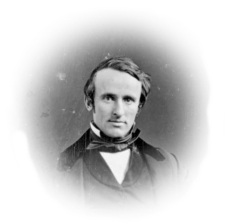
July 31. Wednesday.–Another warm, bright day. Orders from General Rosecrans direct Colonel Lytle to go with his regiment to Sutton and put this place in command of Colonel Scammon. This is supposed to indicate that we are to remain here for some weeks.
Extracts from the journal of Commander Semmes, C.S. Navy, commanding C.S.S. Sumter
July 31, 2026
“It puts us in the place of protectors instead of invaders.”—Rutherford B. Hayes
July 31, 2026
CAMP NEAR WESTON, VIRGINIA,
Wednesday, P. M., July 31, 1861.
DEAR MOTHER:–How you would enjoy sitting by my side on this beautiful hill and feasting your eyes on the sweep of hills that surrounds us. Nothing in Vermont is finer. The great majority of the people here are friendly and glad to have us here to protect them from the Secessionists. This is agreeable; it puts us in the place of protectors instead of invaders. The weather is warm, but a good breeze is blowing. The water is good; milk and blackberries abundant, and the location perfectly healthy. . . .
The village is a pretty one with many good residences and nice people. The State is, or was, building near where we are encamped a large lunatic asylum–an expensive and elegant structure. The war stops the work. This part of Virginia naturally belongs to the West; they are now in no way connected with eastern Virginia. The only papers reaching here from Richmond come by way of Nashville, Louisville, and Cincinnati. The courthouse and several churches are creditable buildings, and the shrubbery and walks in the private grounds are quite beautiful. Do not allow yourself to worry if you do not hear often. I think of you often. Love to Laura and all.
Affectionately, your son,
R. B. HAYES.
MRS. SOPHIA HAYES.
_______
[WESTON], July 31, [1861], Wednesday P.M.
DEAREST:–We are to stay here and keep in countenance the Union people for several days–or a week or more–until others come in to take our places. It is safe, which would please Mother; it is pleasant as a camping ground. I wish you were here.
I tell Mr. Schooley to bring me an India-rubber havelock and cape to keep water out of neck–or some such thing; also strong black buttons–a few–and a pair of yellow spurs, regulation style.
Young Jewett sleeps well and is in no great pain–so far doing well. His chance of saving his foot is about even–a sad case. We are to be alone in this locality; possibly we may be divided so as to occupy two or three places. Kisses for the boys.
Affectionately,
R.
MRS. HAYES.
A most horrible sight & a most disagreeable smell.
July 31, 2026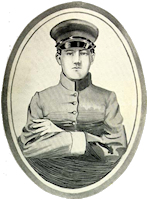
COMPANY F., FOURTH REGIMENT, N. C. STATE TROOPS.
NEAR MANASSAS JUNCTION, VA., July 31, 1861.
Dear Mother:
This is the first opportunity I have had of writing to you since I’ve been here. We do not live as well here as we have, but we make out very well. We have to walk about a mile for our water; as the ground is too rocky to dig a well we get it out of a spring. You can’t imagine how much I wish to see you all, I long to be free to go where I please. But alas, there is no telling where I may be, for when we first came here we did not expect to stay here this long without having a fight. I went over to the battle field last Sunday, and there met a most horrible sight, for it had been over a week after the fight, and the bodies of the men had been blackened by the burning sun and the horses had a most disagreeable smell.
On our going on the field the first object that met our gaze was a grave in which fifteen North Carolinans were buried. We next came to a Yankee who had only a little dust thrown over him. One of his hands was out, which looked very black, the skin peeling off, and you could see the inscission in it. The next which I noticed particularly had his face out and his white teeth looked horrible. The worms were eating the skin off his face. It made me shudder to think that perhaps I may be buried that way.
There are wounded prisoners all through the country in every house. I hope that peace will soon be declared, that we may enjoy the happiness with which we were once blest. I wish you all would write to me for I long to hear from you.
I suppose you heard about Frank T. running from the enemy; it is true, the officers told it. The General gave him his choice to have a Court Martial or be discharged through cowardice, and he took the latter.
We have our little bantams with us yet, and we intend that they shall crow in Washington City, which is only thirty-three miles off, if we live. I must close.
Goodbye,
Your affectionate son,
GEORGE.
Letters from two brothers who served in the 4th North Carolina Infantry during the Civil War are available in a number of sources online. Unfortunately, the brothers are misidentified in some places as Walter Lee and George Lee when their names were actually Walter Battle and George Battle. See The Battle Brothers for more information on the misidentification.
“More removals in the patent office today, only three of the old Exmrs left, so we go.”—Horatio Nelson Taft
July 31, 2026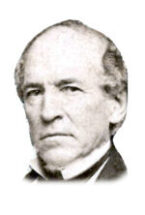
WEDNESDAY 31
This has been a hot day. M. 92. I have been obliged to keep very quiet on account of my lameness. If I had been a “high liver” I should think it was the gout, but I am very clear of that. I have been in the house nearly all day, but went over to the “Camp” awhile at Major Bartletts quarters. More removals in the patent office today, only three of the old Exmrs left, so we go. G P Androus of NY called this evening. He is on a business visit to the City.
______
The three diary manuscript volumes, Washington during the Civil War: The Diary of Horatio Nelson Taft, 1861-1865, are available online at The Library of Congress.
Flesh Wounds
July 31, 2026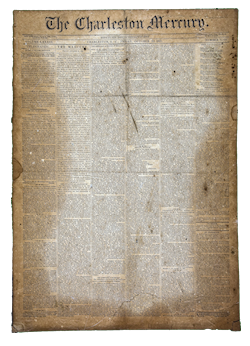
The Charleston Mercury
July 31, 1862,
The following recipe for flesh wounds has proved very efficacious, and is recommended to the Medical Faculty as an experiment. It has been practically tested by an officer in the French army, who was wounded in the arm, and in the space of eight days his wound was healed. It is worth a trial:
Take a linen rag, in which cut small holes throughout, dip it in camphor oil, and apply it to the wounded parts. Take finely powdered camphor and sprinkle over the linen – a piece of lint in camphor salve should then be applied over the wound. Bandage the part wounded, and apply twice or three times a day.
Field Piece
July 31, 2026
Daily Times
Leavenworth, Kansas
July 31, 1861
The Osawattomie Herald gives an interesting reminiscence relating to a field piece, now in possession of Capt. Snyder, of the Third Regiment. During the troubles of ’56, this cannon was at one time, in charge of a guard of six Missourians, at a place near the State line. It was taken from them, at night, by Mr. Stiles, of Shawnee, assisted by three Kansas ladies, viz: Mrs. E. W. Stiles, Miss Virginia King, aged fifteen, and Miss Sophia Knapp, aged thirteen. The old gun which was once used to crush out freedom in Kansas, will now do good service in annihilating the traitors of Missouri.
Foundry
July 31, 2026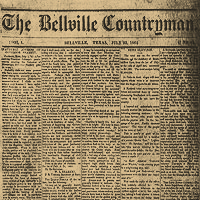
Bellville Countryman
Bellville, Texas
July 31, 1861
The citizens of Port Lavaca, says the Victoria Advocate, have established a foundry for casting cannon, and also procured machinery for the manufacture of small arms. An old nine pounder, long located in Victoria, has been sent down there to be rifled.
The Reagan Guards and Texas Guards, from Anderson county, Texas, arrived in New Orleans on the 8th.
Torn Asunder – Images from America’s Civil War
July 31, 2026Ten years ago, I created a short video using photographs from the civil war and mixed it with a couple of medleys of civil war music recorded about 100 years ago.
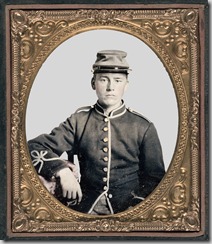
All of the photographs are from the U.S. Library of Congress Prints and Photographs Online Catalog.
_________
Description of photographs:
- Keedysville, Md., vicinity. Confederate wounded at Smith’s Barn, with Dr. Anson Hurd, 14th Indiana Volunteers, in attendance, September 1862.
- Unidentified soldier in Confederate uniform and forage cap.
- Chickahominy River, Va. Grapevine bridge built May 27-28, 1862, by the 5th New Hampshire Infantry under Col. Edward E. Cross.
- Unidentified young soldier in Union uniform with musket, bayonet, and knapsack.
- Aquia Creek Landing, Va. Embarkation of 9th Army Corps for Fort Monroe, February 1863.
- Unidentified soldier in Confederate uniform and slouch hat, missing jacket buttons.
- Cedar Mountain, Va. A Confederate field hospital, 1862.
- Unidentified young soldier in New York Zouave uniform.
- Cumberland Landing, Va. Federal encampment April – May 1862.
- Unidentified young soldier in Confederate shell jacket, Hardee hat with Mounted Rifles insignia and plume with canteen and cup.
- Military Bridge across the Chicahominy, June 1862.
- Unidentified African American soldier in Union uniform in front of painted backdrop showing military camp.
- Rebel gun in front of Fort Hell, April 1865, a Confederate cannon inside of Fort Sedgwick in Petersburg, Virginia.
- Unidentified soldier in Confederate uniform.
- Yorktown, Va. Embarkation for White House Landing, Va.
- Unidentified young sailor in Union uniform.
- Antietam Bridge, September, 1862.
- Unidentified soldier in Confederate shell jacket and slouch hat with object hanging from neck in front of painted backdrop showing waterfall.
- Confederate prisoners at Fairfax Courthouse, June 1863.
- Unidentified girl in mourning dress holding framed photograph of her father as a cavalryman with sword and Hardee hat.
- Hand colored; Tending wounded Union soldiers at Savage’s Station, Virginia, during the Peninsular Campaign, 1862.
- Two unidentified women reading letters.
- James River, Va. Sailors on deck of U.S.S. Monitor; cookstove at left, July 9, 1862.
- Unidentified soldier in Confederate uniform and civilian, likely his father or older brother.
- Harper’s Ferry, meeting of the Potomac and the Shenandoah, July 1865.
- Unidentified soldier in Confederate uniform.
- Libby Prison, Richmond, Va., August 23, 1863.
- Unidentified African American Union soldier with a rifle and revolver in front of painted backdrop showing weapons and American flag at Benton Barracks, Saint Louis, Missouri.
- Manassas, Virginia. Camp of General Irvin McDowell’s body guard, hand colored photographic print.
- Unidentified soldier in uniform with young woman, probably his wife.
- Secret Service agents, Whitehouse, Va.
- Unidentified soldier in Confederate uniform of the 11th Virginia regiment with knapsack and bedroll.
- Dinner time in camp.
- Unidentified woman wearing mourning brooch and displaying framed image of unidentified soldier.
- Confederate artillery near Charleston, S.C.
- Unidentified soldier in Union uniform with Company E, 12th Regiment New Hampshire Volunteers hat.
- Confederate prisoners at Belle Plain Landing, Va., captured with Johnson’s Division, May 12, 1864.
- 1863, Interior view of Fort Sumter showing ruins and explosion.
We were going to war with a people of not half our numbers, without money, without munitions of war, without navy, without anything in fine of those elements which go to make up the ensemble of a people powerful in war…
July 31, 2026
1861, July 31.—On the 19th of June, 1861, the 5th Regiment of Wisconsin Vols., being partially organized, went into camp at Madison, Wis. Here it remained for a time, perfecting its organization, drilling and preparing itself for the hardships, the dangers, and the responsibilities to be encountered in the battle-field, against a people warlike and chivalric; a people who are taught to regard physical courage, and recklessness of physical danger, as the noblest qualities of the human race, and a people whose chief pride was to win in fight, whether with individuals or in masses; but a people, who, having entrusted their politics to professed politicians, were misled to believe that, by their brothers of the Northern States of this Union, their rights of property were invaded, and their homes were coveted as a prize for distribution amongst the overgrown population of the North. But to enter into a discussion of the merits of this rebellion, now devastating the most beautiful country known to man, carrying in its march a passover of beggary, of destitution, and of death, is not in accordance with the object of this little book. It is therefore passed over, that the reader may at once be permitted to enter into a detail of the subjects indicated in our preface.
From the time of the commencement of the rebellion, by actual war on Fort Sumter, in April of this year, its settlement by rapid and decisive victories over the rebels was subject of merriment, and looked on as matter of course. We were going to war with a people of not half our numbers, without money, without munitions of war, without navy, without anything in fine of those elements which go to make up the ensemble of a people powerful in war, and we were entering into the strife as a short interlude to the hum-drum vocations of life. “How could a people thus situated hope to compete with the parent Government, rich in every element which makes a great people?” This was the reasoning. In vain were our people told of the character of the Southerners. In vain were they referred to the results of our own rebellion and successful revolutionary war with England. “Oh!” was the reply, “Steamships were not known in those days, and England had to cross the ocean to fight us.” “But Hungary, with its population of only 3,000,000, and without revenue, withstood the whole power of Austria, till the hordes of Russia had to be called in to aid in their subjugation.” “But Austria had become a superannuated and feeble people.” No reasoning would answer. The subjugation of the revolted States was to be a pastime, and could be nothing but a pastime. Thus went on matters, drilling as an amusement, preparatory to the enjoyment of a war, all the results of which, were to be on our side, and obtained without sacrifice or suffering. [continue reading…]
A Diary of American Events – July 31, 1861
July 31, 2026
July 31.–A letter from Jefferson Davis to John R. Chambless was published. It was an answer to the inquiry of the latter “whether, prior to the 24th day of April, any of the Confederate States had transferred to the Confederate government the public property captured by them from the late United States, and upon what terms; also whether any such transfers have been made since the said date, and upon what terms.”–(Doc. 137.)
–The Twentieth and Twenty-first Regiments of Indiana Volunteers, under the commands of Colonels Brown and McMillen, left Indianapolis for the seat of war. Two companies in each are armed with the Enfield and Minié muskets, and the skirmishers of both regiments have the most approved arms known to the service. The other portions of the regiments are armed with the smooth-bore muskets, which will be exchanged for the rifled guns as soon as the Government can obtain them.–Louisville Journal, August 1.
–The schooner Tropic Wind arrived at New York from Fortress Monroe in charge of a prize crew, consisting of Thomas F. Spencer, prizemaster, Surgeon Linahan, and Alexander Lowe of the Union Coast Guard. The Tropic Wind was seized on the 29th of June, by the order of Major-General Butler, for violation of the blockade and communicating with the enemy, after having been warned by the Pawnee. She had been seized once before by the Monticello and taken to Washington, but was released by order of the Secretary of State, and it was under the voyage down the Potomac that the violated the blockade. The information which led to her seizure was communicated to Major-General Butler by two of her crew, who were free negroes, who were induced to do it from having overheard a conversation between the captain and mate of the schooner in relation to the sale of themselves. The schooner has on board the former mate Mr. James L. Wilson of Virginia, who was a sergeant in an artillery corps attached to the secession army.–N. Y. Tribune, August 1.
–To-day an ordinance passed the Cincinnati (Ohio) City Council, to appropriate the sum of $23,000 to loan the Hamilton County commissioners for the purpose of relieving the wives and families of the volunteers.–Louisville Journal, August 2.
–The Fifth Regiment of Wisconsin Volunteers, under the command of Colonel Amasa Cobb, passed through Baltimore, Md., on the route to Washington. They left Madison, Wisconsin, where they had been in camp four weeks, on Wednesday last, coming by way of Janesville, Chicago, Toledo, Cleveland, and Pittsburg. Their trip was a triumphal march. All along the journey they were met at every station by crowds of people, who not only cheered them by their presence, but also furnished them bountifully with refreshments of all kinds. Not a single accident happened on the whole route. The wives and daughters of several of the officers accompanied the regiment on its journey. It numbers 1,061 men, in addition to the drum corps and band. – Baltimore American, August 1.
– Colonel L. S. Miles, upon whose conduct daring the battle at Bull Run severe animadversions had been made, published a card. He declares that he has been made the victim of personal spite, that he directed the movements of his troops on the field, and that he never gave some of the orders attributed to him. He further says that he has called for a court of inquiry to investigate the whole transaction. – (Doc. 138.)
–General Pillow in command of rebel troops at New Madrid, Mo., issued a proclamation to the citizens of Missouri, announcing his intention to expel the Federal troops from the State and reinstate Claiborne F. Jackson, at Jefferson City. Gen. Pillow’s army is made up of a portion of the Union City, the Randolph, and the Memphis troops, and is from twelve to twenty thousand strong. They are well supplied with cannon, field-pieces, and siege guns. Jeff Thompson, now in command of Watkins’ old force, has moved the encampment from Bloomfield to within eight miles of Charleston. Part of Pillow’s command, numbering some 3,000, are upon the Cape Girardeau road, between Madrid and Charleston. The rebels have taken military possession of the road through West Prairie from New Madrid to Cape Girardeau, and are preparing for an attack upon Bird’s Point or Cape Girardeau. However, every thing is in a masterly state of preparation both at Camp Defiance and at Bird’s Point, for the fight.– (Doc. 139.)
–Yesterday M. Parks, the agent of the State of North Carolina in Portsmouth, Virginia, transferred to the Confederacy a fleet of five steamers already manned and armed. – Richmond Examiner, July 30, 31.
– Brigadier-general Pope issued a special order, assigning Brigadier-General Hurlburt to the command of the United States forces along the Hannibal and St. Joseph railroad. Colonel Grant to command at Mexico, on the North Missouri road ; Colonel Ross to occupy Mounton, and Colonel Palmer to post his regiment at Renick and Sturgeon, making his head-quarters at Renick. These several districts to be divided into sub-districts not exceeding seven miles in extent, and commanding officers are instructed to report to the district head-quarters at Mexico the names of persons suitable to be appointed superintendents and assistant superintendents, whose duty it shall be to protect the railroad property in their respective divisions. Men of property and respectability, without regard to political opinion, are to be selected for positions.
All illegal assemblages to be promptly broken up, and all persons taken in arms against the United States to be sent to Mexico, to be disposed of by the commanding general. No arrests to be made for opinion’s sake, unless the parties are engaged in open acts of hostility, or stimulating others to such acts by inflammatory words or publications. The restoration of peace and safety to the region distracted by civil commotion, and the punishment of the infamous assassins and incendiaries infesting the country, is announced to be the mission of the force in North Missouri.
The troops are cautioned against excesses of any kind, especially depredations on the possessions and property of any citizen of Missouri, and infractions of military discipline and good order will be visited with the greatest severity possible under the articles of war.– Washington Republican, August 2.–(Doc. 140.)
–John H. Reagan, Postmaster-General of the “Confederate” States, issued a decision, in reference to the transmission and delivery of newspapers and periodicals through the mails in the Southern States.–(Doc. 141.)
–The Memphis Appeal of this date ingeniously culls various expressions of several northern men to prove that the present war is solely a war of abolition, and that this object long hidden begins now gradually to appear. Among the persons it quotes are, Abraham Lincoln, W. H. Seward, H. J. Raymond, Lloyd Garrison, and Wendell Phillips.–(Doc. 142.)
–In the House of Representatives at Washington, Mr. Potter from the Select Committee on the loyalty of Government employees made a special report.–(Doc. 143.)
–To-day at Washington, two general orders were issued by General Scott. The first directs that all searches for arms, traitors, or spies, and arrests of offenders, in any military department, shall only be made by authority of the Commander of the department, except in cases of urgent necessity. The second order announces the desecration of Mount Vernon by the bands of armed rebels, and expresses the hope of the Commander-in-Chief that, should the operations of the war take the national troops in that direction, every possible respect will be paid to the sacred precincts.–(Doc. 144.)
–The Missouri State Convention to-day elected for the Provisional Government, Hamilton E. Gamble, for Governor; Willard P. Hale, Lieutenant-Governor; and Mordecai Oliver, Secretary of State. The opposition were excused from voting, protesting against the power of the Convention. In the afternoon the Governor and Lieutenant-Governor were sworn in and inaugurated. Each made a strong Union and patriotic speech, amid loud applause. After the presentation of an address to the people of the State by the Convention, it adjourned till the third Monday in December, unless sooner called together by the new Government, or demanded by the public safety.–(Doc. 145.)
–Joseph Holt addressed the soldiers at Camp Joe Holt, Ind., this day. A vast throng of civilians swelled the audience, including several parties of ladies and gentlemen from Louisville. Mr. Holt was introduced by Gen. Rousseau with soldier-like directness, and spoke for half an hour or upward in a strain of the most enkindling and enchanting eloquence. The effort was one of the most effective and felicitous of his life.–(Doc. 146.)
–Thos. C. Reynolds, ex-Lieut.-Gov. of Missouri, in a long proclamation, announces to the people of Missouri that “the sun which shone in its full mid-day splendor at Manassas is about to rise upon Missouri,” and calls upon them “to rally as one man to the defence of the State.”–(Doc. 148.)
Civil War Day-By-Day
July 31, 2026
July 31, 1861
- 11 Union officers are submitted to Congress to be promoted to brigadier general. Includes William B. Franklin, Ulysses S. Grant, Samuel Heintzelman, Joseph Hooker, William Tecumseh Sherman, Ulysses S. Grant
A Chronological History of the Civil War in America1
- Missouri State Convention elected Hamilton R. Gamble Governor, Willard P. Hall Lieutenant Governor, and Mordecai Oliver Secretary of State—all Union men.
- A Chronological History of the Civil War in America by Richard Swainson Fisher, New York, Johnson and Ward, 1863
“Many of the leading ladies are Secessionists. We meet many good Union men; the other men are prudently quiet.”—Rutherford B. Hayes
July 30, 2026
CAMP ON WEST FORK OF MONONGAHELA
RIVER, WESTON, VIRGINIA, Tuesday, P. M.,
July 30, 1861.
DEAREST:–We are in the loveliest spot for a camp you ever saw–no, lovelier than that; nothing in Ohio can equal it. It needs a mountainous region for these beauties. We do not know how long we shall stay, but we suppose it will be three or four days. We have had two days of marching–not severe marching at all; but I saw enough to show me how easily raw troops are used up by an injudicious march. Luckily we are not likely to suffer in that way. We are probably aiming for Gauley Bridge on the Kanawha where Wise is said to be fortified. General Rosecrans is engaged in putting troops so as to hold the principal routes leading to the point.
The people here are divided. Many of the leading ladies are Secessionists. We meet many good Union men; the other men are prudently quiet. Our troops behave well.
We have had one of those distressing accidents which occur so frequently in volunteer regiments. You may remember that a son of H. J. Jewett, of Zanesville, President of [the] Central Ohio Railroad, was on the request of his father appointed a first-lieutenant in Captain Canby’s company. He joined us at Grafton in company with his father. He had served in Colonel ––’s regiment of three-months men in all the affairs in western Virginia and is very promising. A loaded gun was thrown down from a stack by a careless sentinel discharging a Minie ball through young Jewett’s foot. I was with him in a moment. It is a painful and severe wound, perhaps dangerous. There is a hope he may not be crippled. He bears it well. One of his exclamations was, “Oh, if it had only been a secession ball I wouldn’t have cared. Do you think you can save my leg,” etc., etc. The ball after passing through his foot passed through three of McIlrath’s tents, one full of men lying down. It cut the vest of one over his breast as he lay on his back and stirred the hair of another; finally passed clean through a knapsack and struck a man on the leg barely making a slight bruise and dropping down. Dr. Joe has the flattened bullet now to give to Jewett.
My horse came over the hills in good style.– Pshaw! I wish you were here; this is a camp. The field officers’ tents are on a high greensward hill, the other tents spreading below it in the sweetest way. As I write I can turn my head and from the entrance of the tent see the loveliest scene you can imagine. . . .
Affectionately,
R. B. HAYES.
MRS. HAYES.
“A fine young first lieutenant was accidentally shot by a gun falling on the ground out of a stack.”—Diary of Rutherford B. Hayes
July 30, 2026
July 30. Tuesday.–Warm, bright morning. Damp in the tent with the fogs of the night. Hang out my duds to dry. Have met here divers Cincinnati acquaintances and Lieutenant Conger and Dr. Rice, of Fremont. Just now a fine young first lieutenant (Jewett of Zanesville) was accidentally shot by a gun falling on the ground out of a stack. A great hole was torn through his foot. The ball passed through three tents, barely missing several men, passed through a knapsack and bruised the leg of one of Captain McIlrath’s men.
To the Hon. William H. Seward
July 30, 2026
Washington, D. C.
London, July 30, 1861.
My Dear Sir,–I arrived here the day before yesterday, and through the kindness of a mutual friend had an interview of an hour’s duration, last evening, with Lord Palmerstbn, in one of the private galleries of the House of Commons. The length to which his lordship allowed our interview to be prolonged, and the many interrogatories which he put to me, are a striking evidence of the deep interest with which the government watches the progress of events in our country.
Lord Palmerston, after asking me a number of questions about our army and navy, the feeling at the North, etc., wanted also to know whether the feeling of anger and irritation manifested by our people against England for her position of neutrality was still as violent as ever when I left.
I told him that there was no feeling of hostility in the United States against England, but that throughout all classes of people at the North we felt deeply mortified and disappointed when the proclamation of the Queen revealed to us the fact that the people of the United States had not to expect any sympathy on the part of the British government in their struggle for national existence against a rebellious slave oligarchy; I dwelt upon the criminality, unjustifiability, and lawlessness of that rebellion, and compared the tone of the English government and press with the expression of heartfelt sympathy which came across the Atlantic, from the whole American people, at the time of the rebellion in India.
His Lordship listened with earnest attention to my remarks, and said that the British government, by its strict neutrality, did not do any more than what we had done when we would not permit them to enlist a few men in the States during the Crimean war. In the course of the conversation he used this phrase, ” We do not like slavery, but we want cotton, and we dislike very much your Morrill tariff.”
I think this phrase comprises the whole policy of this government in the present war, and from what I have seen and heard since mv arrival, I am more than ever convinced that we have nothing to hope from the sympathy of the English government and people in our struggle. Because this war is not carried on for the abolition of slavery in the Southern States, they try to maintain that the war has nothing to do with slavery: wilfully shutting their eyes to the fact that the attitude of the North with regard to introducing slavery into the Territories is the main ground upon which the Secessionists justify their action. As a distinguished lady, wife of a prominent liberal in Parliament, told me last evening: “I am sorry to say, we have been found wanting in the present emergency, and principles have to vield to interest.”
The news of the patriotic action of Congress, by voting large supplies of men and money, and the successes of General McClellan, have evidently startled people a good deal. Lord Palmerston was very minute in his inquiries on all these points. He also asked what it meant that Congress had passed a law closing the Southern ports, and whether this act of Congress was to stand in lieu of the blockade, which was thus to be given up.
I gave him my individual views on this question, stating that I thought this action was only taken in order to give additional force and Constitutionality to the blockade, and to meet objections which might be raised against the government blockading its own ports, and as such the United States considered every port in the seceded States.
He then asked me what was the meaning of the law just passed by Congress, authorizing the appointment of collectors in the Southern ports for receiving custom-duties on board of vessels of war, to be stationed at the entrance of the respective ports–that he could not understand how, on one hand, a port could be blockaded, and on the other hand, ships be allowed to enter upon paying customs, maintaining that this was virtually doing away with the blockade.
I replied that I thought the passage of this act was only intended to be authoritative, but not mandatory, upon the executive, and that Congress wanted to give to the President every possible Constitutional power, in order to be prepared for every emergency. That so far from intending to relinquish the blockade of the seceded ports, no efforts would be spared in order to make it respected and effective.
I mention all these remarks and objections in order to show you how every excuse will be seized by this government in order to break through our blockade, and I know that under the influence of Mr. Mercier’s dispatches to his government, we have nothing better to hope from France. I understand that both governments have written to their ministers at Washington, more than a week ago, that they will not allow French and English vessels to be overhauled on the high seas by our blockading squadron, on account of being suspected of having run the blockade, or carried contraband of war.
Lord Palmerston asked me what our manufacturers and spinners in New England would do for their supply of cotton, and how they were situated at present. I told him that by working short time I thought they would have cotton enough to last them until next spring, and that they were all for a strong, vigorous prosecution of the war, convinced that this was the only way in order to get the required supply by next spring.
He asked me, also, where our government intended to raise the large amounts voted by Congress for the prosecution of the war. I told him that I had no knowledge of the intentions of the Secretary of the Treasury, but I supposed he would negotiate his loans wherever he could make the most advantageous terms, that undoubtedly a large portion, if not the whole, would be taken by our people at home, the stagnation of trade having thrown a good deal of idle capital upon the market. I purposely conveyed the idea that we did not look for the probability of negotiating any large loan in England at present, because, since my arrival, the English papers have talked a good deal about my having come over for the purpose of raising money here.
I shall also shorten my visit here for the present, and intend to leave this evening for Paris and Germany. If I have a chance in Paris to see any of the Emperor’s cabinet, I shall do so, and shall not fail to write to you should any thing of interest come to my knowledge. I hope that by the time this reaches you our troops have been victorious in Virginia–one or two battles now will very soon change the tone and feeling of our English cousins.
Extracts from the journal of Commander Semmes, C.S. Navy, commanding C.S.S. Sumter
July 30, 2026
Warning
The following journal entry contains wording that is offensive to many in the world of today. However, the entry is provided unedited for its historical content and context.
Soldier: “This is the first time I ever used a spade and I don’t like it too well.”—Rutherford B. Hayes
July 30, 2026
WESTON, VIRGINIA,
Tuesday Morning, July 30, 1861.
DEAR UNCLE:–If you look on the map you can find this town about twenty-five miles south of Clarksburg, which is about one hundred miles east of Parkersburg on the Northwest Virginia Railroad. So much for the general location; and if you were here, you would see on a pretty sidehill facing towards and overlooking a fine large village, surrounded by lovely hills, almost mountains, covered with forest or rich greensward, a picturesque encampment, and on the summit of the hill overlooking all, the line of field officers’ tents. Sitting in one of them, as [Henry] Ward Beecher sat in the barn at Lenox, I am writing you this letter.
I have seen Conger, acting assistant quartermaster of [the] Tenth Regiment. He wishes a place. I ventured to suggest that he could perhaps raise a company in your region by getting an appointment from the governor. All here praise him both as a business man and as a soldier. He must, I think, get some place. His reputation is so good with those he is associated with.
Dr. Rice also called to see me; he looks well and is no doubt an efficient man. Dr. Joe has had a consultation with him and thinks him a good officer.
We enjoy this life very much. So healthy and so pretty a country is rarely seen. After a month’s campaign here the Tenth has lost no man by sickness and has but seven sick. General Rosecrans takes immediate command of us and will have us with him in his operations against Wise. We shall have mountain marches enough no doubt. So far I stand it as well as the best. . . .
This is the land of blackberries. We are a great grown-up armed blackberry party and we gather untold quantities.
Here there are nearly as many Secessionists as Union men; the women avow it openly because they are safe in doing so, but the men are merely sour and suspicious and silent…
Men are at work ditching around my tent preparatory to a thunder-shower which is hanging over the mountain west of us. One of them I hear saying to his comrade: “This is the first time I ever used a spade and I don’t like it too well.”
But you have had enough of this incoherent talk. Colonel Scammon and Matthews have both been absent and left me in command, so that I have been exposed to numberless interruptions.
Good-bye. Direct to me by my title “Twenty-third Regiment, Ohio troops, Clarksburg, Virginia,” and it will be sent me.
R. B. HAYES.
Send this to Lucy.
S. BIRCHARD.