4th. Boys got ready to go for forage, when orders came to report to H quarters immediately, lightly equipped. E, G. H and C went under Capt. Stewart over the river to Morgantown. A “coffee” girl brought us some peaches. Ate dinner with Rebs. $200 for a pan of flour. Lady said she paid $3,000 for 35 lbs. Take nothing but rebel money. Took two or three prisoners, citizens. E Co. let one get away. Camped at Mr. Griffith’s near Unitia. Union people, gave us a good supper. Slept in a wheat stack.
American Civil War Chronicles
Downing’s Civil War Diary.–Alexander G. Downing.
September 4, 2023
Friday, 4th–The weather today is intensely hot. Those who are not sick spent the day in washing their clothing. Over half of the boys in our regiment are sick with the fever and ague, all because of the very poor water we had to drink while on the march, the weather being very hot and sultry.[1]
[1] The results accomplished by this expedition were meager indeed, While the suffering endured by the men engaged in it was very great. Many died from the effects of the hardships to which they were subjected, and many never fully recovered from the diseases contracted while passing through that malarious region, and that during the hottest days of the summer.—A. G. D.
A Rebel War Clerk’s Diary
September 4, 2023
SEPTEMBER 4th.—There is a rumor that Gen. Lee (who is still here) is to take the most of his army out of Virginia, to recapture the Southern territory lost by Loring, Pemberton, and Bragg. I doubt this for it might involve the loss of Richmond, and indeed of the whole State of Virginia. It would be a sad blow to the extortionate farmers, it is true but we cannot afford to lose the whole country, and sacrifice the cause, to punish the speculators. It may be, however, that this is a ruse, and if so, Lee is preparing for another northern campaign.
The project of the Hon. Mr. Boteler to place Rains’s subterra shells under the Orange and Alexandria Railroad used by the enemy, was referred by the Secretary to Col. J. Gorgas, the Northern Chief of Ordnance, who says he can furnish the shells, but advises against the use of them, as they will “only irritate the enemy, and not intimidate them.” For this presumptuous advice, which was entirely gratuitous, I do not learn that the Secretary has rebuked him.
Letters from Western North Carolina show that the defection is spreading. In Wilkes County, Gideon Smoot is the commander of the insurgents, and has raised the United States flag. I have not learned, yet, whether Lieut.-Col. Lay, of the Bureau of Conscription, reached that far; and I was amazed when the good nature of Col. Preston yielded to his solicitations to go thither. What possible good could he, a Virginian, and formerly an aid of Gen. Scott, effect in that quarter?
War Diary of Luman Harris Tenney.
September 3, 2023
3rd. After breakfast and feeding, moved to Lenoir. Stopped two hours in the shade near the big springs. Several Union men from over the river, Blount County, anxious for us to cross over. Camped in the woods on a high bank of river. Many girls out to see us. Several came up and took coffee with the boys, highly pleased. People all seem to be loyal. Lenoir old rebel. Confiscated corn, sugar, etc. Splendid crops along the river. Uneducated, homely girls and women.
Downing’s Civil War Diary.–Alexander G. Downing.
September 3, 2023
Thursday, 3d–The boats arrived this morning and we embarked immediately, pushing out at 10 o’clock for Vicksburg. The Eleventh and the Sixteenth Iowa were on board the “Samuel Gotz.” We were crowded on the boat, and the heat of the sun was frightful. We reached Vicksburg at 3 o’clock in the afternoon, and disembarking, marched to our old camp.
A Rebel War Clerk’s Diary
September 3, 2023
SEPTEMBER 3d.—Night before last the heavens were illuminated, it is said, by the terrific bombardment of the batteries and forts in the vicinity of Charleston, and earth and sea trembled with the mighty vibrations. Yet no material injury was done our works, and there were not more than a dozen casualties. On the side of the enemy there is no means of ascertaining the effect.
N. S. Walker, Confederate States agent, Bermuda, writes that the steamer R. E. Lee was chased, on her last trip out, twelve hours, and was compelled to throw 150 bales government cotton overboard. He says the British crown officers have decided that British bottoms, with British owners of cargo, running out of blockaded ports, are liable to seizure anywhere on the high seas.
Some of the papers say Knoxville is in the hands of the enemy, and others deny it.
Hon. F. S. Lyon writes from Demopolis, Ala., that the Vicksburg army have not reported upon the expiration of the thirty days’ leave, in large numbers, and that the men never can be reorganized to serve again under Pemberton.
Gen. Jos. E. Johnston writes from Morton, Miss., that he is disposing his force to oppose any raids of the enemy, and that he shall keep the Vicksburg troops (when exchanged) in Eastern Mississippi.
Gov. Jos. E. Brown telegraphs that the men (militia) in Georgia cannot be compelled to leave the State but if the government will send them 5000 arms, he thinks he can persuade them to march out of it, provided he may name a commander. The President indorses on this: “If they are militia, I have no power to appoint; if C. S: troops, I have no power to delegate the authority to appoint.”
Gen. Lee is still here (I thought he had departed), no doubt arranging the programme of the fall campaign, if, indeed, there be one. He rode out with the President yesterday evening, but neither were greeted with cheers. I suppose Gen. Lee has lost some popularity among idle street walkers by his retreat from Pennsylvania. The President seeks seclusion. A gentleman who breakfasted with him this morning, tells me the President complained of fatigue from his long ride with Gen. Lee.
Robert M. McGill
September 2, 2023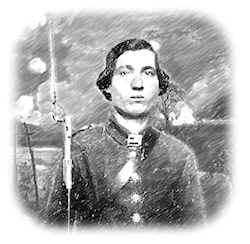
Wednesday, September 2.—Confederates have fallen back from Loudon; bridge burned.
(Note: picture is of an unidentified Confederate soldier.)
War Diary of Luman Harris Tenney.
September 2, 2023
2nd. Aroused at 2 A. M., in readiness for a fight. Got breakfast, fed and moved at 6 o’clock. General order from Burnside saying that any man guilty of stealing, robbing or pillaging should be stripped of clothes, flogged, head shaved, branded with letter T. and drummed out of service. Marched to Lenoir. Then artillery opened up at London and we took the trot for 5 miles. 2nd Tenn. attacked rebels. They burned the bridge and retreated. We too late. An order to scout. Alarm that rebels were crossing. Went swimming in Tenn. River. Half a mile wide. Current swift and water clear. Went to London bridge. Found 45th Ohio there. Took the company up there and showed the breastworks, good fortifications. Rifle pits and acres of trees cut down. Discovered nothing unusual.
Downing’s Civil War Diary.–Alexander G. Downing.
September 2, 2023
Wednesday, 2d–We left Bayou Mason at midnight and marched through to the river, eighteen miles, without stopping, reaching Goodrich’s Landing at 7 o’clock this morning. General Stephenson planned our march so that we should pass through that terrible ten miles of hemp at night, thus avoiding the heat.[1] Our brigade led in the march all the way. The day is very hot and sultry. General Logan’s Division has taken the boats down the river for Vicksburg.
[1] All were thankful to him for it; for, if there is such a place as hell, this piece of road is a sample of the road leading to Satan’s residence. —A. G. D.
A Rebel War Clerk’s Diary
September 2, 2023
SEPTEMBER 2d.—We have no news of any importance from any of the armies. Gen. Bragg, however, telegraphs, August 31st, that he is concentrating his forces to receive the enemy, reported to be on the eve of assailing his position. He says he has sent our paroled men to Atlanta (those taken at Vicksburg), and asks that arms be sent them by the eastern road. Col. Gorgas, Chief of Ordnance, says this is the first intimation he has had as to the disposition of the paroled prisoners. Does he understand that they are to fight before being exchanged?
Brig.-Gen. G. J. Rains writes from Charleston that the grenades reported by the enemy to have been so destructive in their repulse at Battery Wagner, were his subterra shells, there being no hand-grenades used.
The other night Beauregard sent a steamer out with a torpedo to destroy the Ironsides, the most formidable of the enemy’s iron-clads. It ran within forty yards of the Ironsides, which, however, was saved by swinging round. The torpedo steamer’s engine was so imperfect that it could not be worked when stopped, for several minutes, to readjust the arrangements for striking the enemy in his altered position. When hailed, “What steamer is that?” the reply was, “The Live Yankee,” and our adventurers got off and back to the city without injury—and without inflicting any.
There has been much shelling the last few days, but Sumter and Battery Wagner are still under the Confederate flag. How long this will continue no one knows. But it is hoped the great Blakely guns are there by this time, and that Gen. Rains’s torpedoes may avail something for the salvation of the city.
War Diary of Luman Harris Tenney.
September 1, 2023
SEPTEMBER, 1863
1st. Reveille at early daylight. “Boots and Saddles” at 6:30. Marched out on the Kingston road and halted till nearly noon. Gen. B. passed us. Infantry up and massed in a big field. Looks like business. Moved on London road, more big hills. Numerous reports about Rebs. Three taken at ford of Clinch River. Report that Rebs have left London. Camped after crossing river. Got corn.
Village Life in America
September 1, 2023
CANANDAIGUA, September 1.—A party of us went down to the Canandaigua hotel this morning to see President Johnson, General Grant and Admiral Farragut and other dignitaries. The train stopped about half an hour and they all gave brief speeches.
Downing’s Civil War Diary.–Alexander G. Downing.
September 1, 2023
Tuesday, 1st–We lay here at Bayou Mason all day to rest. The boys are very tired after marching for twelve days, with the weather much of the time so fearfully hot. Then on account of the bad water, exposure and fatigue, a large number are sick, many of them not able to carry their accouterments, while others are too sick to walk and have to be hauled. The boys made the sweet potatoes suffer today. Received orders to start tonight at midnight and march to the Mississippi river.
A Rebel War Clerk’s Diary
September 1, 2023
SEPTEMBER 1st.—Another letter from Gen. Whiting, urging the government by every consideration, and with all the ingenuity and eloquence of language at his command, to save Wilmington by sending reinforcements thither, else it must be inevitably lost. He says it will not do to rely upon what now seems the merest stupidity of the enemy, for they already have sufficient forces and means at their command and within reach to capture the fort and city. He has but one regiment for its defense!
I saw to-day a telegraphic correspondence between the Secretary of War and Gen. Buckner in regard to the invasion of Kentucky, the general agreeing to it, being sure that with 10,000 men he could compel Rosecrans to fall back, etc. But I suppose the fall of Vicksburg, and the retreat from Pennsylvania, caused its abandonment.
Hon. Wm. Capeton, C. S. Senate, writes the Secretary on the subject of compelling those who have hired substitutes now to serve themselves, and he advocates it. He says the idea is expanding that the rich, for whose benefit the war is waged, have procured substitutes to fight for them, while the poor, who have no slaves to lose, have not been able to procure substitutes. All will be required to fight, else all will be engulfed in one common destruction. He will endeavor to get an expression of opinion from the Legislature, about to assemble, and after that he will advocate the measure in Congress, intimating that Congress should be convened at an early day.
Through Some Eventful Years
September 1, 2023
September 1st, 1863.—The children have not been well at Bath, so Brother Amos is bringing his family home next week. The War Department will not accept his services, so he is going direct to his plantation on Lake Jackson and try to make lots of syrup, sugar and meat for the armies in the field; such as this is certainly needed.
We are busy spinning, weaving, sewing and knitting, trying to get together clothing to keep our dear soldiers warm this winter. Brother Junius writes that he has worn all his under garments to shreds and wants to know if it would be possible to get some flannel, or some kind of wool goods to make him some new ones? We have tried but none can be had, so I am spinning some wool into knitting yarn and with some big wooden needles I have I am going to knit both drawers and shirts for him. I am so impatient to get to work on them and see if my plan is feasible, that I spend all the time I can at the spinning wheel. I know the shirts can be knit, for I made some for father last winter which he found quite comfortable but I am somewhat doubtful as to the drawers. After awhile we will learn how to supply most of our needs.
Cousin Rob did not have a hat when he was getting ready for school, which opens today, so I plaited palmetto and sewed it into shape and Aunt Robinson, who knows everything, pressed it on a block and then I sewed a ribbon around it and there it was, a sure enough hat and very becoming. He sat near and admired the braid all the time I was making it. I had no shoes except some terribly rough ones that old Mr. McDermid made and Cousin Rob tanned some squirrel skins and made me a pair of really beautiful shoes, nice enough to wear with my one and only silk dress. This dress, you must know, is “made of Mammy’s old one” like Jim Crack Corn’s coat—Little Diary, I am afraid you do not know very much of Mother Goose.
Susan Bradford is 17 years old when this entry was made.
“My duties are not very heavy.”–Army Life of an Illinois Soldier, Charles Wright Wills.
August 31, 2023
Decatur, Ill., August 31, 1863.
The general stopped me here and insists on keeping me for a time. Major Wait’s resignation, which was forwarded the same time the general sent his, has been accepted, and I now being the only member of the staff in the north, he wants me to stay with him, for should he be ordered away for any purpose, he would want some attendance. I would enjoy myself very much but for my biliousness. Appetite poor, miserable, sickish demoralized stomach, and am becoming yellow as saffron. My duties are not very heavy. The general has some very fine riding horses, and I devote some little time to exercising them. Mrs. Miner has very kindly undertaken to introduce me into society here, which, from what I have seen I judge to be very excellent. I went with the general to a union meeting at Charleston, about 100 miles from here, near the crossing of the Terre Haute and Alton and Chicago Branch of the Central. The general made a big speech, and I made a good many small, ones. We stopped with Col. Tom Marshall while there. Had a big dance at night in which I participated heavily, staying with them until the very last moment. Train left at 2 a.m. Never will forget that dance in the world.
War Diary of Luman Harris Tenney.
August 31, 2023
31st. Up at 3 and off at 4, rear of our brigade. Wagons in the way again. 8 hours going 10 miles. Camped on ground of Major Ellis’ fathers. Went out with forage detail. Got plenty of hay and then let the boys go for oats. Got some peaches. Report that 20,000 rebels are at K. Rebs left here this morning.
Downing’s Civil War Diary.–Alexander G. Downing.
August 31, 2023
Monday, 31st–We left Heff river and marched through to Bayou Mason, eighteen miles, and stopped for the night. While marching today some of us heard the report of a rifle, and we learned that a member of the Seventh Missouri had committed suicide by shooting himself. He stepped out of rank into the brush and putting the muzzle of his gun under his chin, touched off the trigger with his toe and blew his head off. We were mustered for pay upon reaching Bayou Mason.
A Rebel War Clerk’s Diary
August 31, 2023
AUGUST 31st.—Governor Vance writes that large bodies of deserters in the western counties of North Carolina are organized, with arms, and threaten to raise the Union flag at the courthouse of Wilkes County on next court-day. The Governor demands a brigade from Virginia to quell them. Lieut.-Col. Lay has been sent thither, by the new good-natured chief of the Bureau of Conscription, to cure the evil. We shall see what good this mission will effect. Col. Preston writes to the Secretary to-day that disorders among the conscripts and deserters are now occurring in South Carolina for the first time—and proposes shortly to visit them himself. The best thing that can be done is to abolish the Bureau of Conscription, and have the law enforced by the military commanders in the field.
I saw to-day a letter to the Secretary of War, written by Mr. Benjamin, Secretary of State, on the 18th inst., referring to a Mr. Jno. Robertson, an artist, whom the Secretary of War promised a free passage in a government steamer to Europe. Mr. B. says the promise was made in the President’s room, and he asks if Mr. Seddon could not spare an hour in his office, for Mr. R. to take his portrait. He says Mr. R. has the heads of the President, all the heads of departments (except Mr. Seddon, I suppose), and the principal generals. It does not appear what was done by Mr. Seddon, but I presume everything asked for by Mr. Benjamin was granted. But this matter has not exalted the President and his “heads of departments” in my estimation. If it be not “fiddling while Rome is burning,” it is certainly egotizing while the Confederacy is crumbling. On that day Sumter was falling to pieces, and some 40 locomotives and hundreds of cars were burning in Mississippi, and everywhere our territory passing into the hands of the invader!
Mr. Robertson, I believe, is a stranger and an Englishman, and a free passage in a government ship is equivalent to some $2000, Confederate States currency. Almost every day passages are denied to refugees, natives of the South, who have lost fortunes in the cause, and who were desirous to place their children and non-combatants in a place of security, while they fight for liberty and independence. The privileged passage is refused them, even when they are able and willing to pay for the passage, and this refusal is recommended by Col. Gorgas, a Northern man. They do not propose to immortalize “the President, the heads of departments, and the principal generals.” But Mr. Benjamin has nothing else to do. Washington would accept no meed of praise until his great work was accomplished.
August 1863
August 31, 2023
Saturday, August 1—Division moves toward Orange Court House. I go with Bro. Stradley into Gordonville with sick. Moon-light night on the road. Pray with Dr. Adams and his drivers. Get to Regiment one mile beyond Orange Court House before sunrise.
August 2—Bro. Power preaches in a. m. and I in p. m.
August 4—Moved camp.
August 6—Preach in a. m. Prayer meeting at night.
August 8—Bro. Lacy preaches in Iverson’s old Brigade. Prayer meeting in my Regiment at night.
Sunday, August 9—Bro. Power preaches in a. m. and I preach in p. m., and meet my church members.
August 10—Sore throat and chest.
August 11—Meet Chaplains.
August 12—Go to Richmond.
August 13—Very busy. Buy good many things for Regiment. Write to Mary.
August 14—Return to Regiment. Carry fifty Testaments and Psalms, thirteen Bibles, one hundred hymns, &c., to my Regiment and much to others.
August 16—Bro. Power preaches in a. m., and I in p. m.
August 17—In camp. Busy every day. Prayer meeting almost every night.
August 18—Meet Chaplains. Rev. Dr. Broadus preaches. Pleasant meeting. Marry C. L. Pettit to A. H. Layton at Henry Atkins’.
August 19—Preach in Dole’s Brigade.
August 20—Write to Advocate.
August 21—Fast day. Prayer meeting at sunrise. Preach at 7. Hear Bro. Lacy at Gen. Ewell’s at 11. Preach to 2nd Regiment at 4 p. m. Assist in communion in the 14th at night. I baptize two men. Perhaps one hundred and fifty take Lord’s Supper.
August 22—Dine at Bro. Newman’s. He and his old Christian wife came to preaching in camp. Her voice, with a thousand male voices, reminded us of the voices of mothers, wives, sisters, and daughters we once heard and now longed to hear again.
Sunday, 23—I preached at 8:30. Bro. Marshall at 11, at 4 p. m.
August 24—Built arbor for meeting.
August 25—Meet Chaplains at Baptist Church and at court house. Dr. Bocock preaches excellent sermon. Rain.
August 26—Bro. Lacy preaches in 14th Regiment on “Prodigal Son.” Rain.
August 27— Ride to 2nd Virginia Regiment with Bros. Hopkins and Anderson on question of correspondence with Chaplains elsewhere.
August 28—Prayer at sunrise. Preach for Bro. Marshall at 8 a. m. Bro. Moore of 12th Alabama Regiment preaches for Bro. Power at 10 a. m.
August 29, 30 and 31. Prayer at sunrise each day and preaching every night. Bro. Howard with me.
War Diary of Luman Harris Tenney.
August 30, 2023
30th. Reveille at 2:45. Moved out at 4. Made the best march for several days. Advance of Brigade. Came up with teams and had a slow time getting by. Gave way for Burnside, Carter and Shackleford. Reached Montgomery at 3 P. M. Occupied the ground of Rebels. Drew rations and forage. Infantry came up by Somerset. Big army. Enemy reported at Kingston–Forrest. Great report.
Downing’s Civil War Diary.–Alexander G. Downing.
August 30, 2023
Sunday, 30th–We left Oak Ridge and covering but ten miles went into bivouac on the banks of Heff river. Some of the men on account of the bad water and climate are suffering with the chills and fever. The boys were raiding all the sweet potato patches they found along the way, today.
Robert M. McGill
August 30, 2023
Sunday, 30th.—Went home, eleven miles away. Next day went squirrel-hunting. Returned to camp, P. M.
(Note: picture is of an unidentified Confederate soldier.)
A Rebel War Clerk’s Diary
August 30, 2023
AUGUST 30th.—The department companies and militia returned yesterday, through a heavy shower, from the wild-goose chase they were rushed into by Gen. Elzey’s order.
Mr. Reagan, the Postmaster-General, informed me to-day (the government will not allow bad news to transpire) that at the second assault on Battery Wagner, Morris Island, the enemy captured and held the rifle-pits. This, perhaps, involves the loss of the battery itself—and indeed there is a report, generally believed, that it fell subsequently. I fear that the port of Charleston is closed finally—if indeed, as I hope, the city will be still held by Beauregard.
Letters from Wilmington, dated 21st instant, urgently ask the Secretary of War to have one of the Great Blakely guns for the defense of that city—and protesting against both being sent to Charleston. From this, I infer that one or both have been ordered to Beauregard.
Gen. Samuel Jones has had a small combat with the enemy in Western Virginia, achieving some success. His loss was about 200, that of the enemy much greater. This is a grain of victory to a pound of disaster.
The owners of several fast blockade-running steamers, in anticipation of the closing of all the ports, are already applying for letters of marque to operate against the commerce of the United States as privateers, or in the “volunteer navy”—still with an eye to gain.
Gen. Lee has returned to the Army of Northern Virginia—and we shall probably soon hear of interesting operations in the field. Governor Vance writes for a brigade of North Carolinians to collect deserters in the western counties of that State.
There must be two armies in Virginia this fall–one for defense, and one (under Lee) for the aggressive—150,000 men in all—or else the losses of the past will not be retrieved during the ensuing terrible campaign.
Some good may be anticipated from the furious and universal outcry in the Confederate States against the extortioners and speculators in food and fuel. Already some of the millers here are selling new flour at $27 to families the speculators paid $35 for large amounts, which they expected to get $50 for! But meat is still too high for families of limited means. My tomatoes are now maturing—and my butter-beans are filling rapidly, and have already given us a dinner. What we shall do for clothing, the Lord knows—but we trust in Him.
War Diary of Luman Harris Tenney.
August 29, 2023
29th. Aroused at daylight. Saddled and waited two hours for “forward.” Hornets’ nest by road. Bees after Gen. Shackleford and others, occasioned considerable fun. Moved 5 miles and stopped for breakfast and to feed horses. More big hills. Air cool and bracing. Nice day for marching. 30 miles from Montgomery, where we camp. Four companies left with wagons. Ours at head of Batt. Rode some with Major Nettleton and Robertson. Camped about dark. Found hay and corn. In the woods.