A Rebel War Clerk’s Diary

A Rebel War Clerk’s Diary at the Confederate States Capital, By John Beauchamp Jones
A likeness of Jones when he was editor and majority owner of the Daily Madisonian during President John Tyler’s administration.

OCTOBER 8th.—The President, accompanied by two of his aids, set off quietly day before yesterday for the Southwest—to Bragg’s army, no doubt, where it is understood dissensions have arisen among the chieftains.

By telegraph we learn that one of Bragg’s batteries, on LookoutMountain, opened fire on the Federals in Chattanooga on the 5th inst., which was replied to briskly.

Night before last an attempt was made to destroy the enemy’s steamer Ironsides at Charleston, but failed. The torpedo, however, may have done it some injury.

From Lee and Meade we have nothing.

A rather startling letter was read by the Secretary of War to-day from _____, Lieut. -Gen. Bragg’s _______d in command. It was dated the 26th of September, and stated that Chickamauga was one of the most complete victories of the war, but has not been “followed up.” On the 21st (day after the battle), Gen. Bragg asked Gen. ______’s advice, which was promptly given: “that he should immediately strike Burnside a blow; or if Burnside escaped, then to march on Rosecrans’s communications in the rear of Nashville.” Gen. Bragg seemed to adopt the plan, and gave orders accordingly. But the right wing had not marched more than eight or ten miles the next day, before it was halted, and ordered to march toward Chattanooga, after giving the enemy two and a half days to strengthen the fortifications. Bragg’s army remains in front of the enemy’s defenses, with orders not to assault him. The only thing Bragg has done well (says Gen. ______) was to order the attack on the 19th of September; everything else has been wrong; and now only God can save us or help us—while Bragg commands. He begs that Gen. Lee be sent there, while the Army of Virginia remains on the defensive, to prosecute offensive measures against Rosecrans. He says Bragg’s army has neither organization nor mobility; and B. cannot remedy the evil. He cannot adopt or adhere to any course, and he invokes the government to interpose speedily. This letter is on file in the archives.

The question now is, who is right? If it be ______, Bragg ought certainly to be relieved without delay ; and the President cannot arrive in the field a moment too soon. As it is, while others are exulting in the conviction that Rosecrans will be speedily destroyed, I am filled with alarm for the fate of Bragg’s army, and for the cause! I am reluctant to attribute the weakness of personal pique or professional jealousy to ______; yet I still hope that events will speedily prove that Bragg’s plan was the best, and that he had really adopted and advised to the wisest course.

0 comments

War Diary of Luman Harris Tenney.

War Diary of Luman Harris Tenney.

7th. A rainy unpleasant day. Wagons up. Tent fly lost. Got one of Lt. Pedrick who had three. Also got hospital fly for the boys. Wrote to friends of Samuel Barnes–said a word in regard to the demise of his brother William. Co. felt sad that no notice had been taken before.

0 comments

Downing’s Civil War Diary.–Alexander G. Downing.

Diary of Alexander G. Downing; Company E, Eleventh Iowa Infantry

Wednesday, 7th–Six regiments were stationed at the different roads last night to reinforce the regular pickets. But the rebels did not make their appearance as it was reported they would. Our regiment was relieved at 10 o’clock this morning by the Thirteenth Iowa. We were struck by a fearful rain and windstorm last night.

0 comments

A crazy man.

Experience of a Confederate Chaplain—Rev. A. D. Betts, 30th N. C. Regiment

October 7—While we stood by the train at the depot we saw in the ladies’ coach a nurse with a little child. I asked her to hold him up that I might see him. I said, “Nurse, please pinch him, I want to hear a baby cry.” The ladies looked out to see a crazy man.

0 comments

A Rebel War Clerk’s Diary

A Rebel War Clerk’s Diary at the Confederate States Capital, By John Beauchamp Jones
A likeness of Jones when he was editor and majority owner of the Daily Madisonian during President John Tyler’s administration.

OCTOBER 7th.—We have not a particle of news from the army today. It may be an ominous calm.

A Mr. Livingstone, from Georgia I believe, has been extensively engaged in financial transactions during the last week. He drew upon the house of North & Co., Savannah, and purchased some $35,000 in gold. After obtaining some $350,000 from the brokers here, he obtained a passport (of course!) and fled into the enemy’s lines.

0 comments

Woolsey Family during the War.

Woolsey family letters during the War for the Union

Point Lookout, Md., Oct. 7th, 1863.

Special Order No. 123:

The female nurses will be relieved from wards 6, 7, 8, 9, 10, is and 14, and they are strictly enjoined to abstain from any intercourse with the Prisoners of War.

A. Heger, U. S. A.

__________

Circular, No. 17.

Point Lookout, Oct. 7, ’63.

Miss G. Woolsey: In accordance with instructions received from the Surgeon-General’s Office, dated October 7th, 1863, the discharge of the female nurses on the 5th inst. refers only to their discharge from the Hospital, not from the service at large. . . Enclosed please find certificates of pay.

By order of the Surgeon-in-Charge.

W. H. G., Assist. Surgeon.

__________

A. Heger, Surgeon-in-Charge Hammond General Hospital: Sir:

I have the honor to enclose four duplicate certificates of pay, for myself and my sister, Miss Jane S. Woolsey. Will you be kind enough to make use of them for the benefit of the hospital fund?

G. M. Woolsey.

__________

Point Lookout, Md., Oct. 7, 1863.

Madam: The transfer of the certificates of pay of yourself and sister to this Hospital is received, and in the name of those poor soldiers who shall enjoy the benefits of your gift, I tender you many thanks for it.

Very respectfully,

Your obedient servant,

A. Heger.

0 comments

War Diary of Luman Harris Tenney.

War Diary of Luman Harris Tenney.

6th. In morning was called again to answer some charges against picket. Boys cleared everything up. Made me feel bad that so much should be charged against us when innocent. Sent boys out after provisions. Commenced work on Quarterly Returns. Mason down to settle.

0 comments

A Confederate Girl’s Diary

A Confederate Girl’s Diary by Sarah Morgan Dawson

Tuesday, October 6th.

I hope this will be the last occasion on which I shall refer to the topic to which this unfortunate book seems to have been devoted. But it gives me a grim pleasure to add a link to the broken chain of the curious story, now and then. Maybe some day the missing links will be supplied me, and then I can read the little humdrum romance of What might have been, or What I ‘m glad never was, as easily as Marie tells her rosary.

Well! the prisoners have gone at last, to my unspeakable satisfaction. Day before yesterday they left. Now I can go out as I please, without fear of meeting him face to face. How odd that I should feel like a culprit! But that is in accordance with my usual judgment and consistency. Friday, I had a severe fright. Coming up Camp Street with Ada, after a ramble on Canal, we met two Confederates. Everywhere that morning we had met gray coats, but none that I recognized. Still, without looking, I saw through my eyelids, as it were, two hands timidly touch two gray caps, as though the question “May I?” had not yet been answered. In vain I endeavored to meet their eyes, or give the faintest token of greeting. I was too frightened and embarrassed to speak, and only by a desperate effort succeeded in bending my head in a doubtful bow, that would have disgraced a dairy maid, after we had passed. Then, disgusted with myself, I endeavored to be comforted with the idea that they had perhaps mistaken me for some one else; that having known me at a time when I was unable to walk, they could have no idea of my height and figure, or walk. So I reasoned, turning down a side street. Lo! at a respectable distance they were following! We had occasion to go into a daguerreau salon. While standing in the light, two gray uniforms, watching us from the dark recess at the door, attracted my attention. Pointing them out to Ada, I hurried her past them downstairs to the street. Faster and faster we walked, until at the corner I turned to look.

There they were again, sauntering leisurely along. We turned into another street, mingled in the crowd, and finally lost sight of them. That fright lasted me an hour or two. Whose purse have I stolen, that I am afraid to look these men in the face? [continue reading…]

0 comments

Downing’s Civil War Diary.–Alexander G. Downing.

Diary of Alexander G. Downing; Company E, Eleventh Iowa Infantry

Tuesday, 6th–Our brigade went into Vicksburg this afternoon at 2 o’clock to be in the review, together with the entire army at this place. We were reviewed by Major General U. S. Grant. The report in camp is that General Grant has been ordered by the War Department to report at Louisville, Kentucky. All are sorry to see him leave. Just after dark, the Eleventh Iowa was ordered out on picket, it being expected that the rebel cavalry would make a dash into Vicksburg in the morning.

0 comments

A Rebel War Clerk’s Diary

A Rebel War Clerk’s Diary at the Confederate States Capital, By John Beauchamp Jones
A likeness of Jones when he was editor and majority owner of the Daily Madisonian during President John Tyler’s administration.

OCTOBER 6th.—Gen. Bragg and others recommend Gen. Hood for promotion to a lieutenant-generalcy but the President says it is impossible, as the number authorized by Congress is full. And Gen. Bragg also gives timely notice to the Commissary-General that the supplies at Atlanta will suffice for but a few weeks longer. This, Commissary-General Northrop took in high dudgeon, indorsing on the paper that there was no necessity for such a message to him that Bragg knew very well that every effort had been and would be made to subsist the army and that when he evacuated Tennessee, the great source of supplies was abandoned. In short, the only hope of obtaining ample supplies was for Gen. Bragg to recover Tennessee, and drive Rosecrans out of the country.

The President has at last consented to send troops for the protection of Wilmington—Martin’s brigade and also Clingman’s, from Charleston, if the enemy should appear before Wilmington.

I read to-day an interesting report from one of our secret agents—Mr. A. Superviele—of his diplomatic operations in Mexico, which convinces me that the French authorities there favor the Confederate States cause, and anticipate closer relations before long. When he parted with Almonte, the latter assured him that his sympathies were with the South, and that if he held any position in the new government (which he does now) he might say to President Davis that his influence would be exerted for the recognition of our independence.

Mr. Jeptha Fowlkes, of Aberdeen, Miss., sends a proposition to supply our army with 200,000 suits of clothing, 50,000 pairs of shoes, etc. etc. from the United States, provided he be allowed to give cotton in return. Mr. Randolph made a contract with him last year, of this nature, which our government revoked afterward. We shall see what will be done now.

It is positively asserted that Gen. Bragg has arrested Lieut.-Gen. (Bishop) Polk and Brig.-Gen. Hindman, for disobedience of orders in the battle of Chickamauga.

LETTER FROM PRESIDENT DAVIS.–The Mobile papers publish the following letter from President Davis to the ” Confederate Society,” of Enterprise, Miss.:

“RICHMOND, VA., Sept. 17th, 1863.

“J. W. HARMON, ESQ., SECRETARY OF THE CONFEDERATE SOCIETY,  ENTERPRISE, MISS.
“SIR:—I have received your letter of the 22d ult., inclosing a copy of an address to the people of the Confederate States, calling upon them to unite in an effort to restore and maintain the par value of the currency with gold by forming societies of citizens who will engage to sell and buy only at reduced prices. The object of the address is most laudable, and I sincerely hope for it great success in arousing the people to concerted action upon a subject of the deepest importance. The passion for speculation has become a gigantic evil. It has seemed to take possession of the whole country, and has seduced citizens of all classes from a determined prosecution of the war to a sordid effort to amass money. It destroys enthusiasm and weakens public confidence. It injures the efficiency of every measure which demands the zealous co-operation of the people in repelling the public enemy, and threatens to bring upon us every calamity which can befall freemen struggling for independence.
“The united exertions of societies like those you propose should accomplish much toward abating this evil, and infusing a new spirit into the community.
“I trust, therefore, that you will continue your labors until their good effect becomes apparent everywhere.
“Please accept my thanks for the comforting tone of your patriotic letter. It is a relief to receive such a communication at this time, when earnest effort is demanded, and when I am burdened by the complaining and despondent letters of many who have stood all the day idle, and now blame anybody but themselves for reverses which have come and dangers which threaten.
……………….“Very respectfully,
………………………………“Your fellow-citizen,
…………………………………………………..“JEFFERSON DAVIS. “

There is a revival in the city among the Methodists; and that suggests a recent expiring. In my young days I saw much of these sensational excitements, and partook of them; for how can the young resist them? But it is the Cæsarean method of being born again, violating reason, and perhaps outraging nature. There was one gratifying deduction derived from my observation tonight, at the Clay Street meeting-house—the absence of allusion to the war. I had supposed the attempt would be made by the exhorters to appeal to the fears of the soldiery, composing more than half the congregation, and the terrors of death be held up before them. But they knew better; they knew that every one of them had made up his mind to die, and that most of them expected either death or wounds in this mortal struggle for independence. The fact is they are familiar with death in all its phases, and there is not a coward among them. They look upon danger with the most perfect indifference, and fear not to die. Hence there was no allusion to the battle-field, which has become a scene divested of novelty. But the appeals were made to their sympathies, and reliance was placed on the force of example, and the contagion of ungovernable emotions.
0 comments

Two armies had been for a long time using the food of that section.

Experience of a Confederate Chaplain—Rev. A. D. Betts, 30th N. C. Regiment

October 6—Meet Chaplains at Pisgah Church. Go with Bro. Rumple toward Orange courthouse. Spend night at Mr. Grymes’. Noble family. Man and wife and several daughters seem so glad to entertain us. Some officers there, too. Two armies had been for a long time using the food of that section. We saw no servant in the princely home. The bright young women waited on the table very gracefully. No reference was made to servants or short food supply. The only food we saw or tasted was corn-bread, milk and butter. My heart did bless them then, and blesses them now. They accepted the situation gracefully.

0 comments

War Diary of Luman Harris Tenney.

War Diary of Luman Harris Tenney.

5th. Went over to the house and learned the damage. Very pleasant people. How these people are suffering and will suffer during the year. Whole Brigade and 103rd made heavy reconnoissance. Several killed, wounded and prisoners. Seven of the 103rd missing. Relieved after dark by Lt. Lough, Co. A and M. All in camp supposed Co. C committed the outrage. Boys told differently.

0 comments

Robert M. McGill

Robert M. Magill – Personal Reminiscences of a Confederate Soldier Boy, 39th Georgia Regiment of Infantry

Monday, 5th.—Cannonading towards Chattanooga.


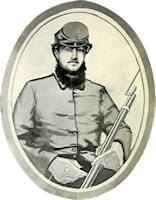
(Note: picture is of an unidentified Confederate soldier.)

0 comments

Downing’s Civil War Diary.–Alexander G. Downing.

Diary of Alexander G. Downing; Company E, Eleventh Iowa Infantry

Monday, 5th–Everything is very quiet here, although as the health of the men is improving our duties become more laborious. Every regiment that can be taken from Vicksburg is being sent to reinforce the armies at other posts. General Sherman has been ordered to proceed to Chattanooga and thus all of the Fifteenth Army Corps will be taken from the vicinity of Vicksburg.

0 comments

The Yankees are on the other side, some four hundred yards distance.

Civil War Letters of Walter and George Battle

CAMP NEAR MORTON’S FORD,
ON RAPIDAN RIVER, October 5th, 1863.

My Dear Mother:
I received your letter of the 23rd yesterday while on picket duty and it seems to me from the way in which you write that you did not receive my last letter. I don’t think that it has been two weeks since I wrote you; ’twas soon after Harry Warren got back. We are at the same camp we were when Henry came. Our Brigade does picket on the river at Morton’s Ford. We (that is, our Regiment) have to go on every fourth night. Night before last was a terrible night, cold and rainy, and the wind was pretty cutting. Our line is on the river bank, in a cornfield. The Yankees are on the other side, some four hundred yards distance. We have no communication with them, it being against General Ramseur’s orders. Battle’s Brigade (Alabama troops) talk and exchange papers with them every day. They join our line above the ford. When we first went on picket at the river we could hear the Yankees’ drums by the hundred. They stopped all at once and we did not hear more than two or three for a whole week. Yesterday morning they opened with their drums again and from the number it would seem that they have a large army across the river. I think they tried to make us believe they had left, but they can’t fool General Lee. We have had orders for a week or more to keep two days’ rations cooked and be ready to move at a moment’s notice. I don’t think that we shall remain much longer at this camp.

Some half-dozen cannons were heard up the river yesterday. I suppose they were signal guns. A pretty good sign of a movement. I hope we will soon do all the fighting that we expect to do this winter, and let us go into winter quarters. The orderly has just come around with orders to be in readiness to move, as the Yankees are advancing and we may probably leave this evening. All the preparation that I have to make is to look up our day’s rations of bread. As soon as we go into camp to stay any length of time, I shall be glad to get my flannel drawers. I will let you know. I hope Dr. Thompson will be well enough to come when his furlough is out, and bring my overcoat, also a pair of socks, gloves (if you can find them) and a little box of lip salve. Tom Stith was waiting about a week before he got his things, which Henry Warren brought. He had to leave them at Orange Court House, as he had to foot it about eighteen miles. Col. Grimes got back a few days ago from North Carolina. He was married while home and he is now a candidate for congress, and I think he will probably be elected. I would like very much to be at home with you to eat some of that nice fruit which you have. Peaches here in camp sell for $2.00 per dozen, so we can’t afford to eat as many as we want at that price, or it would take a month’s wages to pay for the treat. Blake said for me to tell you to please tell Mr. Rhodes to send him thirty dollars by Thompson, if this reaches you in time; if not, send it by mail. Tom Stith says to tell some of his folks not to send him any blanket as yet. He will let them know.

I am enjoying excellent health at present. Sometimes I am troubled with diarrhoea, but I generally stop it by quit eating beef for a few days. Next time you write to Pussy, give her my best love and tell her I would like so much to see her. Give my love to all the family, and believe me, your sincere and devoted son,

WALTER.

Much obliged for the paper and envelopes.


Letters from two brothers who served in the 4th North Carolina Infantry during the Civil War are available in a number of sources online.  Unfortunately, the brothers are misidentified in some places as Walter Lee and George Lee when their names were actually Walter Battle and George Battle. See The Battle Brothers for more information on the misidentification.

0 comments

Diary of Horatio Nelson Taft.

Diary of US patent clerk Horatio Nelson Taft.

Monday Oct 5th 1863

Perhaps I might have made it interesting to have continued my diary. But I have been absent some time since my last date, and important events it is true have occured, great Battles have been fought, and great Victories have been won by our arms. The month of July saw our arms victorious everywhere. Vicksburg & Port Hudson on the Miss River were captured. Over 30,000 prisoners were taken in the first and 7000 in the last place. The Very important Battle of Gettysburge in Penn’a was fought on the 3rd July where the Rebels were signaly beaten and Genl Lee driven back into Virginia. No important Battles since that time in V.A. Genls Meade and Lee have been watching each other since but there has been a good deal of Severe skirmishing on the part of the Cavalry. Our Army of the Potomac is now near Culpepper V.A. Our Pickets and those of the Enemy are within speaking distance of each other. A severe Battle was fought about the 11th of last month in East Tennessee Betwen the Armies of Genl Rosecrans and Genl Bragg. We lost 10,000 Men killed & Wounded and were repulsed but not defeated. The object of the Rebels was to take Chattanooga which we still hold. The Armies are now near each other in force, another Battle there is expected soon. In August Genl Gilmore at Charlston astonished the World by knocking down the Walls of Fort Sumptor at the distance of 2½ miles and by throwing Shells into the City from a distance of 5 miles. He has now got the whole of Morris Island and is engaged preparing Batteries at Cummings Point from which point to Bombard the City with Effect. He took Fort Wagner (on the Island) after the most tremenduous Bombardment that any Fort ever Experienced. We are now expecting to hear that he has again opened upon Charlston with “Greek fire” Shells. Mr Short the inventer has been down there for some time past filling Shells with it.

My Family has remained in Sag Harbor since they went there in June last year. I was at home in August last and staid two weeks. The weather was extremely hot all the month of August everywhere and I did not enjoy myself so well on that account. I returned to Washington the 18th of the month. In the months of June and July while the Rebels were in Maryland and P.A. I belonged to the Volunteer Regt of the Interior Department and drilled about every other day expecting to be called out into the Rifle Pitts back of the City every day. But the danger passed away after the Battle of Gettysburgh since which there has not been much drilling by the Employees of the Department. Washington is if possible more crowded than it was last year. It is utterly impossible to get a House to live in if one is wanted and a great many are wanted. People have to Board and pay high. Provisions, fuel &c are very dear, best flour $12.00, Butter 35.cts, coffee 40., Sugar 16., potatoes $1.25, peaches $1.00 per peck, Tomatoes $2.00 pr B. Beef 18.cts, Oak wood $9.00 pr cord, Coal $10. pr ton &c &c. In August little Jessie died, the first child of my son Charles & Sallie. She was about 10 months old and a very sweet child. She was much loved by Mr & Mrs Woodward and by us all. Mr W provided rather extravagantly for the funeral, attending to everything himself, the coffin (of the finest Rosewood) cost $45.00. He paid all expenses. It is proposed to have a meeting of all our Brothers and Sisters at Lyons this month. I have had two or three letters upon the subject and my attendance requested. I do not know as I can go. It will take too much time and money. On Saturday last I went down to Alexandria V.A. My good friend Surgeon N S Barnes at the Mansion Hospital insisted upon my staying over night with him in the Hospital. The Mansion Hospital is (or was) a large Hotel. The old Braddock House forms a part of it and in that part I slept. It has been built about 120 years and is still in a good state of preservation. Some of the Stone at the corners were crumbling away or scaling off and with the usual Yankee desire for Relics I brought away some of the pieces. The Streets in Alexandria are Strongly Barricaded with round timbers set in the ground close together and standing about eight feet high with holes for Musketry. I returned to Washington last evening. I visit the Hospitals in the City more or less every week. I go to the Stanton Hospital the most. It is composed [of] Barracks or low wooden buildings on the Square in front of the Douglass Hosp’l. I have taken quite an interest in some of the patients there and visit them frequently, especialy in H W Brown of Lyons and John Peters, both wounded at the Battle of Chancellorsville the 3rd of May last. Brown can just go about on Crutches. Peters has not yet been off his bed, both were wounded in the thigh (compound fracture). Not many live through it. One Rebel Col and about forty other rebel prisoners are there. They all receive the same attention which our own soldiers do in every respect (clothing &c).

0 comments

October 1 to 5, 1863

Experience of a Confederate Chaplain—Rev. A. D. Betts, 30th N. C. Regiment

October 1, 1863—Visit Hoke’s Brigade. Bro. Rumple preaches for us.

October 2—Rain, get wet.

October 3—Dr. Rosser preaches for us twice.

October 4—Bro. Kilpatrick preaches a. m. end Bro. Rumple p. m. Fifty or more conscripts arrive for our Regiment.

October 5—Preach for Battle’s Brigade at night.

0 comments

A Rebel War Clerk’s Diary

A Rebel War Clerk’s Diary at the Confederate States Capital, By John Beauchamp Jones
A likeness of Jones when he was editor and majority owner of the Daily Madisonian during President John Tyler’s administration.

OCTOBER 5th.—It is now said that Meade’s army has not retired, and that two corps of it have not been sent to Rosecrans. Well, we shall know more soon, for Lee is preparing for a movement. It may occur this week.

In the West it is said Gen. Johnston is working his way, with a few brigades, from Meridian towards Nashville.

Lieut.-Gen. E. Kirby Smith writes for authority to make appointments and promotions in the trans-Mississippi Army, as its “communications with Richmond are permanently interrupted.” The President indorses that he has no authority to delegate the power of appointing, as that is fixed by the constitution but he will do anything in his power to facilitate the wishes of the general. The general writes that such delegation is a “military necessity.”

The Enquirer and the Dispatch have come out in opposition to the fixing of maximum prices for articles of necessity, by either the Legislature of the State or by Congress. It is charged against these papers, with what justice I know not, that the proprietors of both are realizing profits from speculation.

To-day I got a fine shin-bone (for soup) for $1. I obtained it at the government shop; in the market I was asked $5.50 for one. We had a good dinner, and something left over for tomorrow.

0 comments

“A neighbor told me that old Worthington sold the mother of his children, and with her five other…”–Army Life of an Illinois Soldier, Charles Wright Wills.

Army Life of an Illinois Soldier, Charles Wright Wills, (8th Illinois Infantry)

October 4, 1863.

Have been over to Worthington’s again to-day. Sam got out his hounds and started a deer for us. We stationed ourselves in the runway, but although the deer came near us two or three times in his circling, the dogs didn’t push him hard enough to make him break for distant cover. The major killed a very large snake and some of the boys got a shot at an alligator. We then left the bayou and went out to old River Lake, where we got some splendid shooting. I killed a water turkey at 500 yards, shooting into a flock. Our guns, the Henry rifle, threw bullets full a mile and one-half. I found that I could do tolerably close shooting, something I never suspicioned before. A neighbor told me that old Worthington sold the mother of his children, and with her five other picaninnies.

0 comments

War Diary of Luman Harris Tenney.

War Diary of Luman Harris Tenney.

4th. Did very litle in the forenoon. Robertson and Ritter ate with us. In P. M. detailed with 20 Co. B as picket. Relieved Co. L and Lt. Hillhouse. House robbed by old relief. Went out and posted the pickets. Then went into camp and learned if we were right in instructions. Thede with me. Built good fires. Patrol every hour. Lay down and rested well. No alarm.

0 comments

Downing’s Civil War Diary.–Alexander G. Downing.

Diary of Alexander G. Downing; Company E, Eleventh Iowa Infantry

Sunday, 4th–Our brigade was reviewed this morning at 7 o’clock by General McPherson, major-general commanding the seventeenth Army Corps. The pickets were not relieved until about noon, and so we missed the inspection. The boys are in camp today reading or writing letters.

0 comments

Diary of a Southern Refugee, Judith White McGuire.

Diary of a Southern Refugee During the War by Judith White McGuire

Cedar Hill, October 4.—We came to Ashland on the 29th, to attend the sale of the house in which we lived last year. We got a few pieces of furniture, and determined to rent the little cottage. We spent that night at Mrs. T’s, and came here next morning, and are now collecting hops, brooms, and the various et cœteras necessary for housekeeping. A refugee friend, who will change her location, has lent us her furniture, so that we expect to be very snug. Of course we shall have no curtains nor carpets, which are privations in our old age, but the deficiencies must be made up by large wood fires and bright faces. The war has taught useful lessons, and we can make ourselves comfortable and happy on much less than we ever dreamed of before.

0 comments

“…in these times no one thinks of the losses, the war fills all the mind.”

Journal of Meta Morris Grimball
Meta Morris Grimball

4th October

       I received this morning from Charlotte the painful account of Papa’s death, he suffered at last very much, and passed away on the morning of the 30th September 1863, between 5, & 6 in the morning, he was very much swollen had parozisms of difficulty of breathing which were terrible, had been twelve weeks in bed, had bed sores on his back & when the difficult breathing came on had to be held up in bed but through all that his faith never wavered, & he has gone to that rest & that joy he so longed for, he must have been 78 years of age: Charlotte throughout this painful illness has attended him, & comforted him, by her presence & care.—Lewis was fortunately there, ordered to take charge of some hospitals & was with Papa when he died.—

       I shall miss him as long as I live for he loved me, and was always kind. – The prayer book I now use was a present from him, being a large one so that I need not use spectacles. His life was one of many changes. Belonging to one of the old families in New York he married early, my Mother of Hugenot descent. He was devoted to her, they had $40 thousand to begin with, and he went in debt for a Planting interest, was not very successful, became involved & passed nearly all his life an embarassed man with a large family. (4 years before the war he was more easy, & after the sale of part of the Northern property divided 30 thousand to each of his children) After 16 years my Mother was taken from him by a violent death, being crushed to death, the house falling in the storm on Sulivans Island, of 1822. After my Grandfathers death, he managed the property of his Mother, & gave great dissatisfaction to his brothers & sisters.

       Some years before his Mothers death they induced her to take the charge from him, he married Miss Lowndes, 7 years after my Mothers death, who died leaving 2 children, 1 son, & 1 daughter, the son alone survives, on whom all her property settled.

       The death of this lady was a great grief to him, she was very pious, and sensible. He had become very much interested in Religion just after my Mothers death, and through all the varied scenes of his long life his faith sustained him, & comforted him.—If the Country had not been torn apart by this revolution he would have left a very handsome property to his children, at least one hundred & fifty thousand dollars apiece: but his negroes, 2 hundred of them, have left him, & the Plantations are ruined: but in these times no one thinks of the losses, the war fills all the mind.—

       Since we have been going to the Court House to Church there have been 3 Baptisms. The first was Miss Tompson, an adult, & there was on the table a huge Crockery petcher & Basin, with a towel thrown over it altogether a curious inelegant appearance, then Mrs Irwin’s baby a nice healthy babe, for her there was a very small crockery bowl & Pitcher, & then Mrs Drayton Ford’s baby a large French china bowl, gilt edged, and a fine damask napkin. Mrs Ford, Miss Lucas, Mr Ford, and the maid with the screeching baby standing in front, very elegant, in they own conceat.— Henrietta Gedding’s babe was also christened, for her, a beautiful large silver bowl.—

0 comments

A Rebel War Clerk’s Diary

A Rebel War Clerk’s Diary at the Confederate States Capital, By John Beauchamp Jones
A likeness of Jones when he was editor and majority owner of the Daily Madisonian during President John Tyler’s administration.

OCTOBER 4th.—The major-quartermasters and the acting quartermaster-generals (during the illness or absence of Gen. Lawton) are buffeting the project some of us set on foot to obtain wood at cost, $8, instead of paying the extortioners $40 per cord. All the wagons and teams of Longstreet’s corps are here idle, while the corps itself is with Bragg—and the horses are fed by the government of course. These wagons and teams might bring into the city thousands of cords of wood. The quartermasters at first said there were no drivers; but I pointed out the free Yankee negroes in the prisons, who beg employment. Now Col. Cole, the quartermaster in charge of transportation, says there is a prospect of getting teamsters—but that hauling should be done exclusively for the army—and the quartermaster-general (acting) indorses on the paper that if the Secretary will designate the class of clerks to be benefited, some little wood might be delivered them. This concession was obtained, because the Secretary himself sent my second paper to the quartermaster-general—the first never having been seen by him, having passed from the hands of the Assistant Secretary to the file-tomb.

Another paper I addressed to the President, suggesting the opening of government stores for the sale of perishable tithes,—being a blow at the extortioners, and a measure of relief to the non-producers, and calculated to prevent a riot in the city,—was referred by him yesterday to the Secretary of War, for his special notice, and for conference, which may result in good, if they adopt the plan submitted. That paper the Assistant Secretary cannot withhold, having the President’s mark on it.

0 comments

Through Some Eventful Years

Through Some Eventful Years by Susan Bradford Eppes
Susa Bradford Eppes

October 4th, 1863.—I saw something awful this morning; I wish I had not seen it. We were taking a box of hospital supplies to the depot, to ship to Richmond and, when we turned the corner by Fisher’s Green, a group of soldiers were standing there. It was early, the sun had been up but just a few minutes and it shone bright on the group. I always look at soldiers, but I am sorry I looked at these for they had two poor fellows, who had deserted and been caught and, while we were looking, the squad fired and the deserters fell dead. Isn’t it perfectly awful? I didn’t think it ought to be done. So many are killed in battle and lives are worth more than that. To kill them when maybe they meant to come back. I am afraid I shall not sleep a wink tonight.


Susan Bradford is 17 years old when this entry was made.

0 comments