11th. Last night command marched across the river after caring for the wounded–building campfires. I rode on into camp and read home letters brought by Maj. Nettleton. He called this morning and took breakfast with us. Went down and got hard bread and a little sugar and coffee. Saw Corp. C. S., a little active fellow and knows his business. Do not feel well today–hard cold and bad boil. Read the news and Cincinnati Commercial of Dec. 1st. Nettleton called in evening. Resolutions passed eulogizing Burnside and regretting his loss.
American Civil War Chronicles
“It is six weeks since I have had a change of clothes from my valise.”–Army Life of an Illinois Soldier, Charles Wright Wills.
December 11, 2023
Bivouac in Mud Creek Cove, near Belle Fonte, Ala.,
December 11, 1863.
Without any earthly cause I am troubled with a small fit of the blues this evening. I can’t imagine what brought it on. I am cross, restless and tired. Don’t want any company—wouldn’t go to see a girl if there were a thousand within a hundred rods. Interesting state for an interesting youth, isn’t it. Guess the trouble must be in the fact that I have no trouble. Everything moves too smoothly. No pushing in my family to knock down a looking-glass balanced on a knitting needle. Nothing in my precious life to keep me awake one minute of my sleeping time, and nothing in the future that I now care a scrap for. All of that is certainly enough to make one miserable. I’m convinced that my constitution requires some real misery, or a prospect for the same, in order to keep me properly balanced. If you can furnish me any hints on the subject, that will induce distress, trouble, or care, in a reasonable quantity to settle on my brain, I will be obliged. I have written you so much about soldiering, sister, that I’m thinking the subject must be pretty well exhausted. You must have received as many as 150 letters from me since I entered the army. I have had a host of interesting experiences since I enlisted, but when I am alone, and naturally turn to my little past for company, I always skip the army part and go back to the old home memories. One finds a plenty of opportunities for such self-communing in the service, and if I haven’t profited by mine, it is my own fault. Did I ever tell you how I love picket duty? I have always preferred it over all other of our routine duties, yet it would take a sheet of foolscap to tell you why; and then nobody could understand me the way I’d write it. So we’ll pass. It seems a long time since I was at home. What do you think of my eating Christmas dinner with you? Don’t let’s think of that at all. I start for Chattanooga in the morning to get my team and things. It is six weeks since I have had a change of clothes from my valise. Borrowed a shirt from a woman once and got mine washed.
Downing’s Civil War Diary.–Alexander G. Downing.
December 11, 2023
Friday, 11th–The Eleventh had regimental inspection with accouterments and full dress. The boys are continuing to re-enlist for three years or during the war. Officers from the corps headquarters are out among the different regiments urging reenlistments. They argue that the war will be over anyway by the time the first three-year service shall have expired, and they might as well avail themselves of the extra bounty. Then, too, they say, “What a fine thing it would be to be called a veteran of the war!”
Robert M. McGill
December 11, 2023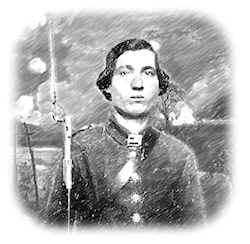
Friday, 11th.—Had very nice sliced potato pie for dinner. The man to be shot to-day was reprieved. I. L. sick. Everything quiet in camp.
(Note: picture is of an unidentified Confederate soldier.)
0
December 11, 2023
December 11th. The morning opened up with a cold rain. I am detailed for picket duty. Posted on a back road, just south of the town. Took possession of an old building for the reliefs and the reserves, when off duty. Manage to keep very comfortable. All quiet.
War Diary of Luman Harris Tenney.
December 10, 2023
10th. Soon after breakfast brigade ordered to Morristown on a reconnoissance. Sent June to see about rations and left the rest of the boys to go for cattle and pork. At the river encountered rebel pickets. Drove them back on Morristown and Cheek’s Cross Roads. Drove the pickets steadily. 2nd O. V. C. on X roads, 9th Mich. and 7th O. V. C. and section of Artillery on M. road. Mile from M. found rebels posted in woods and cornfield behind a fence. Artillery brought up and men dismounted in front and 9th sent to the flank. Soon commenced in earnest. Our A. did badly, rebel artillery first rate. At dusk 9th made a charge and routed three regiments, 8, 21, 36th Va., from intrenchments. About 50 rebels killed. Our loss slight.
Downing’s Civil War Diary.–Alexander G. Downing.
December 10, 2023
Thursday, 10th–It is pretty cold weather now, somewhat cloudy and windy. Our regiment furnished the patrol for the city today, composed of a captain, a lieutenant, two sergeants, eight corporals and forty privates.
Robert M. McGill
December 10, 2023
Thursday, 10th.—Fast day. Prayer meeting, 11 A. M. Preaching at night by chaplin from Longstreet’s Corps.
(Note: picture is of an unidentified Confederate soldier.)
0
December 10, 2023
December 10th. Left camp early this morning. Passed through Martinsburg, going east, bound for Charlestown. Weather good. After a march of about eight miles, came to a halt at Leestown for rest and rations. Again on the march, forded the Opequan Creek. Not very pleasant at this time of year. Soldiers must not stop for wet feet. Pushing on. After a march of about eighteen miles we reached the town of Charlestown, Virginia, eight miles south of Harper’s Ferry, just after dark, tired. Took possession of an old church for our quarters, the weather growing colder. No place for a fire. Trying to make ourselves comfortable for the night.
Diary of David L. Day.
December 10, 2023
The following diary entry contains wording that is offensive to many in the world of today. However, the entry is provided unedited for its historical content and context.
Newport News.
Dec. 10. I am now on the sacred soil of old Virginia, and my first care will be to seek an introduction to some of the F. F. Vs. What this place derived its name from, or why it was named at all, I have not been able to learn. It was simply a plantation before its occupation by Federal troops, and perhaps the name is as good as any to distinguish it by. Our camp is near the river, and only a few rods from us lie the wrecks of the frigates Cumberland and Congress, sunk by the rebel ram Merrimac. The Cumberland lies in deep water out of sight, but the deck of the Congress is seen and often visited by the boys at low water. Since the occupation of this place by Federal troops it has grown into what they call down this way a town, containing quite a collection of rough board store-houses, sutler’s shops, negro shanties and horse sheds. A boat runs from here to Fortress Monroe every day, and three times a week to Norfolk; the distance to either place is about the same, some twelve miles.
For the first time since the war began, the oyster fishing is being prosecuted, and Hampton Roads are alive with oyster schooners. The oysters have had a chance to grow, and are now abundant and of good size and flavor. Newport News was the first place in Virginia, except Washington, that was occupied by Federal troops, and it was from here that a part of old Ben’s famous Big Bethel expedition started. [continue reading…]
A Rebel War Clerk’s Diary
December 10, 2023
DECEMBER 10th.—No news from any of the armies, except that Longstreet has reached Bristol, Va.
Yesterday, in Congress, Mr. Foote denounced the President as the author of all the calamities; and he arraigned Col. Northrop, the Commissary-General, as a monster, incompetent, etc.—and cited * * * *
I saw Gen. Bragg’s dispatch to-day, dated 29th ult., asking to be relieved, and acknowledging his defeat. He says he must still fall back, if the enemy presses vigorously. It is well the enemy did not know it, for at that moment Grant was falling back on Chattanooga! Mr. Memminger has sent to Congress an impracticable plan of remedying the currency difficulty.
To-day I saw copies of orders given a year ago by Gen. Pemberton to Col. Mariquy and others, to barter cotton with the enemy for certain army and other stores.
It is the opinion of many that the currency must go the way of the old Continental paper, the French assignats, etc., and that speedily.
Passports are again being issued in profusion to persons going to the United States. Judge Campbell, who has been absent some weeks, returned yesterday.
The following prices are quoted in to-day’s papers:
“The specie market has still an upward tendency. The brokers are now paying $18 for gold and selling it at $21; silver is bought at $14 and sold at $18.
“GRAIN.—Wheat may be quoted at $15 to $18 per bushel, according to quality. Corn is bringing from $14 to $15 per bushel.
“FLOUR.—Superfine, $100 to $105; Extra, $105 to $110.
“CORN-MEAL.—From $15 to $16 per bushel.
“COUNTRY PRODUCE AND VEGETABLES.—Bacon, hoground, $3 to $3.25 per pound; lard, $3.25 to $3.50; beef, 80 cents to $1; venison, $2 to $2.25; poultry, $1.25 to $1.50; butter, $4 to $4.50; apples, $65 to $80 per barrel; onions, $30 to $35 per bushel; Irish potatoes, $8 to $10 per bushel; sweet potatoes, $12 to $15, and scarce; turnips, $5 to $6 per bushel. These are the wholesale rates.
“GROCERIES.—Brown sugars firm at $3 to $3.25; clarified, $4.50; English crushed, $1.60 to $5; sorghum molasses, $13 to $14 per gallon; rice, 30 to 32 cents per pound; salt, 35 to 40 cents; black pepper, $8 to $10.
“LIQUORS.—Whisky, $55 to $75 per gallon; apple brandy, $45 to $50; rum, proof, $55; gin, $60; French brandy, $30 to $125; old Hennessy, $180; Scotch whisky, $90; champagne (extra), $350 per dozen ; claret (quarts), $90 to $100; gin, $150 per case; Alsop’s ale (quarts), $110; pints, $60.”
A Diary From Dixie.
December 10, 2023
December 10th.–Mrs. Davis and Mrs. Lyons came. We had luncheon brought in for them, and then a lucid explanation of the chronique scandaleuse, of which Beck J. is the heroine. We walked home with Mrs. Davis and met the President riding alone. Surely that is wrong. It must be unsafe for him when there are so many traitors, not to speak of bribed negroes. Burton Harrison[1] says Mr. Davis prefers to go alone, and there is none to gainsay him.
My husband laid the law down last night. I felt it to be the last drop in my full cup. “No more feasting in this house,” said he. “This is no time for junketing and merrymaking.” “And you said you brought me here to enjoy the winter before you took me home and turned my face to a dead wall.” He is the master of the house; to hear is to obey.
[1] Burton Harrison, then secretary to Jefferson Davis, who married Miss Constance Cary and became well known as a New York lawyer. He died in Washington in 1904.
War Diary of Luman Harris Tenney.
December 9, 2023
9th. Up early and breakfasted on mush. Supper last night the same. Infantry soon commenced passing. Left all boys but Thede and went on. Passed through Rutledge. Command moved on to Bean Station and camped–some skirmishing. Issued Hard Bread and beef! Boys came up. Bunked down by the fire and slept soundly. Cold night. Boys go for secesh badly on this trip.
Robert M. McGill
December 9, 2023
Wednesday, 9th.—Notified that a man would be shot Friday.
(Note: picture is of an unidentified Confederate soldier.)
A Rebel War Clerk’s Diary
December 9, 2023
DECEMBER 9th.—The President’s message is not regarded with much favor by the croakers. The long complaint against foreign powers for not recognizing us is thought in bad taste, since all the points nearly had been made in a previous message. They say it is like abusing a society for not admitting one within its circle as well as another. The President specifies no plan to cure the redundancy of the currency. He is opposed to increasing the pay of the soldiers, and absolutely reproaches the soldiers of the left wing of Bragg’s army with not performing their whole duty in the late battle.
Mr. Foote denounced the President to-day. He said be had striven to keep silent, but could not restrain himself while his State was bleeding—our disasters being all attributable by him to the President, who retained incompetent or unworthy men in command, etc.
A Diary From Dixie.
December 9, 2023
December 9th.–” Come here, Mrs. Chesnut,” said Mary Preston to-day, ” they are lifting General Hood out of his carriage, here, at your door.” Mrs. Grundy promptly had him borne into her drawing-room, which was on the first floor. Mary Preston and I ran down and greeted him as cheerfully and as cordially as if nothing had happened since we saw him standing before us a year ago. How he was waited upon! Some cut-up oranges were brought him. “How kind people are,” said he. “Not once since I was wounded have I ever been left without fruit, hard as it is to get now.” “The money value of friendship is easily counted now,” said some one, “oranges are five dollars apiece.”
War Diary of Luman Harris Tenney.
December 8, 2023
8th. Awoke considerably rested. Surprising how a tired man can sleep. Drew one day’s ration of meal and two of H. Bread. Moved around Clinch Mountain to Blains Cross Roads. Boys killed a flock of sheep. Passed a division of the 9th Army Corps in camp. Stopped with boys at a house near road leading to Walker’s Gap. Got coffee and then slept in good bed–secesh.
“I predict that no good will come from scattering the army in this way, and much harm.”–Army Life of an Illinois Soldier, Charles Wright Wills.
December 8, 2023
Mud Creek Cove, Jackson County, Ala.
December 8, 1863.
I was at Stevenson yesterday and put a letter in the office for you, but with my accustomed shrewdness failed to either stamp or frank it. It graphically described the gallant exploits of the detachment I have the honer to command during the past three weeks, and its loss will be deplored in common with the other heavy losses of this “cruel war.” I can now but give you the topics it discussed or elaborated, and leave to your imagination the finishing and stringing together the skeleton. First and foremost, stealing horses; second, defying bravely the tears and entreaties of helpless women, and taking their last measure of meal and rasher of bacon; third, the splendid conduct of our regiment and brigade at the late Mission Ridge fight; fourth, reflections. Do you remember, how, after the evacuation of Corinth one and one-half years ago, Halleck thought the rebellion virtually ended? And how many of the soldiers wrote home that they expected to be mustered out within three months? Then Halleck sent Buell with half of the army toward Chattanooga, Sherman and Hurlburt to Memphis, McClernand and Logan to Jackson, Tennessee; kept some four divisions at Corinth, and with three others opened and guarded 95 miles of railroad east to Decatur. That was what he called letting the army enjoy the rest they had earned by their glorious victory. The whole of the splendid army that had forced the Rebels to leave Corinth, was divided, subdivided and the subdivisions divided until, except Buell’s, there was hardly a detachment left strong enough to hold its own against any overgrown band of guerrillas. The result you know. Buell’s retreat with [continue reading…]
Downing’s Civil War Diary.–Alexander G. Downing.
December 8, 2023
Tuesday, 8th–Everything is marching along fine. The finishing touches are being put upon the outside forts and the heavy guns are mounted and ready for action. The floors of the forts and rifle pits are all laid with the lumber torn from the houses which were removed to make room for the forts, so when it rains while the men are occupying the forts, they will not need to tramp through the mud. News came that General Bragg was retreating with Grant after him. General Grant is the man for us yet. All are loud in their praise of Grant, and declare that he is the coming man of the time, that we will have him at the head of all of the United States armies before the war is ended.
Village Life in America
December 8, 2023
Canandaigua, December 8. – Home again. I had military attendance as far as Paterson, N. J., and came the rest of the way with strangers. Not caring to talk I liked it just as well. When I said good bye I could not help wondering whether it was for years, or forever. This cruel war is terrible and precious lives are being sacrificed and hearts broken every day. What is to be the result? We can only trust and wait.
A Rebel War Clerk’s Diary
December 8, 2023
DECEMBER 8th.—The President’s message was sent to Congress to-day. I was not present, but my son Custis, who heard it read, says the President dwells largely on the conduct of foreign powers. To diminish the currency, he recommends compulsory funding and large taxation, and some process of diminishing the volume of Treasury notes. In other words, a suspension of such clauses of the Constitution as stand in the way of a successful prosecution of the war. He suggests the repeal of the Substitute law, and a modification of the Exemption act, etc. To-morrow I shall read it myself.
0
December 8, 2023
December came in quite pleasant. Weather permitting, drilling is kept up.
December 8th. Marching orders received. Must prepare three days’ rations in haversacks. Ordered to Charlestown for duty. We are informed the cavalry under General Averill are to raid upon the enemy’s country. The General is a dashing cavalry officer. He is all right.
War Diary of Luman Harris Tenney.
December 7, 2023
7th. Awakened by firing over Clinch Mountain. Sent back details and teams for rations. Clear beautiful day. Moved at 9 A. M. up the valley. About 3 P. M. arrived at Bunch’s Trail, a pass through Clinch Mountain. Rebel pickets here and drove them. Col. Acker dismounted 9th Mich. and dislodged them from the Gap. After dark fell back to same place started from in the morning. Very cold night, huddled down by fire with saddle blanket.
Downing’s Civil War Diary.–Alexander G. Downing.
December 7, 2023
Monday, 7th–I was relieved from patrol this morning. Thus far we have not succeeded in locating any of the reported spies. This patrol duty is quite hard, since when we have a few moments for rest the only place is a vacant room over a store, without fire; furthermore, lying down on the floor is not very inviting because of the graybacks running over the floor.
Village Life in America
December 7, 2023
December 7.–The 4th New York Heavy Artillery has orders to move to Fort Ethan Allen, near Washington, and I have orders to return to Canandaigua. I have enjoyed the five weeks very much and as “the soldier” was on parole most of the time I have seen much of interest in the city. Uncle Edward says that he has lived here forty years but has never visited some of the places that we have seen, so he told me when I mentioned climbing to the top of Trinity steeple.