16th. Cold. Did my business. Got transportation for boys and by permission at 3 P. M. left for home. Had to stay over at Grafton. Cold day.
American Civil War Chronicles
Through Some Eventful Years
February 16, 2024
February ___[1], 1864.—By special invitation, we rode over the hills to the Camp today, to see the battalion drill. It was a dress parade and every man looked his best. I made a new (old) acquaintance after the drill was over. Frank Baker, the only son of Judge Bolling Baker, of Virginia. He is just as handsome as a picture and very pleasant. I could scarcely recall the little boy of years ago, who thought I was too small to notice. I think I must have grown just a wee bit.
The camp is beautiful; it is only a short distance from Goodwood and Aunt Sue told the boys to come over whenever they felt like it. She also offered them books to read, which offer was eagerly accepted. Tonight Mrs. Howard Gamble is giving a large party and I must stop writing and see about my dress. We cannot vary our toilettes to any extent in these days of the blockade.
[1] This diary was written in pencil and in many instances the dates are almost, or quite, illegible. The month and year are plain but the figures are not so plain; particularly is this the case during the years of warfare, possibly the pencils were poor, or the paper might have been. At any rate we ask our readers to be lenient if some little mistakes occur.
Susan Bradford is nearly 17 years old when this entry was made.
A Rebel War Clerk’s Diary
February 16, 2024
FEBRUARY 16th.—A plan of invasion. Gen. Longstreet telegraphs that he has no corn, and cannot stay where he is, unless supplied by the Quartermaster-General. This, the President says, is impossible, for want of transportation. The railroads can do no more than supply grain for the horses of Lee’s army—all being brought from Alabama, Georgia, South Carolina, etc. But the President says Longstreet might extricate himself from the exigency by marching into Middle Tennessee or Kentucky, or both.
Soon after this document came in, another followed from the Tennessee and Kentucky members of Congress, inclosing an elaborate plan from Col. Dibrell, of the Army of Tennessee, of taking Nashville, and getting forage, etc. in certain counties not yet devastated, in Tennessee and Kentucky. Only 10,000 additional men will be requisite. They are to set out with eight days’ rations; and if Grant leaves Chattanooga to interfere with the plan, Gen. Johnston is to follow and fall upon his rear, etc. Gen. Longstreet approves the plan—is eager for it, I infer from his dispatch about corn; and the members of Congress are in favor of it. If practicable, it ought to be begun immediately; and I think it will be.
A bright windy day—snow gone.
The Federal General Sherman, with 30,000 men, was, at the last dates, still marching southeast of Jackson, Miss. It is predicted that he is rushing on his destruction. Gen. Polk is retreating before him, while our cavalry is in his rear. He cannot keep open his communications.
Through Some Eventful Years
February 16, 2024
February ___[1], 1864.—We have had a grand time but now it is over. We have had rides and walks and drives; we have had parties, picnics and serenades; we have had a merry two weeks and now our play-mates are gone. They looked so handsome and they held their heads so proudly and marched away with such steady steps. As they went they sang, “The Girl I Left Behind Me.” Poor boys—I hope and pray they may some day come home again.
[1] This diary was written in pencil and in many instances the dates are almost, or quite, illegible. The month and year are plain but the figures are not so plain; particularly is this the case during the years of warfare, possibly the pencils were poor, or the paper might have been. At any rate we ask our readers to be lenient if some little mistakes occur.
Susan Bradford is nearly 17 years old when this entry was made.
A Diary From Dixie.
February 16, 2024
February 16th.–Saw in Mrs. Howell’s room the little negro Mrs. Davis rescued yesterday from his brutal negro guardian. The child is an orphan. He was dressed up in little Joe’s clothes and happy as a lord. He was very anxious to show me his wounds and bruises, but I fled. There are some things in life too sickening, and cruelty is one of them.
Somebody said: “People who knew General Hood before the war said there was nothing in him. As for losing his property by the war, some say he never had any, and that West Point is a pauper’s school, after all. He has only military glory, and that he has gained since the war began.”
“Now,” said Burton Harrison, “only military glory! I like that! The glory and the fame he has gained during the war–that is Hood. What was Napoleon before Toulon? Hood has the impassive dignity of an Indian chief. He has always a little court around him of devoted friends. Wigfall, himself, has said he could not get within Hood’s lines.”
0
February 15, 2024
February 15th. Called on friends in and around Norwich. Visited my country home in Hanover, near Norwich. Time passed quickly and very pleasantly. Must again set my face southward, and join the regiment. Weather very cold during my vacation.
Downing’s Civil War Diary.–Alexander G. Downing.
February 15, 2024
Monday, 15th–After two hours’ marching our army entered Meridian at about 10 o’clock this morning and went into camp. The rebels are still retreating, and detachments of our army are pursuing them. The infantry is sent out in all directions tearing up the railroads, burning the ties and twisting the rails. Large numbers of cars, some engines and the depot have been burned, as also the store buildings and many residences. It is a terrible sight to look upon. Forage is plentiful in this vicinity.
War Diary of Luman Harris Tenney.
February 15, 2024
15th. Packed away C and G equipage and blankets. Boys went to town early. Tom, Smith and I went after dinner. Saw the washerwoman. Pity her but disgusted at her freedom and fondness. Went to Zettler House. Good many of C Co. there. Houses all full. Randall down again. Got my horses out. Am uneasy to get away. Oh dear!
Robert M. McGill
February 15, 2024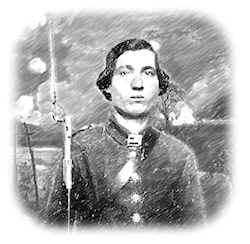
February:
Monday, 15th.—Raining very hard this morning. Singing at night; after singing had good deal of fun, two of the boys trying to see which could ruffle the other’s hair the most, and the fun began; soon the room was filled and everybody laughing; after awhile they remarked “laughing is catching,” and both of them caught and rubbed some other fellow’s head, and he, in turn, helped them. Somebody closed the door, and it wasn’t long till every one had been “initiated;” then the door was opened, and everybody was anxious to see what was the fun. As soon as they made their appearance, they were pulled and pushed in, and “initiated” also, and that was kept up probably one hour. They even went so far as to go and wake fellows out of their sleep and ask them to come and see what fun the boys were having down there. Many came and were immediately “initiated.”
(Note: picture is of an unidentified Confederate soldier.)
I was startled by the reports of six or seven guns
February 15, 2024
February, Monday 15, 1864
I did not get up very early, was eating breakfast in my room, when I was startled by the reports of six or seven guns—dressed hurriedly, on arriving at the gate found all the family, both white and black, in the greatest state of excitement—one of the 2nd. Mo—Mr. Brent—relating to them the particulars of the skirmish which had taken place only a few hundred yards from our house—A family of negroes had got this far on their journey from Hernando to Memphis when Mr. Brent met them, and they ordered him to surrender, at the same time fireing. Of course no Southern Soldier would ever surrender to a Negro, he fired five times, being all the leads he had—killed one Negro, wounded another, he ran in the woods and we saw nothing more of him—one of the women and a little boy succeeded in getting off also—the other woman with three girls were carried back to Hernando—The Soldier got a splendid Cavalry horse & equipments, two Mules and another horse—he left expecting the Yankees. Father had the Negro burried where he was killed—No Yankees—Mr. Wilson came, no late news—
Diary of a Southern Refugee, Judith White McGuire.
February 15, 2024
February 15.—A pause in my diary; but nothing of importance has occurred, either at home or with the country. The armies are mud-bound—I wish they could continue so. I dread the approach of Spring, with its excitements and horrors.
Prices of provisions have risen enormously—bacon $8 per pound, butter $15, etc. Our old friends from the lower part of Essex, Mr. –– ‘s parishioners for many years, sent over a wagon filled most generously with all manner of necessary things for our larder. We have no right to complain, for Providence is certainly supplying our wants. The clerks’ salaries, too, have been raised to $250 per month, which sounds very large; but when we remember that flour is $300 per barrel, it sinks into insignificance.
Through Some Eventful Years
February 15, 2024
February ___[1], 1864.—Last night we had an impromptu musicale and Aunt Sue provided a delicious supper at the close of the evening. The Colonel’s boys have something more to tell of him, whenever we meet. Last night Edward Clayton told me of the lectures which were given almost daily by the officers. Of course they have no books in camp but these lectures are an education in themselves. The boys are encouraged to ask questions and to debate on different points. Mr. Kellar, who is a mountain boy, says the Colonel taught him to read and write and now he is determined to get an education, when the war is over. He has a splendid baritone voice and we keep him singing most of the time. Mr. Seavy told me that sometimes when the boys tried to “run wild” the officers, especially Col. Capers, gave them talks, which were better than any sermon he ever listened to. Mrs. Capers must be very proud of this grand soldier of hers.
Good-bye little Diary, I have an engagement to go to ride this afternoon and must get ready.
[1] This diary was written in pencil and in many instances the dates are almost, or quite, illegible. The month and year are plain but the figures are not so plain; particularly is this the case during the years of warfare, possibly the pencils were poor, or the paper might have been. At any rate we ask our readers to be lenient if some little mistakes occur.
Susan Bradford is nearly 17 years old when this entry was made.
A Rebel War Clerk’s Diary
February 15, 2024
FEBRUARY 15th.—We have over forty of the escaped Federal officers. Nothing more from Gens. Wise and Finnegan. The enemy have retreated again on the Peninsula. It is said Meade’s army is falling back on Washington.
We have a snow storm to-day.
The President is unfortunate with his servants, as the following from the Dispatch would seem:
“Another of President Davis’s Negroes run away.—On Saturday night last the police were informed of the fact that Cornelius, a negro man in the employ of President Davis, had run away. Having received some clew of his whereabouts, they succeeded in finding him in a few hours after receiving the information of his escape, and lodged him in the upper station house. When caught, there was found on his person snack enough, consisting of cold chicken, ham, preserves, bread, etc., to last him for a long journey, and a large sum of money he had stolen from his master. Some time after being locked up, he called to the keeper of the prison to give him some water, and as that gentleman incautiously opened the door of his cell to wait on him, Cornelius knocked him down and again made his escape. Mr. Peter Everett, the only watchman present, put off after him; but before running many steps stumbled and fell, injuring himself severely.”
Downing’s Civil War Diary.–Alexander G. Downing.
February 14, 2024
Sunday, 14th–We marched fifteen miles again today and went into camp for the night. The Seventeenth Corps also corralled their wagon train, leaving two brigades as a guard. There was some skirmishing in the front today, but we learn that the rebels have left Meridian without making any resistance, retiring to the south. Some of our men occupied the town late this evening. Things are marching along fine.
War Diary of Luman Harris Tenney.
February 14, 2024
9th, 10th, 11th, 12th, 13th and 14th spent getting mustered and rolls completed. 8th boys paid off and furloughed Saturday. Most of the regt. already in city. Work on company papers.
Diary of Belle Edmondson
February 14, 2024
February, Sunday 14, 1864
Tate and Helen cam back from Dixie today —
Through Some Eventful Years
February 14, 2024
February ___[1], 1864.—I have found out a good deal about Colonel Capers and all I hear makes me admire him the more. I will try to write this like history, my little Diary, and you must take care of it for future generations.
When Georgia seceded, Henry D. Capers was in command of the Marietta Military Institute. This was one of the best schools in the South. Many fine men had graduated there and some of the very best civil engineers in the Southern army had studied the profession at Marietta.
When the wise men of our country met at Montgomery, to organize a government, Henry D. Capers promptly offered his services, in any capacity where he could be useful. He was accepted and was made Chief Clerk and Disbursing Officer of the Confederate Treasury. Here he served until the spring of 1862, when he resigned, to enter active service in the field. The Treasury Department was loth to give him up and resolutions were drawn up expressing their regret at parting with one, who had proved himself so capable and trustworthy. A fine sword was presented to him by Secretary Memminger, bearing a suitable inscription (the Colonel is wearing this sword now). I intend to read that inscription some day if the fates are propitious.
The War Department made Henry D. Capers a captain in the regular army of the Confederacy and he joined General Magruder but for only a little while. Captain Capers was longing for “his boys,” who were so near his heart. When he left them they all volunteered for twelve months in the Confederate Army and became a part of the 1st Georgia Regiment. This Regiment was about to be disbanded at Augusta, Georgia, and, with a permit from the government, Captain Capers was on the spot, to organize the 12th Georgia Battalion. Can we not imagine his feelings, as one by one “his boys” were sworn in “For the war,” and he realized that they were once more in his keeping? These boys tell many interesting things about their Colonel and they all adore him.
This may not be exactly like history should be written but I will learn to write better as time goes on.
[1] This diary was written in pencil and in many instances the dates are almost, or quite, illegible. The month and year are plain but the figures are not so plain; particularly is this the case during the years of warfare, possibly the pencils were poor, or the paper might have been. At any rate we ask our readers to be lenient if some little mistakes occur.
Susan Bradford is nearly 17 years old when this entry was made.
A Rebel War Clerk’s Diary
February 14, 2024
FEBRUARY 14th.—Clear and windy. There is nothing new that I have heard of; but great apprehensions are felt for the fate of Mississippi—said to be penetrated to its center by an overwhelming force of the enemy. It is defended, however, or it is to be, by Gen. (Bishop) Polk.
I hear of more of the escaped Federal officers being brought in to-day.
The correspondence between the President and Gen. Johnston is causing some remark. The whole is not given. Letters were received from Gen. J. to which no allusion is made, which passed through my hands, and I think the fact is noted in this diary. He intimated, I think, that the position assigned him was equivocal and unpleasant in Tennessee. He did not feel inclined to push Bragg out of the field, and the President, it seems, would not relieve Bragg.
Mr. Secretary Seddon, it is now said, is resolved to remain in office.
Downing’s Civil War Diary.–Alexander G. Downing.
February 13, 2024
Saturday, 13th–We left Decatur early this morning and marched fifteen miles before going into bivouac. The Sixteenth Corps corralled their train and leaving a brigade to guard it pushed forward after the rebels. Skirmishing in the front continued and was brisk at times. The weather is pleasant and the roads are fine for marching. There is still plenty of forage along the way. This morning I saw a woman with her children forcibly moved out of her residence, all the household goods and the house set on fire. The deed was ordered by our officers, for they had been informed that her husband was out in the brush with his rifle, killing Union soldiers at every opportunity. The plantation home had the appearance of wealth.
Through Some Eventful Years
February 13, 2024
February ___[1], 1864.—We have been at Goodwood three days now and there is so much to write about. The first night Aunt Sue invited all the social world of Tallahassee to meet Colonel Capers. He came, attended by fifty or more of his men, the artillery uniform is beautiful and it is particularly becoming to Colonel Capers. I am sure he knows it for I notice he keeps one end of his cape thrown back over his shoulder, bringing the red lining next his face. He wore a vest of fine red broadcloth, buttoned up with round balls of silver for buttons and that added much to the beauty of his uniform.
When I was introduced to him, he said, “I am pleased to make your acquaintance, Miss Bradford. I have already had the pleasure of an acquaintance with your father and mother,” and then he stood there and gave a glowing account of that most unique dinner at Pine Hill, and he added, “I wrote a full description to my wife before I slept that night.”
Lizzie Wirt pinched my arm and whispered, “Horrid creature—I hate married men.”
The music was good and we were soon dancing the Lancers. My partner was Sergeant Clayton, young and handsome and a graceful dancer. The couple opposite were evidently talking about us and presently the gentleman, who was one of the sergeant’s comrades, said, “Clayton, you and Miss Bradford are enough alike to be brother and sister.”
“Yes,” answered my partner, with an apologetic look at me, “As soon as I entered the room I noticed the strong likeness to my sister and when I was introduced was sure we must be related, for my name is Edward Bradford Clayton.”
Of course we claimed kin on that; Uncle Arvah says all Southern people are kin anyway. It is just a part of being born South of Mason and Dixon’s Line. I like the new cousin very much and he told me a great deal of army life and of his commander, whom he loves dearly.
[1] This diary was written in pencil and in many instances the dates are almost, or quite, illegible. The month and year are plain but the figures are not so plain; particularly is this the case during the years of warfare, possibly the pencils were poor, or the paper might have been. At any rate we ask our readers to be lenient if some little mistakes occur.
Susan Bradford is nearly 17 years old when this entry was made.
A Rebel War Clerk’s Diary
February 13, 2024
FEBRUARY 13th.—Bright, beautiful weather, with frosty nights.
The dispatches I cut from the papers to-day are interesting. Gen. Wise, it appears, has met the enemy at last, and gained a brilliant success—and so has Gen. Finnegan. But the correspondence between the President and Gen. Johnston, last spring and summer, indicates constant dissensions between the Executive and the generals. And the President is under the necessity of defending Northern born generals, while Southern born ones are without trusts, etc.
INTERESTING FROM FLORIDA.
OFFICIAL DISPATCH.
“CHARLESTON, February 11th, 1864.
“To GEN. S. COOPER.
“Gen Finnegan has repulsed the enemy’s force at LakeCity–details not known.
“(Signed)…………………………………………………………………..G. T. BEAUREGARD.”
————————————–
SECOND DISPATCH.
“CHARLESTON, February 11th–11 A.M.
“To GEN. S. COOPER.
“Gen. Finnegan’s success yesterday was very creditable—the enemy’s force being much superior to his own. His reinforcements had not reached here, owing to delays on the road. Losses not yet reported.
“(Signed)…………………………………………………………………..G. T. BEAUREGARD.”
————————————–
REPULSE OF THE ENEMY NEAR CHARLESTON.
OFFICIAL DISPATCH.
“CHARLESTON, February 12th, 1864.
“Gen. Wise gallantly repulsed the enemy last evening on John’s Island. He is, to-day, in pursuit. Our loss very trifling. The force of the enemy is about 2000; ours about one-half.
“(Signed)…………………………………………………………………..G. T. BEAUREGARD.”
Every day we recapture some of the escaped Federal officers. So far we have 34 of the 109.
The President sent over a “confidential” sealed letter to the Secretary to-day. I handed it to the Secretary, who was looking pensive.
Dr. McClure, of this city, who has been embalming the dead, and going about the country with his coffins, has been detected taking Jews and others through the lines. Several live men have been found in his coffins.
Again it is reported that the enemy are advancing up the Peninsula in force, and, to-morrow being Sunday, the local troops may be called out. But Gen. Rhodes is near with his division, so no serious danger will be felt, unless more than 20,000 attack us. Even that number would not accomplish much—for the city is fortified strongly.
It is rumored by blockade-runners that gold in the North is selling at from 200 to 500 per cent. premium. If this be true, our day of deliverance is not distant.
A Diary From Dixie.
February 13, 2024
February 13th.–My husband is writing out some resolutions for the Congress. He is very busy, too, trying to get some poor fellows reprieved. He says they are good soldiers but got into a scrape. Buck came in. She had on her last winter’s English hat, with the pheasant’s wing. Just then Hood entered most unexpectedly. Said the blunt soldier to the girl: “You look mighty pretty in that hat; you wore it at the turnpike gate, where I surrendered at first sight.” She nodded and smiled, and flew down the steps after Mr. Chesnut, looking back to say that she meant to walk with him as far as the Executive Office.
The General walked to the window and watched until the last flutter of her garment was gone. He said: “The President was finding fault with some of his officers in command, and I said: ‘Mr. President, why don’t you come and lead us yourself; I would follow you to the death.'” “Actually, if you stay here in Richmond much longer you will grow to be a courtier. And you came a rough Texan.”
Mrs. Davis and General McQueen came. He tells me Muscoe Garnett is dead. Then the best and the cleverest Virginian I know is gone. He was the most scholarly man they had, and his character was higher than his requirements.
To-day a terrible onslaught was made upon the President for nepotism. Burton Harrison’s and John Taylor Wood’s letters denying the charge that the President’s cotton was unburned, or that he left it to be bought by the Yankees, have enraged the opposition. How much these people in the President’s family have to bear! I have never felt so indignant.
Downing’s Civil War Diary.–Alexander G. Downing.
February 12, 2024
Friday, 12th–We reached Decatur at 10 o’clock this morning and went into camp. The rebels attacked the provision train of the Sixteenth Corps and killed twenty of the mules before our men could rally and put them to rout. The town was burned before we left it. Things are marching fine.
A Rebel War Clerk’s Diary
February 12, 2024
FEBRUARY 12th.—It is warm to-day, and cloudy; but there was ice early in the morning. We have recaptured twenty-odd of the escaped prisoners.
A bill has passed Congress placing an embargo on many imported articles; and these articles are rising rapidly in price. Sugar sold to-day at auction in large quantity for $8.00 per pound; rice, 85 cents, etc.
There is a rumor that Gen. Finnegan has captured the enemy in Florida.
Gen. Lee says his army is rapidly re-enlisting for the war.
A Diary From Dixie.
February 12, 2024
February 12th.–John Chesnut had a basket of champagne carried to my house, oysters, partridges, and other good things, for a supper after the reception. He is going back to the army to-morrow.
James Chesnut arrived on Wednesday. He has been giving Buck his opinion of one of her performances last night. She was here, and the General’s carriage drove up, bringing some of our girls. They told her he could not come up and he begged she would go down there for a moment. She flew down, and stood ten minutes in that snow, Cy holding the carriage-door open. “But, Colonel Chesnut, there was no harm. I was not there ten minutes. I could not get in the carriage because I did not mean to stay one minute. He did not hold my hands–that is, not half the time– Oh, you saw? –well, he did kiss my hands. Where is the harm of that?” All men worship Buck. How can they help it, she is so lovely.
Lawrence has gone back ignominiously to South Carolina. At breakfast already in some inscrutable way he had become intoxicated; he was told to move a chair, and he raised it high over his head, smashing Mrs. Grundy’s chandelier. My husband said: “Mary, do tell Lawrence to go home; I am too angry to speak to him.” So Lawrence went without another word. He will soon be back, and when he comes will say, “Shoo! I knew Mars Jeems could not do without me.” And indeed he can not.
Buck, reading my journal, opened her beautiful eyes in amazement and said: “So little do people know themselves! See what you say of me!” I replied: “The girls heard him say to you, ‘Oh, you are so childish and so sweet!’ Now, Buck, you know you are not childish. You have an abundance of strong common sense. Don’t let men adore you so–if you can help it. You are so unhappy about men who care for you, when they are killed.”
Isabella says that war leads to love-making. She says these soldiers do more courting here in a day than they would do at home, without a war, in ten years.
In the pauses of conversation, we hear, “She is the noblest woman God ever made!” “Goodness!” exclaimed Isabella. “Which one?” The amount of courting we hear in these small rooms. Men have to go to the front, and they say their say desperately. I am beginning to know all about it. The girls tell me. And I overhear–I can not help it. But this style is unique, is it not? “Since I saw you–last year–standing by the turnpike gate, you know– my battle-cry has been: ‘God, my country, and you!'” So many are lame. Major Venable says: “It is not ‘the devil on two sticks,’ now; the farce is ‘Cupid on Crutches.'”
General Breckinridge’s voice broke in: “They are my cousins. So I determined to kiss them good-by. Good-by nowadays is the very devil; it means forever, in all probability, you know; all the odds against us. So I advanced to the charge soberly, discreetly, and in the fear of the Lord. The girls stood in a row–four of the very prettiest I ever saw.” Sam, with his eyes glued to the floor, cried: “You were afraid–you backed out.” “But I did nothing of the kind. I kissed every one of them honestly, heartily.”