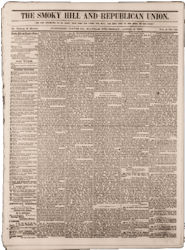
The Smokey Hills and Republican Union, Junction, Davis Co., Kansas, April 3, 1862
Letter from the Second—Fight with Quantrill’s Gang
Camp Blair, Kas., March 25.
To the Union.
The Kansas Second is in the field again.
The night of the 21st inst., our camp was thrown into an excitement by an order from Col. Mitchell for each company to detail from thirty to forty men, to be ready to march at 6 P.M., mounted and armed, with one day’s rations.
We marched at the time appointed, in the direction of Little Santa Fe, and arrived there about 11 P.M., twelve miles distant from our camp. Major Pomeroy, with forty men under Capt. Moore, and thirty men under Lieut. Storer, left the command at Santa Fe, and marched eastward into Missouri, with a guide who stated that he could take us to a house where the notorious Quantrill, with a party of his men, were stopping for the night.
After marching about three miles through the brush, and over the roughest road imaginable, our guide informed us that we were within a few rods of the house, although nothing could be seen, as it was quite dark, there being no moon, and very cloudy.
The Major ordered all to dismount, except every sixth man who was to hold the horses, and a guard of twelve men, of whom I was one, under charge of Lieut. Storer, who were to ride forward and support the Major should he meet with any resistance.
The night was quite cold and chilly, and we sat for more than thirty minutes shivering in our saddles, anxiously awaiting the signal that was to bring us into action, when suddenly the clear report of firearms broke the stillness that surrounded us, and brought every man erect in his seat, and caused our horses to jump and prance as if eager for the engagement.
We were ordered forward with a gallop, but before we reached the scene of action, report after report rang out upon the still night air, and informed us that our boys had stirred up a hot nest of rebels and were having plenty to do to take possession of them.
When we arrived, we ascertained that the Major had surrounded the house with his men, and ordered them to open the doors, when they answered him with a volley from within, badly wounding one of his men (a member of Capt. Moore’s company—since dead.) He instantly returned the fire, and when we arrived both parties were at work in good earnest.
We soon drove them from the windows and silenced their fire, when the Major ordered them to lay down their arms and they should be treated as prisoners of war.
We did not wish to fire on the house more than we could possibly help, as there was a family in it. After many assurances that they should not be harmed, the old man, his wife, two daughters and four sons, came out and gave themselves up, claiming to be good Union people.
We ascertained from them that Quantrill, with twenty-two of his men, was inside; that they were well armed and would fight to the last.
The Major again ordered them to surrender, and two of them came forward and gave themselves up. The rest wanted time to consider the matter, but were told that they could not have a minute, and we were just ready to open fire on the house, when they gave us a volley, severely wounding Major Pomeroy and one of our horses.
Lieut. Storer immediately went to the Major’s assistance, and found that a rifle ball had passed completely through the thick of his thigh and that he was bleeding profusely, an artery being severed. With his handkerchief and revolver, the Lieut. girded his leg sufficiently to stop the flow of blood, and had him removed out of range of the enemy’s fire.
The fall of the Major so exasperated us that we determined to decide the matter by firing the house. Our men had but five rounds apiece when we left camp, and many of them had now fired their last shot, while those inside seemed to have an abundance of ammunition, and the walls of the log house protected them.
Both ends and the front part of the house was log; the back part was light siding, but had neither door nor window in it, consequently we did not guard it as strongly as we did the other points.
We then piled dry wood and lumber against the house and set it on fire, and the whole building was soon in flames.
It being life or death with those inside, they made a desperate attempt and succeeded in bursting off to one side of the house, and eight or ten of the men made their escape, the brush and timber being within twenty feet of the house.
The boys killed two of them as they were entering the brush, and one man discharged his carbine, clubbed it and broke it in two pieces over one fellow’s head, knocking him as “stiff as a mutton.”
We killed five inside of the house, three as they were escaping, and took six prisoners.
I fear that Quantrill was with those that escaped.
We also took all of their horses and saddles, twenty-six in number, besides several revolvers, rifles and other arms.
If we had had plenty of ammunition and a few more men, we would have killed the last one of them. Col. Mitchell, with his men, did not arrive until it was all over. Seeing the house on fire was the first intimation that he had of our engagement.
All of the Junction boys are well. We are ordered to New Mexico, but I do not know when we will start. We have been having very severe weather for the past few days.
Do you know that I am heartily glad that the boys at Fort Riley “gutted” the Frontier. It is the best thing that I have heard of for months. The secessionists of Davis county have had their way long enough, and I think the boys done right in commencing at home. Your paper is getting lots of curses for denouncing and not sustaining the boys.
Yours,
“X.”