Lynch Law

News of the Day

[Marshall] Texas Republican, August 11, 1860

It is reported that a horse thief was arrested a few days ago, in this county, and hung. One report states that he was hung at the cross roads 9 or 10 miles from Marshall, which we think unfounded, and another rumor is to the effect that he was executed upon the same limb in Caddo parish upon which Robinson was hung last week.

0 comments

Barefooted and In a Wretched Condition

News of the Day

[Marshall] Texas Republican, August 11, 1860

On Tuesday last, great excitement was created in Marshall, by the intelligence that a lady of this county was missing from her house, and that apprehensions existed that she had been killed by the negroes. It seems that her husband attended the election in this place, the day previous, and owing to the hot weather, did not leave until late. He arrived at home early in the night, and found his wife missing. The negroes could give no satisfactory account of her absence. Of course an affair of this character created great consternation. Search was instituted and she was finally found about seven miles from home, at the residence of Mr. Boon. Reports had been circulated that the negroes were to rise on election day, and being a short distance from the house, she heard the firing of guns, and becoming frightened ran off, her alarm increasing with her flight. She was out the entire night, and arrived at Mr. Boon’s  This affair shows the necessity of prudence and caution, and the folly of unnecessary alarm.

0 comments

Incendiarism

News of the Day

Navarro Express [Corsicana, TX], August 11, 1860

Incendiarism is the order of the day. The State Gazette of July 30th says the Steam Mill of George Glasscock, near Austin, was burned on the 26th. It is said to be the work of an incendiary. Loss estimated at $30,000.

The Central Texian learns that an attempt was made to burn Brenham. It is supposed to be abolitionists who are at the bottom of it.

The Central Texian says a meeting of the citizens was held on the 26th to organize a Vigilance Committee, that there were strong reasons to believe that servile insurrection was contemplated by the negroes. Among the resolutions passed was one to arrest abolitionists and bring them before the President and conference for trial. Also another resolution the denominations to cease preaching to slaves until after the election in November.

The McKinney Messenger says on Friday, 21st July, the residence of Dr. C. B. Raines, about four miles from McKinney, was destroyed by fire, together with the kitchen, also the furniture and wearing apparel of the family. The fire is supposed to be the work of negro man belonging to the family, who is now in jail awaiting his trial.

Also, on the same day the house of Dr. Shelton, of New Salem, Rusk Co., was burned. Supposed to be done by a white incendiary. On the 8th of July at Black Jack Grove the store of Messrs. Cate & Mount was burned. Also on same day at McCarvinsville, the store of Mr. Dupree was burned.

The Paris Press says that on Monday 23rd, the house of Dr. W. W. Stell was set on fire by one of his negro women, and consumed with all its contents except two trunks. The women confessed to the deed.

The burning of the residences of so many Doctors looks like they are for some purpose marked out for special destruction. It may be to prevent detection of poisoning.

The Belton Democrat says a letter to H. E. Bradford of Belton, dated 24th July says four attempts to burn that city have been made in a week. A guard of forty men was kept up to protect Austin.

The Belton Democrat of the 28th of July learns from the stage driver that while passing through Georgetown on Wednesday, a stable was burning and the people trying to save the building near it.

The Bastrop Advertiser of 28th July says an attempt has been made to fire Bastrop.

0 comments

Murder

News of the Day

Navarro Express [Corsicana, TX], August 11, 1860

A Mr.  Erwin was killed near Brenham last week by two negro men belonging to himself and father. The murderers have been arrested, and the opinion prevailed that summary justice would be dispensed to them.—Central Texian.

0 comments

Colonel Ellsworth of The United States Chicago Zouaves From A Photograph By Brady

Frank Leslie’s Illustrated Newspaper

Frank Leslie’s Illustrated Newspaper, August 11, 1860.

Col. Ellsworth, of the United States Chicago Zouaves. In our paper of the 28th July we gave a short biography of this admirable specimen of an American soldier-citizen, and have now merely to repeat that he is a native of New York, and in his twenty-second year. In presenting his portrait to our readers, we trust it may prove an incentive to our young men to follow his praiseworthy example, and, like him, scorn enervating delights and live laborious days, thus forming the foundation of a manly and, Republican character. Our picture is an admirable resemblance to one, who, although only just out of his teens, has already earned an honorable name among his fellow-men.


Elmer Ephraim Ellsworth was a law clerk and United States Army soldier who was the first conspicuous casualty and the first Union officer to die in the American Civil War. He was killed while removing a Confederate flag from the roof of the Marshall House inn in Alexandria, Virginia.

Born as Ephraim Elmer Ellsworth in Malta, New York, Ellsworth grew up in Mechanicville, New York, and later moved to New York City. In 1854, he moved to Rockford, Illinois, where he worked for a patent agency. In 1859, he became engaged to Carrie Spafford, the daughter of a local industrialist and city leader. When Carrie’s father demanded that he find more suitable employment, he moved to Chicago to study law and work as a law clerk.

In 1860, Ellsworth moved to Springfield, Illinois, to work with Abraham Lincoln. Studying law under Lincoln, he also helped with Lincoln’s 1860 campaign for president, and accompanied the new elected president to Washington, D.C. Ellsworth stood 5 ft 6 in (168 cm) tall; the six-foot-four Lincoln called him “the greatest little man I ever met”.

(Wikipedia), accessed 5-10-20

0 comments

Encampment

general images, Library of Congress

General images from 1860 No. 1

(1860) Indian encampment, Dalles of the Columbia, May. Dalles Oregon, 1860. [Photograph] Retrieved from the Library of Congress, 8-10-2020

Indian encampment, Dalles of the Columbia, May 1860

Medium: 1 photographic print : albumen.

0 comments

The Wives of Presidential Candidates

News of the Day
1860s newsprint

Daily Gazette & Comet [Baton Rouge, LA], August 9, 1860

It is an interesting fact in connection with the several candidates for the Presidency, that they all have Southern wives. Lincoln married a lady of Lexington, Ky., where his opponent Breckinridge was born and married; Mr. Bell’s wife, is, we believe, also a native of Kentucky; and Mr. Douglas married a native of Maryland—his first wife was a native of North Carolina. If is a creditable fact in the histories of these several candidates, which will go far to redeem the errors and shortcomings of some of them, that they should come to the South for wives. Doubtless their success and prominence have been as much due to their wives as to themselves. Southern ladies far surpass others in the quality of winning friends for their husbands, and in promoting their advancement in public favor. They are more thoroughly identified with their husbands, guard their interests with a more devotee zeal, and cultivate in a larger degree those gentle and captivating traits which often extend a shield over a public man, protecting him from violent assaults, and at the same time affording him a solace for the annoyances and disgusts of his position.

We had almost forgotten to add that General Houston, who is also a candidate for the Presidency, is married to a Southern lady, and furnishes in his own case a splendid illustration of the influence of a devoted wife. The excesses and dissipation which threatened at one time to make a miserable wreck of this remarkably gifted man no longer stain his character and disgrace his position.

0 comments

Water

News of the Day
1860s newsprint

Daily Gazette & Comet [Baton Rouge, LA], August 9, 1860

We perceive in a recent issue of the Shreveport (La.) Gazette that the inhabitants of that place are experiencing great inconvenience and actual suffering from their inability to purchase water—the free gift of God to man—even for ordinary purposes.

Mr. Jones, the lessee of the spring which supplies the town with water, advertises to furnish it to families at the following rates:

Drinking water, by the bucket, from the 15th ult., to wit: 2 buckets, daily, for one month,

$3; do., $; 4 do, $5. Watter  by the barrel of 40 gallons, 50 cents, on delivery.

He has a regular superintendent at the reservoir, who keeps the water clean, and execute orders for it. Mr. Jones says the advance is price is owing to the high price of corn, hay and other provisions.

The Gazette urges the corporate authorities to purchase this spring and prevent its monopoly at a time like the present.

0 comments

The oldest fireman

Library of Congress

Title: Jacob Tripler the oldest fireman now attached to the fire department, 1860

Creator(s): Germon, W. L. (Washington Lafayette), photographer

Date Created/Published: Philad[elphi]a : W.L. Germon photographer 168 Chestnut St. Philada., 1860.

Medium: 1 photograph : albumen print on card mount ; photo 23.1 x 15 cm, on mount 29.2 x 24.1 cm.

Summary: Photo shows Jacob Tripler, full-length portrait, facing front, wearing fireman’s uniform and holding a large horn.

Title from item.
Blind stamped at bottom of mount: W.L. Germon 168 Ches’t. St. Phila.
Inscribed in pencil at bottom of mount: Jacob Tripler – 1860.
Inscribed in ink on verso: Jacob Tripler the oldest fireman now attached to the fire department, 1860.
Stamped on verso: W.L. Germon Photographer 168 Chestnut St. Philada..
(DLC/PP-2001:068).
Forms part of: Marian S. Carson collection at the Library of Congress.

Item on Flickr

0 comments

Americans with Garibaldi

News of the Day
1860s newsprint

Daily Gazette & Comet [Baton Rouge, LA], August 8, 1860

A considerable number of Americans have joined the army of Garibaldi. A young Virginian left Paris, on the 11th ult., with a commission as lieutenant, he had just received from headquarters at Palermo.

0 comments

Infernal Machine

News of the Day
1860s newsprint

Daily Gazette & Comet [Baton Rouge, LA], August 8, 1860

An infernal machine, called the centrifugal gun, is on exhibition at Columbus, Ohio, which will throw five hundred balls a minute, with the force of an ordinary rifle, without the aid of powder or cap, by merely turning a crank like a coffee mill.

0 comments

Another Machine Wanted

News of the Day
1860s newsprint

Daily Gazette & Comet [Baton Rouge, LA], August 8, 1860

Some simple contrivance, is certainly wanted, so as to fix in a visible manner, the Post marks on letters. In the hasty manner in which letters are stamped at the various offices in the country, the mark, is utterly worthless, to indicate the place and date of mailing. This is always, important. The mark on the envelope, is not unfrequently the only index as to where the letter was written—at least here in Louisiana, where many persons seem to labor under the impression, that the world ought to know in what particular place they live. The largest half of the people seem to think in dating their letters, that all necessary for them to do, is to give the name of the Parish from which they write. In all such cares , unless the Post mark can be deciphered, it is impossible to give an answer. Another thing in this connection. Ordinary people, have to an alarming degree fallen into the ways of remarkable geniuses. They will write a letter intelligibly, but when it comes to signing the same, they make scratches, something like the legs of a fly, who inadvertantly  falls into the ink and afterwards crawls over the paper and flaps his wings. If the post mark is legible, by cutting out the signature and pasting it on the envelope containing an answer, the local post master may by accident discover the writer. Cannot this remarkable age of invention discover some simple printing machine, to go with a handle, like a coffee mill, and stamp letters legibly?

0 comments

Alexander H Stephens to J Henly Smith

Miscellaneous document sources


Crawfordville [Ga.], Aug. 8th, 1860.

Dear Smith, Yours of the 1st inst. was received some days ago but I have not been in much condition to write with much ease to myself since. About ten or twelve days ago I got a fall as I was going out of the door which gave me some ugly looking bruises on the chin, nose, lips and face generally. Besides this my wrists and both hands suffered. I have not been able to use them well since. The thumb on the pen hand is still out of order. It is with difficulty I write. The accident happened by the heel of my shoe catching or rather heavily touching the carpet strip at the door which gave me a [illegible]. The balance being lost I fell head and face foremost down the steps to the ground, near eight feet, the face striking the hard gravelled ground. It is a wonder the injuries were not more serious than they were. It was truly a frightful fall. But enough of this. I was very sorry indeed to hear of your interview with Mr. Cobb. Sorry to see the vindictive spirit of persecution which the Administration seems determined to carry out. For your own sake I hope nothing further will be done in the matter. Any thing that I could do for you in bringing you in communication with the Constitutionalist or any other papers as a correspondent will be most cheerfully done. I look upon the election of Douglas as hopeless; yet it is important that the truth should be vindicated before the people. It is not my intention to take very active part in the canvass or ever in any political canvass again. This I have told you before. When I quit Congress I quit politicks, particularly its strifes on the hustings, forever. My dislike for that sort of business was one of my reasons for going into retirement.

Linton’s resignation of his seat upon the Supreme Court bench [of Georgia] was not with any view of entering into politicks. Far from it. He looks upon such struggles with even greater aversion, I believe, than I do. His object was to go like myself into perfect retirement where he can pursue such objects as are more agreeable to his feelings and tastes than the wranglings of a multitude can afford, either on the “stump” or in the forum. His fondness for books will afford him ample sources for entertainment and amusement. The country at present I think presents nothing attractive to the mind of a patriot. Everything it seems to me is tending, or rather rapidly rushing to national disruption and general anarchy. There is not political virtue enough in the land to save it. This is my present conviction ; and while I may still hope, for one may hope as long as life lasts, yet I am fully prepared in mind at least for the greatest and worst calamities that can befal a people. Write often.


From Annual Report of the American Historical Association for the Year 1911.

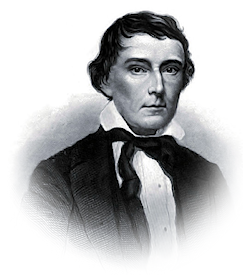
Alexander Hamilton Stephens was an American politician who served as the vice president of the Confederate States from 1861 to 1865. After serving in both houses of the Georgia General Assembly, he won election to Congress, taking his seat in 1843. After the Civil War, he returned to Congress in 1873, serving to 1882 when he was elected as the 50th Governor of Georgia, serving there from late 1882 until his death in 1883.

J. Henley Smith was a Georgia journalist.

0 comments

Thomas W Thomas to Alexander H Stephens

Miscellaneous document sources

Elberton Geo., 8th August, 1860.

Dear Sir: Your letter of the 31st ult. was received last Monday. It was not deemed by me obtrusive. It is true I did not ask for explanations but surely I never said I did not want them. Your conclusion that I did not desire explantions because I did not ask for them seems to me to be illogical. I desire a great many things that I do not ask for. I deemed you an old and valued friend. I learned you had treated me in a manner entirely incompatible with that friendship. I laid the case before you in a manner perfectly friendly, candid and respectful, and I still insist that it was all these. I did not say give me explanations, give me redress. This sort of demand precedes hostility. I felt no hostility and wanted no revenge; and I expressly stated that I was not demanding redress nor explanations, in order that you should not by any possibility mistake the true spirit and intent of my letter by construing it to be one in any event whatever looking to hostility. This is the whole reason and cause why I did not ask for explanations. Now if it be less respectful to you to leave it wholly to your own judgment and sense of justice to say what atonement or explanation shall be made for a supposed injury than to demand these a la mode, then have I offended on this point, and not without.

But you are careful to say you do not offer the remarks in your letter as explanations. Therefore I can only say if they had been so offered they would have been entirely acceptable and satisfactory. You further say you make them as vindications of yourself and character. To this I can only reply that your labor has been lost, for neither you nor your character ever needed any vindication to me. I hope you will excuse me for troubling you. I have been as short as possible and shall close by saying in truth and candor I can still subscribe myself truly your friend.


From Annual Report of the American Historical Association for the Year 1911.

Thomas W. Thomas, born 1822, died 24 Apr 1864, was a soldier, lawyer, and judge of Elberton, GA.

Alexander Hamilton Stephens was an American politician who served as the vice president of the Confederate States from 1861 to 1865. After serving in both houses of the Georgia General Assembly, he won election to Congress, taking his seat in 1843. After the Civil War, he returned to Congress in 1873, serving to 1882 when he was elected as the 50th Governor of Georgia, serving there from late 1882 until his death in 1883.

0 comments

The Abolition Plot in Texas

News of the Day
1860s newsprint

Semi-Weekly Mississippian [Jackson, MS], August 7, 1860

The Houston Telegraph, of the 31st ult. mentions meetings of citizens at Anderson, Hempstead, Brenham, Paris, &c., and the appointment of Vigilance committees, in consequence of the developments of the Abolition plot. The Telegraph says:

It has been ascertained that the negroes of Grimes county have held secret meetings, and many of them are supplied with arms.

 In Fayette county a band of runaways was thought to have been organized, to make a break for Mexico.

 The Gilmer Tribune reports the arrest of three negroes in that town on the 10th. They had in their possession passes, papers, and various documents, way-bills to the Indian Nation, pistols, powder, caps and writing materials. They said they were from Henderson county.

 The house of Dr. W. W. Stell, of Lamar county, was fired by a negro on the 16th, and completely burned.

 A letter in the Waco Democrat, written from Waxahachie, by Judge Buford, of Dallas, confirms the accounts of the troubles in Ellis and Dallas. It says: “Since you left this place the investigations of the vigilance Committee of Dallas has led to very important discoveries, implacating  nearly all the negroes of Ellis and adjoining counties. To-day a committee was organized in this county, who have ascertained the existence of a most perfect and thorough organization, having for its object an indiscriminate massacre of the white population. Under the lash the negroes have admitted that they had in their possession deadly poisons, to be administered to their masters’ families in food; and when demanded of them, they have gone to the kitchen and produced the poison.

 In every part of the State the people seem to be on the alert, and we have no fear of any further outbreak. The troubles in Ellis, Dallas, Denton and Terrant  counties will be settled by the citizens. The committees at work there are composed of the best men in the several counties, and seem determined to make a clean thing of the matter. They are receiving the support of the whole population.

0 comments

The Abolition Plot in Texas

News of the Day
1860s newsprint

Bellville [TX] Countryman, August 4, 1860

We extract the following from a letter to the Houston Telegraph, from Dallas, giving further particulars of the extensive Abolition plot discovered there a few days ago:

The outhouses, granaries, oats and grain of Mr. Crill Miller, were destroyed a few days after the destruction of Dallas. This led to the arrest of some white men, whose innocence, however, was proved beyond a doubt. Several negroes belonging to Mr. Miller, were taken up and examined, and developments of the most startling character elicited. A plot to destroy the country was revealed, and every circumstance even to the minutiae, detailed. Nearly or quite a hundred negroes have been arrested, and upon a close examination, separate and apart from each other, they deposed to the existence of a plot or conspiracy to lay waste the country by fire and assassination—to impoverish the land by the destruction of the provisions, arms and ammunition, and then when in a state of helplessness, a general revolt of the negroes was to begin on the first Monday in August, the day of election for the State officers. This conspiracy is aided and abetted by abolition emissaries from the North, and by those in our midst.

The details of the plot and its modus operandi, are these: each county in Northern Texas has a supervisor in the person of a white man, whose name is not given; each county is laid off into districts under the sub-agents of this villain, who control the action of the negroes in the districts, by whom the firing was to be done. Many of our most prominent citizens were singled out for assassination whenever they made their escape from their burning homes. Negroes never before suspected, are implicated, and the insurrectionary movement is widespread to an extent truly alarming. In some places the plan was conceived in every form shocking to the mind, and frightful in its results. Poisoning was to be added, the old females to be slaughtered along with the men, and the young and handsome women to be parceled out amongst these infamous scoundrels. They had even gone so far as to designate their choice, and certain ladies had already been selected as the victims of those misguided monsters.

Fortunately, the country has been saved from the accomplishment of these horrors; but then, a fearful duty remains for us. The negroes have been incited to these infernal proceedings by abolitionists, and the emissaries of certain preachers who were expelled from this county last year. Their agents have been busy amongst us, and many of them have been in our midst. Some of them have been identified, but have fled from the country; others still remain, to receive a fearful accountability from an outraged and infuriated people. Nearly a hundred negroes have testified that a large reinforcement of abolitionists are expected on the first of August, and these to be aided by recruits from the Indian tribes, while the Rangers are several hundred miles to the North of us. It was desired to destroy Dallas, in order that the arms and ammunition of the artillery company might share the same fate.

Our jail is filled with the villains, many of whom will be hung and that very soon. A man was found hung at our neighboring city of Fort Worth, two days ago, believed to be one of those scoundrels who are engaged in this work. We learn that he had stored away a number of rifles, and the day after he was hung a load of six-shooters passed on to him, but were intercepted. He was betrayed by one of the gang, and hence his plans were thwarted. Many others will share his fate.

I have never witnessed such times. We are most profoundly excited. We go armed day and night, and know not what we shall be called upon to do.

0 comments

The Conflagrations in Northern Texas Startling News

News of the Day

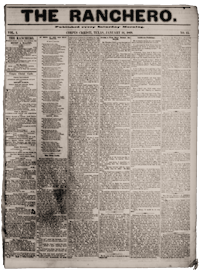
The Ranchero [Corpus Christi, TX], August 4, 1860

Mr. Chas. R. Pryor, editor of the Dallas Herald, writes to the State Gazette, under date of 16th July, giving an account of the destruction of that place by fire, and makes a statement which, if true, will produce exciting times in that quarter. After narrating the particulars of the fire, he says:

All of these were so plainly the work of an incendiary, that suspicions were excited and several white men and negroes were arrested and underwent an examination. This lead to the detection of a most diabolical plot to destroy the country. The scheme was laid by a master mind, and conceived with infernal ingenuity. It was determined by certain abolition preachers who were expelled from the country last year, to devastate with fire and assassination, the whole of Northern Texas, and when the country was reduced to a helpless condition, a general revolt of the slaves aided by white men from the North, and many in our midst, was to come off on the day of Election in August. The object of firing the town of Dallas, was to destroy the arms of the Artillery Company, ammunition and provisions known to be collected here; to destroy the stores throughout the country containing powder and lead—burn the grain and thus reduce this portion of the country to a state of utter helplessness.

When this was accomplished, assistance was expected from Indians and Abolitionists. Many other places have already been fired, Denton, Pilot Point, Belknap, Gainesville, Black-jack Grove; some stores in Kaufman, Navarro, Waxahachie and other places, that I do not now remember.—Each county has a special superintendent, a white man, and each county is laid off in districts under the supervision of a white man, who controls the action of the negroes in that district. The negroes are not permitted to know what is doing outside of their immediate sphere of action. Many of our most prominent citizens were to be assassinated, when they make their escape from the burning houses. Arms have been discovered in possession of the negroes, and the whole plot revealed, for a general insurrection and civil war at the August election. I write in haste; we sleep upon our arms, and the whole country is most deeply excited. Many whites are implicated, whose names are not yet made public. Blunt and McKinney, the abolition preachers, were expected here at the head of a large force at that time. You had better issue extras containing these facts, and warn the country of the dangers that threaten it. We are expecting the worst, and do not know what an hour may bring forth. Do the best you can for us. We have no printing press and can do nothing in that line. We may have to call on the lower counties for assistance—no one can tell. All is confusion, excitement and distrust.

0 comments

Committee Searching Provided With Ropes

News of the Day

[Marshall] Texas Republican, August 4, 1860

Sometime in 1857, a person by the name of Lemmons was expelled from the town of Quitman for expressing abolition sentiments, and went to Illinois, where a printing establishment was purchased for him and where he published an abolition newspaper. A few weeks since, as we are informed by a gentleman just from Quitman, Lemmons returned to that town, and, after remaining a few days, suddenly absconded, and on the very night after his departure the town was set on fire by an incendiary. The fire was fortunately discovered in time to be extinguished without damage being done to property. A committee of the citizens of Quitman are in search of Lemmons, provided with ropes to hang him in case he is caught.—Jefferson Herald.

0 comments

Abolition Incendiaries in Texas

News of the Day

The Ranchero [Corpus Christi, TX], August 4, 1860

In another column we publish a letter written by Col. Chas. R. Pryor, editor of the Dallas Herald, which makes some startling developments. Facts have been elicited by actual testimony, that goes to substantiate the fact that this State is infested with an organized band of abolitionists, whose sole object is to war upon the institution of slavery. Plots have been discovered in different portions of the State, which go to show that an actual conspiracy is on foot to inaugurate a second Harper’s Ferry affair in our very midst. On the same day that Dallas was destroyed, an attempt was made to fire Austin, and twice since; fires at Denton, Jefferson, and many other places occurred at the same time; an abolitionist was detected at Fort Worth who had just distributed fifty guns and fifty six-shooters among the negroes, and another one engaged in a similar act in Parker county was caught. Both were hung by the citizens. A correspondent of the Brenham Ranger writes from Chapel Hill that three suspicious persons were brought before a meeting in that place, and after a fair and impartial investigation, it was proven that they were abolitionists, had said that they sympathised  with the negroes, and had made their boasts that there were three thousand abolitionists in the State, and also that in three years the Black Republicans would rule the State. One of them had been seen to take negroes in his room, and, with closed doors, to converse with them. They were ordered to leave the State, which they did.

The existence of abolitionists in the Cherokee Nation has already been chronicled. The State Gazette says it appears that an active warfare is going on there against the institution of slavery, and that the party engaged in it is of a religious denomination (Methodist Church North); thus infusing religious fanaticism in their hostility to the property of Southern men.

We append the remarks of the Gazette, which we heartily endorse:

We give these facts to our readers with no idea of desiring to create any false impression. We think any one who could thus trifle with the feelings of the people, would be amenable to the severest censure. We only do so desiring to know if there is an actual conspiracy on foot to treat our State with one of those horrible tragedies which it is proposed to enact in slave States for the purpose of creating the impression that powerful enemies to the institution live here among us, and who are willing to see and aid the conflagration of the incendiary, the bloody knife of the assassin, and deluge with blood the dwellings of all who in any way countenance the slave institution: rejoicing over our attack and the perhaps wide spread famine following in its wake.

Let the citizens of Texas everywhere be on their guard, and we hope that should a well attested case of incendiarism be discovered, the severest penalty will be quickly inflicted. The abolitionists have grown insolent from our own laxity and indifference.

0 comments

But Where Is the Thief Gone

News of the Day

[Marshall] Texas Republican, August 4, 1860

 Marshall, Aug. 3, 1860.

Editor Texas Republican:

Dear Sir:–A few days ago, the citizens of Marshall and vicinity held a public meeting for the purpose of self-protection against all persons who might be found inimical to our rights; that is to say, thieves, robbers, murderers, &c., &c. The people seem to be, and no doubt are, much concerned in the preservation of their rights and freedom from any molestation by such pests of society. At the meeting an organization was had with great unanimity, which proposed to aid the law in bringing such offenders to justice. At Marshall we have two Justices of the Peace, a beat Constable, a Sheriff, and a Mayor, besides others; and, in addition to these, the organization constituted a Chief of Police to strengthen the “aid of the law” proposed, and a large number of the people constituted themselves into a police for guarding the lives and property of the people, and also the organization of a Military company. I belong to the Police organization. I have no doubt of the propriety of all this now, or at any other time of emergency in aid of law.

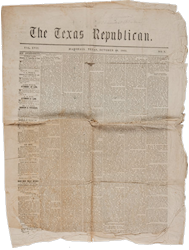
Now, one case, and the first one under this effective union for self-protection. A few days after this organization a case happened to become apparent. A horse thief was caught in our very midst a veritable horse thief, in the person of _____ Robinson, given name not known, and the stealer of more than one horse according to his own showing. Robinson was caught in the vicinity of Marshall, on the 30th July past. Now let us see how the law was aided by these organizations. Robinson was kept in custody two or three days without warrant, as if the only object of his detention was to exhibit him at various points as a horse thief! His keepers were not to blame for they could not discharge him. He had stolen a horse within two miles of Marshall, and in Harrison county, Texas, and they were doing their duty to detain him till the law came. But it seems that the law with all its aids could not come to their relief. It is now the 3rd day of August and the 4th from the time of the apprehension and custody of said horse thief and I believe the law has not come yet. But where is the thief gone? Is the law stronger with these aids than without them?

If the law had no other aid than fidelity on the part of its officers in its proper execution, this thief would now be in the jail at Marshall to answer for his transgression committed within two miles of the prison. But he is not in jail! Where is he?

I hear people speak of the weakness of the law. They don’t understand what they talk about. The weakness of the law! The law is ample; full of life and energy. It arrests offenders and suspected persons with or without warrants and makes provisions for all cases. But its officers! What shall we say?

A vigilant police we have, and it is now doing good service, and bids fair to catch and bring every offender to the law, and the law if properly executed will be sufficient without those aids which intervene and bid defiance to law and transgress it.

Sir, can you tell where that horse thief is? and why it is that he is not in jail in Marshall to answer for his crime? How, sir, is the law to regain its former dignity and respect?

P.

These inquiries, it occurs to us are, in every respect, pertinent and [illegible]. We are no lawyer, and consequently are not prepared to instruct the officers of the law relative to their duties. But we do know what the public interests and the peace of society demanded in this case and what it demands in all other cases of a like nature. The parties who lost their property ought, as good citizens, to have had this man Robinson regularly committed, and if they failed to do so, it was the duty of the officers of the law, to have attended to the matter, and to have instituted such proceedings as would have led to his prosecution. It was a matter of notoriety that a thief had been arrested, and that among other things stolen in this town and vicinity, was the horse of a citizen of this county, living within two miles of Marshall. For several days this thief was paraded about our streets. We take it for granted that our officers were cognizant of the proceeding, and if they were not conversant with all the facts and reports connected with the affair, they were not as vigilant as they ought to be, or as the proper administration of the law requires. It is for them, and not for us to say why there was no action in the premises.

What has become of the thief? One report stated that he had got away. Another that he had been carried to Shreveport, in the State of Louisiana. A friend informed us, on Thursday, that he met three gentlemen that morning, about seven miles from town, with the prisoner hand-cuffed, proceeding in the direction of Shreveport.

Now, we object to such proceedings as we have detailed, for the reason, that their inevitable tendency is to produce contempt for the law, and to substitute in its stead anarchy and mob violence. Speculation was rife, in this community, as to what would be done with the thief, and the opinion was freely expressed that he would be lynched or hung before the parties who had him in charge reached Shreveport. We trust the suspicion was unjust and unfounded, for while we have no sympathy for crime of any sort, we look with what we conceive to be just apprehension and horror upon everything that tends to subvert the good order of society, and particularly by men whose social position demands that they should strengthen and preserve the law. And, in this connection, it is proper to say, that we have with pain heard leading citizens, from whose age, experience, and elevated character we expected different reflections, speak of the weakness of the law, and in terms of approval of the lyncher’s code! Do men reflect properly when they talk thus? Do they know what they are doing when they give encouragement to such a sentiment? If they are correct, we had better abandon all law, and substitute in its stead the course of proceedings which they recommend—the lyncher’s code! which all experience has shown surrenders the control of society, to the most vicious and depraved. But as our correspondent says, the law is not weak, but strong, and fully efficacious for all legitimate purposes. We venture to say that there is no State in the Union that has better laws than Texas, and no State where there is less chance for a thief to escape punishment. But good laws and a virtuous public sentiment are worthless, where officers are not vigilant, or citizens fail in the discharge of their obligations.
0 comments

Abolitionists Caught

News of the Day

[Marshall] Texas Republican, August 4, 1860

On the 3d July, as we learn from a letter in the Brenham Enquirer three men, Clock, Sr., his son, and Perkins, his son-in-law, were arrested in Chapel Hill, and brought before a public meeting on charge of being abolitionists. A committee of twelve of the most respectable citizens were appointed to investigate the affair. It was proven by several gentlemen that the accused had repeatedly said that they were abolitionists; that there were three thousand abolitionists in the State; and that in three years the Black Republicans would rule this State; and that they sympathized with the negroes.

The accused were ordered to leave the State as soon as they could arrange their business. They have complied with the order.

Clock, Sr., is about forty years old and hump-backed; young Clock is about twenty-one, and Perkins about twenty-five.—Galveston News.

0 comments

Incendiaries and Vigilance

News of the Day

[Marshall] Texas Republican, August 4, 1860

Incendiaries

A committee appointed for the purpose at Paris, Texas, has reported that no “thermometer heat will ignite matches.” This proves that the late burnings in the northern portion of the State were produced by incendiaries.

Vigilance committee

In consequence of the numerous fires and other incendiary movements in the Northern portion of the State, the people of Marshall have organized a vigilance committee and a rigid patrol.

0 comments

Galveston

News of the Day

[Marshall] Texas Republican, August 4, 1860

Incendiarism, thieving, and burglary are prevalent in Galveston. The News says:  “There are at this time a larger number of suspicious characters in our midst than we have ever known before—men who are either entirely unknown or of whom no good is known, and who are without any visible means of support, or any occupation, except that of living at the expense of others.”

0 comments

Dallas

News of the Day

[Marshall] Texas Republican, August 4, 1860

We have no late intelligence from Dallas. Reports are current here to the effect that twenty or thirty negroes were in jail at that place—that the incendiary conspiracy was fully established, and that several negroes and two or three white men had been hung. It is stated that the negroes were instructed to burn down all the towns, stores, mills, and residences, and particularly every place containing powder. That the people would be thus rendered defenceless, and that on the day of election, the abolitionists would invade the State in armed force and carry off the negroes to Mexico.

0 comments

The Drouth

News of the Day
1860s newsprint

Standard [Clarksville, TX], August 4, 1860

 Writer in the Union of the 5th, [illegible] Panola county.

The drouth has prevailed in our section of country since the 18th February, with the exception of two showers which [illegible] settled the dust. Notwithstanding the severity of the drouth, we broke up our ground and planted our corn, which did fair for a large yield until the last three or four weeks; after then they have entirely failed.

A large number of our citizens are preparing to abandon their homes with their families and stock to some point where there are provisions to keep them alive.

Many are already destitute of either meat or bread, and are bound to suffer unless speedy relief is had; for there is neither money nor corn in our county.

Our citizens contemplate holding a meeting on Friday next, to petition the Governor to call the Legislature together to provide help for the suffering, and advise that the collection of debts for the present be stopped.

There are men in the county who have offered to hire out negro men and women until next Christmas a year, for their victuals and clothing. Hogs are daily dying for the want of food.

0 comments