Alamo

News of the Day
1860s newsprint

Alamo Express [San Antonio, TX], August 25, 1860

“The Fall of the Alamo.”—As there are a great many false traditions and much perverted history in regard to this, the most heroic action of the Texan struggle, we will attempt to give the public, as soon as it can be conveniently compiled, an account taken from facts on record and from the narratives of men of intelligence on the ground at the time.

0 comments

Burning of a Famous Resort

News of the Day
1860s newsprint

Daily Gazette & Comet [Baton Rouge, LA], August 24, 1860

The Louisville Journal announces that “Bell’s tavern,” in Kentucky, kept by Mr. Proctor, was destroyed by the fire last Friday night, and adds:

For two generations past, and since the beginning of the present century, it has been the stopping place for all visitors to the Mammoth Cave, and there are thousands from every nation and clime who have enjoyed its boundless hospitality, its luxurious comforts, its well-spread table, and its snow drift sheets at night. It is the removal of an old land-mark, the death of a loved friend, the sundering of a strong tie of attachment. We have not as yet received any particulars as to the origin of the casualty, but we learn with regret that the destruction was complete, involving not only the capacious mansion but all its contents.

0 comments

The Poor of the City

News of the Day
1860s newsprint

 Albany [GA] Patriot , August 23, 1860

Few persons perhaps are aware that there are many families in our midst who do not get  half enough to eat. While it has ever been characteristic of our citizens to give with a liberal  hand, yet there are many charitable objects who seem at present to be overlooked. Can nothing  be done in their behalf? If the ladies, who never fail in their efforts to promote every laudable  undertaking, would take the initiatory step, we feel sure that it would end in royal [?] blessings to  the poor and our community.

0 comments

Further Developments

News of the Day
1860s newsprint

Texas Baptist [Anderson, TX], August 23, 1860

August 10.  Brother Baines: In these time  of peril, when every community is threatened with insurrection and murder, any fact which may put our citizens upon their guard will doubtless be of interest to our readers. Almost every day brings some new evidence to establish the suggestion I made in my last letter, viz: that the men are among us who have instigated the late efforts for the destruction of life and property.

A few days ago two men, whose names I am not able to give, living in what is known as the Tennessee Colony, in Anderson county, were convicted as partakers in this iniquitous plot, and executed upon the gallous . I learn that four or five others are being pursued and will share the same fate if caught.

It is reported that on the day of the election at Athens, while the men were at the polls, two shrill blasts of a horn were heard near the town, and in a few minutes a stable was seen in flames, every man rushed to his dwelling and the town was saved.

I learned on yesterday that on Sunday evening last, the day before the election, while the people of Henderson, Rusk co., were at supper the town was set of fire, and the greater part of it burnt to ashes; the loss is estimated at from $300,000 to $400,000.

Tyler has been strictly guarded for several weeks. It is rumored that an effort was made to set fire to this town also, but I cannot vouch for the report.

No town should be without a faithful watch or patroll  every night, and the safety of every community demands that every vagerant  or suspicious character should be closely watched, or made to leave the county.

We shall not be surprised to find that there are men engaged in this thing, whose position in society claims an unusual share of public confidence. We would not impeach any man’s character upon doubtful testimony, but time will reveal the facts.

A negro man belonging to Maj. Lewis, a few miles from this place, was shot on Thursday last, by Mr. Ghant, and supposed to be mortally wounded. The negro had been heard to make his boasts that in two weeks he would have Miss Ghant for his wife, was seized and while in the custody of Mr. Ghant he attempted to make his escape, and was shot.

………….D. B. M.

0 comments

The Census Takers Experience in the Country

News of the Day
1860s newsprint

Daily Gazette & Comet [Baton Rouge, LA], August 23, 1860

A Virginia census taker writes: “I have opened 200 to 2500 gates, let down 1500 to 1800 pairs of bars, and any number of fences; have got off and on my horse from fifty to eighty times a day, done any amount of talking in the way of explanation, made countless calculations, etc., etc. Thus far I have not had an unpleasant word with a human being, but my patience and temper have been severely tried.”

0 comments

Notice

News of the Day
1860s newsprint

Daily Confederation [Montgomery, Al], August 22, 1860

My son John T. M. Bowen left my premises and parental control on Sunday, the 19th inst., taking with him a small clay banked Pony, very drooped rump. All persons are hereby forbid from employing or harboring him, or of trading for said horse or for a watch. A liberal reward will be given for his apprehension and delivery to me, 14 miles south of Montgomery; and any information furnished me that I may know where to find him, will be thankfully received. Said lad is not quite seventeen years of age, is some five feet two inches high, fair, and rather ruddy complexion; thin visaged, black hair and eyes. Had on when he left a black frock cloth coat, black satin vest, black alpaca pants, and low crown straw hat, with a very broad brim.

 James A. Bowen.

0 comments

The Texas Excitement

News of the Day
1860s newsprint

Semi-Weekly Mississippian [Jackson, MS], August 21, 1860

Dr. Pryor writes to the State Gazette, under date of Dallas, July 23 and 24, the following additional particulars of the progress of the Vigilance Committee in their work of ferreting out the guilty parties in the late outrages in that county:

The Vigilance Committee have been in session all day, and this evening they announced that there of the ring leaders of the insurrection are to be hanged tomorrow. These hardened scoundrels were amongst the number. The decision seems to give general satisfaction. The crowd dispersed after this announcement, and a strong guard was detailed to watch the jail in which are confined six or eight of the criminals. The police are active and unremitting in their efforts, and it would be impossible for the whole abolition fraternity to surprise us now, although we might be easily overpowered. They would have to fight for it, however.

 Tuesday, July 24. This evening at 4 o’clock the three ringleaders, Sam, Cato, and Patrick, were escorted from the jail under a strong guard to the place of execution. An immense concourse of citizens and negroes assembled to witness their exit from the scene of their wickedness. As they passed through the town they surveyed with composure the ruins of the once flourishing town, that now lays in a blackened mass before them. Patrick Jennings (so called) remained calm and collected during the whole day, and betrayed no remorse or feeling whatever in view of his approaching doom. He it was who fired the town, and that night after its destruction glorified himself for the deed, and pronounced it only a commencement of the good work. These facts were obtained from many witnesses, who testified to the same facts without any hesitations or contradiction of each others’ statements.—Sam Smith, so called from the name of his master, was an old negro preacher who had imbibed most of his villainous principles from two abolition preachers, Blunt and McKinney, who lived in the country a year before, and had had much intercourse with said negro; this old negro was a deep dyed villain. Cato had always enjoyed a bad reputation. They met their fate with a composure worthy of a better cause. Patrick Jenning with unparalleled nonchalance died with a chew of tobacco in his mouth, and refused to make any statement whatever.

 They were hung on the bank of the river above town, and are buried beneath the gallows.

 Investigations are still going on throughout the country, all of which tend to confirm the facts elicited at this place. The evidence obtained before the committee will be published in due time. More anon.

 The Quitman incendiary, who was fired upon and escaped, leaving his shavings and matches in front of Sparks’ law office, had not been discovered. The Herald extra says:

Since our paper yesterday, [giving an account of the attempted incendiarism,] made its appearance, we learn that Mr. Ed. Pollit, residing some fifteen or eighteen miles south of this place, saw a stranger, on Thursday last of suspicious appearance. He came to Mr. Pollit through the woods, and inquired if he could get through to Quitman, and came on in this direction. On the day after the attempt to fire the town, about noon, a man, answering fully the description, came through the woods to Mr. Gilbreath’s, about fourteen miles southeast of this place. He said he was lost. What a stranger can mean to be straggling through the woods is a question which very naturally excites suspicion. Some of the citizens are inclined to the opinion, from a combination of circumstances, that this is the identical man shot at on last Friday night.

We will give these circumstances as we hear them, thinking, perhaps, they may lead to some light upon the subject.

The Herald says:

Our streets are now nightly guarded with eight men, who will require a strict account from all who may be seen lurking in suspicious places, white or black; and slaves will not be permitted to straggle through the town at a late hour, even with the written permission of masters, unless on urgent business, and then not without the company of a guard.

We believe (says the Houston Telegraph), every city and town in the State, or nearly every one, is now guarded by a vigilant volunteer night police. There are no evidences amounting to anything of there having been any plot in the Southern half of the State.—Still, these vigilant guards have done much good in arresting vagabond white men, and runaway negroes.

0 comments

Indian Fracas

News of the Day
1860s newsprint

The Constitutional [Alexandria, LA], August 20, 1860

On Thursday afternoon last, a murderous conflict occurred between a  number of Indians, in the rear of the Ice House Hotel, which resulted in the killing of two of the redskins. A family feud of Montague and Capulet intensity had been existing for a long time,  which, by the aid of whisky, found active exhibition on the afternoon aforesaid.

0 comments

The Fall of the Alamo

News of the Day
1860s newsprint

Alamo Express [San Antonio, TX], August 18, 1860, p. 3, c. 1

Today’s Weekly Herald contains an account of the Fall of the Alamo by Capt. R. W. Potter. It is the best, fullest, and most authentic that has been published. Mr. Potter is a gentleman of fine talents, and we hope he will continue to dig away in this line. A finer field for the display of literary genius than the history of the early struggles of the Republic of Texas, is presented nowhere, and as the Captain wields a ready and eloquent pen, we hope he will persevere in this much neglected but interesting work. The description is accompanied by a plat of the Alamo, which was executed by Mr. Hoag, foreman of the Herald office.

0 comments

Dismal Report

News of the Day

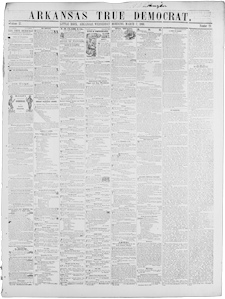
[Little Rock] Arkansas True Democrat, August 18, 1860  Texas.

About a dozen wagons passed through Little Rock on Monday last returning from Texas. They give quite a dismal report of that State. In many portions vegetation is burned up, and the country is threatened with starvation.

0 comments

Burnt Up

News of the Day
1860s newsprint

Bellville [TX] Countryman, August 18, 1860

We hear by Ed Tucker who is just from Houston, that it is reported there that the towns of Tyler and McKinney have been burnt up.

0 comments

Letter from Dallas

News of the Day
1860s newsprint

Bellville [TX] Countryman, August 18, 1860

[Special Correspondence of the Telegraph.]

Dallas, July 25.

Ed. Telegraph.—Three negro men, the leaders in the insurrectionary plot, were executed at this place last Tuesday evening. One of them, Pat. Jennings, was the man who applied the torch to the town of Dallas, and one of the most prominent of those who were engaged in the work. Sam. Smith, another and a preacher, was a hardened old scoundrel, and the third—old Cato—has always borne a bad character in this county. They were taken out of jail, escorted to the place of execution by the military, and, in the presence of a large concourse of people, expiated their crimes as justice demanded. They betrayed no discomposure in view of the awful fate before them. Pat positively refused to say anything, and died with as much indifference as if he had been about his ordinary occupation. With unparalleled nonchalance, he retained his chew of tobacco in his mouth, and died with it there. They hung about twenty minutes, Pat dying very hard, and the other two without a struggle—the former by asphyxia and the two latter by dislocation of the cervical vertebrae.

This is a fearful warning to the rest, who yet may share the same fate. In Waxahachie, many important developments have been made, and a large amount of poison found in the possession of negroes. The whole affair will have the most important results. The dangerous sentiments entertained by some people will be shown up in their naked deformity, stripped of all adventitious coloring. Men in high places will find a practical interpretation of their political dogmas in the view taken of them by deluded negroes. The plot to devastate northern Texas is dated from a certain time, and based upon facts calculated to mislead a people no better informed than our negro population. The danger of suffering negroes to go out to celebrations, to hear political speeches and to hold meetings of their own, is rendered apparent by the developments connected with this matter. We have learned a lesson, and will profit by it.

0 comments

Abolitionists

News of the Day

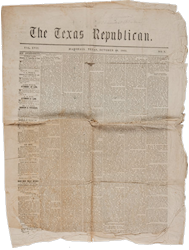
[Marshall] Texas Republican, August 18, 1860

We have received a letter from Clarksville, Texas, dated the 13th inst., which says:

On the 11th inst., a traveller by the name of Pierce, formerly a cabinet maker of Shreveport, was arrested here and carried to Paris from whence I think they will send him to Henderson. He is strongly suspected of having had a hand in the fire in Henderson. Three Abolitionists hung in Gainesville, Cook county, (Templeton, Hensley, and Kirk.) These men before they were hung implicated 15 other men belonging to an Abolition conspiracy.

0 comments

Burning Of Henderson

News of the Day

[Marshall] Texas Republican, August 18, 1860

We copy the following from the Henderson Times of Saturday last. Who that reads this article will not feel his heart melted with sympathy over this great misfortune? It forms another of the terrible outrages, which have driven our people to the verge of madness.

The Fire.—The painful duty devolves upon us of recording one of the most terrible and distressing calamities that ever befell any community in the time of peace.

Henderson is in ashes. Our once beautiful, quiet, and peaceful town is now a scene of the most awful desolation. The whole square is destroyed with the exception of three dry-goods stores, one provision store, one drinking saloon, and the Court-house. Our neighbor of the ‘New Era’ has lost everything in connection with his office.

Men, that a few days ago were in the enjoyment of peace and plenty, are now cast upon the world penniless, and without employment. We might name at least twenty men, we think, who have lost their all. And men too, who were shining examples of industry and moral worth, and who had labored energetically all their lives to accumulate what they have seen destroyed in one short hour.

As we before published, on Sabbath night about eight o’clock, when the most of the people were assembled in the Methodist and Cumberland Presbyterian Churches, for public worship, the alarm of fire was given, and such consternation, such excitement, as then prevailed. The women and children running and screaming in every direction, the men, a part of them endeavoring to save some property, and the rest in arms to protect the lives of the citizens, as that was the time which report said, the negroes incited by abolitionists, were to raise an insurrection. And from our exchanges, we learn that there is a deep laid plan among the abolitionists and negroes, to burn towns, and poison and murder the people of North Eastern Texas.

These are truly alarming times, the people are in arms both night and day, to protect the town and their families, and the greatest excitement prevails thro’out the whole country. Discoveries, constantly being made through the county; several white and black men are implicated, and poison has been found in the possession of some of the negroes. Such are the fruits of Black Republican teachings.

A Vigilance Committee has been in session ever since the burning, and doing all they can to discover the perpetrators of this hellish crime. We understand that the guilty party have been found without a doubt, and will be brought to justice.

The same paper contains the following:

Consequence of the Fire.—The undersigned Committee appointed by the citizens of Rusk county, to ascertain the fact attending the burning of the town of Henderson, on Sunday night the 5th inst., and the amount of losses sustained by the burning, make the following report, to-wit:

That the fire was caused beyond a doubt, by an incendiary, and that the losses sustained are as follows:

Loss.

  1. F. McDonough $25,000
    K. Meyer 9,000
    Turner & Harper 30,000
    Felton, Wiggins & Hogg 3,000
    Martin Casey 5,000
    John E. Jones 15,000
    A. M. Murphy 3,000
    L. & A. Mayer 11,000
    Insured for 4,000
    Rosambug & New 600
    J. W. Shelton 10,000
    Dr. J. A. Jordan 1,000
    Charles Fox 10,000
    G. M. Nichols 3,000
    H. D. E. Redwine 5,000
    Thos. M. Yates 6,000
    Insured for 4,500
    W. B. Ector 5,000
    Duncan Preston 3,000
    Bromley & Yates 2,600
    J. L. Miller 1,300
    Webster Flanagan 15,000
    Estill & Likens 5,000
    Wm. Stedman 10,000
    S. L. Earl 500
    Lewis Hammock 100
    John Dyke 2,500
    Latham & Wester 3,000
    Thos. M. Likens 12,000
    S. G. Swan 2,500
    Jas. McBride 1,000
    W. A. McClanahan 300
    Wiley Harris 6,000
    M. O. Ector 1,000
    Cobb & March 300
    Dansby & Dodson 250 [?]
    J. W. Harris 1,000
    M. D. Graham 5,000
    C. J. McDonough 15,000
    D. Le. Rosen 400
    R. B. Tutt 2,000
    Estate of J. T. Likens 2,000
    R. H. Cumby 2,500
    J. B. Likens 2,000
    Ben. Smither 500
    _______

$220,000

Insured 8,500

_______

Clear Loss $211,500

A Vigilance Committee has been organized and been at work since the morning after the fire. The result of their investigation, we suppose will be known in due time by the report of the Committee.

  1. D. Ector, G. H. Gould,
    Wm. Stedman, W. H. Estill,
    J. R. Armstrong, W. C. Kelly,
    A. B. Graham J. McClarty,
    J. M. Dodson J. E. Cobb.
0 comments

Dallas

News of the Day

[Marshall] Texas Republican, August 18, 1860

The people of Dallas have gone to work to rebuild their “burned district.” Several large brick buildings are already going up and many frame buildings are under contract. There is a great demand for carpenters and brick masons. Mrs. Cockrell has already opened a new hotel, although her own was burned.

The slave Joe, convicted of arson, for setting fire to the buildings in Cameron, Milan county last fall, was hung on the 13th ult. A thousand spectators attended. A number of negroes were present, whom he warned against following his example.

0 comments

Excitement and Alarm at Carthage

News of the Day

[Marshall] Texas Republican, August 18, 1860

Carthage, Texas, Aug. 7th, 1860.

At a public meeting called for the purpose of considering of the best means of protecting the town of Carthage, against the torch of the incendiary and the interests of the county of Panola generally, against the secret foes who seem bent upon the ruin of this portion of the Southern country, Judge Drury Field was called to the chair, and having brought the assembly to order, explained the object of the meeting, briefly, pertinently and forcibly.

A. M. Samford was appointed Secretary.

It was then resolved upon motion, that the chairman appoint five persons to draft resolutions which should suggest a plan for the protection of the town of Carthage, and for the accomplishment of the general object of the meeting.

Moved and adopted that the said committee be requested to report instanter, or as soon as possible.

The committee as appointed, consisted of H. P. C. Dulany, A. W. DeBerry, W. Watson, W. M. Thomas and James Long.

Upon motion, W. R. Poag, and J. K. Knight were also added to the committee.

It was moved and seconded that a vigilance committee be appointed to examine all strangers with reference to the purpose of their visit to our town and county.

Moved that the last motion be so amended as to make the officers of the corporation members of this committee. The motion and its amendment were withdrawn, to await the action of the committee appointed to report a plan for the protection of the town and county.

Mr. H. McKay, Rev. Mr. Roguemore, Rev. Mr. Pelham, Mr. Morris and Mr. Clements, being called upon, spoke upon the subject appropriate to the occasion, in brief but stirring addresses.

Moved and carried that the meeting now adjourn till 1 o’clock to give the committee on ways and means time to prepare their report.

Tuesday Afternoon, Aug. 7th.

The citizens assembled at the hour appointed. The meeting being called to order, the following report of the committee appointed this morning, was read by its chairman.

Whereas, we have reason to believe that there are incendiaries in our midst, and that our lives and property may be in danger. Therefore in order for our protection,

Resolved, That the Chief Justice be requested immediately to convene the County Court, for the purpose of appointing patrol detachments for the county, as authorized by Law.

Resolved, That we recommend, that each and every negro quarter be searched, and everything in the nature of weapons be taken away from them.

Resolved, That we earnestly recommend and urge upon our citizens the importance of guarding well and strictly, the conduct of slaves everywhere, and especially do we urge the importance of watching closely their associations with white men.

Resolved, That we recommend and request, that the Mayor and Aldermen of this Town do immediately convene for the purpose of passing such ordinances as may be in their wisdom necessary for the preservation of our Town.

Resolved, That we recommend the establishment of a police or guard. That the town marshal be appointed chief of such police, and that every free white male citizen be required by such ordinance to do and perform such duty when called upon by the said town Marshal.

Resolved, That such police or guard be stationed every night and remain on guard during the night unless relieved.

Resolved, That we recommend and urge upon all those who own unimproved lots, on or near the public square to cut down immediately all the bushes and remove other timbers that may obstruct the view to the Town or any of the buildings.

Resolved, That we advise all owners of slaves in the county to keep them at home for their own safety, and not to allow them to visit this or any other public place in the county unless on special business.

Resolved, That we recommend that when any patrol detachment shall find three or more slaves together, away from home, whether they have permits on paper or not, that they be requested to punish them in the manner authorized by Law.

The report was then adopted with the following amendment to the second resolution, to-wit:–That it be recommended that whatever weapons may be found unlawfully in the possession of slaves be appropriated to the use of the county, until redeemed by their proper owner.

On motion of H. McKay, the following additional resolution was adopted:  Resolved further, That this meeting recommend, that the citizens of the different Beats in the county, assemble immediately and take such steps as will in their wisdom, meet the present emergencies—and that the acting Justices of the Peace, be requested to call together the citizens of their Beats for such purpose; and further, that there be a patrol appointed by the chair to patrol this Beat, and search all negro cabins, and other places where arms may be likely concealed, pursuant to a former resolution, and that said patrol be requested to appoint of their own number, an individual to act as commander of such detachment, and that said Patrol be requested to proceed immediately to patrol this Beat.

On motion of H. P. C. Dulany, the following resolutions were also adopted.

Resolved, That we recommend the immediate organization of a military company here to be held in readiness until our country and military district shall be organized as authorized by the acts of the last Legislature.

Resolved, That we pledge ourselves to sustain every citizen who shall endeavor to carry out these resolutions.

Resolved, That these resolutions be published in the Marshall and Shelbyville papers.

On motion the meeting then adjourned.

 Drury Field, Ch’n.
A. M. Samford, Sec’y.
0 comments

Incendiarism in Texas

News of the Day

[Marshall] Texas Republican, August 18, 1860

We publish below all the intelligence we have been able to gather from our exchanges in different parts of the State. The following is from the Austin State Gazette:

Incendiarism in Austin.—The large Steam Mill of Capt Glasscock is believed by many to have been destroyed by an incendiary. Loss between $30,000 and $50,000.

The workshop of Wilhelm and Burns, destroyed on Sunday last, is also believed to be the work of an incendiary.

The destruction of Dr. Renfro’s residence on Monday last, was attempted by an incendiary, but fortunately the fire was discovered and arrested before doing any mischief.

The residence of Mr. Bennett has been twice fired and discovered in time to arrest the flames before doing any injury. In this case the man was seen applying the light, but escaped before he could be apprehended.

A negro with a knife in hand and a bundle was hailed on Monday by the patrol when he refused to make himself known, and started off on a run. The patrol fired upon him twice without effect. He escaped.

On Wednesday last, the Mayor ordered an examination of the quarters and chests of the negroes. It resulted in finding pistols, knives, bullets, muskets and a keg half full of powder, also, a bottle of powder. The powder is the only ominous sign, and it may yet be explained.

The Gazette very properly cautions the community against false alarms and concludes:

There having been no public investigation, all is mystery at present, and many property holders feel unsafe. The patrols have been largely increased, both in the city and country. Nothing can allay the excitement but a public investigation, conducted by responsible citizens having the entire confidence of the community, and under the auspices of the Mayor, whose course in the whole matter has been highly commendable.

The Galveston News of the 4th says:

Mr. G. R. Chessman, from Wharton, informs the Matagorda Gazette that a report had reached that place that a contemplated insurrection had been discovered in Grimes county, in which two Abolition preachers and about eighty negroes were concerned; the report was further, that the preachers made a full confession, corroborating the belief that there was a deep laid scheme to produce a revolt among the negroes of the State. The preachers were then hung and the negroes put in jail.

A patrol has been established at Matagorda.

The citizens of La Grange have appointed a vigilance committee, and it was recommended at the meeting that in every beat in the county, a guard be organized.

A letter from Independence, Washington county, to Rev. R. C. Burleson, of La Grange, says that a white man had been taken up and with him several negro men, suspected of being connected with the present insurrectionary movement.

Ellis.—A young man who had been employed in a store at Waxahatchie was hung a few days since for giving strychnine to slaves to put in wells.

Smith.—The man who was shot in the attempt to set fire to Tyler, has been found dead.

Cherokee Nation.—The Paris Press speaks of a rumor that a bloody fight had taken place in the nation, between Abolitionists and Pro-Slavery men, in which 159 of the former were killed, and 7 of the latter. This story is most probably a fabrication.

Wood.—On the 29th ult., an armed committee escorted the notorious J. E. Lemon out of Wood county. Just before which, he signed a document binding himself under penalty of his life not to return to Wood county, nor publish or circulate Abolition documents in the State.

We copy the following from the Tyler Reporter, of Saturday:

“We have direct news from Athens, in Henderson county, that one well was poisoned in that place, on Sunday night and that upon investigation, over one hundred bottles of strichnine  were found in the possession of the negroes. After a severe punishment, the latter related the particulars of the plot—which was to poison all the public and private wells in the town on Sunday night—to poison, as far as possible, the family breakfast, and the knife and pistol (with which they were well supplied,) to complete the fiendish work. All the old women and young children were to be murdered and the young women were to be taken as wives by the hellhounds. So far as we have heard, the negroes being examined separately, tell exactly the same story, the truth of which we cannot for a moment doubt.”

The subjoined items are from the same paper:

Mr. E. T. Broughton has this moment informed us that a stable in Athens belonging to Mr. John T. Carlisle was fired on Monday evening, by an incendiary, and burned to the ground.

A negro belonging to Mr. Barron, at Science Hill, Henderson county, was hung last Friday for having a quantity of strychnine in his possession. He confessed to having a hand in the insurrection.

Rumors.—The report is current here that a preacher and another individual were hung, and two negroes burned and one whipped to death at or in the neighborhood of Dallas, a few days since, as having been concerned in the recent conflagration there. We also hear that two negroes have been apprehended at Daingerfield for complicity in incendiary doings. We do not vouch for these rumors.

The Mt. Pleasant Union says:

A rumor has reached here that an abolitionist, named Morrison, was hung on yesterday, at Pittsburg, in the adjoining county of Upshur.

The rumor of the burning of Daingerfield is untrue. The Mt. Pleasant Union says:

Last week, we understand, there was much excitement in Daingerfield, and some slaves were taken up and closely questioned, but nothing of importance could be ascertained.

0 comments

The Abolition Plot

News of the Day

[Marshall] Texas Republican, August 18, 1860

A letter of the 21st ult., from Dallas to the Austin State Gazette, says:

The excitement consequent upon the revelations made by negroes under examination, continues unabated. Already nearly a hundred blacks have been arrested and examined separately before a committee of vigilance, appointed for that purpose. This committee consists of the most respectable and responsible gentlemen of this county, whose proceedings have been characterized by the utmost prudence and moderation.

Crowds of men are in Dallas, anxious and eager to lend their assistance, and ready to quell every disturbance that threatens the peace of the State. The developments are of the most startling character, unfolding the most diabolical plot that the wickedness of man could invent, to destroy this whole section of country.

At the town of Lancaster the same general plot was revealed—to burn the town; to poison the inhabitants; to assassinate the aged females, and to seize and appropriate the young and handsome for the villainous purposes.

Monday, July 23.—An immense concourse of people from all parts of the country, is here awaiting the action of the committee of vigilance. The stage came in from Waxahachie yesterday, bringing news of the high state of excitement in that town. The conspiracy and insurrectionary spirit extend to that place in all the horrid forms contemplated at this place. Throughout the country, so far as we can learn, the same thing exists. That town was to be burned, the people to be poisoned and slaughtered, and the remaining property to be distributed among the victorious blacks. On Red Oak Creek, the chief poisoner had been arrested and executed. Negroes at Waxahachie have been detected with the poison in their possession; and a runner in town yesterday reports that there have been several executions at that place. We have not yet received the particulars.

The committee of vigilance have been in session all day, and this evening they announced that three of the ring leaders of the insurrection are to be hanged tomorrow.

Tuesday, July 24.—This evening, at 4 o’clock, the three ring leaders, Sam, Cato, and Patrick, were escorted from the jail, under a strong guard, to the place of execution. An immense concourse of citizens and negroes assembled. As they passed through the town, they surveyed with composure the ruins of the once flourishing town that now lay a blackened mass before them. Patrick remained calm and collected during the whole day, and betrayed no remorse or feeling whatever in view of his approaching doom. He it was who fired the town, and the night after its destruction glorified himself for the deed, and pronounced it only the commencement of the good work. Sam. Smith, so called from the name of his master, was an old negro preacher, who had imbibed most of his villainous principles from two abolition preachers, Blunt and McKinney, who lived in the county a year before, and had much intercourse with him. Cato had always enjoyed a bad reputation. They met their fate with a composure worthy of a better cause. Patrick, with unparalleled nonchalance, died with a chew of tobacco in his mouth, and refused to make any statement whatever.

They were hung on the bank of the river, above town, and are buried beneath the gallows.

Investigations are still going on throughout the country, all of which tend to confirm the facts elicited at this place. The evidence obtained before the committee will be published in due time.

0 comments

Alarming State of Affairs

News of the Day

[Marshall] Texas Republican, August 18, 1860

We copy the following from the Bonham Era:

Alarming State of Affairs.—What Shall We Do?

We have an extra from the office of the Quitman Herald of the 26th ult., copying the news of the destruction of Dallas, &c., from the Era, with the additional intelligence that the watchman of that town had fired upon a man who dropped, in his retreat, a bundle of shavings and matches. The same extra also mentions the arrest at Gilmer, of three run-away negroes, having in their possession passes, various documents, way-bills, to the Indian Nation, pistols, powder, caps, writing materials, &c.

Were these two merely isolated facts, we should not attach great importance to them, but, taken in consideration with all that has gone before, they only confirm the inevitable conclusion that a deep laid conspiracy against the property and lives of Northern Texas, not only exists, but has borne sad fruit. Several towns have been simultaneously laid in ashes, and plantation houses owned by men conspicuous in the expulsion of abolition emissaries, have been laid to the ground. Whenever such a company has been expelled, or otherwise punished, (except at Bonham,) the hellish spirit of revenge has found agents of retaliation.

We hear many rumors of arrest and summary execution in this connection of which we do not choose to make particular mention, deeming it more prudent to leave the publicity of their operations to the discretion of the vigilance committees having the public safety in charge. That prompt and decisive measures of self-protection are necessary, and should be adopted and sanctioned by every conservative mind in the country is too painfully evident. But to the calm and reflecting it is no less evident that in times of panic, men are apt to be hasty in arriving at conclusions, and that punishment is not unfrequently administered where there is no guilt. If other counties have, like Fannin, Vigilance Committees of the most sedate and substantial men of the community, we do not see what more their citizens can do than to sustain these committees. The resort to such means is a dire necessity. We have been opposed to any and every measure of public security which has not the sanction of a legal basis. When the citizens of Dallas trampled upon the law by taking men from legal custody, and subjected them to unlawful violence, we regretted their conduct; and by this time they no doubt appreciate fully the necessary consequence of their misguided action. Still the need of prompt and vigorous measures of repression, of vigilance, and an unflinching enforcement of summary justice is none the less a duty on that account.

We deem the existing condition of affairs one which imperatively requires of the State Executive an immediate call for the Legislature to meet in special session to provide for a more speedy and energetic administration of justice than is afforded by the slow operation of our established jurisprudence. In Louisiana, if we mistake not, offences of a character like those we now deplore, are cognizable at any and all times before a special jury empanelled by the Sheriff; and are summarily tried and punished. This avoids cumbering the jails  with the worst class of criminals, and lessens the chances of escape. Such a statutory provision is just what we need; and what should be furnished without a delay to the next regular Legislative session. What say our brethren of the press on this subject?

Great excitement exists in Cherokee county. The Rusk Examiner says:

During the past week our town has been the theatre of intense excitement, growing out of the incendiary movements of the negroes in the neighborhood impelled by abolition leaders in our midst. Up to the first of last week, we had thought ourselves comparatively free from the diabolical plottings which have so alarmed the citizens of Northern Texas; still a sense of danger, and a desire to take measures which would secure our safety prompted the calling of a public meeting, by which a committee of vigilance was appointed and an efficient patrol for the town organized. Do developments of a startling nature, however, had been made, until the negroes on the plantation of Mrs. Timmins, in the neighborhood, became unruly and manifested strong symptoms of insubordination. The overseer on the plantation refused to correct the negroes, and Mrs. Timmins called on the town police for assistance. One or two of the negroes were whipped who made such disclosures as startled the whole community. According to the tenor of their confessions, poison had been freely distributed among the negroes, and they were instructed that on the Sunday before the August elections (last Monday) the negroes were to poison the wells and springs and otherwise administer it to the whites—to fire the dwellings in the country and destroy the towns—to get possession of all arms and ammunition they could and kill the men as they returned from the election.

Many negroes were implicated in the plot, well known in the neighborhood, as well as several white men; consequently on Saturday and Sunday several arrests were made of the implicated negroes in different parts of the county. Some of the negroes were severely whipped, and others made full confession with little or no punishment. All, however, told the same story with but little variation, and all confessed that the plot had been in agitation for some months, and all stated they expected shortly to be free, and that they would be assisted by white men in large numbers, when the time came for them to act. This intended emute was under the direction and control of negroes, for the most part preachers, or who pretended to an extraordinary degree of piety, and who were generally the favorites of their masters; but from the disclosures made, although it appeared that all the negroes in the country were aware of the plot, yet comparatively few were willing to participate in it, and many tried to dissuade others from having anything to do with it. According to the confessions of some, a meeting of the leaders was to have been held on Sunday last, a few miles west of this place for the purpose of making a more definite assignment of each to his part; but this meeting was happily frustrated by the discovery of the matter and the arrest of the chief conspirators.

The Committee of Vigilance have had an arduous duty to perform during the past week, as well as severe labor, but they have not as yet concluded that any of the slaves implicated ought to receive the extreme punishment of death. The white men spoken of by the negroes as confidants, or rather leaders do not reside among us, but the evidence against them is now the subject of scrutiny and deliberation, by a committee of cool-headed, fearless and correct men; and if circumstances warrant it, measures will be taken to compel the personal appearance of all implicated.

On Tuesday night a man was started from his concealment in a dark corner of an unoccupied lot, and fired at twice by the guard, but he succeeded in making his escape in the darkness.

The following is from the same paper:

Two German pedlars were apprehended yesterday, charged with complicity with the negroes, but up to the time of going to press we have not learned of anything being elicited of importance in relation to them.

The Henderson Times says:

We have seen a note, (written from near Danville, by Col. Dunn’s overseer, to his son Charles Dunn,) which said that a negro boy, Allen, formerly belonging to Mr. Dunn, had confessed his connection with this insurrectionary movement, and was to have been hung on yesterday.

We copy the following from the Sulphur Springs Monitor:

Just as we are going to press a plan has been disclosed, through the confession of some negroes, for the destruction by fire, of Sulphur Springs. The plot was to have been carried out next Tuesday night.

We copy the following from the Henderson Times.

Abolition Emissaries.—We a few days ago alluded to the evident fact, from recent developments in Grayson and other counties, that Abolition emissaries were at work among the negroes, inciting them to crime. These fellows may possibly come from the Cherokee nation, where their intrigues have caused a most unhappy state of affairs, setting the slave owners and those who are not, in almost open armed hostility to one another.

0 comments

Murdered

News of the Day

[Marshall] Texas Republican, August 18, 1860

Mr. Thomas Erwin, who is represented as proverbially kind to his slaves, was recently murdered by two of his negro men. The negroes are in jail at Brenham.

0 comments

Executions

News of the Day

Navarro Express [Corsicana, TX], August 18, 1860

Mrs. E. B. Smith, wife of E. B. Smith of the Plaza House of this city, says the San Antonio Texian, is in receipt of a letter from her husband from Austin, in which Mr. S. states that six persons have been executed by the populace of Georgetown, Williamson county, three of whom were whites (one a preacher) and three blacks. These executions grew out of startling developments in relation to the abolition movement in this State.

0 comments

Two Men Hung

News of the Day

[Marshall] Texas Republican, August 18, 1860

We learn that on last Saturday an investigation of some negroes was held at Tennessee Colony, and from their testimony sustained to the full satisfaction of the whole assemblage, by circumstances and other corroborative testimony, two white men—Wyrick and Cabelle,—were implicated in the proposed insurrectionary movements of the negroes of our county. A full, fair and impartial investigation was had, as we are informed, and the verdict was unanimous that they were guilty. They were then taken to the woods and expiated their crimes on the gallows. They had both been citizens of our county for years, and on one or two occasions heretofore had been charged with a degree of certainty, of having harbored runaway negroes. Their general character was bad. The citizens engaged in the investigation numbered about two hundred and was composed of some of the coolest, most impartial and respectable men in the county, and we have fullest assurance that they but discharged their duty to themselves, to their families, and to their country. Let no one judge hastily and harshly of their actions, but reflect upon the startling emergency, which called upon them for prompt and decisive action; circumstances admitted of no delay, and however much the necessity may be regretted, yet their course was the only one which presented itself as equal to the emergency.—

Palestine Advocate of the 8th.

 The Rusk Enquirer contains the following letter relative to this denouement and tragedy.

Palestine, Sunday Eve., 5th Aug.—News has just reached here of the hanging of two white men at Tennessee Colony; they had supplied negroes with a quantity of strychnine, and were instructing them as to the details of the plot which is now discovered, for the negroes to poison t-night, to-morrow kill the women and children, get possession of arms and kill the men on their return from the election. Some of the negroes here are engaged in it. I have heard nothing to implicate any one in your county. The plot is general north and north-west of us. The last news from Athens was that they were about to hang three negroes there, who had poison and arms. There have been some negroes arrested here. I do not think we need apprehend much danger as the plot is so generally made known and the people are on their guard. From Dallas, Fort Worth and other places above us, the same plan of action is developed, the negroes all tell the same tale; it is to be hoped that the worst is over.

Yours truly,

J. T. Eppinger.

0 comments

Zouave

News of the Day

[Marshall] Texas Republican, August 18, 1860

The word “Zouave” is generally and incorrectly pronounced as a word of two syllables. It should be spoken as if written Zwuve, the a having the Italian sound as in “fau.” The name is derived from the Arabic Zouaona, a confederacy of the Kabile tribe, who lives on the mountains back of Algiers. The original Zouaves in the French service were composed of Arabs from the country near Algiers.

0 comments

Convicted

News of the Day

[Marshall] Texas Republican, August 18, 1860

A negro woman has been convicted by the Vigilance Committee of Henderson with being concerned in burning the town, and sentenced to be hung on the 27th. Other parties are under arrest, and will be tried.

0 comments

Hung

News of the Day

[Marshall] Texas Republican, August 18, 1860

It is reported that a man was taken out of the Gilmer jail on Thursday by a body of armed men from Wood county, and hung in the town. We sincerely hope that this is not so.

0 comments