Our Situation—What has transpired in the Last Twenty-Four Hours

Civil War Day-by-Day

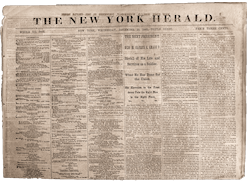
January 11, 1861, The New York Herald

Intelligence has reached us within the last twenty four hours of events transpiring in various quarters of the country pregnant with the most alarming symptoms of impending danger, which seem to be momentarily hurrying us towards inevitable civil war.

The news published in the morning papers yesterday that the steamship Star of the West, with United States troops for Fort Sumter, had been fired into by the South Carolina State militia at Morris Island, and was compelled to put out to sea, created the most intense excitement all over the city, until, at a late hour, it was announced by the bulletins at the newspaper offices that Mrs. McGowen, the wife of the commander of the steamer, had received a despatch from her husband stating that the Star of the West had arrived at Charleston, and that the troops were landed at the fort. Then the most buoyant feeling was manifested everywhere, and people began to feel that a terrible calamity had been averted.

But subsequent intelligence from Charleston changed all this feeling to one of alarm and consternation, for it confirmed the truth of the first despatch – the steamer had been fired into, and the troops of the government had not been landed at Fort Sumter. As this intelligence spread on the wings of the telegraph throughout the country, the effect produced upon the public mind in all quarters was that we were on the eve of war. The first gun had been fired, and the end of the struggle no man could foresee. Despatches from Richmond indicated that the most fearful excitement reigned in the border State of Virginia, and the effect of the news upon other southern States might be easily anticipated.

Following close upon this startling intelligence of an overt act of hostility on the part of South Carolina came the news that North Carolina had seized upon the forts in that [continue reading…]

0 comments

The News

Civil War Day-by-Day

January 11, 1861, The New York Herald

Our intelligence from Charleston, published yesterday, relative to the arrival of the steamer Star of the West in the harbor of Charleston, and her retreat when fired upon by the State batteries, is fully confirmed by later advises. The particulars of the affair are detailed in another column. The Star of the West was intercepted by a steamer in the service of South Carolina, but she gave not attention to her. The batteries were then signaled, and shots were fired across the bows of the Star of the West to bring her to: but she still proceeded on her course, until she was fired upon, and two or three shots struck her, when she put about and went to sea, and has not since been heard of. Major Anderson, during the forenoon of Wednesday, despatched Lieutenant Hall with a flag of truce to Charleston, where he delivered a communication from the Major to Governor Pickens, wherein he recapitulates the facts concerning the Star of the West and requests to know if the action of the State troops is authorized, and says that if such action is not disclaimed by the South Carolina authorities he will prevent the passage of all vessels to the city of Charleston. Governor Pickens replied that the reinforcement of the fort was regarded as an act of hostility to South Carolina, and that he approved of the attack upon the Star of the West. After some deliberation Major Anderson concluded to refer the subject to the federal authorities at Washington, and Lieutenant Talbott was sent to the capital with despatches.

The latest accounts from Charleston state that the city was in a furor of excitement in anticipation of the arrival of the sloop of war Brooklyn. The forts and batteries in possession of the State troops were actively preparing to beat her off. She will most assuredly be attacked should she venture within reach of their guns. It is stated that major Anderson will not hesitate to open the batteries of Fort Sumter should the Brooklyn be attacked.

The authorities of South Carolina have taken possession of the steamer Marion for the [continue reading…]

0 comments

Important from North Carolina—Seizure of Forts Johnson and Caswell

Civil War Day-by-Day

January 11, 1861, The New York Herald

WILMINGTON, N.C., Jan. 10, 1861.

Forts Johnson and Caswell were taken possession of on the night of the 8th by the Smithville Guard.

DESCRIPTION OF THE FORTS SEIZED.

FORT MACON, BEAUFORT, N.C.

Fort Macon protects Beaufort, N.C., and is situated on a bluff on Rougebank, one and three fourths mile from the city. It commands the entrance to Beaufort harbor, having full sweep of fire on the main channel. The opposite entrance to the harbor is Shackelford bank, one and a half mile across. The fortification is of hexagonal form, has two tiers of guns, one in casemated bombproof and the other en barbette. Its armament consists of twenty thirty two pounders, thirty two twenty four pounder, two eighteen pounder, two twelve pounders, three field pieces for flanking defence, twelve flank howitzers, eight eight inch howitzers (heavy) eight eight inch howitzers (light) one thirteen inch mortar, three ten inch mortars, two Coehorn mortars. Total eighty seven guns. The war garrison of the fort is three hundred men. This fort, however is sadly in need of repairs; the masonry requires pointing in many places; nearly all the iron works, such as doors and window fastenings, are rusted away. One of the wooden bridges across the ditch is decayed as also the shingled entire slope of the convert way. The hot furnace is useless, the store rooms need renovation, and the roadway requires to have its embankment repaired, and a new bridge to be built across the canal. The wharf, having its piers undermined by the sea current and its wooden superstructure much decayed, requires to be rebuilt. The fortification cost the federal government half a million dollars. [continue reading…]

0 comments

Our Washington Despatches—The War News in the Federal City—The Brooklyn and the Harriet Lane coming to Charleston—Political Facts and Rumors, etc., etc., etc.

Civil War Day-by-Day

January 11, 1861, The Charleston Mercury

(FROM OUR OWN CORRESPONDENT)

WASHINGTON, December 10 – 4 p.m. – President BUCHANAN and Gen. SCOTT have both expressed their gratification, this morning, at the narrow escape of the Star of the West on the morning of the 9th from the batteries on Morris Island.

The general understanding is, that the Brooklyn will immediately go in search of the Star of the West, and will bring her into Norfolk, and that reinforcements will then be sent to Charleston under ample naval protection.

A large number of the Southern members still in Congress, called, in a body, on President BUCHANAN yesterday (Wednesday), and earnestly protested against sending any reinforcements, or any vessels of any kind to the South, unless the determined policy of the Administration was to provoke a bloody and disastrous civil war.

Gen SCOTT has gained entire control over the policy of the Administration. President BUCHANAN affects great surprise at the idea that the batteries in Charleston harbor should have opened fire upon the Star of the West yesterday morning.

The Constitution newspaper, of this morning published a letter from Vice President BRECKINRIDGE to the Governor of Kentucky, urging union among the Southern States as the only hope of escape from civil war.

SECOND DESPATCH.

WASHINGTON, January 10. – A telegraphic despatch from Charleston was received at the Navy Department, and was spoken of by Secretary TOUCEY in the Senate Chamber today. It was to the effect, that the Star of the West had anchored safely, and was discharging at Fort Sumter. The news elated the Republicans, but the Southern men would not believe it. Subsequent despatches turned the tables. The Republicans and the Administration were much mortified and disappointed at the result. A despatch from Hon. L.M. KEITT gave the particulars of the firing on the steamer, and satisfied the Southern men that the news of the safe arrival of the steamer was bogus…

PRESIDENTS MESSAGE.

The President today sent his long expected message to Congress. He regrets to say that matters instead of becoming better are worse, and hope is diminished. Alluding to the condition of the country, he sees no other alternative but collecting the revenue and protecting the public property as far as practicable under existing laws. His duty is to execute laws and not to say whether the laws are adequate. He says at the opening of the session he called attention to the danger to the Union, and recommended such measures of relief as he believed would have the effect of tranquilizing the country, and save it from peril in which it was needlessly and unfortunately placed. It was not necessary to repeat this opinion and recommendation. His conviction then expressed is unchanged. The right and duty to use military and naval force against those who illegally assail the Federal Government are clear and indisputable, but present a state of things beyond Executive control. We are, he says, in the midst of a great revolution, and he recommends to Congress to meet the present emergency, to which is reserved the power to declare war and restore peace to the country. On them rests the responsibility. After eulogizing the blessings conferred by the Union, he says should it perish, the calamity would be as severe in the Southern as the Northern States. The secession movement is chiefly made in misapprehension of the sentiments of the majority in the Northern States. Let the question be transferred from the political assembly to the ballot box. The people will redress grievances. In Heaven’s name, let the trial be made before we plunge into the assumption that there is no alternative but civil war. Let us have reflection. Would that South Carolina had reflected! He appeals to Congress to say in their might, the Union shall and must be preserved by all constitutional means. He recommends Congress to devote themselves to prompt action with a view to peace. A division on the line of 3630 is suggested, as calculated to produce an adjustment. The danger is now on us. In several States the forts and arsenals have been seized by aggressive acts. Congress should endeavor to give these difficulties a peaceful solution. He states the reason why he had refused to send troops to Charleston harbor, believing this would have furnished a pretext, if not provocation on the part of South Carolina for aggression. referring to ANDERSON, he says that officer could not before he left Fort Moultrie have held that post 48 or 60 hours. He had warned his country of danger, and felt that the duty had been faithfully though imperfectly performed. He was conscious he meant well for his country.

A letter was included from ANDERSON in explanation, showing that he had orders to make the best defence, and concludes with saying that he intends to defend the District, and that the Union must be preserved.

JEFFERSON DAVIS has replied to the Message. He spoke of the high character of the Commissioners and correspondence transmitted, and presented their reply, which the President had returned. He asked that it should be read…

0 comments

The Revolution.

Civil War Day-by-Day

January 11, 1861, The New York Herald

CHARLESTON, Jan. 10, 1861.

The despatches sent yesterday as to the Star of the West are strictly correct.

The Charleston Courier says that at about half past six o’clock yesterday morning the steamer General Clinch discovered the steamship Star of the West, and signalized the fact of her approach to the occupants of the battery on Morris Island. As soon as the signals were seen by those on guard, Morris Island was astir with men at their posts before the orders could be given them to prepare for action. They remained in anxious suspense, but ready for what they believed was sure to come–a volley from Fort Sumter. The Star of the West rounded the point, took the ship channel inside the bar, and proceeded straight forward until opposite Morris Island, about three quarters of a mile from the battery. A ball was then fired a thwart the bows of the steamer. The Star of the West displayed the stars and stripes. As soon as the flag was unfurled the fortification fired a succession of heavy shots. The vessel continued on her course with increased speed, but two shots taking effect upon her, she concluded to retire. Fort Moultrie fired a few shot at her, but she was out of their range. The damage done to the Star of the West is trifling, as only two out of seventeen shots took effect upon her.

Fort Sumter made no demonstration, except at the portholes where guns were run out bearing on Morris Island.

About eleven o’clock yesterday morning a boat from Fort Sumter bearing Lieut. Hall with a white flag, approached the city. Lieut. Hall had an interview with Governor Pickens and was afterward escorted to his boat and re- embarked for Fort Sumter. The communication from Major Anderson is as follows: [continue reading…]

0 comments

The Military Arrivals and Movements

Civil War Day-by-Day

The Charleston Mercury, January 11, 1861

A company of Minute Men from Abbeville District arrived in this city on Wednesday night. They number one hundred men, and are as fine a looking body as any that can be raised. For the information of the Tribune and papers of that ilk, we state that ten members of this company took the first honor in the South Carolina College. The company is made up of the best material. Their uniform is a red frock and dark pants. The following is a list of their officers: Captain, J.M. PERRIN; First Lieutenant, A.M. SMITH; Second Lieutenant, J.G. EDWARDS, Third LIeutenant, A.J. LYTHGOE.

The Monticello Volunteers, from Fairfield District, also passed down yesterday. It is also a strong body of fine looking men, and officered as follows: Captain, J.B. DAVIS; LIeutenants J.T. DAWKINS, W.J. DAWKINS, R.J. KELLY.

In Newberry, in the 28th regiment, on Saturday, the two companies were made up; in one of the battalions not 20 men were left when the call was made.

In Clarendon, on Saturday, the call for volunteers was responded to by one company of 88, and one of 80, promptly marching out from the body of the regiment.

0 comments

North Carolina Takes Her Forts

Civil War Day-by-Day

January 11, 1861, The Charleston Mercury

WILMINGTON, JANUARY 10.

The people here, in consequence of a despatch received from the Hon. W.S. ASHE, at Washington, directed to some of the Minute Men, and stating that the revenue cutter Forward, with fifty men and eight guns, under the command of Lieut. NONES, had left Wilmington, Del., for Fort Caswell, proceeded spontaneously in big boats to the mouth of Cape Fear river and took possession of the two forts, placing a strong force in each. They will resist the last extremity any attempt to land Federal troops.

0 comments

A Diary of American Events – January 11, 1861

The Rebellion Record – A Diary of American Events; by Frank Moore

–To-day a party of Louisiana State troops, under command of Captain Bradford, took possession of the United States Marine Hospital, about two miles below New Orleans. The patients in the Hospital, numbering two hundred and sixteen, were ordered to be removed; those who are convalescent, immediately, and those who are confined to their beds, as soon as possible. The reason assigned for this inhuman action is that the authorities want the quarters for their own troops.

–A Union meeting was held at Wilmington, N. C., this evening, which was attended by over one thousand persons.–Evening Post, Jan. 15.

–Florida and Alabama adopted ordinances of secession; Florida passed her ordinance by a vote of 62 to 7, and Alabama by yeas 61, nays 39. The Alabama Convention was far from unanimous; a large part of that State is decidedly opposed to extreme measures.

The Alabama ordinance of secession cells upon the people of all the Southern States to meet in convention at Montgomery, on the 4th of February next, for the purpose of forming a provisional or permanent government. Immediately after the passage of the ordinance, an immense mass meeting was held in front of the capitol; a secession flag, presented by the women of Montgomery, was raised on the State House, cannon were fired, guns fired, etc., and in the evening the whole town was illuminated.–(Doc. 19.)–Evening Post, Jan. 12.

–Judge Jones, of the United States District Court, this afternoon announced from the windows of the court-room in the custom-house building, at Mobile, that the United States Court for the Southern District of Alabama was “adjourned forever.”

Mr. George M. Brewer, of the same place, gave one hundred cords of wood for the use of the garrison at Fort Morgan, and proffered the services of twenty negro men as laborers on the works.–Mobile Advertiser, Jan. 12.

At Richmond, Va., a banquet was given to John B. Floyd, late Secretary of the Navy. That gentleman made a speech, wherein he related a conversation with the President, which he claimed showed a breach of faith on the part of the latter, leading to the former’s resignation. He also counselled resistance to Federal coercion. Speeches were made by Lieutenant-Governor Montague, Attorney-General Tucker, and others. The policy of the Legislature was severely commented upon.

–Abolitionists attempted to hold a meeting at Rochester, N. Y. It was broken up by citizens, and resolutions in favor of the Union were passed, and cheers given for General Scott and Major Anderson. A flag bearing the inscription, “No compromise with slavery,” was not allowed to be suspended across Buffalo street. The authorities prevented a general riot. –N. Y. Herald, Jan. 12.

–Both branches of the New York Legislature adopted strong Union resolutions, tendering the assistance of the State to the President, and ordered them sent to the President, and the Governors of all the States.–(Doc. 20.)

0 comments

The Secession of North Carolina

War of the Rebellion: from the Official Records of the Union and Confederate Armies and Navies

FORT CASWELL, N. C., January 11, 1861.

SIR: I have the honor to report herewith that this post is reoccupied by a party of citizens from Wilmington and Smithville. They took possession at 7 o’clock on the night of the 10th instant. The individual who represents them as commanding officer is a Mr. Hedrick, from Wilmington; he has signed receipts to me for all the ordnance stores at the post, and is using such of them as he needs.

I would have used every effort to communicate this matter to the Department before this, only that Sergeant-Reilly was pleased to write on the night of its occurrence. Please send me instructions how I am to act, and if I am to receive what portion of the stores that is left; and how I am to expend the property they have destroyed, in the event of my receiving the stores back.

…………..I am, sir, very respectfully, your obedient servant,

FREDERICK DARDINGKILLER,
Ordnance Sergeant, U. S. Army.

Col. S. COOPER,
Adjutant-General, U. S. Army, Washington, D. C.

0 comments

Civil War Day-by-Day

Civil War Day-by-Day
Fort Sumter, Seen from the Rear, at Low Water

January 11, 1861

  • Alabama secedes from the United States.
  • Federal soldiers seize buildings in St. Louis to prevent them from falling into Rebel hands
  • South Carolina demands the surrender of Fort Sumter. Major Anderson refuses.

Image: Fort Sumter, seen from the rear, at low water (Harper’s Pictorial History of the Civil War)

0 comments

Susan Bradford: “The vote was 62 for and 7 against. The ordinance was declared adopted at 22 minutes after 12 o’clock.”

Through Some Eventful Years by Susan Bradford Eppes
Susa Bradford Eppes

January 10th, 1861.—It is night and I am very tired but there is much to tell. The Ordinance of Secession was voted on today. Bishop Rutledge made the opening prayer and it was very impressive. He pleaded so earnestly for God’s guidance for these members, in whose hands lay the future of Florida. These men feel their responsibility I am sure, their faces are so serious and yet so alert. Not one word escapes them and when an amendment is needed they are so careful to make it plain to all. I heard something today about a flag which had been presented to Florida but I have not seen it as yet.

After the committees were disposed of the Ordinance of Secession was voted on. The vote was 62 for and 7 against. The ordinance was declared adopted at 22 minutes after 12 o’clock. It was resolved that at one o’clock on the next day, January 11th, the Ordinance of Secession should be signed on the east portico of the Capitol. The convention then adjourned until the afternoon session.

Mississippi seceded last night and it seems we will have plenty of company. The Union men in the hall looked very sad. They have worked hard for their side, but they had only a few followers.


Susan Bradford is nearly 15 when this entry was made.

0 comments

The Ninth of January, 1861

Civil War Day-by-Day

January 10, 1861, The Charleston Mercury

Great Events crowd rapidly one upon another. Three short weeks ago, and the greatest event of the century upon the Western Hemisphere was transacted in Charleston. The Union of the States of North America, was dissolved by the action of the State of South Carolina.

It appears to be a decree of history that upon all great revolutions or changes of the Government of a people, the red seal of blood must be set. Yesterday, the 9th of January, will be memorable to history. Powder has been burnt over the decree of our State, timber has been crushed, perhaps blood spilled. South Carolina will maintain her liberties and her independence whilst there is single shot in her lockers. Blind infatuation is driving our enemies forward, and stroke by stroke the liberties of the South are being welded and cemented together.

The expulsion of the steamer Star of the West from the Charleston harbor, yesterday morning was the opening of the hall of the Revolution. We are proud that our harbor has been so honored. We are more proud that the State of South Carolina, so long, so bitterly, so contemptuously revilled and scoffed at, above all others, should this proudly have thrown back the scoff of her enemies. Entrenched upon her soil, she has spoken from the mouth of her cannon, and not from the mouths of scurrilous demagogues, fanatics and scribblers. Condemned, the sanctity of her waters violated with the hostile purpose of reinforcing enemies in our harbor, she has not hesitated to strike the first blow, full in the face of her insulter. Let the United States Government bear, or return at their good will, the blow still tingling about her ears – the fruit of her own bandit temerity. We would not exchange or recall that blow for millions! It has wiped out a half century of scorn and outrage. Again South Carolina may be proud of her historic fame and ancestry, without a blush upon her cheek for her own present honor. The haughty echo of her cannon has ere this reverberated from Maine to Texas, through every hamlet of the North, and down along the great waters of the Southwest. The decree has gone forth. Upon every acre of the peaceful soil of the South armed men will spring up, as the sound breaks upon their ears; and it will be found that every word of our insolent foes has indeed been a dragon’s tooth sown for their destruction. And though grisly and traitorous ruffians may cry on the dogs of war, and treacherous politicians may lend their aid in deceptions, South Carolina will stand under her own Palmetto tree, unterrified by the snarling growls or assaults of the one, undeceived or deterred by the wily machinations of the other. And if that red seal of blood be still lacking to the parchment of our liberties, and blood they want – blood they shall have – and blood enough to stamp it all in red. For, by the God of our Fathers, the soil of South Carolina SHALL BE FREE!

0 comments

The War Begun.

Civil War Day-by-Day

January 10, 1861, The New York Herald

When Major ANDERSON spiked the guns of Fort Moultrie, and transferred his command to Fort Sumter, he perpetrated hostile acts against this State. They clearly looked to a bitter instrumentality to coerce South Carolina by military power. The President of the United States understood this when he agree with the South Carolina members of Congress not to change his military status in the bay of Charleston, upon the condition that we would not attack the forts. He knew perfectly well that if South Carolina had a right to secede from the Union, she had a right to have the forts in our harbor delivered up to her. These forts were built on her soil, for her defence against foreign nations. The obligation on the part of the Government of the United States to defend the State of South Carolina by these forts, fell with the secession of the State. Having no duty to discharge with them, their continued possession by the Federal authorities could only be construed into an attitude of hostility. They were held for purposes of violence and war. To put the State entirely right, in the course she was obliged to pursue, consistent with her right and sovereignty, South Carolina sent Commissioners to treat for the peaceable surrender of these forts. A hostile change is made in the military relations of the Government of the United States towards South Carolina, in the bay of Charleston, by which the control of our waters is effected. Any military position, looking to violence, is war. Two friendly nations have a pass between them. They quarrel, and one of them seized the pass. This is an act of war. But if the pass is within the territory of the nation agressed on, no civilian could doubt that it is war commenced. South Carolina would have been justified, immediately on Fort Sumter being seized by Major ANDERSON, in opening a fire upon this fort from every point in the bay of Charleston. But the State authorities forbore – unwilling to commence the conflict with the Government of the United States. Not content, however, with holding the Fort, the Government of the United States determined to make efficient the military command of our waters, and sends additional troops to work its guns against the State. Whether coming by land or water, there was but one course left for the State to pursue, consistent with her [continue reading…]

0 comments

“It has been rumored this afternoon that the Gov of Virginia had ordered two Regiments to Harpers Ferry to take possession of the U S Arsenal”—Horatio Nelson Taft

Diary of US patent clerk Horatio Nelson Taft.

THURSDAY, JANUARY 10, 1861.

The weather is a little colder tonight, just freezing. Exciting news from Charleston. The Steamer “Star of the West” with troops to reinforce Maj Anderson was fired into yesterday and she turned off to Sea. Maj Anderson threatened the City with Bombs if she was again molested. We hear that she is in the Harbor landing her troops and stores at Fort Sumpter. It has been rumored this afternoon that the Gov of Virginia had ordered two Regiments to Harpers Ferry to take possession of the U S Arsenal &c, and that their passage through this City will be resisted by the Govt. I have not been well today, and have not been out of the house since dinner.


The three diary manuscript volumes, Washington during the Civil War: The Diary of Horatio Nelson Taft, 1861-1865, are available online at The Library of   Congress.

0 comments

The News

Civil War Day-by-Day

January 10, 1861, The New York Herald

The Star of the West arrived at Charleston yesterday forenoon, and the South Carolina troops at Morris Island and Fort Moultrie opened fire upon her. The steamer immediately put to sea. An officer from Fort Sumter, under a flag of truce, had an interview with the Governor and Council of South Carolina during the day, but the subject of the meeting had not transpired.

The Mississippi State Convention yesterday adopted the secession ordinance. Mississippi is therefore now out of the Union.

In Congress yesterday the special Message of the President on the crisis was received and read. The document is given in our report of the proceedings, and as it is the most important document ever transmitted by any Executive to the national Legislature, it will be attentively perused by our readers. A debate on the topics embraced in the Message will probably be opened today. Several propositions relating to the affairs of the nation were briefly referred to. The Pacific Railroad bill was taken up, and pending a motion to postpone the subject indefinitely, the Senate adjourned. In the House the President’s Message was referred to a special committee of five, with instructions to inquire whether any executive officers of the United States have been or are now treating or holding communication with any person or person for the transfer of forts and other property; whether any demand for their surrender has been made, and by whom, and what answer has been given; whether any officer or officers have entered into any pledge not to send reinforcements of troops to the harbor of Charleston, and if so, when, where, by whom and on what considerations; whether the Custom House, Post Office, and Arsenal at Charleston have been seized, by whom held in possession; whether any revenue cutter has been seized, and whether any efforts have been made to receive it. The committee have power to send for persons and papers and report from time to time such facts as may be required by the national honor, &c. [continue reading…]

0 comments

Important from the South

Civil War Day-by-Day

January 10, 1861, The New York Herald

CHARLESTON, Jan. 9, 1861.

The Star of the West, in endeavoring to enter our harbor about daylight this morning, was opened upon by the garrison on Morris Island, and also by Fort Moultrie. The steamer put about and went to sea.

I have not been able to learn whether the steamer or any person on board was injured. The belief is that no injury was sustained by either the boat or those on board. Fort Sumter did not respond.

Lieut. Hall, of Fort Sumter, came over to the city about eleven o’clock with a flag of truce. He repaired to the quarters of the Governor, followed by a crowd of citizens. He was in secret communication with the Governor and Council for two hours. At two o’clock he was sent in a carriage with the Governor’s aids to the wharf, and returned to Fort Sumter. The object of his mission is not known. It is supposed that it related to the firing on the Star of the West.

The people are intensely exited.

There were no demonstrations against Lieut. Hall. There is a great curiosity to know what Lieut. Hall came for.

Our citizens were drawn in crowds to our wharves early this morning, in consequence of frequent reports of cannon from seaward. Some twelve or fifteen reports were heard, many of them proceeded from the works on Morris Island.

THE LATEST REPORT.

Lieutenant Hall closed his interview with the Governor and Council about two o’clock. The facts have not transpired. We learn from high authority that there are of a most threatening character.

0 comments

The War Begun—Engagement at Fort Morris.

Civil War Day-by-Day

January 10, 1861, The Charleston Mercury

ATTEMPTED REINFORCEMENT OF FORT SUMTER.

The Star of the West is Fired Into and Driven Back.

The Citadel Cadets Fire the First Shotted Gun – The United States Flag Hauled Down – Three of the Shots Take Effect – The Steamer Puts to Sea with a Tender – What Major Anderson is going to do about it, etc., etc., etc.

The first gun of the new struggle for independence (if struggle there is to be) has been fired, and Federal power has received its first repulse.

About seven o’clock yesterday morning, our citizens were startled by the firing of heavy guns in the direction of Sullivan and Morris Islands. It was at once surmised that the steamship Star of the West, which has been reported by the special telegraphic correspondents of the MERCURY as having left New York with reinforcements and stores for Major ANDERSON, has attempted to pass the battery on Morris Island. Our reporters were immediately despatched to the entrance of the harbor, and after visiting all the fortifications now occupied by our troops, the following facts were elicited:

PARTICULARS OF THE AFFAIR.

Yesterday morning, shortly after [….], the sentries on Morris’s Island reported a steamship standing in the ship channel. The long roll was immediately beat, and all the troops were promptly under arms, Lieutenant Colonel J.L. BRANCH, of the Regiment of Rifles commanding. These comprised the Vigilant Rifles, Capt. TUPPER (90 men); the German Riflemen, Capt. SMALL (90 men); the Zouave Cadets, Lieut. CHICHESTER (45 men); and a detachment of 40 from the Citadel Cadet Corps. The last named body were at once marched to the battery, commanding the ship channel, which, at this point, [continue reading…]

0 comments

A Diary of American Events – January 10, 1861

The Rebellion Record – A Diary of American Events; by Frank Moore

–An intense excitement at Charleston on account of a rumor that the sloop-of-war Brooklyn was dispatched for that place. Great preparations are made to receive her. The buoys in the harbor are removed, and threats are made to fire on the ship.

–A steam-tub called the Aid left the wharf to-night for the purpose of reconnoitring. She is mounted with one gun, and is under the commend of Lieut. Hamilton, formerly of the Federal navy.

Fort Moultrie is being rapidly put in order by a large force of workmen. There are over forty South Carolina railroad hands actively and constantly employed under Mr. Bryant. Twenty hearty, strong negroes were sent down by the Rev. Mr. Prentiss and set to work, and did work faithfully all night upon the ramparts.–Charleston Courier, Jan. 11.

0 comments

Re-enforcements for Fort Jefferson, Florida.—Operations in Florida

War of the Rebellion: from the Official Records of the Union and Confederate Armies and Navies

HEADQUARTERS FORT INDEPENDENCE,
January 10, 1861.

SIR: I have the honor to report that I embark with my command this afternoon on board the steamer Joseph Whitney for Fort Jefferson, Fla. Orders of the General-in-Chief by telegraph. Strength of command, four commissioned officers and sixty-two enlisted men.

Names of officers: Bvt. Maj. L. G. Arnold, commanding; Surg. A.   N. McLaren, First Lieut. Henry Benson, First Lieut. H. M. Blunt, A. A. Q. M. and A. C. S.

I am, very respectfully, your obedient servant,

L. G. ARNOLD,
Brevet Major, U. S. Army, Commanding.

Lieutenant-Colonel THOMAS,
Asst. Adjt. Gen., U.S. Army, New York City.

0 comments

Federals move into better fortifications at Pensacola—Operations in Florida

War of the Rebellion: from the Official Records of the Union and Confederate Armies and Navies

FORT PICKENS, FLA., January 10, 1861.

SIR: I have the honor to report that on this date, I removed my command from Barrancas Barracks, Fla., to Fort Pickens, under special instructions received the previous day from the General-in-Chief.

……….I am, sir, very respectfully, your most obedient servant,

A. J. SLEMMER, ……….
First Lieutenant, First Artillery, Commanding Post.

Col. S. COOPER, Adjutant-General U.S. Army.

0 comments

The Secession of North Carolina

War of the Rebellion: from the Official Records of the Union and Confederate Armies and Navies

RALEIGH, N. C., January 10, 1861.

Hon. WARREN WINSLOW:

Call on General Scott; demand of him to know if he intends to garrison the North Carolina forts. Reply immediately.

JOHN W. ELLIS.

0 comments

“Federal troops are said to be moving” (Operations in Florida – Confederate Correspondence)

War of the Rebellion: from the Official Records of the Union and Confederate Armies and Navies

Private.] . . . . . . . . . . .[STATE OF FLORIDA,] . . . . . . . . EXECUTIVE DEPARTMENT,

January 10, 1861.

Hon. JNO. C. McGEHEE, President of the Convention:

SIR: The inclosed dispatch has this morning reached me, and I hasten to transmit it through you to the Convention.

Very respectfully,

M. S. PERRY.


[Inclosure]


(By telegraph from Washington, dated January 9, 1861. )

For Governor PERRY:

Federal troops are said to be moving, or to move, on the Pensacola forts. Every hour is important. Georgia and Alabama if called will aid in the work, we think. The two seaboard forts are vacant. Chase, at Pensacola, built and knows the works.

S. R. MALLORY.

GEORGE S. HAWKINS.

D. L. YULEE.

0 comments

Fort Johnston Returned to Federals—The Secession of North Carolina

War of the Rebellion: from the Official Records of the Union and Confederate Armies and Navies

FORT JOHNSTON, N. C.,
January 10, 1861–11 o’clock a. m.

SIR: I respectfully wish to state that the party of citizens who took possession of Forts Johnston and Caswell yesterday has perceived their error. It seems that they were not sustained by the people which brought them into it, or caused them to create such an act of violence against the Federal Government. They were the leaders of a few fanatics in Wilmington, who sent a dispatch to this place that the Department had ordered the revenue cutter forward with troops to garrison Forts Johnston and Caswell, and that they should take possession of the forts before the Federal troops should arrive; that they would assist them with both men, money, and provisions. They failed to do so.

Then they came to both me and Sergeant Dardingkiller and asked us to take back the public property. I answered, Yes; if there was none of it broken, or none of the ammunition expended. It was returned in good order. As they deprived me of all quick communication with the Department, so that I might receive instructions how to act, I thought to do as I did. I wanted to go to Wilmington to telegraph this business to the Department, but when they found I was going on the schooner’ that runs between here and Wilmington as a passenger boat, the passengers chartered the boat from the owners to prevent me from going. I hope that the conduct of me and Sergeant Dardingkiller will be approved by the Department, as we took the responsibility of taking the stores back for the best interest of the public service.

I remain, sir, very respectfully, your obedient servant,

JAMES REILLY,
Ordnance Sergeant, U. S. Army.

Col. S. COOPER,
Adjutant-General, U. S. Army, Washington City, D. C.

be approved by the Department, as we took the responsibility of taking the stores back for the best interest of the public service.
I remain, sir, very respectfully, your obedient servant,
JAMES REILLY,
. Ordnance Sergeant, U. S. Army.
Col. S. COOPER,
Adjutant-General, U. S. Army, Washington City, D. C.
No. 2.
Reports of Ordnance Sergeant Frederick Dardingkiller, U. S. Army, of
the first seizure of Fort Caswell.
FORT CASWELL, N. C., January 11, 1861. SIR : I have the honor to report herewith that this post is reoccupied by a party of citizens from Wilmington and Smithville. They took possession at 7 o’clock on the night of the 10th instant. The individual who represents them as commanding officer is a Mr. Hedrick, from Wilmington – he has signed receipts to me for all the ordnance stores at the post, and is using such of them as he needs.
I would have used every effort to communicate this matter to the Department before this, only that Sergeant-Reilly was pleased to write on the night of its occurrence. Please send me instructions how I am to act, and if I am to receive what portion of the stores that is left ; and how I am to expend the property they have destroyed, in the event of my receiving the stores back.
I am, sir, very respectfully, your obedient servant,
FREDERICK DARDINGKILLER, Ordnance Sergeant, U. S. Army.
Col. S. COOPER,
Adjutant-General, U. S. Army, Washington, D. C.
FORT CASWELL, N. C., January 14, 1861. SIR : I most respectfully wish to state that the party of citizens who occupied this post has lett this day. Mr. Hedrick, who signed receipts to me for the ordnance stores, has returned them to me in good order, except what he expended.
I am, sir, very respectfully, your most obedient servant,
F. DARDINGKILLER,
Ordnance Sergeant, U. S. Army.
Col. S. COOPER,
Adjutant-Gen,eral, U. S. Army, Washington, D. C.
No. 3.
Extract from annual report of Capt. John G. Foster, U. S. Engineers,
dated October 1, 1861. (Seizure of Fort Macon.)
This work was taken possession of by the troops of the State of North Carolina about the middle of April. It was at that time in bad repair;
0 comments

Civil War Day-by-Day

Civil War Day-by-Day
Front View of Fort Pickens, Pensacola, Showing the Sally-Port and Glacis

January 10, 1861

  • Florida becomes the third state to secede from the Union. They simply replace the term “United States” with “Confederate States” in their constitution
  • Lieutenant Adam Slemmer moves his small federal garrison from Barrancas Barracks at Pensacola to Fort Pickens on Santa Rosa Island. Slemmer will refuse repeated surrender demands from Florida authorities, allowing Fort Pickens to remain in Union hands for the duration of the war.

Image: Front View of Fort Pickens, Pensacola, Showing the Sally-Port and Glacis (Harper’s Pictorial History of the Civil War)

0 comments

“…the most of the time was spent in debate for or against secession.”—Susan Bradford

Through Some Eventful Years by Susan Bradford Eppes
Susa Bradford Eppes

January 9th, 1861.—There has been a hot time in the convention today; the nearer they get to a final decision the hotter it gets. Colonel Ward made a most eloquent address to the convention. He told them that he was a Union man but it was in this way: in his opinion the South had done more to establish that Union than any other section; it was a Southern man who wrote the Declaration of Independence, it was a Southern man who led the American army, it was Southern men who framed the Constitution, a Southern man wrote our National Anthem and, in so doing had immortalized the Star-spangled Banner and he proposed to hold on to that which we had done so much to bring about. He was willing to fight, if fight we must, but he wanted to fight in the Union and under that flag which was doubly ours. The heartiest applause greeted him as he sat down. It was plain to see that his audience was tremendously affected but the next speaker tore his fine argument to shreds. So it went on all day, some committee business would interrupt now and then but the most of the time was spent in debate for or against secession.

Our old friend, Mr. Burgess says: “If Mrs. Harriet Beecher Stowe had died before she wrote ‘Uncle Tom’s Cabin,’ this would never have happened.” He says, “she has kindled a fire which all the waters of the earth cannot extinguish.” Isn’t it strange how much harm a pack of lies can do?


Susan Bradford is nearly 15 when this entry was made.

0 comments