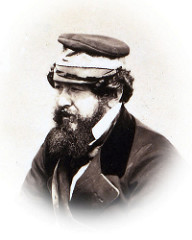
“As matters look very threatening, I must go South and see with my own eyes how affairs stand there…”—William Howard Russell

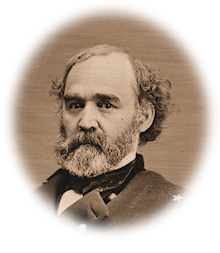
My Diary North and South – William Howard Russell

April 6th.—To-day I paid a second visit to General Scott, who received me very kindly, and made many inquiries respecting the events in the Crimea and the Indian mutiny and rebellion. He professed to have no apprehension for the safety of the capital; but in reality there are only some 700 or 800 regulars to protect it and the Navy Yard, and two field-batteries, commanded by an officer of very doubtful attachment to the Union. The head of the Navy Yard is openly accused of treasonable sympathies.

Mr. Seward has definitively refused to hold any intercourse whatever with the Southern Commissioners, and they will retire almost immediately from the capital. As matters look very threatening, I must go South and see with my own eyes how affairs stand there, before the two sections come to open rupture. Mr. Seward, the other day, in talking of the South, described them as being in every respect behind the age, with fashions, habits, level of thought, and modes of life, belonging to the worst part of the last century. But still he never has been there himself! The Southern men come up to the Northern cities and springs, but the Northerner rarely travels southwards. Indeed, I am informed, that if he were a well-known Abolitionist, it would not be safe for him to appear in a Southern city. I quite agree with my thoughtful and earnest friend, Olmsted, that the United States can never be considered as a free country till a man can speak as freely in Charleston as he can in New York or Boston.

I dined with Mr. Riggs, the banker, who had an agreeable party to meet me. Mr. Corcoran, his former partner, who was present, erected at his own cost, and presented to the city, a fine building, to be used as an art gallery and museum; but as yet the arts which are to be found in Washington are political and feminine only. Mr. Corcoran has a private gallery of pictures, and a collection, in which is the much-praised Greek Slave of Hiram Powers. The gentry of Columbia are thoroughly Virginian in sentiment, and look rather south than north of the Potomac for political results. The President, I hear this evening, is alarmed lest Virginia should become hostile, and his policy, if he has any, is temporizing and timid. It is perfectly wonderful to hear people using the word “Government” at all, as applied to the President and his cabinet– a body which has no power “according to the constitution” to save the country governed or itself from destruction. In fact, from the circumstances under which the constitution was framed, it was natural that the principle point kept in view should be the exhibition of a strong front to foreign powers, combined with the least possible amount of constriction on the internal relations of the different States.

In the hotel the roar of office-seekers is unabated. Train after train adds to their numbers. They cumber the passages. The hall is crowded to such a degree that suffocation might describe the degree to which the pressure reaches, were it not that tobacco-smoke invigorates and sustains the constitution. As to the condition of the floor it is beyond description.
0 comments

View of the Harbor

Civil War Day-by-Day

April 6, 1861; The Charleston Mercury

We have had the pleasure of seeing a very interesting view of the harbor, with all the fortifications, taken from the Battery, executed by a very worthy artist, Mr. GRINEVALD. The picture is very creditable to his skill, and as a memorial of the times possesses an historical interest. It was painted by Mr. G. as a present for his friend, Surgeon-General GIBBES, who had given him his friendship when he first came into our State. Mr. GRINEVALD, at the request of members of the Convention, has been induced to have photographs prepared from it, and no doubt every member who enjoyed Gen. BEAUREGARD’S invitation will be pleased to procure a copy as a memorial of their agreeable excursion to the forts. It may be seen today at St. Andrew’s Hall, and after today at the Surgeon General’s office.

0 comments

The Real Struggle

Civil War Day-by-Day

April 6, 1861; The Charleston Mercury

We will assuredly have to wage a war upon our Northern enemies. But it will be a war of political economy and commercial policy. The conflict must be fought out. But duties on imports will be the field of battle, and there will the scale of battle be turned. The Northern Government may send for officers and consult engineers. They may send provisions, and troops, and mortars, and guns, and bombshells and shot to sea. They may sail about extensively, reinforce Fort Pickens, Key West and Tortugas; they may cruise about the Gulf, and examine the British, French and Spanish fleets. But their voyages are vain and ineffective. The result of the struggle between the North and South will be otherwise determined. The South has the commanding position and can achieve an easy victory. The protective MORRILL Tariff of the North, has to meet a Revenue Tariff of the Confederate States. Already have we observed the effect upon European nations, and yet they are as ignorant and nearly as prejudiced against us as the people of the North. Commercial and manufacturing interests have developed the friendly feelings so soon manifested. And when, in addition to the exaction of duties agreeably moderate from all the rest of the world, the Confederate States impose prohibitory duties upon importations from our unfriendly neighbors north of Mason and Dixon’s Line, the same converting influence will establish itself in the minds and hearts of the foreigners near as we have beheld working upon those afar off. Palpable, pressing interest will overcome abstract theories about African privileges; will smooth down ruffled arrogance, and cool even the fiery desire for a war of arms, if it existed. In two years from this time the North, sorry for itself under the disastrous effects of this war of policy, which not only must bring it into sharp competition with the starving labor, abounding capital and great enterprise of European nations, but actually put it at a positive and insuperable disadvantage–the North will be glad to gain the attitude of a friendly power by making terms with the Confederate States. We only fear that some of them will not be content not to embrace us. It will be unnecessary to sack Philadelphia, New York and Boston with Southern troops, and will be much cheaper.

0 comments

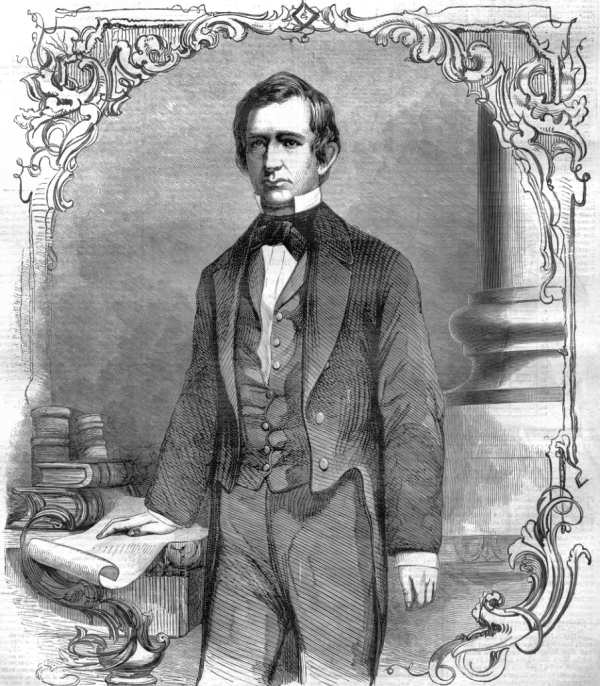
William H. Seward

Harper’s Weekly

Hon William H. Seward, Secretary of State.

April 6, 1861; Harper’s Weekly

2005-216.jpg

THE Hon. WILLIAM H. SEWARD, Secretary of State, whose portrait we publish on the preceding page, is one of the foremost representative men of the age. Few of his fellow-citizens are unwilling to render the due tribute to his intellectual ability, while his party regard him as the champion of human freedom and of progress.

Mr. Seward was born in the village of Florida, Orange County, New York, on the 16th day of May, 1801. Of an active disposition, and possessing an inquiring mind, he mastered the rudiments of education at an early age, and in 1816 entered Union College, at Schenectady, where he greatly distinguished himself as a diligent student. Having graduated with high honors, he went to New York city in 1820, and commenced the study of the law in the office of Hon. John Anthon; but the next year returned to his native county, where he completed his legal studies in the office of Hon. Ogden Hoffman, at that time District Attorney.

In 1822 Mr. Seward was admitted to the bar, at Goshen, and soon afterward he removed to Auburn, where he entered into partnership with his future father-in-law, Judge Miller, and where he has since resided. Devoted to the interests of his numerous clients, the young practitioner soon gained a high reputation, and enjoyed a lucrative practice.

Mr. Seward became identified with the “Anti-Masonic” party in this State, and in 1828 was the President of a Young Men’s State Convention, at Utica, in favor of the reelection of John Quincy Adams to the Presidential chair. In 1830 he [continue reading…]

0 comments

The Stars and Bars

Civil War Day-by-Day

April 6, 1861; Sugar Planter (West Baton Rouge, LA)

We used to talk about the “stars and stripes,” says the Mobile Advertiser. Now the “bars” take the place of the “stripes,” and we can hurrah for the “stars and bars.” Long may they wave–if we are to have no better pattern of banner.

0 comments

Approaching Civil War

Civil War Day-by-Day

April 6, 1861; The New York Herald

Our Charleston Correspondence.

CHARLESTON, S.C., March 27, 1861.

Can the Confederate States Govern Themselves, &c.

In former communications the question was propounded, ‘Can the Southern States maintain their independence?’ Examination into the defences of this harbor, among the most important of the confederacy, has established the fact, in the minds of well-informed and unprejudiced men, that, as far as this section of the Confederate States is concerned, it can defend itself, and, if need be, lend aid to other sections. Fort Sumter evacuated, and the material of war which will be of no immediate use here may be conveyed to other points that may be weak, without detriment to the protection of Charleston. The government at Montgomery has undoubtedly taken the precautions necessary to protect other points on the seaboard as it has to protect this, but probably not to the same extent; for here has been the battle ground of the thus far bloodless revolution.

A question now arises of nearly equal importance to the first, namely: ‘Can the Confederate States govern themselves?’ And in no place can a better solution to the question be given than at a point where a Convention of the representatives of the people of South Carolina meets, and that is, the city of Charleston, at this particular time. Two days have elapsed since the Convention assembled. Many expected a violent and relentless opposition to the new constitution, and perhaps its indignant rejection by the Convention. Some of the provisions of the instrument were of a character repugnant to the views and wishes of many of the people of the State; and hence serious apprehensions were entertained among the well wishers of the new confederacy that the opposition would be overwhelming. The fears of a few were dissipated on the first day’s proceedings. On the second, notwithstanding a lively debate, it became apparent that at heart a large [continue reading…]

0 comments

Our Washington Correspondence

Civil War Day-by-Day

April 6, 1861; The Charleston Mercury

WASHINGTON, April 3, 1861.

Military movements, sudden and secret, are attracting attention, and giving rise to apprehensive speculation. I mentioned yesterday the presence here of an unusual number of engineer officers, and unwonted activity in the War Department. This morning, the sappers and miners, who have been stationed in this city since the commencement of the SCOTT dictatorship, left by railway for New York; another company proceeded in the same train, and it is understood that tomorrow morning other companies of artillery will follow. The generally received opinion is that these troops are being removed to forts in the vicinity of New York, whence they may be quietly shipped to Southern points.

Simultaneously with this change in the disposition of troops, it is noted that several of the officers, summoned hither within the last few days, have left; and there are grounds for believing that they have been sent on secret missions to Southern forts yet retained by the United States Government.

The impression produced upon the minds of the calmest observers and the best informed politicians is that the prospect is considerably more warlike than it has been for some time past. The removal of soldiers and the prolonged labors at the War Office are but a part of the circumstances which have led to this change in the estimate of the future. The treachery of the Administration no longer admits of doubt. The landing of soldiers, en route from Texas, is admitted to have been effected through deception; a trick, in fact, for which the commanding officers avow their responsibility, but of which the authorities at Washington are undeniably the authors. Moreover, it is known that both LINCOLN and SEWARD have become more chary in the use of pacific promises. The Union saving Pilgrims, who wear out shoe leather in tramping from the Convention Hall, at Richmond, to the White House, carry back discouraging accounts. The other day an influential Union man, who visited LINCOLN as the mouthpiece of Virginia Submissionists, was constrained to confess [continue reading…]

0 comments

The mysterious schooner that was fired into—the Captain’s account of the affair

Civil War Day-by-Day

April 6, 1861; The Charleston Mercury

 (From the Savannah News, April 5.)

The schooner R.H. SHANNON, Capt. Joseph Marts, from Boston, with a cargo of ice, to Heyward & Gage, of this city, arrived here at noon. Capt. Marts informs us that on Wednesday morning about 11 o’clock, the weather being rough and heavy, he mistook Charleston harbor for that of Savannah, and did not discover his error until after he had passed the bar, when he made signal for a pilot, intending to go into the harbor and to come out next morning, in the event the weather proved fair, and proceed on his voyage to this port. Shortly after making his signal by displaying the United States colors, in the hands of one of his men at the mast head, and when his vessel had arrived nearly abreast of Fort Moultrie, one or two guns were fired, as he thinks, from that fort, across his bows. He continued on his course, and ordered his colors to be run up to the main peak, supposing that a signification of his nationality was what was required. But in a few moment the fire was opened from both sides of the channel–from Fort Moultrie and from a battery on Morris’ Island–the shot passing fore and aft of the schooner, and whistling, as he describes it, fearfully over head. Not knowing what to do or what was required of him, he ordered his colors hauled down, tacked ship and stood out to sea. The firing from the fort and battery continued, most of the shot coming in dangerous proximity, and one ball passing through his mainsail, only some twelve inches above the head of a man who was standing on the house at the time. The crew think that one shot struck the schooner forward, but under water, and doing no perceptible damage. Passing within speaking distance of a brig that was going into the harbor, Capt. Marts hailed it and asked why he was fired upon. The captain of the brig advised him to haul his jibs down and come to anchor, which he accordingly did and the firing ceased. About an hour after coming to anchor a revenue cutter was seen bearing down towards the schooner, but owing to the roughness of the weather she was compelled to put back after approaching within half a mile of the Shannon. As she wore round, on her return, the officer in command waved his hat, which Capt. Marts took to be a signal that all was right and to come in from his dangerous position. The crew of the Shannon commenced heaving anchor when a boat was seen [continue reading…]

0 comments

Our Montgomery Correspondence

Civil War Day-by-Day

April 6, 1861; The Charleston Mercury

MONTGOMERY, April 3, 1861.

For the past few days we have been in a great state of uncertainty in this city, on account of the conflicting statements received by telegraph from all parts of the country. The State Department has received assurance from Washington that the forts will be given up; but, per contra, the indications in the War Department are that a fight will commence in a short time. At any rate, our people will be prepared for war if it come, for preparations are going on with great activity. I stepped into the Commissary’s Department this evening, and found there a large quantity of army stores and munitions of war. Among the stores were some two thousand barrels of flour, sacks of corn, barrels of meat, boxes of bread, and everything, in fact, necessary for the comfort of the soldiers who will soon be in the field. There are several army depots in the Confederacy, at each of which large quantities of stores are already deposited, and are being deposited daily.

There were rumors in this city yesterday, brought by a gentleman who came as bearer of despatches from Pensacola, that Lieut. SLEMMER had become alarmed at the number of men that are daily pouring into Warrington, and had demanded a reinforcement from the United States vessels in the harbor. He also reported that when the vessels arrived at Key West with the Texas troops who were under Gen. TWIGGS, they were immediately sent to sea with sealed orders, and it is thought highly probable these may be for Fort Pickens. Lieut. SLEMMER knows that if reinforcements are denied him a short time longer, it will be impossible to land them, as our forces are daily growing stronger, and will most certainly prevent the landing of any troops from the ships.

It is also rumored that the Spanish fleet has been seen at the Tortugas, bound westward, probably for Vera Cruz. I hardly think, however, an attack will be made upon that town at present, owing to St. Domingo difficulties, but it was supposed here a short time ago that the fleet sailed to the Gulf for the purpose of landing men at Vera Cruz, and taking [continue reading…]

0 comments

Law of the Land

Civil War Day-by-Day

April 6, 1861; Sugar Planter (West Baton Rouge, Louisiana)

Five States having ratified the Constitution of the Confederate States, it is now the supreme law of the land. Texas and Mississippi, through their Conventions, made up the requisite number. In accordance with that fact, the flag of the State was hauled down from the flag staff in the Garrison at Baton Rogue, on Tuesday last, and the flag of the confederacy run up in its stead, accompanied with a salute of seven guns.–Whoever made the flag for the Garrison must have been very short of bunting, it being the smallest flag we ever saw hoisted on so lofty a pole.

0 comments

“This is the beginning of the war which every statesman and soldier has foreseen…”

War of the Rebellion: from the Official Records of the Union and Confederate Armies and Navies

U. S. TRANSPORT ATLANTIC,
[New York,] April 6, 1861—2 ½ p.m.

Hon. WM. H. SEWARD, Secretary of State:

DEAR SIR: By great exertions, within less than six days from the time the subject was broached in the office of the President, a war steamer sails from this port; and the Atlantic, built under contract to be at the service of the United States in case of war, will follow this afternoon with 500 troops, of which one company is sappers and miners, one a mounted battery. The Illinois will follow on Monday with the stores which the Atlantic could not hold.

While the mere throwing of a few men into Fort Pickens may seem a small operation, the opening of a campaign is a great one.

Unless this movement is supported by ample supplies and followed up by the Navy it will be a failure. This is the beginning of the war which every statesman and soldier has foreseen since the passage of the South Carolina ordinance of secession. You will find the Army and the Navy clogged at the head with men, excellent patriotic men, men who were soldiers and sailors forty years ago, but who now merely keep active men out of the places in which they could serve the country.

If you call out volunteers you have no general to command. The general born, not made, is yet to be found who is to govern the great army which is to save the country, if saved it can be. Colonel Keyes has shown intelligence, zeal, activity, and I look for a high future for him.

England took six months to get a soldier to the Crimea. We were from May to September in getting General Taylor before Monterey. Let us be supported; we go to serve our country, and our country should not neglect us or leave us to be strangled in tape, however red.

Respectfully,

M. C. MEIGS.

0 comments

The Confederate States

Civil War Day-by-Day

April 6, 1861; The Illustrated London News

The Government of the Southern Confederacy has appointed the Hon. William Yansey, of Alabama; Judge Rost, of Louisiana; Colonel Mann, and Mr. Botler King, of Georgia, as Special Commissioners to proceed to England and France for the purpose of obtaining the recognition of the independence of the Confederated States, and to make such commercial arrangements as their joint interests may require.

The Congress at Montgomery has adjourned until May without agreeing upon the tariff.

The citizens of Louisiana, through their State Convention, have rejected the proposed Constitution.

We hear, although no authority is vouchsafed, that the Customs authorities at Havre have notified that ships from the seceded States would be received on the same footing as those sailing under the “stars and stripes.”

The design of the flag recently adopted by the Southern Congress is as follows:—Red, white, and red, in three equal parts, horizontally placed-the white between the red; blue union, with seven stars in the form of a circle reaching down to the lower red.

0 comments

To Robert S. Chew

The Collected Works of Abraham Lincoln

[“War Department.] Washington, April 6. 1861

Sir—You will proceed directly to Charleston, South Carolina; and
if, on your arrival there, the flag of the United States shall be flying over Fort-Sumpter, and the Fort shall not have been attacked, you will procure an interview with Gov. Pickens, and read to him as follows:

“I am directed by the President of the United States to notify you to expect an attempt “will be made to supply Fort-Sumpter with provisions only; and that, if such attempt be not resisted, no effort to throw in men, arms, or amunition, will be made, without further notice, or in case of an attack upon the Fort”
After you shall have read this to Governor Pickens, deliver to him the copy of it herein inclosed, and retain this letter yourself.
But if, on your arrival at Charleston, you shall ascertain that Fort Sumpter shall have been already evacuated, or surrendered, by the United States force; or, shall have been attacked by an opposing force, you will seek no interview with Gov. Pickens, but return here forthwith.
[Respectfully Simon Cameron
Secy of War]

[Endorsement]

Notice carried by R. S. Chew to Gov. Pickens., and his report as to how he gave the notice.

To the President……………………………………. Charleston S.C. April 8th 1861
Under the foregoing orders I left Washington at 6 P.M. Saturday April 6th, 1861, in company with Capt. Theodore Talbot, U.S. Army, and arrived at
Charleston, S.C. on Monday at the same hour. Finding that Fort Sumter had neither been surrendered, evacuated nor attacked, I immediately thro’ Capt. Talbot, requested an interview with Governor Pickens, which was at once accorded to me, and I then read to him the portion of said orders in italics [quotation marks], and delivered to him the copy of the same which was furnished
to me for that purpose, in the presence of Capt Talbot. Govr. Pickens received the Copy and said he would submit it to General Beauregard, he having, since the ratification of the Constitution of the Confederate States by South Carolina, been placed in charge of the Military operations in this vicinity. Genl. Beauregard was accordingly sent for, and the Governor read the paper to him.

In reply to a remark made by Governor Pickens in reference to an answer I informed him that I was not authorised to receive any communication from him in reply.
Respectfully submitted………………………………..R. S. Chew

0 comments

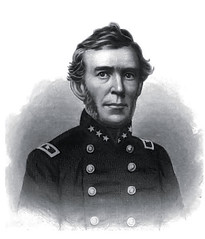
Samuel Cooper warns Braxton Bragg of plans to re-enforce Fort Pickens

War of the Rebellion: from the Official Records of the Union and Confederate Armies and Navies

WAR DEPARTMENT, A. AND I. G. O.,
Montgomery, April 6, 1861.

Brig. Gen. BRAXTON BRAGG:

The Government at Washington have determined to re-enforce Fort Pickens, and troops are now leaving for that purpose.

S. COOPER,

Adjutant and Inspector General.

0 comments

Braxton Bragg to Secretary of War Walker on status with respect to Fort Pickens

War of the Rebellion: from the Official Records of the Union and Confederate Armies and Navies

HEADQUARTERS CONFEDERATE STATE TROOPS,
Near Pensacola, Fla., April 6, 1861.

Hon. L. P. WALKER, Secretary of War, Montgomery, Ala.:

SIR: Your dispatch of the 5th instant reached me this morning, and was answered immediately. Mine of the 3d, asking if I might attack,   was predicated on several occurrences which I could not explain in a dispatch, and which admitted of no delay. A strong easterly wind was blowing, calculated to drive off the United States naval vessels. It continues yet, but they hold on, though evidently with trouble. They have placed an Engineer officer in Fort Pickens in violation, as I conceive, of the agreement “not to re-enforce.” And, finally, I have reason to believe the garrison in Fort Pickens is greatly demoralized by influences which are operating strongly in our favor. Under these circumstances I desired to know if I should be free to act when a favorable occasion might offer. Believing myself that the United States Government and some of its agents are acting in bad faith towards us, I do not hesitate to believe we are entirely absolved from all obligations under the agreement of 29th January; but as a question of political policy might be raised, I deem it prudent to ask the consent of the Department before acting on so important a matter.

I am not prepared with my batteries for anything more than a feeble defense (see my requisition for ordnance and ordnance stores), and that condition cannot be changed until I can get supplies. The only attack which I could hope to make now would be a sudden dash, distracting the enemy by a false attack, and scaling the walls in an opposite direction. The weakness of the garrison, and the ardor and ignorance of my troops, would be strong elements of success. In this movement I should not propose to fire a gun unless in the diversion.

Such is now the incessant occupation of my staff officers in receiving, supplying, and organizing troops that but little can be done in other preparations. We have the force and the labor necessary, but the skill to apply them is confined to a few.

I am, sir, very respectfully, your obedient servant,

BRAXTON BRAGG,

Brigadier-General, Commanding.

0 comments

Rumor on warlike armaments for Fort Pickens and perhaps Sumter growing stronger.

War of the Rebellion: from the Official Records of the Union and Confederate Armies and Navies

[APRIL 6, 1861.]

Hon. ROBERT TOOMBS, Secretary, &c., Montgomery, Ala.:

No change in the activity of the warlike armaments mentioned yesterday. The rumor that they are destined against Pickens and perhaps Sumter is getting every day stronger. We know nothing positive on the subject, but advise equal activity on your part to receive them if they come. We have not yet been notified of the movement, but the notification may come when they are ready to start.

CRAWFORD.

FORSYTH.

ROMAN.

0 comments

Iron and Wooden Naval Vessels

Civil War Day-by-Day

April 6, 1861; The Scientific American

We take the following from the London Mechanics’ Magazine:

The first question for discussion is the comparative value of iron and wooden ships-of-war. In favor of the latter, we have a conservative party represented by Sir Howard Douglas, who is probably the ablest living advocate of “wooden walls.” It is his opinion “that ships formed wholly, or nearly so, of iron, are utterly unfit for all the purposes and contingencies of war, whether as fighting ships or as transports for troops.” In opposition to this opinion Mr. J. Scott Russell endeavors, and we think successfully, to establish :

1. That iron steamships-of-war may be built as strong as wooden ships of greater weight, and stronger than wooden ships of equal weight.

2. That iron ships of equal strength can go on less draught of water than wooden ships.

3. That iron ships can carry much heavier weights than wooden ships.

4. That they are more durable.

5. That they are safer against the sea.

6. That they are safer against fire.

7. That they are much safer against explosive shells.

8. That they are much safer against molten metal.

9. That they are much safer against red-hot shot.

10. That they can be made impregnable even against solid shot.

As Sir H. Douglas has attacked the construction and sailing qualities of the Great Eastern, his opponent first disproves his assertions and predictions regarding her, and then states the facts regarding iron war-ships which have been ascertained by actual experiment. Experience has proved, first, that “when the thickness of a vessel’s side is not more than half an inch, shots fired obliquely have glanced off the iron vessel which would have penetrated a wooden ship; second, that shots fired directly have passed through both sides of the ship, doing less damage to the ship directly and less damage by splinters than would have been the case in timber ships; third, that the shot holes have been as easily stopped, and more expeditiously and less expensively repaired than in wooden ships; fourth, that their plates of wrought-iron, even five-eighths of an inch, are proof against shells; that iron plates four inches and a half thick arc nearly impenetrable to shot fired from the heaviest nature of guns; and, finally, that plates six inches thick are practically impenetrable.”

0 comments

“…you are directed to exclude possibility of the admission of any one who may be sent by or be favorable to the Government at Washington..,”

War of the Rebellion: from the Official Records of the Union and Confederate Armies and Navies

WAR DEPARTMENT, C. S. A.,
Montgomery, April 6, 1861.

Brig. Gen. G. T. BEAUREGARD,
Commanding Charleston Harbor, Charleston, S.C.:

SIR: Your letter of the 4th instant has been received. In reply to your inquiry as to Major Anderson’s mails, I have to say that the policy of the Government is most decided that there shall be such a surveillance of Charleston Harbor and of Fort Sumter as shall assure this Government that the latter is, for all military purposes, entirely isolated. The courtesies which have been accorded to the commander of that fortress have been, in the opinion of this Department, taken advantage of in some cases by persons whose object in visiting Fort Sumter was chiefly to obtain information of the state of our defenses, to be communicated to the Government at Washington. Acting, then, on the leading ideas that the military isolation of Fort Sumter and the prevention of all possible espionage by the Washington Government are absolutely required, you are directed, while allowing Major Anderson to receive his mails, to exercise such instructive discretion as will secure the ends in view.

Minute instructions, covering every possible case, cannot, of course, be given you, but you are directed to exclude possibility of the admission of any one who may be sent by or be favorable to the Government at Washington, always excepting such messenger or bearer of dispatches from that Government as you may be fully assured shall be conveying orders for the surrender or evacuation of the fortress.

You are specifically instructed to permit no one of the persons now in Fort Sumter to depart therefrom; and to secure absolute compliance with this requirement you will use the utmost vigilance and apply all the means at your command. And in this connection the Department would ask your attention to a telegraphic statement generally published under date of “April 4th,” to the effect that Lieutenant Talbot, an officer of the garrison of Fort Sumter, had been allowed to depart therefrom. As this is in apparent conflict with the instructions communicated to you by telegraph, the Department presumes that there were special reasons, affecting the public interest, which, in your judgment, made the case properly exceptional, and I shall therefore be pleased to be made acquainted with the circumstances.

Very respectfully, your obedient servant,

L. P. WALKER.

0 comments

The Hall of Representatives in Washinton

Civil War Day-by-Day

April 6, 1861; The Illustrated London News

2005-212.jpg

OUR Engraving gives a view of the new Hall of Representatives in the Capitol at Washington. The Hall is 139 feet long, 93 feet wide, and 36 feet high. The area of the room is 12,927 square feet, and it is estimated that about 5000 persons could find standing-places within it. It is in form a parallelogram, with galleries on three sides, affording room for 1200 persons, comfortably seated. Upon the floor are seats for 260 representatives, arranged upon a semicircular plan, the seat and desk of the Speaker of the House being at the centre of the semicircle, and in the middle of the south side of the Hall, which is one of the longer sides of the room. The ceiling is of cast iron, with large skylights. The cast-iron ceiling is deeply coffered with sunk panels, relieved with enriched mouldings. A richly-decorated cornice along the upper part of the wall, above the galleries, unites the wall and ceiling. The skylights are glazed with ornamented glass, having in the centre of each skylight the arms of a State or Territory, emblazoned in coloured glass. The decoration of the Hall is yet far from complete. Panels on the gallery fronts have been provided, which it is expected will be filled with pictures of American history, under the orders to be given by Congress; and the upper part of the walls is filled with niches, empty as yet, but which will, at some future day, be tenanted by the effigies in marble of their worthiest citizens.

The scene as depicted by our Artist at page 310 is highly characteristic, and is not, as may be supposed, wholly, if at all, in caricature. The contrast which it presents to our House of Commons is very striking. With us, though the appearance of members is easy enough, especially owing to their privilege of wearing their hats when seated, yet the arrangements of the seats renders their attitudes, as a rule, somewhat rigid, and any comfort in the way of lounging, as well as reading or writing, is not attainable in the House proper, though there is every facility in that way in the anterooms and libraries. None of the messengers of the House are permitted to come within the bar; and the reading of a newspaper or any book, but such as are used for quotation in debate, puts a member out of order. Exactly the reverse state of things prevails in the House of Representatives. Desks for writing and easy-chairs for lounging occupy the floor of the chamber; newspapers appear to be the rule; and lads bearing letters and messages are running about continually, like so many rabbits in a warren. Sometimes our legislators are noisy and excited; but no one ever saw any of them exhibiting in such poses as are depicted in our Illustration, which, looking at the comparative unconcern which appears to prevail, seem to be nothing extraordinary in the Transatlantic Assembly.

0 comments

Braxton Bragg to Secretary of War Walker on Federal re-enforcements to Santa Rosa Island

War of the Rebellion: from the Official Records of the Union and Confederate Armies and Navies

PENSACOLA, April 6, 1861.

Hon. L. P. WALKER:

I can control the dock, but re-enforcements can be landed on the outside Santa Rosa Island in spite of me. The ships, except the Wyandotte, are beyond my range. She can be driven off or destroyed. Any attack by us now must be secretly made by escalade. My batteries are not ready for breaching, and we are entirely deficient in ammunition. No landing should be made on Santa Rosa Island with our present means. Will write.

BRAXTON BRAGG.

0 comments

The very latest important news from Washington

Civil War Day-by-Day

April 6, 1861; The New York Herald

Preparations for War at the North and the South. The Confederate States Ready for Hostilities. Probable Surrender of Forts Sumter and Pickens in Case of Attack. INTENSE EXCITEMENT AT CHARLESTON. The Policy of the Federal Government Towards the South, &c., &c., &c. THE RIVAL CONFEDERACIES PREPARING FOR WAR.

WASHINGTON, April 5, 1861.

MEETING OF THE CABINET.

The first regular Cabinet meeting convened today at noon, and continued in session for three hours. Southern affairs exclusively occupied its attention. Lieutenant Gilman report of the condition of matters at Pensacola and Fort Pickens was the principal subject under consideration.

The failure of the government to obtain any information from Fort Pickens was the subject of great surprise. Fears were entertained that a conflict had ensued, in consequence of the landing of supplies, and that telegraphic communication had been cut off.

Up to a late hour there are no reports from Fort Pickens, and the government is exceedingly anxious to hear from there.

It was noticed this morning that an unusual number of official telegraphic despatches were sent over from the War and Navy Departments to the President. [continue reading…]

0 comments

“…we went on the Planter to take a look at Morris Island and its present inhabitants…,—Mary Boykin Miller Chesnut.

Civil War Day-by-Day

April 6th.—The plot thickens, the air is red hot with rumors; the mystery is to find out where these utterly groundless tales originate. In spite of all, Tom Huger came for us and we went on the Planter to take a look at Morris Island and its present inhabitants–Mrs. Wigfall and the Cheves girls, Maxcy Gregg and Colonel Whiting, also John Rutledge, of the Navy, Dan Hamilton, and William Haskell. John Rutledge was a figurehead to be proud of. He did not speak to us. But he stood with a Scotch shawl draped about him, as handsome and stately a creature as ever Queen Elizabeth loved to look upon.

There came up such a wind we could not land. I was not too sorry, though it blew so hard (I am never seasick). Colonel Whiting explained everything about the forts, what they lacked, etc., in the most interesting way, and Maxcy Gregg supplemented his report by stating all the deficiencies and shortcomings by land.

Beauregard is a demigod here to most of the natives, but there are always seers who see and say. They give you to understand that Whiting has all the brains now in use for our defense. He does the work and Beauregard reaps the glory. Things seem to draw near a crisis. And one must think. Colonel Whiting is clever enough for anything, so we made up our minds to-day, Maxcy Gregg and I, as judges. Mr. Gregg told me that my husband was in a minority in the Convention; so much for cool sense when the atmosphere is phosphorescent. Mrs. Wigfall says we are mismatched. She should pair with my cool, quiet, self-poised Colonel. And her stormy petrel is but a male reflection of me.

0 comments

The Constitution of the Confederate States

Civil War Day-by-Day

April 6, 1861; The Charleston Mercury

The final vote upon the adoption of the Constitution of the Confederate States of America–which was published in THE MERCURY several weeks ago–was taken up yesterday by the Convention in secret session. The following is the precise result: yeas 146, nays 16. Although the record was made public, and intended to be published, we are unable to give the details, because the Secretary of the Convention has taken the responsibility of withholding it.

0 comments

200 recruits to be held in readiness for embarkation on the 8th.

War of the Rebellion: from the Official Records of the Union and Confederate Armies and Navies

HEADQUARTERS OF THE ARMY,
New York, April 6, 1861.

Lieut. CHARLES R. WOODS,
Ninth Infantry, Act. Supt. East. Dept., R. S., Fort Columbus, 21. N.Y.. :

SIR: The General-in-Chief desires that two hundred recruits from Fort Columbus be at once organized into two companies, and held in readiness for embarkation on Monday next, the 8th instant.

A proper proportion of non-commissioned officers will be included in the detachment, which must be fully supplied with arms, ammunition, and subsistence.

First Lieut. Edward McK. Hudson, Fourth Artillery, First Lieut. R. O. Tyler, Third Artillery, and Second Lieut. C. W. Thomas, First Infantry, are assigned to duty with the recruits.

I am, sir, very respectfully, your obedient servant,

H. L. SCOTT,

Lieutenant-Colonel and A.D.C., Act. Adjt. Gen.

0 comments

War movements in the South

Civil War Day-by-Day

April 6, 1861; The New York Herald

Our intelligence from Pensacola dates up to the 26th ult., at which time new levies of troops were arriving, which swelled the available force to sixteen hundred men. The numerous sand batteries commanding Fort Pickens were in an advanced state towards completion. General Bragg had ordered the removal of sixty heavy guns, to be taken from Fort McRae and distributed among the new sand batteries. Five thousand stand of arms and two hundred thousand ball cartridges, for the use of the Confederate troops, arrived at Pensacola on the 26th ult. Commodore Ingraham assumed command of the Warrington Navy Yard on the date of our despatches, superseding Commodore Brent, who remains second in command. Surgeon W. A. W. Spotswood and Paymaster W. J. W. Kelly are also on duty at that port.

The steamer Fulton, at the Warrington Yard, is to be repaired as soon as the work can be prudently done; an appropriation for that purpose has already been made.

Captain Odalowski advertises for thirty laborers–we suppose to assist in placing the unmounted guns in position in the sand batteries about to be erected between Forts McRae and Pickens.

President Davis called for fifteen hundred troops from Mississippi, and more than two thousand have responded to the call. One-fourth of the volunteers that offered to serve the confederacy cannot be accepted.

The Governor of Georgia has, it is said, ordered nine military companies in that State to hold themselves in readiness to march to Pensacola.

The Confederate States government are adopting active measures to complete the Gulf Railway from Montgomery to Pensacola, to facilitate the transportation of troops to the Gulf. It will be completed in a few days. [continue reading…]

0 comments