Civil War Day-By-Day

Civil War Day-by-Day

June 19, 1861

A Chronological History of the Civil War in America1

  • Rebels occupied Piedmont, Va.
  • Wheeling Convention passed an ordinance reorganizing the State government.

  1. A Chronological History of the Civil War in America by Richard Swainson Fisher, New York, Johnson and Ward, 1863
0 comments

To Baron JAMES de ROTHSCHILD: “It is stated that your government will allow the Southern privateers to run in for supplies..,”–August Belmont, DNC Chairman.

Civil War Day-by-Day

Paris.

New York, June 18, 1861.

As far as it lies in my power, I shall continue to give you the most accurate information of the march of events here. I have already expressed to you, repeatedly, my conviction, that unless aided by the moral support of France and England the Southern rebellion has no chance of success, and must be completely overcome.

General Scott is perfectly confident that by next spring he will have conquered a peace. My short visit to Washington, and the interviews which I had there with the different members of the administration, convince me more and more that the government is determined to carry on the war with the utmost vigor. From what Mr. Seward told me, it would seem that France will act jointly with England in its policy during the present war. I regret this for the reasons which I have already given to you.

England has, by her unfriendly position, lost the good-will of our people and government, who both look, more than ever now, to their old ally, France, and to the sympathy of the Emperor.

The time for his mediation may sooner or later come, and great commercial advantages can be secured by France by holding, for the present, at least, aloof.

It is stated that your government will allow the Southern privateers to run in for supplies, and remain with their prizes twenty-four hours in the French ports. This is very much to be regretted, and I hope, still, that the great powers of Europe will accept the adhesion of our government to the declarations of the Congress of Paris annulling privateering. All the maritime powers would then have outlawed that barbarous mode of warfare, and the ports of France would, of course, remain closed to Jeff. Davis’s privateers.

One of them was captured a few days ago by the United States brig Perry, and her crew are now in irons on board the United States steamer Minnesota. They will be tried as pirates, and if not hung, undoubtedly sentenced to hard labor.

The evacuation of Harper’s Ferry, which was, at first, construed into an attempted attack upon Washington, seems to have been forced upon the rebel troops, who were afraid of having their retreat cut off. They will now concentrate at Manassas Junction, hoping, probably, to get General Scott to attack them there, in the strong intrenchments which they have constructed. That veteran hero is, however, too wise to be led into such a mistake. He knows that they are short of provisions, that the place does not give them a sufficient supply of water, and that, consequently, they will soon be obliged to fall back toward Richmond.

In the mean while the divisions under Generals McClellan and Patterson will come down from the West and Northwest and outflank them, unless they retreat. General Scott is confident of being in Richmond by the end of July.

During my short visit to Washington I saw a good many of our officers and soldiers. The most excellent spirit pervades our whole army. Our troops in Virginia behave with exemplary order, and are gaining the good-will of the inhabitants by the respect they show for all public and private property. Their conduct stands in beautiful contrast with that of the secession troops, who have destroyed about two million dollars’ worth of property around Harper’s Ferry, and who compel the Virginia farmers to sell them provisions against valueless paper of the Confederacy. This state of things ought soon to produce a healthy reaction in the sentiments of the Virginia people.

The election for Members of Congress in Maryland has resulted in the defeat of the whole secession ticket by handsome majorities, yet that State was claimed as hostile to the Union.

0 comments

To the Hon. S. P. CHASE,

Civil War Day-by-Day

Secretary af the Treasury, Washington, D. C.

New York, June 18, 1861.

My Dear Sir,–I have the pleasure of handing you inclosed copies of the decrees of the Emperor Napoleon, and of the report of his Minister of Finance, relative to the last national loan of five hundred millions of francs, issued during the last Crimean war.

You will see, thereby, that the subscription was open in all the departments of France for a fortnight at 92 per cent. for 4 ½ per cent. stock, and 65 25/100 per cent. for 3 per cent. stock, which was about one to one and three-quarters per cent. lower than the stock was quoted on that day in Paris, say 93 per cent. for the 4 ½ per cent., and 67 25/100 per cent. for the three per cent. Rentes.

The subscription amounted to two billion one hundred and seventyfive million francs, that is to say, more than four times as much as was required; and the amount required was more than filled up by subscriptions of under five hundred francs, Rentes, say about twelve to fifteen thousand francs capital, so that the large subscribers got nothing.

This loan was issued in the midst of the Crimean war, and nine months only after a similar loan of two hundred and fifty millions, which had been taken in the same proportions. You will also see that a sinking fund is attached to this loan.

If our brave army is, as I trust and hope, victorious in its engagements with the rebels in Virginia, there will be no difficulty in negotiating large amounts of Federal stock here and in Europe.

The elastic-energy of the American people makes them desirous to get quickly through their troubles, and I have no doubt that a vigorous prosecution of the war, and a consequent demand for larger appropriations, will be well received by the people.

My last letter from Paris states : “All uneasiness of hostilities in Europe during the present year appear to have disappeared. Our bank is amply supplied with bullion, and the subscription, which has just closed, to an issue of two hundred and forty million francs railway bonds, has so enormously exceeded the amount as to prove to excess that there is plenty of money here which seeks suitable investments.”

0 comments

Extracts from the journal of Commander Semmes, C.S. Navy, commanding C.S.S. Sumter

War of the Rebellion: from the Official Records of the Union and Confederate Armies and Navies
Tuesday, June 18.—At length, after many vexatious delays, I have been enabled to leave the city of New Orleans. This morning at 10:30 a.m. we got up steam and dropped down to the barracks magazine and took in our powder. Weather very warm and mosquitoes very troublesome. At 10:30 p.m. got up steam again and steamed down the river. Night clear and beautiful.
0 comments

“The C.S.A. troops must fight or back out as they did at Harpers Ferry.”—Horatio Nelson Taft

Diary of US patent clerk Horatio Nelson Taft.

TUESDAY, JUNE 18, 1861.

Weather fine but a good deal of excitement on account of a fight over the River at a little Station on the RR called Vienna. Our troops ran into a trap on a train of cars (under a Masked Battery). Lost a number of men (Ohio Regt). Large bodies of troops are expected to move to Fairfax C.H. by tomorrow. The C.S.A. troops must fight or back out as they did at Harpers Ferry. 12th Regt Reviewed by Sec’y of War this afternoon. Was down at “Willards,” quite a crowd there.

______

The three diary manuscript volumes, Washington during the Civil War: The Diary of Horatio Nelson Taft, 1861-1865, are available online at The Library of   Congress.

0 comments

To Baron LIONEL de ROTHCHILD, “…there is a firm and unalterable determination not to allow a separation of this Union.”–August Belmont, DNC Chairman.

Civil War Day-by-Day

London

New York, June 18, 1861

While I was in Washington I had a two hours’ interview with our Secretary of State. Mr. Seward is clear in the position which he has taken with reference to the rebellion and the attitude into which the recognition of the Southern Confederacy, by any European government, will place the United States.

In that position the people will uphold our government at all hazards. There is no irritation of feeling on the part of the intelligent portion of our people against England, our papers, with one or two exceptions, treat the question very dispassionately, but there is a firm and unalterable determination not to allow a separation of this Union, whatever blood and treasure it may cost to conquer a peace and a reconstruction of the Confederacy.

0 comments

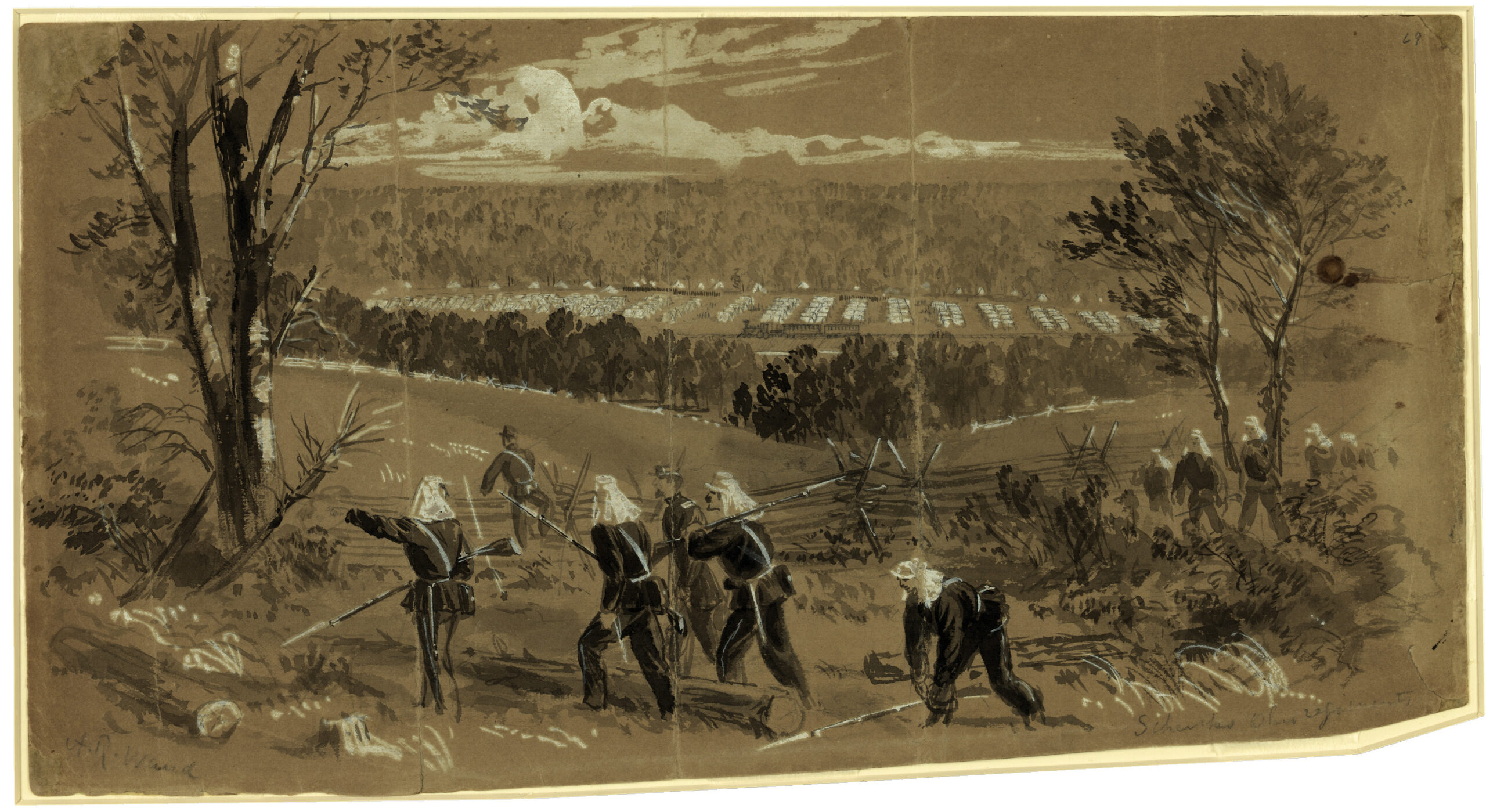
Second Connecticut Regiment at Washington

Library of Congress

Camp of the second Connecticut regiment at Washington, in a grove on the north side of the city- Near th[e] New York 7th [Waud, Alfred R. (Alfred Rudolph)]Title: Camp of the second Connecticut regiment at Washington, in a grove on the north side of the city- Near th[e] New York 7th
Creator(s): Waud, Alfred R. (Alfred Rudolph), 1828-1891, artist
Date Created/Published: [1861 May ca. 20-23]
Medium: 1 drawing on grey-olive paper : pencil, Chinese white, and black ink wash ; sheet 19.0 x 33.7 cm.
Reproduction Number: LC-DIG-ppmsca-21277 (digital file from original item, recto) LC-DIG-ppmsca-21278 (digital file from original item, verso)
Rights Advisory: No known restrictions on publication.
Call Number: DRWG/US – Waud, no. 378 (A size) [P&P]
Repository: Library of Congress Prints and Photographs Division Washington, D.C. 20540 USA
Notes:
…..Title inscribed on verso.
…..Inscribed below image, from left to right: 4 abreast; Seargeant [sic] in front; infantry soldier; sword; bayonet; rifles; sword; bayonets.
…..Rough sketch of soldiers and horses on verso.
…..Published in: New York Illustrated News, June 8, 1861, p.76.
…..Gift, J.P. Morgan, 1919 (DLC/PP-1919:R1.2.378)
…..For more information about this collection, see http://hdl.loc.gov/loc.pnp/pp.drwg
…..Forms part of: Morgan collection of Civil War drawings.

Library of Congress file permalink

___________
Mike’s notes:

Note – This image has been digitally adjusted for one or more of the following:
– fade correction,
– color, contrast, and/or saturation enhancement
– selected spot and/or scratch removal
– cropped for composition and/or to accentuate subject

0 comments

“We must win the first battle at all hazards, and at any cost.”—A Rebel War Clerk’s Diary at the Confederate States Capital, By John Beauchamp Jones.

Civil War Day-by-Day

JUNE 18th.—The city is content at the evacuation. The people have unbounded confidence in the wisdom of the administration, and the ability of our generals. Beauregard is the especial favorite. The soldiers, now arming daily, are eager for the fray; and it is understood a great battle must come off before many weeks; as it is the determination of the enemy to advance from the vicinity of Washington, where they are rapidly concentrating. But our people must curb their impatience. And yet we dare not make known the condition of the army,—the awful fact which may be stated here—and will not be known until after-years,—that we have not enough ammunition at Manassas to fight a battle. There are not percussion caps enough in our army for a serious skirmish. It will be obviated in a few weeks; and until then I pray there may be no battle. But if the enemy advance, our brave men will give them the cold steel. We must win the first battle at all hazards, and at any cost; and, after that,—how long after? —we must win the last!

0 comments

The Letters of Samuel Ryan Curtis

The Letters of Samuel Ryan Curtis

St. Joseph, June 18, 1861.1

Col Curtis:

Dear Sir: The undersigned, citizens of Missouri, fully aware of the delicate duties enjoined upon you, as the military commander of this post, and feeling a deep solicitude for the preservation of as much peace and quietness among the people in the surrounding country, as the extraordinary circumstances which environ us will allow and in further view of the arrests already made by you; and that the public mind is greatly excited. Men have left their homes, business of every character is paralized and apprehensions entertained that the arrests made by you, in discharge of your military duty are to be indiscriminate and against those who entertain southern sentiments, as well as those found in armed organization against the Government of the United States. We, therefore, respectfully ask that you will communicate to us your views upon this subject; hoping and believing that it will have the effect of quieting the public mind, and allow the farmers to return to their homes, and quietly attend to their farms and gather their harvest which is now ripe and suffering for the want of reapers.

We have the honor to be.

Very Respectfully,
Austin A. King
Silas Woodson
J. M. Bassett,
H. M. Vories,
Jas. Craig
R. M. Stewart


1. Printed in the St. Joseph Daily Journal. June 22, 1861.

0 comments

“Certainly, a more extraordinary maze could not be conceived, even in the dreams of a sick engineer—a number of mad beavers might possibly construct such dams.”— William Howard Russell’s Diary:

My Diary North and South – William Howard Russell

Camp Randolph–Cannon practice–Volunteers–”Dixie “–Forced return from the South–Apathy of the North–General retrospect of politics–Energy and earnestness of the South–Fire-arms– Position of Great Britain towards the belligerents–Feeling towards the Old Country.

June 18th. On looking out of my cabin window this morning I found the steamer fast alongside a small wharf, above which rose, to the height of 150 feet, at an angle of 45 degrees, the rugged bluff already mentioned. The wharf was covered with commissariat stores and ammunition. Three heavy guns, which some men were endeavouring to sling to rude bullock-carts, in a manner defiant of all the laws of gravitation, seemed likely to go slap into the water at every moment; but of the many great strapping fellows who were lounging about, not one gave a hand to the working party. A dusty track wound up the hill to the brow, and there disappeared; and at the height of fifty feet or so above the level of the river two earthworks had been rudely erected in an ineffective position. The volunteers who were lounging about the edge of the stream were dressed in different ways, and had no uniform.

Already the heat of the sun compelled me to seek the shade; and a number of the soldiers, labouring under the same infatuation as that which induces little boys to disport themselves in the Thames at Waterloo Bridge, under the notion that they are washing themselves, were swimming about in a backwater of the great river, regardless of cat-fish, mud, and fever.

General Pillow proceeded on shore after breakfast, and we mounted the coarse cart-horse chargers which were in waiting at the jetty to receive us. It is scarcely worth while to transcribe from my diary a description of the works which I sent over at the time to England. Certainly, a more extraordinary maze could not be conceived, even in the dreams of a sick engineer–a number of mad beavers might possibly construct such dams. They were so ingeniously made as to prevent the troops engaged in their defence from resisting the enemy’s attacks, or getting away from them when the assailants had got inside–most difficult and troublesome to defend, and still more difficult for the defenders to leave, the latter perhaps being their chief merit.

The General ordered some practice to be made with round shot down the river. An old forty-two pound carronade was loaded with some difficulty, and pointed at a tree about 1700 yards–which I was told, however, was not less than 2500 yards– distant. The General and his staff took their posts on the parapet to leeward, and I ventured to say, “I think, General, the smoke will prevent your seeing the shot.” To which the General replied, “No, sir,” in a tone which indicated, “I beg you to understand I have been wounded in Mexico, and know all about this kind of thing.” “Fire,” the string was pulled, and out of the touch-hole popped a piece of metal with a little chirrup. “Darn these friction tubes! I prefer the linstock and match,” quoth one of the staff, sotto voce, “but General Pillow will have us use friction tubes made at Memphis, that ar’nt worth a cuss.” Tube No. 2, however, did explode, but where the ball went no one could say, as the smoke drifted right into our eyes.

The General then moved to the other side of the gun, which was fired a third time, the shot falling short in good line, but without any ricochet. Gun No. 3 was next fired. Off went the ball down the river, but off went the gun, too, and with a frantic leap it jumped, carriage and all, clean off the platform. Nor was it at all wonderful, for the poor old-fashioned chamber cannonade had been loaded with a charge and a solid shot heavy enough to make it burst with indignation. Most of us felt relieved when the firing was over, and, for my own part, I would much rather have been close to the target than to the battery.

Slowly winding for some distance up the steep road in a blazing sun, we proceeded through the tents which are scattered in small groups, for health’s sake, fifteen and twenty together, on the wooded plateau above the river. The tents are of the small ridge-pole pattern, six men to each, many of whom, from their exposure to the sun, whilst working in these trenches, and from the badness of the water, had already been laid up with illness. As a proof of General Pillow’s energy, it is only fair to say he is constructing, on the very summit of the plateau, large cisterns, which will be filled with water from the river by steam power.

The volunteers were mostly engaged at drill in distinct companies, but by order of the General some 700 or 800 of them were formed into line for inspection. Many of these men were in their shirt sleeves, and the awkwardness with which they handled their arms showed that, however good they might be as shots, they were bad hands at manual platoon exercise; but such great strapping fellows, that, as I walked down the ranks there were few whose shoulders were not above the level of my head, excepting here and there a weedy old man or a growing lad. They were armed with old pattern percussion muskets, no two clad alike, many very badly shod, few with knapsacks, but all provided with a tin water-flask and a blanket. These men have been only five weeks enrolled, and were called out by the State of Tennessee, in anticipation of the vote of secession.

I could get no exact details as to the supply of food, but from the Quartermaster-General I heard that each man had from ¾ lb. to 1 ¼ lb. of meat, and a sufficiency of bread, sugar, coffee, and rice daily; however, these military Olivers “asked for more.” Neither whisky nor tobacco was served out to them, which to such heavy consumers of both, must prove one source of dissatisfaction. The officers were plain, farmerly planters, merchants, lawyers, and the like–energetic, determined men, but utterly ignorant of the most rudimentary parts of military science. It is this want of knowledge on the part of the officer which renders it so difficult to arrive at a tolerable condition of discipline among volunteers, as the privates are quite well aware they know as much of soldiering as the great majority of their officers.

Having gone down the lines of these motley companies, the General addressed them in a harangue in which he expatiated on their patriotism, on their courage, and the atrocity of the enemy, in an odd farrago of military and political subjects. But the only matter which appeared to interest them much was the announcement that they would be released from work in another day or so, and that negroes would be sent to perform all that was required. This announcement was received with the words, “Bully for us !” and “That’s good.” And when General Pillow wound up a florid peroration by assuring them, “When the hour of danger comes I will be with you,” the effect was by no means equal to his expectations. The men did not seem to care much whether General Pillow was with them or not at that eventful moment; and, indeed, all dusty as he was in his plain clothes he did not look very imposing, or give one an idea that he would contribute much to the means of resistance. However, one of the officers called out, “Boys, three cheers for General Pillow.”

What they may do in the North I know not, but certainly the Southern soldiers cannot cheer, and what passes muster for that jubilant sound is a shrill ringing scream with a touch of the Indian war-whoop in it. As these cries ended, a stentorian voice shouted out, “Who cares for General Pillow?” No one answered; whence I inferred the General would not be very popular until the niggers were actually at work in the trenches.

We returned to the steamer, headed up stream and proceeded onwards for more than an hour, to another landing, protected by a battery, where we disembarked, the General being received by a guard dressed in uniform, who turned out with some appearance of soldierly smartness. On my remarking the difference to the General, he told me the corps encamped at this point was composed of gentlemen planters, and farmers. They had all clad themselves, and consisted of some of the best families in the State of Tennessee.

As we walked down the gangway to the shore, the band on the upper deck struck up, out of compliment to the English element in the party, the unaccustomed strains of “God save the Queen;” and I am not quite sure that the loyalty which induced me to stand in the sun, with uncovered head, till the musicians were good enough to desist, was appreciated. Certainly a gentleman, who asked me why I did so, looked very incredulous, and said “That he could understand it if it had been in a church; but that he would not broil his skull in the sun, not if General Washington was standing just before him.” The General gave orders to exercise the battery at this point, and a working party was told off to firing drill. ‘Twas fully six minutes between the giving of the orders and the first gun being ready.

On the word “fire” being given, the gunner pulled the lanyard, but the tube did not explode; a second tube was inserted, but a strong jerk pulled it out without exploding; a third time one of the General’s fuses was applied, which gave way to the pull, and was broken in two; a fourth time was more successful–the gun exploded, and the shot fell short and under the mark–in fact, nothing could be worse than the artillery practice which I saw here, and a fleet of vessels coming down the river might, in the present state of the garrisons, escape unhurt.

There are no disparts, tangents, or elevating screws to the gun, which are laid by eye and wooden chocks. I could see no shells in the battery, but was told there were some in the magazine.

Altogether, though Randolph’s Point and Fort Pillow afford strong positions, in the present state of the service, and equipment of guns and works, gunboats could run past them without serious loss, and, as the river falls, the fire of the batteries will be even less effective.

On returning to the boats the band struck up “The Marseillaise” and “Dixie’s Land.” There are two explanations of the word Dixie–one is that it is the general term for the Slave States, which are, of course, south of Mason and Dixon’s line; another, that a planter named Dixie, died long ago, to the intense grief of his animated property. Whether they were ill-treated after he died, and thus had reason to regret his loss, or that they had merely a longing in the abstract after Heaven, no fact known to me can determine; but certain it is that they long much after Dixie, in the land to which his spirit was supposed by them to have departed, and console themselves in their sorrow by clamorous wishes to follow their master, where probably the revered spirit would be much surprised to find himself in their company. The song is the work of the negro melodists of New York.

In the afternoon we returned to Memphis. Here I was obliged to cut short my Southern tour, though I would willingly have stayed, to have seen the most remarkable social and political changes the world has probably ever witnessed. The necessity of my position obliged me to return northwards–unless I could write, there was no use in my being on the spot at all. By this time the Federal fleets have succeeded in closing the ports, if not effectually, so far as to render the carriage of letters precarious, and the route must be at best devious and uncertain.

Mr. Jefferson Davis was, I was assured, prepared to give me every facility at Richmond to enable me to know and to see all that was most interesting in the military and political action of the New Confederacy; but of what use could this knowledge be if I could not communicate it to the journal I served?

I had left the North when it was suffering from a political paralysis, and was in a state of coma in which it appeared conscious of the coming convulsion but unable to avert it. The sole sign of life in the body corporate was some feeble twitching of the limbs at Washington, when the district militia were called out, whilst Mr. Seward descanted on the merits of the Inaugural, and believed that the anger of the South was a short madness, which would be cured by a mild application of philosophical essays.

The politicians, who were urging in the most forcible manner the complete vindication of the rights of the Union, were engaged, when I left them arguing, that the Union had no rights at all as opposed to those of the States. Men who had heard with nods of approval of the ordinance of secession passed by State after State were now shrieking out, “Slay the traitors!”

The printed rags which had been deriding the President as the great “rail splitter,” and his Cabinet as a collection of ignoble fanatics, were now heading the popular rush, and calling out to the country to support Mr. Lincoln and his Ministry, and were menacing with war the foreign States which dared to stand neutral in the quarrel. The declaration of Lord John Russell that the Southern Confederacy should have limited belligerent rights had at first created a thrill of exultation in the South, because the politicians believed that in this concession was contained the principle of recognition; while it had stung to fury the people of the North, to whom it seemed the first warning of the coming disunion.

Much, therefore, as I desired to go to Richmond, where I was urged to repair by many considerations, and by the earnest appeals of those around me, I felt it would be impossible, notwithstanding the interest attached to the proceedings there, to perform my duties in a place cut off from all communication with the outer world; and so I decided to proceed, to Chicago, and thence to Washington, where the Federals had assembled a large army, with the purpose of marching upon Richmond, in obedience to the cry of nearly every journal of influence in the Northern cities.

My resolution was mainly formed in consequence of the intelligence which was communicated to me at Memphis, and I told General Pillow that I would continue my journey to Cairo, in order to get within the Federal lines. As the river was blockaded, the only means of doing so was to proceed by rail to Columbus, and thence to take a steamer to the Federal position; and so, whilst the General was continuing his inspection, I rode to the telegraph office, in one of the camps, to order my luggage to be prepared for departure as soon as I arrived, and thence went on board the steamer, where I sat down in the cabin to write my last despatch from Dixie.

So far I had certainly no reason to agree with Mr. Seward in thinking this rebellion was the result of a localised energetic action on the part of a fierce minority in the seceding States, and that there was in each a large, if inert, mass opposed to secession, which would rally round the Stars and Stripes the instant they were displayed in their sight. On the contrary, I met everywhere with but one feeling, with exceptions which proved its unanimity and its force. To a man the people went with their States, and had but one battle cry, “States’ rights, and death to those who make war against them!”

Day after day I had seen this feeling intensified by the accounts which came from the North of a fixed determination to maintain the war; and day after day, I am bound to add, the impression on my mind was strengthened that “States’ rights” meant protection to slavery, extension of slave territory, and free-trade in slave produce with the outer world; nor was it any argument against the conclusion that the popular passion gave vent to the most vehement outcries against Yankees, abolitionists, German mercenaries, and modern invasion. I was fully satisfied in my mind also that the population of the South, who had taken up arms, were so convinced of the righteousness of their cause, and so competent to vindicate it, that they would fight with the utmost energy and valour in its defence and successful establishment.

The saloon in which I was sitting afforded abundant evidence of the vigour with which the South are entering upon the contest. Men of every variety and condition of life had taken up arms against the cursed Yankee and the black Republican–there was not a man there who would not have given his life for the rare pleasure of striking Mr. Lincoln’s head off his shoulders, and yet to a cold European the scene was almost ludicrous.

Along the covered deck lay tall Tennesseans, asleep, whose plumed felt hats were generally the only indications of their martial calling, for few indeed had any other signs of uniform, except the rare volunteers, who wore stripes of red and yellow cloth on their trousers, or leaden buttons, and discoloured worsted braid and facings on their jackets. The afterpart of the saloon deck was appropriated to General Pillow, his staff, and officers. The approach to it was guarded by a sentry, a tall, good-looking young fellow, in a grey flannel shirt, grey trousers, fastened with a belt and a brass buckle, inscribed U.S., which came from some plundered Federal arsenal, and a black wide-awake hat, decorated with a green plume. His Enfield rifle lay beside him on the deck, and, with great interest expressed on his face, he leant forward in his rocking-chair to watch the varying features of a party squatted on the floor, who were employed in the national game of “Euchre.” As he raised his eyes to examine the condition of the cigar he was smoking, he caught sight of me, and by the simple expedient of holding his leg across my chest, and calling out, “Hallo! where are you going to?” brought me to a standstill–whilst his captain, who was one of the happy euchreists, exclaimed, “Now, Sam, you let nobody go in there.”

I was obliged to explain who I was, whereupon the sentry started to his feet, and said, “Oh! indeed, you are Russell that’s been in that war with the Rooshians. Well, I’m very much pleased to know you. I shall be off sentry in a few minutes; I’ll just ask you to tell me something about that fighting.” He held out his hand, and shook mine warmly as he spoke. There was not the smallest intention to offend in his manner; but, sitting down again, he nodded to the captain, and said, “It’s all right; it’s Pillow’s friend– that’s Russell of the London Times.” The game of euchre was continued–and indeed it had been perhaps all night – for my last recollection on looking out of my cabin was of a number of people playing cards on the floor and on the tables all down the saloon, and of shouts of “Eu-kerr !” “Ten dollars, you don’t!” “I’ll lay twenty on this!” and so on; and with breakfast the sport seemed to be fully revived.

There would have been much more animation in the game, no doubt, had the bar on board the Ingomar been opened; but the intelligent gentleman who presided inside had been restricted by General Pillow in his avocations; and when numerous thirsty souls from the camps came on board, with dry tongues and husky voices, and asked for “mint juleps,” “brandy smashes,” or “whisky cocktails,” he seemed to take a saturnine pleasure by saying, “The General won’t allow no spirit on board, but I can give you a nice drink of Pillow’s own iced Mississippi water,” an announcement which generally caused infinite disgust and some unhandsome wishes respecting the General’s future happiness.

By and bye, a number of sick men were brought down on litters, and placed here and there along the deck. As there was a considerable misunderstanding between the civilian and military doctors, it appeared to be understood that the best way of arranging it was not to attend to the sick at all, and unfortunate men suffering from fever and dysentery were left to roll and groan, and lie on their stretchers, without a soul to help them. I had a medicine chest on board, and I ventured to use the lessons of my experience in such matters, administered my quinine, James’s Powder, calomel, and opium, secundum meant artem, and nothing could be more grateful than the poor fellows were for the smallest mark of attention. “Stranger, remember, if I die,” gasped one great fellow, attenuated to a skeleton by dysentery, “That I am Robert Tallon, of Tishimingo county, and that I died for States’ rights; see, now, they put that in the papers, won’t you? Robert Tallon died for States’ rights,” and so he turned round on his blanket.

Presently the General came on board, and the Ingomar proceeded on her way back to Memphis. General Clarke, to whom I mentioned the great neglect from which the soldiers were suffering, told me he was afraid the men had no medical attendance in camp. All the doctors, in fact, wanted to fight, and as they were educated men, and generally connected with respectable families, or had political influence in the State, they aspired to be colonels at the very least, and to wield the sword instead of the scalpel.

Next to the medical department, the commissariat and transport were most deficient; but by constant courts-martial, stoppages of pay, and severe sentences, he hoped these evils would be eventually somewhat mitigated. As one who had received a regular military education, General Clarke was probably shocked by volunteer irregularities; and in such matters as guard-mounting, reliefs, patrols, and picket-duties, he declared they were enough to break one’s heart; but I was astonished to hear from him that the Germans were by far the worst of the five thousand troops under his command, of whom they formed more than a fifth.

Whilst we were conversing, the captain of the steamer invited us to come up into his cabin on the upper deck; and as railway conductors, steamboat captains, barkeepers, hotel-clerks, and telegraph officers are among the natural aristocracy of the land, we could not disobey the invitation, which led to the consumption of some of the captain’s private stores, and many warm professions of political faith.

The captain told me it was rough work abroad sometimes with “sports” and chaps of that kind; but “God bless you,” said he, “the river now is not what it used to be a few years ago, when we’d have three or four difficulties of an afternoon, and may-be now and then a regular free fight all up and down the decks, that would last a couple of hours, so that when we came to a town we would have to send for all the doctors twenty miles round, and may-be some of them would die in spite of that. It was the rowdies used to get these fights up; but we’ve put them pretty well down. The citizens have hunted them out, and they’s gone away west.” “Well, then, captain, one’s life was not very safe on board sometimes.” “Safe! Lord bless you!” said the captain; “if you did not meddle, just as safe as you are now, if the boiler don’t collapse. You must, in course, know how to handle your weepins, and be pretty spry in taking your own part.” “Ho, you Bill!” to his coloured servant, “open that clothes-press.” “Now, here,” he continued, “is how I travel; so that I am always easy in my mind in case of trouble on board.” Putting his hand under the pillow of the bed close beside him, he pulled out a formidable looking double-barrelled pistol at half-cock, with the caps upon it. “That’s as purty a pistol as Derringer ever made. I’ve got the brace of them–here’s the other;” and with that he whipped out pistol No. 2, in an equal state of forwardness, from a little shelf over his bed; and then going over to the clothes-press, he said, “Here’s a real old Kentuck, one of the old sort, as light on the trigger as gossamer, and sure as deeth– Why, law bless me, a child would cut a turkey’s head off with it at a hundred yards.” This was a huge lump of iron, about five feet long, with a small hole bored down the centre, fitted in a coarse German-fashioned stock. “But,” continued he, “this is my main dependence; here is a regular beauty, a first-rate, with ball or buckshot, or whatever you like – made in London; I gave two hundred dollars for it; and it is so short and handy and straight shooting, I’d just as soon part with my life as let it go to anybody” and, with a glow of pride in his face, the captain handed round again a very short double-barrelled gun, of some eleven or twelve bore, with back action locks, and an audacious “Joseph Manton, London,” stamped on the plate. The manner of the man was perfectly simple and bond fide; very much as if Inspector Podger were revealing to a simpleton the mode by which the London police managed refractory characters in the station-house.

From such matters as these I was diverted by the more serious subject of the attitude taken by England in this quarrel. The concession of belligerent rights was, I found, misunderstood, and was considered as an admission that the Southern States had established their independence before they had done more than declare their intention to fight for it.

It is not within my power to determine whether the North is as unfair to Great Britain as the South; but I fear the history of the people, and the tendency of their institutions, are adverse to any hope of fair-play and justice to the old country. And yet it is the only power in Europe for the good opinion of which they really seem to care. Let any French, Austrian, or Russian journal write what it pleases of the United States, it is received with indifferent criticism or callous head-shaking. But let a London paper speak, and the whole American press is delighted or furious.

The political sentiment quite overrides all other feelings; and it is the only symptom statesmen should care about, as it guides the policy of the country. If a man can put faith in the influence for peace of common interests, of common origin, common intentions, with the spectacle of this incipient war before his eyes, he must be incapable of appreciating the consequences which follow from man being an animal. A war between England and the United States would be unnatural; but it would not be nearly so unnatural now as it was when it was actually waged in 1776 between people who were barely separated from each other by a single generation; or in 1812-14, when the foreign immigration had done comparatively little to dilute the Anglo-Saxon blood. The Norman of Hampshire and Sussex did not care much for the ties of consanguinity and race when he followed his lord in fee to ravage Guienne or Brittany.

The general result of my intercourse with Americans is to produce the notion that they consider Great Britain in a state of corruption and decay, and eagerly seek to exalt France at her expense. Their language is the sole link between England and the United States, and it only binds the England of 1770 to the American of 1860.

There is scarcely an American on either side of Mason and Dixon’s line who does not religiously believe that the colonies, alone and single-handed, encountered the whole undivided force of Great Britain in the revolution, and defeated it. I mean, of course, the vast mass of the people; and I do not think there is an orator or a writer who would venture to tell them the truth on the subject. Again, they firmly believe that their petty frigate engagements established as complete a naval ascendancy over Great Britain as the latter obtained by her great encounters with the fleets of France and Spain. Their reverses, defeats, and headlong routs in the first war, their reverses in the second, are covered over by a huge Buncombe plaster, made up of Bunker’s Hill, Plattsburg, Baltimore, and New Orleans.

Their delusions are increased and solidified by the extraordinary text-books of so-called history, and by the feasts, and festivals, and celebrations of their every-day political life, in all of which we pass through imaginary Caudine Forks; and they entertain towards the old country at best very much the feeling which a high-spirited young man would feel towards the guardian who, when he had come of age, and was free from all control, sought to restrain the passions of his early life.

Now I could not refuse to believe that in New Orleans, Montgomery, Mobile, Jackson, and Memphis there is a reckless and violent condition of society, unfavourable to civilisation, and but little hopeful for the future. The most absolute and despotic rule, under which a man’s life and property are safe, is better than the largest measure of democratic freedom, which deprives the freeman of any security for either. The state of legal protection for the most serious interests of man, considered as a civilised and social creature, which prevails in America, could not be tolerated for an instant, and would generate a revolution in the worst governed country in Europe. I would much sooner, as the accidental victim of a generally disorganized police, be plundered by a chance diligence robber in Mexico, or have a fair fight with a Greek Klepht, suffer from Italian banditti, or be garotted by a London ticket-of-leave man, than be bowie-knifed or revolvered in consequence of a political or personal difference with a man, who is certain not in the least degree to suffer from an accidental success in his argument.

On our return to the hotel I dined with the General and his staff at the public table, where there was a large assemblage of military men, Southern ladies, their families, and contractors. This latter race has risen up as if by magic, to meet the wants of the new Confederacy; and it is significant to measure the amount of the dependence on Northern manufacturers by the advertisements in the Southern journals, indicating the creation of new branches of workmanship, mechanical science, and manufacturing skill.

Hitherto they have been dependent on the North for the very necessaries of their industrial life. These States were so intent on gathering in money for their produce, expending it luxuriously, and paying it out for Northern labour, that they found themselves suddenly in the condition of a child brought up by hand, whose nurse and mother have left it on the steps of the poor-house. But they have certainly essayed to remedy the evil and are endeavouring to make steam-engines, gunpowder, lamps, clothes, boots, railway carriages, steel springs, glass, and all the smaller articles for which even Southern households find a necessity.

The peculiar character of this contest developes itself in a manner almost incomprehensible to a stranger who has been accustomed to regard the United States as a nation. Here is General Pillow, for example, in the State of Tennessee, commanding the forces of the State, which, in effect, belongs to the Southern Confederacy; but he tells me that he cannot venture to move across a certain geographical line, dividing Tennessee from Kentucky, because the State of Kentucky, in the exercise of its sovereign powers and rights, which the Southern States are bound specially to respect, in virtue of their championship of States’ rights, has, like the United Kingdom of Great Britain and Ireland, declared it will be neutral in the struggle; and Beriah Magoffin, Governor of the aforesaid State, has warned off Federal and Confederate troops from his territory.

General Pillow is particularly indignant with the cowardice of the well-known Secessionists of Kentucky; but I think he is rather more annoyed by the accumulation of Federal troops at Cairo, and their recent expedition to Columbus on the Kentucky shore, a little below them, where they seized a Confederate nag.

0 comments

“…loud swearing, there as elsewhere, was heard at and about Brigadier General Peirce.”–Adams Family Letters; Charles Francis Adams, Jr., To His Mother

Civil War Day-by-Day

Boston, June 18, 1861

Before this reaches you, you will have heard of the miserable affair at Great Bethel which has made so much noise here. You see a Quincy man was killed – young Souther, a brother of our one-armed friend. Our flags out there were hung at half mast for a day and loud swearing, there as elsewhere, was heard at and about Brigadier General Peirce. It was a bad affair and John Palfrey writes that two companies of regulars would have carried the battery with ease, but this is the beginning of our militia generalship and, alas, that this should have been a Massachusetts man. In fact our good old State, which began this war so well, is likely after going up like a rocket to come down like a stick, and she is now rapidly falling behindhand. While other states have sent out from one to twenty regiments of three year men, she has sent out her first only last week and that one under the command of Colonel Cowdin, a notorious incompetent. In fact Gordon’s regiment is the only decent one, so far as I can hear, yet organized in Massachusetts and the others are so wretchedly officered and so thoroughly demoralized already that it will be almost a miracle if the State is not soon disgraced. In fact Andrew does not show that capacity which he gave promise of and his selections of men so far have, I should say, been wretched. I hope the next batch from here which will probably be called for and organized in July and August will show an improvement, and that we shall then send out some superior men, those whom we are now sending out having previously demonstrated their incompetence. . . .

0 comments

“I am not yet prepared to think ourselves refugees, for I do hope to get home before long.”—Diary of a Southern Refugee.

Diary of a Southern Refugee During the War by Judith White McGuire

18th.—We go to-day to dine with Bishop Meade. He wishes us to spend much of our time with him. He says he must have the “refugees,” as he calls us, at his house. Dear me, I am not yet prepared to think ourselves refugees, for I do hope to get home before long. How often do I think of it, as I left it! Not only blooming in its beauty, but the garden filled with vegetables, the strawberries turning on the vines, the young peach-orchard in full bloom; every thing teeming with comfort and abundance.

But the family is waiting for me ; the carriage is at the door, and my sad thoughts must end.

Night.—The day was passed delightfully; the Bishop, his son, and daughter-in-law, all so kind, hospitable and agreeable. It amused me to see with what avidity the old gentleman watches the progress of events, particularly when I remember how much opposed he was to secession only a few months ago. He clung to the Union with a whole-souled love for all that he had been educated to revere, as long as he could do it; but when every proposal for peace made by us was spurned, and when [continue reading…]

0 comments

Civil War Day-By-Day

Civil War Day-by-Day

June 18, 1861

A Chronological History of the Civil War in America1


  1. A Chronological History of the Civil War in America by Richard Swainson Fisher, New York, Johnson and Ward, 1863
0 comments

“I told (the Secretary) my desire was to serve the cause, and not myself. I suppose he was incredulous.”—A Rebel War Clerk’s Diary at the Confederate States Capital, By John Beauchamp Jones

Civil War Day-by-Day

JUNE 17th.—To-day there was a rumor in the streets that Harper’s Ferry had been evacuated by Gen. Joseph E. Johnston, and, for the first time, I heard murmurs against the government. So far, perhaps, no Executive had ever such cordial and unanimous support of the people as President Davis. I knew the motive of the evacuation, and prepared a short editorial for one of the papers, suggesting good reasons for the retrograde movement; and instancing the fact that when Napoleon’s capital was surrounded and taken, he had nearly 200,000 men in garrison in the countries he had conquered, which would have been ample for the defense of France. This I carried to the Secretary at his lodgings, and he was so well pleased with it he wanted me to accompany him to the lodgings of the President, in the same hotel, and show it to him.

This I declined, alleging it might be too late for the press. He laughed at my diffidence, and disinclination on such occasions to approach the President. I told him my desire was to serve the cause, and not myself. I suppose he was incredulous.

0 comments

General Schenck and four companies of the First Ohio Regiment surprised

Frank Leslie’s Illustrated Newspaper

(from Frank Leslie’s Illustrated History of the Civil War…, edited by Louis Shepheard Moat, Published by Mrs. Frank Leslie,New York, 1895; originally published in Frank Leslie’s Illustrated Newspaper, June 29, 1861)

“General Schenck and four companies of the First Ohio Regiment were approaching Vienna, Va., on June 17th, 1861, by railroad, when, on turning a curve, they were fired upon by masked batteries of three guns, with shells, round shot and grape, killing and wounding the men on the platform and in the cars before the train could be stopped. The engine then became damaged and could not draw the train out of the fire, so the soldiers left the cars and retired through the woods. They retreated slowly, bearing off the wounded about five miles away, where they made a stand, awaiting re-enforcements.”

0 comments

“Ready and glad to go as far south as hospitals have been established.”—Woolsey family letters, Georgeanna Muirson Woolsey to Eliza.

Woolsey family letters during the War for the Union

Wednesday.

My dear Eliza: You must feel that I am ready and glad to go anywhere and at any time with you and dear Joe. You will probably go with him to Washington, at any rate. You and I could be companions for each other at the hotel as long as the regiment camps near the city, and, judging from the way the other regiments have been disposed of, that is likely to be the arrangement for them for some time. We should be able to see them every day and perhaps go even farther south. Since Joe has taken the sick under his care we perhaps shall be able to be a part of the regiment, as other women have been, and may keep together in this way, doing what we can.

You know we three have travelled over rough roads together before, and have now only to take up our little bundles and commence our march again. We shall like it and we will do it if possible. Two of our bands of nurses have been sent on from the Hospital already, and with a letter of introduction from our association (which is accepted by government) I shall probably be able to go where I please, as far south as hospitals have been established; and so we may be able perhaps to keep up with the Sixteenth. If you can, don’t you think you had better come down and be introduced to Dr. Elizabeth Blackwell and others, and go for a few days to one of the hospitals opened to us, so that you may be able to give references from our association, if necessary? It may save you some delay and be useful to you in other ways. I am ready, or shall be at the shortest notice, to do as you say. I cannot tell you how we all feel about this. We shall try and not feel at all, only our hearts are with you and Joe always.

0 comments

“Another Mass Regt came tonight.”—Horatio Nelson Taft

Diary of US patent clerk Horatio Nelson Taft.

MONDAY 17

A cool fine day. Nothing particularly new has occured, but matters over the River seem to be coming to a point. Went after up to the camp at Meridian Hill about a mile north. Three Maine Regts are there; [also] the NY 5th (German) and the NY 9th. About 4000 [men?] were on parade while we were there. It was quite a military show. Another Mass Regt came tonight. I did not go down to the Ave tonight. Retired early.

______

The three diary manuscript volumes, Washington during the Civil War: The Diary of Horatio Nelson Taft, 1861-1865, are available online at The Library of   Congress.

0 comments

Schenks Ohio Regiments near Vienna, Virginia

Library of Congress

Schenks Ohio Corps near Vienna, in a valley through which runs the railroad, on which the skirmish took place, a beautiful and romantic spot, but hardly a safe position against surprise, in the foreground is a scouting party in search of secessionists a great deal of this part of Virginia seems to be good farming land a great deal of wheat and other cereals being grown . . . Waud.Title: Schenks Ohio regiments
Creator(s): Waud, Alfred R. (Alfred Rudolph), 1828-1891, artist
Date Created/Published: 1861 June 17.
Medium: 1 drawing on olive paper : pencil, Chinese white, and black ink wash ; 10.1 x 37.7 cm. (sheet)
Reproduction Number: LC-DIG-ppmsca-21444 (digital file from original item, recto) LC-DIG-ppmsca-21445 (digital file from original item, verso) LC-USC4-5100 (color film copy transparency) LC-USZ62-7000 (b&w film copy neg.)
Rights Advisory: No known restrictions on publication.
Call Number: DRWG/US – Waud, no. 526 (A size) [P&P]
Repository: Library of Congress Prints and Photographs Division Washington, D.C. 20540 USA
Notes:
…..Signed lower left: A.R. Waud.
…..Title inscribed lower right.
…..Inscribed on verso: The Ohio Corps near Vienna, in a valley through which runs the railroad, on which the skirmish took place, a beautiful and romantic spot, but hardly a safe position against surprise, in the foreground is a scouting party in search of secessionists a great deal of this part of Virginia seems to be good farming land a great deal of wheat and other cereals being grown . . . Waud.
…..Gift; J.P. Morgan; 1919; (DLC/PP-1919:R1.2.526).
…..Forms part of: Morgan collection of Civil War drawings.
…..Published in: New York illustrated news, July 13, 1861, p. 157.

Library of Congress permalink

Blog post (link active June 6, 2021)

___________
Mike’s notes:

Note – This image has been digitally adjusted for one or more of the following:
– fade correction,
– color, contrast, and/or saturation enhancement
– selected spot and/or scratch removal
– cropped for composition and/or to accentuate subject

0 comments

William Howard Russell’s Diary: Approach to Memphis.—Slaves for sale.—Memphis.—General Pillow.—Up the Mississippi with Pillow.

My Diary North and South – William Howard Russell

June 17th. If it was any consolation tome that the very noisy and very turbulent warriors of last night were exceedingly sick, dejected, and crestfallen this morning, I had it to the full. Their cries for water were incessant to allay the internal fires caused by “40 rod” and “60 rod,” as whiskey is called, which is supposed to kill people at those distances. Their officers had no control over them–and the only authority they seemed to respect was that of the ” gentlemanly” conductor whom they were accustomed to fear individually, as he is a great man in America and has much authority and power to make himself disagreeable if he likes.

The victory at Big or Little Bethel has greatly elated these men, and they think they can walk all over the Northern States. It was a relief to get out of the train for a few minutes at a station called Holly Springs, where the passengers breakfasted at a dirty table on most execrable coffee, corn bread, rancid butter, and very dubious meats, and the wild soldiers outside made the most of their time, as they had recovered from their temporary depression by this time, and got out on the tops of the carriages, over which they performed tumultuous dances to the music of their band, and the great admiration of the surrounding negrodom. Their demeanour is very unlike that of the unexcitable staid people of the North.


There were in the train some Texans who were going to Richmond to offer their services to Mr. Davis. They denounced Sam Houston as a traitor, but admitted there were some Unionists, or as they termed them, Lincolnite skunks, in the State. The real object of their journey was, in my mind, to get assistance from the Southern Confederacy, to put down their enemies in Texas.

In order to conceal from the minds of the people that the government at Washington claims to be that of the United States, the press politicians and speakers divert their attention to the names of Lincoln, Seward, and other black republicans, and class the whole of the North together as the Abolitionists. They call the Federal levies “Lincoln’s mercenaries ” and “abolition hordes,” though their own troops are paid at the same rate as those of the United States. This is a common mode of procedure in revolutions and rebellions, and is not unfrequent in wars.

The enthusiasm for the Southern cause among all the people is most remarkable,–the sight of the flag waving from the carriage windows drew all the population of the hamlets and the workers in the field, black and white, to the side of the carriages to cheer for Jeff. Davis and the Southern Confederacy, and to wave whatever they could lay hold of in the air. The country seems very poorly cultivated, the fields full of stumps of trees, and the plantation houses very indifferent. At every station more “soldiers,” as they are called, got in, till the smell and heat were suffocating.

These men were as fanciful in their names and dress as could be. In the train which preceded us there was a band of volunteers armed with rifled pistols and enormous bowie knives, who called themselves “The Toothpick Company.” They carried along with them a coffin, with a plate inscribed, “Abe Lincoln, died ____,” and declared they were ” bound” to bring his body back in it, and that they did not intend to use muskets or rifles, but just go in with knife and six-shooter, and whip the Yankees straight away. How astonished they will be when the first round shot flies into them, or a cap full of grape rattles about their bowie knives.

At the station of Grand Junction, north of Holly Springs, which latter is 210 miles north of Jackson, several hundreds of our warrior friends were turned out in order to take the train north-westward for Richmond, Virginia. The 1st Company, seventy rank and file, consisted of Irishmen armed with sporting rifles without bayonets. Five-sixths of the 2nd Company, who were armed with muskets, were of the same nationality. The 3rd Company were all Americans. The 4th Company were almost all Irish. Some were in green others were in grey, the Americans who were in blue had not yet received their arms. When the word fix bayonets was given by the officer, a smart keen-looking man, there was an astonishing hurry and tumult in the ranks.

“Now then, Sweeny, whar are yes dhriven me too? Is it out of the redjmint amongst the officers yer shovin’ me?”

“Sullivan, don’t ye hear we’re to fix beenits?”

“Sarjent, jewel, wud yes ayse the shtrap of me baynit?”

“If ye prod me wid that agin, I’ll let dayloite into ye.”

The officer, reading, “No 23, James Phelan.”

No reply.

Officer again, “No. 23, James Phelan.”

Voice from the rank, “Shure, captain, and faix Phelan’s gone, he wint at the last depot.”

“No. 40, Miles Corrigan.”

Voice further on, ” He’s the worse for dhrink in the cars, yer honour, and says he’ll shoot us if we touch him; ” and so on.

But these fellows were, nevertheless, the material for fighting and for marching after proper drill and with good officers, even though there was too large a proportion of old men and young lads in the ranks. To judge from their dress these recruits came from the labouring and poorest classes of whites. The officers affected a French cut and bearing with indifferent success, and in the luggage vans there were three foolish young women with slop-dress imitation clothes of the Vivandière type, who, with dishevelled hair, dirty faces, and dusty hats and jackets, looked sad, sorry, and absurd. Their notions of propriety did not justify them in adopting straps, boots, and trousers, and the rest of the tawdry ill-made costume looked very bad indeed.

The train which still bore a large number of soldiers for the camp of Corinth, proceeded through dreary swamps, stunted forests, and clearings of the rudest kind at very long intervals. We had got out of the cotton district and were entering poorer soil, or land which, when cleared, was devoted to wheat and corn, and I was told that the crops ran from forty to sixty bushels to the acre. A more uninteresting country than this portion of the State of Mississippi I have never witnessed. There was some variety of scenery about Holly Springs where undulating ground covered with wood, diversified the aspect of the flat, but since that we have been travelling through mile after mile of insignificantly grown timber and swamps.

On approaching Memphis the line ascends towards the bluff of the Mississippi, and farms of a better appearance come in sight on the side of the rail; but after all I do not envy the fate of the man who, surrounded by slaves and shut out from the world, has to pass his life in this dismal region, be the crops never so good.

At a station where a stone pillar marks the limit between the sovereign State of Mississippi and that of Tennessee, there was a house two stories high, from the windows of which a number of negro girls and young men were staring on the passengers. Some of them smiled, laughed, and chatted, but the majority of them looked gloomy and sad enough. They were packed as close as they could, and I observed that at the door a very ruffianly looking fellow in a straw hat, long straight hair, flannel shirt, and slippers, was standing with his legs across and a heavy whip in his hand. One of the passengers walked over and chatted to him. They looked in and up at the negroes and laughed, and when the man came near the carriage in which I sat, a friend called out, “Whose are they, Sam?” “He’s a dealer at Jackson, Mr. Smith. They’re as prime a lot of fine Virginny niggers as I’ve seen this long time, and he wants to realise, for the news looks so bad.”

It was 1.40 p.m. when the train arrived at Memphis. I was speedily on my way to the Gayoso House, so called after an old Spanish ruler of the district, which is situated in the street on the bluff, which runs parallel with the course of the Mississippi. This resuscitated Egyptian city is a place of importance, and extends for several miles along the high bank of the river, though it does not run very far back. The streets are at right angles to the principal thoroughfares, which are parallel to the stream; and I by no means expected to see the lofty stores, warehouses, rows of shops, and handsome buildings on the broad esplanade along the river, and the extent and size of the edifices public and private in this city, which is one of the developments of trade and commerce created by the Mississippi. Memphis contains nearly 30,000 inhabitants, but many of them are foreigners, and there is a nomad draft into and out of the place, which abounds in haunts for Bohemians, drinking and dancing-saloons, and gaming-rooms. And this strange kaleidoscope of negroes and whites of the extremes of civilisation in its American development, and of the semi-savage degraded by his contact with the white; of enormous steamers on the river, which bears equally the dug-out or canoe of the black fisherman; the rail, penetrating the inmost recesses of swamps, which on either side of it remain no doubt in the same state as they were centuries ago; the roll of heavily-laden waggons through the streets; the rattle of omnibuses and all the phenomena of active commercial life before our eyes, included in the same scope of vision which takes in at the other side of the Mississippi lands scarcely yet settled, though the march of empire has gone thousands of miles beyond them, amuses but perplexes the traveller in this new land.

The evening was so exceedingly warm that I was glad to remain within the walls of my darkened bedroom. All the six hundred and odd guests whom the Gayoso House is said to accommodate were apparently in the passage at one time. At present it is the headquarters of General Gideon J. Pillow, who is charged with the defences of the Tennessee side of the river, and commands a considerable body of troops around the city and in the works above. The house is consequently filled with men in uniform, belonging to the General’s staff or the various regiments of Tennessee troops.

The Governors and the Legislatures of the States, view with dislike every action on the part of Mr. Davis which tends to form the State troops into a national army. At first, indeed, the doctrine prevailed that troops could not be sent beyond the limits of the State in which they were raised–then it was argued that they ought not to be called upon to move outside their borders; and I have heard people in the South inveighing against the sloth and want of spirit of the Virginians, who allowed their State to be invaded without resisting the enemy. Such complaints were met by the remark that all the Northern States had combined to pour their troops into Virginia, and that her sister States ought in honour to protect her. Finally, the martial enthusiasm of the Southern regiments impelled them to press forward to the frontier, and by delicate management, and the perfect knowledge of his countrymen which Mr. Jefferson Davis possesses, he is now enabled to amalgamate in some sort the diverse individualities of his regiments into something like a national army.

On hearing of my arrival, General Pillow sent his aide-de-camp to inform me that he was about starting in a steamer up the river, to make an inspection of the works and garrison at Fort Randolph and at other points where batteries had been erected to command the stream, supported by large levies of Tennesseans. The aide-de-camp conducted me to the General, whom I found in his bedroom, fitted up as an office, littered with plans and papers. Before the Mexican war General Pillow was a flourishing solicitor, connected in business with President Polk, and commanding so much influence that when the expedition was formed he received the nomination of brigadier-general of volunteers. He served with distinction and was severely wounded at the battle of Chapultepec and at the conclusion of the campaign he retired into civil life, and was engaged directing the work of his plantation till this great rebellion summoned him once more to the field.

Of course there is, and must be, always an inclination to deride these volunteer officers on the part of regular soldiers; and I was informed by one of the officers in attendance on the General that he had made himself ludicrously celebrated in Mexico for having undertaken to throw up a battery which, when completed, was found to face the wrong way, so that the guns were exposed to the enemy. General Pillow is a small, compact, clear-complexioned man, with short grey whiskers, cut in the English fashion, a quick eye, and a pompous manner of speech; and I had not been long in his company before I heard of Chapultepec and his wound, which causes him to limp a little in his walk, and gives him inconvenience in the saddle. He wore a round black hat, plain blue frock coat, dark trousers, and brass spurs on his boots; but no sign of military rank. The General ordered carriages to the door, and we went to see the batteries on the bluff or front of the esplanade, which are intended to check any ship attempting to pass down the river from Cairo, where the Federals under General Prentiss have entrenched themselves, and are understood to meditate an expedition against the city. A parapet of cotton bales, covered with tarpaulin, has been erected close to the edge of the bank of earth, which rises to heights varying from 60 to 150 feet almost perpendicularly from the waters of the Mississippi, with zigzag roads running down through it to the landing-places. This parapet could offer no cover against vertical fire, and is so placed that well-directed shell into the bank below it would tumble it all into the water. The zigzag roads are barricaded with weak planks, which would be shivered to pieces by boat-guns; and the assaulting parties could easily mount through these covered ways to the rear of the parapet, and up to the very centre of the esplanade.

The blockade of the river at this point is complete; not a boat is permitted to pass either up or down. At the extremity of the esplanade, on an angle of the hank, an earthen battery, mounted with six heavy guns, has been thrown up, which has a fine command of the river; and the General informed me he intends to mount sixteen guns in addition, on a prolongation of the face of the same work.

The inspection over, we drove down a steep road to the water beneath, where the Ingomar, a large river steamer, now chartered for the service of the State of Tennessee, was lying to receive us. The vessel was crowded with troops–all volunteers, of course–about to join those in camp. Great as were their numbers, the proportion of the officers was inordinately large, and the rank of the greater number preposterously high. It seemed to me as if I was introduced to a battalion of colonels, and that I was not permitted to pierce to any lower strata of military rank. I counted seventeen colonels, and believe the number was not then exhausted.


General Clarke, of Mississippi, who had come over from the camp at Corinth, was on board, and I had the pleasure of making his acquaintance. He spoke with sense and firmness of the present troubles, and dealt with the political difficulties in a tone of moderation which bespoke a gentleman and a man of education and thought. He also had served in the Mexican war, and had the air and manner of a soldier. With all his quietness of tone, there was not the smallest disposition to be traced in his words to retire from the present contest, or to consent to a reunion with the United States under any circumstances whatever. Another general, of a very different type, was among our passengers–a dirty-faced, frightened-looking young man, of some twenty-three or twenty-four years of age, redolent of tobacco, his chin and shirt slavered by its foul juices, dressed in a green cutaway coat, white jean trousers, strapped under a pair of prunella slippers, in which he promenaded the deck in an Agag-like manner, which gave rise to a suspicion of bunions or corns. This strange figure was topped by a tremendous black felt sombrero, looped up at one side by a gilt eagle, in which was stuck a plume of ostrich feathers and from the other side dangled a heavy gold tassel. This decrepit young warrior’s name was Ruggles or Struggles, who came from Arkansas, where he passed, I was informed, for ” quite a leading citizen.”

Our voyage as we steamed up the river afforded no novelty, nor any physical difference worthy of remark, to contrast it with the lower portions of the stream, except that upon our right hand side, which is, in effect, the left bank, there are ranges of exceedingly high bluffs, some parallel with and others at right angles to the course of the stream. The river is of the same pea-soup colour with the same masses of leaves, decaying vegetation, stumps of trees, forming small floating islands, or giant cotton-tree, pines, and balks of timber whirling down the current. Our progress was slow; nor did I regret the captain’s caution, as there must have been fully nine hundred persons on board; and although there is but little danger of being snagged in the present condition of the river, we encountered now and then a trunk of a tree, which struck against the bows with force enough to make the vessel quiver from stem to stern. I was furnished with a small berth, to which I retired at midnight, just as the Ingomar was brought to at the Chickasaw Bluffs, above which lies Camp Randolph.

0 comments

Civil War Day-By-Day

Civil War Day-by-Day

June 17, 1861

  • Battle of Vienna, Virginia.
  • Nathaniel Lyons captures Boonville
  • Battle of Booneville, Mo.: rebels under Price and Jackson routed by Gen. Lyon.
  • Wheeling Convention approves the “Declaration of Rights” which characterizes the government in Richmond, which seceded from the union, as illegitimate and illegal. The document also calls for the reorganization of the government of Virginia, as all state offices had been abandoned with the secession of the State from the Union

A Chronological History of the Civil War in America1

  • Surprise at Vienna, Va.-eight Union and six rebel soldiers killed.
  • Gen. Patterson crossed the Potomac at Williamsport

  1. A Chronological History of the Civil War in America by Richard Swainson Fisher, New York, Johnson and Ward, 1863
0 comments

A Rebel War Clerk’s Diary at the Confederate States Capital, By John Beauchamp Jones

Civil War Day-by-Day

JUNE 16th.—To-day, receiving dispatches from General Floyd, in Western Virginia, that ten thousand Yankees were advancing through Fayette County, and might intercept railroad communication between Richmond and Chattanooga—the Secretary got me to send a telegraphic dispatch to his family to repair hither without delay, for military reasons. About this time the Secretary’s health gave way again, and Major Tyler had another fit of indisposition totally disqualifying him for business. Hence I have nearly all the correspondence of the department on my hands, since Col. Bledsoe has ceased to write.

0 comments

Louise Wigfall Wright — A Southern Girl in ’61

Louise Wigfall Wright — A Southern Girl in ’61

I give below some extracts from letters written by myself, a child of fourteen—dated:

“LONGWOOD, near Boston,
“April and May and June, 1861.

” . . . Isn’t the news from Sumter delightful. When I read the account in a paper, I felt like crying for joy. No one sympathizes with me here, except Grandmama, and I feel like a stranger in a foreign land.

“Everybody here is groaning, and deploring the taking of Sumter. Uncle B. says that Boston was the scene of great excitement to-day, all the military were getting ready and everyone is on the lookout for war in earnest. . . .

“I went into Boston to-day and you never saw such confusion; the State House steps and grounds were crowded with men, some to see, and some to volunteer.

“Grandmama had a letter from Mama, written in the midst of the firing of the guns at Sumter. One of Uncle B.’s last puns (you know how fond he is of making them) was the following. ‘What does the man who robs and catches the Governor of South Carolina get? Poor Pickings.’ (Governor Pickens.) I have just returned from seeing a company of Zouaves drill, their manœuvres were miserable(!) and if this is a specimen of Northern chivalry, I don’t think we have much to fear. Everybody here knows who we are, and whenever I go out the people stare and gaze at us. This evening I found little Fanny surrounded by girls, who were questioning and teasing her. She seemed to be perfectly able to maintain her position, and she said, ‘she gave them as good as they sent;’ they all seemed quite amused at he answers, and said they liked to hear her; she talked so ‘funny.’ One of the girls soon after came up to where I stood and said she thought the girls ‘hadn’t ought to tease Fanny.’ This is one of their common expressions, and another is that they ‘admire’ to take a walk, or play on the piano. Grandmama and I went into Boston the other day and to my joy I saw a photo of President Davis in one of the windows. I immediately purchased it. The Babcocks are coming to take tea with us this evening, and I anticipate a good deal of pleasure in seeing Emma. She is lovely as ever and I am sure you would like her. We are fast friends and I made her promise she would read Mr. Davis’s message, and as a reward I shall give her a very small piece of the flag staff you sent me. She is a very sensible girl and in all our discussions we never get the least excited or vexed. ‘Abe Lincoln!’ is her hero, and ‘Jeff Davis’ is mine; but there is one thing she never can explain, namely, ‘Abe’s’ flight through Baltimore! But we agree in almost everything else. She thinks Napoleon the greatest man that ever lived, and so do I, and that is a never failing source of conversation.

“Mrs. Lincoln is now in Boston, and I suppose the Republicans are all flocking to see her, and she is asking them ‘How they flourish?’ Boston is in a whirl of excitement; troops drilling and volunteering all the time – the stores and houses all decked with flags. . . . Dear Papa, won’t you send us each a small flag of South Carolina, and the Confederate States? I am very anxious to see them. Yesterday evening Aunt F. got an invitation to attend a meeting of ladies to make shirts, and sew for the different regiments; she, of course, is not going. A poor set of creatures they must be if they can’t furnish their own shirts! . . . Uncle B. has just bought the Sun announcing the secession of Virginia. I feel as if I can’t contain myself I am so glad. Poor Uncle B. looks as if he had taken a blue pill—he takes everything so to heart; it is deplorable to see him. Aunt F. is in hopes that all the States will now follow and that will be the means of securing peace.”

0 comments

In temporary command. “A sudden responsibility for a civilian..,”—Rutherford B. Hayes

Diary and Letters of Rutherford Birchard Hayes

CAMP JACKSON, Sunday, June 16, 1861.

DEAREST L–:–Morning work done and waiting till Dr. Hoge begins, I write to my darling wife and boys. Would you like to know our daily routine. (Mem.:–Colonel King commanding State troops and my superiors, Colonels Rosecrans and Matthews, all having gone home, I am now in command of all at this post, eighteen companies United States troops and sixteen companies State troops, in all three thousand men and upwards. A sudden responsibility for a civilian, but the duties are chiefly such as a civilian can easily do, so it is strange rather in appearance than reality). First, at 5 A. M., gun fired and reveille sounded, calling all men to roll-call. I was up and dressing. Owing to bright light in a tent, sound sleeping in the cool air, etc., etc., this I did not find difficult. In a few minutes all the captains call at my tent to report themselves and the condition of their men.

I sit at a table looking towards the front entrance of the tent; an orderly on my right to go errands; a clerk at a table on the left to write; an adjutant ditto to give orders and help me guess what ought to be done in each case, and a sentinel slowly pacing back and forth in front of the entrance whose main employment is telling men to take off their hats before entering on the surroundings. The first business is looking over the orders of the day, and telling the adjutant to see them carried out. These are as to guards and such, which are stereotyped with slight alterations to suit circumstances–such as guarding wells, fixing new sentinels where men are suspected of getting out, etc., etc. Next comes issuing permits to go out of camp to town and to parties to go bathing in the Scioto one and one-half miles distant. Then comes in, for an hour or more, the morning reports of roll-call, showing the sick, absent, etc., etc., all to be looked over and corrected; and mistakes abound that are curious enough. Once we got all the officers returned as “under arrest.” One captain lost a lieutenant, although he was present as plainly as Hateful W. Perkins was in Pease’s anecdote. Then rations are returned short; on that point I am strong, and as the commissary is clever, we soon correct mistakes. Then we have difficulties between soldiers, very slight and easily disposed of; but troubles between soldiers and the carpenters whose tools disappear mysteriously, and farmers in the neighborhood who go to bed with roosts of barnyard fowl and wake up chickenless and fowlless, are more troublesome. The accused defenders of their country can always prove an alibi by their comrades, and that the thing is impossible by the sentinels whose beat they must have passed.

Since writing the above, I have waited under a tree, with a flag raised, three quarters of an hour for Dr. Hoge’s congregation, but for some reason he did not come, and an audience of one thousand were disappointed, possibly(?), however, not all disagreeably. I have sent five men and a sergeant to arrest two deserters in Columbus (not of our regiment) belonging to Captain Sturgess’ company of Zanesville; one sergeant and two men to see safely out of camp two men who were about to have their heads shaved for refusing to take the oath of allegiance; a lieutenant and ten men to patrol the woods back of the camp, to prevent threatened depredations on a farmer. This all since I began writing. The wind is rising and the dust floats in on my paper, as you see. As yet, we eat our meals at Colonel King’s quarters–plain good living. Guard-mounting is a ceremonious affair at 9 A. M. At 12 M., drum-beat and roll-call for dinner; at 6 P. M., ditto for supper; at 7 P. M., our band calls out the regiment for a parade; not yet a “dress parade,” but a decidedly imposing affair, notwithstanding. The finale is at 10 P.M.

The evenings and night are capital. The music and hum, the cool air in the tent, and open-air exercise during the day, make the sleeping superb. We have cots about like our lounge, only slighter and smaller, bought in Dayton. Our men are fully equal to the famous Massachusetts men in a mechanical way. They build quarters, ditches, roads, traps; dig wells, catch fish, kill squirrels, etc., etc., and it is really a new sensation, the affection and pride one feels respecting such a body of men in the aggregate.

We are now feeling a good deal of anxiety about Colonel Rosecrans. He is said to be appointed a brigadier. If it were to take effect six weeks or three months hence, we would like it if he should be promoted; but now we fear some new man over us who may not be agreeable, and we do not like the difficulties attendant upon promotion. The governor says we shall not lose Colonel Rosecrans, and we hope he is right.

I enclose a letter in the Cleveland Herald written by some one in one of our Cleveland companies. With Colonel Rosecrans in command, we should have no trouble with our men. We have reconciled them as, I think, perfectly, or as nearly so as men ever are with their officers. But if Colonel Rosecrans goes, we are between Scylla and Charbydis you know–officers at our head whom we may not like, or men under us who do not like us; but it will all come right. I am glad I am here, and only wish you were here.

I was in at Platt’s last evening an hour or so. Laura was expecting Platt by the late train, but as he has not yet come out here, I suspect he did not arrive. Love to all. Kiss the boys. I enjoyed reading your talk about them and their sayings.

Affectionately,

R. B. HAYES.

MRS. HAYES.

0 comments

“Walked down to Willards to hear the news but found not much afloat today, but plenty of reports flying about.”—Horatio Nelson Taft

Diary of US patent clerk Horatio Nelson Taft.

SUNDAY 16

It has been a fine comfortable day with a good breeze. Attended the service at the 12th Regt quarters, the Chaplin (Mathew Hale Smith) officiating. Large numbers of citizens attend every Sunday morning. The Regt is expecting orders every hour to move over the River into Virginia. The Dress Parade was attended by thousands of spectators. Walked down to Willards to hear the news but found not much afloat today, but plenty of reports flying about.

_____

The three diary manuscript volumes, Washington during the Civil War: The Diary of Horatio Nelson Taft, 1861-1865, are available online at The Library of   Congress.

0 comments

View of Indianola (Texas). Taken from the bay, on the Royal Yard, on board the barque Texana, Sept. 1860

Civil War Day-by-Day
View of Indianola (Texas). Taken from the bay, on the Royal Yard, on board the barque Texana, Sept. 1860

Title: View of Indianola. Taken from the bay, on the Royal Yard, on board the barque Texana, Sept. 1860 / drawn from nature by Helmuth Holtz ; Ed. Lang’s lithographical establishment, Hamburg.
Creator(s): Ed. Lang.,
Related Names: Holtz, Helmut , artist
Date Created/Published: Published by Helmuth Holtz, sole proprietor, 1860.
Medium: 1 print : lithograph, color.
Reproduction Number: LC-DIG-pga-03929 (digital file from original print) LC-USZC4-2778 (color film copy transparency) LC-USZCN4-42 (color film copy neg.) LC-USZ62-1324 (b&w film copy neg.)
Call Number: PGA – Lang–View of Indianola (C size) [P&P]
Repository: Library of Congress Prints and Photographs Division Washington, D.C. 20540 USA

https://www.loc.gov/pictures/item/93515580/

0 comments