“Visited an accidentaly wounded soldier. Wife took him some Refreshments, &c.”—Horatio Nelson Taft

Diary of US patent clerk Horatio Nelson Taft.

SUNDAY 23

Rather a hot day but a pleasant one withal. I did not go out to church but busied myself at home reading and writing. Wrote to Brother C.R. Two of the 12 Regt dined with us, Mr Peck and Mr Hart, two fine gentlemanly young men, apparently, belonging evidently to the better Class and soldiering in the ranks just for fun and excitement. Attended the Parade with family. Visited an accidentaly wounded soldier. Wife took him some Refreshments, &c.

______

The three diary manuscript volumes, Washington during the Civil War: The Diary of Horatio Nelson Taft, 1861-1865, are available online at The Library of   Congress.

0 comments

Extracts from the journal of Commander Semmes, C.S. Navy, commanding C.S.S. Sumter

War of the Rebellion: from the Official Records of the Union and Confederate Armies and Navies
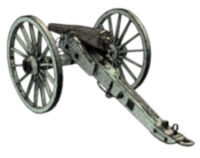
Sunday, June 23.—Yesterday the master of the Pilots’ Association and several of his pilots came on board, having been brought by the Ivy. With the exception of the master, they all agreed to take the ship to sea, whereupon I retained one of them and dismissed the rest. Both the Brooklyn and Powhatan at their anchors all day, close under the respective bars which they guard. Weather very warm and sultry. Mustered the crew at general quarters. Sent dispatches to town by the steamer Empire Parish. In the afternoon dispatched Lieutenant Stribling in the Seminole, in tow of the Ivy, to Pass à l’Outre to destroy the oil at the light-house and bring away the lamps, so as to prevent the enemy from having the use of the light. The object was accomplished. Received on board from Fort St. Philip a 24-pounder howitzer for use on the spar deck.
0 comments

Carroll Rangers Cavalry

News of the Day

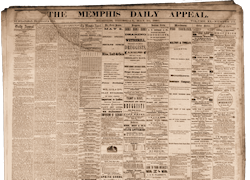
The Memphis Daily Appeal
Memphis, Tennessee
June 23, 1861

Letter from Mississippi.

Camp Vaiden, Carroll Co., Miss.,
June 19, 1861.
Editors Appeal: You will doubtless be interested in all matters connected with the war, and therefore I will write to tell you of our doings in these parts. The Carroll Rangers is a cavalry corps, under command of Captain Hudson. We have just got through an encampment of two weeks, held in some woods about three miles from this, on the property of Dr. Vaiden. Adjoining is a splendid prairie about three quarters of a mile long, beautifully adapted for drills. We have had pretty hard work, and in addition to the regular cavalry maneuvers, we engaged a gentleman of good experience and skill to instruct us in the saber exercise, especially. He has been drilling in the Adams troops of Natchez, and the Grosse Tete Rangers, of Louisiana, and under his care we have made great progress, as his mode of teaching is excellent, and comprises the practical combinations both against horse and foot. On Saturday last we had a grand parade and flag presentation. There were at least 2000 persons collected under the umbrageous shelter of a grove on the prairie, where all could see and hear. The flag was presented with an appropriate speech by our special belle, Miss Maddox, and received with the accustomed honors. Our parade was a successful one, and as the majority of those present had never witnessed such a sight before, it created great interest, especially the saber exercise, the bright blades flashing in the sun’s rays, making a brilliant scene indeed. We are now anxious to be off, and our captain leaves to-day for Richmond, to endeavor to arrange with Gov. Wise for our immediate departure to join his brigade, which if we do, we all trust in common with our Southern brethren to leave our mark upon our invaders. Yours respectfully,
A Carroll Ranger.
0 comments

“I shall wind up my affairs.”—Woolsey Family Letters, Eliza Woolsey Howland to Joseph Howland.

Woolsey family letters during the War for the Union

Tioronda, June 23, 1861.

. . . . I write chiefly to remind you of the stand of colors which Tiffany is making and promises for Wednesday. You may want to have them presented to the regiment the day they pass through New York, and, if so, will have to arrange the affair with the Colonel. I do not wish to appear in the matter, but you can present them in my name, or, if you like, perhaps Charley will be willing to, but don’t have any fuss or parade about it, and don’t let the men tramp through the city à la McChesney till they are exhausted. The colors will remain at Tiffany’s till the Colonel sends for them or notifies me.

Mary and Robert and the children are still here and all well. Mary broke the news of my going to the servants, who were very sorry for me and for themselves. In the course of next week I shall wind up my affairs–pay my debts, etc., and go to Mother’s. I shall go down on Wednesday when the regiment passes through New York, at all events, for the day and night, unless I hear to the contrary from you.


The Sixteenth left Albany for the seat of war via New York, June 25th, and, reaching the city early in the morning of the 26th, marched to Washington Square. Here at 3.30 before embarking for the South the regiment was presented with a stand of colors, state and national, made by Tiffany and Co.,– Eliza’s gift.

Mr. Robert S. Hone made the presentation in E.’s name, and Colonel Davies responded for the regiment,–also saying “already my command is deeply indebted to Mrs. Howland and her family for many articles which they needed while in Albany.”

Colonel Davies then delivered the state flag to the color-sergeant, who bore it to the line. Waving the national flag before the regiment, he asked each company if they would defend it. A prolonged “yes” rang from one end of the line to the other, followed by deafening cheers and waving of caps. That promise was faithfully kept.[1]

That same afternoon of the 26th the regiment left by transports for Elizabethport and from there by rail to Washington, via Baltimore. Before entering the last place ammunition was issued, in remembrance of the brutal attack of the mob there on the Massachusetts Sixth and other national troops. The Sixteenth New York was the first regiment to march through that city without some form of attack.


[1] At Gaines’ Mill the color-bearers were three times shot down, and all except one of the color-guard were either killed or wounded.


The regimental banner was in every march and every battle in which the regiment participated. At Crampton Gap Corporal Charles H. Conant was instantly killed by a minie ball through the head while holding one of the flags, and Corporal Robert Watson, of the color-guard, was shot through the leg in this action.

These flags are now deposited with other battle-flags in the Capitol at Albany.

0 comments

The First Regiment.

News of the Day

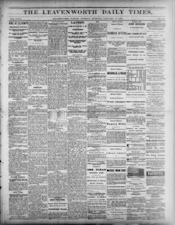
The Leavenworth Daily Times
Kansas
June 23, 1861

[Correspondence of the Times.]
.
Camp Fremont1, June 20th, ’61.
Dear Times:—I have been for sometime in a study as to whether to-day is Thursday or some other day; the monotony of camp life mixes things so considerable. In short to use Ike Marvel’s words, slightly altered, “the hours pass without knowledge and the Summer winds whistle uncared for.” Day after day drags its sometimes not very slow length along, diversified by drills and fatigue parties, roll calls and guard mountings, and the other et ceteras of a soldier’s life, too often associated with indolence and ease. The camp is the gymnasium of the Nation now, and dyspeptic, thin-limbed Americans will become robust and heart; sleep sound o’nights, and relish keenly the mess pork and hard bread, which Uncle Sam provides in no stinted quantity, for them who now aid him in the struggle for existence. Each meal is eaten with a zest and appetite which only health and exercise can give, and one feels, as it were, so rejuvenated after long years of mental toil in the realm of the quill and tripod, that he may be tempted to exclaim, “No middle ground for me; give me the tent of the Nomad, or a moonstone palace in the gorgeous realms of the ideal.”
Camp fare, after all, is not the poorest that has ever fallen to the lot of man. I have had more limited rations during the early days of Kansas, and of a poorer quality, than are furnished to the gallant 1st. Rations for ten days include seven pounds of fresh meat to three of salt junk; rice beans, coffee, hard and soft bread, are the “condiments;” appropos of which, a la Corwin, we have sugar and salt, but no mustard. An occasional supply of what Dr. Jennison terms field onions, lettuce, and other “garden sass,” finds its way in some mysterious manner, through the lines.
But to the news, which is akin to currency just now—very little, in circulation…
Cosmopolite.
.

  1. Probably at Cape Girardeau, Mo
0 comments

Extracts from the journal of Commander Semmes, C.S. Navy, commanding C.S.S. Sumter

War of the Rebellion: from the Official Records of the Union and Confederate Armies and Navies
Saturday, June 23. — The Ivy returned from the pass and reported that none of the pilots were willing to come on board , and having received also the following dispatch (through Captain Duncan ) from the Southwest Pass, viz :
Applied to the captain of the house of pilots for a pilot for the Sumter. He requested me to state that there are no pilots on duty now.
F. S. Woolfen.
I dispatched Lieutenant Stribling in the Ivy with a written order to the master of the Pilots’ Association to come on board of me and bring some of his pilots with him, and, in case of his refusal, directed him to arrest them all and bring them on board.
0 comments

William Howard Russell’s Diary: Impending battle.—By railway to Chicago.—Northern enlightenment.— Mound City.—” Cotton is King.”—Land in the States.—Dead level of American society.—Return into the Union.—American homes.—Across the prairie.—White labourers.—New pillager.—Lake Michigan.

My Diary North and South – William Howard Russell

June 23rd.–The latest information which I received to-day is of a nature to hasten my departure for Washington; it can no longer be doubted that a battle between the two armies assembled in the neighbourhood of the capital is imminent. The vague hope which from time to time I have entertained of being able to visit Richmond before I finally take up my quarters with the only army from which I can communicate regularly with Europe has now vanished.

At four o’clock in the evening I started by the train on the famous Central Illinois line from Cairo to Chicago.

The carriages were tolerably well filled with soldiers, and in addition to them there were a few unfortunate women, undergoing deportation to some less moral neighbourhood. Neither the look, language, nor manners of my fellow passengers inspired me with an exalted notion of the intelligence, comfort and respectability of the people which are so much vaunted by Mr. Seward and American journals, and which, though truly attributed, no doubt, to the people of the New England states, cannot be affirmed with equal justice to belong to all the other components of the Union.

As the Southerners say, their negroes are the happiest people on the earth, so the Northerners boast “We are the most enlightened nation in the world.” The soldiers in the train were intelligent enough to think they ought not to be kept without pay, and free enough to say so. The soldiers abused Cairo roundly, and indeed it is wonderful if the people can live on any food but quinine. However, speculators, looking to its natural advantages as the point where the two great rivers join, bespeak for Cairo a magnificent and prosperous future. The present is not promising.

Leaving the shanties, which face the levees, and some poor wooden houses with a short vista of cross streets partially flooded at right angles to them, the rail suddenly plunges into an unmistakeable swamp, were a forest of dead trees wave their ghastly, leafless arms over their buried trunks, like plumes over a hearse–a cheerless, miserable place, sacred to the ague and fever. This occurs close to the cleared space on which the city is to stand,–when it is finished–and the rail, which runs on the top of the embankment or levee, here takes to the trestle, and is borne over the water on the usual timber frame work.

“Mound City,” which is the first station, is composed of a mere heap of earth, like a ruined brick-kiln, which rises to some height and is covered with fine white oaks, beneath which are a few log huts and hovels, giving the place its proud name. Tents were pitched on the mound side, from which wild-looking banditti sort of men, with arms, emerged as the train stopped. “I’ve been pretty well over Europe,” said a meditative voice beside me, “and I’ve seen the despotic armies of the old world, but I don’t think they equal that set of boys.” The question was not worth arguing–the boys were in fact very “weedy,” “splinter-shinned chaps,” as another critic insisted.

There were some settlers in the woods around Mound City, and a jolly-looking, corpulent man, who introduced himself as one of the officers of the land department of the Central Illonois railroad, described them as awful warnings to the emigrants not to stick in the south part of Illinois. It was suggestive to find that a very genuine John Bull, “located,” as they say in the States for many years, had as much aversion to the principles of the abolitionists as if he had been born a Southern planter. Another countryman of his and mine, steward on board the steamer to Cairo, eagerly asked me what I thought of the quarrel, and which side I would back. I declined to say more than I thought the North possessed very great superiority of means if the conflict were to be fought on the same terms. Whereupon my Saxon friend exclaimed, “all the Northern States and all the power of the world can’t beat the South; and why?–because the South has got cotton, and cotton is king.”

The Central Illinois officer did not suggest the propriety of purchasing lots but he did intimate I would be doing service if I informed the world at large, they could get excellent land, at sums varying from ten to twenty-five dollars an acre. In America a man’s income is represented by capitalizing all that he is worth, and whereas in England we say a man has so much a year, the Americans, in representing his value, observe that he is worth so many dollars, by which they mean that all he has in the world would realise the amount.

It sounds very well to an Irish tenant farmer, an English cottier, or a cultivator in the Lothians, to hear that he can get land at the rate of from £2 to £5 per acre, to be his for ever, liable only to state taxes; but when he comes to see a parallelogram marked upon the map as “good soil, of unfathomable richness,” and finds in effect that he must cut down trees, eradicate stumps, drain off water, build a house, struggle for high-priced labour, and contend with imperfect roads, the want of many things to which he has been accustomed in the old country, the land may not appear to him such a bargain. In the wooded districts he has, indeed a sufficiency of fuel as long as trees and stumps last, but they are, of course, great impediments to tillage. If he goes to the prairie he finds that fuel is scarce and water by no means wholesome.

When we left this swamp and forest, and came out after a run of many miles on the clear lands which abut upon the prairie, large fields of corn lay around us, which bore a peculiarly blighted and harassed look. These fields were suffering from the ravages of an insect called the “army worm,” almost as destructive to corn and crops as the locust-like hordes of North and South, which are vying with each other in laying waste the fields of Virginia. Night was falling as the train rattled out into the wild, flat sea of waving grass, dotted by patch-like Indian corn enclosures; but halts at such places as Jonesburgh and Cobden, enabled us to see that these settlements in Illinois were neither very flourishing nor very civilised.

There is a level modicum of comfort, which maybe consistent with the greatest good of the greatest number, but which makes the standard of the highest in point of well-being very low indeed. I own, that to me, it would be more agreeable to see a flourishing community placed on a high level in all that relates to the comfort and social status of all its members than to recognise the old types of European civilisation, which place the castle on the hill, surround its outer walls with the mansion of doctor and lawyer, and drive the people into obscure hovels outside. But then one must confess that there are in the castle some elevating tendencies which cannot be found in the uniform level of citizen equality. There are traditions of nobility and noble deeds in the family; there are paintings on the walls; the library is stored with valuable knowledge, and from its precincts are derived the lessons not yet unlearned in Europe, that though man may be equal the condition of men must vary as the accidents of life or the effects of individual character, called fortune, may determine.

The towns of Jonesburgh and Cobden have their little teapot-looking churches and meeting houses, their lager-bier saloons, their restaurants, their small libraries, institutes, and reading rooms, and no doubt they have also their political cliques, social distinctions and favouritisms; but it requires, nevertheless, little sagacity to perceive that the highest of the bourgeois who leads the mass at meeting and prayer, has but little to distinguish him from the very lowest member of the same body politic. Cobden, for example, has no less than four drinking saloons, all on the line of rail, and no doubt the highest citizen in the place frequents some one or other of them, and meets there the worst rowdy in the place. Even though they do carry a vote for each adult man, “locations” here would not appear very enviable in the eyes of the most miserable Dorsetshire small farmer ever ferretted out by “S. G. O.”

A considerable number of towns, formed by accretions of small stores and drinking places, called magazines, round the original shed wherein live the station master and his assistants, mark the course of the railway. Some are important enough to possess a bank, which is generally represented by a wooden hut, with a large board nailed in front, bearing the names of the president and cashier, and announcing the success and liberality of the management. The stores are also decorated with large signs, recommending the names of the owners to the attention of the public, and over all of them is to be seen the significant announcement, “Cash for produce.”

At Carbondale there was no coal at all to be found, but several miles farther to the north, at a place called Dugoine, a field of bituminous deposit crops out, which is sold at the pit’s mouth for one dollar twenty-five cents, or about 5s. 2d. a-ton. Darkness and night fell as I was noting such meagre particulars of the new district as could be learned out of the window of a railway carriage; and finally with a delicious sensation of cool night air creeping in through the windows, the first I had experienced for many a long day, we made ourselves up for repose, and were borne steadily, if not rapidly, through the great prairie, having halted for tea at the comfortable refreshment rooms of Centralia.

There were no physical signs to mark the transition from the land of the Secessionist to Union-loving soil. Until the troops were quartered there, Cairo was for Secession, and Southern Illinois is supposed to be deeply tainted with disaffection to Mr. Lincoln. Placards on which were printed the words, “Vote for Lincoln and Hamlin, for Union and Freedom,” and the old battle-cry of the last election, still cling to the wooden walls of the groceries often accompanied by bitter words or offensive additions.

One of my friends argues that as slavery is at the base of Secession, it follows that States or portions of States will be disposed to join the Confederates or the Federalists just as the climate may be favourable or adverse to the growth of slave produce. Thus in the mountainous parts of the border States of Kentucky and Tennessee, in the north-western part of Virginia, vulgarly called the pan handle, and in the pine woods of North Carolina, where white men can work at the rosin and naval store manufactories, there is a decided feeling in favour of the Union; in fact, it becomes a matter of isothermal lines. It would be very wrong to judge of the condition of a people from the windows of a railway carriage, but the external aspect of the settlements along the line, far superior to that of slave hamlets, does not equal my expectations. We all know the aspect of a wood in a gentleman’s park which is submitting to the axe, and has been partially cleared, how raw and bleak the stumps look, and how dreary is the naked land not yet turned into arable. Take such a patch and fancy four or five houses made of pine planks, sometimes not painted, lighted by windows in which there is, or has been, glass, each guarded by a paling around a piece of vegetable garden, a pig house, and poultry box; let one be a grocery, which means a whisky shop, another the post-office, and a third the store where “cash is given for produce.” Multiply these groups if you desire a larger settlement, and place a wooden church with a Brobdignag spire and Lilliputian body out in a waste, to be approached only by a causeway of planks; before each grocery let there be a gathering of tall men in sombre clothing, of whom the majority have small newspapers and all of whom are chewing tobacco; near the stores let there be some light wheeled carts and ragged horses, around which are knots of unmistakeably German women; then see the deep tracks which lead off to similar settlements in the forest or prairie, and you have a notion, if your imagination is strong enough, of one of these civilising centres which the Americans assert to be the homes of the most cultivated and intelligent communities in the world.

Next morning, just at dawn, I woke up and got out on the platform of the carriage, which is the favourite resort of smokers and their antithetics, those who love pure fresh air, notwithstanding the printed caution “It is dangerous to stand on the platform;” and under the eye of early morn saw spread around a flat sea-like expanse not yet warmed into colour and life by the sun. The line was no longer guarded from daring Secessionists by soldiers’ outposts, and small camps had disappeared. The train sped through the centre of the great verdant circle as a ship through the sea, leaving the rigid iron wake behind it tapering to a point at the horizon, and as the light spread over it the surface of the crisping corn waved in broad undulations beneath the breeze from east to west. This is the prairie indeed. Hereabouts it is covered with the finest crops, some already cut and stacked. Looking around one could see church spires rising in the distance from the white patches of houses, and by degrees the tracks across the fertile waste became apparent, and then carts and horses were seen toiling through the rich soil.

A large species of partridge or grouse appeared very abundant, and rose in flocks from the long grass at the side of the rail or from the rich carpet of flowers on the margin of the corn fields. They sat on the fence almost unmoved by the rushing engine, and literally swarmed along the line. These are called “prairie chickens” by the people, and afford excellent sport. Another bird about the size of a thrush, with a yellow breast and a harsh cry, I learned was “the sky-lark;” and apropos of the unmusical creature, I was very briskly attacked by a young lady patriot for finding fault with the sharp noise it made. “Oh, my! And you not to know that your Shelley loved it above all things! Didn’t he write some verses –quite beautiful, too, they are–to the sky-lark.” And so “the Britisher was dried up,” as I read in a paper afterwards of a similar occurrence.

At the little stations which occur at every few miles –there are some forty of them, at each of which the train stops, in 365 miles between Cairo and Chicago– the Union flag floated in the air; but we had left all the circumstance of this inglorious war behind us, and the train rattled boldly over the bridges across the rare streams, no longer in danger from Secession hatchets. The swamp had given place to the corn field. No black faces were turned up from the mowing and free white labour was at work, and the type of the labourers was German and Irish.

The Yorkshireman expatiated on the fertility of the land, and on the advantages it held out to the emigrant. But I observed all the lots by the side of the rail, and apparently as far as the eye could reach, were occupied. “Some of the very best land lies beyond on each side,” said he. “Out over there in the fat places is where we put our Englishmen.” By digging deep enough good water is always to be had, and coal can be carried from the rail, where it costs only 7s. or 8s. a ton. Wood there is little or none in the prairies, and it was rarely indeed a clump of trees could be detected, or anything higher than some scrub brushwood. These little communities which we passed were but the growth of a few years, and as we approached the Northern portion of the line we could see, as it were, the village swelling into the town, and the town spreading out to the dimensions of the city. “I daresay. Major,” says one of the passengers, “this gentleman never saw anything like these cities before. I’m told they’ve nothin’ like them in Europe?” “Bless you,” rejoined the Major, with a wink, “just leaving out London, Edinbro’, Paris, and Manchester, there’s nothing on earth to ekal them.” My friend, who is a shrewd fellow, by way of explanation of his military title, says, “I was a major once, a major in the Queen’s Bays, but they would put troop-sergeant before it them days.” Like many Englishmen he complains that the jealousy of native-born Americans effectually bars the way topolitical position of any naturalised citizen, and all the places are kept by the natives.

The scene now began to change gradually as we approached Chicago, the prairie subsided into swampy land, and thick belts of trees fringed the horizon; on our right glimpses of the sea could be caught through openings in the wood–the inland sea on which stands the Queen of the Lakes. Michigan looks broad and blue as the Mediterranean. Large farmhouses stud the country, and houses which must be the retreat of merchants and citizens of means; and when the train, leaving the land altogether, dashes out on a pier and causeway built along the borders of the lake, we see lines of noble houses, a fine boulevard, a forest of masts, huge isolated piles of masonry, the famed grain elevators by which so many have been hoisted to fortune, churches and public edifices, and the apparatus of a great city; and just at nine o’clock the train gives its last steam shout and comes to a standstill in the spacious station of the Central Illinois Company, and in half-an-hour more I am in comfortable quarters at the Richmond House, where I find letters waiting for me, by which it appears that the necessity for my being in Washington in all haste, no longer exists. The wary General who commands the army is aware that the advance to Richmond, for which so many journals are clamouring, would be attended with serious risk at present, and the politicians must be content to wait a battle longer.

0 comments

“A soldier is a mere machine and has no business to know anything except his duty.”–Army letters of Oliver Willcox Norton.

Civil War Day-by-Day

Camp Wright, Hulton, Penn.,
Saturday. June 22, 1861.

Dear Mother:–

None of the boys have had any letters for a week. At last they begin to come and all bring news, “we heard you were coming home.” Well, the origin of that story was this: Colonel McLane received orders to start for Harrisburg, where his regiment would be sworn in for three years. A vote was taken and not over half the men would enlist for that time, and it was reported that the remainder would be sent home, and the regiment filled from other companies in camp. As usual, the order was countermanded, and we are here yet.

Yesterday a dispatch was received saying we were to be armed and

Sunday morning, 23d.

I had got as far as that yesterday when I was stopped by the cry, “Fall in, marching orders are received, we’re off by the first train,” etc. I put away my writing, seized my gun, and was in the ranks in a short time. The cannon was booming out our joy, and amid the wildest cheers we marched to the guard house and reported to the “Officer of the day,” who said the orders were to have everything packed and ready to leave by 2 o’clock. We returned to our quarters and commenced packing, when, as usual, the orders were countermanded. General McCall telegraphed, “Hold on, don’t start till further orders.” The further orders have not come yet. Here we are at 11 a. m., to-day, and three companies are detailed for guards, Companies E, F and K, showing that we will not leave to-day.

We are ordered to Harrisburg to receive uniforms and equipments, and we expect to go from there to Western Virginia.

That is the fourth time we have had marching orders countermanded. Colonel McLane telegraphed to Harrisburg that he should start for Harrisburg or Erie on Monday. If his regiment was not ordered off he would take them home. The arms were distributed to the regiment a few days ago, and we are having the most severe drill. The thermometer stands in the neighborhood of 100 most of the time and they take us out about two hours at a time and keep us marching till the sweat pours off in streams.

I think this severe drilling shows that we are to see service soon, though when or where, we cannot tell. A soldier is a mere machine and has no business to know anything except his duty. His officers take care that he does not.

0 comments

“The most worthless fellows are the ones that will go home.”–Army Life of an Illinois Soldier, Charles Wright Wills.

Civil War Day-by-Day

Cairo, June 23, 1861.

Camp is very dull now, and we are more closely confined in it than ever. Not a soldier goes out now except in company with a commissioned officer or on a pass from the general. The latter not one in a thousand can get and the former maybe one in five hundred.

We have no drilling now between 8 a.m. and 7 p.m. on account of the heat; so we have plenty of spare time. If I only had some good books! But I can’t send for them now for our colonel keeps us about half excited all the time with a prospect of a move. He says we have two chances: First, if General McClellan suffers anything like a serious repulse in Western Virginia, our whole brigade will move out on two hours’ notice. Second, if any reliable reports come of Arkansas troops moving into Missouri, we will double quick over the river and leave the Point to some other troops. The last is the most likely chance. A thousand of our boys went off on the “City of Alton” at dark last night. We don’t know where to, but ’tis rumored that they went up the Mississippi 25 miles and then marched back into Missouri 30 miles to intercept a train of wagons loaded with provisions going south. The colonel made them a speech; told them they were sure to have a brush and asked them if they would sustain the credit of the 8th. You should have heard them shout! Only two companies went from our regiment under Lieutenant Colonel Rhoads. The Battallion was under Colonel Morgan. The three year question causes more excitement than every thing else now. Nearly our whole company will go. The most worthless fellows are the ones that will go home. I feel as if my place is here. I know I could not content myself at home, and if I could, every young man with no one depending upon him is needed in the army more than anywhere else. I know I have your approval in this resolve, but I would like to have you tell me so. The Americans in our company think some of seceding, filling up from home with American boys and letting the Dutch now in the company paddle their own canoe. I wonder if we could not get a dozen good strong fellows from Canton. We don’t want any poorer men than I am, for we are going to make a crack company.

0 comments

Civil War Day-By-Day

Civil War Day-by-Day

June 23, 1861

  • Confederates under Col. Thomas J. Jackson begin a systematic destruction of the B&O Railroad at Martinsburg, including burning 42 locomotives and numerous cars. (Baltimore American, Stover—Johnston says 6/20–21 56 locos and 386 cars—that was the total haul including those taken south)1

  1. Baer, Christopher, A General Chronology of the Pennsylvania Railroad Company, its Predecessors and Successors and its Historical Context (1861), The Pennsylvania Railroad Technical & Historical Society, 2015 (accessed 5/29/2021)


0 comments

Manufactory of Ammunition.

News of the Day

The Memphis Daily Appeal
Memphis, Tennessee
June 22, 1861

By the kindness of Mr. Trezevant, we were yesterday admitted within the Confederate Government saber manufactory, on the south-east corner of Monroe and Third streets, over which establishment we were obligingly shown by the efficient superintendent and inspector, Lieut. Sengstack. On mounting to the immense room up stairs, we found four large tables ranged from end to end of the room, and at these tables two hundred and fifty women and girls, principally young girls, were busily engaged in the labor of preparing cartridges. The paper is rapidly passed round a stick, giving the required shape and size, then three buck shot and a bullet are placed at the bottom of it and held in their place by threads neatly and quickly tied round them. These are passed to others, who, placing a small funnel into the top of the paper tube deposit within, from a small measure, the required quantity of gunpowder. Others folded up the end of the paper and the cartridge was completed. Ten cartridges are next tied together in a package, and a given number of them are packed in a box, marked and certified as inspected, when they are ready for army use. So efficient is this department that already as many as seventy-five thousand cartridges have been turned out in one day. [continue reading…]
0 comments

“At length I turned my head, and beheld the President not three feet from me.”—A Rebel War Clerk’s Diary at the Confederate States Capital

Civil War Day-by-Day

JUNE 22d.—The Convention has appointed ten additional members to the Provisional Congress—President Tyler among them. It will be observed that my Diary goes on, including every day. Fighting for our homes and holy altars, there is no intermission on Sunday. It is true, Mr. Memminger came in the other day with a proposition to cease from labor on Sunday, but our Secretary made war on it. The President, however, goes to church very regularly—St. Paul’s.

On last Sunday the President surprised me. It was before church time, and I was working alone. No one else was in the large room, and the Secretary himself had gone home, quite ill. I thought I heard some one approaching lightly from behind, but wrote on without looking up; even when he had been standing some time at the back of my chair. At length I turned my head, and beheld the President not three feet from me. He smiled, and said he was looking for a certain letter referred by him to the Secretary. I asked the name of the writer, which he told me. I said I had a distinct recollection of it, and had taken it into the Secretary with other papers that morning. But the Secretary was gone. We then proceeded into the Secretary’s office in search of it. The Secretary’s habit was to take the papers from his table, and after marking on them with his pencil the disposition he wished made of them, he threw them helter-skelter into a large arm-chair. This chair now contained half a bushel; and the President and I set to work in quest of the letter. We removed them one by one; and as we progressed, he said with an impatient smile, “it is always sure to be the last one.” And so it was. Having found it, he departed immediately; and soon after I saw him on his way to church.

0 comments

Camps of Instruction.

News of the Day

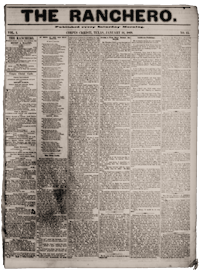
The Ranchero
Corpus Christi, Texas
June 22, 1861

Gov. Clark has issued a proclamation, dated June 8th, 1861, directing the attention of the people to a want which is deeply felt, viz: a thorough knowledge of every movement of the battle-field. Military encampments, for the instruction of infantry troops designed for Confederate service, will be established at the most available points in the State, provided with able drill officers. He says our heroic volunteers themselves are eager to go into these
encampments and they will find a sufficient and incentive reward in the instruction they will receive, and in the thorough readiness for battle they will acquire. Yet, while receiving this instruction, the people must support them; and he makes the appeal to every man who has one drop of patriotic blood in his veins, or one sentiment of State pride in his heart. Let every farmer hold himself in readiness to bestow a portion of his abundant crop; every merchant a share of his commercial profit; every artisan a contribution of his valuable labor, and every man all that is in his power, to support these chivalric men, who will discipline themselves to defend our country and maintain its independence. Aids-de-camp to the Governor have been appointed, each of whom is provided with full authority and instructions to establish a camp and control its organization in his respective district.
In compliance with the above, the Adjutant General of the State issued orders on the 10th inst., dividing the State into eleven military districts, leaving out the frontier counties. The 1st District is [continue reading…]
0 comments

“We do not know the future, and economy is a duty.”—Rutherford B. Hayes

Diary and Letters of Rutherford Birchard Hayes

CAMP CHASE, June 22, 1861.

DEAREST LU:–I start for Fremont this morning. . . . As to surgeons, four only are to be appointed; it will not be possible to get two of them from Cincinnati. Either Clendenin or Dr. Joe will not get appointed. I mention this merely to show the facts. I want the doctor to do nothing at all about it, nor to say anything about it. Dr. Clendenin can probably get an appointment from Washington as brigade surgeon. It will be some days before the appointments will be made. There is a good disposition to accommodate us at headquarters, and I think the prospect fair for his [Dr. Joe’s] appointment.

I shall want towels, sheets, and three table-cloths, one and one-half dozen napkins, two comforts. Don’t buy them, or any of them, but if you have them to spare, I will take them. I would advise the spending of as little as possible. We do not know the future, and economy is a duty. These things are merely luxuries. Love to all.

Affectionately,

R.

P. S.–You will enjoy looking at us here, and I shall be glad to have you come up. You can hardly live out at camp; but possibly, we can keep you a night or two, and you can stay here through the day. It is pleasant living here. Colonel Scammon is our colonel. This will do. It has advantages which I need not explain which would not occur to an outside looker-on.

MRS. HAYES.

0 comments

Washington

Diary of Battery A, First Regiment, Rhode Island Light Artillery, by Theodore Reichardt
Saturday, June 22.—Arrival at the National Capital. By daylight the cupola of the Capitol greeted our eyes, a reviving sight after three sleepless nights. Col. Ambrose E. Burnside and Capt. Chas. H. Tompkins had a breakfast prepared for us, consisting of roast beef, soft bread and coffee. After unloading battery, we marched towards Camp Sprague, and established our quarters on the left of those of the First R. I. infantry regiment and battery. Our camp was named “Camp Clark,” in honor of the celebrated Bishop Clark, of Rhode Island, the model of a Christian minister and true patriot.
0 comments

William Howard Russell’s Diary: American country-walks.—Recklessness of life.—Want of cavalry.—Émeute in the camp.—Defects of army medical department.—Horrors of war.—Bad discipline.

My Diary North and South – William Howard Russell

June 22nd. An active man would soon go mad if he were confined in Cairo. A mudbank stretching along the course of a muddy river is not attractive to a pedestrian; and, as is the case in most of the Southern cities, there is no place round Cairo where a man can stretch his legs, or take an honest walk in the country. A walk in the country! The Americans have not an idea of what the thing means. I speak now only of the inhabitants of the towns of the States through which I have passed, as far as I have seen of them. The roads are either impassible in mud or knee-deep in dust. There are no green shady lanes, no sheltering groves, no quiet paths through green meadows beneath umbrageous trees. Off the rail there is a morass–or, at best, a clearing–full of stumps. No temptations to take a stroll. Down away South the planters ride or drive; indeed in many places the saunterer by the way-side would probably encounter an alligator, or disturb a society of rattle-snakes.

To-day I managed to struggle along the levee in a kind of sirocco, and visited the works at the extremity, which were constructed by an Hungarian named Waagner, one of the emigrés who came with Kossuth to the United States. I found him in a hut full of flies, suffering from camp diarrhÅ“a, and waited on by Mr. O’Leary, who was formerly petty officer in our navy, served in the Furious in the Black Sea, and in the Shannon Brigade in India, now a lieutenant in the United States’ army, where I should say he feels himself very much out of place. The Hungarian and the Milesian were, however, quite agreed about the utter incompetence of their military friends around them, and the great merits of heavy artillery. “When I tell them here the way poor Sir William made us rattle about them 68-pounder guns, the poor ignorant creatures laugh at me–not one of them believes it.” “It is most astonishing,” says the colonel, “how ignorant they are; there is not one of these men who can trace a regular work. Of West-point men I speak not, but of the people about here, and they will not learn of me–from me who knows.” However, the works were well enough, strongly covered, commanded both rivers, and not to be reduced without trouble.

The heat drove me in among the flies of the crowded hotel, where Brigadier Prentiss is planning one of those absurd expeditions against a Secessionist camp at Commerce, in the State of Missouri, about two hours steaming up the river, and some twelve or fourteen miles inland. Cairo abounds in Secessionists and spies, and it is needful to take great precautions lest the expedition be known; but, after all, stores must be got ready, and put on board the steamers, and preparations must be made which cannot be concealed from the world. At dusk 700 men, supported by a six-pounder field-piece, were put on board the “City of Alton,” on which they clustered like bees in a swarm, and as the huge engine laboured up and down against the stream, and the boat swayed from side to side, I felt a considerable desire to see General Prentiss chucked into the stream for his utter recklessness in cramming on board one huge tinder-box, all fire and touchwood, so many human beings, who, in event of an explosion, or a shot in the boiler, or of a heavy musketry fire on the banks, would have been converted into a great slaughter-house. One small boat hung from her stern, and although there were plenty of river flats and numerous steamers, even the horses belonging to the field piece were crammed in among the men along the deck.

In my letter to Europe I made, at the time, some remarks by which the belligerents might have profited, and which at the time these pages are reproduced may strike them as possessing some value, illustrated as they have been by many events in the war. “A handful of horsemen would have been admirable to move in advance, feel the covers, and make prisoners for political or other purposes in case of flight; but the Americans persist in ignoring the use of horsemen, or at least in depreciating it, though they will at last find that they may shed much blood, and lose much more, before they can gain a victory without the aid of artillery and charges after the retreating enemy. From the want of cavalry, I suppose it is, the unmilitary practice of ‘scouting,’ as it is called here, has arisen. It is all very well in the days of Indian wars for footmen to creep about in the bushes, and shoot or be shot by sentries and pickets; but no civilised war recognises such means of annoyance as firing upon sentinels, unless in case of an actual advance or feigned attack on the line. No camp can be safe without cavalry videttes and pickets; for the enemy can pour in impetuously after the alarm has been given, as fast as the outlying footmen can run in. In feeling the way for a column, cavalry are invaluable, and there can be little chance of ambuscades or surprises where they are judiciously employed; but ‘scouting’ on foot, or adventurous private expeditions on horseback, to have a look at the enemy, can do, and will do, nothing but harm. Every day the papers contain accounts of ‘scouts’ being killed, and sentries being picked off. The latter is a very barbarous and savage practice; and the Russian, in his most angry moments, abstained from it. If any officer wishes to obtain information as to his enemy, he has two ways of doing it. He can employ spies, who carry their lives in their hands, or he can beat up their quarters by a proper reconnaissance on his own responsibility, in which, however, it would be advisable not to trust his force to a railway train.”

At night there was a kind of émeute in camp. The day, as I have said, was excessively hot, and on returning to their tents and huts from evening parade the men found the contractor who supplies them with water had not filled the barrels; so they forced the sentries, broke barracks after hours, mobbed their officers, and streamed up to the hotel, which they surrounded, calling out, “Water, water,” in chorus. The General came out, and got up on a rail: “Gentlemen,” said he, “it is not my fault you are without water. It’s your officers who are to blame; not me.” (“Groans for the Quartermaster,” from the men.) “If it is the fault of the contractor, I’ll see that he is punished. I’ll take steps at once to see that the matter is remedied. And now, gentlemen, I hope you’ll go back to your quarters;” and the gentlemen took it into their heads very good-humouredly to obey the suggestion, fell in, and marched back two deep to their huts.

As the General was smoking his cigar before going to bed, I asked him why the officers had not more control over the men. “Well,” said he, “the officers are to blame for all this. The truth is, the term for which these volunteers enlisted is drawing to a close; and they have not as yet enrolled themselves in the United States’ army. They are merely volunteer regiments of the State of Illinois. If they were displeased with anything, therefore, they might refuse to enter the service or to take fresh engagements: and the officers would find themselves suddenly left without any men; they therefore curry favour with the privates, many of them, too, having an eye to the votes of the men when the elections of officers in the new regiments are to take place.”

The contractors have commenced plunder on a gigantic scale; and their influence with the authorities of the State is so powerful, there is little chance of punishing them. Besides, it is not considered expedient to deter contractors, by too scrupulous an exactitude, in coming forward at such a trying period; and the Quartermaster’s department, which ought to be the most perfect, considering the number of persons connected with transport and carriage is in a most disgraceful and inefficient condition. I told the General that one of the Southern leaders proposed to hang any contractor who was found out in cheating the men, and that the press cordially approved of the suggestion. “I am afraid,” said he, “if any such proposal was carried out here, there would scarcely be a contractor left throughout the States.” Equal ignorance is shown by the medical authorities of the requirements of an army. There is not an ambulance or cacolet of any kind attached to this camp; and, as far as I could see, not even a litter was sent on board the steamer which has started with the expedition.

Although there has scarcely been a fought field or anything more serious than the miserable skirmishes of Shenck and Butler, the pressure of war has already told upon the people. The Cairo paper makes an urgent appeal to the authorities to relieve the distress and pauperism which the sudden interruption of trade has brought upon so many respectable citizens. And when I was at Memphis the other day, I observed a public notice in the journals, that the magistrates of the city would issue orders for money to families left in distress by the enrolment of the male members for military service. When General Scott, sorely against his will, was urged to make preparations for an armed invasion of the seceded states in case it became necessary, he said it would need some hundreds of thousands of men and many millions of money to effect that object. Mr. Seward, Mr Chase, and Mr. Lincoln laughed pleasantly at this exaggeration, but they have begun to find by this time the old general was not quite so much in the wrong.

In reference to the discipline maintained in the camp, I must admit that proper precautions are used to prevent spies entering the lines. The sentries are posted closely and permit no one to go in without a pass in the day and a countersign at night. A conversation with General Prentiss in the front of the hotel was interrupted this evening by an Irishman, who ran past us towards the camp, hotly pursued by two policemen. The sentry on duty at the point of the lines close to us brought him up by the point of the bayonet. “Who goes tere?” “A friend, shure your honour; I’m a friend.” “Advance three paces and give the countersign.” “I don’t know it, I tell you. Let me in, let me in.” But the German was resolute, and the policemen now coming up in hot pursuit, seized the culprit, who resisted violently, till General Prentiss rose from his chair and ordered the guard, who had turned out, to make a prisoner of the soldier and hand him over to the civil power, for which the man seemed to be most deeply grateful. As the policemen were walking him off, he exclaimed, “Be quiet wid ye, till I spake a word to the Giniral,” and then bowing and chuckling with drunken gravity, he said, “an’ indeed, Giniral, I’m much obleeged to ye altogither for this kindness. Long life to ye. We’ve got the better of that dirty German. Hoora’ for Giniral Prentiss.” He preferred a chance of more whisky in the police office and a light punishment to the work in camp and a heavy drill in the morning. An officer who was challenged by a sentry the other evening, asked him, “do you know the countersign yourself?” “No, sir, it’s not nine o’clock and they have not given it out yet.” Another sentry who stopped a man because he did not know the countersign. The fellow said, “I dare say you don’t know it yourself.” “That’s a lie,” he exclaimed, “it’s Plattsburgh.” “Plattsburgh it is, sure enough,” said the other, and walked on without further parley.

The Americans, Irish, and Germans, do not always coincide in the phonetic value of each letter in the passwords, and several difficulties have occurred in consequence. An incautious approach towards the posts at night is attended with risk; for the raw sentries are very quick on the trigger. More fatal and serious injuries have been inflicted on the Federals by themselves than by the enemy. “I declare to you, sir, the way the boys touched off their irons at me going home to my camp last night, was just like a running fight with the Ingins. I was a little ‘tight,’ and didn’t mind it a cuss.”

0 comments

It has realy been the most quiet day that we have had for some time.—Horatio Nelson Taft

Diary of US patent clerk Horatio Nelson Taft.

SATURDAY 22

This is the day which was set for the capture of Washington by the “Secessionists.” But the day has passed off quietly and that thing has not been attempted. The Fifty thousand Bayonets here were a slight obsticle in the way. It has realy been the most quiet day that we have had for some time. Three or four Regts have arrived. The 2nd R.I., 1240 men and “Scott Life Guard,” are two of them. Gov Sprague came back with the RI Regt. I went to market, read the papers & Retired.

______

The three diary manuscript volumes, Washington during the Civil War: The Diary of Horatio Nelson Taft, 1861-1865, are available online at The Library of   Congress.

0 comments

“Many are frightened and are looking round for some place to flee to.”—Horatio Nelson Taft

Diary of US patent clerk Horatio Nelson Taft.

FRIDAY, JUNE 21, 1861.

This has been a hot day. At the dress Parade of the “12th” this evening about twenty of the soldiers droped down, overcome with heat. All sorts of reports have been in circulation today. “Genl Beauregard” has been on the march for the City with one hundred thousand men. Many are frightened and are looking round for some place to flee to. Genl Lyon of Missouri is making his mark in puting down rebellion there. So hot that I could not go down to the Ave.

______

The three diary manuscript volumes, Washington during the Civil War: The Diary of Horatio Nelson Taft, 1861-1865, are available online at The Library of   Congress.

0 comments

“…It was Bishop Polk… He had just been appointed a major-general, and assigned to duty in the West, where he would rank Gen. Pillow…,”—A Rebel War Clerk’s Diary at the Confederate States Capital, By John Beauchamp Jones

Civil War Day-by-Day

JUNE 21st.—A large, well-proportioned gentleman with florid complexion and intellectual face, who has been whispering with Col. Bledsoe several times during the last week, attracted my attention to-day. And when he retired, Colonel B. informed me it was Bishop Polk, a classmate of his and the President’s at West Point. He had just been appointed a major-general, and assigned to duty in the West, where he would rank Gen. Pillow, who was exceedingly unpopular in Adjutant-Gen. Cooper’s office. I presume this arose solely from mistrust of his military abilities; for he had certainly manifested much enthusiasm in the cause, and was constantly urging the propriety of aggressive movements with his command. All his purposed advances were countermanded. The policy of the government is to be economical of the men. We have but a limited, the enemy an inexhaustible number.

0 comments

Baltimore—No demonstration was made, the throwing of a few bricks on the cars, in the neighborhood of the depot, excepted.

Diary of Battery A, First Regiment, Rhode Island Light Artillery, by Theodore Reichardt
Friday, June 21.—Arrived at Harrisburg early in the morning. Coffee, bread and pies were given to us by inhabitants of that place. After a short halt, we resumed our journey, crossed the Susquehanna river, passed Little York, and arrived at Baltimore by eight o’clock in the evening. Our battery was immediately loaded on flats, drawn by horses to the top of the hill, the horses unhitched then, and the cars rolled down the other side to the Washington depot. Order was given not to accept of any refreshments from the citizens. No demonstration was made, the throwing of a few bricks on the cars, in the neighborhood of the depot, excepted. Started for Washington by ten o’clock.
0 comments

From the Indian Territory—United States Forts Garrisoned by “Confederate” Savages.

News of the Day

Daily Times
Leavenworth, Kansas
June 21, 1861

We find the following statements in New Orleans Crescent of Friday last. Of course many of the assertions contained therein are exaggerations:
.
We had the pleasure yesterday of an interview with Mr. John A. Peel, who has just returned from Ouachita, in Indian Territory. Fort Ouachita [sic—Fort Washita], he informs us, and all the other forts in the Territory, were evacuated by the federal forces before the arrival of the Texas troops under Col. Young.
The company to which Mr. Peel belonged, the Dead Shot Rangers, from Jefferson, Texas, captured fourteen wagons belonging to Emory’s command, which had been left behind. A company from Fanin county also captured several wagons. Emory, finding the Texans in close pursuit of him, threw away guns, amunition and Government stores, into the Ouachita, first destroying the guns by breaking the locks and taking them to pieces. The enemy left at Fort Ouachita a large quantity of clothing, some provisions, and one field piece. At Fort Arbuckle, also, they [continue reading…]
0 comments

Extraordinary efforts have been made to induce our people to embark in a foolish and wicked assault on the Government and laws that protect them.

The Letters of Samuel Ryan Curtis

Camp Lyon, Near the City of St. Joseph1
June 21, 1861.

Messrs. Austin A. King, and others–

Gentlemen: Your note of the 18th has been received, and I embrace the very first leisure moment to reply thereto. In regard to my mission here, I have to say that I am sent here by my Government and your Government to support and sustain the supremacy of the constitution and laws of our common Government, the United States of America. Extraordinary efforts have been made to induce our people to embark in a foolish and wicked assault on the Government and laws that protect them. Men are enrolled, mustered, and in arms against their own country, and therefore against the peace of society, and my orders and purpose are to suppress these unnatural belligerents by military force. So far from disturbing peaceable law abiding citizens, it is my desire to protect and shield them from insult, anarchy and oppression. But those who are in arms or hiding, directing and encouraging “secession” and civil war I regard as enemies of our country, and they will be pursued with all calamities of civilized warfare.

It is difficult to distinguish between those who enrolled under former laws with no view of rebellion and those who are recently enrolled with the avowed purpose of cooperating with secession armies, but I will of course endeavor to guard the innocent men when found associated with rebels if they promptly take oath of allegiance, and immediately and publicly withdraw from such associations. While it is my painful duty to carry forward the aims and emblems of National power against persons we have before regarded as citizens and friends, I will rejoice to see them surrender their arms, return to their allegiance and unite with us in sustaining a flag that our fathers unfurled, our country maintains, and the world continues to respect and honor.

I hope we of this generation may be equal to the occasion and transmit the blessings of liberty to succeeding generations.

Uniting with you in sympathy with those who innocently suffer from the accidents and havoc of war, I am, very truly and respectfully

Your ob’t Servant,
Sam’I R. Curtis
Colonel Commanding


1. Ibid. A Confederate flag had been raised in St. Joseph, a Union flag hauled down and torn to shreds; a railroad bridge was discovered on fire, and the suspected parties arrested, found to be secessionists: two men were arrested and charged with membership in a military drill company marching under the Confederate banner, using swords taken from the government arsenal at Liberty. Missouri. The Secessionist friends in St. Joseph had also secured a hasty Common Council ordinance against the raising of flags in the city, apparently designed to prevent a federal flag from being flown.

0 comments

William Howard Russell’s Diary: Camp at Cairo.—The North and the South in respect to Europe.—Political reflections.—Mr. Colonel Oglesby.—My speech.—Northern and Southern soldiers compared.

My Diary North and South – William Howard Russell

June 21st. Verily I would be sooner in the Coptic Cairo, narrow streeted, dark bazaared, many flied, much vexed by donkeys and by overland route passengers, than the horrid tongue of land which licks the muddy margin of the Ohio and the Mississippi. The thermometer at 100 ° in the shade before noon indicates nowhere else such an amount of heat and suffering, and yet prostrate as I was, it was my fate to argue that England was justified in conceding belligerent rights to the South, and that the attitude of neutrality we had assumed in this terrible quarrel is not in effect an aggression on the United States; and here is a difference to be perceived between the North and the South.

The people of the seceding States, aware in their consciences that they have been most active in their hostility to Great Britain, and whilst they were in power were mainly responsible for the defiant, irritating, and insulting tone commonly used to us by American statesmen, are anxious at the present moment, when so much depends on the action of foreign countries, to remove all unfavourable impressions from our minds by declarations of good will, respect, and admiration, not quite compatible with the language of their leaders in times not long gone by. The North, as yet unconscious of the loss of power, and reared in a school of menace and violent assertion of their rights regarding themselves as the whole of the United States, and animated by their own feeling of commercial and political opposition to Great Britain, maintain the high tone of a people who have never known let or hindrance in their passions, and consider it an outrage that the whole world does not join in active sympathy for a government which in its brief career has contrived to affront every nation in Europe with which it had any dealings.

If the United States have astonished France by their ingratitude, they have certainly accustomed England to their petulance, and one can fancy the satisfaction with which the Austrian Statesmen who remember Mr. Webster’s despatch to Mr. Hulsemann, contemplate the present condition of the United States in the face of an insurrection of these sovereign and independent States which the Cabinet at Washington stigmatises as an outbreak of rebels and traitors to the royalty of the Union.

During my short sojourn in this country I have never yet met any person who could show me where the sovereignty of the Union resides. General Prentiss, however, and his Illinois volunteers, are quite ready to fight for it.

In the afternoon the General drove me round the camps in company with Mr. Washburne, Member of Congress, from Illinois, his staff and a party of officers, among whom was Mr. Oglesby, colonel of a regiment of State Volunteers, who struck me by his shrewdness, simple honesty, and zeal. (Since died of wounds received in action.) He told me that he had begun life in the utmost obscurity, but that somehow or other he got into a lawyer’s office, and there, by hard drudgery, by mother wit, and industry, notwithstanding a defective education, he had raised himself not only to independence but to such a position that 1000 men had gathered at his call and selected one who had never led a company in his life to be their colonel; in fact, he is an excellent orator of the western school, and made good homely, telling speeches to his men.

“I’m not as good as your Frenchmen of the schools of Paris, nor am I equal to the Russian colonels I met at St. Petersburg, who sketched me out how they had beaten you Britishers at Sebastopol,” said he; “but I know I can do good straight fighting with my boys when I get a chance. There is a good deal in training, to be sure, but nature tells too. Why I believe I would make a good artillery officer if I was put to it. General, you heard how I laid one of them guns the other day and touched her off with my own hand and sent the ball right into a tree half-a-mile away.” The Colonel evidently thought he had by that feat proved his fitness for the command of a field battery. One of the German officers who was listening to the lively old man’s talk, whispered to me, “Dere is a good many of tese colonels in dis camp.”

At each station the officers came out of their tents, shook hands all round, and gave an unfailing invitation to get down and take a drink, and the guns on the General’s approach fired salutes, as though it was a time of profoundest peace. Powder was certainly more plentiful than in the Confederate camps, where salutes are not permitted unless by special order on great occasions.

The General remained for some time in the camp of the Chicago light artillery, which was commanded by a fine young Scotchman of the Saxon genus Smith, who told me that the privates of his company represented a million and a half of dollars in property. Their guns, horses, carriages, and accoutrements were all in the most creditable order, and there was an air about the men and about their camp which showed they did not belong to the same class as the better disciplined Hungarians of Milotzky close at hand.

Whilst we were seated in Captain Smith’s tent, a number of the privates came forward, and sang the “Star-spangled banner” and a patriotic song, to the air of “God save the Queen,” and the rest of the artillerymen, and a number of stragglers from the other camps, assembled and then formed line behind the singers. When the chorus was over there arose a great shout for Washburne, and the honourable Congress man was fain to come forward and make a speech, in which he assured his hearers of a very speedy victory and the advent of liberty all over the land. Then “General Prentiss” was called for; and as citizen soldiers command their Generals on such occasions, he too was obliged to speak, and to tell his audience “the world had never seen any men more devoted, gallant, or patriotic than themselves.” “Oglesby” was next summoned, and the tall, portly, good-humoured old man stepped to the front, and with excellent tact and good sense, dished up in the Buncombe style, told them the time for making speeches had passed, indeed it had lasted too long; and although it was said there was very little fighting when there was much talking, he believed too much talking was likely to lead to a great deal more fighting than any one desired to see between citizens of the United States of America, except their enemies, who, no doubt, were much better pleased to see Americans fighting each other than to find them engaged in any other employment. Great as the mischief of too much talking had been, too much writing had far more of the mischief to answer for. The pen was keener than the tongue, hit harder, and left a more incurable wound; but the pen was better than the tongue, because it was able to cure the mischief it had inflicted.” And so by a series of sentences the Colonel got round to me, and to my consternation, remembering how I had fared with my speech at the little private dinner on St. Patrick’s Day in New York, I was called upon by stentorian lungs, and hustled to the stump by a friendly circle, till I escaped by uttering a few sentences as to “mighty struggle,” “Europe gazing,” “the world anxious,” “the virtues of discipline,” “the admirable lessons of a soldier’s life,” and the “aspiration that in a quarrel wherein a British subject was ordered, by an authority he was bound to respect, to remain neutral, God might preserve the right.”

Colonel, General, and all addressed the soldiers as “gentlemen,” and their auditory did not on their part refrain from expressing their sentiments in the most unmistakeable manner. “Bully for you, General!” “Bravo, Washburne!” “That’s so, Colonel!” and the like, interrupted the harangues and when the oratorical exercises were over the men crowded round the staff, cheered and hurrahed, and tossed up their caps in the greatest delight.

With the exception of the foreign officers, and some of the Staff, there are very few of the colonels, majors, captains, or lieutenants who know anything of their business. The men do not care for them, and never think of saluting them. A regiment of Germans was sent across from Bird’s Point this evening for plundering and robbing the houses in the district in which they were quartered.

It may be readily imagined that the scoundrels who had to fly from every city in Europe before the face of the police will not stay their hands when they find themselves masters of the situation in the so-called country of an enemy. In such matters the officers have little or no control, and discipline is exceedingly lax, and punishments but sparingly inflicted, the use of the lash being forbidden altogether. Fine as the men are, incomparably better armed, clad– and doubtless better fed–than the Southern troops, they will scarcely meet them man to man in the field with any chance of success. Among the officers are bar-room keepers, persons little above the position of potmen in England, grocers’ apprentices, and such like–often inferior socially, and in every other respect, to the men whom they are supposed to command. General Prentiss has seen service, I believe, in Mexico; but he appears to me to be rather an ardent politician, embittered against slaveholders and the South, than a judicious or skilful military leader.

The principles on which these isolated commanders carry on the war are eminently defective. They apply their whole minds to petty expeditions, which go out from the camps, attack some Secessionist gathering, and then return, plundering as they go and come, exasperating enemies, converting neutrals into opponents, disgusting friends, and leaving it to the Secessionists to boast that they have repulsed them. Instead of encouraging the men and improving their discipline these ill-conducted expeditions have an opposite result.

0 comments

“The slaveholding politicians must go down or there will be no permanent peace.”–Adams Family Letters, Charles Francis Adams, Sr., U.S. Minister to England.

Civil War Day-by-Day

Charles Francis Adams To His Son

London, June 21,1861

With respect to his [Sumner’s] language about Governor Seward I very much regret it for the sake of the public interest. He is sowing the seeds of discord where we ought to have a more perfect union. He is disseminating distrust in our Government when it depends upon confidence. I am surprised to find how very general the dislike of the Governor is in society here. The English express fear of his intentions towards them and intimate suspicions of his duplicity, whilst among Americans he finds only here and there a defender. In one or two cases I have already traced these impressions to their source in America, and I think I see the channels through which they are conducted. How much harm they may be doing cannot yet be appreciated. But if by means of them we should be plunged into a war solely from misunderstandings of our reciprocal intentions, we might come to conceive an idea of it. I believe that events are gradually working us out of this danger. But I suspect that the mischief has been considerable, and that we shall feel the effect of it in our future relations with this country for a good while to come. So far as I can, I have done my best to counteract it.


The general impression here is that there will be no war, and a little apprehension is expressed lest the reunion may be the signal for a common crusade against Great Britain. People do not quite understand Americans or their politics. They think this a hasty quarrel, the mere result of passion, which will be arranged as soon as the cause of it shall pass off. They do not comprehend the connection which slavery has with it, because we do not at once preach emancipation. Hence they go to the other extreme and argue that it is not an element of the struggle. With the commercial men the wish is father to the thought. They look with some uneasiness to the condition of the operatives at Manchester, to the downfall of Southern State stocks, to the falling off of the exports of goods and the drain of specie, to the exclusion from the seaports by the blockade, and to the bad debts of their former customers, for all which their sole panacea is settlement, somehow, no matter how. If it be by a recognition of two governments, that is as good a way as any other. On the other hand I now look to something of a war. We are in it and cannot get out. The slaveholding politicians must go down or there will be no permanent peace. I confess that in this sense I look with some anxiety to the meeting of Congress. I know not who there is now to give a right tone to its proceedings. Possibly some of the new men may come in and contribute to help on the work. Judge Thomas has a reputation as a lawyer, and he has also been a little of a legislator as long ago as when I was with him, but this is a new field. I hope and trust he may do well. . . .

0 comments

Extracts from the journal of Commander Semmes, C.S. Navy, commanding C.S.S. Sumter

War of the Rebellion: from the Official Records of the Union and Confederate Armies and Navies
Fridy, June 21.—Practiced the crew at division quarters in the morning and at general quarters in the afternoon and tried a couple of shell with the Borman fuse. Just at nightfall I received the following dispatch:
June 21, 1861.
Captain: I am desired by the commanding officer to state that the Iry reports that the Powhatan has left in pursuit of two ships, and that he has received a telegram from Pass à l’Outre to the effect that a boat from the Brooklyn had put into the river and was making for the telegraph station, where she was expected to arrive in a few minutes.
Got up steam and steamed down to the Head of the Passes, where we came to at 10:30 p . m . Dispatched a boat to the light-house to pro cure a pilot, but the keeper knew nothing of the pilots and was unwilling to come on board, though requested. Sent a boat also on board the Ivy, privateer, with a request either that she would supply us with a pilot or go down to the Southwest Pass and procure one.
0 comments