There is so much temptation and excitement along the line…

The Letters of Samuel Ryan Curtis

Keokuk June 27. 1861

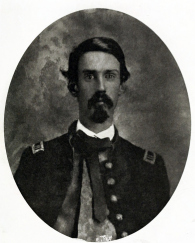
Lieut. Co. Jas. M. Tuttle1
DrSir

I find locations along the line of rail road much more pleasant and much better for the drill and discipline of the men than our Camp at St. Joseph and therefore recommend you to keep only the most orderly and best commanded companies at that point.

Company drills should be kept up and guard duty should be better learned by the officers and Sentinels. I especially desire Major Crockers2 attention to be given to this latter duty. I have ordered our 3d Regiment to be ready to move Saturday morning at Sunrise and design to have them located near together near the center of the line. Capt. Herron3 is still in Command. They have muskets like ours except they are bright. I shall not trouble our men to change for such. The brown are as good as the bright and less trouble to keep them clean.

But they have no cartridgees and I want you to send them a share of what you have in boxes. Say 5 boxes. I will send to Capt. Van Vliet4 and try everywhere to supply you more abundantly with cartridges as soon as possible.

I hope the accession of the 3d Regt will make the duties of our Regiment a little easier and give more time to drill. Above all things try to keep up the discipline of the men. There is so much temptation and excitement along the line, there is great danger the discipline will be relaxed and our men become demoralized. Do all you can to counteract this. Check the disposition manifested to take responsibilities Learn the men never to mave without orders, and the officers not to act without ample reason or the orders of superiors.

If officers become insubordinate arrest them and when men transgress have them also arrested and punished. A few bad men must not impair the reputation of the good and brave men under our command.

I may write you again before leaving for Washington. Give my regards to all especially the major & adjutant believe me

truly yours
Saml R. Curtis

Col. Cog

P.S. Send our Quartermaster or some judicious officer down to Leavenworth with my letters to Capt. Van Vleit. I leave the letter open that you and he may see the importance of it.

[In letter to Col. Smith, dated Keokuk, June 27, 1861, Curtis expressed anxiety concerning the 3rd Iowa because it was not “furnished with Cartridge boxes and bayonet seaboards,” and more importantly it had “no field officers.” The 3rd Regt, was ordered to move at 5 A. M. Saturday morning, June 29, via steamboat, to Hannibal, Missouri.]


1. James M. Tuttle. Keosauqua. Iowa. Lt. Col. 2nd Iowa Vol. Inf. May 31, 1861; col., Sept. 6. 1861; brig. gen. Jane 22, 1862, was an unsuccessful Democratic candidate for governor, 1963.

2. Marcellus Monroe Crocker, Des Moines,. Iowa. U. S. Military Academy. 1849. was Capt. Co. Dd., 2nd Iowa Vol. Inf. until his election as major May 31, 1861. He was elected It. col. Sept. 6. 1861 : and Col. 13th Iowa Inf. Dec. 30, 1861. Raised to a brig. gen. Nov. 29., 1862, he died August 26, 1865. of lingering illness.

3. Richard G. Herron, Dubuque, Iowa, Capt. Co. A, 3rd Iowa Inf., resigned March 8, 1862

4. Stewart Van Vliet. U. S. Military Academy, 1840, in the quartermaster corps in Mexican war, was a major in corps August 3. 1861; later was raised to brig. gen. of volunteers.

0 comments

Rebel War Clerk

Civil War Day-by-Day

JUNE 27th.—We have, I think, some 40,000 pretty well armed men in Virginia, sent hither from other States. Virginia has—I know not how many; but she should have at least 40,000 in the field. This will enable us to cope with the Federal army of 70,000 volunteers, and the regular forces they may hurl against us. But so far as this department is aware, Virginia has not yet two regiments in the service for three years, or the war. And here the war will be sure to rage till the end!

0 comments

“…for in an hour I shall be on my way to Washington.”—War Letters of William Thompson Lusk.

War Letters of William Thompson Lusk.

June 27th, 1861.

Dear Cousin Lou:

Did I not promise to write you, when the time came to say good-bye? Aye, oh best of women! And now I am fulfilling my promise hastily, for in an hour I shall be on my way to Washington. You must feel with me in my happiness! At length I am judged worthy to expose my life for my country’s sake. I go to join the 79th Regiment. Think, Cousin Lou, I am going to see real danger, real privation, real work – not as a mere Carpet-Knight, talking valorously to girls, but going forth in all humility to help to conquer in the name of God and my Country. Pray for me, Cousin Lou! Not for my life – I never prayed for that in any hour of peril – but pray that I may never falter, whether my duty shall lead me to honor or to death.

Good-bye,Cousin. Love to Mr. Grant, Cousin Laura, Cousin Henry, the children, and all friends.

Lovingly,
Willie.

Hurrah! Off in ten minutes, so Au-Revoir here or hereafter.

0 comments

“…no Peace or compromise with Rebels will be the order of the day.”—Horatio Nelson Taft

Diary of US patent clerk Horatio Nelson Taft.

THURSDAY, JUNE 27, 1861.

But little of moment has transpired in the City today. Some little rioting on the part of the soldiers, many having been paid off. The most important event is the arrest of Marshall Kane of Baltimore for treason. No fighting has taken place recently to speak of. But it is expected every day. There is now probably 100,000 men on each side within short call of this City. Congress meets next week. Its proceedings are looked to with much interest. But no Peace or compromise with Rebels will be the order of the day. Three officers of the 12th took tea with us this evening.

______

The three diary manuscript volumes, Washington during the Civil War: The Diary of Horatio Nelson Taft, 1861-1865, are available online at The Library of   Congress.

0 comments

“No one knows what will be done with us.”–Army letters of Oliver Willcox Norton.

Civil War Day-by-Day

Camp Wright, Hulton, Penn.,
Thursday, June 27, 1861.

Dear Father:–

One of the items of interest in the editor’s visit to Colonel McLane yesterday, is found in the Gazette of this morning, viz.: that throughout the whole day (yesterday) no marching orders or countermands were received. For a week or ten days the camp has been in a feverish state of excitement. First came the orders to distribute the arms and hold in readiness to march. The arms were distributed and then came the orders to start for Harrisburg, then the countermand–”Hold on, wait for further orders.” Next day, “Grant no more furloughs, drill fast, you will be called soon.” The orders stopped here and we “drilled fast” for two or three days, anxiously waiting for the “soon.” It did not come, but, in its place, it was announced on Monday that the Governor was not dead, as before reported, only dead drunk, and that he and his aide would be here on Tuesday to dispose finally of the Erie Regiment, either order us to Harrisburg or home. Well, Tuesday came and the Governor didn’t, so he was announced to come on Wednesday. Wednesday came and the Governor didn’t, and it was then announced that the whole thing was a canard, started just to keep the boys quiet.

Some of the boys got a great demijohn and paraded round the camp with it, labeled in staring capitals, “The Governor’s Aide.”

Company F had a comic picture sent up from New York, representing a very milingtary man with a fierce mustache. When turned upside down, it was a complete jackass. That is just about our situation. No one knows what will be done with us. I think we will be kept here the rest of our time and then sent home with our clothes worn out, and no pay to buy more with. They will hardly uniform and equip us and send us into the held for three or four weeks.

Pay no heed whatever to the letters and telegrams saying we are coming home, but continue to write to us till you see us at home. A couple of wagon-loads of dead letters would be nothing compared to our uneasiness without letters from home.

0 comments

“The boys resort to all sorts of expedients to kill time.”–Army letters of Oliver Willcox Norton.

Civil War Day-by-Day

Camp Wright, Hulton, Penn.,

Thursday, June 27, 1861.

Dear Brother E.:–

We’ve had pretty spicy times in camp for a week or ten days. Marching orders are given and immediately countermanded. It’s pack up, then unpack and make fun of it. One of the boys stuck up a picture–a courier driving at the top of his speed, shouting, “Hurrah! Marching orders;” and another following hard after, calling out, “Hold on, blast ye; they’re countermanded.” They call it, “The Erie boys’ experience,” and it is a pretty good hit.

The boys resort to all sorts of expedients to kill time. A good many of them are making clam-shell rings. It requires a good deal of work to make one, but they are the prettiest rings I ever saw. Some of them look like pearl, some are blue and some like carnelian. They take a high polish.

One of the Wildcats had a mud-turtle yesterday. He made a little seccsh flag and tied it to his hind flipper and made him trabble with it, dragging it round in the dust. It made some sport.

The Armstrong Rifles had a veritable secession flag, hanging bottom side up on their quarters, yesterday. It was captured at Philippi and sent up here. It was made of muslin, three stripes and seven stars, tin ones at that, an elegant thing.

I spend a good deal of time in the river. I am improving some in swimming. Swam across the other day at the widest place in sight. Some of our company found the body of a man in the river the other day. He appeared to have been in the water a long time. He was standing erect with his feet firmly bedded in the bottom, and his head about two feet under water. One of the feet broke off in pulling him up.


Well, I must stop. I do not know as there is anything in reach worth sending you as a curiosity. If I find anything, however, I will remember you.

Don’t fail to write again soon. I think your last is the best letter I ever saw of yours. Write often and you will improve. Direct to Camp Wright, Hulton, care of Captain D. W. Hutchinson.

0 comments

Civil War Day-By-Day

Civil War Day-by-Day

June 27, 1861

  • Baltimore Marshal of Police George Proctor Kane arrested in Baltimore on the charge of treason, and sent to Fort McHenry.

A Chronological History of the Civil War in America1

  • Engagement between U. S. gun-boats Freeborn and Pawnee and the rebel batteries at Matthias Point, Va. : Capt. Ward, commander of the Potomac flotilla, killed.

  1. A Chronological History of the Civil War in America by Richard Swainson Fisher, New York, Johnson and Ward, 1863
0 comments

William Howard Russell’s Diary: Progress of events.—Policy of Great Britain as regarded by the North.— The American Press and its comments.—Privacy a luxury.—Chicago.—Senator Douglas and his widow.—American ingratitude.— Apathy in volunteering.—Colonel Turchin’s camp.

My Diary North and South – William Howard Russell

I shall here briefly recapitulate what has occurred since the last mention of political events.

In the first place the South has been developing every day greater energy in widening the breach between it and the North, and preparing to fill it with dead; and the North, so far as I can judge, has been busy in raising up the Union as a nationality, and making out the crime of treason from the act of Secession. The South has been using conscription in Virginia, and is entering upon the conflict with unsurpassable determination. The North is availing itself of its greater resources and its foreign vagabondage and destitution to swell the ranks of its volunteers, and boasts of its enormous armies, as if it supposed conscripts well led do not fight better than volunteers badly officered. Virginia has been invaded on three points, one below and two above Washington, and passports are now issued on both sides.

The career open to the Southern privateers is effectually closed by the Duke of Newcastle’s notification that the British Government will not permit the crusiers of either side to bring their prizes into or condemn them in English ports; but, strange to say, the Northerners feel indignant against Great Britain for an act which deprives their enemy of an enormous advantage, and which must reduce their privateering to the mere work of plunder and destruction on the high seas. In the same way the North affects to consider the declaration of neutrality, and the concession of limited belligerent rights to the seceding States, as deeply injurious and insulting; whereas our course has, in fact, removed the greatest difficulty from the path of the Washington Cabinet, and saved us from inconsistencies and serious risks in our course of action.

It is commonly said, “What would Great Britain have done if we had declared ourselves neutral during the Canadian rebellion, or had conceded limited belligerent rights to the Sepoys?” as if Canada and Hindostan have the same relation to the British Crown that the seceding States had to the Northern States. But if Canada, with its parliament, judges, courts of law, and its people, declared it was independent of Great Britain; and if the Government of Great Britain, months after that declaration was made and acted upon, permitted the new State to go free, whilst a large number of her Statesmen agreed that Canada was perfectly right, we could find little fault with the United States’ Government for issuing a proclamation of neutrality the same as our own, when after a long interval of quiescence a war broke out between the two countries.

Secession was an accomplished fact months before Mr. Lincoln came into office, but we heard no talk of rebels and pirates till Sumter had fallen, and the North was perfectly quiescent–not only that–the people of wealth in New York were calmly considering the results of Secession as an accomplished fact, and seeking to make the best of it; nay, more, when I arrived in Washington some members of the Cabinet were perfectly ready to let the South go.

One of the first questions put to me by Mr. Chase in my first interview with him, was whether I thought a very injurious effect would be produced to the prestige of the Federal Government in Europe if the Northern States let the South have its own way, and told them to go in peace. “For my own part,” said he,” “I should not be averse to let them try it, for I believe they would soon find out their mistake.” Mr. Chase may be finding out his mistake just now. When I left England the prevalent opinion, as far as I could judge, was, that a family quarrel, in which the South was in the wrong, had taken place, and that it would be better to stand by and let the Government put forth its strength to chastise rebellious children. But now we see the house is divided against itself, and that the family are determined to set up two separate establishments. These remarks occur to me with the more force because I see the New York papers are attacking me because I described a calm in a sea which was afterwards agitated by a storm. “What a false witness is this,” they cry, “See how angry and how vexed is our Bermoothes, and yet the fellow says it was quite placid.”

I have already seen so many statements respecting my sayings, my doings, and my opinions, in the American papers, that I have resolved to follow a general rule, with few exceptions indeed, which prescribes as the best course to pursue, not so much an indifference to these remarks as a fixed purpose to abstain from the hopeless task of correcting them. The “Quicklys” of the press are incorrigible. Commerce may well be proud of Chicago. I am not going to reiterate what every Crispinus from the old country has said again and again concerning this wonderful place–not one word of statistics, of corn elevators, of shipping, or of the piles of buildings raised from the foundation by ingenious applications of screws. Nor am I going to enlarge on the splendid future of that which has so much present prosperity, or on the benefits to mankind opened up by the Illinois Central Railway. It is enough to say that by the borders of this lake there has sprung up in thirty years a wonderful city of fine streets, luxurious hotels, handsome shops, magnificent stores, great warehouses, extensive quays, capacious docks; and that as long as corn holds its own, and the mouths of Europe are open, and her hands full, Chicago will acquire greater importance, size, and wealth with every year. The only drawback, perhaps, to the comfort of the money-making inhabitants, and of the stranger within the gates, is to be found in the clouds of dust and in the unpaved streets and thoroughfares, which give anguish to horse and man.

I spent three days here writing my letters and repairing the wear and tear of my Southern expedition; and although it was hot enough, the breeze from the lake carried health and vigour to the frame, enervated by the sun of Louisiana and Mississippi. No need now to wipe the large drops of moisture from the languid brow lest they blind the eyes, nor to sit in a state of semi-clothing, worn out and exhausted, and tracing with moist hand imperfect characters on the paper.

I could not satisfy myself whether there was, as I have been told, a peculiar state of feeling in Chicago, which induced many people to support the Government of Mr. Lincoln because they believed it necessary for their own interests to obtain decided advantages over the South in the field, whilst they were opposed totis viribus to the genius of emancipation and to the views of the black Republicans. But the genius and eloquence of the little giant have left their impress on the facile mould of democratic thought, and he who argued with such acuteness and ability last March in Washington, in his own study, against the possibility, or at least the constitutional legality, of using the national forces, and the militia and volunteers of the Northern States, to subjugate the Southern people, carried away by the great bore which rushed through the placid North when Sumter fell, or perceiving his inability to resist its force, sprung to the crest of the wave, and carried to excess the violence of the Union reaction.

Whilst I was in the South I had seen his name in Northern papers with sensation headings and descriptions of his magnificent crusade for the Union in the west. I had heard his name reviled by those who had once been his warm political allies, and his untimely death did not seem to satisfy their hatred. His old foes in the North admired and applauded the sudden apostasy of their eloquent opponent, and were loud in lamentations over his loss. Imagine, then, how I felt when visiting his grave at Chicago, seeing his bust in many houses, or his portrait in all the shop-windows I was told that the enormously wealthy community of which he was the idol were permitting his widow to live in a state not far removed from penury.

“Senator Douglas, sir,” observed one of his friends to me, “died of bad whisky. He killed himself with it while he was stumping for the Union all over the country.” “Well,” I said, “I suppose, sir, the abstraction called the Union, for which by your own account he killed himself, will give a pension to his widow.” Virtue is its own reward, and so is patriotism, unless it takes the form of contracts.

As far as all considerations of wife, children, or family are concerned, let a man serve a decent despot, or even a constitutional country with an economising House of Commons, if he wants anything more substantial than lip-service. The history of the great men of America is full of instances of national ingratitude. They give more praise and less pence to their benefactors than any nation on the face of the earth. Washington got little, though the plundering scouts who captured Andre were well rewarded; and the men who fought during the War of Independence were long left in neglect and poverty, sitting in sackcloth and ashes at the doorsteps of the temple of liberty, whilst the crowd rushed inside to worship Plutus.

If a native of the British isles, of the natural ignorance of his own imperfections which should characterise him, desires to be subjected to a series of moral shower-baths, douches, and shampooing with a rough glove, let him come to the United States. In Chicago he will be told that the English people are fed by the beneficence of the United States, and that all the trade and commerce of England are simply directed to the one end of obtaining gold enough to pay the western States for the breadstuffs exported for our population.

We know what the South think of our dependence on cotton. The people of the east think they are striking a great blow at their enemy by the Morrill tariff, and I was told by a patriot in North Carolina, “Why, creation! if you let the Yankees shut up our ports, the whole of your darned ships will go to rot. Where will you get your naval stores from? Why, I guess in a year you could not scrape up enough of tarpentine in the whole of your country for Queen Victoria to paint her nursery-door with.”

Nearly one half of the various companies enrolled in this district are Germans, or are the descendants of German parents, and speak only the language of the old country; two-thirds of the remainder are Irish, or of immediate Irish descent; but it is said that a grand reserve of Americans born lies behind this avant garde, who will come into the battle should there ever be need for their services.

Indeed so long as the Northern people furnish the means of paying and equipping armies perfectly competent to do their work, and equal in numbers to any demands made for men, they may rest satisfied with the accomplishment of that duty, and with contributing from their ranks the great majority of the superior and even of the subaltern officers; but with the South it is far different. Their institutions have repelled immigration; the black slave has barred the door to the white free settler. Only on the seaboard and in the large cities are German and Irish to be found, and they to a man have come forward to fight for the South; but the proportion they bear to the native-born Americans who have rushed to arms in defence of their menaced borders, is of course far less than it is as yet to the number of Americans in the Northern States who have volunteered to fight for the Union.

I was invited before I left to visit the camp of a Colonel Turchin, who was described to me as a Russian officer of great ability and experience in European warfare, in command of a regiment consisting of Poles, Hungarians, and Germans, who were about to start for the seat of war; but I was only able to walk through his tents, where I was astonished at the amalgam of nations that constituted his battalion; though, on inspection, I am bound to say there proved to be an American element in the ranks which did not appear to have coalesced with the bulk of the rude and, I fear, predatory Cossacks of the Union. Many young men of good position have gone to the wars, although there was no complaint, as in Southern cities, that merchant’s offices have been deserted, and great establishments left destitute of clerks and working hands. In warlike operations, however, Chicago, with its communication open to the sea, its access to the head waters of the Mississippi, its intercourse with the marts of commerce and of manufacture, may be considered to possess greater belligerent power and strength than the great city of New Orleans; and there is much greater probability of Chicago sending its contingent to attack the Crescent City than there is of the latter being able to despatch a soldier within five hundred miles of its streets.
0 comments

“But there must be no peace till they lay down their arms and return to their duty.”—Horatio Nelson Taft

Diary of US patent clerk Horatio Nelson Taft.

WEDNESDAY 26

It has rained a little today, laid the dust and made everything look fresh pleasant. Nothing has occured. Everything appears to be quiet, although the elements of strife are all around us. I think the rebels are in favor of making peace, and are causing the slight movement north that way. But there must be no peace till they lay down their arms and return to their duty. I was at Willards. Hotel quite full, Congress coming!

______

The three diary manuscript volumes, Washington during the Civil War: The Diary of Horatio Nelson Taft, 1861-1865, are available online at The Library of   Congress.

0 comments

The President is supposed to know best.—A Rebel War Clerk’s Diary at the Confederate States Capital, By John Beauchamp Jones.

Civil War Day-by-Day

JUNE 26th.—The President revised one of my articles for the press to-day, suggesting some slight modifications, which, perhaps, improved it. It was not a political article; but designed exclusively to advance the cause by inciting the people of Virginia and elsewhere to volunteer for the war. Such volunteers are accepted, and ordered into active service at once; whereas six and twelve months’ men, unless they furnish their own arms, are not accepted.

It is certain the United States intend to raise a grand army, to serve for three years or the war. Short enlistments constituted the bane of Washington’s army; and this fact is reiterated a thousand times in his extant letters.

There are a great many applications for clerkships in the departments by teachers who have not followed their pupils to the army. Army and naval officers, coming over at this late day, are commissioned in our service. In regard to this matter, the President is supposed to know best.

0 comments

Extracts from the journal of Commander Semmes, C.S. Navy, commanding C.S.S. Sumter

War of the Rebellion: from the Official Records of the Union and Confederate Armies and Navies
Wednesday, June 26.—Cloudy and occasional rain squalls. The Ivy returned from the city and brought me eighty barrels of coal. Sent the pilot in the light-house keeper’s boat to sound the southeast bar. The Federal ships keep close watch at the bars, neither having stirred from her anchor since my arrival here.
0 comments

We come here to save, not to upturn.

War of the Rebellion: from the Official Records of the Union and Confederate Armies and Navies
Headquarters Department of the Ohio,
Grafton, Va., June 25, 1861.
To the Soldiers of the Army of the West:
You are here to support the Government of your country, and to protect the lines and liberties of your brethren, threatened by a rebellious and traitorous foe. No higher and nobler duty could devolve upon you, and I expect you to bring to its performance the highest and noblest qualities of soldiers—discipline, courage, and mercy. I call upon the officers of every grade to enforce the strictest discipline, and I know that those of all grades, privates and officers, will display in battle cool, heroic courage, and will know how to show mercy to a disarmed enemy.
Bear in mind that you are in the country of friends, not of enemies; that you are here to protect, not to destroy. Take nothing, destroy nothing, unless you are ordered to do so by your general officers. Remember that I have pledged my word to the people of Western Virginia that their right in person and property shall be respected. I ask every one of you to make good this promise in its broadest sense. We come here to save, not to upturn. I do not appeal to the fear of punishment, but to your appreciation of the sacredness of the cause in which we are engaged. Carry with you into battle the conviction that you are right, and that God is on your side.
Your enemies have violated every moral law; neither God nor man can sustain them. They have, without cause, rebelled against a mild and paternal Government; they have seized upon public and private property; they have outraged the persons of Northern men merely because they loved the Union; they have placed themselves beneath contempt, unless they can retrieve some honor on the field of battle. You will pursue a different course. You will be honest, brave, and merciful; you will respect the right of private opinion; you will punish no man for opinion’s sake. Show to the world that you differ from our enemies in the points of honor, honesty, and respect for private opinion, and that we inaugurate no reign of terror where we go.
Soldiers! I have heard that there was danger here. I have come to place myself at your head and to share it with you. I fear now but one thing—that you will not find foemen worthy of your steel. I know that I can rely upon you.
GEO. B. McCLELLAN,
Major-General, Commanding.
0 comments

Individuals and marauding parties are pursuing a guerrilla warfare…

War of the Rebellion: from the Official Records of the Union and Confederate Armies and Navies
Headquarters Department of the Ohio,
Grafton, Va., June 23, 1861.
To the Inhabitants of Western Virginia:
The army of this department, headed by Virginia troops, is rapidly occupying all Western Virginia. This is done in co-operation with, and in support of, such civil authorities of the State as are faithful to the Constitution and laws of the United States. The proclamation issued by me under date of May 26, 1861, will be strictly maintained. Your houses, families, property, and all your rights will be religiously respected; we are enemies to none but armed rebels and those voluntarily giving them aid. All officers of this army will be held responsible for the most prompt and vigorous action in repressing disorder and punishing aggression by those under their command.
To me great regreat I find that enemies of the United States continue to carry on a system of hostilities prohibited by the laws of war among belligerent nations, and of course far more wicked and intolerable when directed against loyal citizens engaged in the defense of the common Government of all. Individuals and marauding parties are pursuing a guerrilla warfare, firing upon sentinels and pickets, burning bridges, insulting, injuring, and even killing citizens because of their Union sentiments, and committing many kindred acts.
I do now, therefore, make proclamation, and warn all persons that individuals or parties engaged in this species of warfare—irregular in every view which can be taken of it—thus attacking sentries, pickets, or other soldiers, destroying public or private property, or committing injuries against any of the inhabitants because of Union sentiments or conduct, will be dealt with in their persons and properly according to the severest rules of military law.
All persons giving information or aid to the public enemies will be arrested and kept in close custody, and all persons found bearing arms, unless of known loyalty, will be arrested and held for examination.
GEO. B. McCLELLAN,
Major-General, U. S. Army, Commanding Department.
0 comments

“These are the pattering drops that must inevitably be succeeded by a torrent of blood!”—A Rebel War Clerk’s Diary at the Confederate States Capital, By John Beauchamp Jones

Civil War Day-by-Day

JUNE 25th.—More accounts of battles and massacres in Missouri and Kansas. I never thought the Yankees would be permitted to ascend the Missouri River. What has become of the marksmen and deer hunters of Missouri? There has been also a fight at Leesburg, and one near Romney, Va. Blood has been shed in all of them. These are the pattering drops that must inevitably be succeeded by a torrent of blood!

0 comments

Extracts from the journal of Commander Semmes, C.S. Navy, commanding C.S.S. Sumter

War of the Rebellion: from the Official Records of the Union and Confederate Armies and Navies
Tuesday, June 25.—A thunderstorm and heavy rain at 3:30 a.m., clearing off at 10 a.m. Visited the light-house at the Head of the Passes and took a receipt for the property deposited there, from the Pass à l’Outre and South Pass houses. Visited also the telegraphic station and held communication with both passes. Both blockading ships still at their anchors. The British steam sloop Jason was off the Southwest Pass yesterday. Received intelligence that the enemy had taken possession of Ship Island and established a blockade of the sound. Filling shell and cartridges and drilling my very green crew.
0 comments

“It will be difficult to keep the contending forces apart much longer.”—Horatio Nelson Taft

Diary of US patent clerk Horatio Nelson Taft.

TUESDAY 25

Another fine day, cool and bright. Troops are coming every day in large numbers, 13000 came last week and 5000 were expected today and tonight. There was a large meeting of Officers at Genl Scotts quarters today. Various surmises are afloat, something is to be done soon. It will be difficult to keep the contending forces apart much longer. I was down to witness the Dress Parade of the 12th with Julia. She, escorted by Capt Fowler, fired the evening gun.

______

The three diary manuscript volumes, Washington during the Civil War: The Diary of Horatio Nelson Taft, 1861-1865, are available online at The Library of   Congress.

0 comments

Mary Chesnut’s Diary: “Yesterday some of the negro men on the plantation were found with pistols.”

Civil War Day-by-Day

June 24th.–Last night I was awakened by loud talking and candles flashing, tramping of feet, growls dying away in the distance, loud calls from point to point in the yard. Up I started, my heart in my mouth. Some dreadful thing had happened, a battle, a death, a horrible accident. Some one was screaming aloft–that is, from the top of the stairway, hoarsely like a boatswain in a storm. Old Colonel Chesnut was storming at the sleepy negroes looking for fire, with lighted candles, in closets and everywhere else. I dressed and came upon the scene of action.

“What is it? Any news?” “No, no, only mamma smells a smell; she thinks something is burning somewhere.” The whole yard was alive, literally swarming. There are sixty or seventy people kept here to wait upon this household, two-thirds of them too old or too young to be of any use, but families remain intact. The old Colonel has a magnificent voice. I am sure it can be heard for miles. Literally, he was roaring from the piazza, giving orders to the busy crowd who were hunting the smell of fire.

Old Mrs. Chesnut is deaf; so she did not know what a commotion she was creating. She is very sensitive to bad odors. Candles have to be taken out of the room to be snuffed. Lamps are extinguished only in the porticoes, or farther afield. She finds violets oppressive; can only tolerate a single kind of sweet rose. A tea-rose she will not have in her room. She was totally innocent of the storm she had raised, and in a mild, sweet voice was suggesting places to be searched. I was weak enough to laugh hysterically. The bombardment of Fort Sumter was nothing to this.

After this alarm, enough to wake the dead, the smell was found. A family had been boiling soap. Around the soappot they had swept up some woolen rags. Raking up the fire to make all safe before going to bed, this was heaped up with the ashes, and its faint smoldering tainted the air, at least to Mrs. Chesnut’s nose, two hundred yards or more away.

Yesterday some of the negro men on the plantation were found with pistols. I have never before seen aught about any negro to show that they knew we had a war on hand in which they have any interest.

Mrs. John de Saussure bade me good-by and God bless you. I was touched. Camden people never show any more feeling or sympathy than red Indians, except at a funeral. It is expected of all to howl then, and if you don’t “show feeling,” indignation awaits the delinquent.

0 comments

The cost of living is more than John Beauchamp Jones’ salary.

Civil War Day-by-Day

JUNE 24th.—To-day I was startled by the announcement from Col. Bledsoe that he would resign soon, and that it was his purpose to ask the President to appoint me chief of the bureau in his place. I said I preferred a less conspicuous position—and less labor—but thanked him. He said he had no influence with the Secretary—an incontrovertible fact; and that he thought he should return to the University. While we were speaking, the President’s messenger came in with a note to the colonel; I did not learn the purport of it, but it put the colonel in a good humor. He showed me the two first words: “Dear Bledsoe.” He said nothing more about resigning.

I must get more lucrative employment, or find something for my son to do. The boarding of my family, alone, comes to more than my salary; and the cost of everything is increasing.

0 comments

Extracts from the journal of Commander Semmes, C.S. Navy, commanding C.S.S. Sumter

War of the Rebellion: from the Official Records of the Union and Confederate Armies and Navies
Monday, June 24.—This morning dispatched an officer on board the Ivy to bring away the oil and lamps from the South Pass, that that light may also be extinguished. The object was accomplished. All the seacoast lights at the passes are now out. Both blockading vessels are lying close at their anchors, and there is an additional vessel at Pass à l’Outre.
0 comments

“Three or four thousand troops crossed into Virginia last night and our lines seem to be slowly advancing.”—Horatio Nelson Taft

Diary of US patent clerk Horatio Nelson Taft.

MONDAY, JUNE 24, 1861.

This has been a fine pleasant day. Nothing in particular has occured that is public. A full cabinet meeting including Genl Scott and other Genls of the Army has been held, a sort of counsel of War and State combined. We may hear from it hereafter. Three or four thousand troops crossed into Virginia last night and our lines seem to be slowly advancing. A Great battle may “come off” soon. The two R.I. Regts with their two Batterys, 12:12 pounders, were Reviewed this evening by the Prest at the Prests House.

______

The three diary manuscript volumes, Washington during the Civil War: The Diary of Horatio Nelson Taft, 1861-1865, are available online at The Library of   Congress.

0 comments

Grand Review.

Diary of Battery A, First Regiment, Rhode Island Light Artillery, by Theodore Reichardt
Monday, June 24.—Grand review of the Rhode Island troops by President Lincoln and Gen. Scott. Marched in front of the White House and through the principal streets of Washington.
From this time up to the 4th of July, nothing of importance occurred; everything went on quiet and pleasant; battery drills and manual of the piece were the usual occupation. Sometimes the long roll would be beat during the night, or guards would fire at some imaginary object of suspicion. On (one) such an occasion a cow was shot.
0 comments

“The army at Manassas said to be strongly reinforced. Measles prevailing there, and near Winchester, among the troops.”—Diary of a Southern Refugee, Judith White McGuire.

Diary of a Southern Refugee During the War by Judith White McGuire

June 24.—We have been in Winchester for the last two days, at Dr. S’s. General Johnston’s army encamped at “The Lick.” Some Southern regiments encamped near Winchester. The army at Manassas said to be strongly reinforced. Measles prevailing there, and near Winchester, among the troops. There has been a slight skirmish in Hampshire, on New Creek, and another at Vienna, in Fairfax County. We repulsed the enemy at both places. Captain Kemper, of Alexandria, led our men in the latter fight, and is much extolled for his dexterity and bravery.

0 comments

Civil War Day-By-Day

Civil War Day-by-Day

June 24, 1861

A Chronological History of the Civil War in America1

  • Bank riots in Milwaukee, Wis.2
  • Gov. Harris proclaimed Tennessee out of the Union, the vote of the people being—for separation 104,019, and against 47,238.

  1. A Chronological History of the Civil War in America by Richard Swainson Fisher, New York, Johnson and Ward, 1863
  2.     By 1861, when southern states seceded and the Civil War began, three-quarters of Wisconsin banks were backed by southern bonds. “The southern governments that issued the bonds were unlikely to want to payback the bonds that were held outside their country, like in Wisconsin,” banking historian Richard Sylla explains. As a result, the Wisconsin Bankers’ Association met to discredit dozens of banks—making their notes worthless.
    On Friday June 21, the Association discredited 10 additional banks. News of this came down the next day, after many of Milwaukee’s German laborers were paid with these now worthless banknotes.    “So you walked into a bar in Milwaukee, let’s say, and you try to buy your beer and the bartender would say, ‘The banker told us not to accept your money.’ So if you got paid in that money a few days before, you might’ve been quite angry,” Sylla says.
0 comments

First Sunday in Camp Clark

Diary of Battery A, First Regiment, Rhode Island Light Artillery, by Theodore Reichardt
Sunday, June 23.— The sanctity of the day was well observed throughout the camp and increased by an impressive sermon, preached by Bishop Clark. In the afternoon, passes were given to the men to visit the city. The day closed with a dress parade, President Lincoln and other functionaries being present.
0 comments

Rebel War Clerk

Civil War Day-by-Day

JUNE 23d.—Every day as soon as the first press of business is over, the Secretary comes out of his office and taps me on the shoulder, and invites me to ride with him in quest of a house. We go to those offered for rent; but he cannot be suited.

0 comments