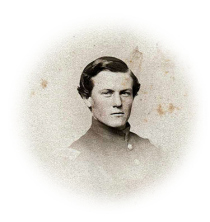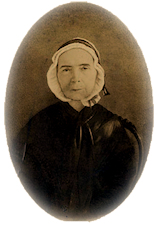
“There are many refugees in this neighbourhood, like ourselves, wandering and waiting. Mrs. General Lee has been staying at Annfield, and at Media, sick, and without a home.”—Diary of a Southern Refugee, Judith White McGuire.

Diary of a Southern Refugee During the War by Judith White McGuire

“The Briars,” October 2d.—We returned yesterday, everybody anxious and apprehensive. Battles seem to be imminent, both in Western Virginia and on the Potomac. Constant skirmishing reported in both places.

General Price, it is said, has taken Lexington, Missouri, with a large number of prisoners. Our army in Fairfax has fallen back from “Munson’s Hill” to the Court-House; thus leaving our dear homes more deeply buried in the shades of Yankeeism than ever. There are many refugees in this neighbourhood, like ourselves, wandering and waiting. Mrs. General Lee has been staying at Annfield, and at Media, sick, and without a home. All Virginia has open doors for the family of General Lee; but in her state of health, how dreadful it is to have no certain abiding place. She is very cheerful, and showed me the other day a picture of “Arlington,” in a number of Harpers’ Magazine, which had mistaken its way and strayed to Dixie. She thought the representation good, as it certainly is of what Arlington was; but it is said that those fine trees are living trees no more—all felled to make room for the everlasting fortifications. She clings to the hope of getting back to it; but I [continue reading…]
0 comments

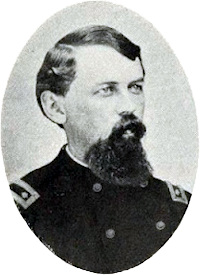
“I never was so well satisfied in my life as I have been since I joined the army.”–Army Life of an Illinois Soldier, Charles Wright Wills.

Civil War Day-by-Day

Bird’s Point, October 2, ’61.

Just at noon yesterday orders came to strike tents and in an hour we were under way and have come to a halt in this forsaken hole. It seems that the 8th can’t get out of hearing of the Cairo morning and evening gun anyway. Our major says they are talking of chucking us into Cairo and making us garrison it this winter. I’ll be tempted to desert if ’tis so. The 22d call us the featherbed regiment now, and if they keep us this way much longer we will be tender as women. It was late and we were tired when we pitched our tents last night and we didn’t “ditch round” as usual, trusting to providence for a dry night. But ’twas confidence misplaced and some of the boys found the ground slightly damp under them this morning. It has been raining like the devil all a.m. and the mud is quite salubrious. I find my old Havana schoolmate, Jem Walker, here in the 28th, Ritter’s company. Haven’t seen Smith yet. The Rebels came right up to Norfolk after we left last night, and about 3 I heard the cavalry called out, and this morning I see the 2d Iowa and 11th Illinois are gone. Suppose they all went down that way. I have disposed of all my surplus baggage and now have two shirts, two pair socks, one blanket, one pair pants, one coat, one pair shoes, one hat, toothbrush and one pocket comb. That’s all I’m worth. I can get all the clothing I want of the quartermaster any time. You scout the idea of one’s liking such a life as this. I tell you that I never was so well satisfied in my life as I have been since I joined the army. I do really enjoy it all the time, and if our boys here write the truth home they will say the same. Nobody ever heard me grumble a word about soldiering and never will if they don’t station us in Cairo.

0 comments

Woolsey family letters; Eliza Woolsey Howland to Joseph Howland.

Woolsey family letters during the War for the Union

Oct. 1, 1861

Very little to tell you about except a few calls, including one from Mrs. General Franklin to ask us to take tea with her to-night. Lieutenant Lusk of the 79th, whom we used to know as “Willy” Lusk, also came. He seems to have grown up into a very fine young fellow, handsome and gentlemanly, and with the same sweet expression he had as a child. He was studying medicine in Europe when the war broke out, but came home at once and enlisted as Lieutenant in the 79th, where he is now Acting Captain–so many of the regiment were either killed or taken prisoners at Bull Run. Dr. E. also came again and Captain Gibson and Col. Montgomery of Philadelphia, so we had quite a levee.

Oct. 2. G. and I are just going up to Columbian College to cover and arrange a nice box of books Hatty Gilman has sent on at our suggestion to form the nucleus of a hospital library –an excellent selection of books, histories, biographies, etc.; half worn, but the covering and labeling we mean to put them through will make them highly respectable and attractive.

We took tea last night with Mrs. Franklin and met five or six other people, among them Major and Mrs. Webb–he on General Barry’s staff. Dr. Bacon has brought G. some splendid bunches of roses this week, the finest I ever saw. He expects to be ordered off with his new regiment, the 7th Connecticut, within a few days, probably to join the Coast Expedition, but this is a secret.

We have been with Captain Gibson all through the Corcoran Art Building, now used as a government warehouse and filled with clothing and camp equipage of every kind, one item being twenty thousand tents. From the roof, to which we mounted, we had a fine view over the city and environs, the river, the opposite heights and an army balloon.

0 comments

Half sheet to-day

Miscellaneous document sources, News of the Day

Southern Confederacy
[Atlanta, Ga], October 2, 1861

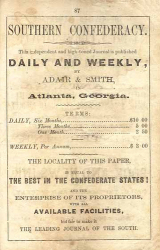
And brown at that. The paper maker has disappointed us. We have made every possible effort to get paper, and have failed. It is not at the mills, or elsewhere within our reach.

We have no assurance of paper–even for a half sheet–for tomorrow. We have it promised to us for Friday’s issue. We shall get it earlier, if possible; but if you get no paper tomorrow, you may know it is for the want of paper.

0 comments

“I am fast coming to the conclusion that the great mortality of camp life is owing much more to neglect of the proper means within our reach of preserving health..,”–Journal of Surgeon Alfred L. Castleman.

Journal of Surgeon Alfred L Castleman.

October, 1st and 2nd.–During these two days the regiment has been busily engaged in moving its camp about four miles. The new camp is to be called Camp Vanderwerken, from the name of a man owning a large property in the immediate neighborhood.

Very shortly after crossing Chain Bridge, our regiment was transferred from Gen. King’s to Gen. Smith’s brigade, to which we remained attached till about the 28th of September, when Gen. Smith was promoted to the command of a division, and we transferred to a new brigade under command of Brigadier General Winfield Scott Hancock, an officer of fine appearance, but with rather a narrow forehead, and from what little I have seen of him, I should presume him to be at least excitable, if not irritable. We have been between three and four months organized, and have not yet lost a man by either disease or accident. So after all, the life of a soldier, if his health is properly looked after, is not more exposed to sickness than that of a civilian. I am fast coming to the conclusion that the great mortality of camp life is owing much more to neglect of the proper means within our reach of preserving health, than to any exposures to which the soldier is peculiarly liable.

0 comments

William Howard Russell’s Diary: Journey to the Western States.—Along the Susquehanna and Juniata.—Chicago.—Sport in the prairie.—Arrested for shooting on Sunday.—The town of Dwight.— Return to Washington.

My Diary North and South – William Howard Russell

On the 18th of September, I left Baltimore in company with Major-General Bell, C.B., and Mr. Lamy, who was well acquainted with the Western States: stopping one night at Altoona, in order that we might cross by daylight the fine passes of the Alleganies, which are traversed by bold gradients, and remarkable cuttings, second only in difficulty and extent to those of the railroad across the Sommering.

So far as my observation extends, no route in the United States can give a stranger a better notion of the variety of scenery and of resources, the vast extent of territory, the difference in races, the prosperity of the present, and the probable greatness of the future, than the line from Baltimore by Harrisburg and Pittsburg to Chicago, traversing the great States of Pennsylvania, Ohio, and Indiana. Plain and mountain, hill and valley, river and meadow, forest and rock, wild tracts through which the Indian roamed but a few years ago, lands covered with the richest crops; rugged passes, which Salvator would have peopled with shadowy groups of bandits; gentle sylvan glades, such as Gainsborough would have covered with waving corn; the hum of mills, the silence of the desert and waste, sea-like lakes whitened by innumerable sails, mighty rivers carving their way through continents, sparkling rivulets that lose their lives amongst giant wheels: seams and lodes of coal, iron, and mineral wealth, cropping out of desolate mountain sides; busy, restless manufacturers and traders alternating with stolid rustics, hedges clustering with grapes, mountains whitening with snow; and beyond, the great Prairie stretching away to the backbone of inhospitable rock, which, rising from the foundations of the world, bar the access of the white man and civilisation to the bleak inhospitable regions beyond, which both are fain as yet to leave to the savage and wild beast. [continue reading…]

0 comments

Civil War Day-By-Day

Civil War Day-by-Day

October 2, 1861

A Chronological History of the Civil War in America1

  • Rebels defeated at Chapmansville, Va.

  1. A Chronological History of the Civil War in America by Richard Swainson Fisher, New York, Johnson and Ward, 1863
0 comments

Ordered to return immediately to Seneca Mills.

Diary of Battery A, First Regiment, Rhode Island Light Artillery, by Theodore Reichardt

Tuesday, October 1.—One o’clock A. M. Orders arrived to return immediately to Seneca Mills. The left section marched at once, arriving towards day-break. At sunrise, the fifth gun went on picket duty once more. Lieut. Newton, Sergeants Hammond and Read, were with the left section. Commenced to throw up intrenchments during the night.

0 comments

Only a few hundred alien enemies departed from the country under the President’s proclamation—Rebel War Clerk

Civil War Day-by-Day

OCTOBER 1st.—I find that only a few hundred alien enemies departed from the country under the President’s proclamation, allowing them forty days, from the 16th of August, to make their arrangements; but under the recent order of Mr. Benjamin, if I may judge from the daily applications, there will be a large emigration. The persons now going belong to a different class of people: half of them avowing themselves friendly to our cause, and desiring egress through our lines on the Potomac, or in the West, to avoid being published as alien enemies going under flag of truce via Norfolk and Fortress Monroe. Many of them declare a purpose to return.

0 comments

“Our troops have advanced somewhat within a day or two on the other side of the River but no fighting yet of any account.”—Horatio Nelson Taft

Diary of US patent clerk Horatio Nelson Taft.

TUESDAY, OCTOBER 1, 1861.

Have had a hard days work moveing down our Furniture. Had six wagon loads left after our sale but I take back some articles from Mr Peck which he bid off having concluded [to] remain in the City awhile longer. We are in a very pleasant neighborhood and pleasant part of the City. Our troops have advanced somewhat within a day or two on the other side of the River but no fighting yet of any account.

______

The three diary manuscript volumes, Washington during the Civil War: The Diary of Horatio Nelson Taft, 1861-1865, are available online at The Library of   Congress.

0 comments

But in the very simplicity of it,

Woolsey family letters during the War for the Union

Rev. Henry Hopkins to Eliza Woolsey Howland.

City Hotel Hospital, ……………
Alexandria, Oct, 1861.

My dear Mrs. Howland: I want to tell you how I am coming on here in my new field, for at Washington I received the impression, which it will take a long time to wear away, that you and Miss Woolsey are cordially interested in all that concerns me in this work.

Dr. Sheldon is entirely propitious thus far. . . . Those who are religious women among the nurses hail my coming with real joy. The very first one whom I encountered was such a woman, and as I sat down in her cheerful ward before the bright fire on the hearth, talking with the men, a poor emaciated creature who was sitting wrapped in blankets, with his feet upon a pillow, asked me–“Are you a physician?” “No,” I told him, “I am a clergyman.” He stretched out his lean hand to me, and said–“Oh, sir, I am so glad to see you. I have been very sick, so that they gave me up, and now I am getting well, and I am not a Christian, and I must be.” Could the most trembling faith ask more than this?

I have just come from attending the funeral of a soldier of the 27th N. Y. regiment, who died last evening of typhoid fever. It was severely simple in all its accompaniments, only a little gathering in the hospital dining room, and a simple exercise; while a corporal’s guard were the only ones to attend the body to the grave, to hear the last sad words spoken. But in the very simplicity of it, and in the peculiar circumstances of those concerned, and especially from being the first time that I had ever officiated on such an occasion, it was to me very impressive. Had I not been here it is unlikely that he would have received a Christian burial.

. . . . Dr. Sheldon called me Mr. Woolsey this morning, and as long as that association of ideas continues I am sure of most excellent treatment.

0 comments

A Capture

Frank Leslie’s Illustrated Newspaper
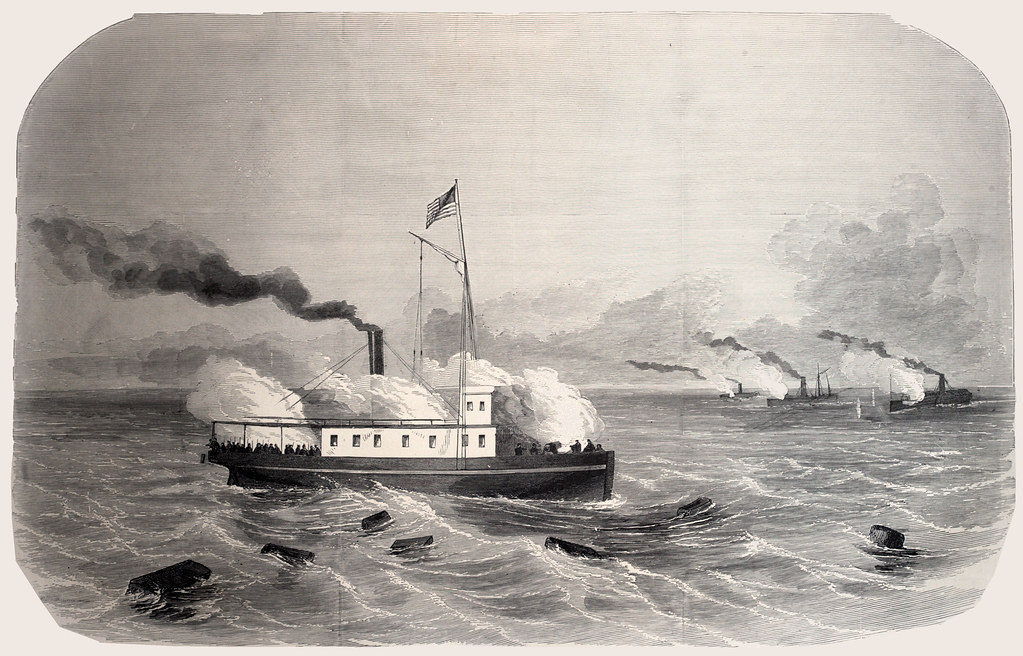
Capture of the Propeller ‘Fanny’ In Pamlico Sound by Three Confederate Steamers while Conveying Men and Stores to the Twentieth Indiana Regiment

Capture of the Propeller ‘Fanny’ In Pamlico Sound by Three Confederate Steamers while Conveying Men and Stores to the Twentieth Indiana Regiment

(from Frank Leslie’s Illustrated History of the Civil War…, edited by Louis Shepheard Moat, Published by Mrs. Frank Leslie, New York, 1895)

“0n the 1st of October, 1861, Colonel Hawkins dispatched the propeller Fanny, with two cannon, ammunition, supplies and provisions, to the camp of the Twentieth Indiana Regiment, then stationed at Chicamacomico. While they were landing their stores into boats they were attacked, about five o’clock in the afternoon, by the Confederate steamer, Northampton, and two tugs, which came from the direction of Roanoke Island, and after a brief engagement the Fanny was surrendered to the enemy.”

0 comments

20th birthday—War Diary of Luman Harris Tenney.

War Diary of Luman Harris Tenney.

1st. My birthday (twenty)–what a contrast between this one and that of the year before. Spent the day about as usual.

0 comments

Our Secesh friends are fortifying in sight—Diary of Rutherford B. Hayes.

Diary and Letters of Rutherford Birchard Hayes

Camp Sewell, October 1, 1861. – About a week ago I left Camp Scott, or Cross Lanes, and came over to General Cox’s camp on the top of Sewell Mountain. Our Secesh friends are fortifying in sight. I staid with McCook. General Cox is an even-tempered man of sound judgment, much loved by his men. McCook and he both wanted to occupy Buster’s Knob on the left of our enemy’s camp, but a dispatch from General Rosecrans prevented. The next day the enemy were fortifying it. General Schenck takes command of our brigade. I have tried five cases the last two days. We had a rain-storm, cold, windy, and awful. Must go to winter quarters. The enemy still fortifying. Our pickets killed a colonel or lieutenant-colonel of the enemy who rode among them. All wrong and cruel. This is too like murder. Shooting pickets, etc., etc., ought to be put down. Another cold night. Jolly times we have in camp.

0 comments

“It seems that we are in camp this time for business.”–Alexander G. Downing.

Diary of Alexander G. Downing; Company E, Eleventh Iowa Infantry

Tuesday, 1st–We drew our cooking utensils and rations for five days. John Batderf, Joseph Tomlinson and I were put in as cooks for the company. We have company drill four hours a day. It seems that we are in camp this time for business. My bunk-mate is James M. Fossett, a brother of Thomas Fossett. James enlisted this time instead of his brother. He’s a fine fellow for a bunk-mate.

0 comments

“We are now formidably intrenched, and I think can make a tolerable defence against the foe.”—War Letters of William Thompson Lusk.

War Letters of William Thompson Lusk.

Headquarters 79th Regt.
Camp Advance, Co. K.
Virginia, 1861.

Dear Mother:

A most delightful moonlight forbids my retiring at the usual hour to rest, so I will write and let you know that all is well – that we have had a dull week, that there has been naught to stir the sluggish blood since last week save once, when it was thought that the Army of Beauregard was marching in heavy columns upon us, but it didn’t come, so we all said: “Pooh, pooh! We knew it wouldn’t. They are too wise to attack us.” Alas, that we should have to tell that sorry tale of Bull Run! Walter has written me, and is full of our defeat. He does not feel flattered by the cheap lithographs in the shop windows representing “Yankees Running,” which are thrust upon his sight all over England. He is delighted though to think that the 79th did well, and that I was a member of the Highland Regiment. As we file out of our camp, full equipped, the soldiers of other Regiments are wont to say, “There go the Highlanders. There will be fighting to-day.” We are now formidably intrenched, and I think can make a tolerable defence against the foe. The Richmond Examiner says: “We” (the Southerners) “flaunt our flag defiantly in the face of the cowed and craven-hearted foe, but they tamely endure the insults we heap upon them, and refuse to accept our challenge to a fair and open fight.” Well I think we can afford to endure the flaunting of the “stars and bars” until McClellan is ready, when we hope to march forward, seeking winter quarters in the pleasant mansions of the South. Just this same thing the Southerners are hoping to gain in the North. Beauregard thinks Philadelphia, Baltimore and New-York gay places in the season, where the Southern youth may join in the festivities of winter. Nous verrons.

We have a little parson in our regiment who has a due regard for his personal safety. We love to get him into our tents, and describe with graphic truthfulness the horrid nature of shell wounds. The worst of shells too, we add, is, that they can be thrown to such a distance that even the Doctor and Chaplain are exposed to their death-bearing explosions. Our parson grows uneasy, and. when an alarm is given, starts off, carpet-bag in hand, to our intense amusement, for the nearest place of safety. He is like that worthy chaplain who, on the eve of battle, told the soldiers, “Fear not, for those of you who fall will this night sup in Paradise.” The battle commenced and the chaplain began to display most entertaining signs of terror. He was reminded of the consoling language he had himself used in the morning. “No thank ye,” he answered quickly, “I never did like suppers.” To such an extent are we obliged to resort to everything to amuse ourselves. Our darkeys give us some amusement and much more trouble. Ours we have dubbed the “Pongo,” who knows how not to do it. in a manner to excite our unbounded admiration. In the evening these Africans have a way of getting around the fire and singing real “nigger melodies,” which are somewhat monotonous as regards the music, and totally idiotic as regards the words. A favorite of theirs goes thus – viz:

My little boat is on de ocean
Where de wild bird makes de music
………..All de day.

This will sometimes be repeated for a couple of hours by the indefatigable nigger – indefatigable in this alone.

Good-bye, darling mother.
Most affec’y.,
W. T. Lusk.
0 comments

Civil War Day-By-Day

Civil War Day-by-Day

October 1, 1861

A Chronological History of the Civil War in America1

  • Rebel camp at Charleston, Mo., broken up by Union
    troops.
  • U. S. transport “Fanny” captured by two rebel steamers between Hatteras Inlet and Chicamacoffico.

  1. A Chronological History of the Civil War in America by Richard Swainson Fisher, New York, Johnson and Ward, 1863
0 comments

Battery once more together.

Diary of Battery A, First Regiment, Rhode Island Light Artillery, by Theodore Reichardt

Monday, September 30 .—The section returned to Darnestown, and the battery was once more together.

0 comments

Rebel War Clerk

Civil War Day-by-Day

SEPTEMBER 30th.—A pretty general jail delivery is now taking place. Gen. Winder, acting I suppose, of course, under the instructions of the Secretary of War—and Mr. Benjamin is now Secretary indeed—is discharging from the prisons the disloyal prisoners sent hither during the last month by Gens. Johnston, Floyd, and Wise. Not only liberating them, but giving them transportation to their homes, mostly within the enemy’s lines. Surely if the enemy reciprocates such magnanimous courtesy, the war will be merely child’s play, and we shall be spared the usual horrors of civil war. We shall see how the Yankees will appreciate this kindness.

0 comments

September 1863

Experience of a Confederate Chaplain—Rev. A. D. Betts, 30th N. C. Regiment

Sept. 1—Meet Chaplains. Dr. Pendleton there. Rev. Dr. Schon and Rosser come on train. (Rev. Thos. Murphy, of Wilmington, and David Sykes, of Bladen died Aug. 18.) Two converts during the week. Much interest in 2nd and 3rd. Several penitents and some converts.

Sept. 4—The Lord’s work goes on. Ten quiet clear conversions at night. Bro. Howard preaches. Ten days furlough comes.

Sept. 5—Self-denial. Furlough in my pocket, but feel it my duty to remain at my work. Much encouraged by frequent conversions.

(Sixteen years from that day I was to see my wife die in Greensboro. She has been seventeen years in Heaven, as I review my little diary of the trials and toils of war.)

Sept. 6—Preach for Doles’ Brigade. In p. m., Bro. Howard, Lawry and I immerse about thirty men. Bro. Powledge, of Georgia, preaches for me at night.

Sept. 7—Bro. Howard preaches for men at night.

Sept. 8—Meet Chaplains. Glorious work in the army, thank God!

Sept. 9—Start home.

Sept. 10—Get to Raleigh at midnight.

Sept. 11—Reach home to breakfast.

Sept. 12—Ride to Orange Church.

Sept. 13—Preach in M. E. Church in Chapel Hill.

Sept. 16—Rev. J. W. Jenkins baptizes my fourth son, James Russell.

Sept. 17—Start to Virginia at 4 p. m. God bless wife and children!

Sept. 19—Get to Orange Courthouse weak and sick. Walk six or eight miles to Dr. Terryll’s.

Sept. 20—Walk to wagon yard. Ride to Palmyra Church. Preach to Ordinance officers.

Sept. 21—Get to Regiment near Morton’s Ford. Bro. Marshall went with me and preached at Palmyra Church. Sleep in stable at Buckner’s.

Sept. 22—Go in camp near Morton’s Ford. Willie’s birthday.

Sept. 23—Preach to Regiment on picket line. Prayers at night.

Sept. 25—Revs. Rumple and Kilpatrick arrive. Bro. Rumple preaches at night.

Sept. 26—Bro. Kilpatrick preaches this p. m. Regiments go on picket. Prayer at night.

Sept. 27—Preach twice on picket. Relieved late. Bro. Rumple preaches at night.

Sept. 28—Two converts.

Sept. 29—Write to Prof. Hepburn.

Sept. 30—Go on picket.

0 comments

“House in tolerable repair and convenient, shall move in tomorrow.”—Horatio Nelson Taft

Diary of US patent clerk Horatio Nelson Taft.

MONDAY 30

We have been all day hard at work getting ready to leave our residence on L St. I have rented a house on 9th St next door to Comodore Smith, No. 346, having 9 rooms and back buildings, rent $200.00 pr year. House in tolerable repair and convenient, shall move in tomorrow. The House belongs to the old “Douty Estate” and is one belonging to “Douty Row” betwen Mass Ave and L St, West. Weather is delightful.

______

The three diary manuscript volumes, Washington during the Civil War: The Diary of Horatio Nelson Taft, 1861-1865, are available online at The Library of   Congress.

0 comments

War Diary of Luman Harris Tenney.

War Diary of Luman Harris Tenney.

30th. Thede returned in the morning. I felt rather ill from a hard cold.

0 comments

Marched through town up to Camp McClellan, where we went into barracks.–Alexander G. Downing.

Diary of Alexander G. Downing; Company E, Eleventh Iowa Infantry

Monday, 30th–I left home early this morning for Tipton, where at 10 o’clock about one hundred of us, with a band, left Tipton in farm wagons for Wilton, which place we reached at 4 o’clock, all covered with mud. At 5 o’clock we took the train for Davenport and arrived there at 8 o’clock. We formed in double line at the station and marched through town past the Burtis Hotel, on up to Camp McClellan, where we went into the barracks. As we passed the hotel every other man was handed a good wool blanket.

Company B of the Eleventh Iowa had supper prepared for us, consisting of boiled potatoes, fried bacon, boiled beef, baker’s bread and coffee. On the way down from Wilton, Governor Kirkwood passed through the train and shook each man by the hand.

0 comments

“I have been much shocked by the growing tendency to drunkenness amongst the officers of the army.”–Journal of Surgeon Alfred L. Castleman.

Journal of Surgeon Alfred L Castleman.

30 h.–During the past week I have been much shocked by the growing tendency to drunkenness amongst the officers of the army. I do not doubt but that if the soldiers could procure spirituous liquors, they would follow the example set them by their much loved officers.

I have been somwhat amused for a few days by the antics of an officer of high rank, who has been shut up by sickness in his tent, and under my supervision. He entered the army about the time I did, and had for some time been a much esteemed member in good standing of the Good Templars. He had been from camp a few days–I think to Washington–and returned sick. He had been with me but a short time when his vivid imagination began to convert the stains on his tent into “all manner of artistic beauties– figures of beasts and men, and of women walking on the walls of his tent, feet upwards.” Fie, fie! Colonel; if I did not know that you were a Good Templar and a married man, I should think such fancies were unbecoming. ‘Tis a good thing to be a Templar and a married man, but still ” All is not gold that glitters.”

0 comments

We were ready in half an hour, and at sunset we started, no one knew where.

Civil War Day-by-Day

Camp Corcoran, Arlington Heights, Va.,

Monday, Sept. 30, 1861.

Dear Sister L. :–

My soldiering now is not play, it is work. The last time I wrote you we were in Camp Casey, above Washington. Last Saturday afternoon we received orders to strike tents and be ready to march. We were ready in half an hour, and at sunset we started, no one knew where. We went down through the city, past the Capitol, and across the Long Bridge, and set our feet on the sacred soil of the “Mother of Presidents.” After marching about eight miles, we halted on a piece of rough ground, evidently a pasture, stacked our guns and lay down to rest. We were hungry, but we had nothing to eat. D., H. and I had each a blanket. We spread one down and the other to cover us and tried to sleep, but it was so cold we could not sleep much. The dew wetted our blankets both through, and H. was almost sick, so we had rather a sorry night. I rose about 4 o’clock and stood by the guard fire till reveille, drying our blankets. Half an hour after sunrise we marched about half a mile to our present camp. We pitched our tents and had our dinner of bread and raw pork at noon. I could not eat raw pork and dry bread at home, but a fast of twenty-four hours, a ten-mile march, and a bivouac at night sharpens the appetite wonderfully. At night we got things arranged, and had a good supper. Our rations are of the best quality, except our salt beef, which is not sweet.


Now for our camp. We are on Arlington Heights, about four miles southwest of the Capitol. The Heights are ranges of hills running parallel with the river and overlooking the city. Fort Corcoran is about twenty rods from our camp, and another fort on the other side. As far as I can see in every direction, the white tents of our enemy dot every hilltop. The rebel camps are within two miles of us, their pickets and ours shooting each other every night.

Our whole regiment has been changed from light infantry to a rifle regiment. We are to have the short Minie rifle with sword bayonet. Our drill is changed entirely, but I am learning it very fast. The whole regiment is doing its best with the hope of soon meeting the enemy. We are drilling with old altered flintlocks.

As I came out of my tent yesterday morning, what was my astonishment to see the Reverend Mr. Reed of Pittsburgh standing before me in uniform. I looked at him and could hardly recognize him, but there was no mistake. He is the chaplain of Governor Black’s regiment, twelve hundred strong. He said his regiment had gone to make a reconnoissance beyond Munson’s Hill–that great fortification was taken without firing a gun, and a lot of wooden guns ingeniously painted showed how they were armed.


Regiments are moving every night, and though we are ignorant of what is to be done, the universal impression is that a great battle is on the tapis.

2 P. M. We have orders to be in readiness to march at a moment’s notice. Forty rounds of cartridges are distributed. Lowe’s balloon is in our camp. I would write more but must stop for want of time.

Address O. W. N., care Captain T. M. Austin, McLane’s Regiment, Camp Corcoran, Washington, D. C.

0 comments