Sworn in!–Alexander G. Downing.

Diary of Alexander G. Downing; Company E, Eleventh Iowa Infantry

Saturday, 5th–Our company was sworn into the United States service today, by Captain Alexander Chambers of the regular army. Four men were rejected, which left ninety in the company. Fisher was rejected because he was too short–less than five feet,[i] and Lowe was rejected because he was pigeon-toed.[ii] I got a pass and went to Allen’s Grove to see John Moore.


[i] He was taken later, however, when the need of men was greater and also because of his persistence.–A. G. D
[ii] Lowe feigned to be pigeon-toed, so that he would be rejected, having got chicken-hearted. The boys jeered him.–A. G. D.

0 comments

Civil War Day-By-Day

Civil War Day-by-Day

October 5, 1861

  • Major papers in London reflect the division over the American Civil War in Britain. In an editorial, the London Post backs an independent Southern Nation. Previously, the London Times had backed the Union.

A Chronological History of the Civil War in America1

  • Unsuccessful efforts of the rebels to retake the Hatteras Inlet forts.
  • Gen. Robert Anderson took command of the Union forces in Kentucky.

  1. A Chronological History of the Civil War in America by Richard Swainson Fisher, New York, Johnson and Ward, 1863
0 comments

“…,pd for Apples at the rate of $3.00 pr Bushel, Potatoes $1.50, Butter 25 cts, Eggs 22 cts, Beef Steak (Surloin) 15 cts, (round) 12 1/2, corn[e]d Beef 8 to 10…,”—Horatio Nelson Taft

Diary of US patent clerk Horatio Nelson Taft.

SATURDAY 5

Very hot again today. M. at 90 in the middle of the day. Went to the Treasury again but did not see the Sec’y. Was at the Pat office awhile and at Charleys rooms. He has rented the Basement room of the house he is in for a Labratory &c. Got down the Aquarium from Pecks tonight. Went to market as usual Sat night, pd for Apples at the rate of $3.00 pr Bushel, Potatoes $1.50, Butter 25 cts, Eggs 22 cts, Beef Steak (Surloin) 15 cts, (round) 12 1/2, corn[e]d Beef 8 to 10, Lima Beans 15 cts pr quart. Oak Wood is $7.50 pr cord, pine $6.50, hickory $9.00. No news.

______

The three diary manuscript volumes, Washington during the Civil War: The Diary of Horatio Nelson Taft, 1861-1865, are available online at The Library of   Congress.

0 comments

Rebel War Clerk

Civil War Day-by-Day

October 5th.—To-day several Southern-born gentlemen, who have lived long in the North, and have their fortunes and families there, applied for passports. They came hither to save the investments of their parents in Northern securities, by having them transferred to their children. This seems legitimate, and some of the parties are old and valued friends of mine. I know their sympathies are with their native land. Yet why are they so late in coming? I know not. It is for me to send them out of the country, for such is the order of the Secretary of War. The loyalty of the connections of these gentlemen is vouched for in a note (on file) written by Mr. Hunter, Secretary of State. Their names must be published as alien enemies. They will take no part in the war.

0 comments

Diary of a Southern Refugee, Judith White McGuire.

Diary of a Southern Refugee During the War by Judith White McGuire

October 5.—M. P. and myself drove to Millwood yesterday, and heard various rumours of victories in Western Virginia, and in Missouri; but we are afraid to believe them. At home we go on as usual.

0 comments

William Howard Russell’s Diary: Another Crimean acquaintance.—Summary dismissal of a newspaper correspondent.

My Diary North and South – William Howard Russell

October 5th.–A day of heat extreme. Tumbled in upon me an old familiar face and voice, once Forster of a hospitable Crimean hut behind Mother Seacole’s, commanding a battalion of Land Transport Corps, to which he had descended or sublimated from his position as ex-Austrian dragoon and beau sabreur under old Radetzsky in Italian wars; now a colonel of distant volunteers, and a member of the Parliament of British Columbia. He was on his way home to Europe, and had travelled thus far out of his way to see his friend.

After him came in a gentleman, heated, wild-eyed, and excited, who had been in the South, where he was acting as correspondent to a London newspaper, and on his return to Washington had obtained a pass from General Scott. According to his own story, he had been indulging in a habit which free-born Englishmen may occasionally find to be inconvenient in foreign countries in times of high excitement, and had been expressing his opinion pretty freely in favour of the Southern cause in the bar-rooms of Pennsylvania Avenue. Imagine a Frenchman going about the taverns of Dublin during an Irish rebellion, expressing his sympathy with the rebels, and you may suppose he would meet with treatment at least as peremptory as that which the Federal authorities gave Mr. D ____. In fine, that morning early, he had been waited upon by an officer, who requested his attendance at the Provost Marshal’s office; arrived there, a functionary, after a few queries, asked him to give up General Scott’s pass, and when Mr. D____ refused to do so, proceeded to execute a terrible sort of proces verbal on a large sheet of foolscap, the initiatory flourishes and prolegomena of which so intimidated Mr. D____, that he gave up his pass and was permitted to depart, in order that he might start for England by the next steamer.

A wonderful Frenchman, who lives up a back street, prepared a curious banquet, at which Mr. Irvine, Mr. Warre, Mr. Anderson, Mr. Lamy, and Colonel Foster assisted; and in the evening Mr. Lincoln’s private secretary, a witty, shrewd, and pleasant young fellow, who looks little more than eighteen years of age, came in with a friend, whose name I forget; and by degrees the circle expanded, till the walls seemed to have become elastic, so great was the concourse of guests.

0 comments

“Can you find out what ground Seward takes on the slave question?”–Adams Family Letters, Henry Adams, private secretary of the US Minister to the UK, to his brother, Charles.

Civil War Day-by-Day

London, October 5, 1861

Your letter and your articles in the Courier arrived last Monday. I sent one set of them down to Lucas, the editor of the London Star, and received a complimentary note in return which I will enclose to you. The other set I sent down to the editor of the Spectator, and from him I have not heard. There was one article to the Star which was partly drawn from your’s, without quoting it, but there has been no reprint. The Spectator never reprints, but if it notices you, I will send you the notice. Your Manchester paper I have made unavailing efforts to find, but London seems to despise anything provincial, and I can find the paper nowhere. London papers go to Manchester but Manchester ditto don’t seem to return the compliment.

This week I have no news for you. Everything seems to be getting along well and the Government here behaves itself very fairly. I don’t know whether my last letters will appear or not, but if they do you can form some judgment as to my inventive powers. The truth is that I ‘ve lately told so much in that way which was not generally known, that my position began to be too hot and I thought I ‘d try a little wrong scent. The facts are all invented therefore, but the idea is carried out as faithfully as I could, of quoting the state of English opinion.

We have been overrun by visitors this week. My friend Richardson goes in the Arabia to Boston, if he can, but I ‘m not sure that he won’t have to make Halifax his terminus. He was in a horrible position. His family and property are in New Orleans and he has a brother in the Virginian army. He is himself a good Union man, I believe; at all events he talks so; but he does not want to do anything which will separate him from his family or make them his enemies. So he could not make up his mind to take the oath, and determined rather to run his risk without a passport. I believe he means to pass the winter in Boston. He told me all about his troubles and I strongly advised him not to think of ever living in New Orleans again; at least as an architect.

Sohier and Charley Thorndike have been here this week. Both leave for Paris this morning. Sohier was quite amusing, and dined with us twice. But the trouble about London is that no one ever stays here and I can’t keep a companion. As for Englishmen I don’t expect to know any of my own age for at least six months more, as this club business has got to be settled and the season to come round again first. We see no English people now, or very few, and the fogs are thick almost every morning. Hooroar! Can you find out (not through Sumner, who seems to have distorted even your ideas of Washington affairs) what ground Seward takes on the slave question?

I need n’t say that the articles are devilish good and made me blue for a day, thinking of my own weak endeavors in the same way.

0 comments

Downing’s Civil War Diary.–Alexander G. Downing.

Diary of Alexander G. Downing; Company E, Eleventh Iowa Infantry

Friday, 4th–The third all-day rain. Our regiment, the Eleventh Iowa, commenced to build their new barracks, located on the east side of the camp ground. Lieutenant Durbin arrived today.

0 comments

Rebel War Clerk

Civil War Day-by-Day

OCTOBER 4th. — Sundry applications were made to-day to leave the country under flag of truce, provided I would not permit the names to be published. The reason for this request is that these persons have connections here who might be compromised. I refused compliance. In one or two instances they intimated that they would not have their names published for thousands of dollars. My response to this was such as to cause them to withdraw their applications.

0 comments

“Prof Lows Balloon was high up over ‘Dixey’ this evening. Heavy guns have been frequently heard over the River.”—Horatio Nelson Taft

Diary of US patent clerk Horatio Nelson Taft.

FRIDAY, OCTOBER 4, 1861.

Another hot day. Much as yesterday “danced attendance” at the Treasury most of the day without seeing the Sec’y. It has been Cabinet day and he much engaged. Think some of getting a room for compounding various medicines and articles for sale with the assistance of Chas — Must do something to make some money, if possible. Julia has been out to the Camp of the “Anderson Zouaves” with Capt Mew. Prof Low[e]s Balloon was high up over “Dixey” this evening. Heavy guns have been frequently heard over the River.

______

The three diary manuscript volumes, Washington during the Civil War: The Diary of Horatio Nelson Taft, 1861-1865, are available online at The Library of   Congress.

0 comments

Fremont’s Hundred Days in Missouri.

The Atlantic Monthly

October 4th. We have been in camp since Sunday, the 29th of September. Our tents are pitched upon a broad shelf half-way down a considerable hill. Behind us the hill rises a hundred feet or more, shutting us in from the south; in front, to the north, the hill inclines to a ravine which separates us from other less lofty hills. Our camp is upon open ground, but there is a fine forest to the east and west.

In a few days we have all become very learned in camp-life. We have found out what we want and what we do not want. Fortunately, St. Louis is near at hand, and we send there to provide for our necessities, and also to get rid of our superfluities. The troops have been gathering all the week. There are several regiments in front of us, and batteries of artillery behind us. Go where you will, spread out upon the plain or shining amidst the trees you will see the encampments. Headquarters are busy providing for the transportation and the maintenance of this great force; and as rapidly as the railway can carry them, regiment after regiment is sent west. There is plenty of work for the staff-officers; and yet our life is not without its pleasures. The horses and their riders need training. This getting used to the saddle is no light matter for the civilian spoiled by years of ease and comfort. But the General gives all his officers plenty of horseback discipline. Then there is the broadsword exercise to fill up the idle time. Evening is the festive hour in camp; though I judge, from what I have seen and heard, that our camp has little of the gayety which is commonly associated with the soldier’s life. We are too busy for merrymaking, but in the evening there are pleasant little circles around the fires or in the snug tents. There are old campaigners among us, men who have served in Mexico and Utah, and others whose lives have been passed upon the Plains; they tell us campaign stories, and teach the green hands the slang and the airs of the camp. But the unfailing amusement is the band. This is the special pride of the General, and soon after nightfall the musicians appear upon the little plaza around which the tents are grouped. At the first note the audience gather. The guardsmen come up from their camp on the edge of the ravine, the negro-quarter is deserted, the wagoners flock in from the surrounding forest, the officers stroll out of their tents,–a picturesque crowd stands around the huge camp-fire. The programme is simple and not often varied. It uniformly opens with “The Star-Spangled Banner,” and closes with “Home, Sweet Home.” By way of a grand finale, a procession is organized every night, led by some score of negro torch-bearers, which makes the circuit of the camp,–a performance which never fails to produce something of a stampede among the animals.

Last night we had an alarm. About eleven o’clock, when the camp was fairly asleep, some one tried to pass a picket half a mile west of us. The guard fired at the intruder, and in an instant the regimental drums sounded the long roll. We started from our beds, with frantic haste buckled on swords, spurs, and pistols, hurried servants after the horses, and hastened to report for duty to the General. The officer who was first to appear found him standing in front of his tent, himself the first man in camp who was ready for service. Presently a messenger came with information as to the cause of the alarm, and we were dismissed.

At two o’clock in the morning there was another alarm. Again the body-guard bugles sounded and the drums rolled. Again soldiers sprang to their arms, and officers rushed to report to the General, –the first man finding him, as before, leaning upon his sword in front of his tent. But, alas for the reputation of our mess, not one of its number appeared. In complete unconsciousness of danger or duty, we slept on. Colonel S. said he heard “the music, but thought it was a continuation of the evening’s serenade,” and went to sleep again. It was not long before we discovered that the General knew that four members of his staff did not report to him when the long roll was sounded.

There are several encampments on the hill-sides north of us which are in full view from our quarters, and it is not the least of our amusements to watch the regiments going through the after-noon drill. In the soft light of these golden days we see the long blue lines, silver-tipped, wheel and turn, scatter and form, upon the brown hill-sides. Now the slopes are dotted with skirmishers, and puffs of gray smoke rise over the kneeling figures; again a solid wall of bayonets gleams along the crest of the hill, and peals of musketry echo through the woods in the ravines.

Colonel Myscall Johnson, a Methodist exhorter and formidable Rebel marauder, is said to be forty miles south of us with a small force, and some of the Union farmers came into camp to-day asking for protection. Zagonyi, the commander of the body-guard, is anxious to descend upon Johnson and scatter his thieving crew; but it is not probable he will obtain permission. The Union men of Missouri are quite willing to have you fight for them, but their patriotism does not go farther than this. These people represent that three-fourths of the inhabitants of Miller County are loyal. The General probably thinks, if this be true, they ought to be able to take care of Johnson’s men. But a suggestion that they should defend their own homes and families astonishes our Missouri friends. General Lyon established Home-Guards throughout the State, and armed them with several thousand Springfield muskets taken from the arsenal at St. Louis. Most of these muskets are now in Price’s army, and are the most formidable weapons he has. In some instances the Rebels enlisted in the home-Guards and thus controlled the organization, carrying whole companies into Price’s ranks. In other cases bands of Rebels scoured the country, went to the house of every Home-Guard, and took away his musket. In the German settlements alone the Guards still preserve their organization and their arms.

A few days ago it fell to the lot of our mess to entertain a Rebel officer who had come in with a flag of truce. Strange to say, he was a New Yorker, and had a younger brother in one of the Indiana regiments. He was a pleasant and courteous gentleman, albeit his faded dress, with its red-flannel trimmings, did not indicate great prosperity in the enemy’s camp. We gave him the best meal we could command. I apologized because it was no better. He replied, –“Make no apology, Sir. It is the best dinner I have eaten these three months. I have campaigned it a good deal this summer upon three ears of roast corn a day.” He added, –“I never have received a cent of pay. None of us have. We never expect to receive any.” This captain has already seen considerable service. He was at Booneville, Carthage, Wilson’s Creek, and Lexington. His descriptions of these engagements were animated and interesting, his point of view presenting matters in a novel light. He spoke particularly of a gunner stationed at the first piece in Totten’s battery, saying that his energy and coolness made him one of the most conspicuous figures of the day. “Our sharp-shooters did their best, but they failed to bring him down. There he was all day long, doing his duty as if on parade.” He also told us there was no hard fighting at Lexington. “We knew,” said he, “the place was short of water, and so we spared our men, and waited for time to do the work.”


Fremont’s Hundred Days in Missouri was published in three installments in The Atlantic Monthly. The anonymous author appears to have been a member of Fremont’s staff with a disdainful bias towards Missourians, even those who were pro-Union.

0 comments

William Howard Russell’s Diary: Poor Trescot! (at Port Royal).—Mr. Seward and myself.

My Diary North and South – William Howard Russell

October 4th.–The new expedition, of which I have been hearing for some time past, is about to sail to Port Royal, under the command of General Burnside, in order to reduce the works erected at the entrance of the Sound, to secure a base of operations against Charleston, and to cut in upon the communication between that place and Savannah. Alas, for poor Trescot! his plantations, his secluded home! What will the good lady think of the Yankee invasion, which surely must succeed, as the naval force will be overwhelming? I visited the division of General Egbert Viele, encamped near the Navy-yard, which is bound to Annapolis, as a part of General Burnside’s expedition. When first I saw him, the general was an emeritus captain, attached to the 7th New York Militia; now he is a Brigadier-General, if not something more, commanding a corps of nearly 5000 men, with pay and allowances to match. His good lady wife, who accompanied him in the Mexican campaign, –whereof came a book, lively and light, as a lady’s should be,–was about to accompany her husband in his assault on the Carolinians, and prepared for action, by opening a small broadside on my unhappy self, whom she regarded as an enemy of our glorious Union; and therefore an ally of the Evil Powers on both sides of the grave. The women, North and South, are equally pitiless to their enemies; and it was but the other day, a man with whom I am on very good terms in Washington, made an apology for not asking me to his house, because his wife was a strong Union woman. A gentleman who had been dining with Mr. Seward to-night told me the Minister had complained that I had not been near him for nearly two months; the fact was, however, that I had called twice immediately after the appearance in America of my letter dated July 22nd, and had met Mr. Seward afterwards, when his manner was, or appeared to me to be, cold and distant, and I had therefore abstained from intruding myself upon his notice; nor did his answer to the Philadelphian petition–in which Mr. Seward appeared to admit the allegations made against me were true, and to consider I had violated the hospitality accorded me–induce me to think that he did not entertain the opinion which these journals which set themselves up to be his organs had so repeatedly expressed.

0 comments

“We are in Secessia and the meanest part of it, too, and anything the boys can forage they consider as theirs.”–Army letters of Oliver Willcox Norton.

Civil War Day-by-Day

Camp Leslie, near Falls Church,
Fairfax County, Va., Oct. 4th, 1861.

Dear Friends at Home:–

I last wrote from Camp Corcoran and once before from Camp Casey, and you see by date we have moved again. The Colonel here presented us to McClellan as a well drilled regiment and asked the privilege of taking a position in the advance, which, I suppose, is granted. You have read of the taking of Hall’s Hill, in the late papers. Our camp is right there on the scene of the skirmish. Falls Church lies at the foot of the hill, to the southwest. We came here Wednesday last from Fort Corcoran. Munson’s, of which we have all heard so much, is two miles to our left on the southeast. Mr. Reed is with his regiment on the same hill; the rebel pickets are about a mile from Falls Church, so you see we are not far from them.

My time is so limited that you must not wait for me to answer each letter individually, but I must write to all at once and hope each will write in return. I did not think you had forgotten me, but I have been five weeks from home and not a letter till to-day. I have been anxious to hear, full as much so as you, I presume. I hope you will write very often. The last letter I sent I did not pay the postage, because I could not. We can get no stamps here, and no one will take charge of postage not in stamps, so the letters have to be franked by the Major and sent on. I wish you could send a few stamps. My money is all gone, and although pay is due us now, I can’t tell when we will get it.

General McClellan and his staff, General McDowell, General Porter, Prince de Joinville, Due de Chartres and other notables visited us last night. They stayed only a short time. I heard McClellan remark as he rode up, “There, those boys haven’t got their pants yet. That’s a shame.”

[continue reading…]

0 comments

Downing’s Civil War Diary.–Alexander G. Downing.

Diary of Alexander G. Downing; Company E, Eleventh Iowa Infantry

Thursday, 3d–It rained again all day, and although our camp is on high ground, on the bluff just east of town, yet it is a jelly of mud. It couldn’t be otherwise with three or four thousand men tramping over it.

0 comments

“Feel quite “used up” with the heat.”—Horatio Nelson Taft

Diary of US patent clerk Horatio Nelson Taft.

THURSDAY 3

This has been a hot day for the season. M. at 86 in the middle of the day. It has passed away without any particular incident occurring. Met John T McKenzie on the Ave. He agreed to meet me at Willards this evening, but he probably took the 6 o’clock train, as I did not see him. Met Genl Scheopf there. Called at the Treasury to see the Sec’y but did not succeed. He has just returned from the East. Feel quite “used up” with the heat.

______

The three diary manuscript volumes, Washington during the Civil War: The Diary of Horatio Nelson Taft, 1861-1865, are available online at The Library of   Congress.

0 comments

Rebel War Clerk

Civil War Day-by-Day

OCTOBER 3d.—The President not having taken any steps in the matter, I have no alternative but to execute the order of the Secretary.

0 comments

…we owned the whole plantation of that old rebel Peters.

Diary of Battery A, First Regiment, Rhode Island Light Artillery, by Theodore Reichardt

Thursday, October 3.—Left the picket line again, returned to Camp Jackson, started for Darnestown by six o’clock, and arrived there by eight o’clock P. M. Thus ended our stay at Seneca Mills, the most pleasant period of our three years service. Vegetables and fruit, chickens and pigs, were plenty, for we owned the whole plantation of that old rebel Peters, who was sent to Fort Lafayette for treason. The Thirty-fourth New York, having the picket line on the river, always proved good companions. The view of the surrounding country is really imposing, including Sugar Loaf Mountain, the natural observatory of the signal corps. Some remarkable items must not be forgotten—for instance, novel songs of “The Nice Legs;” “Jimmy Nutt’s Measuring the Guard Time by the Moon;” “Griffn’s Apple Sauce,” and “Doughnuts for Horses.”

0 comments

Letters of Rutherford B. Hayes.

Diary and Letters of Rutherford Birchard Hayes


Up Gauley River, Camp Sewell, October 3, 1861.

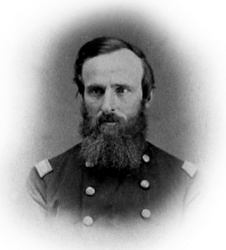
Dear Uncle: – I should have written you, if I had known where you were. We are in the presence of a large force of the enemy, much stronger than we are, but the mud and floods have pretty much ended this campaign. Both the enemy and ourselves are compelled to go back to supplies soon. I think, therefore, there will be no fight. We shall not attack their entrenchments now that they are reinforced, and I suspect they will not come out after us. Donn Piatt just peeped in. He always has funny things. I said, quoting Webster, “I still live.” “Yes,” said he, “Webster – Webster. He was a great man. Even the old Whigs about Boston admit that!” And again, speaking of the prospect of a fight, he said: “This whistling of projectiles about one’s ears is disagreeable. It made me try to think at Bull Run of all my old prayers; but I could only remember, ‘Oh Lord, for these and all thy other mercies, we desire to be thankful.'”

We shall soon go into winter quarters at posts chosen to hold this country, Gauley Bridge, Charleston, etc., etc. Who will get into a better place, is the question. We all want to go to Washington or to Kentucky or Missouri. We are in General Schenck’s brigade, and hope he will make interest enough to get us into good quarters. There is much sickness among officers and men. My health was never better than during these four months. I hope you will continue to improve.

I am still in General Rosecrans’ staff; but having just finished an extensive tour of court-martial, am again in camp with my regiment in good order. It is like going home to get back. Still this practicing on the circuit after the old fashion, only more so – an escort of cavalry and a couple of wagons with tents and grub – has its attractions. I shall get out of it soon, but as a change, I rather enjoy it.

Between you and Platt, I must get a strong, fleet, sure-footed horse for the next campaign. If the paymaster comes, I shall be able to pay from one hundred and fifty to two hundred dollars. My present horse turns out well, very well, but the winter will probably use him up, and I must get another.

Hereafter, direct to me, Gauley Bridge, instead of Clarksburg.

We have just learned that McClellan has had a success at Washington. If so, whatever happens here, the cause is safe. I hope the news is true.

Sincerely,

R. B. Hayes.

S. Birchard.

0 comments

Letters of Rutherford B. Hayes.

Diary and Letters of Rutherford Birchard Hayes

Camp Sewell, October 3, 1861.

Dearest: – This is a pleasant morning. I yesterday finished the work of a court-martial here; am now in my own tent with my regiment “at home.” It does seem like home. I have washed and dressed myself, and having nothing to do I hope to be able today to write to all. I begin, of course, with my darling wife, of whom I think more and more affectionately the longer we are separated. And the dear boys too – kiss and hug them warmly.

We are evidently at the end of our campaign in this direction for this season. The bad roads and floods make it impossible longer to supply an army so far from railroads and navigable waters. How soon we shall begin our backward march, I do not know. If the enemy were not immediately in front of us we should leave instantly but, no doubt, our leaders dislike to make a move that will look like a retreat from an enemy that we care nothing about. But there is nothing to be gained by staying so far in the mountains, and the danger of starving will send us back to Gauley Bridge long before this reaches you. We shall, no doubt, garrison and fortify the strong points which control western Virginia, and the question with us all is, who is to stay and who go to some pleasanter scene.

We are now in General Schenck’s brigade, and hope he will have influence enough to get us a place in the Kentucky or some other army. We are, no doubt, the crack American regiment of all this region, and think we should have the conspicuous place. I think we shall get out of here, but we shall see. I think there will be no battle here. The enemy are strongly entrenched and far superior to us in numbers. Besides there is no object in attacking them. They have twenty-two pieces of artillery. They will not attack us, unless encouraged to do so by our apparent retreat. If they come out of their entrenchments to fight us we think we have got them. So if our retreat is prudently managed, I suspect there will be nothing but skirmishing. That we have a little of daily.

Since we passed into the mountains, we are out of reach of mails. It is almost a month since the date of your last letter. I am still on General Rosecrans’ staff although with my regiment, and [continue reading…]

0 comments

William Howard Russell’s Diary: “The federal armies are not handled easily.”

My Diary North and South – William Howard Russell

October 3rd.–In Washington once more–all the world laughing at the pump and the wooden guns at Munson’s Hill, but angry withal because McClellan should be so befooled as they considered it, by the Confederates. The fact is McClellan was not prepared to move, and therefore not disposed to hazard a general engagement, which he might have brought on had the enemy been in force; perhaps he knew they were not, but found it convenient nevertheless to act as though he believed they had established themselves strongly in his front, as half the world will give him credit for knowing more than the civilian strategists who have already got into disgrace for urging McDowell on to Richmond. The federal armies are not handled easily. They are luxurious in the matter of baggage, and canteens, and private stores; and this is just the sort of war in which the general who moves lightly and rapidly, striking blows unexpectedly and deranging communications, will obtain great results.

Although Beauregard’s name is constantly mentioned, I fancy that, crafty and reticent as he is, the operations in front of us have been directed by an officer of larger capacity. As yet McClellan has certainly done nothing in the field to show he is like Napoleon. The value of his labours in camp has yet to be tested. I dined at the Legation, and afterwards there was a meeting at my rooms, where I heard of all that had passed during my absence.

0 comments

Civil War Day-By-Day

Civil War Day-by-Day

October 3, 1861

  • Battle of Greenbriar WV

A Chronological History of the Civil War in America1

  • Battle at Greenbrier, Va.; rebels defeated after an hour’s fighting, and a large number of cattle and horses taken by the U. S. troops.
  • Ex-Street Commissioner of New York, Gustavus W. Smith, appointed a brig.-general in the rebel army.
  • Rebels evacuated Lexington, Mo.
  • Skirmish at Buffalo Hill, Ky.; Union loss 10 killed and 10 wounded; rebel loss 52 killed, etc.

  1. A Chronological History of the Civil War in America by Richard Swainson Fisher, New York, Johnson and Ward, 1863
0 comments

Election this afternoon for choosing non-commissioned officers, sergeants and corporals.–Alexander G. Downing.

Diary of Alexander G. Downing; Company E, Eleventh Iowa Infantry

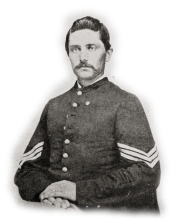
Wednesday, 2d–It rained all day. The band from Tipton left for home this morning. Our company held an election this afternoon for choosing non-commissioned officers, sergeants and corporals. It was quite a political battle, the way the boys strove for the different offices.

0 comments

“Troops keep coming from the North and some are moveing over the River every day.”—Horatio Nelson Taft

Diary of US patent clerk Horatio Nelson Taft.

WEDNESDAY 2

Called at the Treasury, could not see the Sec’y. Was at the Pat office an hour or so. Mr Scheopf has got his Commission as Brigadier Genl of Volunteers for the War. Troops keep coming from the North and some are moveing over the River every day. Unpacked our Boxes today and have been settling matters in the house somewhat, bought a few articles of furniture but as little as possible. Nothing new in the City.

______

The three diary manuscript volumes, Washington during the Civil War: The Diary of Horatio Nelson Taft, 1861-1865, are available online at The Library of   Congress.

0 comments

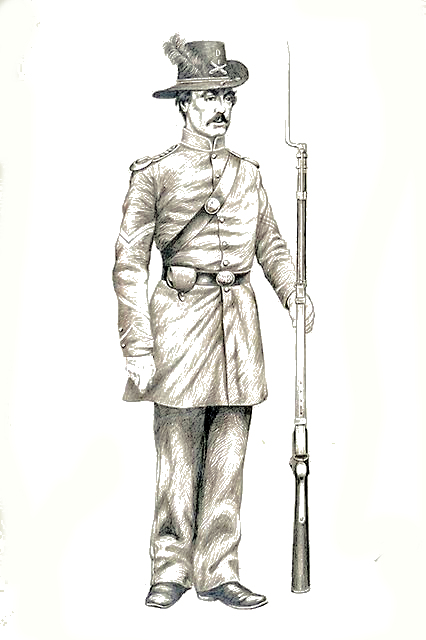
United States corporal in 1859-1861 service dress uniform

Miscellaneous document sources

Title: United States corporal in 1859-1861 service dress uniform
Publisher: U.S. National Park Service
Comment: Reflective Art
Copyright: Government owns art and all reproduction rights.
Constraints Information: Public domain
Keywords: soldier, Military Affairs, Graphite on paper
Resource Type: Image
NPS Units: Fort Washington Park, Code: FOWA
Locations: Fort Washington Park, Prince George’s County, Maryland
Latitude: 38.7122001647949, Longitude: -77.0287017822266

National Park Service item permalink

Mike’s notes:

Image restoration note – This image has been digitally adjusted for one or more of the following:
– fade correction,
– color, contrast, and/or saturation enhancement
– selected spot and/or scratch removal
– cropped for composition and/or to accentuate subject matter
– straighten image

Image restoration is the process of using digital restoration tools to create new digital versions of the images while also improving their quality and repairing damage.

0 comments

Rebel War Clerk

Civil War Day-by-Day

OCTOBER. 2d.—A day or two ago Col. Bledsoe, who visits me now very seldom, sent an order by Mr. Brooks for me to furnish a list of the names of alien enemies for publication. This was complied with cheerfully; and these publications have produced some excitement in the community.

0 comments