“I think we were out looking after that damned Jeff Thompson…,”–Army Life of an Illinois Soldier, Charles Wright Wills.

Civil War Day-by-Day

Bird’s Point, October 10, 1861.

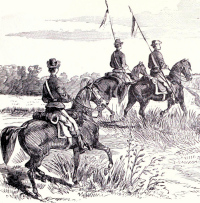
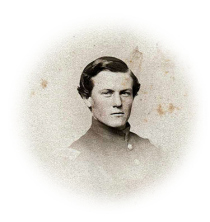
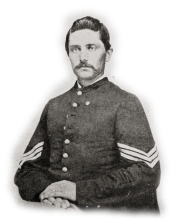
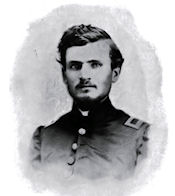
I have just finished a dinner of cider, cake, bread, butter, etc. We have just been paid off and of course have to indulge in a few delicacies for awhile. Last Tuesday we were ordered to strike tents and pack for a march. It wasn’t much of a march though for we were put on the cars and rolled out to Charleston, 12 miles from here, where we camped on a beautiful little prairie adjoining town. The 11th Illinois, Taylor’s artillery and two companies of cavalry and our regiment formed the party. I think we were out looking after that damned Jeff Thompson, who is reported everywhere from Ironton down to New Madrid. I don’t believe he has a thousand men, for there seems to be nothing reliable about any of the reports we have of him. The natives up at Charleston told us that Jeff was at Sykestown, 12 miles from there, with 5,000 or 6,000 troops, and our pickets had several little fights with his, or what we supposed to be his, but—well, the generals may know better but we that stay in the ranks think that there is no enemy nearer than Columbus save a few small bands of bushwhackers, who, under the impression that they are upholding principles eternal and doing their country service, gobble up everything sweet or sour, that weighs less than a ton. We came down from Charleston Thursday. We marched about 10 miles of the way through an immense (it seemed so to me) cypress swamp. I think Mrs. Stowes. “Dred” would have enjoyed that swamp hugely. It was rather an interesting piece of scenery for a first view, but I don’t think I should enjoy living in sight of it. The 18th, Colonel Lawler, worked six or eight weeks in this swamp repairing bridges the secesh had burnt, and it put half their men on the sick list. We got our pay in treasury notes but they are as good as the gold. Lots of the boys have traded them off for gold “even up.” I get $21 this time for two months and five days, our other boys got $14 or $15. I am third sergeant now, our second having been appointed sergeant major. I think I should rather be sergeant, for the field officers make a kind of servant of the sergeant major. I send you a couple of daguerreotypes to let you see what a “skeleton” I have become. Our boys are all very well. The 17th is in a pretty hard condition, nearly half of them sick and as a regiment pretty badly used up. We have been paid twice and they only $10 yet.

0 comments

War Diary of Luman Harris Tenney.

War Diary of Luman Harris Tenney.

10th. Played chess with Miss Hamlin, and visited with the other girls. Wrote to Fannie.

0 comments

Civil War Day-By-Day

Civil War Day-by-Day

October 10, 1861

A Chronological History of the Civil War in America1

  • Further advances of the Union troops into Virginia.

  1. A Chronological History of the Civil War in America by Richard Swainson Fisher, New York, Johnson and Ward, 1863
0 comments

“As I write, a long train of baggage and men equipped for a journey is passing down the street.”—Woolsey family letters; Eliza to husband Joseph Howland.

Woolsey family letters during the War for the Union

Oct. 9, ‘61.

As I told you, Dr. Bacon left either Monday night or early yesterday for Annapolis with the 7th Connecticut. They seem to have been the first ones dispatched, for yesterday others went, and, as I write, a long train of baggage and men equipped for a journey is passing down the street. We think of sending Moritz on to Annapolis this afternoon with a basket of sea-stores for the Doctor, and he can bring us back accounts of the number of vessels, etc. Moritz is anxious to know before leaving if the troops–including the 7th Connecticut! are Union ones!

0 comments

Half Sheet

Miscellaneous document sources
Southern Watchman [Athens, Ga], October 9, 1861
Stern necessity compels us to appear before the public this week on a half sheet. It is no fault of ours. We almost “compassed sea and land” in search of paper, but could find none in the Southern Confederacy, and we were afraid to go to Doodledom after it. We are indebted to the courtesy of Mr. Winter of the Bath Mills, S. C., for the loan of a small lot—he had none for sale.We may possibly have to appear again on a half sheet next week; but after   that, we hope to be able to avoid doing so again. We regret the necessity exceedingly–we never expected to see the Watchman thus cut down; but it could not be helped. We were obliged to yield.
One third of the papers in the Confederate States have been entirely discontinued; while of the remainder, more than one half are published either on a half sheet or have been reduced in size.
In order to secure a supply of paper, we shall be obliged to reduce our size for the present. The great decrease in our advertising patronage, however, will enable us to give our readers more reading matter than we did in our mammoth sheet in more prosperous times.
We trust that we shall not lose one subscriber from this cause. We adopt the plan not to defraud them, but because necessity drives us to it. It will now cost us more to furnish them with a smaller paper than it did to supply them with a large one; while our receipts from advertising have been cut down at least two-thirds, with a large falling off in job work. As soon as circumstances will permit, we will resume the large size.
0 comments

“Never was there such a patriotic people as ours!”—John Beauchamp Jones

Civil War Day-by-Day

OCTOBER 9th.—Contributions of clothing, provisions, etc. are coming in large quantities; sometimes to the amount of $20,000 in a single day.

Never was there such a patriotic people as ours! Their blood and their wealth are laid upon the altar of their country with enthusiasm.

I must say here that the South Carolinians are the gentlest people I ever met with. They accede to every requisition with cheerfulness; and never have I known an instance where any one of them has used subterfuge to evade a rule, however hard it might bear upon them. They are the soul of honor, truth, and patriotism.

0 comments

“The Govt is too strong now, and too well prepared.”—Horatio Nelson Taft

Diary of US patent clerk Horatio Nelson Taft.

WEDNESDAY 9

Change in the weather, cool today. Saw Mr Harrington, Assistant Sec’y of the Treasury, could not see the Sec’y today. A movement of military to the other side of the River. Our forces are slowly advancing and fortifying as they go. I do not think there will be much fighting here. The Govt is too strong now, and too well prepared. I have been puting up window Curtains this evening. Edwd Dickerson called. Doct Piper attends Willie, he seems to be better.

______

The three diary manuscript volumes, Washington during the Civil War: The Diary of Horatio Nelson Taft, 1861-1865, are available online at The Library of   Congress.

0 comments

To John McCune Esq on “…sentiments of rebellion and insolence towards officers of the United States Government”The Letters of Samuel Ryan Curtis

The Letters of Samuel Ryan Curtis

Head Quarters Camp of Instruction
Benton Barracks Oct 9th 1861

John McCune Esq1
Prest Keokuk & St Louis Packet Co

Sir

I am informed by an officer of the mail service that you have reproached him for expressing Union sentiments and denouncing secession in the presence of the passengers on your boats.

I wish to know of you whether it is your purpose to conduct your boats on such terms of equality, and especially, whether you are going to foster in any way, sentiments of rebellion and insolence towards officers of the United States Government whose duty it is at all times & in all places to vindicate our National Government.

Very Respectfully
Your obdt Servt
Saml R Curtis
Brig Geni Commanding Post

[copy]


1. McCune may possibly have been a Keokuk acquaintance of Curtis’.

0 comments

Fremont’s Hundred Days in Missouri.

The Atlantic Monthly

Tipton, October 9th. The General was in the saddle very early, and left camp before the staff was ready. I was fortunate enough to be on hand, and indulged in some excusable banter when the tardy members of our company rode up after we were a mile or two on the way. We have marched twelve miles to-day through a lovely country. We have left the hills and stony roads behind us, and now we pass over beautiful little prairies, bordered by forests blazing with the crimson and gold of autumn. The day’s ride has been delightful, the atmosphere soft and warm, the sky cloudless, and the prairie firm and hard under our horses’ feet. We passed several regiments on the road, who received the General with unbounded enthusiasm; and when we entered Tipton, we found the country covered with tents, and alive with men and horses. Amidst the cheers of the troops, we passed through the camps, and settled down upon a fine prairie-farm a mile to the southwest of Tipton. The divisions of Asboth and Hunter are here, not less than twelve thousand men, and from this point our course is to be south-ward.


Fremont’s Hundred Days in Missouri was published in three installments in The Atlantic Monthly. The anonymous author appears to have been a member of Fremont’s staff with a disdainful bias towards Missourians, even those who were pro-Union.

0 comments

Letters of Rutherford B. Hayes.

Diary and Letters of Rutherford Birchard Hayes

Headquarters 23d Reg’t., O. V. Inf., U. S. A.,
Mountain Cove, Six Miles Above Gauley Bridge,
October 9, 1861.

Dear Brother: – We are now near or at the point where an entrenched camp for winter quarters is to be established. It will command the main entrance to the head of the Kanawha Valley, and can be held by a small force; is within a day’s ride of navigable waters connecting with Cincinnati, and telegraphic communication nearly completed. From half to two-thirds of the men in western Virginia can be spared as soon as a few days’ work is done. Indeed, green regiments just recruited could take care of this country and release soldiers who have been hardened by some service. Our regiment is second to no other in discipline, and equal in drill to all but two or three in western Virginia. We think it would be sensible to send us to Kentucky, Missouri, or the sea coast for the winter. We can certainly do twice the work that we could have done four months ago, and there is no sense in keeping us housed up in fortifications and sending raw troops into the field. In Kentucky, disciplined troops – that is, men who are obedient and orderly – are particularly needed. A lot of lawless fellows plundering and burning would do more hurt than good among a Union people who have [continue reading…]

0 comments

The first thing in the morning is drill, then drill, then drill again. Then drill, drill, a little more drill. Then drill, and lastly, drill.—Army letters of Oliver Willcox Norton.

Civil War Day-by-Day

Camp Leslie, near Falls Church,
Fairfax County, Va., Oct. 8, 1861.

Friend P——s.:—

In accordance with your expressed desire and my own promise, I have commenced writing to you. I intended to have written before, but an aversion to writing at all, which I have acquired in camp, is my only excuse. The inconveniences, or the total want of all conveniences, makes letter-writing in camp a very different thing from the same at home. If you find my letter written with a pencil, my paper soiled, my pencilmanship execrable, and the whole thing miserable, please don’t set me down as one who knows no better or cares for nothing better, but excuse me as the victim of circumstances.

You will see by the date that I am in the advance army. Our Colonel has recommended us to General McClellan as a well drilled regiment, and we have been assigned the honorable position we now occupy. We reached Washington on Thursday evening, September 19th, and encamped on Meridian Hill, on the north side of the city, staying there long enough to get our arms, equipments and part of our uniforms, and see some of the lions (the Capitol, Patent Office, Arsenal, Old Abe and family, etc.), and then we crossed the Long Bridge and set foot on the “sacred soil”; the soil may be sacred, but we sacrilegious Yankees can’t help observing that it is awfully deficient in manure. It is so poor that buckwheat or beans won’t grow more than an inch high, and pennyroyal just sticks out. [continue reading…]

0 comments

War Diary of Luman Harris Tenney.

War Diary of Luman Harris Tenney.

9th. My mother’s birthday. The Wellington Three Hundred came to camp. Somewhat indisposed. Had a good time though.

0 comments

Letters of Rutherford B. Hayes.

Diary and Letters of Rutherford Birchard Hayes

Camp Ewing, Mountain Cove, Six Miles Above
Gauley Bridge, Wednesday, October 9, 1861.

Dearest: – Captain Zimmerman and I have just returned from a long stroll up a most romantic mountain gorge with its rushing mountain stream. A lovely October sun, bright and genial, but not at all oppressive. We found the scattered fragments of a mill that had been swept away in some freshet last winter, and following up came to the broken dam, and near by a deserted home – hastily deserted lately. Books, the cradle, and child’s chair, tables, clock, chairs, etc., etc. Our conjecture is they fled from the army of Floyd about the time of [the] Carnifax fight. We each picked up a low, well-made, split-bottom chair and clambered up a steep cliff to our camp. I now sit in the chair. We both moralized on this touching proof of the sorrows of war and I reached my tent a little saddened to find on my lounge in my tidy comfortable quarters your good letter of October 1, directed in the familiar hand of my old friend [Herron]. Love to him and Harriet. How happy it makes me to read this letter.

Tell Mother Webb not to give up. In the Revolution they saw darker days – far darker. We shall be a better, stronger nation than ever in any event. A great disaster would strengthen us, and a victory, we all feel, will bring us out to daylight.

No, I don’t leave the Twenty-third. I have been with them all the time except six days. I am privileged. In the Twenty-third I am excused from duty as major being judge-advocate general. On the staff I am free to come and go as major of the Twenty-third. [continue reading…]

0 comments

Downing’s Civil War Diary.–Alexander G. Downing.

Diary of Alexander G. Downing; Company E, Eleventh Iowa Infantry

Wednesday, 9th–Drill twice a day and dress parade at 5 p. m. New recruits are daily coming into camp.

0 comments

“But these delays are doubtless necessary on the start. War is new to us. Our armies had to be organized and educated to war.”–Journal of Surgeon Alfred L. Castleman.

Journal of Surgeon Alfred L Castleman.

9th.–We have remained bivouaced all day, and there is talk of our moving our camp to this place to-morrow. This will advance us another three miles in the direction of Richmond. On the 8th of August we arrived in Washington– two months ago yesterday. We are now eight miles nearer Richmond than then. At this rate when shall we reach that famous city? If we do not go faster, I fear Mr. President Lincoln will never dine there at the head of his armies. But these delays are doubtless necessary on the start. War is new to us. Our armies had to be organized and educated to war. Munitions had to be procured, and as most of those belonging to the nation had been appropriated by the South, much of them had to be manufactured. Our navy had to be called home from the four quarters of the world, and innumerable other preparations had to be made, of which we uninitiated are wholly ignorant. Gen. McClellan seems to be active, and we doubt not that under the counsels of the veteran General Scott, matters will be pushed forward as rapidly as circumstances will permit. True, many of us think that Gen. McClellan’s “Stand by me and I’ll stand by you” speech was not in refined taste–in about as good taste as Pope’s proclamation–but as we do not expect or desire exhibitions of delicate taste on the battle-field with an unscrupulous enemy, we overlook the departure from it in our General, and accord to him full confidence, as to both his will and ability to lead us to victory.

We are at present within half a mile of the splendid mansion of the late Commodore Thos. Ap’ Catesby Jones. I visited that and his splendid grounds, found them deserted by the whites; a few of the old and almost helpless negroes being left on the place. The soldiers had entered, and made some havoc amongst books and papers. The fine furniture stood in every room in the house, and the walls were covered by the finest paintings, including the family pictures. But the strictest orders, denouncing severe punishment to depredators, were posted about the house, and a strong guard placed to enforce them. I picked up a few articles of little value, except as relics from the home of this once happy and popular family, now in rebellion against the Government to which they were indebted for the favors and protection to which they owed their prosperity. I was strongly inclined to take down the family pictures, and to remove them to where they could be taken care of till happier times befall us, that they might then be returned to the family, by whom they must be held in high estimation, but I feared that the motive would be misconstrued, and that it would lead to trouble.

0 comments

“This poor President!”–William Howard Russell’s Diary.

My Diary North and South – William Howard Russell

October 9th.–A cold, gloomy day. I am laid up with the fever and ague, which visit the banks of the Potomac in autumn. It annoyed me the more because General McClellan is making a reconnaissance to-day towards Lewinsville, with 10,000 men. A gentleman from the War Department visited me to-day, and gave me scanty hopes of procuring any assistance from the authorities in taking the field. Civility costs nothing, and certainly if it did United States officials would require high salaries, but they often content themselves with fair words.

There are some things about our neighbours which we may never hope to understand. To-day, for instance, a respectable person, high in office, having been good enough to invite me to his house, added, “You shall see Mrs. A., sir. She is a very pretty and agreeable young lady, and will prove nice society for you,” meaning his wife.

Mr. N. P. Willis was good enough to call on me, and in the course of conversation said, “I hear McClellan tells you everything. When you went away West I was very near going after you, as I suspected you heard something.” Mr. Willis could have had no grounds for this remark, for very certainly it has no foundation in fact. Truth to tell, General McClellan seemed, the last time I saw him, a little alarmed by a paragraph in a New York paper, from the Washington correspondent, in which it was invidiously stated, “General McClellan, attended by Mr. Russell, correspondent of the London Times, visited the camps to-day. All passes to civilians and others were revoked.” There was not the smallest ground for the statement on the day in question, but I am resolved not to contradict anything which is said about me, but the General could not well do so; and one of the favourite devices of the Washington correspondent to fill up his columns, is to write something about me, to state I have been refused passes, or have got them, or whatever else he likes to say.

Calling on the General the other night at his usual time of return, I was told by the orderly, who was closing the door, “The General’s gone to bed tired, and can see no one. He sent the same message to the President, who came inquiring after him ten minutes ago.”

This poor President! He is to be pitied; surrounded by such scenes, and trying with all his might to understand strategy, naval warfare, big guns, the movements of troops, military maps, reconnaissances, occupations, interior and exterior lines, and all the technical details of the art of slaying. He runs from one house to another, armed with plans, papers, reports, recommendations, sometimes good humoured, never angry, occasionally dejected, and always a little fussy. The other night, as I was sitting in the parlour at headquarters, with an English friend who had come to see his old acquaintance the General, walked in a tall man with a navvy’s cap, and an ill-made shooting suit, from the pockets of which protruded paper and bundles. “Well,” said he to Brigadier Van Vliet, who rose to receive him, “is George in?”

“Yes, sir. He’s come back, but is lying down, very much fatigued. I’ll send up, sir, and inform him you wish to see him.”

“Oh, no; I can wait. I think I’ll take supper with him. Well, and what are you now,–I forget your name–are you a major, or a colonel, or a general?” “Whatever you like to make me, sir.”

Seeing that General McClellan would be occupied, I walked out with my friend, who asked me when I got into the street why I stood up when that tall fellow came into the room. “Because it was the President.” “The President of what?” “Of the United States.” “Oh! come, now you’re humbugging me. Let me have another look at him.” He came back more incredulous than ever, but when I assured him I was quite serious, he exclaimed, “I give up the United States after this.”

But for all that, there have been many more courtly presidents who, in a similar crisis, would have displayed less capacity, honesty, and plain dealing than Abraham Lincoln.

0 comments

Civil War Day-By-Day

Civil War Day-by-Day

October 9, 1861

  • Union troops repel a Confederate attempt to capture Fort Pickens.

A Chronological History of the Civil War in America1

  • Rebels attack Santa Rosa Island, Fla., and are repulsed by regulars and Wilson’s Zouaves.
  • Advance of the Union lines beyond the Potomac; Lewinsville occupied.
  • Charter election in Baltimore—no disturbance by the secessionists.
  • All the banks in Pittsburg, Pa., resumed specie payments.

  1. A Chronological History of the Civil War in America by Richard Swainson Fisher, New York, Johnson and Ward, 1863
0 comments

…they certainly do themselves much good by their successful speculations.—Rebel War Clerk

Civil War Day-by-Day

OCTOBER 8th.—Mr. Gustavus Myers, a lawyer of this city, seems to take an active interest in behalf of parties largely engaged in business at Baltimore. And he has influence with the Secretary, for he generally carries his points over my head. The parties he engineers beyond our lines may possibly do us no harm; but I learn they certainly do themselves much good by their successful speculations. And do they not take gold and other property to the North, and thereby defeat the object of the sequestration act? The means thus abstracted from the South will certainly be taxed by the North to make war on us.

0 comments

“Mrs Everitt and Servt called this evening, she had her ‘white Slave’ child with her. The Servt is the mother.”—Horatio Nelson Taft

Diary of US patent clerk Horatio Nelson Taft.

TUESDAY 8

The great review came off today, 108 pieces of Artillery and the 6400 Cavalry. Julia went with Capt Mew, H N Jr went on his ow[n] hook. I was at the “White House” this morning with Doct Dyer of Chicago. Mr Lincoln passed us on the steps. He stoped and shook hands with both of us. He was going to the Review. Have spent most of the day at Home, wrote to Brother C R and to Thos Bourne of Lyons. Mrs Everitt and Servt called this evening, she had her “white Slave” child with her. The Servt is the mother. Mrs E bought them both [for] $1000.

______

The three diary manuscript volumes, Washington during the Civil War: The Diary of Horatio Nelson Taft, 1861-1865, are available online at The Library of   Congress.

0 comments

California is a mean, thriftless village; there are no trees shading the cottages, no shrubbery in the yards…Fremont’s Hundred Days in Missouri.

The Atlantic Monthly

California, October 8th. This morning we broke camp at six o’clock and marched at eight. The road was bad, for which the beauty of the scenery did not entirely compensate. To-day’s experience has taught us how completely an army is tied to the wheels of the wagons. Tell a general how fast the train can travel and he will know how long the journey will be. We passed our wagons in a terrible plight: some upset, some with balky mules, some stuck in the mud, and some broken down. The loud-swearing drivers, and the stubborn, patient, hard-pulling mules did not fail to vary and enliven the scene.

A journey of eighteen miles brought us to this place, where we are encamped upon the county fair-ground. California is a mean, thriftless village; there are no trees shading the cottages, no shrubbery in the yards. The place is only two or three years old, but already wears a slovenly air of decay.

I set out with Colonel L. upon a foraging expedition. We passed a small house, in front of which a fat little negro-girl was drawing a bucket of water from the well, the girl puffing and the windlass creaking.

“Will Massa have a drink of water?”

It was the first token of hospitality since Hermann. We stopped and drank from the bucket, but had not been there a minute before the mistress ran out, with suspicion in her face, to protect her property. A single question sufficed to show the politics of that house.

“Where is your husband?”

“He went off a little while ago.”

This was the Missouri way of informing us that he was in the Rebel army.

A little farther on we came to what was evidently the chief house of the place. A bevy of maidens stood at the gate, supported by a pleasant matron, fair and fat.

“Can you sell us some bread?” was our rather practical inquiry.

“We have none baked, but will bake you some by sundown,” was the answer, given in a hearty, generous voice.

The bargain was soon made. Our portly dame proved to be a Virginian, who still cherished a true Virginian love for the Union.


Fremont’s Hundred Days in Missouri was published in three installments in The Atlantic Monthly. The anonymous author appears to have been a member of Fremont’s staff with a disdainful bias towards Missourians, even those who were pro-Union.

0 comments

“I suppose we are now stuck for three years -unless sooner shot.”–Diary of David L. Day.

David L Day – My diary of rambles with the 25th Mass

Oct. 8. Col. Upton assumed command of the regiment today, and will at once set about perfecting the organization and discipline. The officers are:

Field and Staff.

Colonel, …. Edwin Upton Fitchburg.

Lieutenant Colonel, . Augustus B. R. Sprague, Worcester.

Major, . . . Matthew J. McCafferty, Worcester.

Adjutant, . . . Elijah A. Harkness, Worcester.

Quartermaster, . . William O. Brown, Fitchburg.

Surgeon, … J. Marcus Rice, M. D., Worcester.

Company A. Captain, Josiah Picket. Worcester. 1st Lieutenant, Frank E. Goodwin, Worcester. 2d Lieutenant. Merritt B. Bessey, Worcester.

Company B. Captain, Willard Clark, Milford. 1st Lieutenant, William Emery, Milford. 2d Lieutenant, William F. Diaper, Milford.

Company C. Captain, Cornelius G. Atwood. Boston. 1st Lieutenant, James Tucker, Boston. 2d Lieutenant. Merrick F. Prouty, Spencer.

Company D. Captain, Albert F. Foster, Worcester. 1st Lieutenant, George S. Campbell, Worcester. 2d Lieutenant, George H. Spaulding, Worcester.

Company E. Captain. Thomas O’Neill, Worcester. 1st Lieutenant, William Daly, Worcester. 2d Lieutenant, Henry McConville, Worcester.

Company F. Captain, Charles II. Foss. Fitchburg. 1st Lieutenant, Levi Lawrence, Fitchburg. 2d Lieutenant, J. Henry Richardson, Fitchburg.

Company G. Captain, Louis Wagely, Worcester. 1st Lieutenant, Henry M. Rickster, Worcester. 2d Lieutenant, Frederic M. Weigand, Worcester.

Company H. Captain, Orson Moulton, Worcester. 1st Lieutenant, David M. Woodward, Worcester. 2d Lieutenant, Nathaniel H. Foster, North Brookfield.

Company I. Captain. Varanus P. Parkhnrst, Templeton. 1st Lieutenant, James B. Smith, Royalston. 2d Lieutenant, Amos Buffom, Templeton.

Company K. Captain, J. Waldo Denny, Worcester. 1st Lieutenant, Samuel Harrington, Paxton. 2d Lieutenant, James M. Drennan, Worcester.

Most of these officers and many of the enlisted men have done military duty either in the state militia, or as three-months men around Washington. So we are not an entirely green crowd. The officers are a fine looking body of young men, and I think, with a little flattery and catering to their vanity, we shall get along nicely with them.

0 comments

This wet dirty letter and its writer… Letters of Rutherford B. Hayes.

Diary and Letters of Rutherford Birchard Hayes

Tuesday morning, 6 A. M., October 8.
Your election day.

Dearest : – This wet dirty letter and its writer have had considerable experience in the last twenty-four hours, and since the above was written. In the first place we have had another bitter storm, and this cold raw morning we shiver unless near the fires. At one time yesterday I thought I should have to take back a good deal of what I said in the letter I had just started for Cincinnati. I was at the hospital three-quarters mile from camp, helping Dr. Joe and Captain Skiles put the sick into wagons to be transported to Gallipolis and Cincinnati, when firing was heard and word came that the enemy in force had attacked our camp. The doctor and I hurried back leaving Captain Skiles to look after the sick. All the army, seven regiments (five to six thousand men), were forming in line of battle. I joined my regiment, and after waiting a half hour or so we were ordered to quarters with word that it was only a scouting party driving in our pickets. This was all in a rain-storm. The poor fellows in hospital – many of them – panic-stricken, fled down the road and were found by Dr. Joe on his return three or four miles from the hospital. Three of our regiment got up from their straw piles, got their guns and trudged up the road and took their places in line of battle. The behavior of the men was for the most part perfectly good. The alarm was undoubtedly a false one. No enemy is near us.

We shall go, if the sun comes out, seven miles nearer home, to Mountain Cove, and begin to build quarters and fortifications for a permanent stronghold. This brings us within an easy day’s ride of the navigable waters of the Kanawha. Thence a steamboat can [continue reading…]

0 comments

On the drill ground regularly every day.–Alexander G. Downing.

Diary of Alexander G. Downing; Company E, Eleventh Iowa Infantry

Tuesday, 8th–Regular drill morning and afternoon. All men are supposed to be on the drill ground regularly every day, unless they are marked not fit for duty by the surgeon of the regiment.

0 comments

A “recognizance in force.”—Journal of Surgeon Alfred L. Castleman.

Journal of Surgeon Alfred L Castleman.

8th.–To-day our division made a “recognizance in force.” Marched to Prospect Hill, on the river turnpike, about four miles, and after settling into bivouac two or three times during the day, brought up about 11 o’clock at night at Lewinsville. Having crawled into my ambulance to rest, I note this before dropping asleep.

0 comments

William Howard Russell’s Diary: Review of artillery.— “Habeas Corpus.”

My Diary North and South – William Howard Russell

October 8th.–A review of the artillery at this side of the river took place to-day, which has been described in very inflated language by the American papers, the writers on which–never having seen a decently-equipped force of the kind–pronounce the sight to have been of unequalled splendour; whereas the appearance of horses and men was very far from respectable in all matters relating to grooming, cleanliness, and neatness. General Barry has done wonders in simplifying the force and reducing the number of calibres, which varied according to the fancy of each State, or men of each officer who raised a battery; but there are still field-guns of three inches and of three inches and a-half, Napoleon guns, rifled 10 lb. Parrots, ordinary 9-pounders, a variety of howitzers, 20-lb. Parrot rifled guns, and a variety of different projectiles in the caissons. As the men rode past, the eye was distressed by discrepancies in dress. Many wore red or white worsted comforters round their necks, few had straps to their trousers; some had new coats, others old; some wore boots, others shoes; not one had clean spurs, bits, curb-chains, or buttons. The officers cannot get the men to do what the latter regard as works of supererogation.

There were 72 guns in all; and if the horses were not so light, there would be quite enough to do for the Confederates to reduce their fire, as the pieces are easily handled, and the men like artillery and take to it naturally, being in that respect something like the natives of India.

Whilst I was standing in the crowd, I heard a woman say, “I doubt if that Russell is riding about here. I should just like to see him to give him a piece of my mind. They say he’s honest, but I call him a poor pre-jewdiced Britisher. This sight’ll give him fits.” I was quite delighted at my incognito. If the caricatures were at all like me, I should have what the Americans call a bad time of it. [continue reading…]

0 comments