May 5th.—Thirty of Company F on picket two miles in front. Reported Federals advancing.
(Note: picture is of an unidentified Confederate soldier.)
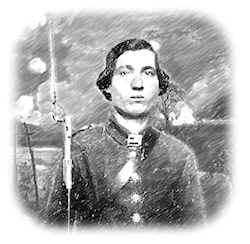
May 5th.—Thirty of Company F on picket two miles in front. Reported Federals advancing.
(Note: picture is of an unidentified Confederate soldier.)
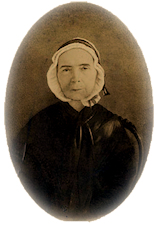
May 5.—Our army on the Rapidan is in line of battle. Grant is moving his mighty columns. Where the battle will take place Heaven only knows. I pray that God may be with us, and that the enemy may be driven far from our borders.
We are now attending the prayer-meetings held by the Young Men’s Christian Association, which are very interesting; three of them will be held this week for our dear army, and for the battle now pending.
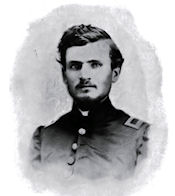
5th. Orders to march at 4 o’clock. Got up in time for breakfast. Today our forces seem to abandon Brandy Station, and the railroad. Most of the army across the Rapidan and Germania Ford. Reached the ford with 300 cattle at 10. Four companies reported to Gen. Wilcox. Infantry crossing all day, 9th Corps. A very warm day. Dusty roads, faces all crisped. Rapidan a narrow rocky bottom, high banks, rapid stream. Rappahannock narrow and less rapid. Went into camp about a mile from the river, rode out Pike to our pickets. Rebel pickets in sight. Very heavy firing on the left in the 6th Sedgwicks Corps. Quite heavy loss. Rumor that Butler was in Petersburg and Thomas fighting at Dalton. (Beginning of Grant’s attack on Lee and the Campaign of the Wilderness.)
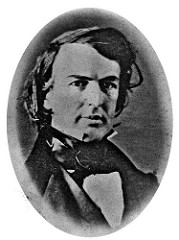
MAY 5th.—We have many rumors to-day, and nothing authentic, except that some of the enemy’s transports are in the James River, and landing some troops, a puerile demonstration, perhaps. The number landed at West Point, it seems, was insignificant. It may be the armies of the United States are demoralized, and if so, if Grant be beaten, I shall look for a speedy end of the invasion. It is said some of the advanced forces of Grant were at Spottsylvania C. H. last night, and the great battle may occur any hour.
Gov. Smith is calling for more exemptions (firemen, etc.) than all the governors together.
Col. Preston asks authority to organize a company of conscripts, Reserve classes, in each congressional district, the President having assigned a general officer to each State to command these classes. The colonel wants to command something.
The Commissary-General, Col. Northrop, being called on, reports that he can feed the army until fall with the means on hand and attainable. So, troops didn’t starve in thirty days several months ago!
A Mr. Pond has made a proposition which Mr. Memminger is in favor of accepting, viz.: the government to give him a bill of sale of 10,000 bales of cotton lying in the most exposed places in the West, he to take it away and to take all risks, except destruction by our troops, to ship it from New Orleans to Antwerp, and he will pay, upon receiving said bill of sale, 10 pence sterling per pound. The whole operation will be consummated by the Belgian Consul in New Orleans, and the Danish Vice-Consul in Mobile. It is probable the United States Government, or some members of it, are interested in the speculation. But it will be advantageous to us.
“A PERTINENT RESOLUTION.—The following was offered recently in the United States Senate, by Mr. Saulsbury, of Delaware:
`’Resolved, That the Chaplain of the Senate be respectfully requested hereafter to pray and supplicate Almighty God in our behalf, and not to lecture Him, informing Him, under pretense of prayer, his, said chaplain’s, opinion in reference to His duty as the Almighty; and that the said Chaplain be further requested, as aforesaid, not, under the form of prayer, to lecture the Senate in relation to questions before the body.'”

The following diary entry contains wording that is offensive to many in the world of today. However, the entry is provided unedited for its historical content and context.
May, Thursday 5, 1864
I have spent a most unhappy day,—half sick, and the “black spirits” haunted me teribly—oh! I don’t know what is the matter with me—or what on earth is to become of me. I spent the evening sewing on Harriet’s dress—Laura and Bettie both sewed late, yet I am left alone, and no prospects of sleep relieveing my poor, weary, aching heart—I pray for hope, and patience, yet virtue is lost in everything to me in my present state of feeling. Old Mrs. Holmes, Mr. Wormely, & Bedford came over this evening, no news except a rumor that Forrest had beaten the Nigger troops who left Memphis—God grant it may be so. Poor Danie Donelson’s body has been found, at Pounder’ ford, he was murdered, on his way back to the Army—his only Bro was killed at battle of Chickamauga—oh! heavenly Father, give us peace, crown our Sunny land with victory & peace, guide my dear Brothers, and return them safe to our Father’s now lonely fireside—we humbly crave thy pardon, thy forgiveness and peace.
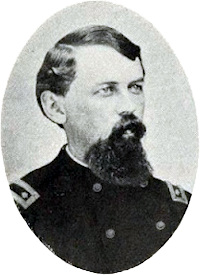
Whiteside, May 4, 1864.
The day’s march has been much more pleasant than any of us expected. Most of the dead mules have been buried, and the road much improved, especially through the narrows. We smelled a number of mules, though, after all the improvements. This, Whiteside, is like Bridgeport, a portable town, with canvas covers and clapboard sides.
The boys have been catching some nice fish in a little stream by our camp this evening. Made about 15 miles to-day.
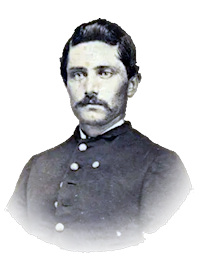
Wednesday, 4th–We lay here all day awaiting the boats. Nathan Chase, a veteran of our company, got into trouble with some men of the Fifty-third Indiana Regiment and one of them shot him twice, one ball going through his right arm and the other taking effect in his mouth, but neither wound is dangerous. The trouble was caused by drink. The health of the regiment is good, yet there are several sick, some with light attacks of the ague, and they are sent to the hospital here at Paducah. The transports arrived late this evening and we received orders to go aboard early in the morning.
Wednesday, 4th.—Witnessed a scene to-day that I humbly pray God I may never witness again. Army marched out and made to see fourteen men tied up to stakes and shot to death. Charges, desertion. Most of them belonged to the 58th North Carolina. Will this army prosper after such as this?
(Note: picture is of an unidentified Confederate soldier.)
May 4th. On the third relief last night from 1 to 3 A. M. Visited by the grand-rounds about 2 A. M. All was well. Relieved this morning. Weather clear and fine. Saw one of our cavalry scouting parties pass along the pike, having captured a rebel Major and twelve men up near Strasburg. Drilling and dress parade kept up when the weather permits.
4th. Got off before 4 o’clock. Came up with one div. of infantry at Bealeton Station. Beautiful morning. Went on to Brandy Station, unsaddled and got dinner and finally remained overnight. Drew hay and picked up some oats. Fight at Chancellorsville. Did some business.
May, Wednesday 4, 1864
I have sewed buisy all day, finished my white braided swiss—I think it is beautiful. Laura finished her new Calico, we both had to sew very late tonight to finish them. Bettie got sleepy and went home some time since—We all had a considerable fright tonight—by Anna Nelson sending to warn us of danger if any Confederate Soldiers were here—so poor Johny, although he has spent the day in the woods, shouldered his blanket, took his Pa’s horse, and went to the woods. Cousin Frazor will stay in and take the chances. Capt. Floyd with 20 men passed about dusk, going across the creek, don’t know their destination—the lines open this evening—Joanna and Nannie got home—no news of interest—We are still victorious on all sides, the negroes have raised the black flag—gone out on a raide after Forrest, and I will bet, but few will ever return,—God grant not one life of our dear Soldiers will be sacrificed to those cowardly dogs. Oh! give us victory, that peace may once again smile on our Sunny land. God bless my poor old Father and dear Bros.
MAY 4th.—Bright, beautiful, and warmer; but fire in the morning.
The following dispatch from Gen. Lee was received by Gen. Bragg to-day and sent to the Secretary.
“ORANGE C. H., May 4th, 1864.
—————“Reports from our lookouts seem to indicate that the enemy is in motion. The present direction of his column is to our right.
—————“Gen. Imboden reports the enemy advancing from Winchester, up the Valley, with wagons, beef cattle, etc.——————————R. E. LEE.”
There is a rumor of fighting at Chancellorville, and this is the anniversary, I believe, of the battle there. May we be as successful this time! But the report is not authentic. Firing is beard now in the direction of York River.
Twelve miles east of Bridgeport, May 3, 1864.
Have made about 15 miles to-day. This is the fourth time I have been over the same ground, have ridden over it five times. This is the first time I ever started on a march where real judgment was used in breaking the men in. We always before made from 15 to 25 miles the first day and broke down about one-fourth of our men. This time you see, our first two day’s marches were short and the 15 miles to-day seemed to affect no one. I hear from good authority here that Thomas is in Dalton, after some heavy skirmishing. Everything is moving to the front here. A portion of the 12th, or 20th Corps now, is just ahead of us. Morgan L. Smith and Osterhaus are just behind us, but Logan will not be along until relieved by some other troops.
I expect Dodge, with some 6,000 of the 16th Army Corps, is behind us. The 17th Army Corps was coming into Huntsville as we left.
Camp is in an orchard, and apples are as large as hazel nuts and we make sauce of them.
Tuesday, 3d–We remained in bivouac all day. The transports did not return today as expected. The recruits of the Eleventh Iowa were formed into a battalion and drilled twice a day, by Captain Kelly of Company D. We had our first dress parade this evening, since returning from furlough, and the regiment looked well in their new uniforms, but it was very awkward in the manual of arms because of the new recruits. An order was read on dress parade making some promotions of noncommissioned officers in Companies A and H, since they went in as veterans. Paducah is a nice town and contained about seven thousand inhabitants just before the rebellion broke out.
May 3d. Received three days’ rations. On picket post near the Romney road. A dangerous point, as the rebel scouts and cavalry take the dirt roads instead of the pikes. Cannot be heard as they advance. Horses make more noise on the pike.
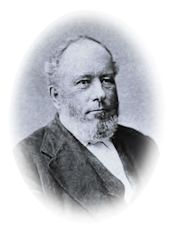
Yorktown.
May 3. On the 27th of April we broke camp at Getty’s station, arriving here about dark, and marched up the Williamsburg road about two miles where we bivouacked. On this trip we were furnished transportation. On the morning of the 29th we were ordered into camp about three miles higher up the road. We had not much more than got up there when an order came for us to report at the landing immediately. We now had a five mile march before us, with the dust in the road about three inches deep. This was no march but a race, the companies trying to run past each other and get the advance to shield themselves from the dust. The colonel let them have it their own way and they made the dust fly right smart. We made the distance in less than an hour and on arriving at the landing looked like walking dirt heaps. A guard was placed along the bank of the river to prevent our washing in it for fear of creating a sand bar. There didn’t appear to be anything wanted of us after we got here and we are now in camp on the bluff just above the landing.
Our brigade now consists of the 9th New Jersey and the 23d, 25th and 27th Massachusetts, under command of Brig. Gen. C. A. Heckman, and is known as the 1st brigade, 2d division, 18th army corps, under command of Gen. William P. Smith, otherwise known as “Baldy.” Our knapsacks have been sent back to Portsmouth and we are now in light marching order, having only the clothing we have on and our blankets. Our camp equipage consists of two camp kettles for each company, and shelter tents. These tents are simply pieces of cotton cloth, about six feet long by four wide, made to button together, and every man is supplied with one which he carries with his blanket. Ordinarily they are used as blankets, but in ease of a storm three of them are buttoned together, two forming the roof and the other the end, which makes a kind of burrow which partly shelters three men. We fellows who are used to roughing it think it all well enough, but I feel sorry for the officers; it will come pretty hard on them. It is something they are not used to and besides it sort of reduces them to the ranks. [continue reading…]
Tuesday Morning, May 3.—Yesterday passed as usual. We attended Mr. Peterkin’s prayer-meeting before breakfast, which we generally do, and which was very interesting. Then came by market for our daily supplies; and at nine I commenced my labour in the office, while Mr. –– went to his hospital, which occupies a great deal of his time.
Washington, North Carolina, has been evacuated by the Federals, who have retired to Newbern. All quiet on the Rapidan. Six steamers have run the blockade within a few days, laden with ammunition, etc. Surely God is with us. It is a delightful thing to contemplate that so many of our officers of high position, who are leading and giving an example to our soldiers, should be God-fearing men; from the President and General Lee down, I believe a majority of them are professing Christians. On Sunday I saw General R. Ransom (who has lately been put in command here) and General Kemper, who has just recovered from the wound received at Gettysburg, both at the communion-table.
On Saturday our President had a most heart-rending accident in his family. His little son was playing on the backportico, fell over, and was picked up apparently lifeless. Both parents were absent, nor did they get home in time to see their child alive. The neighbours collected around him, physicians were immediately called in, but the little fellow could not be aroused; he breathed for about three-quarters of an hour. His devoted parents returned to find their boy, whom they had left two hours before full of “life in every limb,” now cold in death. They have the deep sympathy of the community.
(excerpt)
May 3rd, 1864: “It is very uncomfortable at Mrs. – as they allowance each person to butter, etc. Things are in a dreadful state. Have you tried to get your shoes mended? I am completely unshod, as my boot gave way entirely yesterday in my walk with F.”
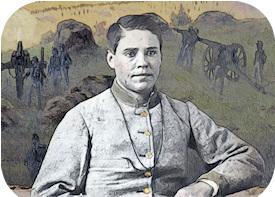
(Note: picture is of an unidentified Confederate soldier.)
Washington May 3rd/64
Matters remain in about Status quo as it regards the war. Both sides are concentrating their armies in Virginia. No movement of Genl Grants army has yet taken place. But we are waiting to hear of the Crash every day. It is said that the rebel Genl Lee is drawing all the troops he can to Virginia to meet Grant. I esteem the present crisis a most important one, perhaps the most important that has existed since the war began. If Grant succeeds in crushing Lees army the war will be virtualy ended for I think the rebels have staked nearly all they have on this Campaign. Their men are all in the field. They evidently esteem this as their last chance and they are playing a desperate game. We can carry on the war for any length of time that may be necessary to subdue them. The cost of the war is enormous, at least two Millions pr day, that is, it probably takes one Million to pay the legitimate expenses of the Govt (perhaps a little more). The balance is squandered and stolen. Not a very small number of those who have the management of the expenses and the disbursements are knaves and fools. The one have no idea of honesty, the other no idea of economy. But in times of great popular commotion the scum will float on the surface, where the brazen villian and the conceited ass are often found occupying positions of great responsibility. Tomorrow my Brother Newell & wife take Steamer for NY from Alexandria. I am intending to go down there in the morning and see them off. The weather has been quite cool today, too cold to sit without fire in the office or in my room.
MAY 3d.—A cold, windy day, with sunshine and clouds.
It is rumored that Grant’s army is in motion, and the great battle is eagerly looked for. The collision of mighty armies, upon the issue of which the fate of empire depends, is now imminent.
The following dispatch was received to-day from Gen. Johnston:
“DALTON, May 2d, 1864.
……………..“Two scouts, who went by Outawah and Cleveland, report the enemy sending all Southern people and heavy baggage to the rear, stopping rations to the inhabitants, collecting a large supply of trains at Graysville, and bringing their cavalry from Middle Tennessee. An officer just from Columbia reports 13,000 had been collected there. All scouts report Hooker’s troops in position here……………………………..J. E. JOHNSTON, General.”
May, Tuesday 3, 1864
The lines still closed, no news from Memphis, can’t tell when Nannie and Joanna will be home—I did not get up until nearly dinner, spent the remainder of the day sewing for Laura, trying to get her clothes in order, it seems I can never get her again for any length of time. No one has been here today. John spent the day hid in the woods with Cousin Frazor’s horse—Father as usual running round trying to hear the news. I think the Country is rather dull, since the blockade—This is a lonely day in my weary life, and I can record nothing which would give, either pleasure or profit in after years to look back upon—the children have been happy at play—and I expect Helen and Tate have passed the day pleasantly together—mine has been alone. Father and Cousin Frazor left the Parlor early after tea—John & I sat up right late talking, and I played for him. Laura is still sewing and nodding—no bread for Goslins, they are very noisy
West bank of Crow Creek, near Stevenson,
May 2d, 1864.
Only about seven miles from last night’s camp, but will have to wait until to-morrow to build a bridge. The creek is some 150 feet wide. Our Pioneer Corps will from the rough put a bridge over it in ten hours, that is to be passed over within the next three days by 800 wagons and 100 cannon of our corps. We reached here about 9 this a.m., and were led into a very large field of prairie grass, standing three feet high and as dry as tinder. A stiff breeze was blowing and the first fire started in our regiment set the grass in our front on a perfect rampage. It run down on the 46th Ohio, and such a grabbing of “traps” and scattering was never before seen, but was equaled about half an hour afterwards when a fire set in our rear came sweeping down on us. We threw our things out on the bare space in our front and escaped with little loss. My drummer had his coat, cap, drum and a pet squirrel burned, and a number of ponchos and small articles were also sent up in smoke. The days are almost like summer, but the nights are rather cool. The trees are about in full leaf and vermin are becoming altogether too numerous. Every man is a vigilance committee on the wood-tick question. They are worse than guerrillas or gray-backs. On an ordinary good “tick day” we capture about ten per capita. They demoralize one tremendously. The boys did some good work fishing in the p.m., catching a number of fine bass, etc.
A surgeon, who I think belongs on some brigade staff, has been stopping at nearly every house visiting, etc., and then rides past us to his place in front. This morning, after a visit he was passing our regiment; as we commenced crossing a little stream his horse got into a hole some four feet deep, stumbled, fell, rolled over, and liked to have finished the doctor. He was under both water and horse. The boys consoled him with a clear 1,000 cheers, groans, and sharp speeches. Anything short of death is a capital joke. I have seen them make sport of a man lying by the roadside in a fit.
Monday, 2d–We left Cairo at 1 o’clock in the night and arrived at Paducah, Kentucky, at 10 o’clock today. We were sent here to reinforce the troops at this place, as it was reported that the rebels, thought to be Forrest’s command, would make a raid into Paducah for the purpose of destroying our supplies. We went ashore while the transports with large details of men were sent back to Cairo for ammunition and provisions. I was detailed this morning for the first time as corporal of the guard. We have a force of about five thousand men at this place, with but one fort.
May 2.—Just taken leave of J. J., who has gone to Halifax, where the Bishop resides. It seems so strange that she does not want to go to the country. If I could only get to some quiet nook, some lodge in a vast wilderness, where rumours of unsuccessful or successful war could never reach me more, I think I should be happy. The Bishop says it is too expensive here for his income, and so it is for everybody’s income, but were we to leave it we should have none; our whole dependence is now upon the Government, except the interest on a small amount invested in Confederate bonds.
Our army, it is said, is fighting at or near Newbern, North Carolina. I trust they are following up the Plymouth victory.
2nd. Reveille at 4. Off at 7. Pike road still. Passed through Fairfax C. H. a place of only half a dozen scattered buildings. No fences along the road and very few houses, and those abandoned, hilly country and considerably woody. Camped near Bristol Station. 22nd and 24th N. Y. and 3rd N. J. near us. Commenced raining before we got our tents pitched. Cold, wet night. Slept very well.