Tuesday, 16th–There was a heavy rain this afternoon. All is quiet and there is no train in today from the front. I sold my American lever watch today for $33.50, which is $4.50 more than I paid for it in Davenport, Iowa.
American Civil War Chronicles
0
August 16, 2024
August 16th. Line of battle still maintained. The boys are discussing the question of a probable battle at this point. It seems to be a question of watching and waiting. Marching orders received to march back to Winchester tonight. General Sheridan is now in command. Many movements and maneuvers are often made that are puzzling and hard to understand by the average soldier. It is our duty to obey orders and not ask questions. Our Corps, the 8th, also known as the Army of West Virginia, the Mountain Creepers, Foot Cavalry, and the Buzzards, so called by its making so many forced marches over the mountains and valleys of Virginia.
A Rebel War Clerk’s Diary
August 16, 2024
AUGUST 16th.—Warm and cloudy.
There are movements of interest of the armies below, from the fact that we have as yet no authentic account of the fighting during the last few days. I fear we have not been so successful as usual.
The enemy is reported to be in force on this side (north) of the river, and marching toward this city. The local (clerks) troops have been called out to man the fortifications. But the blow (if one really be meditated) may fall on the other (south) side of the river.
Col. Moseby has taken 200 of the enemy near Berryville, burning 75 wagons, and capturing 600 horses and mules. His loss trifling.
War Diary of Luman Harris Tenney.
August 15, 2024
15th. Monday. Brigade commenced pulling out before daylight. 1st Brigade in rear. Passed through Leesburg about 3 P. M. Once a very wealthy little town apparently, now old and rusty. Very noted for rebel sympathy. Saw several pretty ladies. Camped near Purcellville. In P. M. near Leesburg one wagon got behind and two rebels jumped out upon the road, stripped a sergeant of his arms and clothes and took four mules. Rear guard was too far behind.
Robert M. McGill
August 15, 2024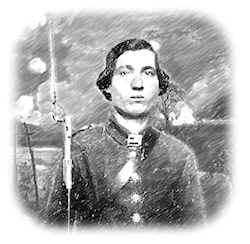
Monday, 15th.—Reported that J. M. Baggett was thought to have died at Griffin, Ga., soon after he got to the hospital.
(Note: picture is of an unidentified Confederate soldier.)
Downing’s Civil War Diary.–Alexander G. Downing.
August 15, 2024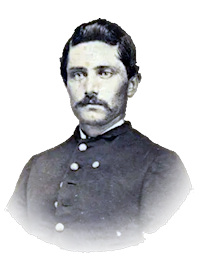
Monday, 15th–It is quite warm. All is quiet. There is nothing new from the front. A large number of men left the hospital this morning for the front. I would like to go, too, but the doctor tells me that I can do more good by staying here and caring for the sick. This is my birthday—twenty-two years old today.
Diary of a Southern Refugee, Judith White McGuire.
August 15, 2024
August 15.—An account from my relatives, of the raid of the 19th of June into the village of Tappahannock, has lately reached me. The village had been frequently visited and pillaged before, and both sides of the beautiful Rappahannock, above and below, had been sadly devastated; but the last visit seems to carry with it more of the spirit of revenge than any before. My aunt writes:
“About daybreak on that peaceful Sabbath morn six gunboats were seen returning down the river. A rumour that Hampton was after them, had driven them from their work of devastation in the country above us to their boats for safety. By six o’clock six hundred negroes and four hundred cavalry and marines were let loose upon the defenceless town. The first visit I received was from six cavalrymen; the pantry-door was unceremoniously broken open, and a search made for wine and plate; but all such things had been removed to a place of safety, and when I called loudly for an officer to be sent for, the ruffians quietly went to their horses and departed. Next came a surgeon from Point Lookout, to search the house, and deliver the key to Dr. R’s store, which he had sent for as soon as he landed—making a great virtue of his not breaking open the door, and of his honesty in only taking a few pills. This dignitary walked through the rooms, talking and murdering the ‘king’s English’ most ludicrously. However, he behaved quite well through the day, and was, under Heaven, the means of protecting us from aggressions by his frequent visits. In a short time every unoccupied house in the village was forcibly entered, and every thing taken from them or destroyed. Dr. R’s house was completely sacked. L. had made all necessary preparations for returning home, but all was swept by the Vandals. Dr. R’s surgical instruments, books, medicines, his own and his sister’s clothes, as well as those of their dead parents, were taken, the officers sharing the plunder with the soldiers. The furniture, such as was not broken up, was carried off in dray-loads to the boats, and these two young people were as destitute of domestic comforts as though a consuming fire had passed over their pleasant residence. My lot was filled with the creatures going in and out at pleasure, unless the cry, ‘The Johnnies are coming,’ sent them running like scared beasts to their rendezvous, and gave us a few moments of quiet. The poor negroes belonging to the town seemed to lose all power over themselves, and to be bereft of reason. Some seemed completely brutalized by the suggestions that were constantly whispered in their ears; others so frightened by the threats made, that reason deserted them; others so stupefied that they lost all power to direct themselves, and gave up to the control of others. It is impossible to describe the madness that possessed them. For myself, I had but one care left—to keep them from polluting my house any farther by keeping them out; and this I was enabled to do after shutting and locking the door in the face of one of them. The most painful event of the day was when a little coloured girl, a great pet with us, was dragged from the house. The aunt of the child was determined to take her with her, but she resisted all her aunt’s efforts, and came to the house for protection. An officer came for her, and after talking with her, and telling her that he would not ‘trouble her, but she was not old enough to know what was good for her,’ he went off. About night a white man and the most fiendish-looking negro I ever saw came for her in the name of the aunt, and vowed they would have her at all risks.
“The officers had all gone to the boats, and it was in vain to resist them, and with feelings of anguish we saw the poor child dragged from us. I cannot think of this event without pain. But night now set in, and our apprehensions increased as the light disappeared; we knew not what was before us, or what we should be called on to encounter during the hours of darkness. We only knew that we were surrounded by lawless banditti, from whom we had no reason to expect mercy, much less kindness; but above all, there was an eye that never slumbered, and an arm mighty to defend those who trusted to it, so we made the house as secure as we could, and kept ready a parcel of sharp case-knives (don’t laugh at our weapons) for our defence, if needed, and went up-stairs, determined to keep close vigils all night. Our two faithful servants, Jacob and Anthony, kept watch in the kitchen. Among the many faithless, those two stood as examples of the comfort that good servants can give in time of distress. About nine o’clock we heard the sound of horses’ feet, and Jacob’s voice under the window. Upon demanding to know what was the matter, I was answered by the voice of a gun-boat captain, in broken German, that they were going to fire over my house at the ‘Rebs’ on the hill, and that we had better leave the house, and seek protection in the streets. I quietly told our counsellor that I preferred remaining in my own house, and should go to the basement, where we should be safe. So we hastily snatched up blankets and comforts, and repaired to the basement, where pallets were spread, and G’s little baby laid down to sleep, sweetly unconscious of our fears and troubles. We sent to apprise the Misses G. of the danger, and urge them to come to us. They came, accompanied by an ensign, who had warded off danger, from them several times during the day. He was a grave, middle-aged man, and was very kind. At the request of the ladies, he came into the room with us and remained until twelve o’clock. He was then obliged to return to the gun-boat, but gave us an efficient guard until daybreak. He pronounced Captain Schultz’s communication false, as they had no idea of firing. We knew at once that the object had been to rob the house, as all unoccupied houses were robbed with impunity. This gentleman’s name was Nelson. I can never forget his kindness. During the night our relative, Mrs. B——m, came to us in great agitation; she had attempted to stay at home, though entirely alone, to protect her property. She had been driven from her house at midnight, and chased across several lots to the adjoining one, where she had fallen from exhaustion. Jacob, hearing cries for help, went to her, and brought her to us. Our party now consisted of twelve females of all ages. As soon as the guard left us at daybreak, they came in streams to the hen-yard, and woe to the luckless chicken who thought itself safe from robbers! At one o’clock on Monday the fleet of now eight steamers took its departure. Two of the steamers were filled with the deluded negroes who were leaving their homes. We felt that the incubus which had pressed so heavily upon us for thirty hours had been removed, and we once more breathed freely, but the village was left desolate and destitute.”
0
August 15, 2024
August 15th. This morning finds us still in line near Cedar Creek. Not much firing along the skirmish line. Sometimes both sides seem to get tired of the continual popping of the guns and cease firing. A large mail came for our regiment. Wrote a few letters to friends at home. All is quiet tonight near Cedar Creek.
“Not well enough to travel.”
August 15, 2024
August, Monday 15, 1864
Tate, Nannie and Hal, with the rest of their crowd, left for Macon on the 9 o’clock train. I left the Hotel after their departure and went over to Mrs. Long’s to spend the day with Therese. My ear pained me teribly all day, I felt very badly after Tate left, but she promised to Telegraph me if they moved. Col. Young sent for me about two, o’clock. I had a lonely ride, met Duke about half way, he arrived safe with my trunk. Lou met me and I was really happy to be with her again. We all went to bathe as soon as I arrived, Judge Clayton came out, brot me a telegram from Tate telling me to come to Macon immediately, they leave tomorrow for Grenada.
I am almost crazy with my ear, so Col. Young Dispatched “Not well enough to travel.” I am suffering so much, no sleep for me tonight.
A Rebel War Clerk’s Diary
August 15, 2024
AUGUST 15th.—Cloudy, damp, and pleasant. A rain fell last night, wetting the earth to a considerable depth; and the wind being southeast, we look for copious showers—a fine season for turnips, etc.
Cannon was distinctly heard from my garden yesterday evening, and considerable fighting has been going on down the river for several days; the result (if the end is yet) has not been officially stated. It is rumored that Pemberton lost more batteries; but it is only rumor, so far. Nor have we anything definite from Early or Hood.
Bacon has fallen to $5 and $6 per pound, flour to $175 per barrel. I hope we shall get some provisions from the South this week.
Sowed turnip-seed in every available spot of my garden to-day. My tomatoes are beginning to mature—better late than never. The following official dispatch was received on Saturday:
———“MOBILE, August 11th.—Nothing later from Fort Morgan. The wires are broken. Gen. Forrest drove the enemy’s advance out of Oxford last night.
———“All the particulars of the Fort Gaines surrender known, are that the commanding officer communicated with the enemy, and made terms, without authority. His fort was in good condition, the garrison having suffered little.
———“He made no reply to repeated orders and signals from Gen. Page to hold his fort, and surrendered upon conditions not known here. ——————————————————D. H. MAURY, Major-General.”
Gen. Taylor will cross the Mississippi with 4000 on the 18th of this month. Sherman must get Atlanta quickly, or not at all.
War Diary of Luman Harris Tenney.
August 14, 2024
14th. Sunday. Got into camp at noon. Lay all day near Dranesville.
Downing’s Civil War Diary.–Alexander G. Downing.
August 14, 2024
Sunday, 14th–A hot, sultry day. There is no news of any importance. We are giving close attention to the very sick and the severely wounded, some of whom are dying every day.
A Set of Resolutions.
Resolved, That I may from this day learn something new from the Scriptures every day, and that I may obey the laws of God as near as I can, in entreating my fellow men, and in doing good for the Master’s sake.
Resolved, That I may once a day or more offer thanks to my Savior for his help; and, above all, that I may try to live a true Christian until death. May God help me so to live, is my prayer.
Resolved, That I may once a day or more offer thanks to my Savior for his help; and, above all, that I may try to live a true Christian until death. May God help me so to live, is my prayer.
Village Life in America
August 14, 2024
August.–The New York State S. S.¹ Convention was held in Buffalo and among others Fanny Gaylord, Mary Field and myself attended. We had a fine time and were entertained at the home of Mr and Mrs Sexton. Her mother is living with her, a dear old lady who was Judge Atwater’s daughter and used to go to school to Grandfather Beals. We went with other delegates on an excursion to Niagara Falls and went into the express office at the R. R. station to see Grant Schley, who is express agent there. He said it seemed good to see so many home faces.
_____
¹ Sunday School
Diary of a Southern Refugee, Judith White McGuire.
August 14, 2024
14th.—Norfolk, poor Norfolk! nothing can exceed its long-suffering, its night of gloom and darkness. Unlike Winchester, it has no bright spots—no oasis in its blank desert of wretchedness. Like Alexandria, it has no relief, but must submit, and drag on its chain of servility, till the final cry of victory bursts its bonds, and makes it free. I have no time to write of all I hear and know of the indignities offered to our countrymen and countrywomen in Alexandria, Norfolk, Portsmouth, and other places which remain incarcerated in the sloughs of Federal tyranny. God help them, and give us strength speedily to break the chain that binds them.
0
August 14, 2024
August 14th. This morning finds us still in line near Cedar Creek, and skirmish firing continues, but we are reminded that every battle kills a soldier, some one’s dear friend killed, as we see them brought in from the skirmish line. We continue to watch one another from the hills. Sometimes the enemy will run a section of field guns up a high hill and throw a few shells over our way. A hot skirmish at Hupp’s Hill. Near our line is a very high hill. Our boys have a habit of going up it to watch the enemy. Guards have been placed there to keep us away, as we might draw the enemy’s fire. A shell coming over that hill would no doubt drop in the midst of our regiment. The weather is fearful hot, day and night. No trouble to sleep.
Great deal of sickness in Memphis—
August 14, 2024
August, Sunday 14, 1864
A bright and beautiful day—I did not come to Columbus this morning—Mrs. Johnson & Mary Poullium came in to Church, brot me a note from Tate saying she would send Johnie out for me this eve. Lou and I spent the morning alone, in the octagon. Mrs. Reynolds writing to Maj. Reynolds, Mr. Willie Young making preperations to depart for Forrest’s command. We had all just gone to our rooms, and ready for a nap, when Johnie came. I concluded to come in and make arrangements with Tate what to do. John & I had a delightful drive in—
Mary and Robert both look badly, met Mr. Holmes just from home, left all well—Great deal of sickness in Memphis—Tate and the girls go to Macon on the train tomorrow morning—I have concluded to stay with Lou Young, will return tomorrow. I am almost crazy with my ear tonight—Parlor full of company, I excused myself—and of all the miserable places, I have landed in it tonight. Hal, Nannie & I all in one bed, and the warmest night imagineable—
A Rebel War Clerk’s Diary
August 14, 2024
AUGUST 14th.—Hot and dry.
Rumors of a fight down the river yesterday, driving the enemy from Deep Bottom, and grounding of the Richmond. Guns were heard, and I suppose we made a demonstration both by land and water.
Cavalry (Hampton’s) still pass northward. They ride as if they grew to the horses. As they trot past, they can be seen cutting and dividing large round watermelons, and none are permitted to fall. Occasionally a staring negro in the street is astonished by the crushing of a rind on his head.
I never saw melons and other fruit so abundant; but they are held so high I cannot indulge.
Mr. Seddon draws 75 pounds rice per month, his family being fifty; and gets 12 pads cotton yarn from the State distribution. I shall get 10 ½ pounds rice, at 50 cents–retail price, $2; and perhaps 1 pad—5 pounds—yarn for $45; my family being seven.
A Diary From Dixie.
August 14, 2024
August 14th.–We have conflicting testimony. Young Wade Hampton, of Joe Johnston’s staff, says Hood lost 12,000 men in the battles of the 22d[1] and 24th, but Brewster, of Hood’s staff, says not three thousand at the utmost. Now here are two people strictly truthful, who tell things so differently. In this war people see the same things so oddly one does not know what to believe.
Brewster says when he was in Richmond Mr. Davis said Johnston would have to be removed and Sherman blocked. He could not make Hardee full general because, when he had command of an army he was always importuning the War Department for a general-in-chief to be sent there over him. Polk would not do, brave soldier and patriot as he was. He was a good soldier, and would do his best for his country, and do his duty under whomever was put over him by those in authority. Mr. Davis did not once intimate to him who it was that he intended to promote to the head of the Western Army.
Brewster said to-day that this “blow at Joe Johnston, cutting off his head, ruins the schemes of the enemies of the government. Wigfall asked me to go at once, and get Hood to decline to take this command, for it will destroy him if he accepts it. He will have to fight under Jeff Davis’s orders; no one can do that now and not lose caste in the Western Army. Joe Johnston does not exactly say that Jeff Davis betrays his plans to the enemy, but he says he dares not let the President know his plans, as there is a spy in the War Office who invariably warns the Yankees in time. Consulting the government on military movements is played out. That’s Wigfall’s way of talking. Now,” added Brewster, “I blame the President for keeping a man at the head of his armies who treats the government with open scorn and contumely, no matter how the people at large rate this disrespectful general.”
[1] On July 22d, Hood made a sortie from Atlanta, but after a battle was obliged to return.
War Diary of Luman Harris Tenney.
August 13, 2024
13th. Saturday. Awfully warm. Lay in camp till 4 P. M. Had charge of brigade train. Rained.
Downing’s Civil War Diary.–Alexander G. Downing.
August 13, 2024
Saturday, 13th–This is general scrub-day, and we are cleaning up the wards of the hospital. We have good food for the sick served to them on their cots. The convalescents go out to the dining room for their meals. No news from General Grant’s army.
0
August 13, 2024
August 13th. Early this morning our regiment took position in line, having been relieved from picket and skirmish duty. We can see the enemy over on the hills near Strasburg. Skirmish fighting is kept up between the lines during the day. We watch one another from the hills. Both sides open up once in a while with field guns. All is quiet this hot night, firing ceased.
—had my game ear looked into by a Confederate Surgeon.
August 13, 2024
August, Saturday 13, 1864
[First part of this entry is in a different handwriting]
The sun shone about as usual, the birds sang gaily, I suppose, tho’ I didn’t listen—a gentle breeze was stirring—entirely too gently for the temperature of the day. In fact the whole face of “nature” displayed nothing more than a hot August day. I have managed to love through it by “dint of a squeeze”—I ate breakfast, dinner & supper, knit socks, played backgammon & cards—(at all of which I am a proficient—) pinched, beat, battered and bruised all of the white inhabitants—had my game ear looked into by a Confederate Surgeon. I was dressed in my usual “flowery stile ” at that time of day. I took a bath, but failed to get drowned—by reason of over caution—got “egregriously ” beaten at Euchre & went to bed in a sprightly state of mind.
Tate, and the girls, have returned to Columbus, a note from Tate today, telling me to report to Hd. Qts.—they will return home in a few days.
Lou, like a good child, wrote the first of today.
A Rebel War Clerk’s Diary
August 13, 2024
AUGUST 13th.—Hot and dry. Large green worms have attacked my tomatoes, and from the leaves are proceeding to the fruit. But not many of them will escape! I am warring on them.
No war news, except the continuation of the movement of troops northward. Hampton’s division of cavalry, at least three brigades, passed this morning.
From Mobile and Atlanta we have nothing of interest.
Flour is falling: it is now $200 per barrel—$500 a few weeks ago; and bacon is falling in price also, from $11 to $6 per pound. A commission merchant said to me, yesterday, that there was at least eighteen months’ supply (for the people) of breadstuffs and meats in the city; and pointing to the upper windows at the corner of Thirteenth and Cary Streets, he revealed the ends of many barrels piled above the windows. He said that flour had been there two years, held for “still higher prices.” Such is the avarice of man. Such is war. And such the greed of extortioners, even in the midst of famine—and famine in the midst of plenty!
War Diary of Luman Harris Tenney.
August 12, 2024
12th. Friday. Drew and issued more clothing during the day. At 5 P. M. division moved. A. B., Thede and I went ahead. Had two dishes of ice cream at expense of George Palmer. Went to the depot and saw 150 O. N. G. starting home. It makes us almost homesick and yet we do not envy them much. Called at Mr. Holtslander’s–away. Then at Mr. Mills’. Much pleased with the family–pretty children–Flint, Leof and Lyra. Marched 15 miles. Crossed the river at Chain Bridge. Went into camp about midnight.
Robert M. McGill
August 12, 2024
Friday, 12th.—J. M. Baggett severely wounded. Had been on detail at Fort Louisiana; coming back to regiment, was just taking up arms, when he was struck.
(Note: picture is of an unidentified Confederate soldier.)