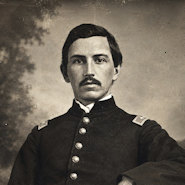
“…rejoiced to find myself a real soldier..,”—Josiah Marshall Favill

Diary of a Young Officer – Josiah Marshall Favill (57th New York Infantry)

(April 15, 1861)

I have actually joined the army and am going to the war as a high private in Company C of the Seventy-first New York Regiment, commanded by Captain Coles. The regiment has been accepted for three months’ service by the general government, and is to start for the front on Sunday next, April 21, 1861.

It was not so easy to join this regiment, as the armory was crowded with men, mostly fine young fellows, all crazy to be enrolled. Finding myself getting left, I went up to the Captain, who sat near by, and asked him if he would not make a point to squeeze me in. I told him I was very anxious to go, and gave him an account of my acquirements in the military line, which I urged might be of service to him. After some questions and agreeable chatting, he directed the clerk to take down my name, saying some one would be certain to back out at the last moment, and there would be room enough for all who really wanted to go.

I left the armory rejoiced to find myself a real soldier, and could hardly realize that in less than a week’s time I should be leaving home and marching to the front. I have always dreamed of a soldier’s life as an ideal one, and have been enthusiastic on all things military since I was old enough to read. Charles O’Malley, Tom Burke of Ours, and the Three Musketeers are mainly responsible for it, I think, but however that may be, I have learned to drill, to fence, to ride, and to shoot, and devour every kind of military history that comes in my way. During the Crimean War I was absorbed in the details of the siege of Sebastopol, and sought everywhere for anything published relating to it. [continue reading…]

0 comments

Events Diary, April 15, 1861

The Rebellion Record – A Diary of American Events; by Frank Moore

–Major Anderson evacuated Fort Sumter, going out with the proper honors to his flag. While the salute of fifty guns was being fired, a gun exploded, and killed one man and wounded four others. Major Anderson and his command were conveyed on board the Baltic steam transport.–Times, April 16.

–The President of the United States called by proclamation for 75,000 volunteers to suppress insurrectionary combinations; and commanded “the persons composing the combinations aforesaid to disperse and retire peaceably to their respective abodes within twenty days.” In the same proclamation, an extra session of both houses of Congress was called for the 4th of July.–(Doc. 57.)–Times, April 15.

–At Alexandria, Va., the publication of President Lincoln’s proclamation has greatly increased the secession feeling. Business of all kinds is completely suspended. Merchants are engaged in discussing the probability of a prolonged sanguinary civil war. The impression is that the Virginia Convention will instantaneously pass the ordinance of secession, or call a Border State Convention.

–At Mobile, Ala., President Lincoln’s response to the Virginia Commissioners is regarded as a declaration of war.

–At Richmond, Va., the President’s proclamation is received with general execration.

The public mind is fearfully excited. The secessionists declare that nothing is more favorable to their cause, and that military men would sooner die than respond to such a call.

–At Wilmington, N. C., the proclamation is received with perfect contempt and indignation. The Union men openly denounce the Administration. The greatest possible unanimity prevails. There was great rejoicing there Saturday on the reception of the news of the reduction of Fort Sumter.–Tribune, April 16.

–Large Union meetings were held at Detroit, Mich., Westchester and Pittsburgh, Pa., Lawrence, Mass., and Dover, N. H. At Pittsburgh the meeting was opened by the Mayor, who introduced the venerable William Wilkinson. Mr. Wilkinson was made President of the meeting. About twenty-five Vice-Presidents were also appointed. Resolutions were adopted, declaring undying fealty to the Union, approving the course of the Legislative and Executive branches of the State Government in responding to the call of the President, disregarding all partisan feeling, and pledging their lives, fortunes, and sacred honor in the defence of the Union, and appointing a Committee of Public Safety.

A resolution approving the action of the Philadelphia banks in the prompt offer of money to the Government, was also passed.

The meeting was addressed by Judge Wilkins, Thomas M. Marshall, the Hon. P. C. Shannon, Dr. McCook, Ex-Governor Johnston, the Hon. A. W. Loomis, and other prominent citizens of all parties. The speeches elicited great applause.–Tribune, April 16.

–Governor Yates, of Illinois, issued a proclamation to convene the Legislature at Springfield, on the 23d of April, for the purpose of enacting such laws and adopting such measures as may be deemed necessary upon the following subject, to wit: The more perfect organization and equipment of the militia of the State, and placing the same upon the best footing, to render efficient assistance to the General Government in preserving the Union, enforcing the laws, protecting the property and rights of the people, and also the raising of such money, and other means, as may be required to carry on the foregoing objects.–Commercial Advertiser.

–A large meeting of citizens, irrespective of party, was held at Erie, Pa., this evening. Resolutions were adopted, pledging the hearts and hands of Erie city and county to maintain the integrity of the Government and honor of the flag.

The Wayne Guards, of Erie, and other companies, will offer their services to the Governor.–Evening Post, April 17.

–This afternoon, a coasting schooner was discovered lying in Newark Bay, with a palmetto flag flying at its masthead. A party of “glass-house boys” procured a boat, and proceeding to the vessel, ordered the captain to lower the flag and substitute in its place the Stars and Stripes. The captain, refused, when they threatened to pitch him overboard and sink the vessel. The American flag was soon spread out to the breeze, when it was heartily cheered, and the palmetto was stowed away below.–N. Y. Times.

–At Philadelphia the Union pledge is receiving the signature of all classes of citizens. It responds to the President’s proclamation, and declares an unalterable determination to sustain the Government, throwing aside all differences of political opinion.

An excited crowd assembled this morning before the printing office on the corner of Fourth and Chestnut streets, where The Palmetto Flag, a small advertising sheet, is published, and threatened to demolish it. The proprietor displayed the American flag, and threw the objectionable papers from the windows; also, The Stars and Stripes, another paper printed at the same office, restoring the crowd to good humor. The crowd moved down to The Argus office in Third street, opposite Dock street, ordering that the flag should be displayed.

After visiting the newspaper offices and Government property, they marched in a body up Market street, bearing a flag. At all points on the route, well-known Union men were obliged to make all haste to borrow, beg, or steal something red, white, and blue, to protect their property with. Searches were made for the publication rooms of The Southern Monitor; but as that paper has suspended, the mob were unable to carry out their intention of destroying the forms. They satisfied themselves with breaking the signs to pieces. The ring-leaders were furnished with ropes with which to hang the editor if caught.

During the afternoon, General Patterson’s mansion, corner of Thirteenth, and Locust streets, was mobbed and threatened with destruction. A servant answered their call, and unfortunately slammed the door in their faces. The crowd became uproarious and violent, and made an attempt to force open the door. General Patterson finally appeared at the window, bearing the colors of the regiment. The crowd then moved away. It is understood that General Patterson, who is charged with secessionism, intends throwing up his commission.

They then visited General Cadwallader, who made a Union speech and threw out a flag. Several prominent Southerners, with secession proclivities, including Robert Tyler, have received warnings from a so-called Vigilance Committee.

The following is the speech that was made by Mayor Henry to the excited mob which threatened The Palmetto Flag building:

“Fellow-Citizens: By the grace of Almighty God, treason shall never rear its head or have a foothold in Philadelphia. [Immense cheering.] I call upon you as American citizens to stand by your flag and protect it at all hazards–at the point of the bayonet, if necessary; but, in doing so, remember the rights due your fellow-citizens and their private property. [Immense cheering.] That flag is an emblem of the Government, and I call upon all good citizens who love their country and its flag, to testify their loyalty by going to their respective places of abode, leaving to the constituted authorities of the city the task of protecting the peace, and preventing every act which could be construed into treason to their country.”

The Mayor then hoisted the stars and stripes. –Tribune, April 16.

–Seventeen vessels were seized in the port of New York from ports in southern States, their clearances being improper, and not signed by United States officers. They were fined $100 each, and some were held subject to forfeiture.– World, April 18.

–Jefferson Davis replies to President Lincoln’s proclamation as follows:

“Fort Sumter is ours, and nobody is hurt. With mortar, Paixhan, and petard, we tender ‘Old Abe’ our Beau–regard.” – Charleston Mercury.

–At Albany, N. Y., popular sentiment grows stronger and stronger. Several prominent citizens, particularly among the young men, have sent in applications as volunteers, and some are already organizing companies among those who are friends at home. The capital has presented an unusual appearance all day, the whole building having been filled with citizens who have apparently left their business to gather at head-quarters, and watch eagerly the progress of events. The spirit of the masses is decidedly aroused, and from present indications Albany will be behind no city in the State or Union in evincing her patriotism and her determination, as the crisis has come, to stand firmly by the Government of the country, without pausing to charge upon any the responsibility of the present terrible events.– Tribune.

–Fernando Wood, Mayor of New York, issued a proclamation, calling upon the people of the city to avoid turbulence and excitement, and to rally to the restoration of the Constitution and Union.–(Doc. 58.)

–An enthusiastic Union meeting was held at Cleveland, Ohio. Speeches were made by Senator Wade and other prominent gentlemen. Resolutions were adopted to sustain the Government, approving of the President’s call for volunteers, recommending the Legislature to make appropriations of men and money, and appointing a committee to ascertain the efficiency of the Cleveland militia. The greatest unanimity of feeling prevailed, and the speakers were constantly interrupted by wild cheers and responses. A similar meeting was held at Norwalk, Ohio.–Buffalo Courier.

–The Directors of the Bank of Commerce, of Providence, R. I., advanced a loan of $30,000 to the State for aiding in the outfit of troops. Large offers from private citizens have also been made to Governor Sprague for a similar purpose. The Globe Bank tendered to the State a loan of $50,000.–Tribune.

–An immense Union meeting was held at Troy, N. Y. Resolutions were adopted, sustaining the Government, and pledging the city to raise a regiment of volunteers. Hon. John A. Griswold presided, and Isaac McConihee, Jonas C. Heartt, Henry Ingraham, Judge Gould, and Judge Robinson were made Vice-Presidents. Secretaries were also appointed. The meeting adjourned in a body to the residence of General Wool, where, on behalf of the citizens, an address was made by Martin J. Townsend, to which General Wool responded that his heart was rejoiced at this glorious demonstration of patriotism. Never, by any former compliment bestowed upon him, had he been thrilled by such a measure of joy. It is true that he had fought under the old flag, but he had done no more than his duty towards the best Government that ever existed. He had fought under the stars and stripes that were carried in triumph by Washington, and under which Jackson closed the second war for independence at New Orleans in a halo of glory. Will you permit that flag to be desecrated and trampled in the dust by traitors now? Will you permit our noble Government to be destroyed by rebels in order that they may advance their schemes of political ambition and extend the area of slavery? No, indeed, it cannot be done. The spirit of the age forbids it. Humanity and manhood forbid it, and the sentiments of the civilized world forbid it. My friends, that flag must be lifted up from the dust into which it has been trampled, placed in its proper position, and again set floating in triumph to the breeze. I pledge you my heart, my hand, all my energies to the cause. The Union shall be maintained. I am prepared to devote my life to the work, and to lead you in the struggle.–Times, April 17.

–The Governor of Kentucky, in reply to Secretary Cameron’s call for troops from that State, says: “Your despatch is received. In answer, I say emphatically, Kentucky will furnish no troops for the wicked purpose of subduing her sister southern States.

B. Magoffin.”
–Louisville Journal.

–At New York, Philadelphia, Trenton, and other places, journals were compelled to display the American flag. Happily no damage was done to persons or property.–Herald, Tribune, Times, World, April 16.

April 16.–The Ringgold Flying Artillery, of Reading, Pa., Captain James McKnight, 180 men, with four field-pieces, received a requisition from the Governor this morning to set out this evening, at 6 o’clock, for Harrisburgh, a place of rendezvous for the first Pennsylvanians in the field.

There was a large and enthusiastic Government meeting at Tyrone, Blair county, to-night. Speeches were enthusiastically received. Ex-Senator Bigler arrived after the adjournment, and expressed himself unequivocally for the Government, and he was determined to sustain it to the last. Two military companies from Tyrone, two from Altoona, and two from Hollidaysburgh, will leave to-morrow for Harrisburgh.–Times, April 17.

–The Mechanics’, Elm City, Fairfield County, Thames, and other banks of Connecticut, voted large sums of money to assist in equipping the troops, and the support of their families.–Idem.

–Governor Buckingham, of Connecticut, issued a proclamation calling for volunteers, to rendezvous at Hartford.–Idem.

–The session of the New York East Methodist Conference was opened by the following prayer:

“Grant, O God, that all the efforts now being made to overthrow rebellion in our distracted country, may be met with every success. Let the forces that have risen against our Government, and Thy law, be scattered to the winds, and may no enemies be allowed to prevail against us. Grant, O God, that those who have aimed at the very heart of the republic may be overthrown. We ask Thee to bring these men to destruction, and wipe them from the face of the country “–Tribune, April 17.

–New Hampshire responds to the President’s proclamation, and will furnish the troops required. The Concord Union Bank tendered a loan of $20,000 to the Governor, and all the Directors, with the Cashier, agree to contribute $100 each to the support of such families of the volunteers of Concord, as may fall in defending the flag of the country.–N. H. Statesman.

–A Union meeting was held at the Hudson House, Jersey City, N. J., for the purpose of taking action to raise volunteers, whose services are to be tendered to the Federal Government. J. W. Scudder, Esq., was chosen President; two Vice-Presidents from each ward were also chosen, and C. H. Dummer acted as Secretary.

Stirring speeches were made by Dr. H. D. Holt, Hon. N. C. Slaight, Benjamin Van Riper, and John H. Low.

During the speaking, cheers were given for the Stars and Stripes, the Federal Government, Major Anderson, &c.

Benjamin Van Riper advocated the striking down of every northern man who advocated secession, and all traitorous newspapers.

Mr. John Low proposed that at some future period they call upon the proprietors of the American Standard, in Jersey City, “the editor of which had so much maligned the Government, and make them hoist the American flag, or make them leave the town.” This proposition was received with tremendous cheering, and cries of “Let’s do it to-night.”–Times, April 17.

–Four regiments, ordered to report for service in Boston, Mass., commenced arriving there before 9 A. M. this morning, the companies first arriving not having received their orders until last night. Already about thirty companies have arrived, numbering over 1,700 men in uniform, and with these are several hundred who are importunate to be allowed to join the ranks.

The bark Manhattan, which arrived at Boston this forenoon from Savannah, had a secession flag hoisted. A crowd proceeded to the wharf, and compelled Captain Davis to take it down and hoist the stars and stripes.

The City Government of Lawrence, Mass., appropriated $5,000 for the benefit of the families of those who have volunteered to defend the country’s flag.–Boston Transcript.

–One of the largest meetings ever held in Delaware was held this evening at Wilmington, the Mayor presiding. The following resolution was adopted unanimously:

Resolved, That we censure and condemn the course of Senator Bayard, in the United States Senate, for not advocating a compromise between the North and South, and that we feel confident that his course has placed us in a false position before the world; that we repudiate his teachings, as having an Anti-Union tendency, and are unworthy of a patriot and Delawarian.–Times, April 17.

–Governor Letcher , of Virginia, in reply to the call of the President of the United States, refuses to furnish troops for the support of the Federal Government. In his letter to Secretary Cameron, he remarks:

“I have only to say that the militia of Virginia will not be furnished to the powers at Washington for any such use or purpose as they have in view. Your object is to subjugate the southern States, and a requisition made upon me for such an object–an object, in my judgment, not within the purview of the Constitution or the Act of 1795–will not be complied with. You have chosen to inaugurate civil war, and having done so, we will meet it in a spirit as determined as the Administration has exhibited towards the South.”–World, April 20.

–Governor Ellis, of North Carolina, telegraphed the President that he could not respond to the call for troops, as he had doubts of his authority and right to do so.

A war bill, with an appropriation of $3,000,000, was passed in the New York Legislature, and signed by the Governor.

The Government of the Southern Confederacy called for 32,000 men; 2,000 from Florida, and 5,000 from each of the other States.–Times, April 17.

–A large meeting of German workingmen was held at Newark, N. J., this evening. An attempt was made to disorganize the body, which was soon suppressed by earnest and loud repeated cries for the Constitution and the Union. Several speeches were made, and it was declared that the only hope for the workingmen was to be found in the preservation of the Government. The meeting broke up with cheers for the Union. This is a sample of the spirit which pervades the German population.

“The German Turners’ Society,” numbering about a hundred men, also met, and unanimously resolved to form a military corps of riflemen, and offer their services to the Government. They also resolved to send delegates to the various Turner associations in the State, and to recommend a plan of organization.– Evening Post.
0 comments

Event’s Diary, April 13, 1861

The Rebellion Record – A Diary of American Events; by Frank Moore

–Fire from the enemy’s batteries was resumed at daylight, and from Fort Sumter at 7 A. M. At about 8 the officers’ quarters in Sumter took fire from a shell, and the work at the guns was necessarily somewhat slackened, as nearly all the men were taken away to extinguish the flames. Shells from Moultrie and Morris’ Island fell now faster than ever. Dense volumes of smoke still poured out of the barracks at 9, when the men were again sent to the guns. At 10 o’clock the halliards on the flag-staff were cut by a shell, and the flag ran down a little and stuck, so that it appeared to be displayed at half-mast. Several ships, one a large steamer, were in the offing at 10.30, and shots were fired at them from Morris’ Island and Fort Moultrie. About 11 o’clock the fire in the barracks again burst forth fiercely. Three piles of hand-grenades and shells, placed ready for use, became heated by it and exploded at intervals. The day was oppressively warm, and the heat of the fire added, made the atmosphere of the fort almost insufferable. At 12 the whole roof of the barracks was in flames, and soon after men were set to work to take the powder out of the magazine, lest the heat should reach and explode it there. Ninety barrels were rolled out and the doors closed. The fire of Fort Sumter was now almost entirely relinquished, though from the other forts it was rather increased. Cartridges were nearly all gone, and owing to the flying sparks no more could be made. Smoke from the fire was blown into the fort so thickly that the men could not see one another. As the fire in the barracks spread from the officers’ to the men’s quarters, it became necessary to throw overboard the powder that had been taken from the magazines. All was thrown over but three barrels, which were wrapped around with wet cloths and left. From these the garrison was soon separated by the fire, and now only the cartridges in the guns were left. These were fired now and then to indicate that the fort was not silenced. Thus in truth the work was held while there was a cartridge to fire or powder enough accessible to make one. The flagstaff, which had been hit nine times, was cut at about 1, and the flag was then nailed to the cut piece, and so raised upon the ramparts. At this time both officers and men were compelled to lie flat upon their faces in the casemates, and hold wet cloths to their months to escape suffocation. Soon after Ex-Senator Wigfall came to the fort with a flag of truce, which he wished held up while he spoke; but the batteries did not respect it. [continue reading…]

0 comments

Events Diary, April 12, 1861

The Rebellion Record – A Diary of American Events; by Frank Moore

–At 1 A. M. a second deputation from General Beauregard conveyed to Fort Sumter the message that if Major Anderson would name the time when he would evacuate, and would agree not to fire in the mean time upon the batteries unless they tired upon him, no fire would be opened upon Fort Sumter. To this Major Anderson replied that he would evacuate at noon on the 15th, if not previously otherwise ordered, or not supplied, and that he would not in the mean time open his fire unless compelled by some hostile act against his fort or the flag of his Government At 3.30 A. M. the officers who received this answer notified Major Anderson that the batteries under command of General Beauregard would open on Fort Sumter in one hour, and immediately left.

The sentinels in Sumter were then ordered from the parapets, the posterns were closed, and the men ordered not to leave the bomb-proofs until summoned by the drum.

At 4.30 A. M. fire was opened upon Fort Sumter from Fort Moultrie, and soon after from the batteries on Mount Pleasant., Cummings’ Point, and the floating battery; in all 17 mortars and 80 large guns for shot–mostly columbiads. Meantime the garrison of Sumter took breakfast quietly at their regular hour, were then divided into three reliefs, each of which was to work the guns for four hours; and the fire of Sumter was opened at 7 A. M. from the lower tier of guns, upon Fort Moultrie, the iron battery on Cummings’ Point, two batteries on Sullivan’s Island, and the floating battery simultaneously. When the first relief went to work, the enthusiasm of the men was so great that the second and third reliefs could not be kept from the guns.

As the fire of the enemy became warm, it was found that there was no portion of the fort not exposed to the fire of mortars. Shells from every direction burst against the various walls. Cartridges soon ran out; there were no cartridge bags, and men were set to make them out of shirts. There was no instrument to weigh powder, and this, with the absence of breech-sides and other implements necessary to point guns, rendered an accurate fire impossible.

Fire broke out in the barracks three times, and was extinguished. Meals were served at the guns. At 6 P. M. the fire from Sumter ceased. Fire was kept up from the enemy’s batteries all night, at intervals of twenty minutes.–Tribune, Times, and Herald, April 13, 14, 15.

0 comments

Events Diary, April 11, 1861

The Rebellion Record – A Diary of American Events; by Frank Moore

–The steamship Coatzacoalcos arrived at New York this morning, bringing home the Federal troops who were left in Texas without a commander, after the treason of General Twiggs.

–The Government at Washington is acting on positive information in taking all possible precautionary measures for the defence of, and the maintenance of peace at, that point.

A company of military were marched inside the capitol to-night, and a picket of guards is stationed on each of the roads leading into the city. This was done on no new information, but is among the signs of the revolution. A military company has not been within the walls of the capitol before since the war of 1812.

The oath of fidelity was administered to several companies of volunteers to-day.– World, April 12.

–Unusual activity now prevails in military circles in Pennsylvania. New companies are forming, and the old organizations are drilling frequently. The prospect of active service in the event of the breaking out of actual hostilities in the South, is exciting much discussion among the volunteer companies, and it is understood that several have already tendered their services to the Secretary of War, in case the Government should need their aid. It is also understood that in the event of an attack on the Government, the latter will make an early call upon Pennsylvania for men. Our volunteers labor under great disadvantages in respect to arms, and in a case of emergency many more men would be forthcoming than there are arms to place in their hands.–Phila. Press.

–This morning the Commissioners of the Confederate States left Washington. They are satisfied that no recognition of the Southern Confederacy will ever take place under the administration of President Lincoln. In their final communication they reflect severely on the Administration, taking the ground they have exhausted every resource for a peaceful solution of the existing difficulties, and that if civil war results, on the head of the Federal Government will rest the responsibility. They charge the Administration with gross perfidy, insisting that under the shelter of the pretext and assertion that Fort Sumter was to be evacuated, an immense armada has been despatched to provision and reinforce that fort. They repeat they had almost daily indirect assurances from the Administration that Fort Sumter was positively to be abandoned, and that all the Government’s efforts were to be directed toward peace. The commissioners allege that the Government at Montgomery was earnestly desirous of peace; and that, in accordance with its instructions, as well as their own feelings, they left no means unexhansted to secure that much-desired end; but all their efforts having failed, they were now forced to return to an outraged people with the object of their mission unaccomplished; and they express the firm conviction that war is inevitable.–(Doc. 51.)–World, April 12.

–At 2 P. M. Colonel Chesnut and Major Lee, aids to General Beauregard, conveyed to Fort Sumter the demand that Major Anderson should evacuate that fort. Major Anderson replied at 6 P. M. that his “sense of honor and his obligations to his Government would prevent his compliance” with the demand. He informed the gentlemen verbally that he would be “starved out in a few days.”

It was stated that there were at this time 7,000 men around Fort Sumter under arms, and 140 pieces of ordnance of heavy calibre in position and ready for use.–Charleston Mercury.

0 comments

Events Diary, April 10, 1861

The Rebellion Record – A Diary of American Events; by Frank Moore

–The floating battery, finished, mounted, and manned at Charleston, was taken out of the dock last evening, and anchored in the cove, near Sullivan’s Island.

The people are not excited, but there is a fixed determination to meet the issue. The Convention has just adjourned, subject to the call of the president. Before adjourning, it passed resolutions approving the conduct of General Twiggs in resigning his commission and turning over the public property under his control to the authorities.

Governor Pickens was in secret session with the Convention. About 1,000 troops were sent to the fortifications to-day; 1,800 more go down to-morrow.

Messrs. Wigfall, Chesnut, Means, Manning, McGowan, and Boyleston, have received appointments in General Beauregard’s staff. A large number of the members of the Convention, after adjournment, volunteered as privates. About 7,000 troops are now at the fortifications. The beginning of the end is coming to a final closing. Fort Sumter will be attacked without waiting for the fleet. Every thing is prepared against a land attack. The enthusiasm is intense, and the eagerness for the conflict, if it must come, unbounded.–N. Y. Day Book.

–The officers of the District of Columbia militia were ordered to meet at 10 o’clock A. M., in consequence of information relative to a contemplated movement for the seizure of the city of Washington by the secessionists under Ben McCullough. Orders were issued for the militia to assemble at their armories.

Seven militia companies reported to General Scott, and between six and eight hundred of them volunteered for any service in which the President might desire them to act.–Times, April 11.

0 comments

Events Diary, April 9, 1861

The Rebellion Record – A Diary of American Events; by Frank Moore

–Governor Curtin, of Pennsylvania, sent a special message to the Legislature to-day, urging the necessity of purchasing arms and reorganizing the military system of that State.–Times, April 10.

–Jefferson Davis made a requisition on the Governor of Alabama for 8,000 soldiers.–Tribune, April 10.

–The Charleston Mercury of to-day announces war as declared. “Our authorities,” it says, “yesterday evening received notice from Lincoln’s Government, through a special messenger from Washington, that an effort will be made to supply Fort Sumter with provisions and that if this were permitted, no attempt would be made to reinforce it with men! This message comes simultaneously with a fleet, which we understand is now off our bar, waiting for daylight and tide to make the effort threatened.

“We have patiently submitted to the insolent military domination of a handful of men in our bay for over three months after the declaration of our independence of the United States. The object of that self humiliation has been to avoid the effusion of blood, while such preparation was made as to render it causeless and useless.

“It seems we have been unable, by discretion, forbearance, and preparation, to effect the desired object, and that now the issue of battle is to be forced upon us. The gage is thrown down, and we accept the challenge. We will meet the invader, and the God of Battles must decide the issue between the hostile hirelings of Abolition hate and Northern tyranny, and the people of South Carolina defending their freedom and their homes. We hope such a blow will be struck in behalf of the South, that Sumter and Charleston harbor will be remembered at the North as long as they exist as a people.”

–Steamers Illinois and Baltic, in commission for United States Government, got to sea from New York. They discharged their pilots at 7.30 A. M., and sailed southwardly.–(Doc. 50)

–United States sloop-of-war Pawnee sailed from Norfolk at 6 P. M., with sealed orders.–Times, April 11.

0 comments

Events Diary, April 8, 1861

The Rebellion Record – A Diary of American Events; by Frank Moore

–Information having been given by the United States authorities to the authorities at Charleston that they desired to send supplies to Fort Sumter by an unarmed vessel, they were informed that the vessel would be fired upon and not permitted to enter the port. Official notification was then given by the United States Government that supplies would be sent to Major Anderson, peaceably if possible, otherwise by force. Lieutenant Talbot, attached to the garrison of Fort Sumter, and who accompanied the bearer of this despatch, was not permitted to proceed to his post.

–Orders were issued to the entire military force of Charleston, held in reserve, to proceed to their stations without delay. Four regiments of a thousand men each were telegraphed for from the country.

Dr. Gibbs, surgeon-general, was ordered to prepare ambulances, and make every provision for the wounded.

–At midnight Charleston was thrown into great excitement by the discharge of seven guns from Citadel square, the signal for all the reserves to assemble ten minutes afterwards.

Hundreds of men left their beds, hurrying to and fro towards their respective destinations.

In the absence of sufficient armories, at the corners of the streets, publics squares, and other convenient points, meetings were formed, and all night the long roll of the drum and the steady tramp of the military, and the gallop of the cavalry resounding through the city, betokened the close proximity of the long-anticipated hostilities. The Home Guard corps of old gentlemen, who occupy the position of military exempts, rode through the city, arousing the soldiers, and doing other duty required by the moment.

United States vessels were reported off the bar. Major Anderson displayed signal lights during the night from the walls of Fort Sumter.–Times, April 10.

–The State Department at Washington replied to-day to the Confederate State Commissioners, declining to receive them in their official capacity, but expressing deference for them as gentlemen. The Secretary expressed a peaceful policy on the part of the Government, declaring a purpose to defend only when assailed. Tribune, April 9.

0 comments

Events Diary, April 7, 1861

The Rebellion Record – A Diary of American Events; by Frank Moore

–General Beauregard issued an order, and sent a special messenger to Major Anderson, to give him an official notification that no further intercourse between Fort Sumter and the city would be permitted. – Times, April 9.

–The steam transport Atlantic sailed under sealed orders from New York, laden with troops and provisions. Among the troops is Captain Barry’s celebrated company of United States Flying Artillery. – Commercial Advertiser, April 8.

0 comments

Events Diary, April 4, 1861

The Rebellion Record – A Diary of American Events; by Frank Moore

–The Virginia Convention adopted, in committee of the whole, several of the series of resolutions reported by the majority of the Committee on Federal Relations, and rejected, by the decisive vote of 89 to 45, a motion to substitute for one of the resolutions an ordinance of secession, to be submitted to the popular vote.– World, April 5.

–Many rumors are in circulation to-day. They appear to have originated from movements on the part of the United States troops, the reasons for which have not been communicated to the reporters at Washington as freely as the late Administration was in the habit of imparting Cabinet secrets. There can be no doubt that serious movements are on foot. The tone of the southern press for the last week, and the concentration of troops at Pensacola, indicate a determination to precipitate a conflict at Fort Pickens, probably with a view to hasten the secession movement in Virginia.–Tribune, April 5.

0 comments

Fight with Quantrill’s Gang

William Quantrill from Miscellaneous Sources

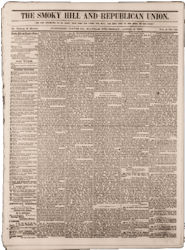
The Smokey Hills and Republican Union, Junction, Davis Co., Kansas, April 3, 1862

Letter from the Second—Fight with Quantrill’s Gang
Camp Blair, Kas., March 25.

To the Union.

The Kansas Second is in the field again.

The night of the 21st inst., our camp was thrown into an excitement by an order from Col. Mitchell for each company to detail from thirty to forty men, to be ready to march at 6 P.M., mounted and armed, with one day’s rations.

We marched at the time appointed, in the direction of Little Santa Fe, and arrived there about 11 P.M., twelve miles distant from our camp. Major Pomeroy, with forty men under Capt. Moore, and thirty men under Lieut. Storer, left the command at Santa Fe, and marched eastward into Missouri, with a guide who stated that he could take us to a house where the notorious Quantrill, with a party of his men, were stopping for the night.

After marching about three miles through the brush, and over the roughest road imaginable, our guide informed us that we were within a few rods of the house, although nothing could be seen, as it was quite dark, there being no moon, and very cloudy.

The Major ordered all to dismount, except every sixth man who was to hold the horses, and a guard of twelve men, of whom I was one, under charge of Lieut. Storer, who were to ride forward and support the Major should he meet with any resistance.

The night was quite cold and chilly, and we sat for more than thirty minutes shivering in our saddles, anxiously awaiting the signal that was to bring us into action, when suddenly the clear report of firearms broke the stillness that surrounded us, and brought every man erect in his seat, and caused our horses to jump and prance as if eager for the engagement.

We were ordered forward with a gallop, but before we reached the scene of action, report after report rang out upon the still night air, and informed us that our boys had stirred up a hot nest of rebels and were having plenty to do to take possession of them.

When we arrived, we ascertained that the Major had surrounded the house with his men, and ordered them to open the doors, when they answered him with a volley from within, badly wounding one of his men (a member of Capt. Moore’s company—since dead.) He instantly returned the fire, and when we arrived both parties were at work in good earnest.

We soon drove them from the windows and silenced their fire, when the Major ordered them to lay down their arms and they should be treated as prisoners of war.

We did not wish to fire on the house more than we could possibly help, as there was a family in it. After many assurances that they should not be harmed, the old man, his wife, two daughters and four sons, came out and gave themselves up, claiming to be good Union people.

We ascertained from them that Quantrill, with twenty-two of his men, was inside; that they were well armed and would fight to the last.

The Major again ordered them to surrender, and two of them came forward and gave themselves up. The rest wanted time to consider the matter, but were told that they could not have a minute, and we were just ready to open fire on the house, when they gave us a volley, severely wounding Major Pomeroy and one of our horses.

Lieut. Storer immediately went to the Major’s assistance, and found that a rifle ball had passed completely through the thick of his thigh and that he was bleeding profusely, an artery being severed. With his handkerchief and revolver, the Lieut. girded his leg sufficiently to stop the flow of blood, and had him removed out of range of the enemy’s fire.

The fall of the Major so exasperated us that we determined to decide the matter by firing the house. Our men had but five rounds apiece when we left camp, and many of them had now fired their last shot, while those inside seemed to have an abundance of ammunition, and the walls of the log house protected them.

Both ends and the front part of the house was log; the back part was light siding, but had neither door nor window in it, consequently we did not guard it as strongly as we did the other points.

We then piled dry wood and lumber against the house and set it on fire, and the whole building was soon in flames.

It being life or death with those inside, they made a desperate attempt and succeeded in bursting off to one side of the house, and eight or ten of the men made their escape, the brush and timber being within twenty feet of the house.

The boys killed two of them as they were entering the brush, and one man discharged his carbine, clubbed it and broke it in two pieces over one fellow’s head, knocking him as “stiff as a mutton.”

We killed five inside of the house, three as they were escaping, and took six prisoners.

I fear that Quantrill was with those that escaped.

We also took all of their horses and saddles, twenty-six in number, besides several revolvers, rifles and other arms.

If we had had plenty of ammunition and a few more men, we would have killed the last one of them. Col. Mitchell, with his men, did not arrive until it was all over. Seeing the house on fire was the first intimation that he had of our engagement.

All of the Junction boys are well. We are ordered to New Mexico, but I do not know when we will start. We have been having very severe weather for the past few days.

Do you know that I am heartily glad that the boys at Fort Riley “gutted” the Frontier. It is the best thing that I have heard of for months. The secessionists of Davis county have had their way long enough, and I think the boys done right in commencing at home. Your paper is getting lots of curses for denouncing and not sustaining the boys.

Yours,

“X.”


0 comments

Events Diary, April 3, 1861

The Rebellion Record – A Diary of American Events; by Frank Moore
  • Despatches were received in Washington to-day, confirming the reported reinforcement of Fort Pickens; and the Cabinet held a long session, without coming to any definite conclusion in regard to the long-mooted evacuation of Fort Sumter. One company of artillery left Washington for Fort Hamilton, and two more are to follow to-morrow. Unwonted activity also prevails in the navy, several vessels being rapidly fitted for service.–World, April 4.
  • The mortar batteries on Morris’ Island, Charleston harbor, fired into an unknown schooner. She displayed the stars and stripes, and put to sea. A boat from Sumter with a white flag went out to her; nobody hurt. A shot had gone through her.–(Doc. 49.)
  • All officers of the Southern Confederate army, on leave of absence, were ordered to their respective commands.–Times, April 5.
  • The South Carolina Convention ratified the Constitution of the Confederate States, by a vote of 114 to 16.–Tribune, April 6.
  • The Charleston correspondent writes: “By the by, let us never surrender to the North the noble song, the ‘Star-Spangled Banner.’ It is southern in its origin; in sentiments, poetry and song; in its association with chivalrous deeds, it is ours; and the time, I trust, is not remote, when the broad stripes and brilliant stars of the confederate flag of the South will wave triumphantly over our capitol, Fortress Monroe, and every fort within our borders.”–Richmond Examiner.
0 comments

A Diary of American Events – March 31, 1861

The Rebellion Record – A Diary of American Events; by Frank Moore

–It is asserted for the hundredth time, in apparently authoritative circles, that Fort Sumter will be evacuated on or before Wednesday next, April 8d.– World, April 1.

0 comments

A Diary of American Events – March 30, 1861

The Rebellion Record – A Diary of American Events; by Frank Moore

–The Mississippi State Convention, at Jackson, ratified the Constitution of the Confederate States, by a vote of 78 to 7.–Tribune, April 1.

0 comments

A Diary of American Events – March 28, 1861

The Rebellion Record – A Diary of American Events; by Frank Moore

–Governor Pickens, of South Carolina, sent a message to the convention of that State, informing it that six hundred men would be required to garrison the forts in Charleston harbor; besides giving other important details respecting the financial condition of the State. (This message is printed complete in the New York Tribune of April 2, 1861.)

–The actual vote of the State of Louisiana on secession is given by the New Orleans papers of to-day as follows: For secession, 20,448; against it, 17,296.– World, April 4.

0 comments

A Diary of American Events – March 25, 1861

The Rebellion Record – A Diary of American Events; by Frank Moore

–Colonel Lamon, a Government messenger, had an interview at Charleston with Governor Pickens and General Beauregard.–Times, March 26.

–The rumors from Charleston are very conflicting concerning the evacuation of Fort Sumter. One report states that Major Anderson is strengthening his position; another, that he has received orders to evacuate the fort and report himself for duty at Newport barracks, and that the officers are packing their goods in expectation of immediate departure. The truth of the matter will probably be known in a day or two.–Evening Post.

0 comments

A Diary of American Events – March 22, 1861

The Rebellion Record – A Diary of American Events; by Frank Moore

–Governor Pettus, of Mississippi, in accordance with the order of the President of the Confederate States, issued a proclamation calling upon the organized military of the State for fifteen hundred infantry.–Georgia Republic, March 25.

–Dr. Fox, of the United States navy, a special messenger from the Government to Major Anderson, reached Charleston and visited Fort Sumter by permission, in company with Captain Hartstein.

“Intercepted despatches”–by which we are to understand “stolen letters”–subsequently disclosed to the authorities in Charleston, it is said, that Mr. Fox employed this opportunity to devise and concert with Major Anderson a plan to supply the fort by force; and that this plan was adopted by the United States Government.–Times, March 28 and April 18.

–A meeting was held at Frankfort, Ala., at which the following resolutions, among others of a similar character, were passed:

Resolved, That we approve the course pursued by our delegates, Messrs. Watkins and Steele, in convention at Montgomery, in not signing the so-called secession ordinance.

That secession is inexpedient and unnecessary, and we are opposed to it in any form, and the more so since a majority of the slave States have refused to go out, either by what is called “southern cooperation,” or “precipitate secession;” and that the refusal to submit the so-called secession ordinance to the decision of the people is an outrage upon our right and liberty, and manifests a spirit of assumption, unfairness, and dictatorship.

Resolved, That our congressional nominee, if elected, is to represent us in the United States Congress, and not in the Congress of this so-called “Southern Confederacy.”–Tuscumbia North Alabamian.

–The Montgomery Mail protests against the word stripes: “We protest against the word ‘stripes,’ as applied to the broad bars of the flag of our confederacy. The word is quite appropriate as applied to the Yankee ensign or a barber’s pole; but it does not correctly describe the red and white divisions of the flag of the Confederate States. The word is bars–we have removed from under the stripes.”– World, April 2.

0 comments

A Diary of American Events – March 21, 1861

The Rebellion Record – A Diary of American Events; by Frank Moore

–A. H. Stephens, Vice-President of the “Confederate States” of the South, delivered a speech at Savannah, Ga. It is intended to be a vindication of the new features in the constitution, which has been adopted for their government.–(Doc. 48.)

0 comments

A Diary of American Events – March 20, 1861

The Rebellion Record – A Diary of American Events; by Frank Moore

–At about 7 o’clock this evening, Lieutenant Homer, in command of the Continentals, at drill was informed that there was a sloop lying at the wharf at the foot of Spanish alley in Mobile, which was laden with supplies for the United States fleet outside, between that place and Pensacola. A detachment of the company was on drill at the time, and Lieutenant Homer immediately ordered them down to the point mentioned, and then and there took charge of the little sloop Isabel. She was laden with beef, pork, barrels of eggs, etc. The person in charge acknowledged that these supplies were intended for the fleet outside.–Mobile Tribune, March 21.

–Correspondence between Mr. Secretary Seward and the Commissioners from the Confederate States is published.–(Doc. 47.)

0 comments

A Diary of American Events – March 18, 1861

The Rebellion Record – A Diary of American Events; by Frank Moore

–Supplies were cut off from Fort Pickens and the fleet in the Gulf of Mexico.– (Doc. 46.)

0 comments

A Diary of American Events – March 14, 1861

The Rebellion Record – A Diary of American Events; by Frank Moore

–The act, passed by the Florida Legislature, defining treason, became a law by the approval and signature of the Governor. It declares that in the event of any actual collision between the troops of the late Federal Union and those in the employ of the State of Florida, it shall be the duty of the Governor of the State to make public proclamation of the fact; and thereafter the act of holding office under the Federal Government shall be declared treason, and the person convicted shall suffer death.–Evening Post, March 26.

0 comments

A Diary of American Events – March 12, 1861

The Rebellion Record – A Diary of American Events; by Frank Moore

–The London News of to-day publishes a strong protest against a recognition of the Southern Confederacy by the British Government.–(Doc. 45.)

0 comments

A Diary of American Events – March 9, 1861

The Rebellion Record – A Diary of American Events; by Frank Moore

–The Southern Confederacy Congress passed an act for the establishment and organization of the army of the Confederate States.–(Doc. 44.) –Times, March 16.

0 comments

A Diary of American Events – March 6, 1861

The Rebellion Record – A Diary of American Events; by Frank Moore

–Fort Brown, Texas, was finally surrendered by arrangement between Captain Hill and the Texas Commissioners.–Galveston Civilian, March 11.

0 comments

A Diary of American Events – March 5, 1861

The Rebellion Record – A Diary of American Events; by Frank Moore

–General Peter G. T. Beauregard, lately a major in the United States Engineer Corps, was ordered by Jefferson Davis, President of the Southern Confederacy, to proceed to Charleston and take command of the forces there assembled, and to be assembled for the investment of Fort Sumter.–Herald, March 7.

–In the Texas State Convention, a letter was received from General Wanl, enclosing a letter from the Secretary of War of the Confederate States, in relation to the military complications in Texas. President Davis instructs the Secretary of War to say that he is disposed to assume every responsibility compatible with the relations of the Federal Government to Texas. Davis considers it due to international courtesy that the Government of the Confederate States (Texas included, after her withdrawal from the United States) should accord to the troops belonging to the Federal Government a reasonable time within which to depart from her territory. Should the Federal Government refuse to withdraw them, President Davis does not hesitate to say, that all the powers of the Southern Confederacy shall be promptly employed to expel them. General Waul says that the possibility of settling difficulties by a reconstruction of the old Union is never alluded to in the Congress, and that the proposal would receive about the same encouragement as a proposition to reannex Texas to the States of Mexico.–Evening Post, March 20.

–The President’s inaugural meets with a varied reception throughout the country. The South pronounces it warlike, while a greater portion of the North considers it conservative. –(Doc. 43.)

0 comments