Civil War Day-By-Day

Civil War Day-by-Day

July 2, 1861

  • General Robert Patterson crosses the Potomac at Williamsport, Maryland and moves towards Harpers Ferry.

A Chronological History of the Civil War in America1

  • Engagement near Martinsburg between Patterson’s (U.) and Jackson’s (R.) forces: rebels defeated.
  • New Legislature of Virginia met and organized at Wheeling. The new government had already been recognized by the United States.

  1. A Chronological History of the Civil War in America by Richard Swainson Fisher, New York, Johnson and Ward, 1863
0 comments

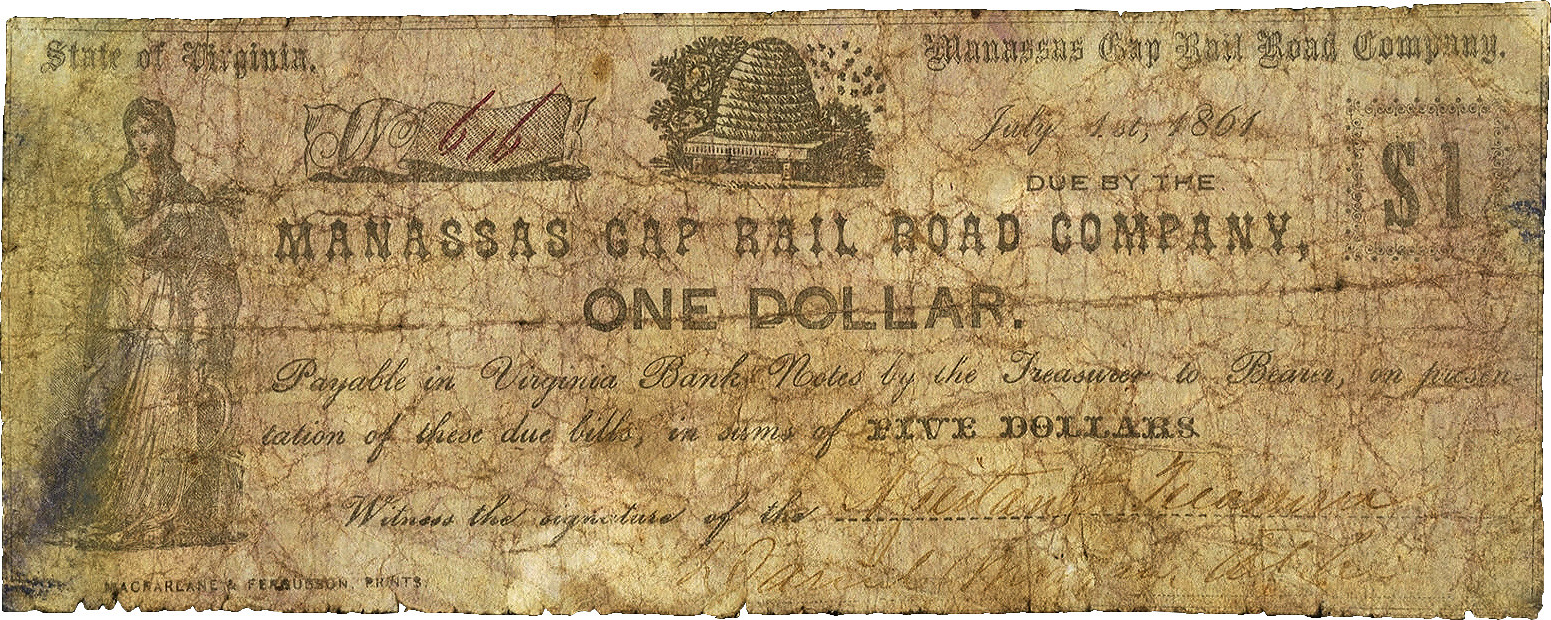
(Alexandria), VA—Manassas Gap Rail Road Company—$1—July 1, 1861

Civil War Day-by-Day
(Alexandria), VA—Manassas Gap Rail Road Company—$1—July 1, 1861

A beehive is seen at top center on this note printed on blue paper. The company was headquartered in Alexandria and was incorporated on March 9, 1850. It is an elusive issuer in any grade.
___________
Mike’s notes:

Note – This image has been digitally adjusted for one or more of the following:
– fade correction,
– color, contrast, and/or saturation enhancement
– selected spot and/or scratch removal
– cropped for composition and/or to accentuate subject

0 comments

Confederate Secretary of War piqued about article on the difficulty of getting arms from Georgia with the volunteers from that State.

Civil War Day-by-Day

JULY 1st.—My family are gone. We have moved the department to Mechanics’ Hall, which will be known hereafter as the War Department. In an evil hour, I selected a room to write my letters in, quite remote from the Secretary’s office. I thought Mr. Walker resented this. He had likewise been piqued at the effect produced by an article I had written on the subject of the difficulty of getting arms from Georgia with the volunteers from that State. One of the spunky Governor’s organs had replied with acerbity, not only defending the Governor, but striking at the Secretary himself, to whom the authorship was ascribed. My article had been read and approved by the Secretary before its insertion; nevertheless he now regretted it had been written—not that there was anything improper in it, but that it should have been couched in words that suggested the idea to the Southern editor that the Secretary might be its author. I resolved to meddle with edged tools no more; for I remembered that Gil Blas had done the same thing for the Duke of Lerma. Hereafter I shall study Gil Blas for the express purpose of being his antithesis. But I shall never rise until the day of doom brings us all to our feet again.

0 comments

Extracts from the journal of Commander Semmes, C.S. Navy, commanding C.S.S. Sumter

War of the Rebellion: from the Official Records of the Union and Confederate Armies and Navies
Monday, July 1.—Weather beautiful and clear, with the deep blue sea rolling brightly around us, and a gentle breeze from the southward and westward. We have seen no sail since we lost sight of the Brooklyn, and have averaged a speed of about 8 knots. Latitude at noon, 26° 18′ north; longitude, 87° 23′, steering S. S. E. Calm at nightfall, with a sky full of stars. A brilliant comet bearing about N. N. E.was visible in the early part of the night.
0 comments

“There is no outside influence used to induce a man to re-enlist.”–Army Life of an Illinois Soldier, Charles Wright Wills.

Civil War Day-by-Day

Cairo, July 1, 1861.

Writing letters is getting to be harder work than drilling, and is more dreaded by the boys. Lots of people are visiting the camp now, many of them ladies, but I tell you that they use their fans more than their spy-glasses after a very few looks.

I was up to Mound City yesterday with nine others of our company on a United States boat that has three cannons on her. Mound City is a beautiful little place, and takes it name from a mound about 30 feet in diameter and 10 feet high, on which grow a dozen spindling locusts. I have been about 12 miles up each river from the point here. At that distance the river banks are, say 25 feet high, and slope down to the point, and run into a broad wide sandbar that ends Illinois.

Fishing is a principal amusement or time-killer now. I have fished about four days and caught nary a “minner.”

There is no outside influence used to induce a man to re-enlist. Officers tell every man to use his own judgment, and each fellow does his own thinking and—another long dash or words to that effect.

0 comments

“I am not yet Lieutenant, though assured of an eventual appointment.”—War Letters of William Thompson Lusk.

War Letters of William Thompson Lusk.

Georgetown Heights, July 1st, 1861.

Headquarters 79th Regiment.

Dear Mother:

At length I have an opportunity to inform you of my doings since we parted.

I will spring over details.however, to say that I am now with Elliott at the Barracks of the 79th Regt. – that I slept last night upon the floor – that I am not yet Lieutenant, though assured of an eventual appointment – so until I write that I am entitled to wear the epaulets, please direct my letters to the care of Lieut. S. R. Elliott, 10th Co., 79th Regt., N. Y. S. M., Washington, D. C. Up to the present I have enjoyed myself much and am delighted with the novelty of the situation. However, I have no catalogue of hardships to complain of, as I have been dining in the best of company at a very good Secessionist Hotel which lies handy to our quarters, so please, dear mother, don’t expose yourself to any privations, for the purpose of better sympathizing with me as regards camp experiences. . . . Elliott you know, and I need not sound his praises. . . . By-the-way, my expenses here to Washington were paid by a grateful country, and in this wise. Young Quartermaster Elliott, meeting me at the Steamboat Landing, introduced me to some officers of a Maine Regt. on its way hither. I was introduced as Lieut. Lu

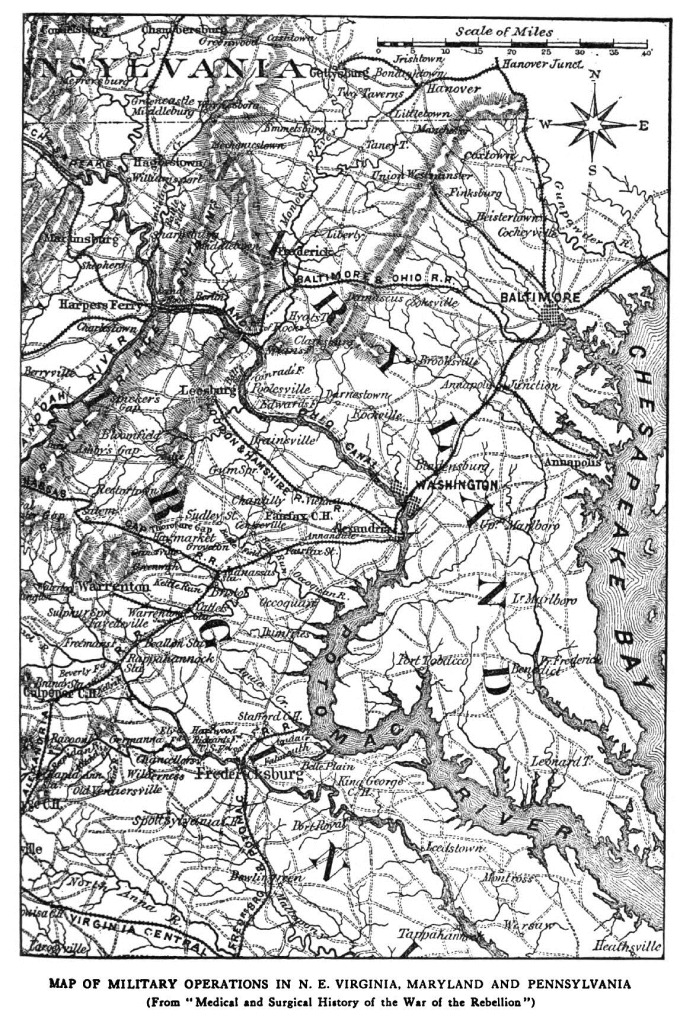
Map of Military Operationsin N.E. Virginia - Maryland and Pennsylvania

Map of Military Operations in N.E. Virginia – Maryland and Pennsylvania (Click on map for larger version)

sk and in that capacity was invited to occupy the car appropriated for the staff. The officers manifested some curiosity regarding the Regt. I was supposed to represent, so it was with no little difficulty that I resorted to such evasions as would enable me to cover my ignorance. I pronounced the 79th Regt. to be the finest in the field, and was looked upon quite respectfully.

We are now delightfully quartered on Georgetown Heights in the Catholic College, but are going into Camp today. Yesterday a preacher from the Scottish Kirk discoursed to the soldiers in the yard. The Catholic priests must have shuddered at the terrible sacrilege, but even sectarianism must bend to meet the exigencies of war.

Elliott sends kind regards to you, and the sisters, and Hunt. Love to all.

Very affec’y-,

W. T. Lusk.

0 comments

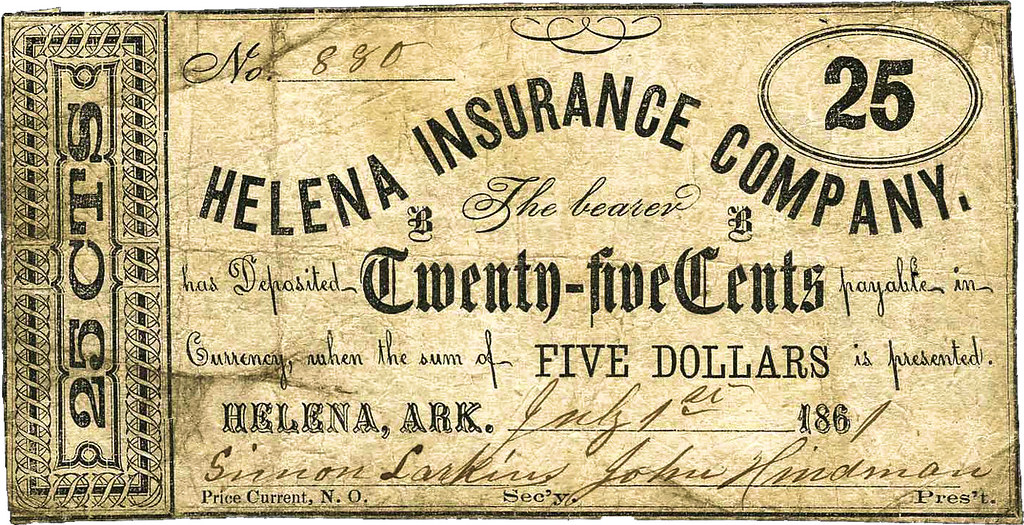
Helena, AR—Helena Insurance Co.—25¢—July 1, 1861

Miscellaneous document sources
Helena, AR—Helena Insurance Co.—25¢—July 1, 1861

Mike’s notes:

Note – This image has been digitally adjusted for one or more of the following:
– fade correction,
– color, contrast, and/or saturation enhancement
– selected spot and/or scratch removal
– cropped for composition and/or to accentuate subject

0 comments

Horatio Nelson Taft

Diary of US patent clerk Horatio Nelson Taft.

MONDAY, JULY 1

This has been a fine cool day, but a heavy rain this evening. We all (the family) took a ride after dinner to the Camps back of us. We saw the Camps of fifteen Regts and went into a number. Saw the officers of most of the NY Regts in that vicinity, Col [Roger?], Col Clarks, Col Lansing, &c. Got home in the midst of the rain and got quite wet getting out of the carriage. Spent the evening at the quarters of Capt Fowler & Lieut Whitlock of the 12th. Mr Woodbury was there. Got home 1/2 past 10 o’clock. Retired at 11 — .

______

The three diary manuscript volumes, Washington during the Civil War: The Diary of Horatio Nelson Taft, 1861-1865, are available online at The Library of   Congress.

0 comments

Manassas Gap Rail Road Company—$2—July 1, 1861

Civil War Day-by-Day
Manassas Gap Rail Road Company—$2—July 1, 1861

The railroad, which ultimately ran 87 miles from Mount Jackson to Manassas, VA was begun in 1851 and essentially completed in 1859. It played a role in the audacious Great Train Raid pulled off by Stonewall Jackson in May 1861 which netted 67 locomotives and 386 cars which were removed, captured, or burned at the expense of the B&O Railroad. As can be imagined as the war progressed, significant damage was done to railroad as both sides fought over the territory. PCGS notes a replaced upper left corner and some minor staining.
___________
Mike’s notes:

Note – This image has been digitally adjusted for one or more of the following:
– fade correction,
– color, contrast, and/or saturation enhancement
– selected spot and/or scratch removal
– cropped for composition and/or to accentuate subject

0 comments

William Howard Russell’s Diary: Niagara.—Impression of the Falls.—Battle scenes in the neighbourhood.—A village of Indians.—General Scott.—Hostile movements on both sides.

My Diary North and South – William Howard Russell

At eight o’clock on the morning of the 27th I left Chicago for Niagara, which was so temptingly near that I resolved to make a detour by that route to New York. The line from the city which I took skirts the southern extremity of Lake Michigan for many miles, and leaving its borders at New Buffalo, traverses the southern portion of the state of Michigan by Albion and Jackson to the town of Detroit, or the outflow of Lake St. Clair into Lake Erie, a distance of 284 miles, which was accomplished in about twelve hours. The most enthusiastic patriot could not affirm the country was interesting. The names of the stations were certainly novel to a Britisher. Thus we had Kalumet, Pokagon, Dowagiac, Kalamazoo, Ypsilanti, among the more familiar titles of Chelsea, Marengo, Albion, and Parma.

It was dusk when we reached the steam ferry-boat at Detroit, which took us across to Windsor; but through the dusk I could perceive the Union Jack waving above the unimpressive little town which bears a name so respected by British ears. The customs’ inspections seemed very mild; and I was not much impressed by the representative of the British crown, who, with a brass button on his coat and a very husky voice, exercised his powers on behalf of Her Majesty at the landing-place of Windsor. The officers of the railway company, who received me as if I had been an old friend, and welcomed me as if I had just got out of a battle-field. “Well, I do wonder them Yankees have ever let you come out alive.” “May I ask why?” “Oh, because you have not been praising them all round, sir. Why even the Northern chaps get angry with a Britisher, as they call us, if he attempts to say a word against those cursed niggers.”

It did not appear the Americans are quite so thinskinned, for whilst crossing in the steamer a passage of arms between the Captain, who was a genuine John Bull, and a Michigander, in the style which is called chaff or slang, diverted most of the auditors, although it was very much to the disadvantage of the Union champion. The Michigan man had threatened the Captain that Canada would be annexed as the consequence of our infamous conduct. “Why, I tell you,” said the Captain, “we’d just draw up the negro chaps from our barbers’ shops, and tell them we’d send them to Illinois if they did not lick you; and I believe every creature in Michigan, pigs and all, would run before them into Pennsylvania. We know what you are up to, you and them Maine chaps; but Lor’ bless you, sooner than take such a lot, we’d give you ten dollars a head to make you stay in your own country; and we know you would go to the next worst place before your time for half the money. The very Bluenoses would secede if you were permitted to come under the old flag.”

All night we travelled. A long day through a dreary, ill-settled, pine-wooded, half-cleared country, swarming with mosquitoes and biting flies, and famous for fevers. Just about daybreak the train stopped.

“Now, then,” said an English voice; “now, then, who’s for Clifton Hotel? All passengers leave cars for this side of the Falls.” Consigning our baggage to the commissioner of the Clifton, my companion, Mr. Ward, and myself resolved to walk along the banks of the river to the hotel, which is some two miles and a half distant, and set out whilst it was still so obscure that the outline of the beautiful bridge which springs so lightly across the chasm, filled with furious hurrying waters, hundreds of feet below, was visible only as is the tracery of some cathedral arch through the dim light of the cloister.

The road follows the course of the stream, which whirls and gurgles in an Alpine torrent, many times magnified, in a deep gorge like that of the Tête Noire. As the rude bellow of the steam-engine and the rattle of the train proceeding on its journey were dying away, the echoes seemed to swell into a sustained, reverberating, hollow sound from the perpendicular banks of the St. Lawrence. We listened. “It is the noise of the Falls,” said my companion; and as we walked on the sound became louder, filling the air with a strange quavering note, which played about a tremendous uniform bass note, and silencing every other. Trees closed in the road on the river side, but when we had walked a mile or so, the lovely light of morning spreading with our steps, suddenly through an opening in the branches there appeared, closing up the vista– white, flickering, indistinct, and shroud-like–the Falls, rushing into a grave of black waters, and uttering that tremendous cry which can never be forgotten.

I have heard many people say they were disappointed with the first impression of Niagara. Let those who desire to see the water-leap in all its grandeur, approach it as I did, and I cannot conceive what their expectations are if they do not confess the sight exceeded their highest ideal. I do not pretend to describe the sensations or to endeavour to give the effect produced on me by the scene or by the Falls, then or subsequently; but I must say words can do no more than confuse the writer’s own ideas of the grandeur of the sight, and mislead altogether those who read them. It is of no avail to do laborious statistics, and tell us how many gallons rush over in that down-flung ocean every second, or how wide it is, how high it is, how deep the earth-piercing caverns beneath. For my own part, I always feel the distance of the sun to be insignificant, when I read it is so many hundreds of thousands of miles away, compared with the feeling of utter inaccessibility to anything human which is caused by it when its setting rays illuminate some purple ocean studded with golden islands in dreamland.

Niagara is rolling its waters over the barrier. Larger and louder it grows upon us.

“I hope the hotel is not full,” quoth my friend. I confess, for the time, I forgot all about Niagara, and was perturbed concerning a breakfastless ramble and a hunt after lodgings by the borders of the great river.

But although Clifton Hotel was full enough, there was room for us, too; and for two days a strange, weird-kind of life I led, alternating between the roar of the cataract outside and the din of politics within; for, be it known, that at the Canadian side of the Falls many Americans of the Southern States, who would not pollute their footsteps by contact with the soil of Yankee-land, were sojourning, and that merchants and bankers of New York and other Northern cities had selected it as their summer retreat, and, indeed, with reason; for after excursions on both sides of the Falls, the comparative seclusion of the settlements on the left bank appears to me to render it infinitely preferable to the Rosherville gentism and semi-rowdyism of the large American hotels and settlements on the other side.

It was distressing to find that Niagara was surrounded by the paraphernalia of a fixed fair. I had looked forward to a certain degree of solitude. It appeared impossible that man could cockneyfy such a magnificent display of force and grandeur in nature. But, alas! it is haunted by what poor Albert Smith used to denominate “harpies.” The hateful race of guides infest the precincts of the hotels, waylay you in the lanes, and prowl about the unguarded moments of reverie. There are miserable little peepshows and photographers, bird stuffers, shell polishers, collectors of crystals, and proprietors of natural curiosity shops.

There is, besides, a large village population. There is a watering-side air about the people who walk along the road worse than all their mills and factories working their water privileges at both sides of the stream. At the American side there is a lanky, pretentious town, with big hotels, shops of Indian curiosities, and all the meagre forms of the bazaar life reduced to a minimum of attractiveness which destroy the comfort of a traveller in Switzerland. I had scarcely been an hour in the hotel before I was asked to look at the Falls through a little piece of coloured glass. Next I was solicited to purchase a collection of muddy photographs, representing what I could look at with my own eyes for nothing. Not finally by any means, I was assailed by a gentleman who was particularly desirous of selling me an enormous pair of cow’s-horns and a stuffed hawk. Small booths and peepshows corrupt the very margin of the bank, and close by the remnant of the “Table Rock,” a Jew (who, by-the-bye, deserves infinite credit for the zeal and energy he has thrown into the collections for his museum), exhibits bottled rattlesnakes, stuffed monkeys, Egyptian mummies, series of coins, with a small living menagerie attached to the shop, in which articles of Indian manufacture are exposed for sale. It was too bad to be asked to admire such lusus natures as double-headed calves and dogs with three necks by the banks of Niagara.

As I said before, I am not going to essay the impossible or to describe the Falls. On the English side there are, independently of other attractions, some scenes of recent historic interest, for close to Niagara are Lundy’s Lane and Chippewa. There are few persons in England aware of the exceedingly severe fighting which characterised the contests between the Americans and the English and Canadian troops during the campaign of 1814. At Chippewa, for example, Major-General Riall, who, with 2000 men, one howitzer, and two 24-pounders, attacked a force of Americans of a similar strength, was repulsed with a loss of 500 killed and wounded; and on the morning of the 25th of July the action of Lundy’s Lane, between four brigades of Americans and seven field-pieces, and 3100 men of the British and seven field-pieces, took place, in which the Americans were worsted, and retired with a loss of 854 men and two guns, whilst the British lost 878. On the 14th of August following Sir Gordon Drummond was repulsed with a loss of 905 men out of his small force in an attack on Fort Erie; and on the 17th of September an American sortie from the place was defeated with a loss of 510 killed and wounded, the British having lost 609. In effect the American campaign was unsuccessful; but their failures were redeemed by their successes on Lake Champlain, and in the affair of Plattsburgh.

There was more hard fighting than strategy in these battles, and their results were not, on the whole, creditable to the military skill of either party. They were sanguinary in proportion to the number of troops engaged, but they were very petty skirmishes considered in the light of contests between two great nations for the purpose of obtaining specific results. As England was engaged in a great war in Europe, was far removed from the scene of operations, was destitute of steam-power, whilst America was fighting, as it were, on her own soil, close at hand, with a full opportunity of putting forth all her strength, the complete defeat of the American invasion of Canada was more honourable to our arms than the successes which the Americans achieved in resisting aggressive demonstrations.

In the great hotel of Clifton we had every day a little war of our own, for there were but why should I mention names? Has not government its bastiles? There were in effect men, and women too, who regarded the people of the Northern States and the government they had selected very much as the men of ’98 looked upon the government and people of England; but withal these strong Southerners were not very favourable to a country which they regarded as the natural ally of the abolitionists, simply because it had resolved to be neutral.

On the Canadian side these rebels were secure. British authority was embodied in a respectable old Scottish gentleman, whose duty it was to prevent smuggling across the boiling waters of the St. Lawrence, and who performed it with zeal and diligence worthy of a higher post. There was indeed a withered triumphal arch which stood over the spot where the young Prince of our royal house had passed on his way to the Table Rock, but beyond these signs and tokens there was nothing to distinguish the American from the British side, except the greater size and activity of the settlements upon the right bank. There is no power in nature, according to great engineers, which cannot be forced to succumb to the influence of money. The American papers actually announce that “Niagara is to be sold;” the proprietors of the land upon their side of the water have resolved to sell their water privileges! A capitalist could render the islands the most beautifully attractive places in the world.

Life at Niagara is like that at most watering-places, though it is a desecration to apply such a term to the Falls, and there is no bathing there, except that which is confined to the precincts of the hotels and to the ingenious establishment on the American side, which permits one to enjoy the full rush of the current in covered rooms with sides pierced, to let it come through with undiminished force and with perfect security to the bather. There are drives and picnics, and mild excursions to obscure places in the neighbourhood, where only the roar of the Falls gives an idea of their presence. The rambles about the islands, and the views of the boiling rapids above them, are delightful, but I am glad to hear from one of the guides that the great excitement of seeing a man and boat carried over occurs but rarely. Every year, however, hapless creatures crossing from one shore to the other, by some error of judgment or miscalculation of strength, or malign influence, are swept away into the rapids, and then, notwithstanding the wonderful rescues effected by the American blacksmith and unwonted kindnesses of fortune, there is little chance of saving body corporate or incorporate, from the headlong swoop to destruction.

Next to the purveyors of curiosities and hotel keepers, the Indians, who live in a village at some distance from Niagara, reap the largest profit from the crowds of visitors who repair annually to the Falls. They are a harmless and by no means elevated race of semi-civilised savages, whose energies are expended on whiskey, feather fans, bark canoes, ornamental mocassins, and carved pipe stems. I had arranged for an excursion to see them in their wigwams one morning, when the news was brought to me that General Scott had ordered, or been forced to order the advance of the Federal troops encamped in front of Washington, under the command of McDowell, against the Confederates, commanded by Beauregard, who was described as occupying a most formidable position, covered with entrenchments and batteries in front of a ridge of hills, through which the railway passes to Richmond.

The New York papers represent the Federal army to be of some grand indefinite strength, varying, from 60,000 to 120,000 men, full of fight, admirably equipped, well disciplined, and provided with an overwhelming force of artillery. General Scott, I am very well assured, did not feel such confidence in the result of an invasion of Virginia, that he would hurry raw levies and a rabble of regiments to undertake a most arduous military operation.

The day I was introduced to the General he was seated at a table in the unpretending room which served as his boudoir in the still humbler house where he held his head-quarters. On the table before him were some plans and maps of the harbour defences of the Southern ports. I inferred he was about to organise a force for the occupation of positions along the coast. But when I mentioned my impression to one of his officers, he said, “Oh, no, the General advised that long ago; but he is now convinced we are too late. All he can hope, now, is to be allowed time to prepare a force for the field, but there are hopes that some compromise will yet take place.”

The probabilities of this compromise have vanished: few entertain them now. They have been hanging Secessionists in Illinois, and the court-house itself has been made the scene of Lynch law murder in Ogle county. Petitions, prepared by citizens of New York to the President, for a general convention to consider a compromise, have been seized. The Confederates have raised batteries along the Virginian shore of the Potomac. General Banks, at Baltimore, has deposed the police authorities “proprio motu,” in spite of the protest of the board. Engagements have occurred between the Federal steamers and the Confederate batteries on the Potomac. On all points, wherever the Federal pickets have advanced in Virginia, they have encountered opposition and have been obliged to halt or to retire.

As I stood on the verandah this morning, looking for the last time on the Falls, which were covered with a grey mist, that rose from the river and towered unto the sky in columns which were lost in the clouds, a voice beside me said, ” Mr. Russell, that is something like the present condition of our country, mists and darkness obscure it now, but we know the great waters are rushing behind, and will flow till eternity.” The speaker was an earnest, thoughtful man, but the country of which he spoke was the land of the South. “And do you think,” said I, “when the mists clear away the Falls will be as full and as grand as before?” “Well,” he replied, “they are great as it is, though a rock divides them; we have merely thrown our rock into the waters,–they will meet all the same in the pool below.” A coloured boy, who has waited on me at the hotel, hearing I was going away, entreated me to take him on any terms, which were, I found, an advance of nine dollars, and twenty dollars a month, and, as I heard a good account of him from the landlord, I installed the young man into my service. In the evening I left Niagara on my way to New York.
0 comments

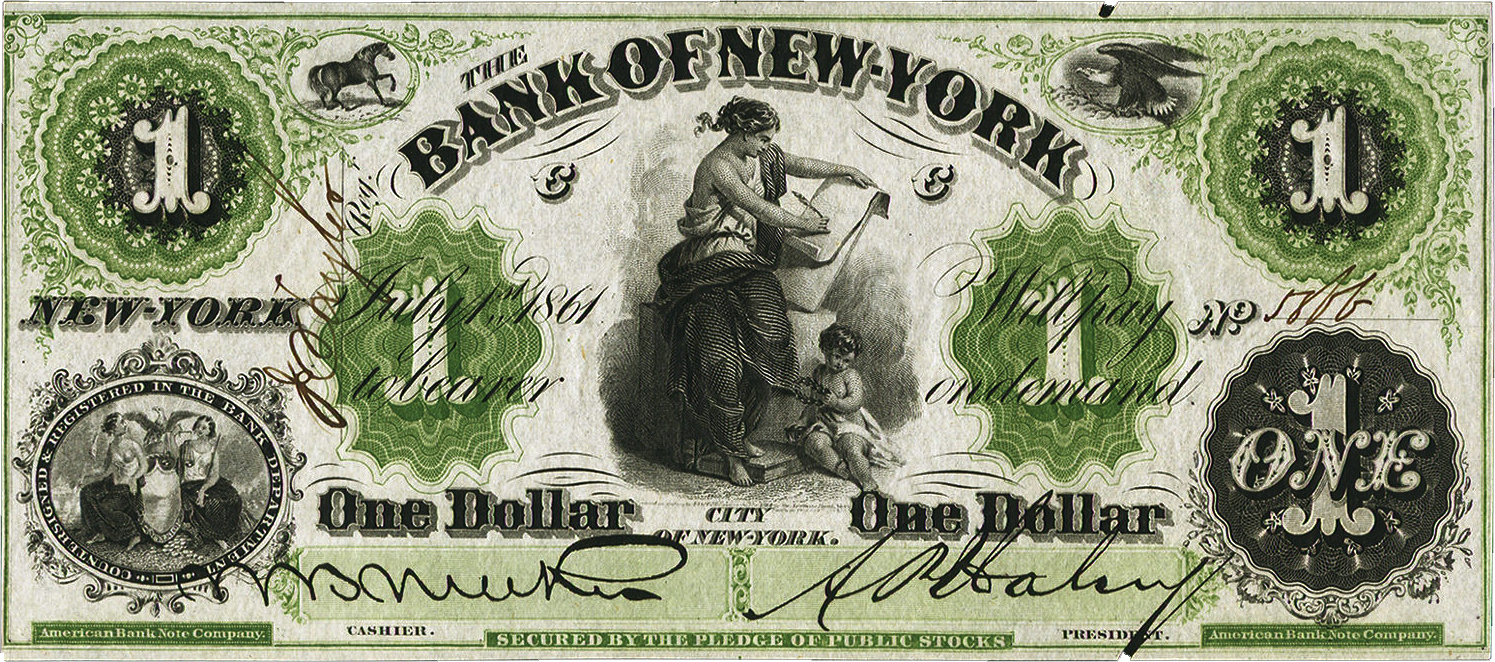
Bank of New-York—$1—July 1, 1861

Miscellaneous document sources
Bank of New-York—$1—July 1, 1861

This always popular black and green $1 from this venerable New York bank that was organized in 1784 depicts History Instructing Youth and has green protectors and design elements. The note faces up very well and has many of the attributes of an even higher graded example. A perfect addition if you need a representative from New York or one of the nation’s earliest banking institutions.

___________
Mike’s notes:

Note – This image has been digitally adjusted for one or more of the following:
– fade correction,
– color, contrast, and/or saturation enhancement
– selected spot and/or scratch removal
– cropped for composition and/or to accentuate subject

0 comments

“A rumour of a skirmish…,”—Diary of a Southern Refugee, Judith White McGuire.

Diary of a Southern Refugee During the War by Judith White McGuire

July 1.—A rumour of a skirmish, in which the Messrs. Ashby were engaged, and that Richard Ashby was severely wounded. I trust it may not be true.

0 comments

A Diary of American Events – July 1, 1861

The Rebellion Record – A Diary of American Events; by Frank Moore

–General Banks issued a proclamation announcing the arrest of Charles Howard, William Getchell, John Hincks, and John W. Davis, late members of the police board of Baltimore, and giving his reasons therefor.– (Doc. 62.)

–This afternoon Lieutenant Yelverton and eighteen men of the Seventh New York Volunteers, made a reconnoissance from Newport News, Va., up the James River road to within a mile and a half of Great Bethel. At that point they came upon five of the rebel pickets, who precipitately fled, leaving behind, with other trophies, their hats and coats, which showed that the owners were officers. In the pockets of the hitter were several letters just finished, giving a complete account of the late advance of 2,800 men from Yorktown to attack Newport News. One of an amusing character from the pocket of James Steele, bookseller, Richmond, describes the federal troops as a set of baboons, to be speedily driven from the sacred soil of Virginia.–N. Y. Evening Post, July 3.

–Edward Clark, the Governor of Texas, issued a proclamation, in which he said: “It will also be treasonable for any citizen of Texas to pay any debts now owing by him to a citizen of either of the States or Territories now at war with the Confederate States of America.–National Intelligencer, July 3.

–Fifty Home Guards under Captain Cook, from De Soto and Hopewell, Mo., proceeded last night by rail to Irondale, where they arrived this morning at 9 o’clock, and marched towards Farmington in search of contraband arms, &c., reported to be in the neighborhood of that place. They passed through Farmington about three miles eastward towards the river, but finding nothing, were returning home, when about six miles west of Farmington, they were attacked by a body of some 250 to 300 well armed and mounted secessionists, who were in ambush. Their fire was returned by the Homo Guards, mortally wounding Win. Hunter, one of the secession leaders. The Home Guards returned to De Soto without the loss of a man or a gun.

The rebels in that section are in possession of artillery, and gathered their clan by the discharge of their cannon, and were rallying all their forces in anticipation of the return of the Home Guards. The brave 300 were concealed in the brush, and fired upon the Home Guards in an open field.–Missouri Democrat, July 3.

–The marine artillery of the First Rhode Island Regiment left Washington, at night, by rail; destination unknown.–The Third Massachusetts Regiment moved from the encampment within Fortress Monroe, to occupy a position between Hampton and Newmarket Bridge. Col. McChesney’s Regiment (N. Y.) took the place of the Third Massachusetts.–N. Y. World, July 3.

–The Governor of Tennessee stationed an agent at Mitchellsville, on the Louisville and Nashville Railroad, near the northern Tennessee line, to prevent goods declared contraband in the southern confederacy from coming north.–Louisville Journal, July 2.

–James M. Sanderson assumed the control of the culinary department of the army at Washington, under the direction of the Sanitary Commission.–N. Y. World, July 1.

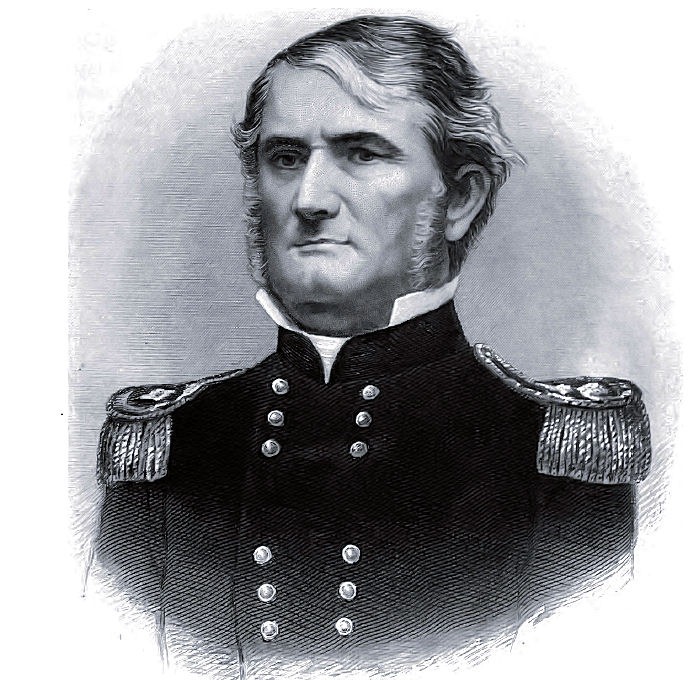
mccullough_ben–Ben. McCulloch, Brigadier-General of the rebel forces, issued a proclamation to the citizens of Arkansas, as follows:–”To defend your frontier, troops of Missouri are falling back upon you. If they are not sustained, your State will be invaded and your homes desolated. All that can arm themselves will rendezvous at Fayetteville, where they will await further orders. All those who have arms of the State, will march to the scene of action, or give their arms to those who will not desert their country in the hour of danger. All organized companies, whether cavalry or infantry, will report at Fayetteville, and will at once be formed into regiments and battalions. The necessary subsistence stores will be forwarded from this post. Rally promptly, then, citizens of Arkansas, and let us drive this Northern horde back from whence they came.”–Memphis Argus, July 1.
–The Fifteenth and Seventeenth Regiments of Indiana volunteers, left Indianapolis this afternoon for Virginia. Each regiment has a corps of fifty sharpshooters, and two pieces of artillery.–N. Y. Tribune, July 2.

–The Fourth Regiment of Michigan volunteers, numbering 1,046 men, under the command of Colonel Dwight A. Woodbury, passed through Baltimore on the route to Washington.–Baltimore American, July 2.

0 comments

Civil War Day-By-Day

Civil War Day-by-Day

July 1, 1861

A Chronological History of the Civil War in America1

  • C. S. privateer “Sumter” escaped from the “Mississippi.”
  • C. S. privateer “Petrel” escaped from Charleston.
  • Late members of the Baltimore Board of Police arrested and sent to Fort McHenry.
  • Fight at Buckhannon, Va.
  • Skirmish at Falling Waters, Va.
  • Engagement at Haynesville, Va.
  • Skirmish at Farmington, Mo.

  1. A Chronological History of the Civil War in America by Richard Swainson Fisher, New York, Johnson and Ward, 1863
0 comments

A Diary of American Events – June 30, 1861

The Rebellion Record – A Diary of American Events; by Frank Moore

–The Ninth Regiment of Massachusetts, numbering one thousand men, under the command of Colonel Cass, arrived at Washington.–National Intelligencer, July 1.

–This morning at daybreak fourteen rebel scouts attacked three pickets of the Fourth Pennsylvania Regiment, belonging to Company E, stationed on Shuter’s Hill, Va., four miles from Alexandria, wounding Lewellan Roemer, of Blue Bell, and killing Thomas Murray, of Norristown. The pickets returned the fire, killing two rebels and wounding a third. One of the slain was a sergeant of the Letcher Guard. The rebels beat a hasty retreat. The firing having been heard by the Union troops, a detachment of Zouave and another of the Fourth Pennsylvania Regiment reinforced the pickets, and followed in the trail of the rebels for some distance, finding four rifles and three revolvers, which the latter threw away in their hasty flight. One of the revolvers, very valuable, was marked with the name of John Johnson, a farmer living in that vicinity, who is a noted rebel. The Pennsylvanians behaved with great spirit and with the coolness of veterans, boldly holding their position, though wounded, in the hope of being reinforced.– N. Y. Herald, July 1.

–John Williams, who behaved so bravely in the skirmish at Matthias Point, carrying the American flag out of the fight in safety, though it was completely riddled with bullets as he went, was promoted to the post of Master’s Mate for his gallant conduct.–N. Y. Times, July 1.

–Yesterday the armed steamer Sumter, “of the Confederate States Navy,” ran the blockade of New Orleans, and got safely to sea. The New Orleans Picayune, in noting the fact, said:–”The first vessel of our little navy, the C. S. steamer-of-war Sumter, sailed on Saturday last, on a cruise, having ran the paper blockade of the Lincoln Abolition war steamers, off the mouth of the Mississippi. She has a picked crew, and her commander is known to be a most brave and chivalrous sailor, and he has under him a most gallant set of officers: Commander, Raphael Semmes; Lieutenants, John M. Kells, R. F. Chapman, W. E. Evans, J. M. Stribling; Paymaster, Henry Myers; Passed Assistant-Surgeon, Francis L. Gait; Lieutenant of Marines, Becket E. Howell; Midshipmen, Richard F. Armstrong, W. A. Hicks, A. G. Hudgins, J. D. Wilson; Gunner, Thomas C. Cuddy; Sail-maker, M. P. Beaufort; Engineers, First Assistant, acting as chief, Miles J. Freeman; Second Assistant, W. P. Brooks; Third Assistants, Matthew O’Brien and Simeon W. Cummings. She has a crew of sixty-five men and twenty marines.”

–The Charleston Mercury published the following on the Confederate Commissioners in Europe: It is now several months since our commissioners were sent to Europe. Thus far it seems they have got no further than England. Mr. Rost, one of them, has gone over to France; but as he can have no authority to act alone, we presume that he goes rather to ascertain the views of the Emperor of the French than to make a treaty. We infer from Mr. Rost’s departure from London to Paris that nothing has been accomplished in England.

Indeed, from the order in Council forbidding Confederate privateers bringing their prizes into British ports, we are only surprised that any of the Commissioners should have remained in London a day after this new order was issued. This is an act of quasi hostility, which, it appears to us, ought to have arrested a conference with the British authorities. It was well known that, whilst Great Britain has the greatest interest in the independence of the Confederate States, there is an element of antislavery fanaticism which would, in all likelihood, paralyze her counsels in our favor.

Why our commissioners have lingered so long in England, and have not gone directly to the greatest source of success, the government of France, we are at a loss to determine. By pretermitting the Emperor of the French, the British ministry have had the opportunity of obtaining, perhaps, his co-operation in the line of policy they design to pursue. By a direct communication with him, he would most probably have controlled instead of supporting the policy of England.

We, of course, do not know the means used by our government to conciliate the prompt acknowledgment of our independence by France and England, but it is clear, if we expected them to depart from that policy which the laws of nations strictly required, we must offer them inducements of industry. Our separation from the North, and our lower tariff, certainly gave them the prospect of great commercial advantages, from our independence; but the tariff might be changed–it might be made low from motives of present policy, and we might, after that policy is accomplished, in our independence have renewed higher duties. To present to these great States alluring assurances of present commercial advantages, it appears to us our commissioners ought to have proposed a low maximum of duties, to extend over many years yet to come.

It is absurd to suppose that either France or Great Britain will run the risk of disagreeable, if not hostile complications with the United States, without the security of clear advantages to be obtained. When we have fairly fought out our independence, of course all foreign nations will acknowledge us; but to take us by the hand when we are weak and want their aid, and when our position is surrounded with doubts–in their opinion, at least–as to our future success, we must offer such inducements, strongly appealing to their interests, as will indemnify them for all risk in taking us in their embraces by friendly commercial treaties.

Have our commissioners been empowered to offer to France and England a treaty guaranteeing for a number of years low duties on their manufactured commodities imported into the Confederate States? We fear not; for if they had been empowered to make such treaties, we are satisfied that they might have returned home with their mission completely successful, and the war on our frontier, on the part of the United States, reduced to a weak absurdity.

polk_leonidas–Leonidas Polk, better known as Bishop Polk, of Louisiana, having received the appointment of Major-General in the rebel service, assumed the command of his division. His headquarters were at Memphis, Term., in the neighborhood of which the troops comprising his command had their rendezvous. “This is the first instance,” says the Memphis Appeal “in the country ‘s history of the appointment of a high-church dignitary to a position of so much responsibility in the military service, and will, therefore, as a matter of course, evoke criticism among the old fogies of the red-tape school. But apart from the fact that the acceptance of this appointment was urged upon Gen. Polk with great earnestness by the President, the general-in-chief of the army, and other military officers of distinction who are well acquainted with his qualifications, there is much in the character and history of the appointee which inclines to the opinion that the selection is highly judicious, and one which will give great satisfaction. General Polk received a thorough military education at the West Point Academy, which he entered, from North Carolina, in 1828. He graduated with honor and entered the United States service, his first commission as second lieutenant of artillery bearing date July 1, 1827.

“He did not remain long in the army, however, but resigned in December of the same year, and embarked in another and different field of usefulness. General Polk will bring to the discharge of the duties of his position, a mature judgment, ripe scholarship, unusual activity of mind and body, great firmness and decision of character, a chivalric bearing, and the presence and mien of a thorough soldier. Though not a stickler for mere etiquette of the camp, he is a rigid disciplinarian, and, withal, the very man to win the confidence, and command the respect of his soldiers.”

–A correspondent of the Charlatan (S. C.) Courier, writing from Richmond, Va., says:– “There are few points of a war character which, just at this time, can appropriately form the subject of a letter. All eyes, however, are directed towards Manassas, and it is not improbable that by the time these lines reach your readers, the telegraph will have preceded me with the details of a great battle. The northern despatches all indicate the gradual approach of the two armies, the strengthening of outposts and various other movements which forerun hostilities. The southern press, on the contrary, are discreetly silent, and all we know is what we see ourselves, or hear from those who have seen for us; but the two sources of intelligence concur in the fact that unless the good Lord creates a modern Babel at Manassas and Alexandria, or drops down between the armies a veil of Cimmerian darkness, nature, personal gravitation, and animal magnetism will as certainly conspire to produce a collision as the multiplication table tells the truth.

“There are some yet, however, who affect to believe that we shall have a peace before we have a fight. The reaction so long predicted at the North having begun, the circulating petitions of merchants, bankers, clergymen, and other citizens of New York, which are pressing their peaceful influences upon Abraham Lincoln, are also operating here. The question is already being discussed in its various bearings, and the auspicious event has even been assigned a place this side of Christmas.

“We have no idea, however, of giving up the contest without, at least, one grand exhibition of the power, the prowess, and the resources of the people who have been stigmatized as the ‘ruffian rebels of the South.’ We went into the war on principle. Let us come out on principle, but not until we have left a mark upon our enemies that will secure for us for all time to come the respect of the world.

“Two hundred thousand men we have in the field will not be content to lay down their arms in peace until they have struck a blow that shall quiver through the North; and unless this be done, the millions they have left behind them will have their ‘welcome home’ alloyed by the thought that their husbands, sons, and brothers have returned without teaching that lesson of humiliation to an insolent foe, which, next to the Lord’s Prayer, has been the uppermost desire in every southern heart.

“In a civil point of view, as rapidly as circumstances will permit, the wheels of government are being geared and the machinery set in motion. The old adage that ‘large bodies move slowly,’ meets its falsification every hour. The operations of the various departments are in fall blast, and from the President down to the errand boy, every man moves as if he was a confederation of steel springs. Nor is this activity confined alone to the government. Artisans and merchants have all the work they can do in supplying the demands upon their several vocations incident to the presence of an army of needful soldiers.

“Blacksmiths are fabricating bowie knives; machinists are making arms and altering flint to percussion locks; millers are turning out floor; bakers are kneading bread by the ton, while butchers, grocers, and caterers generally are beleaguered day and night to supply the wants of the augmented population. Clothing, shoes, accoutrements, and camp equipage–all find ready sale. The frequent arrivals hereof poorly uniformed companies keep the ladies likewise up to their elbows in business.”

0 comments

A Diary of American Events – June 29, 1861

The Rebellion Record – A Diary of American Events; by Frank Moore

–Colonel Allen of the First Regiment N. Y. S. V., was arrested at Fortress Monroe for court martial, by order of General Butler.–The Eleventh Regiment of Massachusetts Volunteers, under the command of Colonel George Clark, Jr., left Boston for the seat of war. The regiment, previous to their starting, were encamped at Camp Cameron. They were enlisted in April last, and sworn into the United States service about three weeks ago. They number 950 men, and are all armed with new smooth-bore Springfield muskets. In point of equipage, no regiment, perhaps, has exceeded the Eleventh. Their camping arrangements are complete, and they will enter upon their duties with no less than twenty-five baggage wagons, and eighty horses. So complete, indeed, are their arrangements that they will be dependent on the Government for nothing except food and ammunition.–N. Y. News, June 30.

–The steamer St. Nicholas was captured in the Potomac River, by a party of secessionists. The steamer left Baltimore, having on board about fifty passengers. Among those who went aboard previous to her departure, was a very respectable “French lady,” who was heavily veiled, and, pleading indisposition, she was immediately shown to her state-room, where she was kindly cared for by the females on board. There were also a party of about twenty-five men dressed in the garb of mechanics, carrying with them carpenters, tinners, blacksmiths’, and other tools. When near Point Lookout, the “French lady ” appeared on deck, not in crinoline, but in the person of a stalwart man, who was immediately surrounded by the party of mechanics above alluded to. Captain Kirwan of the steamer, demanded an explanation, when the “lady-man” informed him that he designed confiscating the steamer and going on a privateering expedition. Finding himself overpowered, Capt. Kirwan was compelled to submit, and the boat was handed over to the man and his crew, who took possession, and proceeded to run the steamer to a point known as “The Cone,” on the Virginia shore. Upon landing at that place, the steamer was boarded by a body of about 1,000 Virginia troops, when the passengers were all landed, and allowed to go on their way. About one hundred and fifty of the troops were then placed on board the steamer, Captain Kirwan and fourteen of the crew being retained as prisoners. Leaving the shore the steamer was run down as far as the mouth of the Rappahannock River, where the “new Captain” hailed three large brigs which were lying off a few miles from Fredericksburg. These vessels were immediately boarded, and not having a sufficient force on board to offer any resistance they were all then quietly delivered over to the party as prizes. The prizes, one of which was laden with coffee, a second with ice, and the third with coal, were run into Fredericksburg, Virginia, and delivered into the possession of the Virginians, the steamer being kept at that port, together with her captain and crew.–Baltimore American, July 2.

–An elaborate article respecting the constitutional power of the President of the United States to suspend the writ of habeas corpus, was published. It was prepared by Reverdy Johnson, of Maryland, in response to the opinion of Chief Justice Taney, of the Supreme Court of the United States.–(Doc. 58.)

–The Fifteenth Regiment N. Y. S. V., under the command of Colonel John McLcod Murphy, left Willet’s Point, N. Y., for Washington.

Two regiments, one of Alabamians and the other of Mississippians, reached Harper’s Ferry, Va., this morning, and destroyed the balance of the trestle work of the railroad bridge. They then went over to the Maryland shore, seizing all the boats they could lay their hands on, either breaking them up or taking them over the river. All the Union men of Harper’s Ferry were driven out by them.–N. Y. Herald, June 30.

–A skirmish took place at Bowners, twelve miles from Cheat River bridge, between portions of the Fifteenth and Sixteenth Ohio, the First Virginia regiments, and a company of rebel cavalry. The former were sent to protect the polls, and the latter, mistaking their number, attacked them, and were routed with the loss of several men, among them the lieutenant of the company. Several horses were captured. The only loss on the Federal side is N. O. Smith, of the Fifteenth Regiment.–Louisville Journal, July 1.

–The Twenty-fifth Pennsylvania Regiment, stationed at Washington, left that place for Edward’s Ferry. Lieutenant Hamilton H. Dutton, of Mississippi, having tendered his resignation, was dismissed from the navy of the United States.

An imposing ceremony took place this afternoon at Washington, in the President’s grounds on the front of the White House toward Virginia. The New York 12th Regiment of Militia, with Company G United States Infantry, formed a hollow square, enclosing the fountain and a pavilion, under which were the President and Mrs. Lincoln, surrounded by the members of the Cabinet and other distinguished gentlemen. The Rev. Dr. Pyne offered a fervent prayer for the Union, law and good Government, the well-being of the nation and of its appointed rulers, and the peace which comes with the restoration of order.

While the Marine Band was playing, the President hauled up the flag, which was slightly torn in the process. Simultaneously, cannon roared and shouts went up from the throng of civilians and lines of soldiers.

The soldiers having gone through with a leaf of the manual, cheers for the flag and the President were given heartily. Gen. Scott, with his staff and other officers, were on a portico adjoining.–N. Y. Tribune, June 30.

–During last night there was a skirmish between the New Jersey Zouaves and the rebels outside of Fall’s Church, Va. Two of the rebels were killed, and one of the Zouaves was wounded. The dead bodies were brought to Washington this morning.–N. Y. Commercial Advertiser, June 29.

0 comments

A Diary of American Events – June 28, 1861

The Rebellion Record – A Diary of American Events; by Frank Moore

June 28.–The steamer Pawnee arrived at the Navy Yard at Washington this morning, bringing the dead body of Capt. James H. Ward, of the steamer Freeborn, who was killed in an engagement yesterday, while attempting to cover a landing at Matthias Point, on the Potomac River.

The Freeborn was off the Point reconnoitring, when Capt. Ward discovered indications of a movement for the erection of a battery at that Point by the rebel soldiers encamped near there. On Wednesday night he sent up to the Pawnee at Acquia creek for Capt. Owens to send him a reinforcement of two boats’ crews to assist in effecting a landing. Two small cutters’ crews were sent down to the Freeborn, under Lieut. Chaplain, and with them a boat’s crew from the Freeborn, numbering from thirty to forty men in all. Lieut. Chaplain the next morning effected a landing, and succeeded in driving in the rebel pickets. Finding preparations for the erection of a rebel battery there, it was determined to throw up breastworks and mount guns thereon to give the enemy a warm reception should they attack the crews. Accordingly the men were set to work, under cover of the Freeborn’s guns, at throwing up a sandbag breastwork, and succeeded in working four hours and a half, and got their works completed about five in the evening. They then went to the boats to go on board for guns to mount on the work, when, just as they were embarking, they were surprised by the rebels, estimated at from one thousand to fifteen hundred strong, who poured in a heavy and continuous fire of musketry upon them from the bashes near by. Under cover of the guns of the Freeborn the crews precipitately made for the steamer, leaving a few of the men on shore, the guns of the Freeborn meanwhile opening with activity and precision apparently upon the enemy, who were concealed by the underbrush. Some ten shell were thrown among them, with what effect could not be seen, owing to their position.

Captain Ward behaved with great coolness, standing by the guns and directing the fire. When his gunner received a wound in the thigh, which disabled him, he immediately took his place, and was sighting the gun when he received a Minie musket ball, which killed him almost instantly.

The men left on the shore by the boats in their retreat swam out to the Freeborn–one of the men carrying on his back a wounded comrade named Bess, who had four musket balls shot into him. John Williams, coxswain of the third cutter, received a flesh wound in the leg while waving the Stars and Stripes, which he carried in his hand the whole time, behaving most gallantly under the hottest fire. The American ensign, which he never ceased to wave, was pierced with nineteen musket balls. Only three men of the boats were wounded, and the only life lost was that of the gallant Ward, who, the moment the enemy was discovered, blew the signal for the crews to come aboard, and instantly opened on the foe with his heavy guns.

While the crews were engaged on the breastworks, a slave, belonging to Dr. Hooe, approached the shore with a white flag on a pole, and getting aboard the Freeborn, informed Capt. Ward that the enemy were in the underbrush near by, one thousand strong. Still the work was continued, and made ready, as the event turned, for the rebels to occupy with guns.–(Doc. 55.)

–A Georgia Regiment arrived in Richmond, Va., without arms, the Governor of Georgia refusing to allow more arms to be taken from the State.–Richmond Examiner, June 29.

–Eight companies of rebel infantry and cavalry went from Knoxville, Tenn., to Cumberland and Wheeler’s Gap, to guard those places and prevent the federal troops from passing through Kentucky to the aid of the Union men in East Tennessee. They were encountered by the Union men in the mountains. –Louisville Journal, July 2.

–The Thirtieth Regiment N. Y. S. V. from Albany, under the command of Colonel Edward Frisbie; the Thirty-second N. Y. S. V., under the command of Colonel Matheson, and Colonel E. D. Baker’s California Regiment, left New York for the seat of war.–The latter for Fortress Monroe.–(Doc. 50.)

–The Charleston (S. C.) Courier, of to-day, prints the following from a private letter received from Manassas Junction:

“Our force is less than has been supposed. Two days ago it consisted of only about 7,000, and so also are all our forces at other points smaller than is supposed. Johnson, when he evacuated Harper’s Ferry, had not more than 7,000 effective men. Two thousand joined him about that time, and in one way and another, he has now a force of about 10,000 men. It was a military necessity, and he is the man to make the most of it. These facts account for the retreating and apparent indisposition to meet the foe. Their invasion of Virginia, and our inability to repel them, have been the result of the strange notion that we are engaged in a five years’ war, and of the consequent policy of rejecting, six weeks ago, at Montgomery, over 100,000 troops offered for twelve months. The scheme of requiring them for three years or the war, has produced great delay in the organization of the Southern army, and we are still very deficient, although now there is a willingness to accept on terms previously rejected. Our reliance, at present, is solely in the superior morale and desperate valor of our soldiers, and in the ability and judgment of our generals. Our cause has been greatly impeded and imperilled by this idea of a five years’ war, which nothing but the effect of this backwardness can produce.”

–Petitions for compromise, addressed to the President of the United States, which had been secretly circulated throughout the city of New York, were seized at the office of Frederick A. Guion. Mr. Guion issued an earnest remonstrance against the seizure.–(Doc. 51.)

–Colonels Magruder and Hardee were appointed Brigadier-Generals in the Confederate army.–The Nashville (Tenn.) City Council appropriated $750,000 for a residence for the President of the Southern Confederacy, as an inducement to remove the capital there.–The State Treasurer of Georgia gave notice that on account of the war with the Anti-Slavery States, the interest on the coupons and bonds of that State payable in New York, must be redeemed at Savannah.–An advertisement announces the reopening of the Confederate loan at several places in Georgia. It says that only $11,000,000 of the $15,000,000 have been subscribed for.–Nashville Union, June 28.

–General Banks at Fort McHenry issued a proclamation nullifying the protest and acts of the late police board of Baltimore.–(Doc. 52.)

–The Twenty-second Regiment N. Y. S. V., left Albany, N. Y., for the seat of war. The regiment is commanded by Colonel Walter Phelps, and is composed of men from the counties of Warren, Essex, Washington, and Saratoga. They belong to the class of hardy and industrious woodsmen, and intelligently understand the questions which underlie the present contest.–N. Y. Tribune, June 80.

–The First Regiment of New Jersey Volunteers left Trenton this morning for Washington in twenty-one cars, at 8 o’clock.–The Second and Third Regiments left this afternoon by way of the Camden and Amboy Railroad. The tents and other equipage –which Quartermaster-General Perine had, under the direction of Governor Olden, and at the request of the War Department, supplied them, went with each regiment.–N. Y. World, June 29.

0 comments

A Diary of American Events – June 27, 1861

The Rebellion Record – A Diary of American Events; by Frank Moore

–John C. Fremont arrived at Boston, Mass., this morning, in the steamer Europa, from Liverpool, bringing with him a large assortment of valuable arms for the Government. –Boston Transcript, June 28.

–At three o’clock this morning George P. Kane, marshal of police of Baltimore, Md., was arrested at his house by order of Gen. Banks, and conveyed to Fort McHenry, where he is held a prisoner.

Gen. Banks issued a proclamation, naming John R. Kenly, of the Maryland regiment, as provost marshal, and superseding the powers of the police commissioners. Kenly is to exercise supreme control over the police department until some known loyal citizen is appointed to act as marshal.

The proclamation gives as the reason for the arrest of Kane, that he is known to be aiding and abetting those in armed rebellion to the Government, and is at the head of on armed force, which he has used to conceal rather than detect acts of treason to the Government.– (Doc. 48.)

–The Board of Police of Baltimore, Md., published a protest against the arrest of Marshal Kane, declaring the act of General Banks “an arbitrary exercise of military power, not warranted by any provision of the Constitution or laws of the United States,” and Mayor Brown approved the protest. Moreover, the Board declared that, while the Board, yielding to the force of circumstances, would do nothing to increase the present excitement, or obstruct the execution of such measures as Major General Banks might deem proper to take on his own responsibility for the preservation of the peace of the city and public order, they could not, consistently with their views of official duty and of the obligations to their oaths of office, recognize the right of any of the officers and men of the police force, as such, to receive orders and directions from any other authority than from the Board; and that, in the opinion of the Board, the forcible suspension of their functions suspends at the same tune the active operations of the Police law, and puts the officers and men off of duty for the present, leaving them subject, however, to the roles and regulations of the service as to their personal conduct and deportment, and to the orders which the Board might see fit hereafter to issue, when the illegal suspension of their functions should be removed.”–Baltimore American, June 28.

–The following proclamation was received to-day at Washington:

Head-quarters Army of Potomac
Manassas Junction, June 25, 1861

On and after Sunday, the 30th instant, no person whatsoever, with or without passports, (except from the War Department,) will be permitted to enter the lines occupied by the Army of the Potomac with intention to pass thence or thereafter into the United States or the lines of the enemy.

Brig. Gen. Beauregard.

Thos. Jordan. A. A. Adj’t Gen.

–At Dover, Delaware, a meeting was held at which resolutions were adopted advocating the recognition of the Southern Confederacy, if a reconciliation by peaceable means should become impossible. The assembly was addressed by Thomas F. Bayard, William G. Whitely, and ex-Governor Temple, and others. –(Doc. 60.)

–The “Camp Record,” a folio newspaper, was issued yesterday from the camp at Hagerstown, Md., by a party of printers belonging to the Wisconsin Regiment. The object announced is to meet a want by supplying a convenient medium of communicating to friends at homo all matters pertaining to the little world of the 6th Brigade; but another reason may fairly be supposed, and that is the “irrepressible” impulse in the breasts of four editors and forty compositors, of the Wisconsin Regiment, to keep their hands and pens in practice. When they finish up the war on hand, these American soldiers will return to the desk and the case. The next number will be issued “The day after the editors get to Richmond!”–N. Y. Tribune, June 30.

–The Fifth Regiment of Maine Volunteers, commanded by Colonel Mark H. Dunnell, of Portland, passed through New York on its way to the seat of war. It was received by a committee of several hundred of the Sons of Maine resident in New York, and was escorted by them through Battery Place and Broadway to the front of the City Hall, where the presentation of a banner took place. The banner is a regimental ensign, regulation size, of blue silk, bordered with heavy, yellow fringe, and supported by a lancewood staff, surmounted by a gilt spear. The arms of the State of Maine and of the United States, combined in a shield, appear on both sides. The motto of the State of Maine, “Dirigo,” and the numerical title of the regiment, appear above the shield, and the following inscription appears below: “Freedom and Union, now and forever, one and inseparable.” The ceremonies commenced with a prayer. The presentation speech was read by J. T. Williams. The regiment contains 1,046 men, who are fully armed and equipped. Their uniform is gray throughout, with drab felt hats, regulation pattern. The officers are also uniformed in gray, with regulation hats. The arms consist of the Springfield musket and common bayonet.– (Doc. 49.)

0 comments

A Diary of American Events – June 26, 1861

The Rebellion Record – A Diary of American Events; by Frank Moore

–Gen. McClellan, in a despatch to an officer of the Navy in Cincinnati, states that the interview which Gen. Buckner has reported was strictly private and personal; that it was repeatedly solicited, and that he gave no pledge whatever on the part of the authorities at Washington that United States troops should not enter Kentucky. The only result of the interview as he understood it, was, that Confederate troops should be confined to Confederate soil, so far as Kentucky was concerned. –N. Y. Evening Post, June 27.

–The address of the Sanitary Commission to the citizens of the United States was published.–(Doc. 44.)

–A flag was raised upon the flagstaff on North Hill, Needham, Mass. It was run up by Newell Smith, Esq., one of the oldest inhabitants of the town, and saluted by the firing of cannon on a neighboring hill, the “Star Spangled Banner” by Flagg’s Band, and the cheers of the spectators. A public meeting was organized, and addresses were made by Rev. Messrs. Green, Atwood, and Emerson, all of Needham, and by Major Wright and Solomon Flagg, Esq. An original poem was delivered by Benjamin G. Kimball, Esq., and an ode, written for the occasion, by Hon. E. W. B. Canning, of Stockbridge, was sung by the people to the air of “America.”–Boston Transcript, June 28.

–The First Minnesota Regiment of Infantry, commanded by Colonel Willis A. Gorman, passed through Baltimore on its way to Washington. The full regiment makes an aggregate of 1,046 men all told, but only nine companies were on the march. This is accounted for by the fact that Company A was left at Fort Snelling, and this decreases the command to 910 men. The regiment is accompanied by Capt. Ingalls cornet band, of seventeen performers. They left Fort Snelling on Saturday week, and were ordered to report at Harrisburg on the 20th, but as they reached there on the 25th, after a hurried travel of over 1,800 miles, they concluded to report at Washington. They are a hardy-looking set of men, some of them of enormous size, all of them well disciplined and equipped, and only one sick man on the list. The uniform consists of plain gray cassimere, trimmed with black, and a black felt hat, according to the army regulation.

–Corporal Hayes and twelve men belonging to Col. Wallace’s regiment of Zouaves, while scouting on Patterson’s Creek, twelve miles east of Cumberland, Md., encountered a party of rebels numbering about forty. A sharp engagement ensued. Seventeen of the enemy were killed, and a number wounded. One of Hayes’s party was killed, and himself badly wounded.–(Doc. 45.)

–The Sixteenth Regiment N. Y. S. V. passed through New York en route to the seat of war. Before leaving the city the regiment was presented with a regimental flag by the wife of G. Howland. The dress of the soldiers is of the United States army pattern, and all the officers wear the regulation uniform, with felt hats and plumes. The commander of the regiment, Col. Thomas A. Davies, is a graduate of West Point, and served in the war with Mexico. The men are volunteers from the region of country about Albany, and northward as far as Plattsburgh.–(Doc. 46.)

0 comments

A Diary of American Events – June 25, 1861

The Rebellion Record – A Diary of American Events; by Frank Moore

–The Twenty-eighth Regiment N. Y. S. V., (Colonel Donnelly,) passed through New York on their way to the seat of war. This regiment was enlisted in the western part of the state, and made up of men of nearly all occupations, prominent among whom are school teachers. One company (that from Medina) contains 19 of the latter class, and company K, of Lockport, has nearly as many. All the companies contain a fair proportion of teachers. The regiment is a well-drilled, well-equipped rifle corps, armed with the United States rifle of 1851, with the sabre bayonet.–(Doc. 41.)

–The Second Regiment of Vermont arrived at New York en route for Washington. The troops are commanded by Colonel Henry Whiting, and number nine hundred and thirty, rank and file. They are a fine body of men, their short encampment at Burlington, Vt., having perfected the men in drill and discipline. They are armed with Springfield muskets of recent manufacture, with the exception of the right flank, or skirmishers, who carry the Enfield rifles with sabre bayonets.

At two o’clock in the afternoon, the regiment was formed in front of the City Hall, and E. D. Culver, of Brooklyn, presented the regiment, on behalf of the residents of Vermont in New York, with a magnificent regimental standard. Senator Solomon Foote, of Vermont, replied to the presentation in an eloquent and patriotic manner on behalf of Colonel Whiting.–(Doc. 42.)

–The Second Wisconsin Regiment, commanded by Col. Coon, arrived in Washington this morning. They number 1,046 men, with a gray uniform. They are stalwart men who appear to be able to stand all the vicissitudes of active service. They met with cordial greetings at Cleveland and other places on the way. –(Doc. 43.)

0 comments

Village Life in America

Village Life in America, 1852 – 1872, by Caroline Cowles Richards

Sunday, June 24.-—My Sunday School scholars are learning the shorter catechism. One recited thirty-?ve answers to questions to-day, another twenty-six, another twenty, the others eleven. Very well indeed. They do not see why it is called the “ shorter ” Catechism! They all had their ambrotypes. taken with me yesterday at Finley’s—Mary Hoyt, Fannie and Ella Lyon, Ella Wood, Ella Van Tyne, Mary Vanderbrook, Jennie Whitlaw and Katie Neu. They are all going to dress in white and sit on the front seat in church at my wedding. Grandmother had Mrs. Gooding make individual fruit cakes for each of them and also some for each member of our sewing society.

0 comments

A Diary of American Events – June 24, 1861

The Rebellion Record – A Diary of American Events; by Frank Moore

–The Pawnee, commanded by Commander Rowan, accompanied by the tender James Guy, left Acquia, Creek, Va., this morning for Matthias Point, carrying Capt. Woodbury, U. S. Engineers, and Capt. Palmer, U. S. Topographical Engineers, to make a reconnoissance, to learn whether batteries were or were not being erected there. At 5 A.M. Capt. Rowan sent an expedition of 40 men, sailors and marines, ashore in two boats, in charge of Lieut. Chaplin and Master Blue, all under Capt. Woodbury’s command. As the steamer approached the rebels showed themselves in considerable numbers, but they scampered over the hills when the ship directed a few shells against them, and they were kept in check by an occasional shell while the expedition was ashore, enabling it to accomplish its work unmolested. Its sailors captured two horses, saddled and bridled, compelling the riders to seek safety in flight. One of the men received a slight wound in the wrist from a revolver shot. The horses were brought off, hoisted into the James Guy, and sent to the Washington Navy Yard as prizes. During the reconnoissance the Pawnee threw 30 shells, which kept the enemy in, check, though their reported force there is 600 men, 100 or more being mounted. The party that landed saw the enemy’s camp from Grimes’s house on the hill, and having, on their return to the Pawnee, found out its direction, Com. Rowan put his ship in a proper position within the shoal, and shelled it, completely dispersing the camp, and setting fire to something behind the hill. A negro man came off to the ship, and gave information that 200 of the enemy are kept constantly on the beach, and the remainder in the camp. The Pawnee was relieved for the trip by the Freeborn, which took her place at the creek.–Rowan’s Official Report.

–This day the steamer Monticello had a fight with the rebels on the Rappahannock River, in Va. The steamer was on a reconnoitring expedition, and after she had proceeded a few miles, the pilot, Mr. Phillips, went ashore in a launch, with twelve of the crew, for the purpose of obtaining information as to whether there were any marked batteries in the vicinity. They landed on the farm of Mr. Gersham, when Mr. Phillips proceeded, unaccompanied, to the house, and was advised by the owner to return to his boat as quickly as possible, as there was danger abroad. The pilot took the advice, but had not proceeded far when a party of about fifty rebels made their appearance and commenced firing at those in the launch, who were lying on their oars waiting the return of Mr. Phillips; the boat immediately put off in the direction of the Monticello, leaving Mr. Phillips ashore. The commander of the steamer ordered the boat to return for him, and immediately opened fire upon the party on shore, causing them to disperse in double-quick time. During the firing upon the launch one of the crew was killed, Augustus Peterson, and Surgeon Heber Smith mortally wounded, and six others hurt by splinters and bullets. Their boat and oars were completely riddled by the flying missiles.–(Doc. 36.)

The steamer Quaker City also had a short engagement this morning with a large number of rebel dragoons. While cruising in Lynn Haven Bay, near Capo Henry, Commander Carr picked up a man named Lynch, a refugee from Norfolk, who represented that the master plumber of the Norfolk Navy Yard was ashore and wished to be taken off. An armed boat which was sent for the purpose was fired upon when near the shore, mortally wounding James Lloyd, a seaman, of Charlestown, Mass. A few thirty-two-pound shells dispersed the rebels.–N. Y. Evening Post, June 26.

–The blockade at the Louisville end of the Nashville Railroad commenced to-day. Nothing is allowed to pass except by permission of the surveyor of the port.–N. Y. Herald, June 26.

–Isham G. Harris, governor of Tennessee, issued a proclamation declaring that State independent of the Federal Government, and giving the official vote on secession.–(Doc. 37.)

–At Washington a detachment of the New York Fourteenth Regiment arrested a spy this morning, who had full details of the number of troops, position, and strength of batteries around that city. There was also found upon him a sketch of plan of attack upon the city. He had the positions of all the mounted cannon in that vicinity.

The scouts of the New Hampshire Second Regiment wounded a man this morning, who was approaching the lines and observing carefully the position of the camps and batteries. He pretended to be unable to speak English at first, but recovered his knowledge of the language as soon as he was shot.–N. Y. Commercial Advertiser, June 25.

–The Thirty-first Regiment N. Y. S. V., commanded by Col. Calvin C. Pratt, struck their tents at Riker’s Island and departed for the seat of war.–(Doc. 38.)

–Five companies of cavalry, six companies of infantry and dragoons, ten companies of volunteers–in all about 1,590 men with one battery, under command of Major S. D. Sturgis, left Kansas City to-day at 1 P. M., destined for south-western Missouri.–Sandusky Register, June 25.

–A Proclamation of neutrality by Napoleon III was received in America.–(Doe. 39.)

The Tenth Regiment of Ohio troops left Camp Dennison for Western Virginia,–National Intelligencer, June 26.

0 comments

A Diary of American Events – June 23, 1861

The Rebellion Record – A Diary of American Events; by Frank Moore

–To-day Professor Lowe went into the rebels’ country as far as Fall’s Church with his balloon, from which place he made several ascensions. He was so far towards Fairfax Court House that his appearance in the air created a report here that the rebels had an opposition balloon. He was escorted into the interior by one company of the Eighth New York regiment. Major Colburn, of the Connecticut regiment, accompanied Professor Lowe in his voyage, and made a sketch of the enemy’s country that was so correct, that Virginians who were familiar with the vicinity of Fairfax Court House, at once recognized it, and named the roads, lanes, streams, and dwellings. A small encampment of rebels was discovered near Fairfax Court House. Maps of the whole country occupied by the enemy will be taken by these balloon ascensions, under the superintendence of Professor Lowe.–N. Y. Herald, June 26.

–The Thirty-seventh regiment N. Y. S. V., commanded by Col. John H. McCunn, left New York for Washington.–(Doc. 33.)

–Major-general McClellan issued from his head-quarters at Grafton, Va., a proclamation “to the inhabitants of Western Virginia” and another “to the soldiers of the army of the West.” He has now taken command of the Western Virginia forces in person, and intends to prosecute the war vigorously.–(Doc. 34.)

0 comments

A Diary of American Events – June 22, 1861

The Rebellion Record – A Diary of American Events; by Frank Moore

–The Louisville, Ky., papers this morning contain letters from Gov. Magoffin and General Buckner, stating that an agreement has been made between General McClellan and the Kentucky authorities, that the territory of Kentucky will be respected by the Federal authorities, even though it should be occupied by the Confederates. But if Kentucky does not remove them the Federal troops will interfere. The Governor of Tennessee agrees to respect the neutrality of Kentucky until occupied by Federal troops.–(Doc. 30.)

–This evening as Col. Sturges’s battery was practising at a target on a low piece of ground, about a mile from Grafton, Va., five or six shots were fired upon the men by rebels, from a concealed position, without effect. A scouting party was sent out, and some five or six rebels, with arms in their hands, were captured and brought into camp. Among the rest were three of the Poe family, father and two sons, most notorious desperadoes.–National Intelligencer, June 26.

–The proclamation of Henry M. McGill, acting governor of Washington Territory, in response to the call of President Lincoln for troops, is published.–(Doc. 31.)

–Charles Henry Foster, in an address to the “freemen” of the First Congressional District of North Carolina, announced himself as a Union candidate for the United States Congress as follows:

“Fellow-Citizens: I hereby announce myself as an unconditional Union candidate for the Congress of the United States from this District. The usurpations of your Governor, and the revolutionary acts of your Convention, cannot command the acquiescence of loyal citizens. They are utterly without authority; they have no validity in law or public exigency, and impose no binding obligation upon the people. Your allegiance to the Federal Union remains first and highest, and there is no fealty that can conflict with or override it.

“A law of North Carolina fixes the first Thursday of August as the day of election for your Representatives in Congress. The default or malfeasance of no seditious Governor or other public functionary can defeat or impair your right of representation in the councils of the nation. It is your privilege to go to the polls, on the day designated by the statute of the State, and cast your ballots without fear or intimidation. You will be protected in the exercise of the sacred right of franchise to the full extent of the power of the Government.”

–Francis H. Pierpont, Governor of Virginia, issued his first proclamation calling together the members of that State to meet in Wheeling on the first day of July.–(Doc. 32.)

0 comments

Village Life in America

Village Life in America, 1852 – 1872, by Caroline Cowles Richards

Thursday, June 21.—We went to a lawn fete at Mrs. F. F. Thompson’s this afternoon. It was a beautiful sight. The ?owers, the grounds, the young people and the music all combined to make the occasion perfect.

Note: Canandaigua is the summer home of Mrs. Thompson, who has previously given the village a children’s playground, a swimming school, a hospital and a home for the aged, and this year (1911) has presented a park as a beauty spot at foot of Canandaigua Lake.

0 comments