A Diary From Dixie

A Diary From Dixie by Mary Boykin Miller Chesnut.

Richmond, Va., November 28, 1863.–Our pleasant home sojourn was soon broken up. Johnny had to go back to Company A, and my husband was ordered by the President to make a second visit to Bragg’s Army.[1]

So we came on here where the Prestons had taken apartments for me. Molly was with me. Adam Team, the overseer, with Isaac McLaughlin’s help, came with us to take charge of the eight huge boxes of provisions I brought from home. Isaac, Molly’s husband, is a servant of ours, the only one my husband ever bought in his life. Isaac’s wife belonged to Rev. Thomas Davis, and Isaac to somebody else. The owner of Isaac was about to go West, and Isaac was distracted. They asked one thousand dollars for him. He is a huge creature, really a magnificent specimen of a colored gentleman. His occupation had been that of a stage-driver. Now, he is a carpenter, or will be some day. He is awfully grateful to us for buying him; is really devoted to his wife and children, though he has a strange way of showing it, for he has a mistress, en titre, as the French say, which fact Molly never failed to grumble about as soon as his back was turned. “Great big good-for-nothing thing come a-whimpering to marster to buy him for his wife’s sake, and all the time he an–” “Oh, Molly, stop that!” said I.

Mr. Davis visited Charleston and had an enthusiastic reception. He described it all to General Preston. Governor Aiken’s perfect old Carolina style of living delighted him. Those old gray-haired darkies and their noiseless, automatic service, the result of finished training–one does miss that sort of thing when away from home, where your own servants think for you; they know your ways and your wants; they save you all responsibility even in matters of your own ease and well doing. The butler at Mulberry would be miserable and feel himself a ridiculous failure were I ever forced to ask him for anything.


[1] Braxton Bragg was a native of North Carolina and had won distinction in the war with Mexico.
0 comments

Downing’s Civil War Diary.–Alexander G. Downing.

Diary of Alexander G. Downing; Company E, Eleventh Iowa Infantry

Friday, 27th–A detail of men, two of them from Company E, was sent as a guard to go up North with some deserters from our army. Upon being caught, the deserters were brought back, court martialed, and will now be confined in one of the United States military prisons.

0 comments

War Diary of Luman Harris Tenney.

War Diary of Luman Harris Tenney.

27th. Lt. Byard started for home. People sick. Sent two letters, one home. Did some writing, business. Near night moved to Bay Springs. Foster’s Brigade passed today on K. road. Crossed Clinch River. Sent Lu Emmons to the Gap to see if he could not get rations. Cattle came up. Gave hogs to the regiments.

0 comments

Robert M. McGill

Robert M. Magill – Personal Reminiscences of a Confederate Soldier Boy, 39th Georgia Regiment of Infantry

Friday, 27th.—Heavy fighting back about Ringgold; this was Pat Cleaborn’s Division, mentioned in another place. 10:30 A. M., Cousin James Anderson came by and said brigade was going to Dalton. Left home at 12:30 P. M.; at Tunnel Hill at 3; Dalton at sundown.


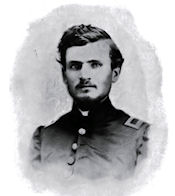
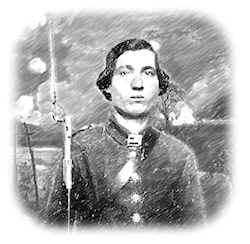
(Note: picture is of an unidentified Confederate soldier.)

0 comments

A Rebel War Clerk’s Diary

A Rebel War Clerk’s Diary at the Confederate States Capital, By John Beauchamp Jones
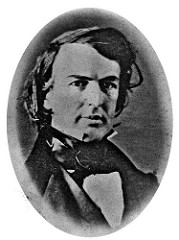
A likeness of Jones when he was editor and majority owner of the Daily Madisonian during President John Tyler’s administration.

NOVEMBER 27th.—Dark and gloomy. At 10 o’clock Gov. Vance, of North Carolina, telegraphed the Secretary of War, asking if anything additional had been heard from Bragg. The Secretary straightened in his chair, and answered that he knew nothing but what was published in the papers.

At 1 o’clock P.M. a dispatch was received from Bragg, dated at Ringgold, Ga., some thirty miles from the battle-field of the day before. Here, however, it is thought he will make a stand. But if he could not hold his mountain position, what can he do in the plain? We know not yet what proportion of his army, guns, and stores he got away—but he must have retreated rapidly.

Meade is advancing, and another battle seems imminent.

To-day a countryman brought a game-cock into the department.

Upon being asked what he intended to do with it, he said it was his purpose to send its left wing to Bragg!

0 comments

0

News of the Day

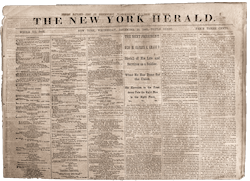
November 27, 1863, The New York Herald

            The official despatches of Generals Grant and Thomas confirm all the glorious story of the three days’ battles at Chattanooga. Lookout Mountain, the rifle pits in Chattanooga valley and the whole of Missionary Ridge are now in possession of our troops; while General Bragg is in hasty retreat towards Dalton, Georgia, closely pursued by Hooker and Sherman, who were following hard on his footsteps yesterday evening and harassing him terribly. The enemy are burning the bridges after them, to retard pursuit. They are also burning their depots and abandoning or destroying everything that will embarrass their flight. The reports received at the War Department represent that three thousand prisoners were captured from the rebels yesterday, with fifty-two cannon, five thousand stand of small arms and ten flags. Other reports put the number of prisoners up to last night at six thousand. Desertions and captures are thinning out Bragg’s army as they fly. Prisoners report the rebel army terribly demoralized, and incapable of offering serious resistance; and also that Bragg will fall back to Atlanta if not cut off. It is said that the rebel government has two million bales of cotton stores at the latter place, which would prove quite a prize for General Grant. We give a map of the scene of the late battles in another part of the paper.

            The latest news from General Burnside reports him perfectly safe, and about to be reinforced. No doubt the victories at Chattanooga will relieve him from his precarious situation.

            Stirring news from the Potomac. The whole army is on the move since yesterday morning. The roads are in fine condition, the weather clear and cold, and the men in splendid spirits. The rebel line extends on the south side of the Rapidan from White Ford to Mile run. The strength of Leearmy is reported at 36,000 infantry and 10,000 cavalry. A battle is looked for at Germania Ford. Jeff. Davis reviewed the corps of General Hill and General Ewell within the last two days. General Early is in temporary command of Ewell’s corps. The latter officer is reported to have died recently after a protracted sickness. The army of General Meade commenced its march at eight o’clock in the morning, and presented a magnificent spectacle in the bright sun of a November day.

0 comments

Downing’s Civil War Diary.–Alexander G. Downing.

Diary of Alexander G. Downing; Company E, Eleventh Iowa Infantry

Thursday, 26th–I returned from picket and all is quiet. I loaned $5.00 to Corporal Daniel E. Sweet, until next payday. All of the furloughed men are back now.

0 comments

War Diary of Luman Harris Tenney.

War Diary of Luman Harris Tenney.

26th. I shall be glad when the suspense shall end and we can move forward or back where we can find plenty to eat. Had some hogs driven up for 9th and 2nd. Bought 5 head of cattle. Drove up 7 from near Gap. Infantry Brigade, Wilcox’s, came up, still half starved. Jackson so begged that we lent him 1,200 lb. of meal. Letter from Ella Clark. Answered it. Did me good. Hid a dispatch on a messenger.

0 comments

A Confederate Girl’s Diary

A Confederate Girl’s Diary by Sarah Morgan Dawson

November 26th.

Yes! It is so, if his own handwriting is any proof. Mr. Appleton has just sent Brother a letter he had received from Gibbes, asking him to let Brother know he was a prisoner, and we have heard, through some one else, that he had been sent to Sandusky. Brother has applied to have him paroled and sent here, or even imprisoned here, if he cannot be paroled.

0 comments

Robert M. McGill

Robert M. Magill – Personal Reminiscences of a Confederate Soldier Boy, 39th Georgia Regiment of Infantry

Thursday, November 26th.—Started at daylight, after turning prisoners over to others; got to Uncle Nathan Anderson’s at 11 A. M.; stayed for dinner. Going down to bridge across creek, found Lieutenant Evans stopping all of brigade that came that way. Everything in confusion; passed through Ringgold at 4 P. M. As we were near home, George Vincent and myself went by home and spent the night.


(Note: picture is of an unidentified Confederate soldier.)

0 comments

0

Louise Wigfall Wright — A Southern Girl in ’61
(excerpts)
CHARLOTTESVILLE, Nov. 26th, 1863.         

         “. . . We hear to-night that the Army is to move, it is thought to Fredericksburg.
         “The news from the West has made every one look very blue—and I should think Mr. Davis would feel very uncomfortable with such a weight to carry. . . . What is to happen next no one can tell. We are all quite busy getting ready to go to Richmond. We leave here Monday, Dec. 1st. . . . I had a letter from Mrs. Johnston a few days ago. She was with her husband at Meridian. I expect he feels very keenly his present position; it is certainly an odd one—for such a general, at such a time—no army and nothing to do. I suppose you have seen by the papers that Genl. Hood is in Richmond. We hear that Dr. Darby is going to Europe to buy a leg for him, so Gen’l Ewell told your father; he is up here at present with his wife.”

0 comments

A Rebel War Clerk’s Diary

A Rebel War Clerk’s Diary at the Confederate States Capital, By John Beauchamp Jones
A likeness of Jones when he was editor and majority owner of the Daily Madisonian during President John Tyler’s administration.

NOVEMBER 26th.—The weather is clear and bright again; but, oh, how dark and somber the faces of the croakers!

The following dispatches have been received :

[BATTLE AT LOOKOUTMOUNTAIN.]
(OFFICIAL DISPATCH.)

“MISSION RIDGE, Nov. 24th, 1863.

“To GEN. S. COOPER.

“We have had a prolonged struggle for LookoutMountain today, and sustained considerable loss in one division. Elsewhere the enemy has only manœuvered for position.

“[Signed]BRAXTON BRAGG, General.”

The Latest—Official.

“CHICKAMAUGA, Nov. 25th, 1863.

“GEN. S. COOPER, A. AND I. GENERAL.

“After several unsuccessful assaults on our lines to-day, the enemy carried the left center about four o’clock. The whole left soon gave way in considerable disorder. The right maintained its ground, repelling every assault. I am withdrawing all to this point.

“[Signed]BRAXTON BRAGG.

“Official—JOHN WITHERS, A. A. G.”

All agree in the conviction that the enemy has been defeated–perhaps badly beaten.

Hon. H. S. Foote, just arrived from the vicinity of the field, says Bragg has only some 20,000 or 30,000 men, while Grant has 90,000, and he infers that incalculable disaster will ensue.

And Meade is steadily advancing. Gen. Pickett, at Petersburg, has been ordered to send some of his troops north of Richmond, for the defense of the railroad in HanoverCounty.

Miss Stevenson, sister of Major-Gen. Stevenson, has written the President for employment in one of the departments. He referred it to Mr. Memminger, who indorsed on it, coldly, as usual, there were no vacancies, and a hundred applications. The President sent it to the Secretary of War. He will be more polite.

Another letter to-day from Mr. Memminger, requesting that a company, commanded by a son of his friend, Trenholm, of Charleston, be stationed at Ashville, where his family is staying.

Lieut.-Gen. D. H. Hill has applied for a copy of Gen. Bragg’s letter asking his removal from his army. The President sends a copy to the Secretary, who will probably comply, and there may be a personal affair, for Bragg’s strictures on Hill as a general were pretty severe.

There are rumors of a break in the cabinet, a majority, it is said, having been in favor of Bragg’s removal.

Bragg’s disaster so shocked my son Custis that, at dinner, when asked for rice, he poured water into his sister’s plate, the pitcher being near.

0 comments

0

News of the Day

November 26, 1863, The New York Herald

The news from Chattanooga is glorious. The fighting of three days has ended in the complete defeat of the enemy yesterday. Lookout Mountain was occupied by the troops of General Hooker, who took 2,000 prisoners, and the rebels fled from every position which they held. General Bragg has made a full retreat, leaving all the strong points for which we are contending in our possession. We have not yet received the list of casualties, but we are assured that they are not heavy, while those of the enemy are put down as much greater than ours. Our loss of field officers appears to be considerable. The fighting at the Ridge was very severe. Two desperate assaults were made, in the latter of which our troops broke the centre of the enemy’s line and drove them down the Western slope and across the ridge of the Chicamauga. It is probable that we have captured in all fully 5,000 prisoners or more. Gen. Hooker is expected to intercept the flying enemy in the vicinity of Rossville.
Official despatches from General Grant and General Thomas were received at the War Department yesterday containing an account of the successful progress of events up to a late hour on Tuesday, the final results of which we have given above. The receipt of these despatches created much satisfaction in Washington.
All intelligence from General Burnside represents his position at Knoxville as perfectly safe and his communications open, although the city is closely invested by rebel batteries and rifle pits, the latter being within a short distance of General Burnside’s works on the north side. The south side, however, remains open.
The contemplated advance of General Meade’s army has been indefinitely postponed, it is said, in consequence of the premature disclosure of the plan of action by a Washington newspaper (the Chronicle) to which, it would appear, some confidential statements were made by a high official of the government, greatly to the disgust and annoyance of General Meade.
Jefferson Davis was at Orange Court House on Saturday. He is temporarily the guest of General Lee.
The news from Charleston is not very interesting. The firing on Forts Sumter, Moultrie, Johnson and Simpkins on Monday (our latest accounts) was not very heavy. The shelling of the city was for the time suspended.

0 comments

Village Life in America

Village Life in America, 1852 – 1872, by Caroline Cowles Richards

Friday.–Last evening Uncle Edward took a party of us, including Abbie Clark, to Wallack’s Theater to see “Rosedale,” which is having a great run. I enjoyed it and told James it was the best play I ever “heard.” He said I must not say that I “heard” a play. I “saw” it. I stand corrected.

I told James that I heard of a young girl who went abroad and on her return someone asked her if she saw King Lear and she said, no, he was sick all the time she was there! I just loved the play last night and laughed and cried in turn, it seemed so real. I don’t know what Grandmother will say, but I wrote her about it and said, “When you are with the Romans, you must do as the Romans do.” I presume she will say “that is not the way you were brought up.”

0 comments

Downing’s Civil War Diary.–Alexander G. Downing.

Diary of Alexander G. Downing; Company E, Eleventh Iowa Infantry

Wednesday, 25th–Out on picket. The guard continues strong and the officers are very strict.

0 comments

War Diary of Luman Harris Tenney.

War Diary of Luman Harris Tenney.

25th. In the morning rode out and found the wagons 1 ½ miles from town. Had Dan and Lewis go with Lt. Leavitt 14 miles for flour and meal. Got back about midnight, clear and cold. One of the Drivers came down. No move today. Spent the day at the wagons mostly. Read some, pitched a fly and took our ease. Numerous reports as to Burnside.

0 comments

Robert M. McGill

Robert M. Magill – Personal Reminiscences of a Confederate Soldier Boy, 39th Georgia Regiment of Infantry

1863—Chatanooga Valley

Battle of Missionary Ridge

Wednesday, 25th.—2 A. M., former and ordered to march out. Federals gained position, and could not be dislodged, consequently the ditches on our left wing are of no benefit. Arrived at top of Missionary Ridge at daylight moving towards right wing. Took our position over the tunnel of the Eastern Tennessee, Virginia and Georgia Railroad, through Missionary Ridge. Level Valley in front, several miles wide and all open; plain view. 9 A. M., Federals advanced in plain view. Our batteries opened fire; 9:15, still advancing. Companies A and F sent to the front as skirmishers; we deployed, and at 9:30 A. M., ordered to fix bayonets and charge. Drove back their advance skirmishers, being uncovered so that Federal batteries enfiladed our line; were ordered to halt; skirmishers’ ammunition about out; still heavy fighting. 10 A. M. second line of Federals advancing across the field in rear of the first. 10:15 A. M-; ordered back to top of hill; 11 A. M., five companies of our regiment thrown forward as skirmishers drove Yanks back from dwelling; ordered to fall back, and did so, but in few moments were ordered to charge and go to the house, which was done, and the house set on fire. Soon after the family made their appearance having been in the cellar, unknown to the officers. We were again ordered back to the top of the hill. Just as we were getting back, Federals charged battery on point just to our right. Col. McConnell ordered regiment up there. 2 P. M. Yanks within thirty yards of battery, but can’t come over; 2:30 P. M., Colonel McConnell shot through the head, mortally wounded. 3 P. M., our regiment and part of Cleaburn’s Division charged Yanks and drove them back in confusion, capturing about two hundred prisoners. I am sent to Chickamauga Station with the prisoners; arrived at 10 P. M., where we learned that Bragg’s left wing and left center was broken and that he had lost nearly all his artillery on that part of the line. Whole army in retreat.


(Note: picture is of an unidentified Confederate soldier.)

0 comments

A Rebel War Clerk’s Diary

A Rebel War Clerk’s Diary at the Confederate States Capital, By John Beauchamp Jones
A likeness of Jones when he was editor and majority owner of the Daily Madisonian during President John Tyler’s administration.

NOVEMBER 25th.—We have an unintelligible dispatch from Gen. Bragg, saying he had, yesterday, a prolonged contest with the enemy for the possession of Lookout Mountain, during which one of his divisions suffered severely, and that the manœuvring of the hostile army was for position. This was the purport, and the language, as well as I remember. There is no indication of the probable result—no intimation whether the position was gained. But the belief is general that Bragg will retreat, and that the enemy may, if he will, penetrate the heart of the South! To us it seems as if Bragg has been in a fog ever since the battle of the 20th of September. He refused to permit—to move on the enemy’s left for nearly two months, and finally consented to it when the enemy had been reinforced by 30,000 from Meade, and by Sherman’s army from Memphis, of 20,000, just when he could not spare a large detachment! In other words, lying inert before a defeated army, when concentrated; and dispersing his forces when the enemy was reinforced and concentrated! If disaster ensues, the government will suffer the terrible consequences, for it assumed the responsibility of retaining him in command when the whole country (as the press says) demanded his removal.

From letters received the last few days at the department, I perceive that the agents of the government are impressing everywhere—horses, wagons, hogs, cattle, grain, potatoes, etc. etc.—leaving the farmers only enough for their own subsistence. This will insure subsistence for the army, and I hope it will be a death-blow to speculation, as government pays less than one-fourth the prices demanded in market. Let the government next sell to non-producers, and every man of fighting age will repair to the field, and perhaps the invader may be driven back.

We have the speech of the French Emperor, which gives us no encouragement, but foreshadows war with Russia, and perhaps a general war in Europe.

We have rain again. This may drive the armies in Virginia into winter quarters, as the roads will be impracticable for artillery.

The next battle will be terrific; not many men on either side will be easily taken prisoners, as exchanges have ceased.

Dr. Powell brought us a bushel of meal to-day, and some persimmons.

0 comments

0

News of the Day

November 25, 1863, The New York Herald

The latest news from Chattanooga reports the rebels falling back from Chickamauga Station. Their artillery have entirely withdrawn from our front. Our forces, under Generals Wood and Sheridan, of the Fourth army corps, under the direction of General Gordon Granger, of General Thomas’ division, made a most brilliant movement on the 23d to obtain possession of two eminences half way between our left and Missionary Ridge, where the enemy were in force. The brigade of Gen. Hazen opened the attack, supported by that of Gen. Willich on the left, and the whole division of General Sheridan on the right, General Howard’s corps forming the reserve. The points of attack aimed at were soon occupied, and in ten minutes after General Willich carried the enemy’s rifle pits in front, their defenders flying before him after firing one volley. Meantime, General Sheridan pushed through the forest, drove in the enemy’s pickets, and halted on reaching the rifle pits. We not only captured two hundred prisoners by this movement, but obtained a most important position in the occupation of the heights north of Missionary Ridge. We give a map today showing the vicinity in which General Thomas achieved this brilliant result. But this is not the end of it. The reconnaissance commenced on Monday has resulted in a general battle which was going on up to our latest reports yesterday with great success, the enemy retreating gradually, although making a stubborn resistance. Despatches to the War Department from General Grant, received last night, are of a most cheering character.

No further news had been received from Gen. Burnside up to yesterday. Cannonading, however, was still going on. A battle was supposed to be imminent between the forces of Generals Grant and Bragg yesterday. A despatch from General Bragg to Adjutant General Cooper, at Richmond dated at Mission Ridge, on the 19th, says that General Wheeler reports an attack upon the Union troops, in which they were dispersed and driven into their works at Knoxville, with the loss of three hundred prisoners.

The latest rebel accounts from Charleston are to the 20th inst., and state that on the day previous our guns fired eleven shots from battery Gregg at the city, but did little damage. Some three or four buildings were struck, and one person was injured. The Pawnee and another gunboat came up the Stono and shelled Battery Pringle, but effected nothing.

On the 20th the firing on Charleston was renewed. The shelling of FortSumter was more heavy than usual. But few rifled shots were fired. No casualties occurred either in the city or at the fort.

There is no change in the position of the Army of the Potomac. The unpropitious state of the weather appears for the time to have interrupted the contemplated movement on the Rapidan.

The steamer Convoy has returned to Fortress Monroe from City Point, in charge of Captain Irving, who reports having transferred the government rations for our prisoners at and about Richmond satisfactorily into the hands of Commissioner Ould.

0 comments

0

Civil War Diary of Charles H. Lynch, 18th Conn. Vol’s.
Charles Lynch

November 25th. Thanksgiving Day. Weather fine. Our second one in the U. S. service. Some of the boys received boxes from home containing good things which they divided with others. Connecticut mince pies were all right. We had baked chicken prepared by a baker in town. Our Thanksgiving in camp passed very quiet and pleasant. Excused from all duty except picket and guard. These days are passing quietly, nothing extra so far to perform. Kept busy most of the time.

0 comments

Downing’s Civil War Diary.–Alexander G. Downing.

Diary of Alexander G. Downing; Company E, Eleventh Iowa Infantry

Tuesday, 24th–The weather is clear and cool, and the regiment is in good health. No news of importance.

0 comments

War Diary of Luman Harris Tenney.

War Diary of Luman Harris Tenney.

24th. Rob came before daylight and got flour for 2nd O. V. C. Hard up for rations seemingly. Another alarm and all saddled up before noon. Wagons moved to the rear and flour and meal collected. Letters from home and A. B. Moved to Tazewell. Wagons moved beyond. Couldn’t find them. Slept at Hdqrs. after rambling round awhile. Cold night.

0 comments

Robert M. McGill

Robert M. Magill – Personal Reminiscences of a Confederate Soldier Boy, 39th Georgia Regiment of Infantry

Monday, 24th.—15th Company F, sent on picket two hours before day. 8 A. M., still in line of battle on Chattanooga Creek; heavy cannonading about the point of the mountain. 12 M., very heavy cannonading on point; 1 P. M., heavy skirmishing on the mountain. 1:15 P. M., Federals charged mountain; came over the mountain, down under the point, across a field, in plain view of us; went up to works; our forces have fallen back a little. 2 P. M. Fog has risen so we can see the battle; 3 P. M., firing rather slow; 3:15 P. M., battle raging with renewed vigor. Yanks have our works, but seem as though they can’t go farther. 4 P. M., battle still raging; 4:30 P. M., reported Walthal’s Brigade pretty badly cut up, there being no other troops on the mountain; 5 P. M., battle continues unabated. Yanks falling back a little. Rebs re-inforced with Lee’s Brigade, Alabamians; 6 P. M., raining; 11 P. M., firing ceased. The general opinion is that Lookout Mountain is taken.


(Note: picture is of an unidentified Confederate soldier.)

0 comments

A Rebel War Clerk’s Diary

A Rebel War Clerk’s Diary at the Confederate States Capital, By John Beauchamp Jones
A likeness of Jones when he was editor and majority owner of the Daily Madisonian during President John Tyler’s administration.

NOVEMBER 24th.—The President is expected back today. A letter from Gen. Lee indicates that the Commissary-General has been suggesting that he (the general) should impress supplies for his army. This the general deprecates, and suggests that if supplies cannot be purchased, they should be impressed by the agents of the Commissary Department; and that the burden should be laid on the farmers equally, in all the States. Gen. Lee does not covet the odium. But it is plain, now, that the extortionate farmers, who were willing to see us non-producing people starve, unless we paid them ten prices for their surplus products, will be likely to get only the comparatively low schedule price fixed by the government. Instead of $20 per bushel for potatoes, they will receive only $2 or $3. This will be a good enough maximum law. But the government must sell to us at cost, or I know not what may be the consequences.

0 comments

0

News of the Day

November 24, 1863, The New York Herald

The condition of the roads in Virginia, notwithstanding the recent rains, is such that the army of General Meade is now in a position to move at any moment. His troops fully occupy the country up to the north bank of the Rapidan, but there is no official information that any portion of his army has crossed the river. Reports of the advance of the army to the south side of the river were circulated yesterday, but the announcement is premature. General Lee is said to be prepared to make a desperate resistance to any such movement.

Despatches from Cincinnati yesterday state that General Burnside was holding out at Knoxville, and had notified the citizens of that place that he would hold it under all circumstances. The rebels — who are reported to be 30,000 strong — have withdrawn from the south side of the river. General Foster had reached Cincinnati, en route for Knoxville, which he doubtless reached by this time. It is said that the President has not accepted General Burnside’s resignation; but is willing to grant him leave of absence to attend to his private affairs, which need his supervision, with the understanding that he will return to his command at the earliest moment consistent with the business engagements which imperatively call him temporarily from his duties in the field. We give a fine map today of the scene of General Burnside’s operations in East Tennessee up to this date.

The steam transport Fulton, from Port Royal, which arrived at this port yesterday, reports that the sea wall of FortSumter was entirely destroyed, and the rebels were constructing bombproof buildings on the ruins. The firing on the fort was still going on. During Sunday night the Monitor Lehigh, while on picket duty near FortSumter, got aground. Daylight discovered her position to the enemy, who at once began a furious fire upon her, both from James and Sullivan’s Island. Three other Monitors — the Montauk, Passaic and Nahant — moved up to aid her by command of Admiral Dahlgren. The admiral boarded the Nahant and called for volunteers to carry a hawser to the Lehigh. Out of the number who offered themselves, the surgeon and two sailors were accepted and proceeded on their desperate mission under a tremendous fire. After three attempts they succeeded in getting a line fast to the Lehigh, and at the turn of the tide the Nahant towed her off. Admiral Dahlgren promoted the two seamen on the spot to the rank of petty officers. Commander Bryson of the Lehigh, and the executive officer, Lieutenant Hopkins, were both wounded.

The Fulton brought in here the rebel prize steamer Banshee, captured by the Fulton and the transport Delaware, with a valuable cargo, bound from Nassau to Wilmington.

We learn from Fortress Monroe the particulars of the delivery of the provisions sent by the steamer Convoy for the relief of the Union prisoners at Richmond.

Colonel Irving, who had them in charge, has satisfactorily transferred all the government rations, as well as all the provisions from the Baltimore Relief Fund, for the Union prisoners in and about Richmond, to Commissioner Ould. The immediate wants of our officers and soldiers in Richmond will thus be supplied.

0 comments