South Carolina Commissioners Reply to President Buchanan.

War of the Rebellion: from the Official Records of the Union and Confederate Armies and Navies

WASHINGTON, D.C., January 1, 1861.

To his Excellency the PRESIDENT OF THE UNITED STATES:

SIR: We have the honor to acknowledge the receipt of your letter of the 30th December, in reply to a note addressed by us to you on the 28th of the same month, as Commissioners from South Carolina. [continue reading…]

0 comments

A Diary of American Events – January 1, 1861

The Rebellion Record – A Diary of American Events; by Frank Moore

The evidences of a purpose on the part of the secessionists to seize upon the public property and usurp the Government at its capital, have become so clear that energetic measures are taking to defeat their plans, and repress the treason. Now that the Administration begins to appreciate the necessity of preserving the Government, and manifests the purpose to repudiate the treasonable influences which have hitherto paralyzed its arm, the people are beginning to report facts exposing the violent plots concocting in the District and its neighborhood.

It is now well known that military companies have been organized and drilled for months past in Maryland and Virginia–some of them under the eye of an officer of the regular army –and that the distinct object of their organization is to aid in the seizure of Washington city in the interest of the disunionists, or the prevention by force of Lincoln’s inauguration, Some of the less prudent of their leaders boast in private circles that they have five thousand well-armed and organized men ready to strike the blow instantly upon the concerted signal being given.–Times, Jan. 2.

–At Charleston, the attitude of the Administration is regarded as warlike.

A censorship is exercised over the telegraph, and the city is nightly patrolled by the military. It is proposed to starve out the troops at Fort Sumter, and then attack them on rafts with the aid of batteries already erected. There is a battery of earthwork, logs, and sand, on the end of Sullivan’s Island, and also one on Morris’ Island.

Commander Pettigru, of Castle Pinckney, orders that no boat shall be allowed to approach the wharf-head without permission, under penalty of serious consequences in case of violation. The city river-front is carefully guarded. The Palmetto Guards, 100 strong, have charge of the arsenal under the palmetto flag, instead of the Federal flag.

Collector Colcock notifies ship-masters that all vessels from and for ports outside of South Carolina must enter and clear at Charleston.

The Columbia Artillery, numbering 50 men, arrived at 1 o’clock to-day, and proceeded to the harbor. They will use cannon belonging to Charleston.–Boston Transcript, Jan. 2.

In South Carolina Convention passed an ordinance to define and punish treason. It declares that in addition to that already declared treason by the General Assembly, treason against the State shall consist only in levying war against the State, adhering to its enemies, and giving them aid and comfort. The penalty is death without the benefit of the clergy.– Evening Post, Jan. 2.

0 comments

I have Given Up the Ship

Miscellaneous document sources

Mrs. Robert Toombs to Alexander H. Stephens.

Washington, D. C., Jan. 1st, 1861[i]

Dear Sir: I write a few lines to you this morning to ask you what I shall do with your furniture that is in our house. I have despaired of the Union and will begin to pack up my own things today. If you can do anything you must be at it. I have given up the ship notwithstanding your old friends’ opinion in a telegram of the morning papers; I mean Messrs. Douglas and Crittenden.[ii] I shall go home with Mr. Toombs when he goes to the convention.[iii] I will take great pleasure in having your things packed and shipped or will do anything with them that you desire. You have the following articles: a carpet, bedstead, feather bed, mattrass, bolster and pillows, bowl and pitcher, bureau, couch, shovel and tongs, etc. Please let me know as soon as you can what to do with them. We will send the most of our things home, for we can’t get one cent for them here.I hope you are well.


[i] Erroneously dated Jan. 1, 1860, in the original.
[ii] In reply to a telegraphic inquiry addressed to them by eight citizens of Atlanta asking whether there was any hope of Southern rights in the Union, Crittenden and Douglas had telegraphed, Dec. 30, 1860: “In reply to your inquiry, we have hopes that the rights of the South, and of every state and section, may be protected within the Union. Don’t give up the ship. Don’t despair of the Republic.”
[iii] The Georgia secession convention, to which Toombs had been elected a delegate from Wilkes county.


From Annual Report of the American Historical Association for the Year 1911.

Robert Toombs had married his childhood sweetheart, Martha Juliann “Julia” DuBose.

Alexander Hamilton Stephens was an American politician who served as the vice president of the Confederate States from 1861 to 1865. After serving in both houses of the Georgia General Assembly, he won election to Congress, taking his seat in 1843. After the Civil War, he returned to Congress in 1873, serving to 1882 when he was elected as the 50th Governor of Georgia, serving there from late 1882 until his death in 1883.


0 comments

Resignation of the Secretary of War.

Civil War Day-by-Day

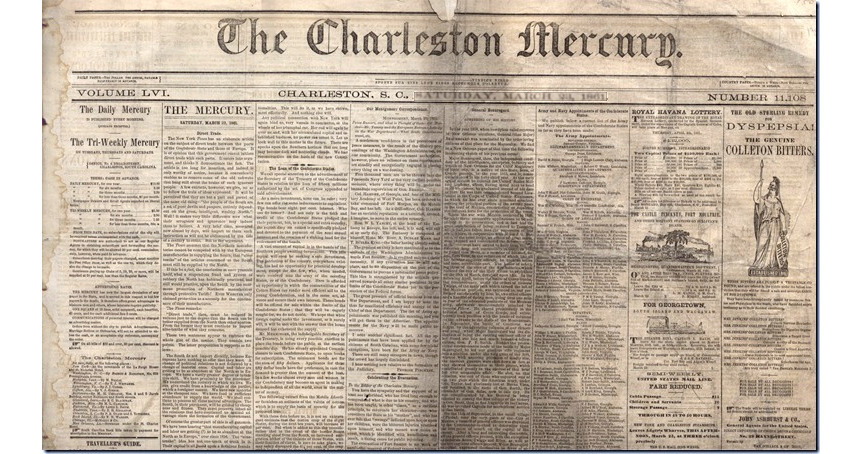
January 1, 1861, The Charleston Mercury

Our readers will perceive, from our telegraphic despatches, that Governor FLOYD has resigned his seat in the Cabinet as Secretary of War, and that General SCOTT has been appointed, as interim, in his place, or Mr. HOYT, who is equally in favor of coercion; and that the war steamer, Harriet Lane, had been ordered to this port; and that troops may also be expected. This looks very belligerent, and, we confess, quite exceeds the folly we were prepared to attribute to the Administration. In twelve days three more States – Florida, Alabama and Mississippi – will most probably be out of the Union. In one month four more – Louisiana, Texas, Arkansas and Georgia – will also most probably be out of the Union. If there was any doubt of such results, the Government will make them sure by its futile attempts to coerce South Carolina. It will do more. It will speedily bring all the other Southern States into sympathy and union with the Cotton States. If the Cotton States had the ordering of events, they could not devise any expedient so certain and speedy in its operation to drive all the Southern States together into a separate Confederacy, than that which the Administration, under the counsels of General SCOTT, is now about to adopt. As soon as this intelligence passes down the South, the people of every Southern State, will seize it. We could have seized Fort Sumter, but failing to do so, we see it garrisoned for the control of the bay. The other Southern States will profit by the lesson, and will know how to meet the faithlessness and hostility of the Federal Government. Virginia, Florida, Alabama, will now understand the uses to which the United States fortresses in their respective States are to be applied. They are to be filled with enemies to enforce the authority of a Government as unscrupulous as it is tyrannical. Nor will the spirit of the people of the South quail before such demonstrations. It will rise with the development of the true nature of the Government of the United States. Some of our people have not realized that it has become a remorseless sectional despotism. Now its true characteristics will be made plain to all; and as it raises its bloody front, it will be met with that stern courage which always animates men struggling for their liberties and institutions. Although we deprecate collisions with the General Government we cannot doubt that it must, more speedily than any other instrumentality, produce the triumph of the policy of South Carolina. That policy is an eternal separation of the Southern from the Northern States, and a mighty Southern Confederacy. The poor fools who are trying to defeat its consummation by drawing the sword, will only give it loftier and more enduring triumph.

South Carolina, with the Ithurial spear of Seccession, has touched the toad – and lo! it springs up, a devil.

0 comments

Resignation of the Secretary of War

Richmond Enquirer

January 1, 1861 Richmond Enquirer

The resignation of Secretary Floyd, which was tendered on Saturday night last, will be deeply regretted by the people of Virginia. Under the circumstances, Secretary Floyd has done only what every high toned gentleman would have done.
The Administration had given an unqualified pledge, to the Representatives from South Carolina, that no reinforcements should be sent to the Forts, and that their status should not be changed, if the authorities and people of South Carolina would make no attempt to seize the Forts. South Carolina gave the pledge, and, what is more, honorably observed it. Under its operation peace was preserved, and the peace commissioners from that State were in to violate that pledge, to change the [….] of the forts, and to hazard the peace of the country. Gov. Floyd considered this action of Maj. Anderson as violating the pledge of the administration, and ruinous to the policy which, under the pledge of the President, had preserved the peace. The reoccupation of Fort Moultrie by Major Anderson, Secretary Floyd considered just and proper, and made it the condition of his longer remaining in the Cabinet. The President admitting the pledge, yet refused to order Major Anderson to Fort Moultrie, and Secretary Floyd would no .longer remain a member of the Administration which would permit its subordinate officer, by violating its pledge, to ruin its policy and involve the country in civil war. He, therefore, resigned; and the people in Virginia, while deeply regretting his loss to the War Department at this time, will yet sustain him in his action. If the rumor be true that Gen. Scott has been appointed to the War Department, with his previous declarations against the South, it will speedily involve the country in civil war – indeed, we should not be surprised if individual action did not precipitate Virginia into collision with the Federal Government.

0 comments

Civil War Day-by-Day

Civil War Day-by-Day
Fort Sumter, Seen from the Rear, at Low Water

January 1, 1861

  • On New Year’s Day Georgians go to the polls to elect either a pro-Union or pro-Seccession slate of delegates to a state convention to be held in Milledgeville. According to Gov. Brown the results are overwhelmingly pro-secession, however, later research by the Georgia Historical Society indicates that the returns were overstated in favor of the secessionists.
  • A Virginia pro-Union meeting in Parkersburg (now West Virginia) resolves that “secession is revolution.”

The image is of Fort Sumter, seen from the rear, at low water (Harper’s Pictorial History of the Civil War)

0 comments

General John Ellis Wool’s Letter to a Friend in Washington

The Rebellion Record – A Diary of American Events; by Frank Moore

Troy, December 31, 1860.

My dear Sir:—South Carolina, after twenty-seven years—Mr. Rhett says thirty years—of constant and increasing efforts by her leaders to induce her to secede, has declared herself out of the Union; and this, too, without the slightest wrong or injustice done her people on the part of the government of the United States. Although she may have seized the revenue cutter, raised her treasonable Palmetto flag over the United States Arsenal, the Custom-house, Post-office, Castle Pinckney, and Fort Moultrie, she is not out of the Union, nor beyond the pale of the United States. Before she can get out of their jurisdiction or control, a re-construction of the constitution must be had or civil war ensue. In the latter case it would require no prophet to foretell the result.

It is reported that Mr. Buchanan has received informally the Commissioners appointed by the rebels of South Carolina to negotiate for the public property in the harbor of Charleston, and for other purposes. It is also reported that the President disapproved of the conduct of Major Anderson, who, being satisfied that he would not be able to defend Fort Moultrie with the few men under his command, wisely took possession of Fort Sumter, where he could protect himself and the country from the disgrace which might have occurred, if he had remained in Fort Moultrie. Being the commander in the harbor, he had the right to occupy Fort Sumter, an act which the safety of the Union as well as his own honor demanded. It is likewise stated that apprehensions are entertained that Major Anderson will be required to abandon Fort Sumter and re-occupy Fort Moultrie. There can be no foundation for such apprehensions; for surely the President would not surrender the citadel of the harbor of Charleston to rebels. Fort Sumter commands the entrance, and in a few hours could demolish Fort Moultrie. So long as the United States keeps possession of this fort, the independence of South Carolina will only be in name and not in fact. If, however, it should be surrendered to South Carolina, which I do not apprehend, the smothered indignation of the free states would be roused beyond control. It would not be in the power of any one to restrain it. In twenty days two hundred thousand men would be in readiness to take vengeance on all who would betray the Union into the hands of its enemies. Be assured that I do not exaggerate the feelings of the people. They are already sufficiently excited at the attempt to dissolve the Union, for no other reason than that they constitutionally exercised the most precious right conferred on them, of voting for the person whom they considered the most worthy and best qualified to fill the office of President. Fort Sumter therefore ought not, and I presume will not, be delivered over to South Carolina. I am not, however, pleading for the free States, for they are not in danger, but for the Union and the preservation of the cotton States. Those who sow the wind may expect to reap the whirlwind. The leaders of South Carolina could not have noticed that we live in an age of progress, and that all Christendom is making rapid strides in the march of civilization and freedom. If they had, they would have discovered that the announcement of every victory obtained by the hero of the nineteenth century, Garibaldi, in favor of the oppressed of Italy, did not fail to electrify every American heart with joy and gladness. “Where liberty dwells there is my country,” was the declaration of the illustrious Franklin. This principle is too strongly implanted in the heart and mind of every man in the free States, to be surrendered because South Carolina desires it in order to extend the area of slavery. With a Christianized Europe and nearly all the civilized world opposed to slavery, are the Southern States prepared to set aside the barriers which shield and protect their institutions under the United States government? Would the separation of the South from the North, give greater security to slavery than it has now under the Constitution of the Union? What security would they have for the return of runaway slaves? I apprehend none; whilst the number of runaways would be greatly augmented, and the difficulties of which slaveholders complain would be increased ten-fold. However much individuals might condemn slavery, the Free States are prepared to sustain and defend it as guarantied by the Constitution.

In conclusion, I would avoid the bloody and desolating example of the Mexican States. I am now, and forever, in favor of the Union, its preservation, and the rigid maintenance of the rights and interests of the States, individually as well as collectively.

Yours, &c.,

John E. Wool.
0 comments

A Diary of American Events – December 31, 1860

The Rebellion Record – A Diary of American Events; by Frank Moore

—Strong fortifications have been ordered by the South Carolina Convention in and around Charleston harbor, to resist any reinforcements that may be sent to Major Anderson.

Governor Pickens is in daily receipt of dispatches from the South, tendering men to defend South Carolina from invasion.

—The scene in the Senate at Washington to-day was intensely exciting. Senator Benjamin, of Louisiana, who, it had been reported, would make a conciliatory speech, gave out that he would make a parting secession speech —an announcement which drew an immense audience. Senator Benjamin spoke calmly throughout, but the character of his speech at the close opened up to every one the new era in national affairs. His closing declaration, that the South could never be subjugated, was greeted by the galleries with disgraceful applause, screams, and uproar. It was evidently the act of persons who had purposely packed the galleries. For this demonstration the galleries were promptly cleared; but as the people passed out, remarks were current among the mob such as, “That’s the talk “—”Now we will have war”—”Benjamin’s a brick”—“ D–n the abolitionists”—” Abe Lincoln will never come here.”–Times, Jan. 1.

—General Wool takes strong ground in favor of the Union, of sustaining Anderson in his position at Fort Sumter, and earnestly urges that a firm ground be adopted to put down rebellion.

He declares that if Fort Sumter be surrendered to the secessionists, in twenty days two hundred thousand men will be in readiness to take vengeance on all who would betray the Union into the hands of its enemies.—(Doc. 11.) —Troy Times, Dec. 31.

0 comments

A Diary of American Events – December 30, 1860

The Rebellion Record – A Diary of American Events; by Frank Moore

—It is generally considered that Mr. Floyd has not resigned because of Major Anderson’s patriotic course, but merely used it as a pretext to conceal the real cause. The whole country knows that his position, under the “trying circumstances,” has not been a very agreeable one, especially during the last two weeks. The alleged cause of his leaving Mr. Buchanan is, that the latter refuses to recall or order back to Fort Moultrie the gallant Anderson. Floyd asserts that he, some time ago, promised the South Carolina seceders to leave things in the harbor of Charleston undisturbed—in statu quo ante bellum—and that the President gave the same promise. This agreement having been broken by Major Anderson, he insisted upon his returning to Fort Moultrie; and, because the President was unwilling to give that order, he sent in his resignation.—Phila. Press, Dec. 31.

—The South Carolina troops took possession of the arsenal at Charleston. The arsenal contains many thousand arms and military stores. Military preparations are actively and zealously progressing.—Evening Post, Dec. 31.

0 comments

Secretery of War Floyd’s Resignation

The Rebellion Record – A Diary of American Events; by Frank Moore

War Department, Dec. 29, 1860.

Sir: On the morning of the 27th inst. I read the following paper to you in the presence of the Cabinet:

Counsel Chamber, Executive mansion.
Sir: It is evident now from the action of the Commander of Fort Moultrie, that the solemn pledges of the Government have been violated by Major Anderson. In my judgment but one remedy is now left us by which to vindicate our honor and prevent civil war. It is in vain now to hope for confidence on the part of the people of South Carolina in any further pledges as to the action of the military. One remedy is left, and that is to withdraw the garrison from the harbor of Charleston. I hope the President will allow me to make that order at once. This order, in my judgment, can alone prevent bloodshed and civil war.
John B. Floyd, Secretary of War.
.

I then considered the honor of the Administration pledged to maintain the troops in the position they occupied, for such had been the assurances given to the gentlemen of South Carolina who had a right to speak for her. South Carolina, on the other hand, gave reciprocal pledges that no force should be brought by them against the troops or against the property of the United States. The sole object of both parties in these reciprocal pledges was to prevent a collision and the effusion of blood, in the hope that some means might be found for a peaceful accommodation of the existing troubles, the two Houses of Congress having both raised Committees looking to that object. Thus affairs stood until the action of Major Anderson, taken unfortunately while the Commissioners were on their way to this capital on a peaceful mission looking to the avoidance of bloodshed, has complicated matters in the existing manner. Our refusal or even delay to place affairs back as they stood under our agreement, invites a collision and must inevitably inaugurate civil war. I cannot consent to be the agent of such calamity. I deeply regret that I feel myself under the necessity of tendering to you my resignation as Secretary of War, because I can no longer hold it under my convictions of patriotism, nor with honor, subjected as I am to a violation of solemn pledges and plighted faith.

With the highest personal regard,

I am most truly yours,

John B. Floyd.

To His Excellency the President of the United States.

0 comments

A Diary of American Events – December 29, 1860

The Rebellion Record – A Diary of American Events; by Frank Moore

—Major Anderson is denounced by the Charleston papers. The Courier says:

“Major Robert Anderson, United States Army, has achieved the unenviable distinction of opening civil war between American citizens by an act of gross breach of faith. He has, under counsels of a panic, deserted his post at Fort Moultrie, and, under false pretexts, has transferred his garrison and military stores and supplies to Fort Sumter.”

The Mercury, more temperately, says:

“Major Anderson alleges that the movement was made without orders and upon his own responsibility, and that he was not aware of such an understanding. He is a gentleman, and we will not impugn his word or his motives. But it is due to South Carolina and to good faith that the act of this officer should be repudiated by the Government, and that the troops be removed forthwith from Fort Sumter.”—(Doc. 9.)

—John B. Floyd resigned his position as Secretary of War, owing to the refusal of the President to withdraw the Federal troops from the forts at Charleston.—(Doc. 10.)—Baltimore Sun, Jan. 1.

0 comments

A Diary of American Events – December 28, 1860

The Rebellion Record – A Diary of American Events; by Frank Moore

—Early this afternoon the palmetto flag was raised over the Custom House and Post Office at Charleston; and to-night Castle Pinckney and Fort Moultrie have been taken possession of by the South Carolina military. These forts are held under instructions from Governor Pickens, who authorizes their peaceable possession, for the protection of the government property. Castle Pinckney and Fort Moultrie were held by a very small force, which surrendered without collision.—Times, Dec. 29.

—An enthusiastic Union meeting was held at Memphis, Tenn., to-day. It was addressed by Hon. Neil S. Brown and others. Resolutions were passed opposing separate State secession; against coercion; and favoring a Convention of the Southern States to demand their rights, and if refused to take immediate action.—Phila. Press, Dec. 29.

—The citizens of Wilmington, Del., fired a salute of twenty-one guns in honor of Major Anderson and his heroic band.

—Governor Hicks’ refusal to convene the Maryland Legislature for disunion purposes, is generally regarded at Washington with warm approbation, and creates great dismay among the disunionists who have urged it. The greater portion of the latter are said to be office-seekers, disappointed politicians, and rowdies, who seek plunder. A prominent gentleman, who has just seen Governor Hicks, says the rank and file of Maryland are true to him.—Tribune, Dec. 29.

0 comments

A Diary of American Events – December 26, 1860

The Rebellion Record – A Diary of American Events; by Frank Moore

—Fort Moultrie was evacuated tonight. Previous to the evacuation, the guns were spiked and the carriages destroyed by fire. The troops have all been conveyed to Fort Sumter. Major Anderson states that he evacuated the fort in order to allay the discussion about that post, and at the same time strengthen his own position.—(Doc. 7.) The evacuation of the fort commenced a little after sundown. The men were ordered to hold themselves in readiness, with knapsacks packed, at a moment’s notice; but up to the moment of their leaving had no idea of abandoning the post. They were reviewed on parade, and were then ordered to two schooners lying in the vicinity, where they embarked, taking with them all the necessaries, stores, &c., requisite in their evacuation.

Several trips were made during the night, and a great part of the provisions and camp furniture were transported under cover of night. The brightness of the moon, however, afforded but slight concealment to their movements, and in one of the trips, Lieutenant Davis in command, a schooner full of soldiers and baggage passed directly under the bow of the guard-boat Nina. The officer who made the statement expressed himself to be ignorant whether the watch on board the Nina discovered the movement or not; at all events, he said, they did not signify any cognizance of the fact.—(Doc. 8.)—Charleston Mercury, Dec. 28.

—Messrs. Barnwell, Orr, and Adams, the Commissioners appointed by South Carolina to treat with the Federal Government, arrived in Washington to-day. This evening they have held a consultation with a few friends, among whom was Senator Wigfall, of Texas.—Boston Post, Dec. 27.

—In the Convention at Charleston, Mr. Rhett offered the following ordinance;

First.—That the Conventions of the seceding slaveholding States of the United States unite with South Carolina, and hold a Convention at Montgomery, Ala., for the purpose of forming a Southern Confederacy.

Second.—That the said seceding States appoint, by their respective Conventions or Legislatures, as many delegates as they have representatives in the present Congress of the United States, to the said Convention to be held at Montgomery; and that on the adoption of the Constitution of the Southern Confederacy, the vote shall be by States.

Third.—That whenever the terms of the Constitution shall be agreed upon by the said Convention, the same shall be submitted at as early a day as practicable to the Convention and Legislature of each State, respectively, so as to enable them to ratify or reject the said Constitution.

Fourth.—That in the opinion of South Carolina, the Constitution of the United States will form a suitable basis for the Confederacy of the Southern States withdrawing.

Fifth.—That the South Carolina Convention appoint by ballot eight delegates to represent South Carolina in the Convention for the formation of a Southern Confederacy.

Lastly.—That one Commissioner in each State be elected to call the attention of the people to this ordinance.

0 comments

‘T is the last Christmas, probably, that we shall be together, freedmen!

Dolly Sumner Lunt Burge – A Woman’s Wartime Journal.

December 25, 1865.

Sadai woke very early and crept out of bed to her stocking. Seeing it well filled she soon had a light and eight little negroes around her, gazing upon the treasures. Everything opened that could be divided was shared with them. ‘T is the last Christmas, probably, that we shall be together, freedmen! Now you will, I trust, have your own homes, and be joyful under your own vine and fig tree, with none to molest or make afraid.

THE END

0 comments

A Diary of American Events – December 25, 1860

The Rebellion Record – A Diary of American Events; by Frank Moore

—The dispatches from Pittsburgh, that the arms in the arsenal there would not be allowed to be shipped, made a great sensation at Washington. The story was greatly enlarged. Northern men, including members of Congress, have telegraphed to the people to stand firm, and not allow the arsenals to be stripped of all arms.

0 comments

How many poor freedmen are suffering!

Dolly Sumner Lunt Burge – A Woman’s Wartime Journal.

December 24, 1865.

It has been many months since I wrote in this journal, and many things of interest have occurred. But above all I give thanks to God for His goodness in preserving my life and so much of my property for me. My freedmen have been with me and have worked for one-sixth of my crop.

This is a very rainy, unpleasant day. How many poor freedmen are suffering! Thousands of them must be exposed to the pitiless rain! Oh, that everybody would do right, and there would not be so much suffering in the world! Sadai and I are all alone in the house. We have been reading, talking, and thus spending the hours until she went to bed, that I might play Santa Claus. Her stocking hangs invitingly in the corner. Happy child and childhood, that can be so easily made content!

0 comments

A Diary of American Events – December 24, 1860

The Rebellion Record – A Diary of American Events; by Frank Moore

—Governor Pickens, agreeably to the ordinance of secession, issued a proclamation, proclaiming South Carolina a separate, sovereign, free, and independent State, with the right to levy war, conclude peace, negotiate treaties, leagues, or covenants, and do all acts whatever that rightly appertain to a free and independent State.—Herald, Jan. 1, 1861.

—A mass meeting was held at New Orleans to ratify the nominations of the Southern Rights candidates for the Convention. It was the largest congregation of every party ever assembled in that city. Cornelius Fellows was President, and speeches were made by Charles M. Conrad, Charles Gayare, and others, advocating immediate secession, amid unbounded enthusiasm. The Southern Marseillaise was sung as the banner of the Southern Confederacy was raised, amid reiterated and prolonged cheers for South Carolina and Louisiana.—National Intelligencer, Dec. 25.

—The election for delegates to the State Convention to meet January 7th, took place to-day. The separate State secession ticket was elected in Mobile by a thousand majority.

The election passed off quietly through the State. In many places there was no opposition; the secession ticket, in the whole State, has 50,000 majority.–Times, Dec. 25.

—Governor Moore issued a proclamation, convening the Legislature of Alabama January 14th, to provide by State laws for any emergency that may arise from the action of the secession Convention called for January 7th.

—The Speaker laid before the House of Representatives a letter signed by Messrs. McQueen, Bonham, Boyce, and Ashmore, members from South Carolina, to the effect that the act of secession passed by their State had dissolved their connection with that body, and that they should accordingly withdraw. The letter was laid on the table, and the Speaker directed the names of the South Carolina members to be retained on the roll, thus not recognizing the conduct of their State as severing their connection with the House.–(Doc. 6.)

—The Richmond Enquirer of to-day announces that President Lincoln will be forced to relinquish Washington, and suggests the propriety of the prompt interposition of Maryland and Virginia to prevent Mr. Lincoln’s inauguration at Washington, by taking possession of the capital without delay.

—Excitement at Pittsburgh, Pa., in consequence of a report that the artillery at the Alleghany arsenal was to be transferred to new forts in the southwest. A call is in circulation, addressed to the Mayor, to convene a meeting of the citizens to take action in the matter. The call is signed by prominent men of all parties. The feeling against allowing a gun to be removed south is almost unanimous.—Evening Post, Dec. 28.

0 comments

A Diary of American Events

The Rebellion Record – A Diary of American Events; by Frank Moore

Letter of South Carolina Congressmen to the Speaker of the House of Representatives.

Sir: We avail ourselves of the earliest opportunity since the official communication of the intelligence, of making known to your honorable body that the people of the State of South Carolina, in their sovereign capacity, have resumed the powers heretofore delegated by them to the Federal Government of the United States, and have thereby dissolved our connection within the House of Representatives. In taking leave of those with whom we have been associated in a common agency, we, as well as the people of our Commonwealth, desire to do so with a feeling of mutual regard and respect for each other — cherishing the hope that in our future relations we may better enjoy that peace and harmony essential to the happiness of a free and enlightened people.

Dec. 24.
John McQueen, M. L. Bonham, W. W. Boyce, J. D. Ashmore,
To the speaker of the House of Representatives.

0 comments

A Diary of American Events – December 23, 1860

The Rebellion Record – A Diary of American Events; by Frank Moore

—This evening, Senator Toombs, of Georgia, assuming that there is no hope of compromise, telegraphed from Washington an address to the people of that State—(Doc. 5.)

—At Petersburg, Va., a secession pole, one hundred feet high, erected yesterday on the most prominent street, amid the cheers from a large crowd, and bearing the palmetto flag, was sawed down this morning, just before the dawn of day, by an unknown party, and the flag carried off. There was great excitement when it was known.—N. Y. Daily News, Dec. 24.

—A company of eighty men arrived at Charleston from Savannah, and yesterday tendered their services to the Governor of the State, under the name of the Minute Men, or Sons of the South.—Charleston Courier.

—The disbursing clerk in charge of the Indian Trust Fund, at Washington, was detected in embezzling a large amount of State bonds and coupons belonging to that fund. The sum is estimated at $830,000. The Secretary of State first discovered the defalcation, and telegraphed to Secretary Thompson (who was then in North Carolina as Commissioner from Mississippi to recommend secession) to return to Washington immediately. The Secretary arrived on Saturday evening, and had an interview with the President. In company with the Secretary of State, the Attorney-General, and District Attorney Ould, he then proceeded to make an investigation. Bailey, the defaulter, was absent from his office, and the key of the safe was missing; but entrance was obtained by force, and a large sum in bonds was found to have disappeared.

Godard Bailey, the defaulting clerk, has not been arrested; and it is supposed he has several accomplices, of whom the Washington police are in search.

0 comments

A Diary of American Events – December 23, 1860

The Rebellion Record – A Diary of American Events; by Frank Moore

Toombs’ telegraphic address to the people of Georgia, Dec. 23, 1860.

I came here to secure your constitutional rights, and to demonstrate to you that you can get no guarantee for those rights from your Northern confederates. The whole subject was referred to a Committee of Thirteen in the Senate. I was appointed on the Committee, and accepted the trust. I submitted propositions, which, so far from receiving decided support from a single member of the Republican party of the Committee, were all treated with derision or contempt. A vote was then taken in the Committee on amendments to the Constitution proposed by Hon. J. J. Crittenden, and each and all of them were voted against unanimously by the Black Republican members of the Committee. In addition to these facts, a majority of the Black Republican members of the Committee declared distinctly that they had no guarantees to offer, which was silently acquiesced in by the other members. The Black Republican members of this Committee of Thirteen are representative men of the party and section, and, to the extent of my information, truly represent them.

The Committee of Thirty-three on Friday adjourned for a week, without coining to any vote, after solemnly pledging themselves to vote on all the propositions then before them on that day. It is controlled by the Black Republicans, your enemies, who only seek to amuse you within delusive hope until your election, that you may defeat the friends of secession. If you are deceived by them, t shall not be my fault. I have put the test fairly and frankly. It is decisive against you now. I tell you, upon the faith of a true man, that all further looking to the North for security for your constitutional rights in the Union ought to be instantly abandoned. It is fraught with nothing but ruin to yourselves and your posterity. Secession by the 4th day of March next should be thundered froin the ballot-box by the unanimous vote of Georgia on the 2d day of January next. Such a voice will be your best guarantee for liberty, security, tranquillity, and glory.

R. Toombs.

0 comments

A Diary of American Events – December 22, 1860

The Rebellion Record – A Diary of American Events; by Frank Moore

—Senator Andrew Johnson was burned in effigy at Memphis, Tenn., to-day.

—There was a secession meeting in Ashland Hall, in Norfolk, Va. Disunion speeches were delivered by Colonel V. D. Grover and General John Tyler. The speeches were enthusiastically applauded.—N. Y. Times, Dec. 23.

—Senator Crittenden, of Kentucky, made a speech this evening to the citizens of Washington, in which he advocated Union and the laws.

—This evening the New England Society at New York celebrated the anniversary of the landing of the Pilgrims, by a dinner, toasts, and speeches. The reading of the sentiment, “The American Union; it must and shall be preserved,” was received with unbounded applause. Among the speakers were the Vice President elect and Senator Seward. —(Doc. 4.)

—The Charleston Mercury insists that the President will not reinforce the garrison at Fort Moultrie. “The reinforcement of the forts at this time and under present circumstances,” says that paper, “means coercion—war.—When the forts are demanded and refused to be delivered up to those in whom is vested the title of eminent domain, and for whose protection and defence alone they were ceded and built up; and when, the Federal Government showing a hostile purpose, it shall become necessary and proper for us to obtain possession, then it will be right for the world and Black Republicanism to expect that the State, by her authorities, will move in the premises. The people will obey the call for war, and take the forts.”

—Governor Buckingham, of Connecticut, in his proclamation for a day of fasting and prayer, urges upon the citizens of that State the propriety of a petition that the country may be carried through this crisis “in such a manner as shall forever check the spirit of anarchy, bring peace to a distracted people, and preserve, strengthen, and perpetuate our national Union.”

0 comments

A Diary of American Events – December 21, 1860

The Rebellion Record – A Diary of American Events; by Frank Moore

—At New Orleans a general demonstration of joy over the secession of South Carolina was made. One hundred guns were fired, and the pelican flag unfurled. Impromptu secession speeches were made by leading citizens, and the “Marseillais Hymn” and polkas were the only airs played. A bust of Calhoun was exhibited decorated with a cockade.

—South Carolina’s secession produced no sensation at Baltimore. People seemed relieved and cheerful, and the streets were gaily crowded, and business was better.—Times, Dec. 22.

—At Wilmington, Del., one hundred guns were fired to-day in honor of the secession of South Carolina.—Tribune, Dec. 22.

—The Convention of South Carolina adopted the declaration of causes justifying the secession of that State.—(Doc. 3.)

0 comments

A Diary of American Events – December 20, 1860

The Rebellion Record – A Diary of American Events; by Frank Moore

Dec. 20.—The news from Charleston is very unfavorable this morning.

—“Civil war is imminent—peace is impossible,” are the utterances which meet the ear on every side. There is here no longer any more hope of peace than of compromise, say the people. The speeches from northwestern representatives have taken us by surprise. Such flaming tirades against disunion, coupled with direct threats of coercion, were not expected from that quarter. It is not deemed impossible that the rich and saucy Northwest may join forces with the poor and starving East, and give the South some trouble, in the times now pressing upon us. The position of South Carolina is, however, so firmly taken, that though “one rose from the dead” to urge her retreat, she would not take one step backward.—N. Y. Times, Dec. 21.

—The Secession Ordinance passed the Convention of South Carolina to-day by a unanimous vote.–(Doc. 2.)

As soon as its passage was known without the doors of the Convention, it rapidly spread on the street, a crowd collected, and there was immense cheering.

In the House of Representatives at Washington, Mr. Garnet of Virginia announced the fact as follows: “Why, Sir, while your bill is under debate, one of the sovereign States of this Confederacy has, by the glorious act of her people, withdrawn, in vindication of her rights, from the Union, as the telegraph announced at to-day.” [Here some three or four Southern members expressed approval by a slight clapping of hands. There was no other manifestation in the House.]

—There was an enthusiastic meeting at Memphis, Tennessee, this evening, to ratify the secession of South Carolina.

—The Charleston Mercury discusses the necessity of providing for seacoast defence, and proposes to construct a half-sunken battery at the mouth of the river, with a block-house one hundred and fifty feet in the rear.

—The secession of South Carolina was celebrated at Mobile by the firing of a hundred guns, and a military parade. There was great rejoicing. The bells rang merrily, and the people in the streets by hundreds expressed their joy at the secession. Many impromptu speeches were made, and the greatest excitement existed.

—In the midst of a crowd of over three thousand people, collected in Secession Hall at Charleston this evening, the ordinance of secession was duly signed and sealed by the members of the Convention. The occasion was one of the greatest solemnity at some of its periods, and of the wildest excitement at others.—N. Y. Times, Dec. 21.

0 comments

A Diary of American Events – December 19, 1860

The Rebellion Record – A Diary of American Events; by Frank Moore

—A meeting of members of the Georgia Legislature, favoring cooperation, was held at Milledgeville. A convention of Southern States desiring cooperation was urged, and an address to the people of South Carolina, Alabama, Mississippi, and Florida, was issued.—Tribune, Dec. 20.

—A bill has been introduced into the Legislature of North Carolina, providing that

—“No ordinance of said Convention, dissolving the connection of the State of North Carolina with the Federal Government, or connecting it with any other, shall have any force or validity until it shall have been submitted to, and ratified by, a majority of the qualified voters of the State for members of the General Assembly, to whom it shall be submitted for their approval or rejection.”—Evening Post, Dec. 20.

—The Commissioner from Mississippi to Maryland addressed the citizens of Baltimore this evening. In the course of his remarks upon the intentions of the seceding States, he said: “Secession is not intended to break up the present Government, but to perpetuate it. We do not propose to go out by way of breaking up or destroying the Union as our fathers gave it to us, but we go out for the purpose of getting further guaranties and security for our rights; not by a Convention of all the Southern States, nor by Congressional tricks, which have failed in times past and will fail again. But our plan is for the Southern States to withdraw from the Union, for the present, to allow amendments to the Constitution to be made, guaranteeing our just rights; and if the Northern States will not make those amendments, by which these rights shall be secured to us, then we must secure them the best way we can. This question of slavery must be settled now or never. The country has been agitated seriously by it for the past twenty or thirty years. It has been a festering sore upon the body politic; and many remedies having failed, we must try amputation, to bring it to a healthy state. We must have amendments to the Constitution, and if we cannot get them we must set up for ourselves.”

—The secession leaders at Charleston declare no more soldiers shall be sent to the forts in that harbor. A captain of a schooner landed some supplies there a few days since, and was terribly abused for it. He was told it would not be safe for any vessel to attempt it in future.

—The Governor of Maryland declined to receive the Commissioner from Mississippi to that State, setting forth his reasons in an elaborate Union letter.–(See Document No. 1.)

0 comments

A Diary of American Events – December 18, 1860

The Rebellion Record – A Diary of American Events; by Frank Moore

—The bill for arming the State of South Carolina passed the Senate, after considerable debate, by a vote of forty-one to three. The Commissioners from Alabama and Mississippi have arrived at Raleigh.—Herald, Dec. 19.

—Senator Crittenden, of Kentucky, offered a resolution in the Senate for certain amendments to the Constitution, which would practically reestablish the Missouri Compromise, prevent the interference of Congress with slavery in the States, and provide for the faithful performance of the Fugitive Slave Law.—N. Y. Times, Dec. 19.

0 comments