Village Life in America

Village Life in America, 1852 – 1872, by Caroline Cowles Richards

December 20, 1855.–Susan B. Anthony is in town and spoke in Bemis Hall this afternoon. She made a special request that all the seminary girls should come to hear her as well as all the women and girls in town. She had a large audience and she talked very plainly about our rights and how we ought to stand up for them, and said the world would never go right until the women had just as much right to vote and rule as the men. She asked us all to come up and sign our names who would promise to do all in our power to bring about that glad day when equal rights should be the law of the land. A whole lot of us went up and signed the paper. When I told Grandmother about it she said she guessed Susan B. Anthony had forgotten that St Paul said the women should keep silence. I told her, no, she didn’t for she spoke particularly about St Paul and said if he had lived in these times, instead of 1800 years ago, he would have been as anxious to have the women at the head of the government as she was. I could not make Grandmother agree with her at all and she said we might better all of us stayed at home. We went to prayer meeting this evening and a woman got up and talked. Her name was Mrs Sands. We hurried home and told Grandmother and she said she probably meant all right and she hoped we did not laugh.

Monday.–I told Grandfather if he would bring me some sheets of foolscap paper I would begin to write a book. So he put a pin on his sleeve to remind him of it and to-night he brought me a whole lot of it. I shall begin it to-morrow.

Tuesday.–I decided to copy a lot of choice stories and have them printed and say they were “compiled by Caroline Cowles Richards,” it is so much easier than making them up. I spent three hours to-day copying one and am so tired I think I shall give it up. When I told Grandmother she looked disappointed and said my ambition was like “the morning cloud and the early dew,” for it soon vanished away. Anna said it might spring up again and bear fruit a hundredfold. Grandfather wants us to amount to something and he buys us good books whenever he has a chance. He bought me Miss Caroline Chesebro’s book, “The Children of Light,” and Alice and Phoebe Cary’s Poems. He is always reading Channing’s memoirs and sermons and Grandmother keeps “Lady Huntington and Her Friends” next to “Jay’s Morning and Evening Exercises” and her Testament. Anna told Grandmother that she saw Mrs George Willson looking very steadily at us in prayer meeting the other night and she thought she might be planning to “write us up.” Grandmother said she did not think Mrs Willson was so short of material as that would imply, and she feared she had some other reason for looking at us. I think dear Grandmother has a little grain of sarcasm in her nature, but she only uses it on extra occasions. Anna said, “Oh, no; she wrote the lives of the three Mrs Judson and I thought she might like for a change to write the biographies of the ‘two Miss Richards.'” Anna has what might be called a vivid imagination.

0 comments

John Brown Account of Wakarusa War

Miscellaneous document sources

Osawatomie K T 16th Dec 1855 Sabbath Evening

Dear Wife & Children every one

I improve the first Mail since my return from the camp of volunteers who lately turned out for the defence of the town of Lawrence in this Territory; & not withstanding I suppose you have learned the result before this (possibly) will give a brief account of the invasion in my own way. About Three of the Four Weeks ago news came that a Free State man by the name of Dow had murdered by a pro-Slavery man by the name of Coleman; who had gone & given himself up for trial to pro Slavery Gov Shannon. This was soon followed by further news that a Free State man who was the only reliable witness against the murderer had been seized by a Missourian appointed Sheriff by the Bogus Legislature of Kansas upon false pretexts examined, & held to Bail under such heavy bonds to answer to those false charges as he could not give; & that while on his way to jail in charge of the Bogus Sheriff; he was rescued by some men belonging to a company near Lawrence; & that in consequence of the rescue Gov Shannon had ordered out all the pro Slavery force he could muster in the Territory; & called on Missouri for further help; that about two thousand had collected demanding a surrender of the rescued witness, & of the rescuers; the destruction of several buildings & printing presses & giving up of the Sharp’s Rifles by the Free State men; some threatening to destroy the Town with Cannon with which they were provided etc & that about an equal number of Free State men had turned out to resist them, & that a Battle was hourly expected; or supposed to have been already fought. These reports appeared to be well authenticated; but we could get no further account of matters; & I left this for the place where the Boys are settled at Evening intending to go to Lawrence to learn the facts the next day. John was however started on Horseback; but before he had gone many rods word came that our help was immediately wanted. On getting this last news it was at once agreed to break up at Johns Camp, & take Wealthy, & Jonny to Jasons Camp, (some Two Miles off); & that all the men but Henry, Jason, & Oliver, should at once set off for Lawrence under Arms, those Three being wholly unfit for duty. We then set about providing a little Corn Bread; & Meat, Blankets, Cooking Utensils, running Bullets, loading all our Guns Pistols etc. The Five set off in the Afternoon, & after a short rest in the Night (which was quite dark) continued our march untill after daylight next Morning when we got our Breakfast, started again; & reached Lawrence in the Forenoon all of us more or less lamed by our tramp. In reaching the place we found that negotiations had commenced between Gov Shannon(having a force of some Fifteen or Sixteen Hundred men) & the principal leaders of the Free State men; they having a force of some Five Hundred men at that time. These were busy night & day fortifying the Town with Embankments; & circular Earthworks up to the time of the Treaty with the Gov; as an attack was constant looked for; not withstanding the negociations then pending; This state of things continued from Friday until Sunday Evening. On the Evening we left a company of the invaders of from Fifteen to Twenty attacked some Three or Four Free State men mostly unarmed killing a Mr Barber from Ohio wholly unarmed. His boddy was afterward brought in; & lay for some days in the room afterward occupied by a part the company to which belong; (it being organized after we reached Lawrence) The building was a large unfinished Stone Hotel; in which a great part of the volunteers were quartered; & who witnessed the scene of bringing in the Wife & other friends of the murdered man. I will only say of this scene that it was Heart rending; & calculated to exasperate the men exceedingly; & one of the sure results of Civil War. After frequently calling on the leaders of the Free State men to come & have an interview with him, by Gov Shannon; & after as often getting for answer that if we had any business to transact with any one in Lawrence to come, & attend to it; he signified his wish to come into the Town; & an escort was sent to the invaders Camp to conduct him in. When there the leading Free State men finding out his weakness, frailty, and conciousness of the awkward circumstances into which he had really got himself; took advantage of his Cowardice, & Folly; & by means of that; & the free use of Whiskey; & some Trickery; succeeded in getting a written arrangement with him much to their own liking. He stipulated with them to order the pro Slavery men of Kansas home; & to proclaim to the Missouri invaders that they must quit the Territory without delay; & also give up Gen Pomeroy a prisoner on their Camp; which was all done; he also recognizing the volunteers as the Militia of Kansas; & empowering their Officers to call them out whenever in their discretion the safety of Lawrence or other portions of the territory might require it to be done He Gov Shannon gave up all pretention of further attempt to enforce the enactments of the Bogus Legislature, & retired subject to the derision & scoffs of the Free State men (into whose hands he had commited the welfare & protection of Kansas); & to the pity of some; & the curses of others of the invading force So ended this last Kansas invasion the Missourians returning with flying colors after incuring heavy expences; suffering great exposure, hardships & privations; not having fought any Battles, Burned or destroyed any infant Towns, or Abolition Presses; leaving the Free Statemen organized, & armed; & in full possession of Territory; not having fulfilled any of all their dreadful threatenings, except to murder One unarmed man; & to commit some Roberies, & waste of property uppon defenceless families unfortunately in their power. We learn by their papers they boast of a great victory over the Abolitionists; & well they may. Free State men have only hereafter to retain the footing they have gained; And Kansas is Free. Yesterday the people passed uppon the Free State Constitution. The result though not yet known; no one doubts. One little circumstance connected with our own number showing a little of the true character of those invaders. On our way about Three Miles from Lawrence we had to pass a Bridge (with Arms and Amunition) of which the invaders held possession; but as the Five had each a gun, with two large Revolvers in a Belt (exposed to view) with a Third in his Pocket; & as we moved directly on to the bridge without making any halt, they for some reason suffered us to pass without interruption; notwithstanding there were some Fifteen toTwenty Five (as variously reported) stationed in a Log House at one end of the Bridge. We could not count them. A Boy on our approach ran & gave them notice. Five others of our Company well armed; who followed us some Miles behind met with equally civil treatment the same day. After we left to go to Lawrence until we returned when disbanded; I did not see the last sign of cowardice or want of self possession exhibited by any volunteer of the Eleven Companies who constituted the Free State force & I never expect again to see an equal number of such well behaved, cool, determined men; fully as I believe sustaining the high character of the Revolutionary Fathers; but enough of this as we intend to send you a paper giving a more full account of the affair. We have cause for gratitude in that we all returned safe, & well; with the exception of hard Colds; & found those left behind rather improving. We have received Fifty Dollars from Father, & learn from him that he has sent you the same amount for which we ought to be grateful; as we are much relieved both as respects ourselves; & you. The mails have been kept back during the invasion; but we hope to hear from you again soon. Mr. Adairs folks are well; or nearly so. Weather mostly pleasant but sometimes quite severe. No snow of account as yet. Can think of but little more tonight. Monday Morning 17th Dec. The ground for the first time is barely Whitened with snow & it is quite cold but we have before had a good deal of cold weather with heavy Rains. Henry & Oliver & I may Jason were disappointed in not being able to go to war. The disposition at both our Camps to turn out was uniform I believe I have before acknowledged the receipt of a letter from you & Watson. Have just taken one from the Office for Henry that I think to be from Ruth. Do write often & let me know all about how you get along through the Winter. May God abundantly bless you all; & make you faithful.

Yours Affectionate Husband & Father

John Brown

____________________

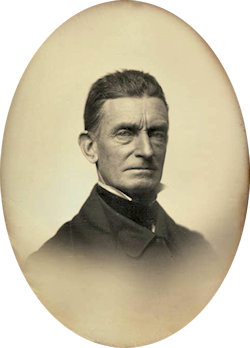
Soon after his return from Lawrence, where he and other volunteers had successfully defended that place, John Brown wrote from Osawatomie to give his family “a brief account of the invasion,” the so-called Wakarusa War. As it turned out, Brown provided some interesting details about their preparations and arrival in the besieged city and the negotiations that were ongoing when the Browns came on the scene. The Free State leaders, according to Brown, skillfully accomplished and signed an agreement with Governor Shannon that was “much to their own liking.”

Territorial Kansas at The University of Kansas
0 comments

“Trickery on the one side; & of cowardice, folly, & drunkeness on the other…”

Miscellaneous document sources

Kansas 1855

Browns Station, Kansas Territory, 14th Decem 1855

Orson Day Esqr
White Hall
N Y

Dear Sir

I have just returned for the Kansas War (about which you have no doubt learned by the news papers;) & find your Letter of the 19th Nov. As I intend to send you shortly a paper published here giving you a more full account of the invasion than I can consistently afford the time to give; I will only say at this time that the territory is now entirely in the power of the Free State men; & notwithstanding this result has been secured by means of some bravery, & tact; with a good deal of trickery on the one side; & of cowardice, folly, & drunkeness on the other yet so it is; & I believe the Missourians will give up all further hope of making Kansas a Slave State. Tomorrow the people of Kansas will decide whether to adopt or to reject the Free Constitution submitted to them; & I have no doubt of its adoption. Indeed I consider it no longer a question whether this is to be a free or a Slave State. As I wrote you a few days since we have secured a good claim for you & shall be preparing to build on it for you as fast as we can. As we have access to no Saw Mill as yet for any lumber. Think you & Mrs Day had better leave the plannig of a House to Mr. Thompson & myself; but still if you send us a plan in season we will conform to it so far as circumstances will allow of it. Could you be on the ground & understand all the circumstances in connection you would probably decide to do in many respects different from what you would if at White Hall. I would be glad to get you to buy a Draft on New York at some good bank in your vicinity for $146.38 One Hundred & Forty Six Dollars & Thirty Eight Cents payable to the order of T W Carter, Esqr; & send it to him in a letter directed T W Carter Esqr. Agent Mass. Arms Co. Chicopee Falls, Mass.; asking him to acknowlege the receipt as for me; & will make the same all right with you I want to remit him that amount in payment for Fire arms sent me by him; & without which we might have been placed in very awkward circumstances. I am more & more plased with this country; & with the prospects of my friends here; & think I may recommend it to you in good faith. Please write me on receipt of this whether you can accommodate me about the Draft for Mr. Carter or not; so that I may know as soon as may be. Land Warrants will be as good as gold in payment for Land as soon as the Lands are in readiness for market; & you will be safe in improving on a Claim while you keep a Warrant ready to pay for it with The health of my Family out here is improving. The most of them are in fine health. In great haste

Your Friend

John Brown

____________________

Territorial Kansas at The University of Kansas
0 comments

A Grate Excitment Here

Miscellaneous document sources

Kansas 1855

Richmond friday Dec 7 1855

Dear Brother

Thinking you May Want to hear Whare I am and how I get along I take my pen to inform you — I am on my way to Kansas City My health is improving. I think if I am carefull I Shall get along without any more trouble from Sickness unless I take cold — in Regard To the State of things here it is imposable to tell how things are — one thing is certain Thare is a grate Excitment here the Missourians tell terible Stories about the Abolitionest they Say the abilitionest are Driving out pro Slavery famelies & Burning thare Houses others Say thare is a conspiracy to do that thing — the probable trouth is that thare was a Difficulty Beteen a free State man & a pro Slavery man the pro Slavery Man Shot the free State man & killed him and he was taken by the Sheriff and the people at Lawrence or about 40 men took him from the Sheriff & Thretened to Shoot or Hang him that probably is about the trouth in the case thare is great Stories got up for the Momment to cause Excitment — The Report is that thare are Eleven Hundred Men at Lawrence all armed With Sharps Riffels With Six Cannon and that they have Thrown an imbankment around the City and are Deturmined to fight — the pro Slavery party have at the Last account about Eight Hundred in the vicinity of Lawrence and Wer coming in from all quarters — the govenor Says he Wants three thousand Men then he Shall trye to Subdue the Rebelion — the Report is that the president has instructed the govenor to Call out the Soldiers from the forts in this vicinity to help put down the Rebelion as I Said Before it is imposable to tell What to beleive one thing is Certain thare is a very grate Excitment thare has ben — Reselutions passed by the Missourians To Burn Lawrence and drive out the Dambd Abilitionists — What the Result Will be god only Can tell if they Should get afiting whare it will End it is imposable for human Knowlage to fore See My prayer is that god Who Controols the affairs of men will Controol these — Raging Elements & Bring about a calm

I think I Shall be in Kansas City tomorow Evening if nothing happens then I Can tell Better How things Look and perhaps get Something nearer the truth – The Report is that Judge Johnson who came up on the Boat with us and Left Lexington Sabbath Morning in Company with Mr Whitney has ben arested also General Pumroy and two other Men and that Pumroy has got away from them and is at Lawrence Cince Wrighting the above thare has a Stage driven come from Weston who Says thare has ben a fight and that thare has ben 60 pro Slavery men Killed and Woonded. I think this is not So but to help fan and the Excitment So as to get men Enough thare to over [???] the Rebbils as they are Called here — I think the Dye will be Cast Within two or three days — if I am a Live and Well I will Wright you again — you need not give your Self any unesines about me I Shall trye to Keep out of harms Way — if they Should get a fighting I Should Return Home as I Could do no buisnes out here — Remember me to all Who is or may be interested

Respectfully yours Hiram Hill

P S. if thare is anything in this that you think Would be intresting to Geare or Trumble you may pick it out to send it them
— good By H Hill

________________________________

Hiram Hill, a resident of Williamsburgh, Massachusetts en route to Kansas City and ultimately to Lawrence, Kansas Territory, wrote from Richmond, Missouri to his brother. He relayed the murder of an unnamed free state man (likely Charles W. Dow), the gathering of 1,100 free state and 800 proslavery men at Lawrence, and other Wakarusa War events. Hill, a free state supporter, felt that the information he received from Missourians was inaccurate or exaggerated. He doubted reports that 60 proslavery men had been killed at Lawrence, or of abolitionists driving proslavery settlers from their homes. Hill reported the arrests of free state men including Judge Johnson and General Pomeroy, who he heard had escaped.

Territorial Kansas at The University of Kansas

 

0 comments

Lexiton Misesoury

Miscellaneous document sources

Lexiton Misesoury Saterday Nov 31/55

Dear Wife…… I arived here this afternoon We Started from St Lewis Monday Eve and arived at Hills Landing So Called about 25 Miles from here Whare we had to disembark on account of Low Water we could get no farther we had over two Hundred passengers all had to put of and get teams to this place we arived here about 2 o clock. What was our Suprise on getting here to Learn that thare is a War going on in Kansas and the inhabitants are going from her up thare in Large parties all armed to the teeth What the Result is To bee god only Knows one thing is pretty Shure that Blood has ben Spilt and thare is a very Grate Excitment — What I Shall do I have not decided upon — My health has ben Rather poor Ever cince I Left St. Lewis the Second day after I Started from that place I have ben Troubled with a diareah I could not Stop it untill yesterday I did almost conclude to Return When the Boat concluded to Return But feeling So much Better this Morning I concluded to go Through had I Known What I now Know I Should have Returned I think now I Shall go to fort Independence or Kansas City Wate the Movements of the waters — if My health is no worse Mr Whitney will continue his Journey to Lawrence with Judge Johnson if he can get thare the Excitement is So grate that its imposable to tell What the Real State of things are thare — Give yourself no unesiness about Me for you Cannot help me it is god that has the harts of all in his hands he Controlls the affairs of men We may trye to Comitt ourselves With all our Concerns into his hands

Remember me to all our friends Kiss Auther fer me & tell him to be a good Boy
afectionally yours

.
Hiram Hill

____________________

Territorial Kansas at The University of Kansas

0 comments

Village Life in America

Village Life in America, 1852 – 1872, by Caroline Cowles Richards

(1855) November 25.–I helped Grandmother get ready for Thanksgiving Day by stoning some raisins and pounding some cloves and cinnamon in the mortar pestle pounder. It is quite a job. I have been writing with a quill pen but I don’t like it because it squeaks so. Grandfather made us some to-day and also bought us some wafers to seal our letters with, and some sealing wax and a stamp with “R” on it. He always uses the seal on his watch fob with “B.” He got some sand, too. Our inkstand is double and has one bottle for ink and the other for sand to dry the writing.

0 comments

Village Life in America

Village Life in America, 1852 – 1872, by Caroline Cowles Richards

(1855) September 1.–Anna and I go to the seminary now. Mr Richards and Mr Tyler are the principals. Anna fell down and sprained her ankle to-day at the seminary, and had to be carried into Mrs Richards’ library. She was sliding down the bannisters with little Annie Richards. I wonder what she will do next. She has good luck in the gymnasium and can beat Emma Wheeler and Jennie Ruckle swinging on the pole and climbing the rope ladder, although they and Sarah Antes are about as spry as squirrels and they are all good at ten pins. Susie Daggett and Lucilla Field have gone to Farmington, Conn., to school.

Monday. – I received a letter from my brother John in New Orleans, and his ambrotype. He has grown amazingly. He also sent me a N. O. paper and it gave an account of the public exercises in the school, and said John spoke a piece called “The Baron’s Last Banquet,” and had great applause and it said he was “a chip off the old block.” He is a very nice boy, I know that. James is sixteen years old now and is in Princeton College. He is studying German and says he thinks he will go to Germany some day and finish his education, but I guess in that respect he will be very much disappointed. Germany is a great ways off and none of our relations that I ever heard of have ever been there and it is not at all likely that any of them ever will. Grandfather says, though, it is better to aim too high than not high enough. James is a great boy to study. They had their pictures taken together once and John was holding some flowers and James a book and I guess he has held on to it ever since.

Sunday.–Polly Peck looked so funny on the front seat of the gallery. She had on one of Mrs Greig’s bonnets and her lace collar and cape and mitts. She used to be a milliner so she knows how to get herself up in style. The ministers have appointed a day of fasting and prayer and Anna asked Grandmother if it meant to eat as fast as you can. Grandmother was very much surprised.

0 comments

Abraham Lincoln to Owen Lovejoy in 1855

Uncollected Letters of Abraham Lincoln—1917

SPRINGFIELD, August 11, 1855.

Mr. Owen Lovejoy,

My dear Sir: Yours of the 7th. was received the day before yesterday. Not even you are more anxious to prevent the extension of slavery than I. And yet the political atmosphere is such, just now, that I fear to do anything, lest I do wrong. Know Nothingism has not yet entirely tumbled to pieces. Nay, it is even a little encouraged by the late elections in Tennessee, Kentucky and Alabama. Until we can get the elements of this organization there is not sufficient material to successfully combat the Nebraska democracy with. We cannot get them so long as they cling to a hope of success under their own organization; and I fear an open push by us now may offend them and tend to prevent our ever getting them. About us here, they are mostly my old political and personal friends, and I have hoped this organization would die out without the painful necessity of my taking an open stand against them. Of their principles I think little better than I do of those of the slavery extensionists. Indeed I do not perceive how any one professing to be sensitive to the wrongs of the negro, can join in a league to degrade a class of white men. I have no objection to “fuse” with any body provided I can fuse on grounds which I think right. And I believe the opponents of slavery extension could now do this if it were not for the K.N.ism. In many speeches last summer I advised those who did me the honor of a hearing to “stand with” any body who stands right, and I am still quite willing to follow my own advice. I lately saw in the Quincy Whig the report of a preamble and resolution made by Mr. Williams, as chairman of a committee, to a public meeting and adopted by the meeting. I saw them but once, and have them not now at command, but so far as I can remember them they occupy the ground I should be willing to “fuse” upon. As to my personal movements this summer and fall, I am quite busy trying to pick up my lost crumbs of last year. I shall be here till September; then with Circuit till the 20th, then to Cincinnati awhile, after a Patent Right case, and back to the Circuit to the end of November. I can be seen here any time this month and at Bloomington at any time from the 10th. to the 17th. of September. As to an extra session of the Legislature, I should know no better how to bring that about than to lift myself over a fence by the straps of my boots.

Yours truly,
LINCOLN.

0 comments

Village Life in America

Village Life in America, 1852 – 1872, by Caroline Cowles Richards

(1855) July.–Our sensitive plant is growing nicely and it is quite a curiosity. It has fern-like leaves and when we touch them, they close, but soon come out again. Anna and I keep them performing.

0 comments

Village Life in America

Village Life in America, 1852 – 1872, by Caroline Cowles Richards

(1855) May.–Father has sent us a box of fruit from New Orleans. Prunes, figs, dates and oranges, and one or two pomegranates. We never saw any of the latter before. They are full of cells with jelly in, very nice. He also sent some seeds of sensitive plant, which we have sown in our garden.

This evening I wrote a letter to John and a little “poetry” to Father, but it did not amount to much. I am going to write some a great deal better some day. Grandfather had some letters to write this morning, and got up before three o’clock to write them! He slept about three-quarters of an hour tonight in his chair.

Sunday.–There was a stranger preached for Dr Daggett this morning and his text was, “Man looketh upon the outward appearance but the Lord looketh on the heart.” When we got home Anna said the minister looked as though he had been sick from birth and his forehead stretched from his nose to the back of his neck, he was so bald. Grandmother told her she ought to have been more interested in his words than in his looks, and that she must have very good eyes if she could see all that from our pew, which is the furthest from the pulpit of any in church, except Mr Gibson’s, which is just the same. Anna said she couldn’t help seeing it unless she shut her eyes, and then every one would think she had gone to sleep. We can see the Academy boys from our pew, too.

Mr Lathrop, of the seminary, is superintendent of the Sunday School now and he had a present to-day from Miss Betsey Chapin, and several visitors came in to see it presented: Dr Daggett, Mr and Mrs Alex. Howell, Mr Tousley, Mr Stowe, Mr and Mrs Gideon Granger and several others. The present was a certificate of life membership to something; I did not hear what. It was just a large piece of parchment, but they said it cost $25. Miss Lizzie Bull is my Sunday School teacher now. She asked us last Sunday to look up a place in the Bible where the trees held a consultation together, to see which one should reign over them. I did not remember any such thing, but I looked it up in the concordance and found it in Judges 9:8. I found the meaning of it in Scott’s commentary and wrote it down and she was very much pleased, and told us next Sunday to find out all about Absalom.

0 comments

Village Life in America

Village Life in America, 1852 – 1872, by Caroline Cowles Richards

(1855) April.–Grandmother received a letter from Connecticut to-day telling of the death of her only sister. She was knitting before she got it and she laid it down a few moments and looked quite sad and said, “So sister Anna is dead.” Then after a little she went on with her work. Anna watched her and when we were alone she said to me, “Caroline, some day when you are about ninety you may be eating an apple or reading or doing something and you will get a letter telling of my decease and after you have read it you will go on as usual and just say, ‘So sister Anna is dead.'” I told her that I knew if I lived to be a hundred and heard that she was dead I should cry my eyes out, if I had any.

0 comments

Village Life in America

Village Life in America, 1852 – 1872, by Caroline Cowles Richards

(1855) Sunday, January 29.–Mr Daggett preached this morning from the text, Deut. 8:2: “And thou shalt remember all the way which the Lord thy God led thee.” It is ten years to-day since Mr Daggett came to our church, and he told how many deaths there had been, and how many baptisms, and how many members had been added to the church. It was a very interesting sermon, and everybody hoped Mr Daggett would stay here ten years more, or twenty, or thirty, or always. He is the only minister that I ever had, and I don’t ever want any other. We never could have any one with such a voice as Mr Daggett’s, or such beautiful eyes. Then he has such good sermons, and always selects the hymns we like best, and reads them in such a way. This morning they sang : “Thus far the Lord has led me on, thus far His power prolongs my days.” After he has been away on a vacation he always has for the first hymn, and we always turn to it before he gives it out:

“Upward I lift mine eyes,
From God is all my aid;
The God that built the skies,
and earth and nature made.

“God is the tower
To which I fly
His grace is nigh
In every hour.”

He always prays for the oil of joy for mourning and the garment of praise for the spirit of heaviness.

January, 1855. – Johnnie Lyon is dead. Georgia Wilkinson cried awfully in school because she said she was engaged to him.

0 comments

Village Life in America

Village Life in America, 1852 – 1872, by Caroline Cowles Richards

(1855) January 23.–This evening after reading one of Dickens’ stories I knit awhile on my mittens. I have not had nice ones in a good while. Grandmother cut out the ones that I am wearing of white flannel, bound round the wrist with blue merino. They are not beautiful to be sure, but warm and will answer all purposes until I get some that are better. When I came home from school to-day Mrs. Taylor was here. She noticed how tall I was growing and said she hoped that I was as good as I was tall. A very good wish, I am sure.

0 comments

Village Life in America

Village Life in America, 1852 – 1872, by Caroline Cowles Richards

(1855) Wednesday, January 9.–I came downstairs this morning at ten minutes after seven, almost frozen. I never spent such a cold night before in all my life. It is almost impossible to get warm even in the dining-room. The thermometer is 10° below zero. The schoolroom was so cold that I had to keep my cloak on. I spoke a piece this afternoon. It was “The Old Arm Chair,” by Eliza Cook. It begins, “I love it, I love it, and who shall dare to chide me for loving that old arm chair?” I love it because it makes me think of Grandmother. After school to-night Anna and I went downtown to buy a writing book, but we were so cold we thought we would never get back. Anna said she knew her toes were frozen. We got as far as Mr. Taylor’s gate and she said she could not get any farther; but I pulled her along, for I could not bear to have her perish in sight of home. We went to bed about eight o’clock and slept very nicely indeed, for Grandmother put a good many blankets on and we were warm.

0 comments

Diary of a Tar Heel Confederate Soldier By Louis Léon

Diary of a Tar Heel Confederate Soldier By Louis Léon [53d North Carolina Regiment, infantry]

November and December–Nothing, only bitter cold. We dance every night at some of our quarters. Some of the men put a white handkerchief around one of their arms, and these act as the ladies. We have a jolly good time.

0 comments

Village Life in America

Village Life in America, 1852 – 1872, by Caroline Cowles Richards

December.–There was a moonlight sleighride of boys and girls last night, but Grandfather did not want us to go, but to-night he said he was going to take us to one himself. So after supper he told Mr Piser to harness the horse to the cutter and bring it around to the front gate. Mr Piser takes care of our horse and the Methodist Church. He lives in the basement. Grandfather sometimes calls him Shakespeare to us, but I don’t know why. He doesn’t look as though he wrote poetry. Grandfather said he was going to take us out to Mr Waterman Powers’ in Farmington and he did. They were quite surprised to see us, but very glad and gave us apples and doughnuts and other good things. We saw Anne and Imogene and Morey and one little girl named Zimmie. They wanted us to stay all night, but Grandmother was expecting us. We got home safe about ten o’clock and had a very nice time. We never sat up so late before.

0 comments

Village Life in America

Village Life in America, 1852 – 1872, by Caroline Cowles Richards

November.–Abbie Clark’s father has been elected Governor and she is going to Albany to live, for a while. We all congratulated her when she came to school this morning, but I am sorry she is going away. We will write to each other every week. She wrote a prophecy and told the girls what they were going to be and said I should be mistress of the White House. I think it will happen, about the same time that Anna goes to be a missionary.

0 comments

Diary of a Tar Heel Confederate Soldier By Louis Léon

Diary of a Tar Heel Confederate Soldier By Louis Léon [53d North Carolina Regiment, infantry]

October–We have got the smallpox in prison, and from six to twelve are taken out dead daily. We can buy from prisoners rats, 25 cents each, killed and dressed. Quite a number of our boys have gone into the rat business. On the 11th of this month there were 800 sick prisoners sent South on parole.

0 comments

Village Life in America

Village Life in America, 1852 – 1872, by Caroline Cowles Richards


October.–Grandmother told us a story today, how when she was a little girl, down in Connecticut, in 1794, she was on her way to school one morning and she saw an Indian coming and was so afraid, but did not dare run for fear he would chase her. So she thought of the word sago, which means “good morning,” and when she got up close to him she dropped a curtesy and said “Sago,” and he just went right along and never touched her at all. She says she hopes we will always be polite to every one, even to strangers.

0 comments

Diary of a Tar Heel Confederate Soldier By Louis Léon

Diary of a Tar Heel Confederate Soldier By Louis Léon [53d North Carolina Regiment, infantry]

September–It is very cold, worse than I have seen it in the South in the dead of winter.

0 comments

Village Life in America

Village Life in America, 1852 – 1872, by Caroline Cowles Richards

Tuesday, September 1.–I am sewing a sheet over and over for Grandmother and she puts a pin in to show me my stint, before I can go out to play. I am always glad when I get to it. I am making a sampler, too, and have all the capital letters worked and now will make the small ones. It is done in cross stitch on canvas with different colour silks. I am going to work my name, too. I am also knitting a tippet on some wooden needles that Henry Carr made for me. Grandmother has ravelled it out several times because I dropped stitches. It is rather tedious, but she says, “If at first you don’t succeed, try, try again.” Some military soldiers went by the house today and played some beautiful music. Grandfather has a teter and swing for us in the back yard and we enjoy them usually, but to-night Anna slid off the teter board when she was on the ground and I was in the air and I came down sooner than I expected. There was a hand organ and monkey going by and she was in a hurry to get to the street to see it. She got there a good while before I did. The other day we were swinging and Grandmother called us in to dinner, but Anna said we could not go until we “let the old cat die.” Grandmother said it was more important that we should come when we are called.

0 comments

Diary of a Tar Heel Confederate Soldier By Louis Léon

Diary of a Tar Heel Confederate Soldier By Louis Léon [53d North Carolina Regiment, infantry]

August–Nothing worth recording this month, except that the fare is the same as at Point Lookout.

0 comments

Village Life in America

Village Life in America, 1852 – 1872, by Caroline Cowles Richards

Sunday, August 10, 1854. – Rev. Mr Daggett’s text this morning was, “Remember the Sabbath day to keep it holy.” Grandmother said she thought the sermon did not do us much good for she had to tell us several times this afternoon to stop laughing. Grandmother said we ought to be good Sundays if we want to go to heaven, for there it is one eternal Sabbath. Anna said she didn’t want to be an angel just yet and I don’t think there is the least danger of it, as far as I can judge. Grandmother said there was another verse, “If we do not have any pleasure on the Sabbath, or think any thoughts, we shall ride on the high places of the earth,” and Anna said she liked that better, for she would rather ride than do anything else, so we both promised to be good. Grandfather told us they used to be more strict about Sunday than they are now. Then he told us a story, how he had to go to Geneva one Saturday morning in the stage and expected to come back in the evening, but there was an accident, so the stage did not come till Sunday morning. Church had begun and he told the stage driver to leave him right there, so he went in late and the stage drove on. The next day he heard that he was to come before the minister, Rev. Mr Johns, and the deacons and explain why he had broken the fourth commandment. When he got into the meeting Mr Johns asked him what he had to say, and he explained about the accident and asked them to read a verse from the 8th chapter of John, before they made up their minds what to do to him. The verse was, “Let him that is without sin among you cast the first stone.” Grandfather said they all smiled, and the minister said the meeting was out. Grandfather says that shows it is better to know plenty of Bible verses, for some time they may do you a great deal of good. We then recited the catechism and went to bed.

August 21.–Anna says that Alice Jewett feels very proud because she has a little baby brother. They have named him John Harvey Jewett after his father, and Alice says when he is bigger she will let Anna help her take him out to ride in his baby carriage. I suppose they will throw away their dolls now.

0 comments

A Diary From Dixie.

Civil War Day-by-Day

August 19th.–Began my regular attendance on the Wayside Hospital. To-day we gave wounded men, as they stopped for an hour at the station, their breakfast. Those who are able to come to the table do so. The badly wounded remain in wards prepared for them, where their wounds are dressed by nurses and surgeons, and we take bread and butter, beef, ham, and hot coffee to them.

One man had hair as long as a woman’s, the result of a vow, he said. He had pledged himself not to cut his hair until peace was declared and our Southern country free. Four made this vow together. All were dead but himself. One was killed in Missouri, one in Virginia, and he left one at Kennesaw Mountain. This poor creature had had one arm taken off at the socket. When I remarked that he was utterly disabled and ought not to remain in the army, he answered quietly, “I am of the First Texas. If old Hood can go with one foot, I can go with one arm, eh?”

How they quarreled and wrangled among themselves– Alabama and Mississippi, all were loud for Joe Johnston, save and except the long-haired, one-armed hero, who cried at the top of his voice: “Oh! you all want to be kept in trenches and to go on retreating, eh?” “Oh, if we had had a leader, such as Stonewall, this war would have been over long ago! What we want is a leader!” shouted a cripple.

They were awfully smashed-up, objects of misery, wounded, maimed, diseased. I was really upset, and came home ill. This kind of thing unnerves me quite.

Letters from the army. Grant’s dogged stay about Richmond is very disgusting and depressing to the spirits. Wade Hampton has been put in command of the Southern cavalry.

A Wayside incident. A pine box, covered with flowers, was carefully put upon the train by some gentlemen. Isabella asked whose remains were in the box. Dr. Gibbes replied: “In that box lies the body of a young man whose family antedates the Bourbons of France. He was the last Count de Choiseul, and he has died for the South.” Let his memory be held in perpetual remembrance by all who love the South!

0 comments

Diary of a Tar Heel Confederate Soldier By Louis Léon

Diary of a Tar Heel Confederate Soldier By Louis Léon [53d North Carolina Regiment, infantry]

July 29–There are at present some 3,000 prisoners here. I like this place better than Point Lookout. We are fenced in by a high fence, in, I judge, a 200acre lot. There is an observatory outside, and some Yankee is making money, as he charges ten cents for every one that wishes to see the rebels.

0 comments