
July 31st.
I believe I forgot to mention one little circumstance in my account of that first night at the Deaf and Dumb Asylum, which at the time struck me with extreme disgust. That was seeing more than one man who had no females or babies to look after, who sought there a refuge from the coming attack. At daylight, one dapper young man, in fashionable array, came stepping lightly on the gallery, carrying a neat carpet-bag in his hand. I hardly think he expected to meet two young ladies at that hour; I shall always believe he meant to creep away before any one was up; for he certainly looked embarrassed when we looked up, though he assumed an air of indifference, and passed by bravely swinging his sack – but I think he wanted us to believe he was not ashamed. I dare say it was some little clerk in his holiday attire; but I can’t say what contempt I felt for the creature.
Honestly, I believe the women of the South are as brave as the men who are fighting, and certainly braver than the “Home Guard.” I have not yet been able to coax myself into being as alarmed as many I could name are. They say it is because I do not know the danger. Soit. I prefer being brave through ignorance, to being afraid in consequence of my knowledge of coming events. Thank Heaven, my brothers are the bravest of the brave! I would despise them if they shrunk back, though Lucifer should dispute the path with them. Well! All men are not Morgan boys! They tell me cowards actually exist, though I hope I never met one. The poor men that went to the Asylum for safety might not have what Lavinia calls “a moral backbone.” No wonder, then, they tumbled in there! Besides, I am told half the town spent the night on the banks of the river, on that occasion; and perhaps these unfortunates were subject to colds, and preferred the shelter of a good roof. Poor little fellows! How I longed to give them my hoops, corsets, and pretty blue organdie in exchange for their boots and breeches! Only I thought it was dangerous; for suppose the boots had been so used to running that they should prance off with me, too? Why, it would ruin my reputation! Miss Morgan in petticoats is thought to be “as brave as any other man”; but these borrowed articles might make her fly as fast “as any other man,” too, if panic is contagious, as the Yankees here have proved. One consolation is, that all who could go with any propriety, and all who were worthy of fighting, among those who believed in the South, are off at the seat of war; it is only trash, and those who are obliged to remain for private reasons, who still remain. Let us count those young individuals as trash, and step over them. Only ask Heaven why you were made with a man’s heart, and a female form, and those creatures with beards were made as bewitchingly nervous?
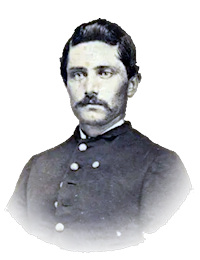
Thursday, 31st–We started at 8 o’clock this morning and arrived at Bolivar at 12 o’clock noon. We went into camp two miles east of town on the banks of the Hatchie river. Our camp is in a fine piece of timber, well shaded. I was almost played out when we arrived in camp; the weather being so hot, it was hard work to carry knapsack and accouterments and keep up with the company. Our officers are expecting to be attacked at this place and have put three or four hundred negroes to work throwing up breastworks. There is some very pretty land in this part of old Tennessee and there are some very nice farms. The timber here is chiefly of white oak, but there is some poplar and beech. Bolivar is a fine town and has one railroad.
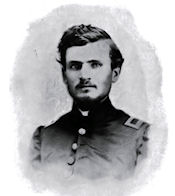
July 31st. Thursday. Finished a letter to Fred Allen. The Court Martial meetings still continue, Major Purington presiding. The officers are beginning to be more strict and exacting. The discipline cannot but be improved. Went to the river and bathed. Washed a pair of pants and handkerchief and towel. Went up on a high bluff of rocks, a more romantic place than I had seen for a long time. It reminded me much of Old Vermont, or Canada side of Niagara. Marched at three P. M. Reached Baxter’s Springs at sundown. Major Miner, Capt. Stanhope and Adj. Weeks ate supper with us, had tomatoes and pineapples for dessert.
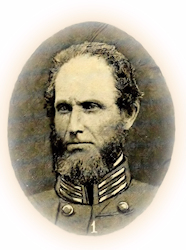
July 24—Leave Richmond at 4 a. m. and reach Wilmington at 8 p. m. Spend night at Mrs. McCaleb’s Hotel.
July 25—Steamer North Carolina takes us to White Hall.
Sunday, 27—Visit Sunday School at Bladen Springs. Capt. John Barr Andrews died at Richmond, Virginia, July 23, 1862. He was the first person to whom I spoke after I found peace with God, Oct. 15, 1853, at University of North Carolina.
July 28—Spend day with Bro. W. A. Savage. Meet Rev. D. C. Johnson, his pastor.
July 29—Ride to Elizabethtown. Wife spends day with old Mrs. McKay on her farm. Spend the night with Mr. Russ.
July 31, 1862—Wife and children ride with me to Wh te Hall. Part with loved ones, to meet—?

30th [July]
This morning a letter was received from Baltamore to Mrs. Butler announcing her daughter’s death on the 30th of June at New Port very suddenly. Mrs. Butler was then in Richmond. I am glad she went on for she will be better satisfied. We suppose she was at her own house at Norwood near Philadelphia with her Grand children—Elizabeth was a beautiful spoiled child and always seemed a very strong and healthy person, her death so young is a terrible affliction to her Mother.—
Mrs. Stevens the wife of John’s 1 Lieutenant has been very kind in getting her husband to join John’s name with his in the Telegrams he sends and she always lets me see them. I feel very much her kindness and we went yesterday to thank her and found her at home looking very sad she has no children.—and would like to join her husband.
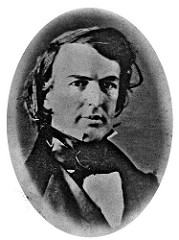
July 30th.—Both Gen. Jackson and Gen. Stuart were in the department to-day. Their commands have preceded them, and must be near Orange C. H. by this time. These war-worn heroes (neither of them over forty years of age) attracted much attention. Everybody wished to see them; and if they had lingered a few minutes longer in the hall, a crowd would have collected, cheering to the echo. This they avoided, transacting their business in the shortest possible space of time, and then escaping observation. They have yet much work to do.
Wednesday, 30th–We camped on a large “secesh” plantation last night. The owner of it being a general in the rebel army, we made ourselves at home, killing all the cattle that we wanted and taking all the honey that we could carry away with us. We started at 8 o’clock this morning and marched fourteen miles, when we bivouacked for the night.
30th. Wednesday. In camp on Rocky Creek, Spring River. Issued five days’ rations, preparatory to marching northward. Boys in good spirits. Wrote to Fred Allen. Saw Charlie in the morning. Read Will’s last journal, much better than his late ones. His discouragement about the late reverses. To be sure the present hour looks dark but I have faith in the future. The light will soon break. I have faith to believe that the North will yet be victorious over the South, right be victorious over wrong. I am sorry Will feels so. It looks like an apology for not enlisting. To fear defeat and yet not raise a hand looks faulty.
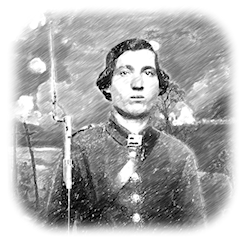
Wednesday 30th.—Arriving at Knoxville, was ordered to convalescent camp. Don’t like the place; much rather go on to regiment; on guard nearly half the time. Regiment eighteen miles from here, at Camp Hatten.
(Note: picture is of an unidentified Confederate soldier.)
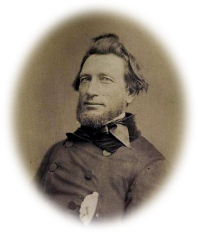
30th.–Rumors of battle have to-day, waked up our drowsy energies, and put all on the qui vive. Orders at noon to “be ready for action at any moment.” The enemy’s gun boats are coming down the river, and a land attack is anticipated. Humiliated as we feel at being shut up here on the defence, there is a kind of “let ’em come” defiance in every heart and on every face. My own opinion is that it is a feint, and that we shall not be attacked. My experience in the late retreat, has fully gratified all my curiosity to see a great fight. For five days and nights I was not out of sight of our lines; in fact, never left the field of battle. It will require more than idle curiosity to induce me to undergo the same again.
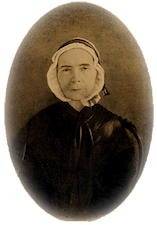
July 29.—No army news. In this quiet nook mail-day is looked forward to with the greatest anxiety, and the newspapers are read with avidity from beginning to end—embracing Southern rumours, official statements, army telegrams, Yankee extravaganzas, and the various et caeteras. The sick and wounded in the various hospitals are subjects for thought and action in every part of our State which is free to act for them; we all do what we can in our own little way; and surely if we have nothing but prayer to offer, great good must be effected. Yesterday evening, while walking out, a young woman with a baby in her arms passed us rapidly, weeping piteously, and with the wildest expressions of grief; we turned to follow her, but found that another woman was meeting her, whom we recognized as her mother; in another moment all was explained by her father, whom we met, slowly wending his way homeward. He had been to the hospital at Danville to see his son-in-law, whose name appeared among the wounded there. On reaching the place, he found that he had just been buried. On returning he met his daughter walking; in her impatience and anxiety about her husband, she could not sit still in the house; and in her ignorance, she supposed that her father would bring him home, to be nursed. Poor thing! she is one of thousands. Oh that the enemy may be [continue reading…]
JULY 29th.—Pope’s army, greatly reinforced, are committing shocking devastations in Culpepper and Orange Counties. His brutal orders, and his bragging proclamations, have wrought our men to such a pitch of exasperation that, when the day of battle comes, there will be, most be terrible slaughter.
July 29th.
This town, with its ten thousand soldiers, is more quiet than it was with the old population of seven thousand citizens. With this tremendous addition, it is like a graveyard in its quiet, at times. These poor soldiers are dying awfully. Thirteen went yesterday. On Sunday the boats discharged hundreds of sick at our landing. Some lay there all the afternoon in the hot sun, waiting for the wagon to carry them to the hospital, which task occupied the whole evening. In the mean time these poor wretches lay uncovered on the ground, in every stage of sickness. Cousin Will saw one lying dead without a creature by to notice when he died. Another was dying, and muttering to himself as he lay too far gone to brush the flies out of his eyes and mouth, while no one was able to do it for him. Cousin Will helped him, though. Another, a mere skeleton, lay in the agonies of death, too; but he evidently had kind friends, for several were gathered around holding him up, and fanning him, while his son leaned over him crying aloud. Tiche says it was dreadful to hear the poor boy’s sobs. All day our vis-á-vis, Baumstark, with his several aids, plies his hammer; all day Sunday he made coffins, and says he can’t make them, fast enough. Think, too, he is by no means the only undertaker here! Oh, I wish these poor men were safe in their own land! It is heartbreaking to see them die here like dogs, with no one to say Godspeed. The Catholic priest went to see some, sometime ago, and going near one who lay in bed, said some kind thing, when the man burst into tears and cried, “Thank God, I have heard one kind word before I die!” In a few minutes the poor wretch was dead.
Tuesday, 29th–We got on the right road and started at 8 o’clock this morning. We marched twelve miles and bivouacked for the night. The weather is extremely hot and the roads are very dusty. Orlando Stout of Company E fell out of the ranks today, and getting too far behind, was taken prisoner.
29th. Wrote to Uncle Albert Harris.
Tuesday, 29th.—Left home 11 A. M. Got to Chattanooga, 4 P. M.
(Note: picture is of an unidentified Confederate soldier.)
29th.–It is a source of unspeakable gratification to me that after my long fights, the comforts of the suffering soldiers are being heeded; whether on account of my much importunity, or from the fact that the necessity of this course has become apparent to the Military Department, or that the new Surgeon General has directed his attention more particularly to it, it matters not. When I call for aid for the hospitals under my care I get it. All the surgeons in this department now have only to call for help to procure enough to clean, drain, and sweep camp grounds every day, to ask for the necessary food, medicine and furniture, and if they will then give their personal attention to it, they can have it. The scurvy has been rapidly increasing with us, but we have now the means of arresting it. Thanks to U. S. Sanitary Commission for the larger share of them.
Some mysterious movements are going on in this army. At night we look over a large flat covered with tents, lighted by camp fires, resonant with the sounds of living soldiers. In the morning that same flat is deserted and still, as if the angel of death had enjoyed a passover. What has become of the busy actors of the night, none who dare speak of it can conjecture. In fact, in the present perilous condition of the army all purposes are necessarily secret. Some think the troops thus disappearing are crossing the river and marching on Fort Darling. Some think they are moving down the river to possess ourselves of a fort which is being built to blockade the river and cut off our supplies. Others think Washington is again in danger, and that a part of this army is being shipped thither, whilst many others are of opinion that we are slowly and secretly withdrawing our forces, and that Gen. Smith’s division is to be left here as a blind and sacraficed to save the balance of the army. This would seem hard; yet when it becomes necessary, Gen. Smith will be found to be the very man, and his the very army to submit to the necessity without a murmur.
I am, however, of the opinion that the bulk of the rebel army has withdrawn from about us, and is after General Pope, and that we are taking advantage of their absence to escape from our present perilous position. General Pope’s antecedents warrant the belief that whatever is in his power to do for our relief will be accomplished to the utmost of his ability.
28th.—The report of Hindman’s having captured Curtis untrue; but our army is doing well in the West. Murfreesboro’, in Tennessee, has been captured by Confederates—a brigade, two brigadiers, and other officers, taken. “Jack Morgan” is annoying and capturing the Kentucky Yankees.
The true Southerners there must endure an almost unbearable thraldom!
A long letter from S. S., describing graphically their troubles when in Federal lines. Now they are breathing freely again. A number of servants from W. and S. H, and indeed from the whole Pamunky River, went off with their Northern friends. I am sorry for them, taken from their comfortable homes to go they know not where, and to be treated they know not how. Our man Nat went, to whom I was very partial, because his mother was the maid and humble friend of my youth, and because I had brought him up. He was a comfort to us as a driver and hostler, but now that we have neither home, carriage, nor horses, it makes but little difference with us; but how, with his slow habits, he is to support himself, I can’t imagine. The wish for freedom is natural, and if he prefers it, so far as I am concerned he is welcome to it. I shall be glad to hear that he is doing well. Mothers went off leaving children—in two instances infants. Lord have mercy upon these poor misguided creatures! I am so thankful that the scurf of the earth, of which the Federal army seems to be composed, has been driven away from Hanover. I would that “Clarke” were as free.
JULY 28th.—The Examining Board of Surgeons, established by the Secretary of War, has been abolished by order of Gen. Lee. It was the only idea of the Secretary yet developed, excepting the “handing over” of the” whole business of passports to Gen. Winder.”

We had a pleasant passage to New Orleans, where we arrived July 28th, and found the U. S. transport Connecticut awaiting us with a large mail. On this evening we had a heavy shower of rain, accompanied by heavy thunder and sharp lightning, purifying the air to a very pleasant degree. We now proceeded to coal ship preparatory to proceeding on our way. The sailors were here given liberty on shore–about eighty at a time–for twenty-four hours each. I here took a few hours to myself, and set foot on shore for the first time in six months. I had a very limited view of a portion of the city, and came back to the ship after a stay of four hours.
On the night of the 25th intelligence arrived from Baton Rouge that the rebels had made an attack on the latter place and, killing General Williams, had been repulsed. The Hartford was immediately turned up the river for Baton Rouge. On our passage we lost our orderly sergeant of marines, who died of bilious colic; we buried him at the latter place. On arriving we learned that a hard battle had been fought, and that the rebel ram Arkansas had been attacked and destroyed. As the rebels had left the place, and the Arkansas had ceased to trouble us, we turned our ship, and for the last time sailed down the stream. Things went quietly until arriving at Donaldsonville, where we came to, and after bombarding the little village for an hour, sent a few boats ashore and burned the place to the ground. This act was occasioned by guerrilla bands repeatedly firing upon our transports, and after being warned, the Commodore determined to make an example of it. Nothing in the line of eatables was found here, but large quantities of choice wines were discovered, of which our sailors partook freely, notwithstanding their fear of poison.
We arrived at New Orleans on the following day, where we remained several days.
Monday, 28th–We struck our tents and at sunup started on our march for Bolivar, Tennessee. Our guide took us on the wrong road and we countermarched about ten miles, thus not being far from our starting point. The guide was tied and taken back to Corinth.[1] It is very warm and the roads are dusty. Our road being on high ground, we found water very scarce, and what little we got was of poor quality. General Turtle is in command of our division, the Sixth.
[1] I never learned what became of him.–A. G. D.
28th. Mail came. Letter from home. Rather discouraging news. Adjutant Weeks slept with the Major. Such a time talking and carrying on.
JULY 27th.—Gen. Lovell, it is said, will be tried by a court-martial. The same has been said of Generals Magruder and Huger. But I doubt it.
July 27th.
I have my bird back! As I waked this morning, I heard a well-known chirp in the streets, and called to mother I knew it was Jimmy. Sure enough it is my bird. Lucy Daigre has had him ever since the shelling, as a negro caught it that day and gave it to her.
Sunday, 27th–We had regimental inspection this morning by Colonel Hare. We received orders to march in the morning. The Eleventh Iowa lost two men by disease while here in this camp—such is the penalty of camp life.