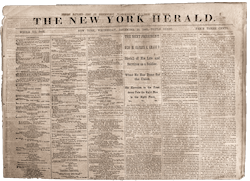
November 28, 1863, The New York Herald The news from Chattanooga represents the absolute destruction of General Bragg’s army as beyond doubt. General Grant very briefly announces, in a despatch dated at one o’clock yesterday morning, that he has just returned from the front; that the rout of the enemy is most complete. Abandoned [...]
November 27, 1863, The New York Herald The official despatches of Generals Grant and Thomas confirm all the glorious story of the three days’ battles at Chattanooga. Lookout Mountain, the rifle pits in Chattanooga valley and the whole of Missionary Ridge are now in possession of our troops; while General Bragg is in hasty [...]
November 26, 1863, The New York Herald The news from Chattanooga is glorious. The fighting of three days has ended in the complete defeat of the enemy yesterday. Lookout Mountain was occupied by the troops of General Hooker, who took 2,000 prisoners, and the rebels fled from every position which they held. General Bragg has [...]
November 25, 1863, The New York Herald The latest news from Chattanooga reports the rebels falling back from Chickamauga Station. Their artillery have entirely withdrawn from our front. Our forces, under Generals Wood and Sheridan, of the Fourth army corps, under the direction of General Gordon Granger, of General Thomas’ division, made a most brilliant [...]
November 24, 1863, The New York Herald The condition of the roads in Virginia, notwithstanding the recent rains, is such that the army of General Meade is now in a position to move at any moment. His troops fully occupy the country up to the north bank of the Rapidan, but there is no official [...]
November 23, 1863, The New York Herald There is no change in the Army of the Potomac. The different corps occupy the same positions which they did ten days ago. The enemy are working like beavers on their defences at the Rapidan. Meade’s troops are in good spirits, and eager for a fight. Mosby’s guerillas [...]
November 22, 1863, The New York Herald Perhaps the most important war news we have today is from the Texas expedition of General Banks. The occupation of Brownsville appears to have been dictated by some very urgent reasons. An attempt to revolutionize the district of Tamaulipas, which includes Matamoros and the mouth of the Rio [...]
November 20, 1863, The New York Herald The latest news from Charleston, to eight o’clock P.M. of the 16th instant, by the steamer Admiral Dupont, reports that the firing on FortSumter continues without intermission; that the flag of the rebel garrison has been shot down several times within a few days, but is always hoisted [...]
November 19, 1863, The New York Herald The treatment of the Union prisoners at Richmond has been the theme of many comments in our columns of late, and the miserable condition to which they were reduced for want of food and other necessaries of life has been repeatedly described by our correspondents and others. [...]
November 18, 1863, The New York Herald The United States steamer Ashland, from Hilton Head, brigs us accounts from Charleston up to Sunday. The bombardment of Fort Sumter continued unabated. Rebel telegrams to Richmond say that the fort cannot be injured any further. The Battery Gregg kept up a fire on the rebel batteries [...]
November 17, 1863, The New York Herald We lay before our readers today further particulars of the great Texas expedition, the main points of which, together with a full account of its success on the Rio Grande, we gave exclusively yesterday, from the pen of our special correspondent on the flagship McClellan. The account [...]
November 16, 1863, The New York Herald By the arrival of the steamers Cromwell, Columbia and Continental from New Orleans yesterday, we have highly interesting news of the expedition of General Banks. It has landed safely on the Texas shore of the Rio Grande, after experiencing some severe weather at sea, and much difficulty [...]
November 14, 1863, The New York Herald All continues quiet in front of the Potomac Army. The headquarters of the Commissary Department are now at Warrenton Junction, from which immediate supplies of rations are daily forwarded. The demoralization in the rebel army is reported to be on the increase. A deserter from the Ninth [...]
November 13, 1863, The New York Herald The Richmond papers of Wednesday have telegrams from Charleston to the day previous. Slow firing had been going on all day at Sumter. The two Monitors was then in action firing about thirty shots. Altogether, during the day, sixty rifle shots and twenty-five shells were fired, only [...]
November 12, 1863, The New York Herald There is no change in the position of the Army of the Potomac. A reconnoissance of General Buford through Culpepper and towards the Rapidan resulted in the discovery that no large force of the enemy are now north of that river, although guerillas constantly harass our troops. [...]
November 11, 1863, The New York Herald The latest news from General Meade’s army reports no fighting on yesterday. Between six and seven hundred of the enemy were captured near Culpepper. Our pickets near Warrenton Junction were in sight of Mosby’s pickets all day yesterday, but no collision took place. General Buford’s cavalry [...]
November 10, 1863, The New York Herald Heavy firing was heard on Sunday and yesterday in the direction of Culpepper, towards the junction of the Rapidan and Rappahannock. It was thought that it might have proceeded from the light artillery of General Buford’s corps in collision with the enemy. The Third army corps, [...]
November 9, 1863, The New York Herald The Army of the Potomac, after a long period of ease, has commenced a forward movement, and its advance has been heralded with victory. The divisions of Generals French and Sedgwick met the enemy on the banks of the Rappahannock — the former at Kelly’s Ford and [...]
November 8, 1863, The New York Herald A report reached Philadelphia yesterday by the steamer Salvor, which left Hilton Head on last Monday, the 2d. inst., that Fort Sumter had surrendered, that the Stars and Stripes were flying over the dismantled ramparts, and the One Hundred and Forty-fourth Pennsylvania regiment of Volunteers were then [...]
November 7, 1863, The New York Herald There is nothing later from the Army of the Potomac. Perfect quietude appears to reign, with the exception of the guerilla raids which disturb the outposts and the occasional reconnoissances which occupy the attention of our cavalry. From Charleston we have nothing later than the news [...]
November 6, 1863, The New York Herald There is but little news yet of moment from Gen. Meade’s army. The guerillas seem to gain boldness every day. On the night before last they captured a Major of our army within two miles of our headquarters on the road to Auburn, and the same band [...]
November 5, 1863, The New York Herald The Richmond papers furnish us with two days still later news from Charleston. The firing on Sumter was continued on Saturday and Sunday, and on the latter evening was still going on, both from Forts Gregg and Wagner and the Monitors. The bombardment is described by the [...]
November 4, 1863, The New York Herald The news from Washington indicates approaching active operations in General Meade’s army. All the able bodied troops under the command of General Martindale, the Military Governor of the capital, are to be relieved from duty and sent to the field. Their place will be supplied by the Invalid [...]
November 3, 1863, The New York Herald Sumter has been undergoing a terrible bombardment from the Union batteries. The latest news we have from Charleston is taken from the Richmond Whig of the 31st ult. — three days later than we have had before. It states that the bombardment of Fort Sumter on the [...]
November 2, 1863, The New York Herald Affairs in the Army of the Potomac do not present many new features. Beyond some guerilla movements in the rear of General Meade’s army, and some manÅ“uvering for favorable positions for an anticipated coming fight on the part of both armies, there is nothing of any importance [...]